🏬Supersize Online Funeral Retailer🪦1000's of Headstones⚱️Over 10,000 Cremation Urns⚰️Caskets Overnight Delivery🛒Funeral & Memorial Superstore🚚FREE Shipping on ALL Orders👨👩👧👦Helping Families for over 20 Years💰Lowest Price Guarantee🏬Supersize Online Funeral Retailer🪦1000's of Headstones⚱️Over 10,000 Cremation Urns⚰️Caskets Overnight Delivery🛒Funeral & Memorial Superstore🚚FREE Shipping on ALL Orders👨👩👧👦Helping Families for over 20 Years💰Lowest Price Guarantee
🏬Supersize Online Funeral Retailer🪦1000's of Headstones⚱️Over 10,000 Cremation Urns⚰️Caskets Overnight Delivery🛒Funeral & Memorial Superstore🚚FREE Shipping on ALL Orders👨👩👧👦Helping Families for over 20 Years💰Lowest Price Guarantee🏬Supersize Online Funeral Retailer🪦1000's of Headstones⚱️Over 10,000 Cremation Urns⚰️Caskets Overnight Delivery🛒Funeral & Memorial Superstore🚚FREE Shipping on ALL Orders👨👩👧👦Helping Families for over 20 Years💰Lowest Price Guarantee
Cemetery plot prices catch many families off guard. The average cost of a burial plot in the United States falls between $1,000 and $5,000 for a single grave, but that number swings dramatically based on where you live, the type of cemetery you choose, and whether you need a standard casket plot or a smaller cremation space. When you factor in opening and closing fees, vault requirements, perpetual care charges, and a memorial marker, total out-of-pocket expenses can easily double.
This guide breaks down every cost you should expect so you can make informed decisions at your own pace. For a broader look at the entire process — from choosing a location to selecting a memorial — our cemetery planning and buying guide walks through each step in detail.
Not all burial plots are priced the same. The type of plot you need depends on whether you are planning a traditional casket burial, a cremation interment, or a shared resting place for two or more family members.
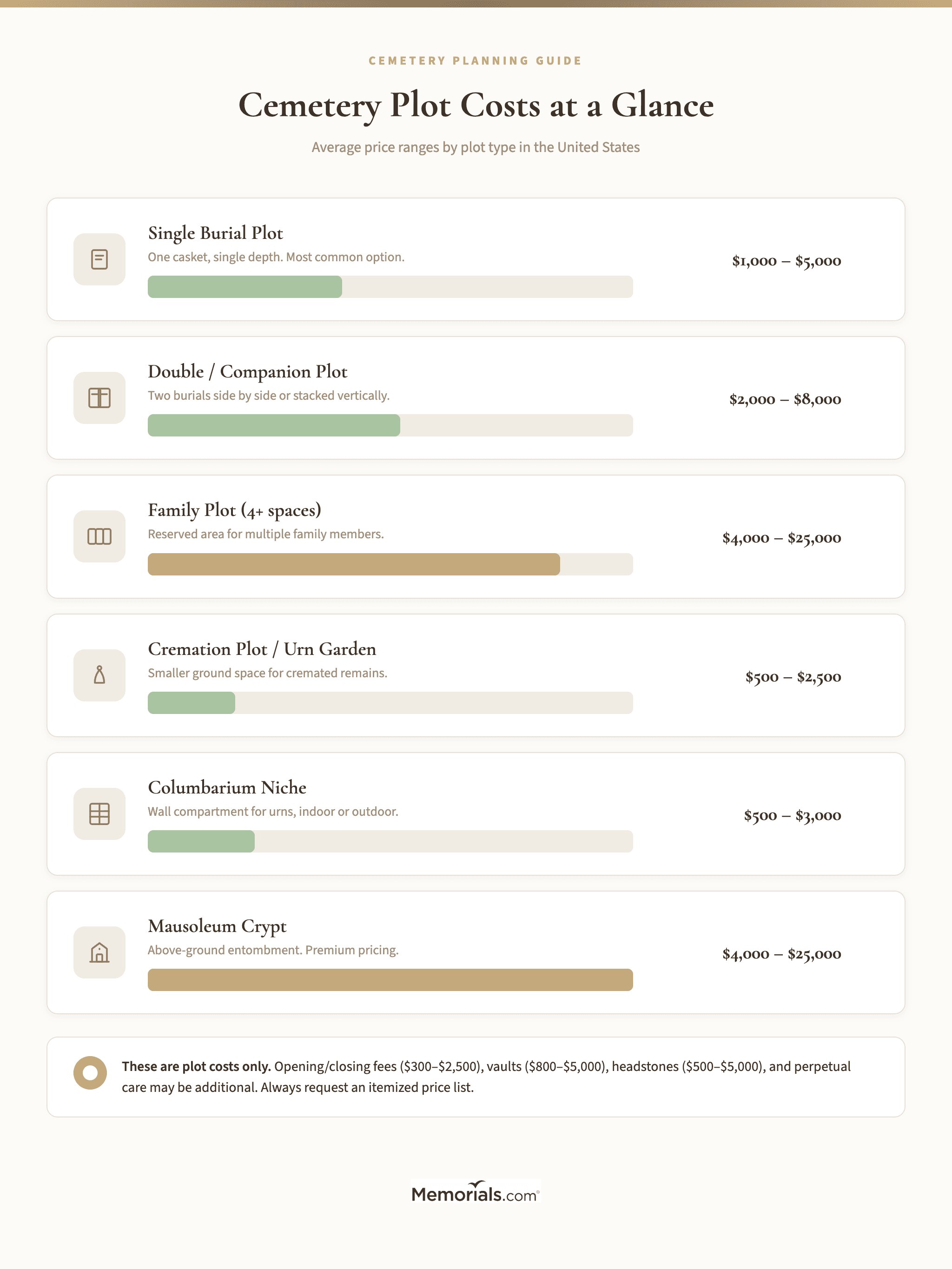
Single burial plot. A single-depth plot holds one casket and typically costs $1,000 to $5,000 at a public or municipal cemetery. Private and religious cemeteries often charge $2,000 to $10,000 or more for the same space. Urban locations push those numbers higher.
Double or companion plot. A companion plot accommodates two burials, either side by side or stacked vertically (single depth on top, second depth below). Expect to pay $2,000 to $8,000 depending on the cemetery and configuration. Stacked plots usually cost less than side-by-side because they use less ground area.
Family plot. Family plots reserve space for four or more burials. Pricing varies widely — from $4,000 in a rural public cemetery to $25,000 or more in a prestigious private garden. Many families purchase these plots decades in advance to lock in lower prices.
Cremation plot or urn garden. Because cremated remains require far less space, cremation plots typically run $500 to $2,500. Some cemeteries offer dedicated urn garden sections with landscaped settings at the lower end of that range. If you are comparing columbarium and burial options, columbarium niches — individual compartments in an indoor or outdoor wall — generally cost $500 to $3,000 and eliminate the need for ground space entirely.
Mausoleum crypt. Above-ground entombment in a mausoleum is the most expensive option, ranging from $4,000 to $12,000 for a single crypt and $7,000 to $25,000 for a companion crypt. Premium locations within the structure — such as eye-level placement — command higher prices.
How Cemetery Type Affects Price
The kind of cemetery you choose is one of the largest factors in what you pay. Understanding different types of cemeteries helps you narrow your search and set realistic budget expectations.
Public and municipal cemeteries are funded in part by local government, which keeps prices lower. Single plots in public cemeteries often fall between $500 and $2,000. Some municipalities offer discounted rates for local residents and require proof of residency at the time of purchase.
Private cemeteries set their own pricing and are not subsidized. A single plot at a private cemetery typically starts around $2,000 and can climb well above $5,000 in desirable areas. These cemeteries often include more manicured grounds, additional amenities, and stricter aesthetic standards.
Religious and denominational cemeteries serve members of a specific faith community. Pricing varies — some parish cemeteries charge modest fees to active members while applying higher rates for non-members. Catholic, Jewish, and other faith-specific cemeteries each have their own rules regarding eligibility and interment practices.
Green and natural burial grounds focus on environmentally conscious interment without embalming, concrete vaults, or metal caskets. Plot costs at green cemeteries range from $1,000 to $4,000, but families save considerably on associated expenses since vaults and elaborate caskets are not required. Our cost of cremation vs. burial comparison covers how green burial and cremation stack up financially.
National and veterans cemeteries provide burial at no charge for eligible veterans, active-duty service members, and certain family members. The VA covers the plot, opening and closing, a government-issued headstone or marker, and perpetual care — all at zero cost to the family. Spouses and dependent children may also qualify. Availability depends on space at the nearest national cemetery.
Cemetery Plot Cost by Region
Geography has a powerful effect on burial plot pricing. Urban land is expensive, and cemeteries in dense metro areas reflect that reality.
Northeast and Mid-Atlantic. Cemetery plots in New York City range from $4,500 at a municipal cemetery to $20,000 or more at established private gardens like Green-Wood. Boston, Philadelphia, and Washington D.C. generally fall between $2,000 and $8,000.
Southeast. Costs trend lower across much of the South. Families in Georgia, the Carolinas, and Tennessee typically find single plots between $1,000 and $3,000. Florida, particularly South Florida, runs higher due to population density — $2,000 to $6,000 is common.
Midwest. The Midwest offers some of the most affordable burial options in the country. Single plots in Ohio, Indiana, and Iowa frequently cost $800 to $2,500. Chicago and other metro areas push prices closer to $3,000 to $5,000.
Southwest and Mountain West. Arizona, New Mexico, and Colorado fall in the moderate range of $1,000 to $3,500. Las Vegas and Phoenix metro areas sit at the higher end.
West Coast. California leads in cemetery costs alongside New York. Los Angeles county plots start around $3,000 and can exceed $10,000 in premium locations. San Francisco is similarly priced. Oregon and Washington generally run $2,000 to $5,000 in metro areas and significantly less in smaller communities.
Texas. Prices in the Lone Star state reflect its diversity of markets. Rural Texas cemeteries may charge as little as $500, while plots in Austin, Dallas, and Houston typically run $1,500 to $4,000.
Additional Fees Most Families Overlook
The plot itself is only one line item. Several additional charges appear on cemetery invoices, and together they can equal or exceed the cost of the plot.
Opening and closing fees. Every interment requires the cemetery to excavate the gravesite, place the casket or urn, and restore the ground afterward. For a full-size casket burial, these fees average $800 to $2,500. For cremated remains, expect $300 to $800. Weekend and holiday interments typically carry a surcharge of $200 to $500.
Burial vault or grave liner. Most traditional cemeteries require some type of outer burial container to prevent the ground from settling over time. A basic concrete grave liner costs $800 to $1,200, while a sealed burial vault ranges from $1,500 to $5,000 or more. Understanding burial vaults and when they are required can help you anticipate this expense. If you are burying cremated remains, an urn vault is sometimes required and costs far less — typically $50 to $300.
Perpetual care or endowment care fees. Most cemeteries charge a one-time perpetual care fee that funds ongoing groundskeeping, landscaping, and infrastructure maintenance. This fee is often bundled into the plot price but sometimes listed separately. Expect $200 to $1,000 depending on the cemetery.
Headstone or grave marker. A flat bronze or granite grave marker typically costs $500 to $2,000, while an upright headstone ranges from $1,000 to $5,000 or more. The cemetery may also charge a setting fee of $100 to $500 for installation. Families who want a simpler tribute sometimes choose a memorial rock as a personalized alternative.
Administrative and transfer fees. Deed recording, title transfer, and other paperwork fees can add $50 to $300. If you later decide to transfer or sell the plot, additional transfer fees typically apply.
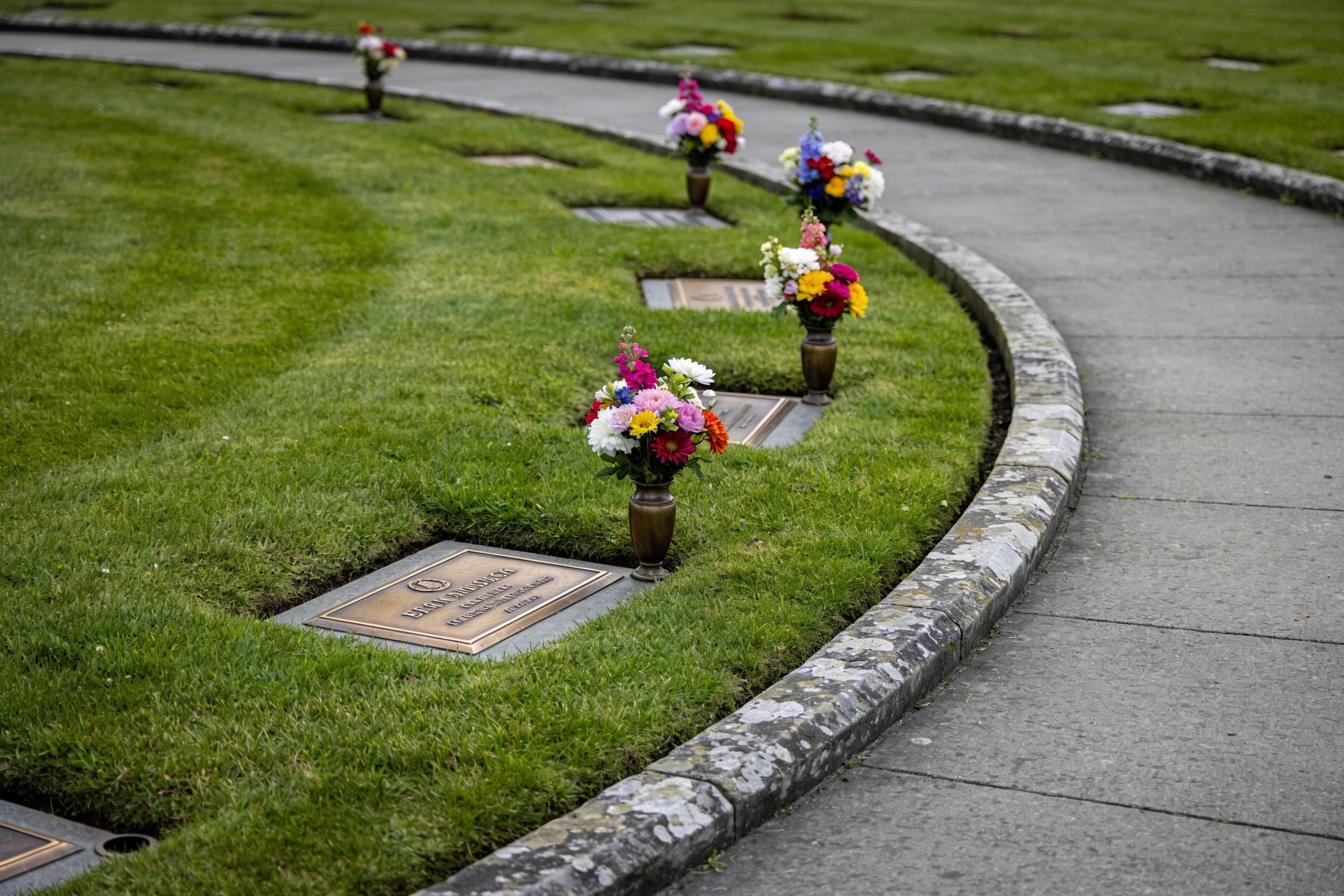
Flower vases, decorations, and accessories. Permanent cemetery vases mounted to a headstone or flush with the ground cost $50 to $200. Some cemeteries restrict the type of gravestone decorations allowed, so it is worth asking about policies before purchasing.
What Is Included When You Buy a Cemetery Plot
Knowing what your plot purchase actually covers helps prevent surprises. Most cemetery plot purchases include:
Right of burial. You are purchasing the right to inter remains in that specific space — not ownership of the land itself.
Deed or certificate of ownership. This document confirms your burial rights and may be needed for future arrangements.
Perpetual care (if included). Verify whether grounds maintenance is part of the purchase or billed separately.
Some cemeteries bundle several of these into a single "burial package." Always request an itemized price list — the FTC's Funeral Rule requires funeral homes to provide one, though cemeteries that do not sell funeral goods and services may not be covered by the same rule.
How to Reduce Cemetery Plot Costs
Families who plan ahead have more leverage over costs. Several strategies can make a meaningful difference.
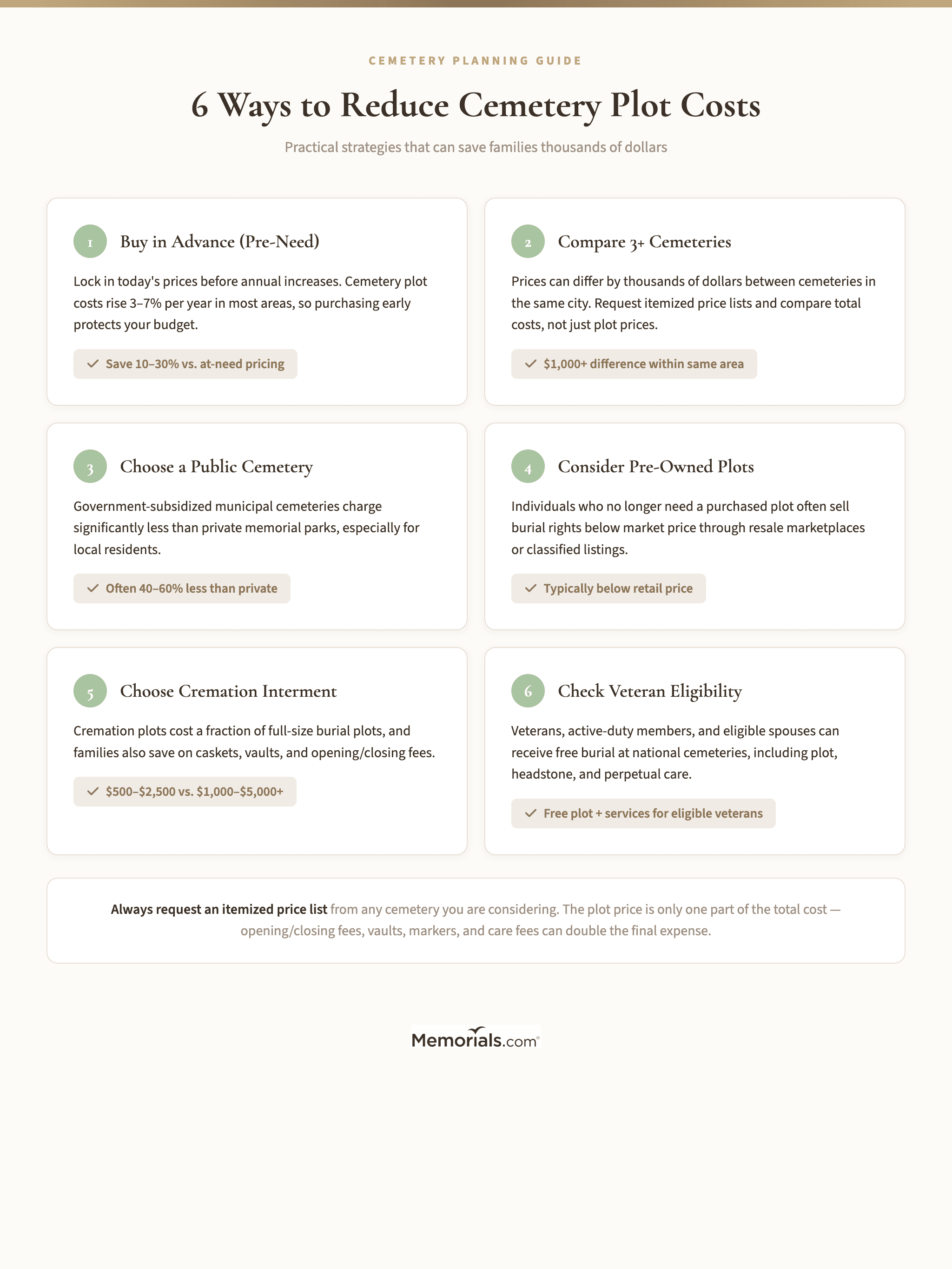
Buy in advance (pre-need). Purchasing a plot before it is needed locks in current prices and protects against annual increases. Cemetery plot prices have historically risen faster than general inflation. Advance planning also gives you more time to compare options without the pressure of an immediate need.
Compare multiple cemeteries. Even within the same city, plot prices can differ by thousands of dollars. Visit at least three cemeteries, request itemized price lists, and compare the total cost — not just the plot price.
Consider a public or municipal cemetery. Government-subsidized cemeteries offer significantly lower prices, especially for local residents. The trade-off may be fewer aesthetic amenities, but the care and dignity of the burial itself remain the same.
Look into pre-owned plots. Individuals who no longer need a purchased plot sometimes sell their burial rights at below-market prices. Cemetery-specific resale marketplaces and classified listings connect buyers and sellers. If you want to understand the process, our article on selling a cemetery plot covers the legal and practical steps from both sides.
Choose cremation interment. Cremation plots cost a fraction of full-size burial plots, and families also save on caskets, vaults, and opening and closing fees. Even with the added cost of cremation services, the total is typically thousands of dollars less than a traditional burial.
Check veteran eligibility. If the deceased (or their spouse) served in the military, they may qualify for free burial at a national cemetery. The VA also provides a burial allowance for veterans interred in private cemeteries.
Cemetery Plot Cost vs. Total Burial Cost
A common source of confusion is the difference between the plot price and the total cost of burial. The plot is just one piece of a much larger financial picture.
According to the National Funeral Directors Association, the median cost of a funeral with viewing, ceremony, and burial reached roughly $10,000 in recent years when vault fees are included. That figure covers funeral home services, a casket, embalming, transportation, and ceremony costs — but does not include the cemetery plot, headstone, or cemetery service fees.
When you add a mid-range cemetery plot ($2,000 to $4,000), opening and closing fees ($1,000 to $1,500), a burial vault ($1,500 to $2,500), and a headstone ($1,500 to $3,000), the total all-in cost of a traditional burial can reach $15,000 to $20,000 or more. Our funeral cost breakdown provides a detailed look at every component.
Unexpected costs can also emerge down the line. Families occasionally need to relocate remains due to cemetery closures, family moves, or estate changes. The cost of relocating a grave — including exhumation permits, re-interment fees, and transportation — ranges from $3,000 to $10,000 depending on distance and legal requirements.
Frequently Asked Questions
Can I finance a cemetery plot?
Many cemeteries offer payment plans for pre-need purchases, allowing you to spread the cost over 12 to 60 months. Interest rates and terms vary. Some cemeteries charge no interest on short-term plans while others apply financing fees. Always confirm whether the burial rights are granted immediately or only after the balance is paid in full.
Do cemetery plot prices go up every year?
Yes. Cemetery land is a finite resource, and prices tend to rise as available inventory shrinks. Annual increases of 3 to 7 percent are common, particularly in urban areas. Buying in advance is one of the most effective ways to avoid higher future costs.
Can I buy a cemetery plot in a state where I do not live?
In most cases, yes. Private cemeteries generally sell to anyone regardless of residency. Public and municipal cemeteries, however, may restrict sales to local residents or charge higher rates for non-residents. Veterans are eligible for burial in any national cemetery with available space, regardless of where they lived.
What happens to a cemetery plot I never use?
Policies vary by cemetery. Some allow you to transfer the plot to a family member, resell it privately, or sell it back to the cemetery — sometimes at a reduced buyback price. Others restrict transfers or require approval. Review the deed and cemetery bylaws before assuming you can resell.
Is a burial vault always required?
Not always, but most traditional cemeteries require a vault or grave liner to prevent ground settling. Green burial grounds specifically prohibit vaults. If cost is a concern, a basic concrete grave liner meets most cemetery requirements at a lower price than a sealed vault.
Planning Ahead
Cemetery plot costs represent one of the most significant and least discussed expenses families face when planning end-of-life arrangements. The price you pay depends on the type of plot, the cemetery's classification, your geographic region, and the additional services each cemetery requires. By comparing options early, asking for itemized price lists, and considering alternatives like cremation plots or pre-owned spaces, you can find a meaningful resting place that respects both your loved one's memory and your family's budget.
Browse cemetery products including bronze plaques, vases, and grave accessories to personalize a gravesite with lasting tributes.