🏬Supersize Online Funeral Retailer🪦1000's of Headstones⚱️Over 10,000 Cremation Urns⚰️Caskets Overnight Delivery🛒Funeral & Memorial Superstore🚚FREE Shipping on ALL Orders👨👩👧👦Helping Families for over 20 Years💰Lowest Price Guarantee🏬Supersize Online Funeral Retailer🪦1000's of Headstones⚱️Over 10,000 Cremation Urns⚰️Caskets Overnight Delivery🛒Funeral & Memorial Superstore🚚FREE Shipping on ALL Orders👨👩👧👦Helping Families for over 20 Years💰Lowest Price Guarantee
🏬Supersize Online Funeral Retailer🪦1000's of Headstones⚱️Over 10,000 Cremation Urns⚰️Caskets Overnight Delivery🛒Funeral & Memorial Superstore🚚FREE Shipping on ALL Orders👨👩👧👦Helping Families for over 20 Years💰Lowest Price Guarantee🏬Supersize Online Funeral Retailer🪦1000's of Headstones⚱️Over 10,000 Cremation Urns⚰️Caskets Overnight Delivery🛒Funeral & Memorial Superstore🚚FREE Shipping on ALL Orders👨👩👧👦Helping Families for over 20 Years💰Lowest Price Guarantee
Cemetery regulations can feel surprisingly specific when you are simply trying to place an urn, install a marker, or leave flowers for someone you love. Yet most of these rules come from practical needs: keeping lawns safe for mowers, preventing trip hazards, limiting theft, and making sure memorials hold up for decades in weather. Our cemetery planning and buying guide covers the full process from choosing a plot to selecting a memorial, but this article focuses specifically on the regulations you will encounter along the way.
A little planning up front saves time, avoids extra fees, and helps you choose items that will actually be allowed in the section you purchased. If you are also selecting , our covers the full process from choosing materials to working with a cemetery.
Cemeteries function as a blend of public park, construction site, and permanent archive. Grounds crews need clear access to mow and trim. Staff need to know what is buried where and at what depth. Families want a setting that feels cared for and consistent.
Those goals are where most cemetery rules and regulations originate. Lawn maintenance requires flat, stable surfaces and limited objects on the grass. Safety requires limits on glass, metal stakes, sharp edges, and loose decorations. Long-term stability requires foundations, liners, and approved materials that will not crack or degrade quickly. Ground settlement prevention is also a major factor: when an urn or a casket deteriorates underground, the soil above it can sink, creating a dip that is difficult to mow and potentially unsafe for visitors.
Rules also vary because cemeteries vary. A traditional cemetery with upright headstones may allow features that a memorial park with only flush markers will not. Even within a single property, different sections often follow different sets of rules.
How Regulations Differ by Cemetery Type
Not all cemeteries operate under the same framework, and understanding the type of cemetery you are working with helps you anticipate what rules to expect.
Public and Municipal Cemeteries
Public cemeteries are typically managed by a city, county, or township. Their regulations tend to be standardized and publicly available, sometimes posted on a municipal website. Rules often prioritize uniformity and ease of maintenance over individual expression. Many public cemeteries restrict entire sections to flat grave markers only, with strict size limits tied to the plot dimensions.
Private and For-Profit Cemeteries
Private cemeteries set their own policies, which can range from highly restrictive (memorial parks that allow only flush bronze markers) to relatively open (rural cemeteries that permit a wider variety of monument styles). Private cemeteries may also require families to purchase vaults, foundations, and sometimes even the marker itself through the cemetery or an approved vendor. The Federal Trade Commission's Funeral Rule does protect consumers by allowing them to purchase headstones and other memorial items from outside vendors without penalty, though cemeteries may charge reasonable installation or setting fees.
Religious Cemeteries
Religious cemeteries often add faith-based requirements on top of the practical ones. A Catholic cemetery may require a cross or other religious symbol on the marker. Jewish cemeteries may prohibit above-ground vaults or require certain inscription formats. Some religious cemeteries restrict cremation burials entirely or allow them only in designated sections.
National and Veterans Cemeteries
National cemeteries administered by the VA follow federal guidelines and provide government-furnished markers at no cost. Families may not substitute private markers unless the section was authorized for private headstones before 1947. Urn dimensions must fit standard niche openings, and the VA typically requests urn measurements during scheduling. Government-furnished markers include the veteran's name, service branch, and dates, so families do not need to engrave the urn itself for identification purposes.
Memorial Parks
Memorial parks (sometimes called "lawn cemeteries") are designed for a uniform, garden-like appearance. Nearly all require flush-level markers, and many restrict material to bronze set in a granite base. Decorations, plantings, and raised objects are usually limited to small approved items during designated holiday periods.
Start With the Section Rules, Not the Product
Before shopping for an urn vault, a vase, or a marker, identify the exact placement location and the section's rules. "Cemetery rules" are rarely one set of policies for the entire property. The same cemetery may have a flush-marker lawn section, an upright-monument section, a columbarium, and a veterans area, each with different requirements. If you have not yet secured a plot, our guide to buying a cemetery plot explains what to look for.
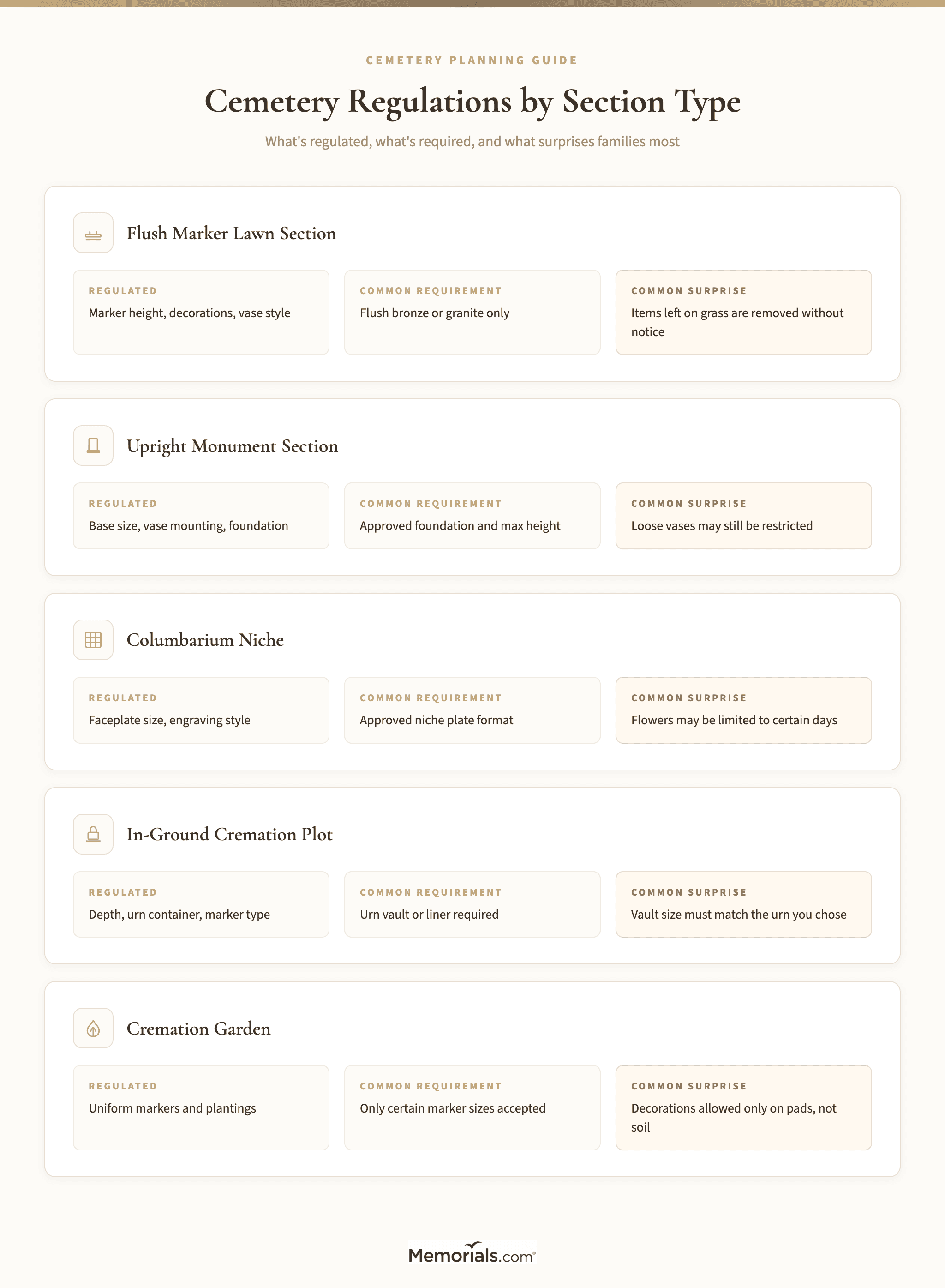
Here is a quick way to map what usually changes by placement type:
Flush marker lawn section — Marker height, decorations, and vase styles are regulated most heavily. A common requirement is "flush bronze or granite only." Many items left on the grass are removed without notice.
Upright monument section — Base size, vase mounting, and foundation specifications are the main concern. Approved foundation dimensions and maximum height are standard requirements, and loose vases may still be restricted.
Columbarium niche — Faceplate size and engraving style are closely regulated. The cemetery typically specifies an approved niche plate format, and exterior flowers may be limited to certain days. For families considering this option, our columbarium and niche placement guide explains what to expect in detail.
In-ground cremation plot — Depth, urn container type, and marker style are the regulated factors. An urn vault or liner is commonly required, and the vault size must match the urn you chose.
Cremation garden — Uniform markers and plantings are the priority. Only certain marker sizes are accepted, and decorations may be allowed only on concrete pads rather than directly on soil.
Get the section name, lot number, and the cemetery's written rules if possible. Even a short email from the office confirming "flat bronze, 24 × 12" can prevent a costly redo.
Marker and Memorial Regulations
Marker rules can be emotional because the marker is the most visible piece of remembrance. The good news is that most cemeteries allow meaningful personalization within a clear set of boundaries.
Size Restrictions
Nearly every cemetery specifies maximum dimensions for markers, and these limits vary by section and plot type. Standard single-grave flush markers are commonly 24 × 12 inches, 28 × 16 inches, or 18 × 24 inches. Companion (double) markers are typically 36 × 18 inches or 44 × 14 inches. Upright monuments usually have both a maximum height (often 36 to 42 inches above ground for standard plots) and a maximum width that must not extend beyond the lot boundaries. If the section allows upright monuments, the base footprint must also fall within cemetery specifications. Our headstone size guide covers standard dimensions and what cemeteries typically allow.
Material Requirements
Granite and bronze are accepted at nearly every cemetery in the United States because they resist weathering, staining, and erosion. Many cemeteries restrict or prohibit softer stones like marble, sandstone, and limestone, which can become unreadable over time. Wood is almost universally prohibited for permanent markers due to rapid degradation. Some memorial parks require all markers to be bronze set into a granite base, which creates the flush, uniform appearance those properties are designed around. If a cemetery says "approved materials only," it almost always means granite, bronze, or both.
Foundation Specifications
Even a beautiful marker can tilt or sink if it is not installed on the right base. Most cemeteries require a poured concrete foundation of a specified thickness, often four to six inches for flush markers and deeper for upright monuments. Some cemeteries require their own staff to pour the foundation and set the marker. Others allow an approved outside contractor but will inspect the work before final acceptance. Our overview of the headstone installation process explains what to expect and what questions to ask.
Inscription and Design Rules
Cemeteries also tend to regulate inscription details more than families expect. Names and dates usually must match cemetery records exactly. Some cemeteries restrict business names, maker marks, or logos on the visible face of the marker. Many require approval of the layout, font, and dimensions before fabrication begins, and this approval step can add two to four weeks to the timeline. For families exploring personalization ideas, our guide to choosing between flat and upright styles can help match the right marker type to your cemetery's rules.
Emblems, Photos, and Add-Ons
If you are adding a memorial picture, an emblem, or a vase feature, treat those as regulated components. Some cemeteries are very open to ceramic photo plaques, bronze emblems, and mounted vases. Others want a uniform look and restrict anything that extends beyond the marker surface. Always confirm whether these features require separate approval.
Urn Vault and Burial Container Regulations
An urn vault (sometimes called an urn liner or outer container) is a rigid box placed around a cremation urn when the urn is buried in the ground. The primary purpose is not just moisture protection. It is also about maintaining the grade, meaning preventing the ground from settling and creating an unsafe or difficult-to-mow depression.
A single sentence clears up a lot of confusion: vault requirements are usually cemetery policy, not a universal law. No federal or state law in the United States requires an urn vault, but the majority of traditional cemeteries do require one for in-ground cremation burials. To understand what burial vaults are and when they're required, it helps to look at the different cemetery sections independently.
When Vaults Are Required
Most cemeteries require an urn vault for in-ground cremation burials, especially in lawn sections where maintaining a flat, even surface is part of the cemetery's design. Above-ground placements, such as columbarium niches, typically do not require an urn vault because the niche itself serves as the protective structure. Some cemeteries will waive the vault requirement for urns made of granite, marble, or cultured stone because those materials are structurally self-supporting and will not degrade underground.
Vault Materials and Specifications
Urn vaults come in concrete, composite, fiberglass, and certain metals. Cemeteries may specify strength ratings, material types, or approved brands. Our guide to cremation vault types explains the differences and what to expect at each price level.
Sizing Considerations
Sizing matters more than most people realize. The vault must fit the urn with room to close securely. If two urns will be placed together in the same plot, the cemetery may have specific rules about whether they can share one container or must have separate containers. The vault's outer dimensions also need to match the plot's available space. For a complete walkthrough of vault dimensions and compatibility, see our article on urn vault rules for ground burial.
Key Questions to Ask About Vaults
If you are unsure what to ask, focus on the practical details the cemetery staff can answer quickly: Is an urn vault required in this section? What interior dimensions are required for the vault? Are there material or strength specifications? Are two cremation containers allowed in one space, and if yes, how must they be packaged? Can a stone urn be buried without a vault?
Vase and Flower Container Regulations
Vase policies tend to be stricter than families expect because containers become maintenance and safety issues quickly. Cemeteries often limit vases to "approved" designs, and many prefer vases that are permanent or that lock into place.
In many locations, the safest bet is a cemetery vase that is built into the monument base or a bronze vase designed to mount securely. In flush-marker sections, you may be limited to a vase cone or an approved marker-mounted vase that does not stick out beyond the marker's footprint.
Most cemeteries also manage decorations on a schedule. Some allow temporary vases for a short period after burial, then require a permanent solution. Many require in-ground vases to be turned down or removed during winter months so mowing equipment does not strike them.
Common items that cemeteries typically prohibit include glass containers, mason jars and bottles, tin cans, breakable pottery, and solar lights in some sections. Many cemeteries remove items without notice when they become faded, tipped over, or difficult to maintain. That can feel personal, but it is usually routine housekeeping performed across the entire grounds.
If you are ordering a monument or marker with a vase feature, confirm whether the cemetery requires the vase to be recessed into the base and whether it must stay within the marker width.
Decoration Policies
Many families want to leave more than flowers at a gravesite. Stuffed animals for a child, solar lights, sports items, small flags, wind chimes — these can be comforting. For more inspiration, see our guide on cemetery grave decoration ideas.
They can also be the first items removed by staff, especially in flush-marker lawns where anything on the grass interferes with mowing. Decoration rules typically fall into a few categories:
Always prohibited — Glass containers, fencing, landscape edging driven into the ground, concrete or masonry structures, and any item that creates a trip hazard or obstructs mowing.
Seasonally restricted — Many cemeteries allow holiday wreaths, flags, and certain decorations only during defined windows (such as two weeks before and two weeks after Memorial Day or Christmas). Items not removed by the deadline are collected during scheduled cleanups, usually in spring and fall.
Conditionally allowed — Fresh flowers in approved vases, small flags on designated holidays, and mounted emblems are often permitted year-round if they meet the cemetery's specifications.
A simple approach is to treat temporary items as "visit day" items. Bring them, spend time, take them with you. This keeps the space tidy and reduces the chance of loss or removal.
If you want a personal touch that lasts, consider options that are physically part of the memorial: an engraved symbol, an approved vase, a bronze emblem, or a memorial picture plaque if the cemetery allows it.
Common Fees and Costs You Should Expect
Cemetery regulations often come with associated fees that families do not always anticipate. Knowing these in advance helps with budgeting and avoids surprises.
Opening and closing fees cover the labor of excavating and restoring the plot or niche for urn interment. For cremation burials, these fees typically range from $200 to $800 depending on the cemetery and region.
Foundation and setting fees cover the installation of a concrete base and the placement of the marker. Some cemeteries charge these as a flat rate, while others calculate by the square inch or linear foot of marker. Fees typically range from $100 to $500 for a standard flush marker and $300 to $1,000 for an upright monument.
Marker approval fees are charged by some cemeteries to review the design, dimensions, and inscription before fabrication. Not every cemetery charges for approval, but when they do, expect $25 to $100.
Perpetual care fees are often included in the plot purchase price. This ongoing maintenance fund covers lawn care, landscaping, and general upkeep of the section. If it is not included, ask how much it adds.
Your Consumer Rights
The Federal Trade Commission's Funeral Rule protects your right to purchase memorial items from the vendor of your choice. Cemeteries cannot require you to buy a marker, urn, or vault from them. They cannot charge a handling fee simply because you purchased from an outside supplier, though they may charge reasonable installation or setting fees that apply equally regardless of where the item was purchased.
If a cemetery attempts to restrict your choice of vendor or charges fees that seem punitive, you have the right to ask for the policy in writing and to contact the FTC if the practice appears to violate the Funeral Rule.
A Practical Checklist Before You Order
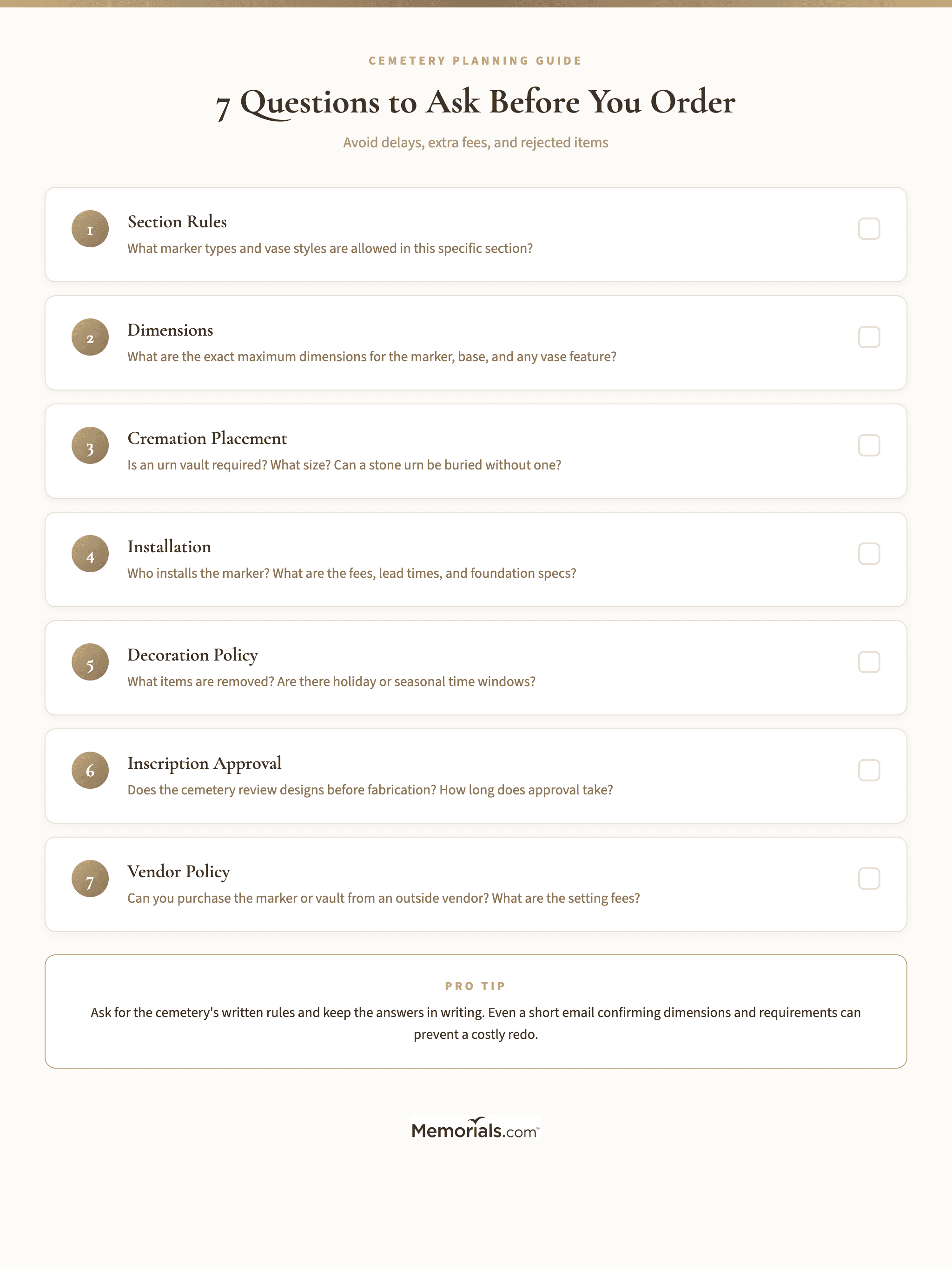
Even when you are working with a helpful cemetery office, it is easy to miss one key detail that triggers delays. A short checklist keeps the process calm.
Section rules — What marker types and vase styles are allowed where this space is located?
Dimensions — What are the exact maximum dimensions for the memorial and any vase feature?
Cremation placement — If cremated remains are being buried, is an urn vault required, and what size? Can a stone urn be buried without a vault?
Installation — Who installs the marker, and what are the fees, lead times, and foundation specs?
Decoration policy — What items are removed, and are there holiday or seasonal time windows?
Inscription approval — Does the cemetery need to review the design before fabrication, and how long does approval take?
Vendor policy — Can you purchase the marker or vault from an outside vendor, and what are the setting fees?
This list also helps when multiple family members are involved, since it prevents a well-meaning purchase that the cemetery will not accept.
Getting Help When You Are Not Sure What Will Pass Approval
If you are purchasing a marker, vase, urn vault, or related cemetery item from a retailer, it helps to choose one that expects cemetery compliance to be part of the process. Look for practical safeguards like clear sizing information, durable materials suited for outdoor placement, and customer support that can coordinate details with your cemetery.
Memorials.com carries a wide range of cemetery products, including grave markers in granite and bronze, mounted and invertible cemetery vase options, and burial vaults designed for cemetery compliance. Free ground shipping, a 30-day return policy, and experienced customer service make it easier to adjust if the cemetery requests a change in size or style.
The cemetery's rules control what can be installed, so the most important step is still a quick confirmation with the office before anything is engraved or set. One call to the cemetery can turn "I think this should be fine" into "Yes, that is approved in this section."
Frequently Asked Questions
Can a cemetery refuse a headstone I bought from another company?
A cemetery cannot refuse a headstone simply because you purchased it from an outside vendor. The FTC's Funeral Rule protects your right to buy memorial items from any supplier. However, the cemetery can refuse a marker that does not meet its size, material, or design requirements, and it may charge a setting fee for installation.
Do all cemeteries require an urn vault for cremation burial?
No. Vault requirements are cemetery policy, not federal or state law. Most traditional cemeteries require one for in-ground cremation burials to prevent ground settling. Some cemeteries waive the requirement for urns made of stone or metal. Always confirm the policy for your specific section before purchasing.
How do I find out what size marker my cemetery allows?
Contact the cemetery office and ask for written specifications for the section where your plot is located. Request the maximum dimensions for both the marker and any base or foundation. Many cemeteries have printed rule sheets they will email or mail to you.
Can I plant flowers or leave decorations at a grave?
Most cemeteries allow fresh flowers in approved vases but restrict plantings in the ground. Decorations are typically subject to seasonal cleanup schedules. Items left outside designated windows are often removed. Ask for the cemetery's decoration policy in writing so you know what is permitted year-round versus during holiday windows.
Are there different rules for cremation plots versus traditional burial plots?
Yes. Cremation plots are usually smaller and may have different marker size limits. The urn vault or liner requirement is specific to cremation burials. Columbarium niches have their own set of rules around urn dimensions, niche plate styles, and engraving. Different cemetery sections can have entirely different regulations even within the same property.