🏬Supersize Online Funeral Retailer🪦1000's of Headstones⚱️Over 10,000 Cremation Urns⚰️Caskets Overnight Delivery🛒Funeral & Memorial Superstore🚚FREE Shipping on ALL Orders👨👩👧👦Helping Families for over 20 Years💰Lowest Price Guarantee🏬Supersize Online Funeral Retailer🪦1000's of Headstones⚱️Over 10,000 Cremation Urns⚰️Caskets Overnight Delivery🛒Funeral & Memorial Superstore🚚FREE Shipping on ALL Orders👨👩👧👦Helping Families for over 20 Years💰Lowest Price Guarantee
🏬Supersize Online Funeral Retailer🪦1000's of Headstones⚱️Over 10,000 Cremation Urns⚰️Caskets Overnight Delivery🛒Funeral & Memorial Superstore🚚FREE Shipping on ALL Orders👨👩👧👦Helping Families for over 20 Years💰Lowest Price Guarantee🏬Supersize Online Funeral Retailer🪦1000's of Headstones⚱️Over 10,000 Cremation Urns⚰️Caskets Overnight Delivery🛒Funeral & Memorial Superstore🚚FREE Shipping on ALL Orders👨👩👧👦Helping Families for over 20 Years💰Lowest Price Guarantee
Few questions weigh on grieving families as heavily as whether scattering a loved one's ashes aligns with their faith. If you have been searching for biblical guidance on this topic, you are not alone — and the short answer may surprise you. The Bible never directly mentions scattering cremated ashes. There is no verse that permits it and no verse that forbids it. That silence, however, has not stopped Christian denominations from developing very different positions on the practice. Understanding where each tradition stands can help you make a decision that honors both your loved one and your beliefs. For a broader look at all the decisions families face after choosing cremation — from urns and burial to memorialization — our cremation guide walks through every step.
Scripture uses the words "ashes" and "dust" dozens of times, but always in a metaphorical or ritualistic sense rather than as instructions about cremated remains. Genesis 3:19 reminds humanity that "you are dust, and to dust you shall return." Ecclesiastes 3:20 echoes this: "All go to the same place; all come from dust, and to dust all return." Job 42:6 describes repentance "in dust and ashes." These passages speak to mortality, humility, and the human condition — not to what a family should do with cremated remains after a modern cremation.
The Old Testament records burial as the standard practice. Abraham purchased a cave at Machpelah to bury Sarah (Genesis 23:19). Jacob gave detailed instructions for his burial in the same family tomb (Genesis 49:29–32). The New Testament follows the same pattern: Jesus was buried in a tomb (Matthew 27:59–60), and the early church continued the practice.
Cremation itself appears only a handful of times in Scripture, and those references are complicated. The burning of Saul and his sons at Jabesh-Gilead (1 Samuel 31:12) is sometimes cited, though scholars debate whether this was a full cremation or a partial burning before burial of the bones. The burning of Achan's body (Joshua 7:25) was a punishment, not a funerary honor. None of these passages address what should happen with the resulting ashes.
The theological question that runs through every denomination's position is whether the physical disposition of remains affects the resurrection of the body. Most Christian traditions agree that God's power to resurrect is not limited by what happens to the body after death. As the Billy Graham Evangelistic Association has stated, the Bible contains nothing that forbids cremation or scattering, and God can reassemble whatever has been scattered. The real differences emerge not over whether scattering is possible, but whether it is respectful.
To understand how the broader question of cremation fits into Christian theology, the article on what the Bible says about cremation covers the scriptural foundation in detail.
What the Catholic Church Says About Scattering Ashes
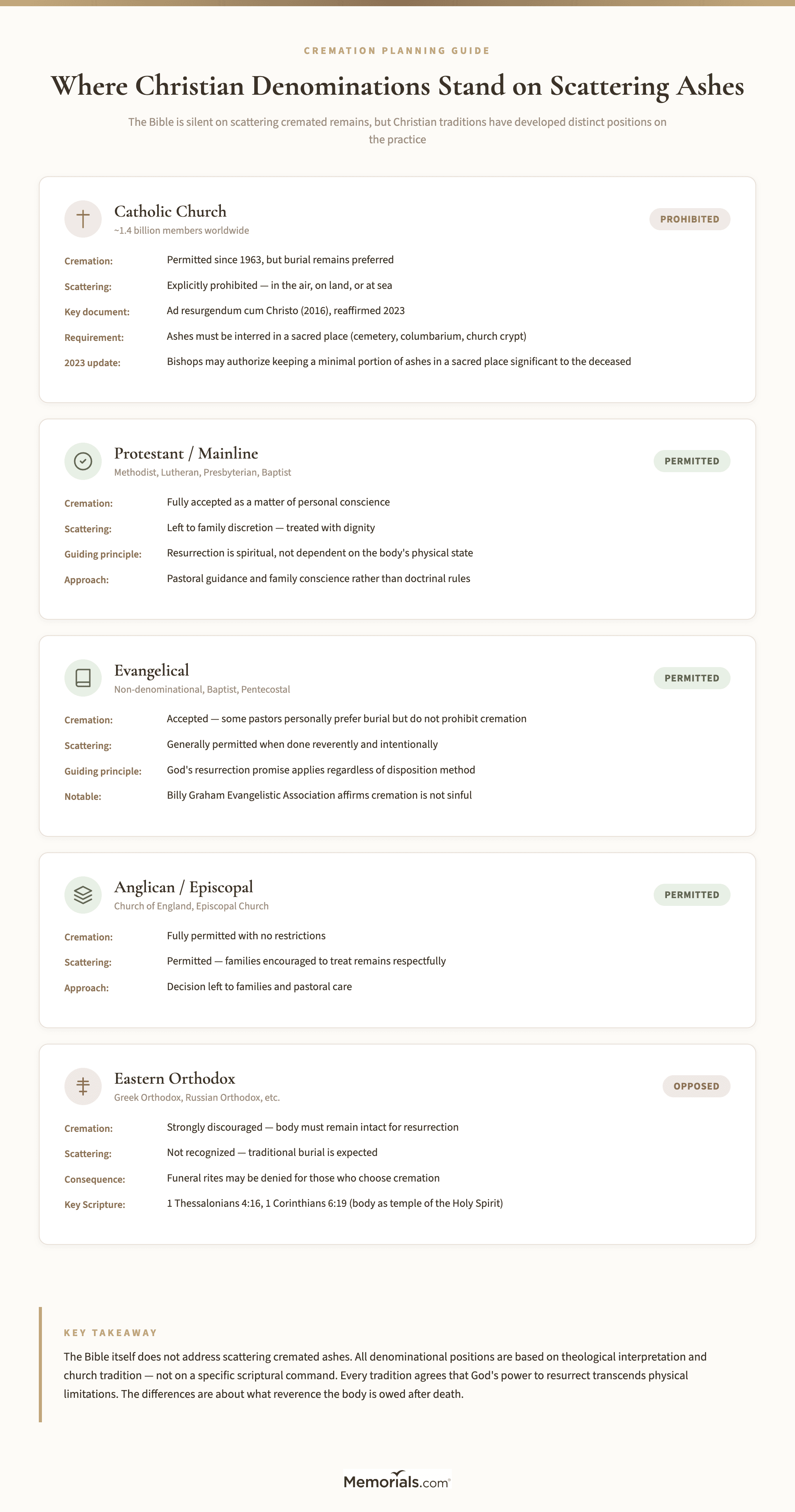
The Catholic Church's position is the most clearly defined of any Christian denomination — and the most restrictive. While the Church permitted cremation beginning in 1963 (formally codified in the 1983 Code of Canon Law), it did not address what should happen with the ashes until much later.
The 2016 Vatican Instruction: Ad Resurgendum cum Christo
On October 25, 2016, the Vatican's Congregation for the Doctrine of the Faith (now the Dicastery for the Doctrine of the Faith) published the instruction "Ad resurgendum cum Christo" ("To Rise with Christ"). This document set out clear rules for Catholic faithful regarding cremated remains. The instruction states that cremation itself does not prevent God from raising the body to new life, but it specifies that ashes must be treated with the same reverence as an intact body.
The key prohibitions include scattering ashes in the air, on land, or at sea; keeping ashes at home (except in rare cases authorized by a bishop); dividing ashes among family members; and preserving ashes in jewelry, glass, or keepsake items.
Instead, the Church requires that cremated remains be interred in a sacred place — a cemetery, columbarium, church crypt, or other area designated by ecclesiastical authority. The instruction connects this requirement to the Catholic belief in bodily resurrection, stating that burial "confirms her faith in the resurrection of the body" and "intends to show the great dignity of the human body as an integral part of the human person." The Church explicitly rejects the idea that death represents a fusion with nature, a stage in reincarnation, or the final annihilation of the person — all concepts it associates with pantheism, naturalism, or nihilism.
Families who deliberately choose to scatter ashes for reasons contrary to Catholic teaching may be denied a Christian funeral under canon law. This is not a new position, but the 2016 instruction was the first time the Church spelled out the practical rules so explicitly. For families navigating the legal side of these decisions, understanding scattering ashes laws in your area is equally important, since both church guidelines and civil regulations may apply.
The 2023 Vatican Update
In December 2023, the Dicastery for the Doctrine of the Faith responded to questions from Cardinal Matteo Zuppi of Bologna with a clarifying note. The update reaffirmed that the 2016 instruction "still retains all its validity" — scattering remains prohibited, ashes must be kept in a sacred place. However, it introduced one notable exception: local church authorities may now authorize a family to keep a minimal portion of ashes in a place of significance to the deceased, provided that place has a sacred nature and the request is evaluated on a case-by-case basis. The bulk of the ashes must still be interred in consecrated ground.
Protestant and Evangelical Views on Scattering Ashes
Protestant denominations generally take a far more flexible approach. Most mainline churches — Methodist, Lutheran, Presbyterian, and Baptist — consider cremation and scattering to be matters of personal conscience rather than doctrinal law. The reasoning centers on the belief that resurrection is a spiritual transformation accomplished by God's power, not a physical reassembly of the original body.
Many Protestant pastors counsel families that what matters most is the intention behind the act, not the method of disposition. If scattering ashes in a meaningful place brings comfort and honors the deceased, most Protestant traditions see no conflict with Scripture. The emphasis falls on grief support, family unity, and reverent handling of remains rather than on specific rules about where ashes must go.
Families who want to scatter but cannot bear to part with all of it often keep a token portion in a permanent form. Some choose glass art from ashes, where a small amount is infused into hand-blown glass; others look at cremation diamond cost, which runs from a few thousand dollars into five figures for a stone grown from the carbon. Both leave the great majority of the ashes free to be scattered, which is frequently the arrangement that settles a disagreement.
Evangelical Christians often share this flexibility. Well-known evangelical ministries, including the Billy Graham Evangelistic Association, have publicly affirmed that cremation is not sinful and that God's promise of resurrection applies regardless of how the body is laid to rest. Some evangelical pastors personally prefer burial for its symbolic resonance with Christ's burial and resurrection, but they do not teach that scattering ashes is wrong. For a deeper look at how different Christian views on cremation break down across denominations, that guide covers the full spectrum.
The Anglican Communion and the Episcopal Church similarly permit cremation and scattering, leaving the decision to families with encouragement to treat remains with dignity and respect.
The Eastern Orthodox Position
The Eastern Orthodox Church holds the most conservative view among major Christian traditions. Orthodox teaching strongly opposes cremation itself — not just scattering — on the grounds that the body is sacred and must remain intact for resurrection. This position draws on passages like 1 Thessalonians 4:16 ("the dead in Christ will rise first") and 1 Corinthians 6:19 (the body as a "temple of the Holy Spirit").
In practice, Orthodox Christians who choose cremation may face denial of funeral rites, though individual bishops and parishes sometimes exercise pastoral discretion. Scattering ashes is not part of any Orthodox tradition, and families within this faith are expected to pursue traditional burial whenever possible.
Is Scattering Ashes a Sin?
This is the question many families are really asking, and the answer depends entirely on your denominational perspective.
For Catholics, deliberately scattering ashes in defiance of Church teaching could be considered a grave matter — serious enough that it may result in being denied a Christian funeral. The Church frames this not as a punishment but as a consequence of choosing a practice the Church considers incompatible with the faith's understanding of death and resurrection.
For most Protestants and evangelicals, scattering ashes is not a sin. The Bible does not address the practice, and these traditions hold that God's ability to resurrect the body is not limited by what happens to physical remains. The principle from Daniel 12:2 — "many who sleep in the dust of the earth will awake" — suggests that resurrection does not depend on the body's physical state.
For Orthodox Christians, the question is broader than scattering alone. Cremation itself is viewed as inconsistent with Orthodox theology, so scattering ashes compounds a practice already considered inappropriate.
The common thread across all traditions is this: every denomination agrees that God's power transcends physical limitations. The disagreements are about what we owe to the body in death — whether specific practices of reverence are required or whether sincere intention is enough. Many families who choose religious urns as a permanent resting place find that an urn inscribed with a cross or scriptural reference honors both the deceased and the family's faith, even when some ashes have been scattered.
Scripture-Based Readings for a Scattering Ceremony
For families who do choose to scatter ashes — whether their tradition permits it or they have made a personal decision to do so — incorporating Scripture into the ceremony can make the experience more meaningful. Several passages speak directly to themes of mortality, hope, and God's care for the departed.
Psalm 23 ("The Lord is my shepherd; I shall not want") remains one of the most frequently read passages at funerals and scattering ceremonies. Its imagery of being led "beside still waters" and through "the valley of the shadow of death" resonates especially during outdoor scattering. Psalm 90:2–3, which speaks of God's eternal nature and humanity's return to dust, provides a contemplative framework. Ecclesiastes 3:1–2 ("To everything there is a season, and a time to every purpose under heaven") acknowledges the natural cycle of life and death. John 14:1–3, in which Jesus promises to prepare a place for his followers, offers comfort and assurance about what lies beyond.
Some families also draw on non-scriptural prayers and personal words. If you are planning a ceremony and want guidance on readings, reflections, and how to structure the moment, our guide to words for a scattering ceremony offers both scriptural and secular options.
Honoring Your Loved One Within Your Faith
Whatever your denomination teaches, the decision about what to do with a loved one's ashes is deeply personal. Here are a few approaches families commonly take when faith and scattering intersect.
Some families scatter a portion of ashes in a meaningful location while interring the rest in a cemetery or columbarium. This approach satisfies the Catholic requirement for interment (assuming bishop authorization for the small portion) while still honoring a loved one's connection to a special place. Keepsake urns make it easy to set aside a small amount of ashes for this purpose, while a full-size urn holds the remainder for permanent placement.
Other families choose not to scatter at all, instead selecting an urn with religious symbolism — a cross, dove, or scriptural verse — and placing it in a columbarium niche or burial plot. This honors both the tradition of interment and the family's desire for a tangible memorial.
Still others hold a full scattering ceremony with Scripture readings and prayers, treating the act itself as a sacred return of the body to the earth that God created. For Protestant and evangelical families, this approach often feels both biblically grounded and personally meaningful.
No matter which path you choose, treating remains with reverence and intentionality is the principle that unites every Christian tradition. The method may differ, but the underlying respect for human dignity does not.
Frequently Asked Questions
Does the Bible forbid scattering ashes?
No. The Bible does not mention scattering cremated ashes at all — neither to forbid nor to permit the practice. Denominational positions on scattering come from theological interpretation and church tradition, not from a specific biblical command.
Can Catholics scatter ashes at sea?
The Catholic Church's 2016 instruction "Ad resurgendum cum Christo" prohibits scattering ashes in the air, on land, or at sea. Cremated remains must be interred in a sacred place such as a cemetery or columbarium. A 2023 update allows local bishops to authorize families to keep a minimal portion of ashes in a sacred place of significance to the deceased.
Do Protestant churches allow scattering ashes?
Most Protestant denominations — including Methodist, Lutheran, Presbyterian, Baptist, Anglican, and Episcopal churches — leave the decision to individual families. These traditions generally hold that God's power to resurrect is not limited by what happens to the physical body, and they view scattering as a matter of personal conscience.
Is cremation a sin according to the Bible?
The Bible does not identify cremation as a sin. Most Christian denominations now permit cremation, including the Catholic Church (since 1963). The Eastern Orthodox Church discourages cremation but frames it as inconsistent with tradition rather than as a biblical sin.
What Scripture should I read when scattering ashes?
Common choices include Psalm 23, Ecclesiastes 3:1–2, Genesis 3:19, John 14:1–3, and Psalm 90:2–3. These passages address mortality, hope, God's eternal nature, and the promise of life beyond death.
Religious permission and civil permission are separate questions, and a scattering has to satisfy both. The rules for scattering ashes in Hawaii, for instance, come from federal ocean regulation and the state land agency rather than from any church.
Memorials.com carries a wide selection of cremation urns, religious urns, and keepsake urns to help you honor your loved one in a way that reflects your family's faith and values. Browse our collection to find the right memorial for your needs.