🏬Supersize Online Funeral Retailer🪦1000's of Headstones⚱️Over 10,000 Cremation Urns⚰️Caskets Overnight Delivery🛒Funeral & Memorial Superstore🚚FREE Shipping on ALL Orders👨👩👧👦Helping Families for over 20 Years💰Lowest Price Guarantee🏬Supersize Online Funeral Retailer🪦1000's of Headstones⚱️Over 10,000 Cremation Urns⚰️Caskets Overnight Delivery🛒Funeral & Memorial Superstore🚚FREE Shipping on ALL Orders👨👩👧👦Helping Families for over 20 Years💰Lowest Price Guarantee
🏬Supersize Online Funeral Retailer🪦1000's of Headstones⚱️Over 10,000 Cremation Urns⚰️Caskets Overnight Delivery🛒Funeral & Memorial Superstore🚚FREE Shipping on ALL Orders👨👩👧👦Helping Families for over 20 Years💰Lowest Price Guarantee🏬Supersize Online Funeral Retailer🪦1000's of Headstones⚱️Over 10,000 Cremation Urns⚰️Caskets Overnight Delivery🛒Funeral & Memorial Superstore🚚FREE Shipping on ALL Orders👨👩👧👦Helping Families for over 20 Years💰Lowest Price Guarantee
The moment you release a loved one's ashes into the wind, water, or earth, words can feel impossible — and yet having something prepared to say often brings a sense of purpose and calm when emotions run highest. Knowing what to say when scattering ashes helps transform a quiet, uncertain moment into a ceremony that feels intentional and personal.
This guide walks through the types of words families choose — personal reflections, readings, prayers, and blessings — along with practical ceremony ideas that give the gathering shape and meaning. For a broader look at every step of planning cremation and the decisions that follow, our cremation planning guide covers the full process from start to finish.
Grief has a way of stealing language exactly when you need it most. Families who arrive at a scattering ceremony without a plan often describe the moment as rushed or hollow — not because the love wasn't there, but because the weight of the occasion left them unable to speak.
Preparing words in advance accomplishes three things. First, it gives structure to a gathering that has no formal rules, which helps nervous participants know what to expect. Second, it creates space for silence — when you know someone else has a reading planned, you can stand quietly without feeling like you should fill the gap. Third, having something written down means you can hand it to someone else to read aloud if your voice fails you in the moment. There is no shame in that, and experienced officiants will tell you it happens far more often than not.
None of this means you need a polished script. A single sentence spoken from the heart carries more weight than a long, rehearsed eulogy. The goal is simply to arrive with something — a few notes, a folded piece of paper, a bookmarked passage — so the silence feels chosen rather than empty.
Structuring a Scattering Ceremony
A scattering ceremony does not require an officiant, a venue, or a program, but a loose structure helps everyone present feel grounded. Most families find that 15 to 30 minutes is the right length, with the spoken portion lasting only five to ten minutes. Below is a framework you can adapt to any setting — a beach, a hilltop, a backyard garden, or a boat on the water.
Opening Words and Welcome
The person leading the ceremony — a family member, a close friend, or a hired celebrant — opens with a brief welcome. This is not a eulogy. It is a short acknowledgment of why everyone has gathered and what is about to happen. A few sentences are enough: state your loved one's name, explain that you have come together to release their ashes, and invite those present to share in the moment.
If children are present, the welcome is a good place to explain what will happen next in simple, reassuring terms. Let them know they can participate by tossing flower petals, holding a candle, or simply standing nearby.
Readings and Reflections
This is the heart of the ceremony. Choose one or two readings — a poem, a passage from a book, a prayer, or a personal letter — that reflect who your loved one was and what they meant to your family. You might also invite two or three attendees to share a brief memory or a single sentence about the person being honored.
Some families prefer a single reader; others pass a reading around so that everyone holds the words for a moment. Either approach works. The key is keeping individual contributions short. A scattering ceremony has an intimacy that long speeches can dilute.
The Scattering Itself
This is the physical act of release. Before you begin, take a moment of silence — even just five seconds — to mark the transition. Then scatter the ashes slowly and deliberately. If you are scattering over water, check the wind direction first so the ashes move away from the group. If multiple people are participating, take turns.
For a step-by-step walkthrough of scattering methods — casting, trenching, raking, and water release — see a guide to scattering ashes, which covers the practical side of how to scatter with dignity and care.
Before choosing your scattering location, review the scattering ashes laws and regulations that apply in your state or region. Federal, state, and local rules vary widely — especially for water scattering, national parks, and public lands.
Closing Words
End the ceremony with a brief blessing, a final quote, or a simple "We love you." Some families close by releasing butterflies, floating flowers or candles on the water, or planting a small tree or shrub at the scattering site. Others simply stand together in silence for a moment, then walk away when they are ready.
If the ceremony is part of a larger memorial gathering, planning a cremation memorial can help you connect the scattering to a reception, a meal, or a celebration of life held at a separate location.
Non-Religious Words and Personal Reflections
Not every family wants a prayer or a scriptural reading. For secular ceremonies, personal reflections and carefully chosen quotes carry just as much weight.
Speaking from the Heart
The most powerful words at a scattering ceremony are often the simplest. You do not need eloquence — you need honesty. Try completing one of these prompts and reading it aloud:
"What I will miss most about you is..." "The thing you taught me that I carry every day is..." "When I think of you, I always remember the time we..." "You made the world better because..."
You can also address your loved one directly: "We are here today to let you go, but not to forget you. The wind will carry your ashes, and we will carry your memory."
Quotes That Speak to Loss and Release
Quotes work well at scattering ceremonies because they are brief, self-contained, and can be read by anyone without preparation. Look for words that speak to themes of nature, freedom, continuity, or the relationship between love and loss. Authors and thinkers who wrote about mortality — philosophers, naturalists, poets who explored grief — often have lines that fit the tone of a scattering ceremony without feeling borrowed from a funeral template.
When selecting a quote, match it to your loved one's personality. A free-spirited adventurer deserves different words than a quiet homebody. A parent who valued family above all else deserves different words than a friend who lived for the open road.
Poems for Scattering Ashes Ceremonies
Poetry carries emotional weight that prose sometimes cannot. Poems about nature, the ocean, the wind, and the cycle of life pair naturally with the act of scattering. Themes to look for include release, transformation, gratitude, and the enduring presence of someone who has passed.
Many families choose works by poets who wrote about death with grace rather than despair — exploring ideas of peace, homecoming, and the continuation of spirit through the natural world. Poems about the sea work especially well for water ceremonies, while works about trees, forests, and gardens fit land-based scatterings. Your local library, a funeral home resource book, or a quick online search for "poems about letting go" or "poems about the sea and loss" will surface dozens of options grouped by tone and theme.
Keep your selection short. One poem of eight to twelve lines is usually more powerful than two or three longer pieces. Read it slowly, pausing between stanzas.
Faith-Based Readings and Prayers
For families of faith, scripture and prayer give the ceremony a sense of tradition and spiritual continuity. Here are starting points for several traditions.
Christian Readings
Christian families frequently turn to the Psalms and the Gospel of John for scattering ceremonies. Psalm 23, which speaks of being led beside still waters and through the valley of the shadow of death, is among the most commonly chosen passages. Other frequently selected readings include Psalm 121 (focused on God's protection), Ecclesiastes 3:1–8 (which speaks of a time for every season), and John 14:1–3 (which offers the promise of a prepared place).
The Irish Blessing — which begins with the wish that the road will rise to meet you — is also widely used at scattering ceremonies, particularly for families of Irish heritage. It pairs especially well with outdoor settings.
For a deeper look at what the Bible says about cremation, scattering, and the treatment of ashes, our article on biblical words for scattering explores the scriptural perspectives in detail.
Catholic Considerations
The Catholic Church permits cremation but asks that ashes be kept intact rather than scattered. The 2016 guidelines from the Vatican's Congregation for the Doctrine of the Faith clarified that cremated remains should be interred in a sacred place — a cemetery, a church, or a designated area — rather than scattered at sea, divided among family members, or kept at home. Families who belong to the Catholic tradition should discuss their plans with their parish priest before proceeding.
That said, many Catholic families still choose a brief ceremony before interring ashes in a columbarium or burial plot, and the readings listed above are equally appropriate for those gatherings.
Jewish Perspectives
Traditional Jewish law strongly favors burial over cremation, and scattering is not part of the standard mourning practice. Reform and some Conservative congregations have adopted more flexible positions, and individual families sometimes choose scattering as part of their own spiritual journey. Families navigating this decision may wish to consult their rabbi.
Hindu Traditions
In Hindu practice, the scattering of ashes — called asthi visarjan — is a central ritual typically performed in a sacred river. The Ganges is considered the most auspicious location, but families outside of India often scatter in local bodies of water with prayers and chanting. Traditional chants include the invocation of "Naarayana" and passages from the Vedas or the Bhagavad Gita. Hindu scattering ceremonies are usually led by a priest or an elder family member.
Other Traditions
Buddhist families may recite sutras or chant during the scattering. Unitarian Universalist ceremonies often blend readings from multiple traditions, and humanist ceremonies focus on personal reflections and naturalistic language. There are no universal rules — choose what brings comfort to the people present.
What to Say When Scattering Ashes at Sea
Water scattering carries its own emotional resonance. The sight of ashes dissolving into waves or drifting downstream adds a visual element that land-based scattering does not, and the words you choose should acknowledge that imagery.
Readings that reference the ocean, rivers, tides, and horizons fit naturally. Themes of journey, exploration, and homecoming resonate with the idea of returning a loved one to the water. If your loved one was a sailor, an angler, or simply someone who found peace near the water, let that connection guide your choice of words.
Practically, keep your spoken portion brief when you are on a boat. Wind, engine noise, and the motion of the vessel can make long readings difficult to hear. A single short reading followed by a moment of silence is usually more effective than multiple speakers.
If you are scattering from shore, you have more flexibility. Stand at the water's edge, speak your words, and then release the ashes — or place them in a biodegradable urn designed to dissolve in water. These urns float briefly before sinking, giving the group a visual focal point during the ceremony.
Ceremony Ideas Beyond Words
Words are central, but they are not the only element. Several additions can deepen the ceremony without adding complexity.
Music
Playing a meaningful song during or after the scattering gives attendees something to hold onto emotionally. A portable speaker and a single track is all you need. Choose something your loved one enjoyed — or something that captures the mood you want for the gathering. Instrumental pieces work well if lyrics would compete with the spoken readings.
Candle Lighting
Each attendee lights a small candle or holds a tea light while words are spoken. At the close of the ceremony, the candles are either placed at the scattering site or extinguished together. For water ceremonies, floating candles on biodegradable holders add a beautiful visual element, especially at dusk.
Letters and Notes
Invite family and friends to write a short letter to the person who passed. These can be read aloud, read silently, or placed in a memory box. Some families bury the letters with a portion of the ashes; others burn them as a symbolic act of release.
Flowers and Natural Offerings
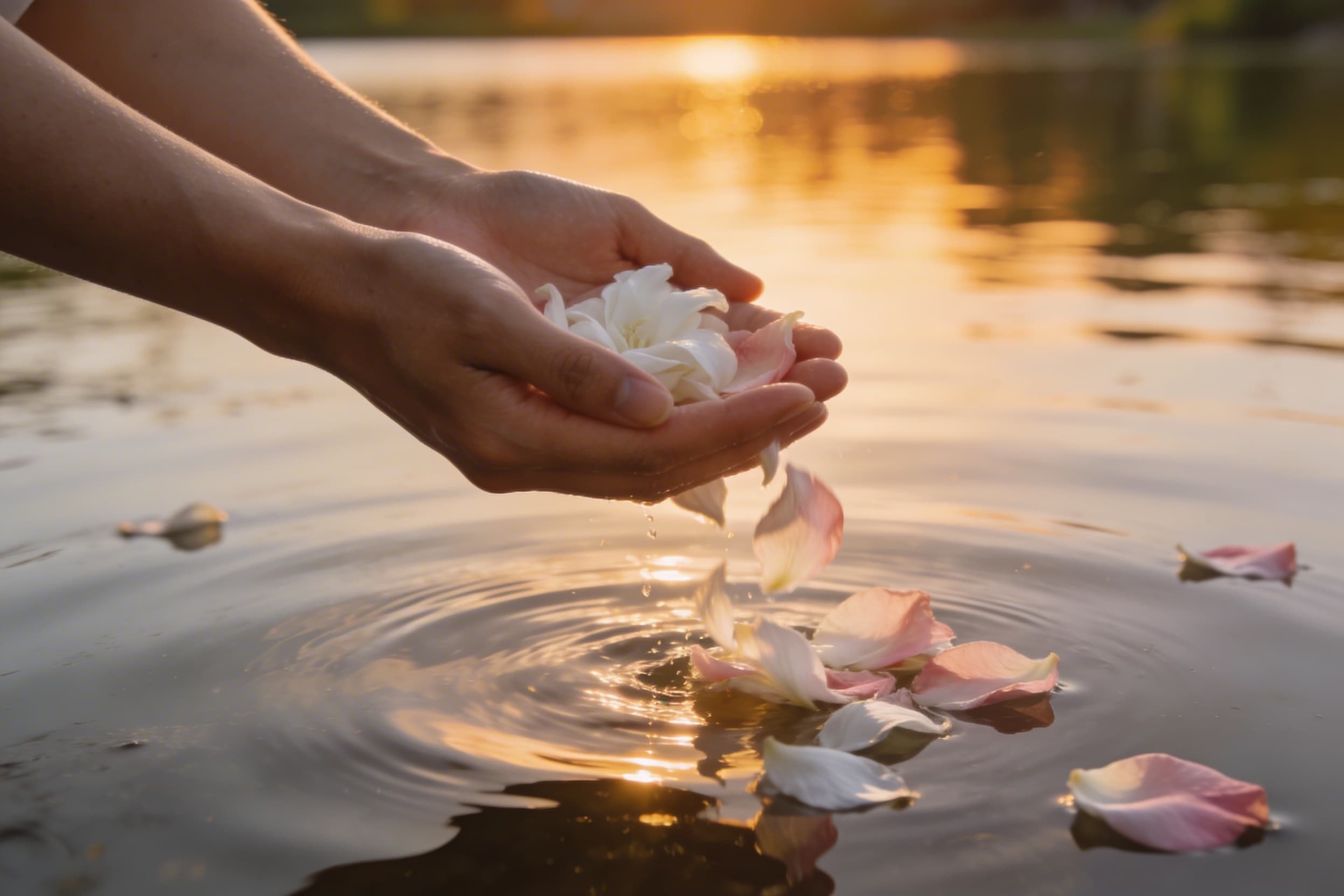
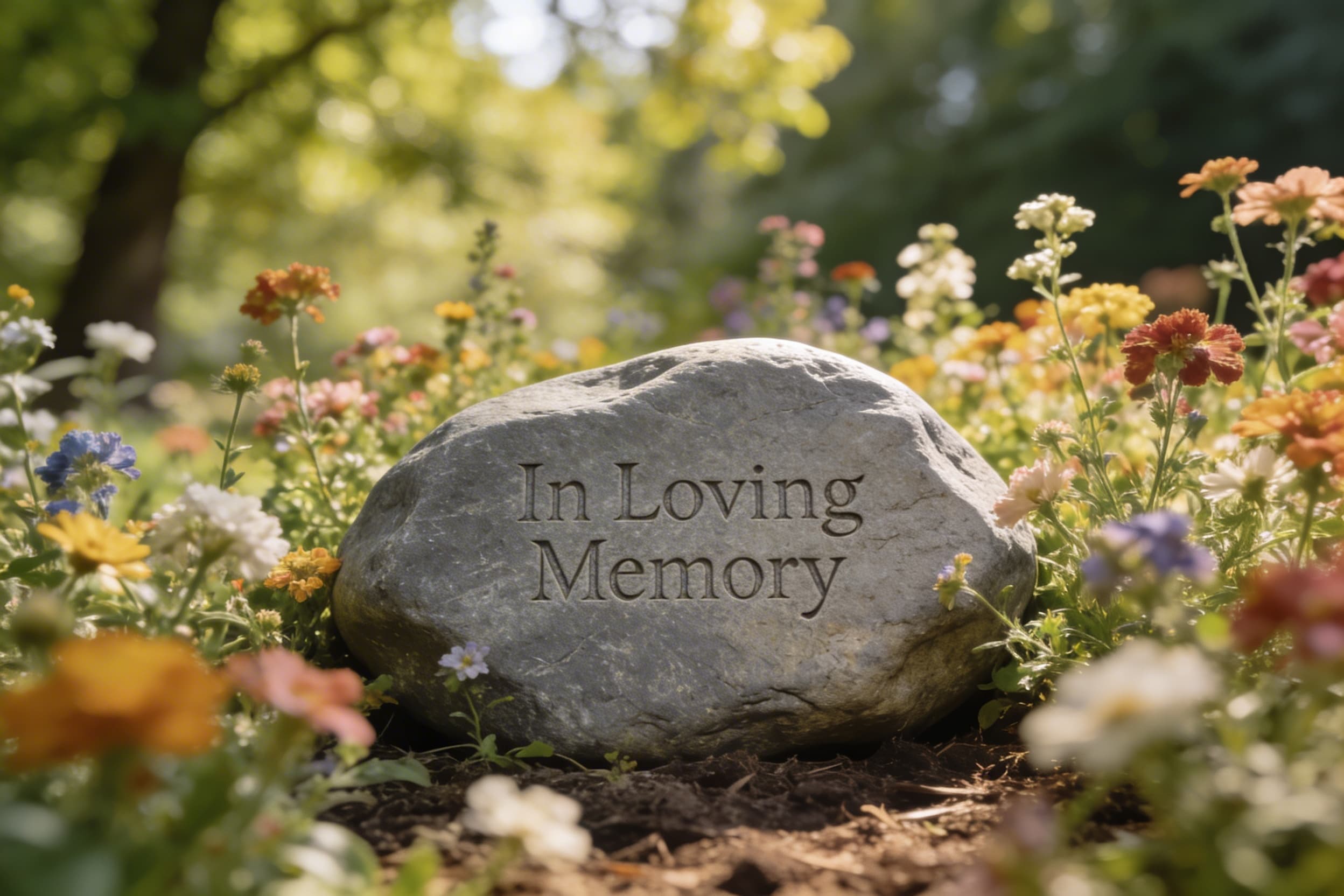
Scattering flower petals alongside the ashes — or tossing a small bouquet into the water — adds color and a sense of ceremony. For garden scatterings, some families plant a tree or flowering shrub at the site, creating a garden memorial that grows into a living tribute they can visit and tend over time. A memorial stone placed at the scattering site also gives friends and family a permanent marker to return to.
Keeping a Portion of Ashes
You do not have to scatter everything. Many families set aside a small portion of ashes before the ceremony to place in keepsake urns or cremation jewelry, giving each family member a tangible connection to carry with them. This is especially meaningful for families who are geographically spread out and may not be able to visit the scattering location again.
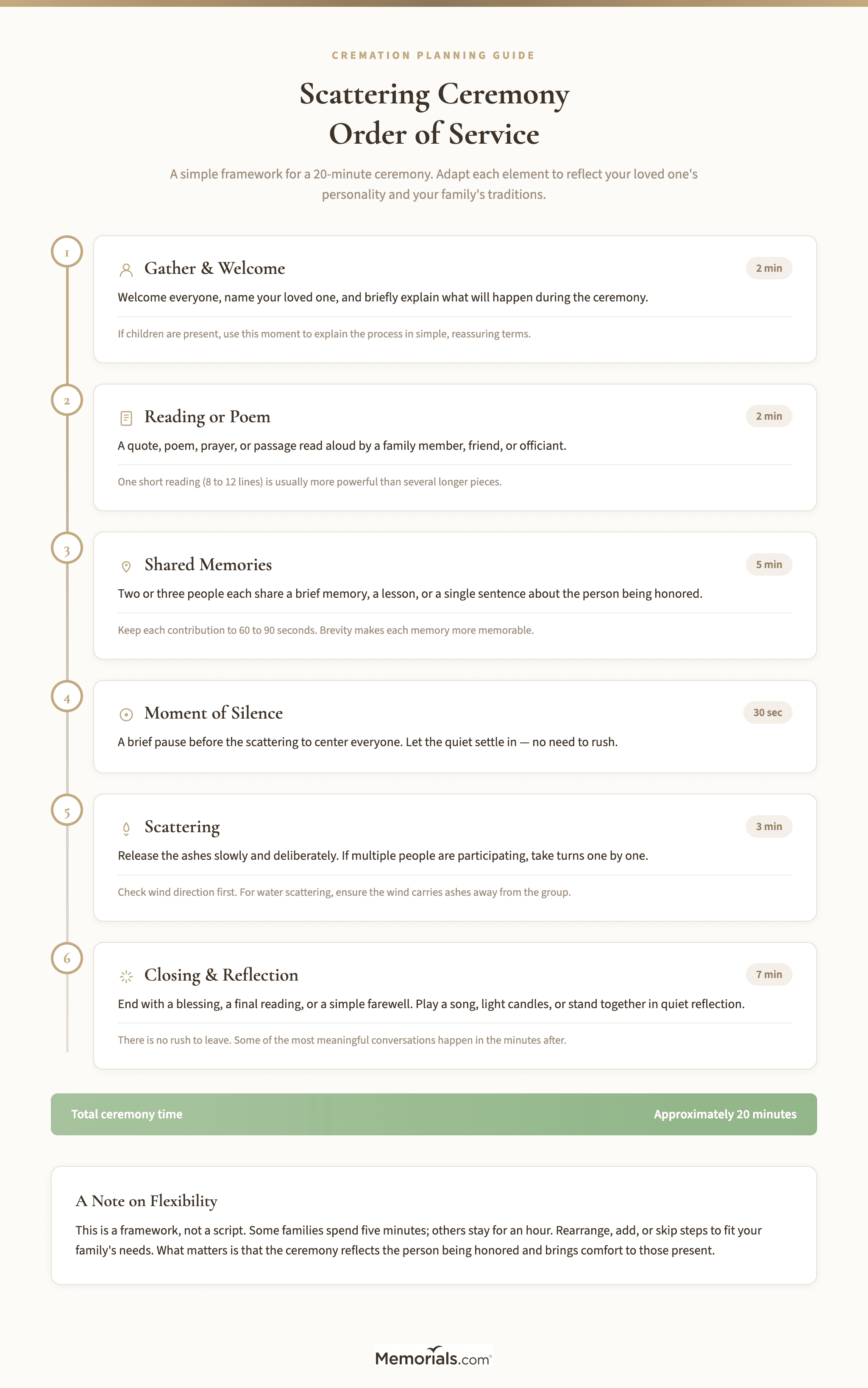
Sample Ceremony Outline
If you want a simple framework to follow, this outline covers the essentials for a 20-minute gathering:
1. Gather and welcome (2 minutes) — The leader welcomes everyone, names the person being honored, and briefly explains what will happen.
2. First reading (2 minutes) — A quote, a poem, or a passage read aloud by a family member or friend.
3. Shared memories (5 minutes) — Two to three people each share a brief memory or a single sentence about the person. Keep contributions to 60 to 90 seconds each.
4. Moment of silence (30 seconds) — A pause before the physical scattering to allow everyone to center themselves.
5. Scattering (3 minutes) — Release the ashes slowly. If multiple people are participating, take turns.
6. Closing words and blessing (2 minutes) — A final reading, a prayer, or a simple farewell. Examples: "May you find peace wherever the wind carries you" or "We release you with love and hold you in our hearts."
7. Music or quiet reflection (5 minutes) — Play a song, light candles, or stand together in silence before departing.
Frequently Asked Questions
Do you have to say something when scattering ashes?
No. There is no requirement to speak during a scattering ceremony. Some families choose to stand together in silence, and that is entirely appropriate. Silence can be its own form of tribute. If you would like words but cannot speak them yourself, ask someone else to read on your behalf, or play a recorded message or song instead.
What if I start crying and cannot finish?
This happens often, and no one will judge you for it. Pause, take a breath, and continue when you are ready — or hand your notes to someone nearby and let them finish. Tears are part of the ceremony, not an interruption to it. Writing your words down in advance ensures they can be read even if your voice is not cooperating.
Can children participate in a scattering ceremony?
Yes. Children can toss flower petals, say "I love you," hold a candle, or draw a picture to leave at the scattering site. Let them participate on their own terms without pressure. Explain what will happen beforehand in simple language so they feel prepared rather than surprised.
How long should a scattering ceremony last?
Most ceremonies last 15 to 30 minutes, with the spoken portion taking only 5 to 10 minutes. There is no minimum or maximum. Let the gathering last as long as it needs to, and do not rush the departure afterward — some of the most meaningful conversations happen in the quiet minutes after the ashes have been released.
Can each person say something different at the ceremony?
Absolutely. Many families invite everyone present to share a word, a memory, or a short message. This can be done aloud or written on slips of paper that are collected or scattered alongside the ashes. The variety of voices often makes the ceremony feel richer and more complete.
Finding the Right Words for Your Family
There is no script that fits every family, every loss, or every scattering location. The right words are the ones that feel true — whether they come from scripture, from a poet you admire, or from a sentence you wrote on the back of an envelope that morning.
What matters most is not the eloquence of what you say but the intention behind it. You are marking a moment of release, honoring a life, and giving everyone present permission to feel whatever they need to feel. A few honest words, a moment of silence, and the sound of wind or water carrying the ashes forward — that is enough.
If you have not yet chosen a container for the ceremony, Memorials.com offers a full selection of urns for ashes designed for every type of farewell, including biodegradable options for water and earth scattering.