🏬Supersize Online Funeral Retailer🪦1000's of Headstones⚱️Over 10,000 Cremation Urns⚰️Caskets Overnight Delivery🛒Funeral & Memorial Superstore🚚FREE Shipping on ALL Orders👨👩👧👦Helping Families for over 20 Years💰Lowest Price Guarantee🏬Supersize Online Funeral Retailer🪦1000's of Headstones⚱️Over 10,000 Cremation Urns⚰️Caskets Overnight Delivery🛒Funeral & Memorial Superstore🚚FREE Shipping on ALL Orders👨👩👧👦Helping Families for over 20 Years💰Lowest Price Guarantee
🏬Supersize Online Funeral Retailer🪦1000's of Headstones⚱️Over 10,000 Cremation Urns⚰️Caskets Overnight Delivery🛒Funeral & Memorial Superstore🚚FREE Shipping on ALL Orders👨👩👧👦Helping Families for over 20 Years💰Lowest Price Guarantee🏬Supersize Online Funeral Retailer🪦1000's of Headstones⚱️Over 10,000 Cremation Urns⚰️Caskets Overnight Delivery🛒Funeral & Memorial Superstore🚚FREE Shipping on ALL Orders👨👩👧👦Helping Families for over 20 Years💰Lowest Price Guarantee
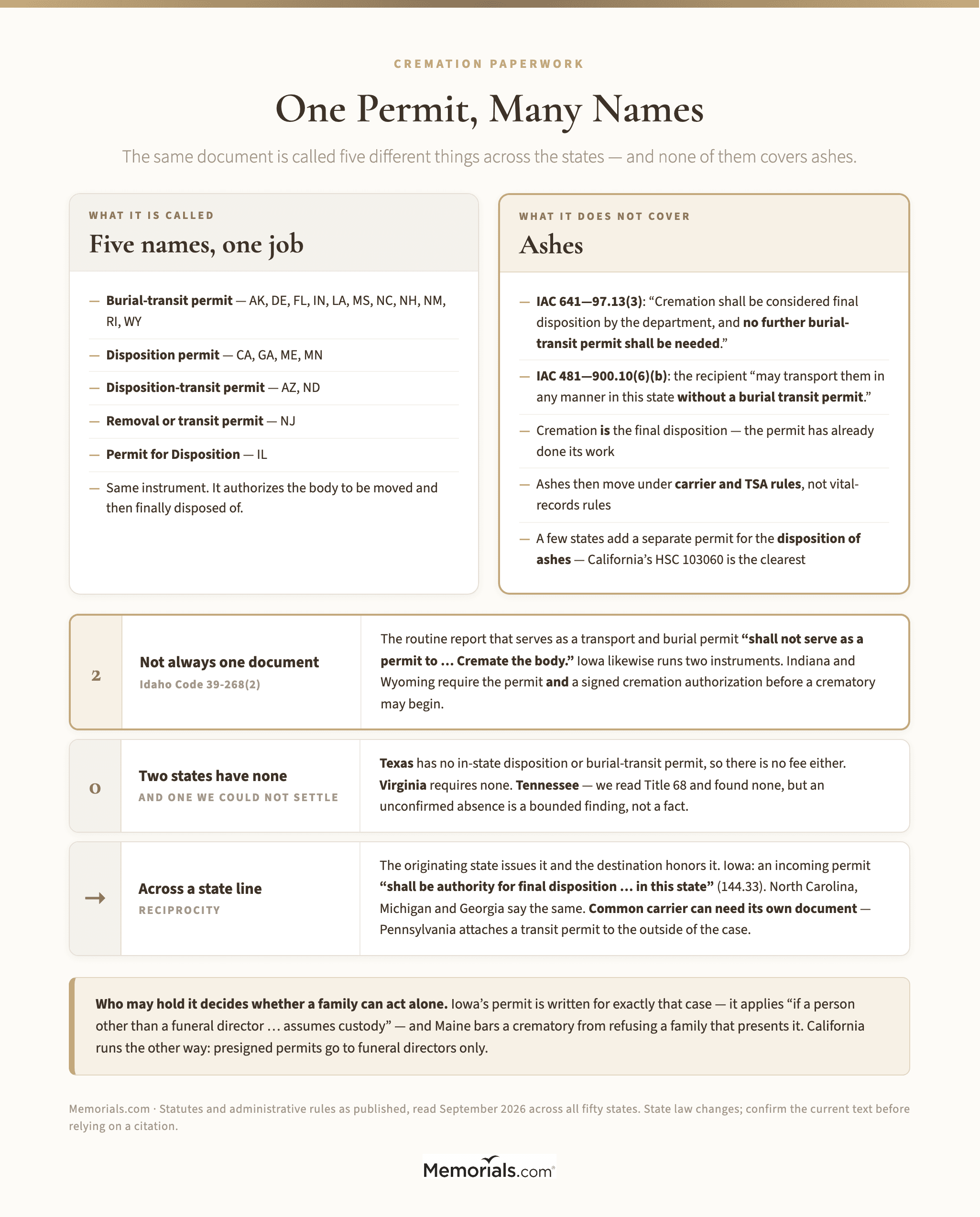
A burial transit permit is one document with at least five names, and most of the confusion around it comes from that alone. Depending on the state you are standing in it is called a burial-transit permit, a disposition permit, a disposition-transit permit, a removal or transit permit, or simply a permit for disposition. People reasonably conclude they need several. In almost every case they need one.
Two things make this worth getting right. The permit gates the cremation or burial itself in most states, so nothing happens until it exists. And it applies to a body, not to ashes — which is the single most useful sentence on this page, and the one most often got backwards.
We read the vital-records statutes and rules of every state for our cremation cost research. What follows is drawn from that, with the citation attached wherever the claim is a legal one. Our covers the wider process this sits inside.
It is the authorization from a vital-records office that lets a body be moved and then finally disposed of. Issued by a local registrar, a county medical examiner, a municipal clerk or the state registrar depending on the state, it travels with the body and is surrendered or endorsed at the end.
The name changes but the job does not. In North Carolina it is a burial-transit permit; in Maine and Minnesota a disposition permit; in Arizona and North Dakota a disposition-transit permit; in New Jersey a removal or transit permit; in Illinois a Permit for Disposition. What is a disposition permit, then, is the same question as what is a burial transit permit — different vocabulary, one instrument.
The gate is real. Under Minnesota Statutes 149A.93, subdivision 3, "A disposition permit is required before a body can be buried" or otherwise disposed of. Delaware requires one before any disposition under 16 Del. C. § 3151. Georgia's crematories cannot proceed without one under O.C.G.A. § 31-10-20. North Dakota's NDCC 23-06-07 says a body "may not be interred, deposited in a vault or tomb, cremated, donated to a school of medicine, or otherwise disposed" until the permit issues, and the subregistrar may not issue it if the death certificate is incomplete.
That last clause is the practical timing lesson. The permit is downstream of the death certificate. Where a cremation is slow, it is usually the medical certification holding up the permit rather than the permit itself.
The permit is issued by a vital-records office and is downstream of the death certificate. Where a cremation runs slow, that is usually what is waiting.
Do You Need a Permit to Transport Cremated Remains?
No. This is the distinction the whole subject turns on, and Iowa states it more plainly than most.
Under IAC 641—97.13(3), "Cremation shall be considered final disposition by the department, and no further burial-transit permit shall be needed." The companion rule at IAC 481—900.10(6)(b) says the recipient "may transport them in any manner in this state without a burial transit permit."
Once a body has been cremated, the permit has done its work. The ashes are not a body in the eyes of a vital-records statute, and they travel without one. That is why you can carry an urn home in a car, mail it, or fly with it without visiting a registrar — the rules that apply then are the carrier's and the TSA's, not the state's.
Two qualifications worth holding onto.
The paperwork still matters for shipping, just not this paperwork. The United States Postal Service is the only carrier that will accept cremated remains domestically, by Priority Mail Express, and it wants the container sealed and rigid with the death certificate and cremation permit enclosed. That is a carrier requirement rather than a permit, and it is why a rigid, screenable container matters more for the journey than the finish does — a biodegradable urn intended for a water release is a different object from the one you travel with.
A few states have their own instrument for ashes specifically. California is the clearest example: its separate cremated-remains permit under Health and Safety Code section 103060 attaches to the disposition of the ashes rather than the movement of a body, and carries a written acknowledgment that it conveys no right of access to property you do not own. Our guide to scattering ashes in California sets that out in full.
The Permit to Transport a Dead Body Is Not Always the Permit to Cremate
The second common mix-up. In some states one document does both jobs; in others there are two, and holding the first does not get you the second.
Idaho is explicit about it. Idaho Code § 39-268(2) provides that the routine report which serves as a transport and burial permit "shall not serve as a permit to … Cremate the body." A cremation there needs a separate coroner authorization that a burial does not.
Iowa likewise runs two instruments — the burial-transit permit at Iowa Code 144.32 and a cremation permit at Iowa Code 331.805(3)(b) — which is exactly why families there are told the two are "commonly confused". Indiana stacks the requirements instead: under IC 23-14-31-27(a) a crematory may not begin until it holds a signed cremation authorization, "a completed and executed burial transit permit provided by the local health officer to the funeral director indicating that the human remains are to be cremated", and a completed death certificate or a coroner's release.
Wyoming puts the same idea in two lines: under 035-6 Wyo. Code R. § 6-7(a) no crematory may accept remains "until it has received a burial-transit permit required by law and an authorization for cremation… signed by the nearest legal next of kin."
So a permit to transport dead body movements is not automatically clearance to cremate. Ask your provider which documents their crematory requires, in the plural.
Burial Permit Requirements: Who May Actually Hold It
Most burial permit requirements are administrative. This one is not, because it decides whether a family can act without hiring a funeral director.
The permit is often written as the family-custody instrument. Iowa Code 144.32(1) opens: "If a person other than a funeral director, medical examiner, or emergency medical service assumes custody of a dead body or fetus, the person shall secure a burial transit permit." Read that carefully and the consequence is the opposite of what directories usually say — when a funeral director has custody, which is the normal case, no separate permit step gates the family at all. The permit exists precisely for when nobody in the chain is licensed.
Iowa is worth one more note here, because that family-custody provision matters most where a family is arranging something a funeral home does not package. Iowa has no dedicated natural burial ground, so a natural burial there is negotiated with a conventional cemetery — our guide to green burial in Iowa covers what that takes and what the law already allows.
Several states put the same permission in their own words:
Maine. Under 22 M.R.S. §2843 the permit "may not be issued to anyone other than a funeral director until the state registrar or the clerk of the municipality receives a medical certificate signed by a physician or a medical examiner" — so a family member can obtain it, once the medical certificate is on file. Maine goes further at 32 M.R.S. §1405: where an authorized person presents the certificate, a certified copy and the burial transit permit, a crematory "may not refuse to cremate … solely because these documents are presented by such an authorized person."
New Hampshire. RSA 290:12 allows the transfer of a body to be directed by a funeral director, the next of kin, or a designated agent.
Rhode Island. § 23-3-18(a) lets "the funeral director, his or her duly authorized agent, or another person acting as a duly authorized agent, who first assumes custody" prepare the permit within seven days — although subsection (b) requires the permit to be signed by the funeral director, which may cut against it, and we have not resolved that tension.
New Mexico. § 24-14-23 requires the permit where someone other than a funeral home handles disposition.
And one state pulls the other way. In California the registrar "may issue blank presigned permits to the funeral director only", which is how a funeral home turns one around the same day and is not open to a family acting alone.
There is one limit that recurs and is worth knowing before you plan around any of this. Iowa Code 144.32(4) bars issuing the permit to a non-funeral-director where the cause of death is, or is suspected to be, a communicable disease.
The permit travels with the body and is surrendered or endorsed at the end. In most states it is the funeral director who holds it, but a number of states let a family member obtain it.
Two States Have No Permit at All
Worth stating plainly, because a page that implies every state requires one is wrong twice over.
Texas has no in-state disposition or burial-transit permit. We read the statutes looking for one and there is none, so there is also no fee.
Virginia requires no in-state disposition permit either.
Tennessee we could not resolve. We read Title 68 and found no burial-transit permit, but an absence we could not confirm is a bounded finding rather than a fact — treat Tennessee as unestablished and ask locally.
This is the general shape of American death paperwork: it is state law, it varies more than people expect, and the honest answer to almost any national question about it is "it depends which state, and here is how to find out".
The same instrument is called five different things across the states, two states have none, and none of them covers ashes.
Transporting a Body Across State Lines
The permit is also the document that makes an interstate transfer work, and the mechanism is reciprocity: the state you leave issues it, and the state you arrive in honors it.
Iowa sets it out from both directions. Under Iowa Code 144.32(2) the funeral director who first assumes custody must obtain a permit to transfer a body out of Iowa. Under 144.32(3) and 144.33, a body brought into Iowa must be accompanied by the originating state's permit, and that permit "shall be authority for final disposition … in this state."
North Carolina mirrors it. G.S. 130A-113 provides that a body may not be brought into the state without "a burial-transit or disposal permit issued under the law of the state in which death or disinterment occurred", and G.S. 90-210.129(c1) puts the same duty on the crematory, which "shall not cremate a dead human body without first obtaining a copy of the burial-transit or disposal permit issued under the law of the state, province, or foreign government in which death or disinterment occurred." Michigan honors an incoming out-of-state permit under MCL 333.2848(5), and Georgia honors a permit issued by another state.
Mississippi takes a simpler route: a certified copy of the death certificate can itself serve as the permit, and it must accompany a body moved out of state.
Shipping by common carrier can be a separate document again. Pennsylvania's 28 Pa. Code § 1.24 reads: "In addition to the burial permit, in all cases where dead human bodies are to be shipped by common carrier, or transferred while in shipment, a transit permit shall be securely attached to the outside case as authority for the shipment or transfer." Note the scope — that is an air or rail freight document, not a routine step for a local cremation. Alaska's permit is broader still, covering final disposition, movement within the state, shipment out of state, common-carrier transport, and holding a body beyond 72 hours after death.
None of this is a reason to avoid moving someone home. It is a reason to tell the funeral home at the first conversation that the disposition will happen in another state, because the permit has to be obtained with that in mind rather than corrected afterwards.
What "Disposition" Means on a Death Certificate
A related question that sends people to the same searches. The death certificate carries fields for the type of disposition and the place of disposition, and sometimes a disposition date.
They are descriptive, not another permit. Type of disposition records the method — burial, cremation, entombment, removal from state, donation. Place of disposition names the cemetery, crematory or other destination. The date records when it happened. Registrars use these fields to close the record, and they are the reason the permit is endorsed and returned: Maine's crematory must endorse and return the permit within seven days under § 2843(3), and California's holder returns the first copy within ten days.
If you are reading a certificate and the disposition fields look wrong, that is a correction request to the issuing registrar, not something the funeral home can amend later on your behalf.
What It Costs
Almost never a headline number, because the fee is usually local rather than statutory.
We looked for a published figure in every state we read and mostly did not find one. North Dakota sets no state fee in statute and leaves it to local practice. Neither North Carolina's statutes nor any state page we found publishes one. Maryland's regulation creates the requirement without a fee. Pennsylvania's rule names neither an issuer nor a fee. Massachusetts sets it locally, and we could not establish the amount.
Where a figure does surface, it surfaces on a funeral provider's own price list rather than in the code, and it is small. Maine price lists we read show the disposition permit at $5 to $25. A California price list carries the disposition permit at $12. Those are dated observations from published documents, not a national rate.
The practical guidance: treat the permit as a modest cash-advance item, ask whether it is inside or outside the quoted package, and do not accept a large number for it without asking what else is bundled in. The urn is the line you control: our metal urns for human ashes sit alongside the wider range of cremation urns, and buying one yourself is explicitly protected by the federal Funeral Rule. Our guide to cremation costs sets out how price lists separate the funeral home's own charges from pass-through items like this one.
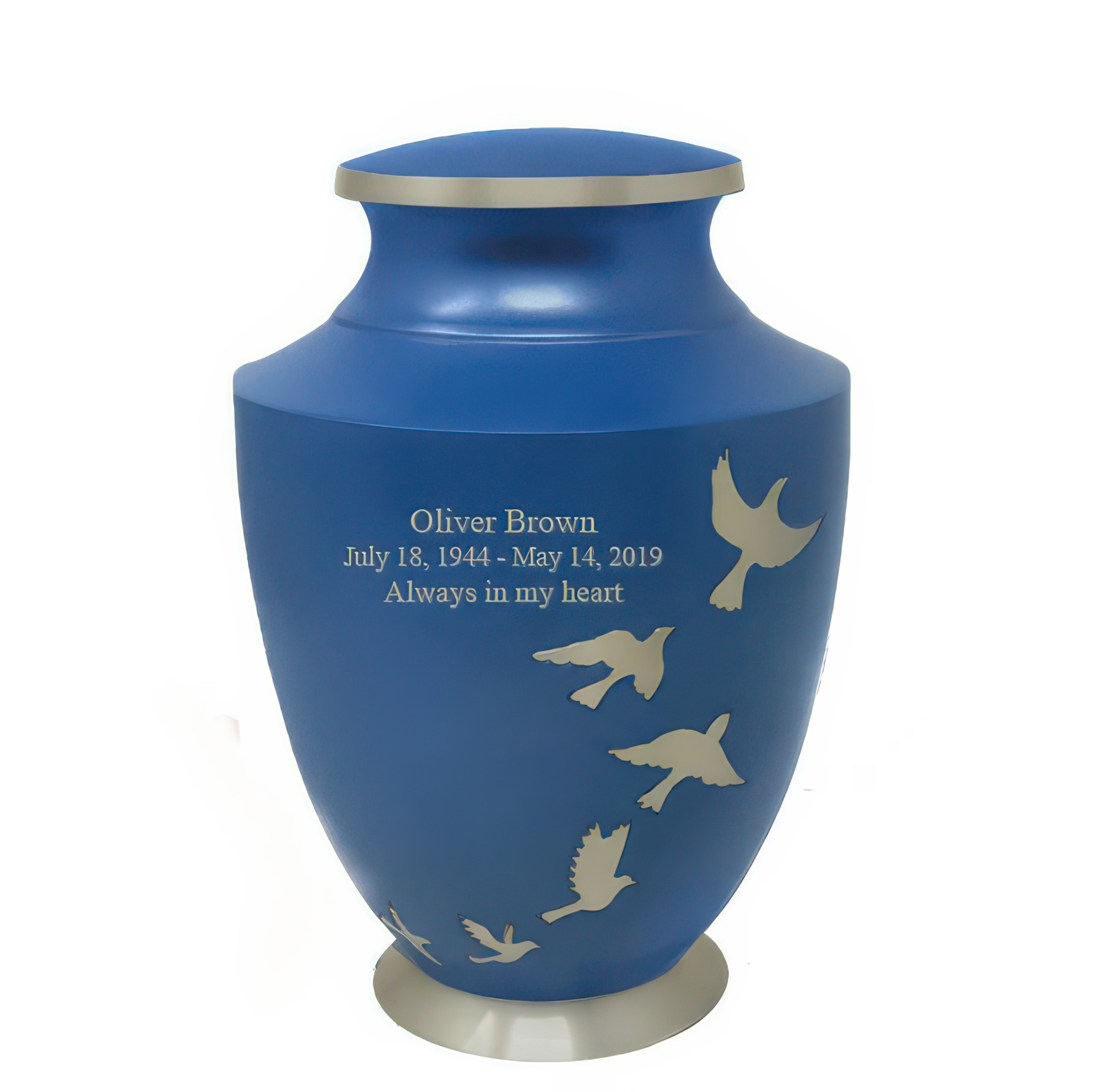
Once the permit has done its work and the cremation is complete, what comes back needs somewhere to go. A full-size adult urn holds the remains of one person. Products from left to right: Spartacus Cremation Urn, Eagle Cremation Urn and Pink Rose Cremation Urn.
Frequently Asked Questions
What is a burial transit permit in plain terms? The authorization from a vital-records office that lets a body be moved and then buried, cremated or otherwise disposed of. It is issued by a registrar, medical examiner or municipal clerk depending on the state, it travels with the body, and it is endorsed or surrendered at the end.
Do you need a permit to transport cremated remains? No. Cremation is itself the final disposition, and Iowa's rule says so directly: "no further burial-transit permit shall be needed." Ashes move under carrier and TSA rules rather than vital-records rules. A handful of states have a separate permit attached to the disposition of ashes, California's being the clearest.
Is a burial permit the same as a cremation permit? Not always. Idaho's transport and burial permit expressly "shall not serve as a permit to … Cremate the body." Iowa runs two instruments. Ask which documents the crematory needs, rather than assuming one covers everything.
Can a family get the permit without a funeral director? In a number of states, yes. Iowa's permit is written for exactly that case, Maine allows it once the medical certificate is filed and bars a crematory from refusing the family on that ground, and New Hampshire and Rhode Island name the next of kin or an authorized agent. California is the counter-example: presigned permits go to funeral directors only.
What paperwork do I need for transporting a body across state lines? The originating state's permit, which the destination state honors. Iowa, North Carolina, Michigan and Georgia all say so in their own statutes. Shipping by common carrier can require an additional transit document — Pennsylvania attaches one to the outside of the case.
How much does a burial transit permit cost? Usually a small local fee that is not set in statute. The published figures we found sit between $5 and $25, and they come from funeral providers' price lists rather than from any state schedule.
A Final Thought
The reason this document is confusing is not that it is complicated. It is that fifty states named the same thing differently, split it into two in some places, dispensed with it entirely in two others, and left the fee to counties.
For most families it resolves into one question worth asking at the first arrangement conversation: which permits does this cremation need, who is obtaining them, and are they inside the price? Everything above is the reason that question is worth asking in the plural.