🏬Supersize Online Funeral Retailer🪦1000's of Headstones⚱️Over 10,000 Cremation Urns⚰️Caskets Overnight Delivery🛒Funeral & Memorial Superstore🚚FREE Shipping on ALL Orders👨👩👧👦Helping Families for over 20 Years💰Lowest Price Guarantee🏬Supersize Online Funeral Retailer🪦1000's of Headstones⚱️Over 10,000 Cremation Urns⚰️Caskets Overnight Delivery🛒Funeral & Memorial Superstore🚚FREE Shipping on ALL Orders👨👩👧👦Helping Families for over 20 Years💰Lowest Price Guarantee
🏬Supersize Online Funeral Retailer🪦1000's of Headstones⚱️Over 10,000 Cremation Urns⚰️Caskets Overnight Delivery🛒Funeral & Memorial Superstore🚚FREE Shipping on ALL Orders👨👩👧👦Helping Families for over 20 Years💰Lowest Price Guarantee🏬Supersize Online Funeral Retailer🪦1000's of Headstones⚱️Over 10,000 Cremation Urns⚰️Caskets Overnight Delivery🛒Funeral & Memorial Superstore🚚FREE Shipping on ALL Orders👨👩👧👦Helping Families for over 20 Years💰Lowest Price Guarantee
One of the most practical questions families face after choosing cremation is straightforward: how much will the ashes weigh? The answer matters more than you might expect. Ash weight determines what size urn you need, whether a keepsake urn can hold a meaningful portion, and how much remains are available if your family plans to divide ashes among multiple memorial keepsakes. This cremation planning guide covers the full range of decisions families navigate — here, we focus specifically on the weight and volume of cremated remains and how those numbers connect to the choices ahead.
Understanding cremation ash weight also helps set expectations. Many families are surprised by what they receive from the crematory — sometimes by how much there is, sometimes by how little. Knowing the general range beforehand removes one layer of uncertainty during an already difficult time.
How Much Do Cremation Ashes Weigh?
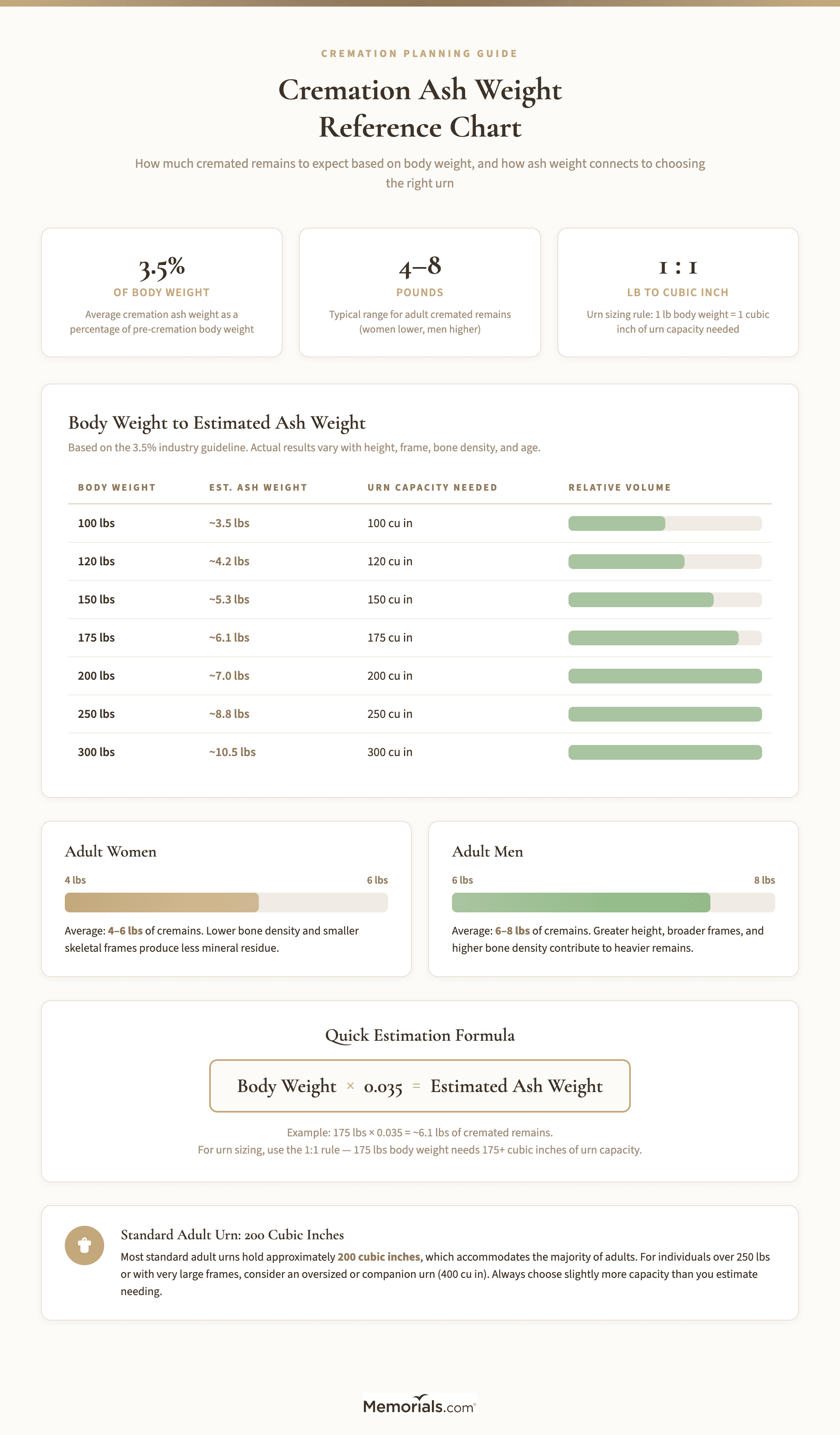
The average adult's cremated remains weigh between four and eight pounds. Women typically produce four to six pounds of cremains, while men average six to eight pounds. These numbers come from the bone fragments that survive the cremation process — all soft tissue, muscle, fat, and fluids are consumed by the heat of the cremation chamber.
The industry standard estimation is that cremated remains weigh approximately 3.5% of the person's original body weight. A person who weighed 150 pounds at the time of death would produce roughly 5.25 pounds of ashes. A 200-pound individual would yield about 7 pounds. These are averages, and individual results can fall above or below this range depending on several factors.
It is worth noting that the term "ashes" is somewhat misleading. What families receive are not ashes in the way you would think of fireplace ash. Cremated remains are processed bone fragments — ground to a coarse, sand-like consistency by a machine called a cremulator after the cremation cycle is complete. The material is primarily calcium phosphates and trace minerals, off-white to pale gray in color, with a texture closer to fine gravel than soft powder. For a deeper look at what cremains are composed of and how they are produced, our article on everything about human ashes covers the full picture.
What Affects Cremation Ash Weight?
Several factors influence how much cremated remains a person produces. Understanding these helps explain why ash weight varies from person to person, even among people of similar body weight.
Height and Skeletal Frame
Height is the single strongest predictor of ash weight. Taller individuals have larger bones — longer femurs, wider pelvises, broader ribcages — and larger bones produce more cremated remains. A person who stood 6'2" will almost always produce heavier ashes than someone who stood 5'2", regardless of their body weight at the time of death.
Skeletal frame size — small, medium, or large — also plays a role. Two people of the same height can have meaningfully different bone mass depending on their frame. Broad-shouldered, large-framed individuals carry more skeletal weight than narrow-framed individuals of the same height.
Bone Density
Bone density refers to the concentration of mineral content within the bones themselves. Denser bones produce heavier cremated remains. Several factors affect bone density over a lifetime. Younger adults and physically active individuals tend to have denser bones than elderly adults. Men generally maintain higher bone density than women, particularly after menopause when hormonal changes accelerate bone mineral loss. Conditions like osteoporosis significantly reduce bone density and can result in noticeably lighter cremains.
Body Weight vs. Bone Weight
This distinction trips up many families. A person's total body weight includes muscle, fat, organs, and fluids — none of which survive the cremation process. Only bone remains. This means a 250-pound person with average bone structure may produce a similar amount of cremains as a 180-pound person of the same height and frame, because the additional weight was soft tissue rather than bone.
The 3.5% rule works as a rough guideline precisely because body weight does loosely correlate with skeletal size — heavier people tend to be taller and broader. But it is an approximation, not an exact formula. For someone who was significantly overweight or underweight relative to their frame, the actual cremains may deviate from the estimate.
Age
Age affects ash weight primarily through its impact on bone density. Bones reach peak density in the mid-20s to early 30s and gradually lose mineral content over the following decades. A person cremated at age 40 will typically produce slightly heavier remains than someone of the same height and frame cremated at age 85.
Gender
Men produce heavier cremated remains than women on average — roughly six to eight pounds versus four to six pounds. This difference reflects the combined effects of larger skeletal frames, greater height on average, and typically higher bone density throughout life.
How to Estimate Cremation Ash Weight
The simplest method to estimate cremation ash weight uses the 3.5% rule. Multiply the person's body weight by 0.035 to get an approximate ash weight in pounds.
A few practical examples: a 120-pound woman would produce roughly 4.2 pounds of cremains. A 175-pound man would yield about 6.1 pounds. A 220-pound man would produce approximately 7.7 pounds. These estimates are close enough for practical purposes — choosing the right urn size, deciding whether to divide ashes into keepsake portions, or understanding what to expect from the crematory.
For a more precise estimate, consider the person's height and frame size alongside their weight. A tall, large-framed individual will produce more cremains than the 3.5% formula predicts, while a short, small-framed person will produce less. If precision matters — for instance, if you are purchasing an urn before receiving the remains — err on the side of choosing a slightly larger urn. Running short on capacity creates a problem; having a small amount of extra space does not.
Your crematory or funeral director can also provide a more specific estimate based on their experience. They handle cremations daily and can give you a realistic range based on the details of your loved one's build.
Cremation Ash Weight and Urn Sizing
Understanding ash weight is only half the equation. The other half is volume — and volume is what determines whether a specific cremation urn will hold your loved one's remains.
The funeral industry uses a standard guideline: for every pound of body weight before cremation, allow one cubic inch of urn capacity. A person who weighed 150 pounds would need an urn with at least 150 cubic inches of internal volume. Most standard adult urns hold approximately 200 cubic inches, which accommodates the majority of adults comfortably. For more detail on matching urn capacity to remains, our sizing guide explains what size urn you need based on body weight and build.
This one-cubic-inch-per-pound rule is deliberately generous. Cremated remains are denser than many people expect — with a density of approximately 0.75 grams per milliliter — so the actual volume of remains tends to fall slightly below the person's body weight in cubic inches. The overshoot gives families a comfortable margin.
When Standard Sizing Does Not Apply
There are situations where the standard urn size may not be sufficient. Very tall individuals — those over 6'3" — or those with unusually large frames may produce remains that exceed 200 cubic inches. In these cases, an oversized urn or a companion urn used for a single person provides the additional capacity needed.
On the other end of the spectrum, children and infants produce significantly fewer cremains. A child weighing 50 pounds might yield 50 cubic inches of remains or less. Infant cremains can be as little as a few tablespoons. Specialized infant and child urns are designed for these smaller volumes.
Dividing Ashes by Weight: Keepsakes and Sharing
Many families choose to divide cremated remains among several family members. This is one of the most common reasons people look up cremation ash weight — they want to know how much is available to share.
Because the average adult produces four to eight pounds of cremains, there is typically more than enough material to fill a primary urn and still set aside portions for multiple keepsake urns or cremation jewelry. A standard keepsake urn holds 1 to 15 cubic inches, and a cremation pendant requires less than a teaspoon. Even after filling a full-size urn, families can usually create several keepsakes without noticeably reducing the primary container's contents. How a memorial pendant is filled and sealed covers the actual operation — a funnel, a pinch of ash, and a threaded seal — and how the two compare at these capacities is the choice this section is really about.
If your family plans to divide ashes, consider these practical steps. Request a private cremation to ensure you receive only your loved one's remains. Ask the crematory for the total weight of the cremains before placing them in the urn. Measure or weigh the portions you plan to separate using a small kitchen scale — this keeps the process orderly and ensures each family member receives a fair share.
Dividing ashes is a personal decision, and it is one that families should discuss openly. If you want guidance on respectful ways to handle cremated ashes, that resource covers both the etiquette and the cultural considerations around ash disposition.
How the Cremation Process Produces Ashes
Understanding where cremation ash weight comes from starts with how the cremation process works. The body is placed in a cremation chamber — sometimes called a retort — and exposed to temperatures between 1,400 and 1,800 degrees Fahrenheit. Over a period of one to three hours, the intense heat reduces all organic matter through evaporation and combustion.
What survives are calcified bone fragments. These fragments are collected from the chamber after cooling, and any non-organic materials — surgical implants, dental work, prosthetics — are removed. The remaining bone fragments are placed into a cremulator, a mechanical processor that grinds them into the uniform, coarse consistency that families receive.
The entire weight of the cremated remains comes from bone mineral content. Fat contributes nothing. Muscle contributes nothing. Organs contribute nothing. This is why two people of very different body weights but similar skeletal size can produce nearly identical amounts of cremains. The cremation process strips everything except the skeleton's mineral residue.
Cremation Ash Weight for Children and Infants
Families who lose a child face unique challenges when it comes to cremation and memorialization. The weight of a child's cremated remains is proportionally less than an adult's — typically around 2.5% of their body weight, compared to the 3.5% average for adults. This lower percentage reflects the fact that children's bones are less dense and less mineralized than adult bones.
A child weighing 60 pounds might produce 1.5 pounds of cremains, or roughly 60 cubic inches of volume. An infant weighing 8 pounds could produce just a few ounces. These small quantities mean that choosing the right memorial vessel matters — a standard adult urn would be far too large. Small keepsake urns, infant-specific urns, and cremation jewelry designed for tiny amounts of ashes are the most appropriate choices for these families.
Cremation Weight for Pets
Pet cremation follows the same principles as human cremation, and the same general weight relationships apply. A pet's cremated remains will weigh approximately 3.5% of their body weight, and the one-cubic-inch-per-pound sizing rule holds.
A 10-pound cat produces roughly 10 cubic inches of cremains. A 70-pound Labrador yields about 70 cubic inches. Very small pets — hamsters, birds, small rabbits — may produce just a tablespoon or two of remains. The key difference is scale: pet urns are sized specifically for smaller volumes, and families should verify the urn's internal capacity before purchasing.
Frequently Asked Questions
How much do cremation ashes weigh for an average adult?
The average adult's cremated remains weigh between four and eight pounds. Women typically fall in the four-to-six-pound range, while men average six to eight pounds. The actual weight depends on the person's height, bone density, and skeletal frame size — not on their total body weight, since only bone material survives the cremation process.
How do you calculate cremation ash weight from body weight?
The standard estimate is to multiply the person's body weight by 0.035 (3.5%). A 180-pound person would produce approximately 6.3 pounds of cremated remains. This formula provides a useful approximation, though actual results can vary based on height, bone density, age, and gender. For urn sizing purposes, the industry guideline of one cubic inch of capacity per pound of body weight offers a safer margin.
Why are cremation ashes heavier than expected?
Many families expect cremated remains to be light and powdery — like fireplace ash. In reality, cremains are processed bone fragments with a density similar to coarse sand. The mineral composition of bone — primarily calcium phosphates — creates a material that is surprisingly dense for its volume. Five pounds of cremains occupies roughly the same space as a small bag of sugar.
Can I divide ashes among multiple family members?
Yes. Most adult cremations produce enough remains to fill a full-size urn and still set aside portions for several keepsake urns or cremation jewelry pieces. A keepsake urn typically holds 1 to 15 cubic inches, and a cremation pendant requires less than a teaspoon. Dividing ashes is a common practice and allows each family member to carry a personal connection to their loved one.
Does body fat affect how much ashes are produced?
No. Fat, muscle, organs, and fluids are all consumed during the cremation process. Only bone remains. Two people of the same height and skeletal frame will produce similar amounts of cremains regardless of differences in body fat. The 3.5% body weight guideline works as a rough estimate because heavier individuals tend to have proportionally larger skeletal structures, but the weight of the remains comes entirely from bone mineral content.
Knowing what to expect from cremation ash weight helps families make informed decisions — from choosing the right urn to planning how to honor and share their loved one's remains. If you are beginning to explore urn options, browse our full collection of urns for ashes to find the right size, material, and style for your family's needs.