🏬Supersize Online Funeral Retailer🪦1000's of Headstones⚱️Over 10,000 Cremation Urns⚰️Caskets Overnight Delivery🛒Funeral & Memorial Superstore🚚FREE Shipping on ALL Orders👨👩👧👦Helping Families for over 20 Years💰Lowest Price Guarantee🏬Supersize Online Funeral Retailer🪦1000's of Headstones⚱️Over 10,000 Cremation Urns⚰️Caskets Overnight Delivery🛒Funeral & Memorial Superstore🚚FREE Shipping on ALL Orders👨👩👧👦Helping Families for over 20 Years💰Lowest Price Guarantee
🏬Supersize Online Funeral Retailer🪦1000's of Headstones⚱️Over 10,000 Cremation Urns⚰️Caskets Overnight Delivery🛒Funeral & Memorial Superstore🚚FREE Shipping on ALL Orders👨👩👧👦Helping Families for over 20 Years💰Lowest Price Guarantee🏬Supersize Online Funeral Retailer🪦1000's of Headstones⚱️Over 10,000 Cremation Urns⚰️Caskets Overnight Delivery🛒Funeral & Memorial Superstore🚚FREE Shipping on ALL Orders👨👩👧👦Helping Families for over 20 Years💰Lowest Price Guarantee
A dead man's switch, in the sense this page is about, is a service that sends a message if you stop checking in. You confirm you are alive at intervals — a click on an email, a tap in an app — and if enough of those go unanswered, whatever you left is released to whoever you named.
The name comes from machinery: the lever on a train or a mower that stops the engine when the operator lets go. This page is not about that hardware. It is about the software version, sometimes searched for as a dead man's switch email, and it belongs in the estate affairs guide because people reach for it to solve a real problem — how to get information to a family who will need it.
It solves that problem partially, and it fails in ways worth knowing before you rely on one.
How They Work
The mechanism is simple and every service is a variation on it.
You write something — an email, a document, a set of instructions — and name recipients.
You set a check-in interval. Weekly, monthly, quarterly. The service emails you and you click a link.
If you miss one, it escalates. More reminders, usually to a secondary address, sometimes a text.
After a defined silence, it sends. Commonly measured in weeks after the first missed check-in.
Some add a human verification step, requiring a nominated person to confirm before anything is released. That step is the difference between a tool that is merely automated and one that is trustworthy, and it is worth choosing for.
The intervals matter more than they look. Too short and a two-week holiday without signal triggers it. Too long and your family waits three months for something they needed in week one. Monthly check-ins with a thirty-day silence window is a common compromise, and it still means a month's delay at exactly the wrong time.
You confirm you are alive; silence sends the message. The interval you pick is the delay your family inherits.
Where They Fail
Four failure modes, and the first is the one nobody plans for.
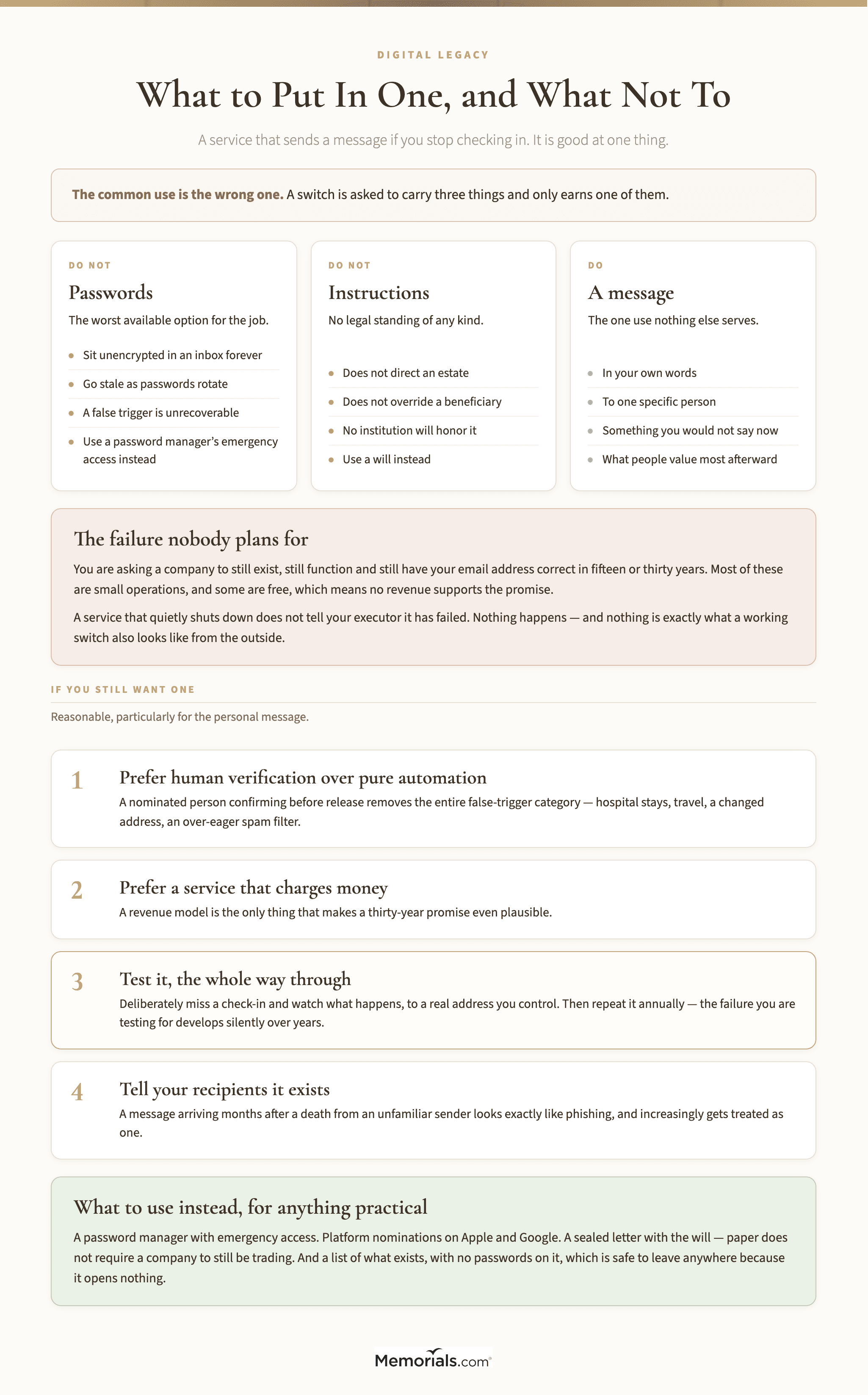
The service outlives you or it does not. You are asking a company to still exist, still function, and still have your email address correct in fifteen or thirty years. Most of these are small operations. Some are free, which means no revenue supports the promise. A service that quietly shuts down does not tell your executor it has failed — nothing happens, and nothing is exactly what a working switch also looks like from the outside.
False triggers. Hospital stays, travel, a changed email address, an over-eager spam filter. A message announcing your death, sent to your family while you are in a ward with no signal, is a real and documented outcome.
Email is a poor delivery mechanism for anything sensitive. It sits unencrypted on somebody's server, forever, and the recipient's inbox may itself be compromised years later.
Nobody knows to expect it. A message arriving from an unfamiliar sender, months after a death, referencing accounts and instructions, looks precisely like a phishing attempt — and increasingly gets treated as one.
What Not to Put in One
The common use is the wrong one, and this is the section worth reading twice.
Do not put passwords in a dead man's switch. People do this constantly and it is the worst available option for the job. The credentials sit in an email inbox indefinitely, they go stale as passwords rotate, and if the switch fires by accident they are simply gone to whoever received them. A deadman switch email holding a master password is a security incident waiting for a trigger.
Do not put it in place of a will. It has no legal standing whatsoever. Instructions in an email do not direct an estate, do not override a beneficiary designation, and will not be honored by any institution. What a properly executed will does, this does not do at all.
Do not use it for the things platforms already handle. Apple and Google both let you nominate somebody directly, and their mechanisms are more reliable than any third party because the platform itself enforces them — see Apple Legacy Contact.
Do use it for what it is good at: a personal message. Something you want said in your own words, to a specific person, that you would not say now. That is a use no other mechanism serves, and it is the one people find most valuable afterward.
Good for one thing. The common use is the wrong one, and it is the one most people choose.
What to Use Instead
For the practical problem — a family who needs to know what exists and where — there are better instruments, and they are boring on purpose.
A password manager with an emergency access feature. The major ones let you nominate a trusted contact who can request access, with a waiting period during which you can decline. Same idea as a dead man's switch, run by a company whose entire business is not losing credentials, with encryption throughout.
Platform nominations. Apple's Legacy Contact, Google's Inactive Account Manager, Facebook's legacy contact. Four minutes each, enforced by the platform.
A sealed letter with the will. Unglamorous and extremely reliable. Paper does not require a company to still be trading, does not misfire on a bad email address, and is found by exactly the person who is meant to find it.
A list of what exists, not how to get in. Which banks, which insurers, which brokerages — no passwords. That list is what actually saves a family months, and it is safe to leave anywhere reasonably secure because it opens nothing.
Tell one person. The single most effective step, and free. Somebody who knows where the documents are and what the shape of things is.
Paper does not require a company to still be trading in thirty years. The unglamorous option is the reliable one.
Too short an interval and a holiday triggers it. Too long and the family waits months for week-one information.
What to Actually Write
If the personal message is the use — and it is the one worth having — the writing is harder than the setup, and most people never get past the setup.
Write to one person, not to everybody. A message addressed to a group becomes a statement, and a statement is what a eulogy is for. Several short messages to individuals land differently and are what people keep.
Say the specific thing. Not that you loved them, which they know, but the particular memory, the thing you were proud of, the argument you regret. Generalities read as a form letter and are forgotten within the week.
Answer the question they will have. People are left with unfinished conversations, and a message that addresses the actual open question — why you made a decision, what you meant by something said years ago — does more than any amount of warmth.
Do not use it to settle scores. A message that cannot be replied to is not the place for a grievance, and the recipient carries it permanently with no way to respond.
Keep it short. Two hundred words read in that state is a great deal.
Then leave it alone. The instinct is to keep refining, and a message that exists imperfectly beats a perfect one still in drafts. Revisit it once a year and change what has genuinely changed.
If You Still Want One
Reasonable, particularly for the personal-message use. Choose carefully.
Prefer human verification over pure automation — a nominated person confirming before release removes the entire false-trigger category.
Prefer a service that charges money. A revenue model is the only thing that makes a thirty-year promise even plausible.
Test it. Deliberately miss a check-in and watch what happens — the whole way through, to a real recipient address you control, not just to the first reminder. An untested switch is an assumption, and this is a cheap assumption to verify. Repeat it annually, because the failure you are testing for is one that develops silently over years rather than one present on day one.
Tell your recipients it exists. This solves the phishing problem entirely — a message that was announced in advance reads as intended rather than as fraud.
Write for the recipient's state of mind. Whoever opens it will be reading it in the worst week of their life. Short, plain, and no unexplained references.
Review it annually. Email addresses change, relationships change, and a message written to somebody you have since fallen out with is a bad thing to send automatically.
Do not encrypt it in a way only you can undo. Several people have left encrypted archives whose key died with them, which is the same outcome as leaving nothing at all, reached more expensively.
The writing is harder than the setup, and most people never get past the setup.
The Recording Nobody Regrets
Adjacent to all of this, and worth saying because it comes up whenever families talk about what they wish they had.
Voices go first. People are consistently surprised by how quickly they lose the sound of somebody, and how much they want it back. Photographs survive in abundance; recordings almost never do.
A phone records adequately. Nothing needs to be produced. Ten minutes of somebody answering ordinary questions — where they grew up, how they met, what their mother was like — is worth more later than anything staged.
Ask while you can. This is a conversation with a living person, not a task for an estate, and the families who have one describe it as the single best thing they did.
Keep it somewhere real. A file in a cloud account nobody can reach is the same problem as everything else on this page. Copy it to a drive, give copies to two people, and it survives.
A voicemail greeting counts. If nothing else exists, call the number and record the outgoing message before the line closes — a point covered in what happens to a phone after a death, and one families name repeatedly as the thing they nearly missed.
Frequently Asked Questions
Is a dead man's switch legally binding? No. It carries no legal weight of any kind. Anything that needs to be enforceable belongs in a will, a trust or a beneficiary designation.
What if the service shuts down? Nothing happens, and nobody is told. This is why an annual check that it still exists is part of using one at all.
Could someone trigger it deliberately? By blocking your check-in emails, in principle. Verification by a nominated human closes this off, which is another argument for it.
Is it the same as a digital vault? No. A vault stores documents for access on request. A switch is time-based and fires on silence. Some services offer both and the distinction is worth confirming before you rely on either.
Can I use it for cryptocurrency keys? Technically yes, and it is a poor idea for the same reason as passwords — the keys sit in an inbox and a false trigger is unrecoverable. A hardware wallet with a seed phrase in a safe or a bank box, and somebody who knows it exists, is the sounder arrangement.
How many people actually use one? Very few, and fewer keep them working. The abandonment rate is the real story here — people set one up, miss check-ins, get annoyed by the reminders and let it lapse, at which point it either fires wrongly or sits dead. Anything that depends on your continued attention for thirty years is competing against your attention, and attention usually wins.
Would a lawyer hold a letter for me instead? Many will, alongside the will, and some charge nothing for it. It is slower than an email and immeasurably more reliable, and the person delivering it knows the family.
I received one of these and I think it is a scam. Reasonable suspicion. Verify through the family directly, and open nothing and click nothing until you have. This is the failure mode that makes announcing them in advance worthwhile.
In Closing
The mechanism works. The question is what you ask it to carry.
For a personal message in your own words, sent after you are gone, it does something nothing else does and does it well. For passwords, instructions or anything an institution has to act on, it is the wrong tool — and the right ones are a nominated contact, a password manager's emergency access, and a sealed envelope with the will.