🏬Supersize Online Funeral Retailer🪦1000's of Headstones⚱️Over 10,000 Cremation Urns⚰️Caskets Overnight Delivery🛒Funeral & Memorial Superstore🚚FREE Shipping on ALL Orders👨👩👧👦Helping Families for over 20 Years💰Lowest Price Guarantee🏬Supersize Online Funeral Retailer🪦1000's of Headstones⚱️Over 10,000 Cremation Urns⚰️Caskets Overnight Delivery🛒Funeral & Memorial Superstore🚚FREE Shipping on ALL Orders👨👩👧👦Helping Families for over 20 Years💰Lowest Price Guarantee
🏬Supersize Online Funeral Retailer🪦1000's of Headstones⚱️Over 10,000 Cremation Urns⚰️Caskets Overnight Delivery🛒Funeral & Memorial Superstore🚚FREE Shipping on ALL Orders👨👩👧👦Helping Families for over 20 Years💰Lowest Price Guarantee🏬Supersize Online Funeral Retailer🪦1000's of Headstones⚱️Over 10,000 Cremation Urns⚰️Caskets Overnight Delivery🛒Funeral & Memorial Superstore🚚FREE Shipping on ALL Orders👨👩👧👦Helping Families for over 20 Years💰Lowest Price Guarantee
An online trust and will service produces a real, legally valid document — provided it is signed and witnessed properly, and provided your situation is one it was built for. Both of those conditions do real work, and most of the trouble comes from the second one going unexamined.
This is also the only page in the estate affairs guide written for the person still living. Everything else here is for the family afterward, and the reason this one exists is that almost every difficulty described on those other pages traces back to a decision somebody either made or did not make while they could.
General information rather than legal advice. Requirements are set state by state, and an estate planning attorney is the right call for anything below that is not clearly simple.
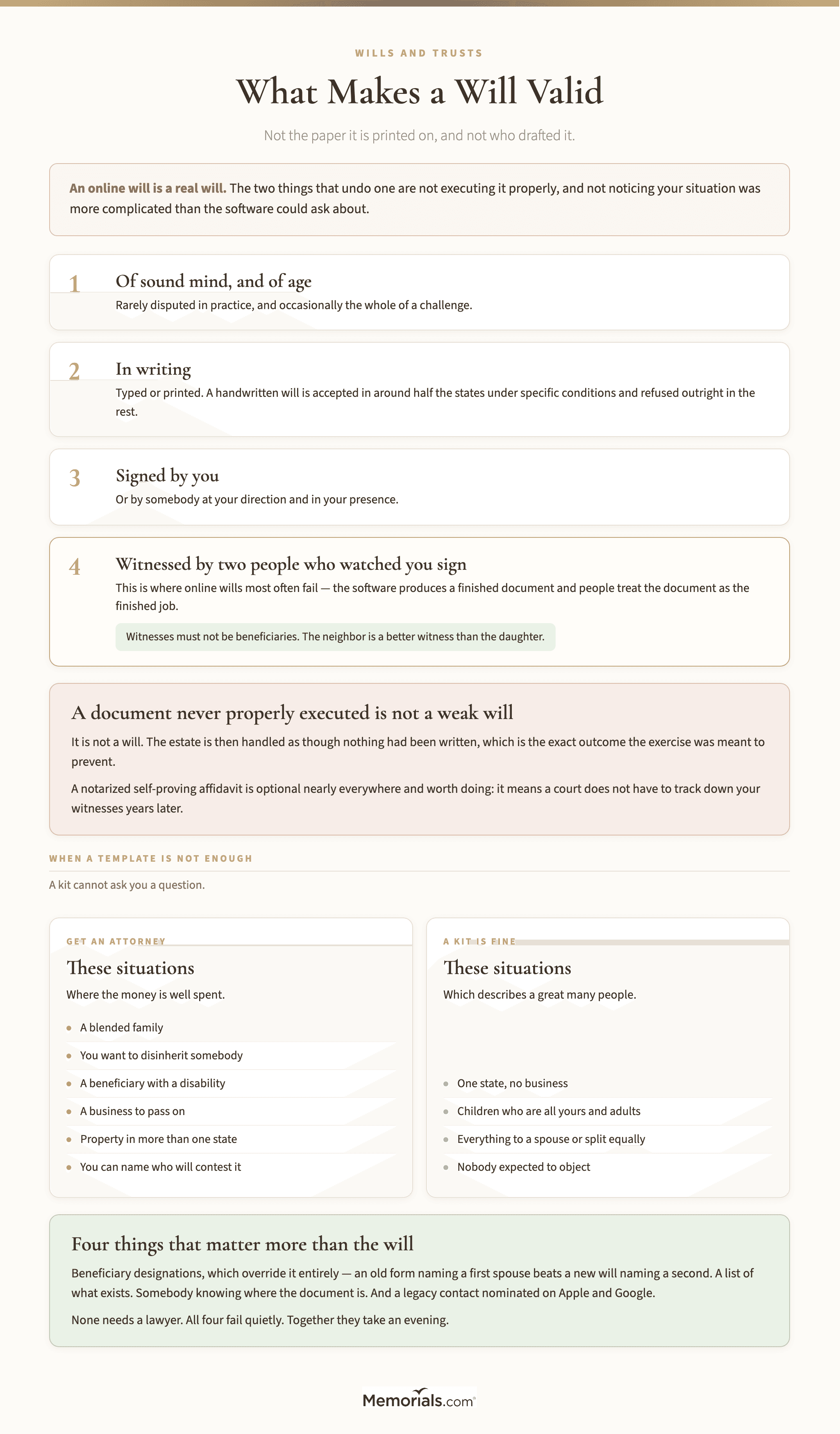
Not the paper it is printed on, and not who drafted it. Four things, broadly consistent across states:
You were of sound mind and of age, which in practice is rarely disputed and occasionally is.
It is in writing. Typed or printed. A handwritten will — a holographic will — is accepted in around half the states under specific conditions, and refused outright in the rest.
You signed it, or somebody signed at your direction and in your presence.
Witnesses watched you sign, usually two, and they signed too. This is where online wills most often fail, because the software gets you to a finished document and then people treat the finished document as the finished job.
Witnesses must not be beneficiaries. An interested witness can void their own inheritance in many states, and can void the will in a few. The neighbor is a better witness than the daughter.
Notarization is usually optional but valuable. A notarized self-proving affidavit means the court does not have to track down your witnesses years later. Cheap, quick, and it removes a genuine cause of delay.
A document that was never properly executed is not a weak will. It is not a will. The estate is then handled as though nothing had been written, which is the outcome the exercise was meant to prevent.
The software gets you a document. Two witnesses watching you sign is what turns it into a will.
The software produces a document. Two witnesses watching you sign is what makes it a will.
What a Will Kit Actually Is
So what is a will kit? A template — a fill-in-the-blanks document sold in a stationery store or downloaded, with instructions.
Where it works. A simple estate, a clear family, everything going to a spouse or split equally among children, no business and no property in another state. That describes a great many people, and for them a kit is entirely adequate.
Where it fails. The kit cannot ask you a question. It does not know you have a stepchild you intend to include, or a child you intend to exclude, or a house in a second state, or a disabled beneficiary whose inheritance could cost them their benefits. It produces exactly what you tell it and nothing warns you about what you did not think to mention.
The good online services sit in between. They ask a structured set of questions and branch, which catches more than a static template does — and they are still not a conversation with somebody who can notice what you have not said.
Cost is not the differentiator people assume. A kit is a few dollars, an online service is a few hundred, an attorney a few thousand. The relevant comparison is not against each other but against the cost of getting it wrong, which is measured in months of probate and occasionally in a family that stops speaking.
Doing a Will Without a Lawyer
Doing a will without a lawyer is legal everywhere and sensible in plenty of situations. The question worth asking is not whether you are allowed to but whether your situation is simple, and people are poor judges of their own complexity.
Simple usually means: married or single with no complicated history, children who are all yours and all adults, property in one state, no business, an estate under the federal estate tax threshold, and nobody you expect to contest it.
Get an attorney if any of these are true:
A blended family. Stepchildren, second marriages, children from different relationships. This is the single largest source of contested estates and templates handle it badly.
You want to disinherit somebody, particularly a spouse or a child. Doing this so that it survives a challenge is a specialist skill, and most states restrict what you can do to a spouse regardless.
A beneficiary with a disability. An outright inheritance can disqualify somebody from means-tested benefits. A special needs trust prevents that and no template will suggest one.
A business. Succession, valuation and buy-sell agreements are not template material.
Property in more than one state, which can mean probate in each of them.
A large estate, where tax planning is worth real money.
Any expectation of a challenge. If you can name the person likely to contest it, that is the money's best use.
Are Video Wills Legal?
Short answer: almost nowhere, and the question is asked often enough to deserve a direct one.
Are video wills legal as standalone documents — a recording of you saying what you want, with no signed paper? No, in essentially every state. The writing requirement is not decorative. A video is not a writing, and a will that exists only as a recording will not be admitted.
Is a video will valid in any form at all? Only as a supplement. A recording made alongside a properly executed written will can be genuinely useful:
As evidence of capacity. A video showing you lucid, unhurried and clearly understanding what you were signing is strong evidence against a later claim that you were not.
As explanation. Why one child received the house and another received the investments. A written will states outcomes; a recording can give reasons, and reasons defuse a great deal of resentment.
As something the family will want. Setting the legal question aside entirely, a recording of somebody explaining themselves in their own voice is worth a great deal to the people who receive it.
But record it carefully or not at all. A video that contradicts the written will hands a challenger their argument. Keep it consistent, keep it short, and do not use it to say anything you were not willing to put in the document.
Electronic wills are a separate thing and genuinely emerging — a growing number of states now permit properly executed electronic wills with remote witnessing. That is a real document with real formalities, not a video, and the rules differ enough by state that it is worth checking rather than assuming.
A recording is evidence of capacity, not a will. As a standalone document it is admitted essentially nowhere.
Wills Versus Trusts
The other half of what these services sell, and the distinction that most affects the family afterward.
A will directs what happens and goes through probate. It is a set of instructions the court supervises.
A living trust holds assets and avoids probate, because assets in a trust are not part of the probate estate. The successor trustee distributes them directly.
The advantages of a trust are real: no probate delay, privacy where probate is a public record, and a mechanism that already works if you become incapacitated rather than only when you die.
And the drawbacks are real too. A trust costs more up front, and — this is the part that defeats people — it only works for assets actually transferred into it. An unfunded trust is an expensive document that does nothing, and it is a common and entirely avoidable failure.
Most people with a trust still need a will. A pour-over will catches anything not transferred in, and it is where guardians for minor children are named, which a trust cannot do.
Whether you need one at all depends heavily on your state. Where probate is slow and expensive, a trust saves the family months. Where the small estate threshold is generous, a straightforward will and a small estate affidavit may achieve the same thing for far less.
How to Write a Will in California
The most-asked state version, and California is a useful example because it is stricter than average in one respect and unusually permissive in another.
Knowing how to write a will in California means, at minimum: eighteen or older, of sound mind, in writing, signed by you, and witnessed by two people who watched you sign and who are not beneficiaries.
California accepts holographic wills, which is the permissive part — a will entirely in your own handwriting and signed can be valid with no witnesses at all. It is a genuine safety net and a poor plan, because handwriting invites challenge and ambiguity.
California is a community property state, which is the strict part. A surviving spouse already owns half of most property acquired during the marriage, and a will can only give away the other half. This trips up people who assume they can leave everything to a child.
Probate in California is slow and the fees are set by statute as a percentage of the gross estate — not the net — which is why living trusts are more common there than in most states. A house with a large mortgage is valued at the house price for fee purposes.
An unfunded trust is an expensive document that does nothing. Moving the assets in is the part people skip.
The Four Things That Matter More Than the Will
Measured against what actually causes difficulty for families, the will is not the top of the list. These are, and all four take an evening.
Beneficiary designations. Retirement accounts, life insurance, transfer-on-death brokerage accounts. These pass outside the will entirely and they override it, so an old form naming a first spouse beats a new will naming a second one. Reviewing them is the highest-value hour in estate planning and almost nobody does it.
A list of what exists. Not passwords — just a list. Which banks, which brokerages, which insurers, whether there is a safe deposit box and where the key is. Families spend months reconstructing this from the mail because it was never written down.
Somebody knowing where the document is. A perfectly drafted will nobody can find does nothing. Tell the executor, and tell one other person.
The digital nominations. Four minutes each on Apple and Google, and they are the difference between a family getting the photographs in a week or needing a court order.
And one question the will is opened too late to answer. Whether to authorize an examination is decided in the first day or two, before anybody has read anything, and the answer to how much does an autopsy cost is $3,000 to $7,000 for a private examination — a decision made by a family who cannot yet reach the estate's money. A line about it beside the funeral wishes costs nothing to write and settles an argument nobody wants to have.
None of these needs a lawyer, and all of them fail quietly. The will gets attention because it feels like the serious document. These four are what determine whether the months after are manageable.
Frequently Asked Questions
Will an online will hold up in court? Yes, if properly executed, and this is settled. Challenges succeed on capacity, undue influence or faulty execution — not on who drafted the document.
Do I need to update it? After any marriage, divorce, birth, death, house move to another state, or significant change in assets. Divorce in particular: many states revoke gifts to an ex-spouse automatically, but not all, and not for beneficiary designations.
Where should I keep it? Somewhere the executor can actually reach. A safe deposit box that gets sealed on death is a genuine problem — tell someone where it is, and consider lodging the original with the probate court where your state allows it.
Does a will cover my retirement account? No. Beneficiary designations override the will entirely, and reviewing them is often more important than the will itself. Same for digital accounts, which follow terms of service rather than any document.
My spouse and I want one document. Joint wills are generally a bad idea and hard to unwind. Two mirror wills achieve the same thing and stay flexible.
What happens if I die without one? Your state decides, by a fixed order of relatives — see next of kin hierarchy. It rarely matches what anybody would have chosen, and it never accounts for a friend, a partner you never married, or a charity.
A perfectly drafted will nobody can find does nothing. Tell the executor, and tell one other person.
In Closing
An online will is a real will. The two things that undo it are not signing it properly and not noticing that your situation was more complicated than the software could ask about.
And whatever you use, do the other four things while you are there: name beneficiaries on every account, nominate a legacy contact on your Apple and Google accounts, tell somebody where the document is, and leave a list of what exists. Those take an evening between them, and they save more difficulty than the will does.