🏬Supersize Online Funeral Retailer🪦1000's of Headstones⚱️Over 10,000 Cremation Urns⚰️Caskets Overnight Delivery🛒Funeral & Memorial Superstore🚚FREE Shipping on ALL Orders👨👩👧👦Helping Families for over 20 Years💰Lowest Price Guarantee🏬Supersize Online Funeral Retailer🪦1000's of Headstones⚱️Over 10,000 Cremation Urns⚰️Caskets Overnight Delivery🛒Funeral & Memorial Superstore🚚FREE Shipping on ALL Orders👨👩👧👦Helping Families for over 20 Years💰Lowest Price Guarantee
🏬Supersize Online Funeral Retailer🪦1000's of Headstones⚱️Over 10,000 Cremation Urns⚰️Caskets Overnight Delivery🛒Funeral & Memorial Superstore🚚FREE Shipping on ALL Orders👨👩👧👦Helping Families for over 20 Years💰Lowest Price Guarantee🏬Supersize Online Funeral Retailer🪦1000's of Headstones⚱️Over 10,000 Cremation Urns⚰️Caskets Overnight Delivery🛒Funeral & Memorial Superstore🚚FREE Shipping on ALL Orders👨👩👧👦Helping Families for over 20 Years💰Lowest Price Guarantee
The practical answer to what happens to someone's phone when they die is that it becomes two separate problems wearing one shape: the line, which is a contract somebody is paying for, and the device, which is a locked box holding things the family may need.
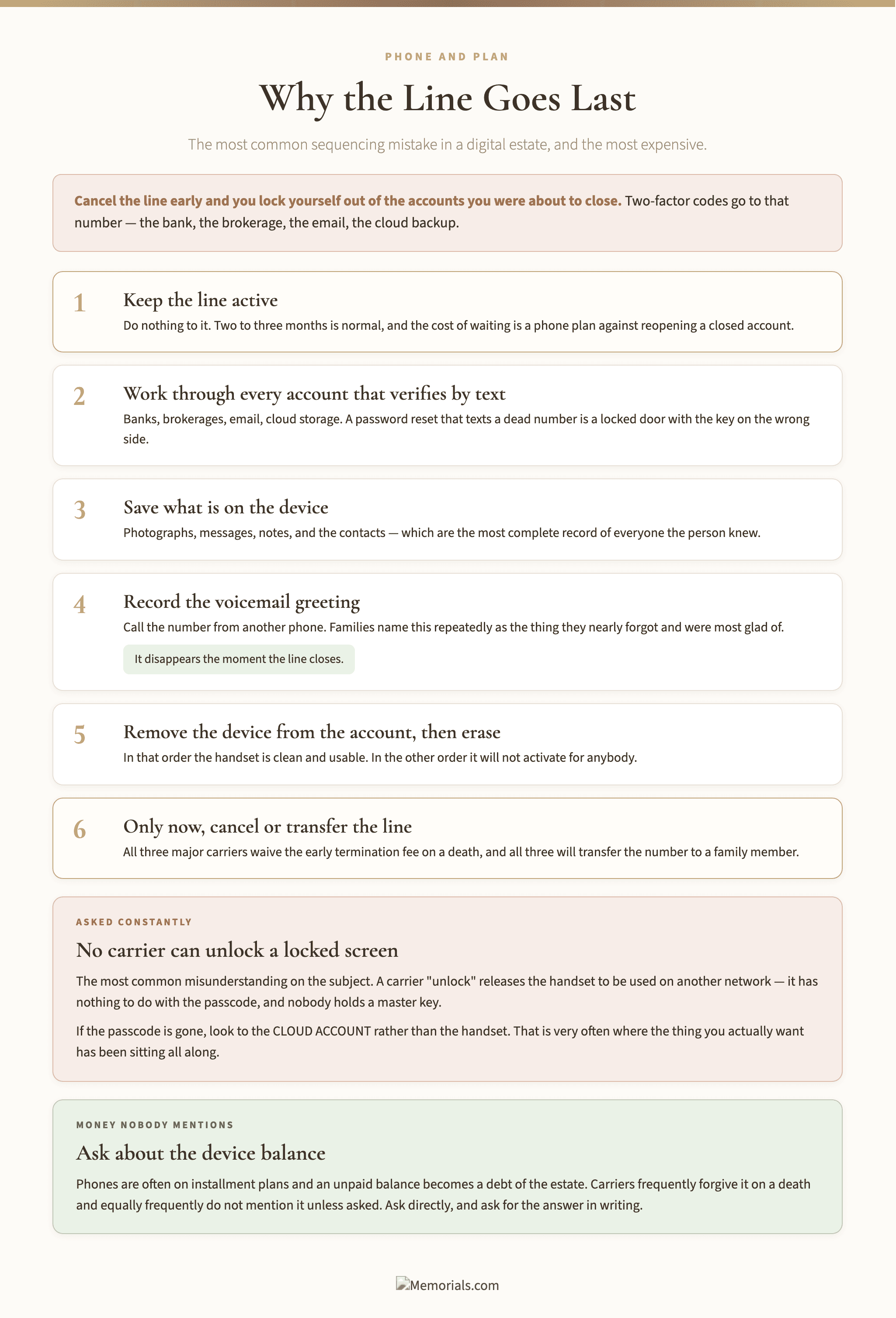
They pull in opposite directions. The instinct is to cancel the line quickly to stop the bill. The right move is almost always to keep it running for several weeks, because that number is what verifies access to the bank, the email and the cloud account.
Cancel it early and you lock yourself out of the accounts you were about to close. It is the most common sequencing mistake in a digital estate, and it is covered here rather than in the broader digital accounts directory because it deserves its own warning. The rest of the paperwork sits in the .
Two-factor codes go to that number. The bank, the brokerage, the email account, the cloud backup — most of them will text a verification code to a phone that is about to be disconnected. Once the line is gone, so is the route. The estate departments are the exception worth knowing about — Bank of America estate services and its equivalents work from documents rather than from a text message, so those accounts stay reachable after the number stops working. Everything self-service stops with the line.
Some of those accounts cannot be recovered any other way. A password reset that texts a dead number is a locked door with the key on the wrong side. A dead man's switch is the arrangement that prevents this outright, and like every other useful thing here it only works if it was set up beforehand.
The cost of waiting is small. A month or two of a phone plan against reopening a closed account is not a close comparison.
Port the number if it matters. Where somebody wants to keep the number — a spouse who has had the same one for thirty years, or a business line — carriers will transfer it to another account holder. This has to happen before the line is canceled; a released number cannot be recovered and may be reissued to a stranger within weeks.
So the order is: keep the line, work through every account that needs verification, save what you want off the device, and only then deal with the plan. Everything else on this page assumes you have done it in that order.
The line is a key, not just a bill. Cancel it early and it locks the accounts it verifies.
Canceling the Line
Working out how to cancel a cell phone when someone dies is easier than most of an estate. Every major carrier has a bereavement process, and all three of them waive the early termination fee. It is worth knowing where it sits in the stack, though — how many death certificates do I need sets out which institutions keep the certified copy and which hand it back, and a carrier is one worth asking.
What they want. A certified copy of the death certificate, your own ID, and usually evidence you are the executor or next of kin. Some accept a photocopy for a simple cancellation and want a certified copy for anything involving a balance or a device credit. Where nobody has been appointed executor yet — which is most of the first month — the carrier works down the next of kin hierarchy, the same order that decides the funeral.
Verizon. The Verizon death policy covers both cancellation and transfer. A Verizon wireless death of account holder report is handled by their care team rather than a store, though a store can start it. If you want to cancel Verizon for a deceased person outright, that is one call. If you want to keep the number, ask about assuming liability instead. Working out how to change name on Verizon account after death is a transfer of service rather than a cancellation, and the two go down different paths from the first question they ask you.
AT&T and T-Mobile run equivalent processes. Both waive termination fees on a death, and both can transfer a number to a family member.
Ask about the device balance. Phones are often on installment plans, and an unpaid balance becomes a debt of the estate. Carriers frequently forgive the remaining balance on a death, and equally frequently do not mention it unless asked. Ask directly and ask for the answer in writing.
Verizon cancel service due to death and a normal cancellation are different requests with different outcomes, which is why it is worth using the word "bereavement" on the first call. The general queue applies fees the bereavement team waives.
The line is a key, not just a bill. It is the last thing to cancel, not the first.
Whether the Phone Itself Can Be Opened
This is the harder half, and the honest answer is that it depends almost entirely on whether you know the passcode.
With the passcode, the phone is simply a phone. Open it, save what you want — photographs first, then messages, then anything in notes — and take your time. This is the route most families use and it is worth doing before anything else, because every other option is worse.
Without the passcode, the picture is bleak. If someone dies can you unlock their phone android is asked constantly and the answer is: not by guessing, and not by asking the manufacturer. Modern phones encrypt storage with a key derived from the passcode, which means nobody holds a master key — not Google, not Apple, not the manufacturer, and not the carrier.
Can Verizon unlock a deceased person's phone? No, and this is the most common misunderstanding on the whole subject. A carrier "unlock" means releasing the handset to be used on another network. It has nothing to do with the screen lock, and no carrier can open a locked phone for anybody.
Do not keep guessing. Android and iPhone both escalate delays after failed attempts, and both can be configured to erase the device entirely. More than one family has destroyed the only copy of something irreplaceable this way.
What sometimes works. A cloud backup you can reach with the account credentials rather than the device — Apple's legacy contact or Google's account recovery. A computer the phone previously synced to. A phone that is still unlocked from before, which is why nobody should let the battery run flat before the family has finished.
Commercial forensic services exist, are expensive, and their success against a current phone with a strong passcode is limited. Treat any service promising guaranteed access with suspicion.
No carrier can open a locked screen. Their "unlock" releases the handset to another network — a different thing entirely.
Before You Erase Anything
Two separate traps, and both are easy to walk into in the week when somebody is trying to be helpful.
Activation Lock and Factory Reset Protection. Both iPhone and Android tie a device to the account that set it up. Erase the phone without first removing it from that account and it will not activate for anybody — it cannot be sold, donated or given to a grandchild. It becomes a paperweight.
So the order is: remove the device from the account, then erase. In that order it is clean and usable. In the other order it is scrap, and reversing it needs proof of purchase most families do not have.
Messages may exist only on the device. If the person did not have cloud message sync switched on, their message history lives in exactly one place. Erasing the phone erases the only copy.
Do not trade it in yet. Carriers offer trade-in credit against the outstanding balance and it is a reasonable offer, but not until everything is off the device and the account link is removed.
Remove the device from the account, then erase. In the other order it will not activate for anybody.
What to Do With the Handset
Once everything is off it and the account link is removed, there are four reasonable ends and one bad one.
Give it to a family member. The commonest, and it is why removing the account link matters — a phone still tied to a dead person's account is unusable no matter who has it.
Trade it in. Carriers and manufacturers both offer credit, often against an outstanding installment balance, which can clear a debt of the estate outright.
Donate it. Several charities refurbish phones for domestic violence services and for older people, and a three-year-old handset is genuinely useful to them. Wipe it properly first.
Recycle it. Carrier stores take handsets back regardless of condition. A phone in a drawer is a battery slowly degrading.
The bad one is leaving it in a drawer indefinitely, which is what usually happens. There is no harm in it beyond the battery, and families should not feel pressed — but it is worth deciding rather than defaulting, because a drawer phone is a small unfinished thing that gets rediscovered at bad moments.
Keep the SIM card if you are unsure. It is small, it holds contacts on older phones, and it costs nothing to put in an envelope.
The Number Afterward
Worth thinking about, because it catches families twice.
A released number gets reissued. Carriers return disconnected numbers to the pool, often within a few months. Somebody else will be answering it, and old contacts will reach a stranger — occasionally with a message meant for someone who has died.
Keeping the number costs about the price of the cheapest plan. Families sometimes keep a line active for a year on a prepaid plan so that old contacts, medical offices and long-lost friends reach a family member rather than a stranger. It is not a common choice and the people who make it rarely regret it.
Or transfer it to a family member's account as an additional line, which is cheaper still and keeps it permanently.
If you do release it, expect calls for a while beforehand. A short outgoing voicemail message is kinder than a disconnection tone for people who have not heard.
The Contacts, and Who Still Needs Telling
The phone is also an address book, and it is usually the most complete one that exists.
Nobody has a list of everyone somebody knew. Not the family, not the workplace. The contacts on a phone are the closest thing, and they are how families find the people who would want to know but were not close enough to be called in the first week — an old colleague, a friend from years ago, a cousin.
Institutions are a separate list, and none of them is in the phone. The urgent one is the credit bureaus: an Experian death notification is what stops the identity being used, and no contact list will ever remind you to send it.
Export the contacts before the device is reset, not just the photographs. It is a single file and it takes a minute.
Then decide who is telling whom. Working through a contact list is not a job for one person, and it is not a job for the week of the funeral. Splitting it among several family members, a few names each, is how it actually gets done.
Recent calls and messages are a different kind of record. They show who the person was talking to at the end, which occasionally identifies a friend or a carer nobody in the family had met. Families sometimes find this the hardest thing on the phone and sometimes the most valuable.
The voicemail box may be holding messages that arrived after the death, including from people who have not heard. Check it before the line closes.
Frequently Asked Questions
How long should I keep the line running? Until every account that might text a code has been dealt with. In practice, two to three months.
Is the phone bill a debt of the estate? Yes, along with any device installment balance — though carriers commonly forgive the device balance on a death if you ask. Keep the final bill and the cancellation confirmation afterward, on the rules in how long to keep utility bills after death: routine statements can go after a year, a closure confirmation is worth keeping permanently.
They had a prepaid phone. Simpler. Stop topping it up and it lapses. Save anything off the device first, because there is no account to recover from.
The phone is locked and the photographs are the only reason I care. Try the cloud rather than the device. If the account had backup switched on, the photographs are recoverable through the account holder's own account recovery process, and the phone is beside the point.
Can I keep using their phone myself? Once it is removed from their account and reset, yes, and it is a common and sensible thing to do. Before that, no — it is still signed into somebody else's accounts.
Do I need to tell the carrier at all if I just stop paying? The service lapses either way, but the balance keeps accruing and can be pursued against the estate, and the number is released without anybody choosing when. Ten minutes on the phone is better than either.
A voicemail greeting in their voice. Save it before the line closes. Call the number from another phone and record the greeting. Several families have said this was the last thing they thought of and the thing they were most glad of.
Record the voicemail greeting before the line closes. Families name this as the thing they nearly forgot.
In Closing
Keep the line, open the accounts, save what is on the device, then cancel. That order is the whole of it, and getting it backward is the mistake that costs the most.
If the phone is locked and the passcode is gone, look to the cloud account rather than the handset — it is very often where the thing you actually want has been sitting all along.