🏬Supersize Online Funeral Retailer🪦1000's of Headstones⚱️Over 10,000 Cremation Urns⚰️Caskets Overnight Delivery🛒Funeral & Memorial Superstore🚚FREE Shipping on ALL Orders👨👩👧👦Helping Families for over 20 Years💰Lowest Price Guarantee🏬Supersize Online Funeral Retailer🪦1000's of Headstones⚱️Over 10,000 Cremation Urns⚰️Caskets Overnight Delivery🛒Funeral & Memorial Superstore🚚FREE Shipping on ALL Orders👨👩👧👦Helping Families for over 20 Years💰Lowest Price Guarantee
🏬Supersize Online Funeral Retailer🪦1000's of Headstones⚱️Over 10,000 Cremation Urns⚰️Caskets Overnight Delivery🛒Funeral & Memorial Superstore🚚FREE Shipping on ALL Orders👨👩👧👦Helping Families for over 20 Years💰Lowest Price Guarantee🏬Supersize Online Funeral Retailer🪦1000's of Headstones⚱️Over 10,000 Cremation Urns⚰️Caskets Overnight Delivery🛒Funeral & Memorial Superstore🚚FREE Shipping on ALL Orders👨👩👧👦Helping Families for over 20 Years💰Lowest Price Guarantee
People searching for transferring ownership of life insurance policy to funeral home arrangements have almost always hit the same wall in the same week. A funeral has to be paid for within days. The life insurance that exists to pay for it takes weeks to arrive, and the bank accounts are frozen. The money is real, it is coming, and nobody can reach it.
What bridges that gap is usually not a transfer of ownership at all but a funeral assignment. The insurer pays the funeral home directly out of the death benefit, the family pays nothing up front, and the balance goes to the beneficiaries.
It is a genuinely useful instrument and it is not free. This page covers how it works and what it costs, and it sits with the rest of the money questions in the estate affairs guide.
So what is a funeral home assignment, exactly? Not a change of ownership, despite how it is usually described — and that distinction matters.
An assignment redirects part of a payout. The policy still belongs to whoever owned it. The beneficiary is still the beneficiary. What changes is that a defined portion of the benefit — the funeral bill — is paid to the funeral home before anything reaches the family.
Actual transfer is a different thing. To transfer ownership of life insurance policy to funeral home control means the home becomes the policy owner outright, and that belongs to pre-need arrangements bought years in advance rather than to the week after a death. If somebody offers that after a death, ask carefully what they mean.
An assignment of benefits to funeral home accounts is the same instrument under another name, and you will see both phrases on the paperwork. Neither changes who owns the policy.
Who has to sign. The beneficiary, or beneficiaries. Not the executor and not the next of kin as such — the person entitled to the money is the person who can assign it. Where several share a benefit, most insurers want all of them.
The funeral home has to accept it. Not all do. Assignments carry a risk that the claim is denied or reduced, and smaller independent homes in particular may decline or ask for a deposit as well.
How It Works in Practice
The sequence is quick when it works, and it works most of the time.
You bring the policy details to the arrangement conference. The policy number and the insurer's name are enough to start; the original document is helpful and not always essential.
The funeral home verifies the policy with the insurer, confirming it is in force, what it pays, and whether anything would prevent a claim.
Everybody signs the funeral assignment form. The beneficiaries assign a specific amount, the funeral home accepts, and the insurer is notified.
The funeral proceeds. The family pays nothing at that point, which is the entire purpose.
The insurer pays the funeral home directly once the claim is processed, typically in two to six weeks, and pays the remainder to the beneficiaries.
The beneficiary assigns, not the executor. The person entitled to the money is the person who can redirect it.
What It Costs
The part that is easy to sign without noticing, and worth a direct look.
There is usually a fee, taken from the benefit. Sometimes a flat charge of a few hundred dollars, sometimes a percentage. It exists because somebody is carrying the risk and the delay.
Third-party assignment companies are common. Many funeral homes route assignments through a specialist funding company rather than dealing with the insurer directly, and that company takes a cut. This is where the cost usually sits, and it is not always volunteered.
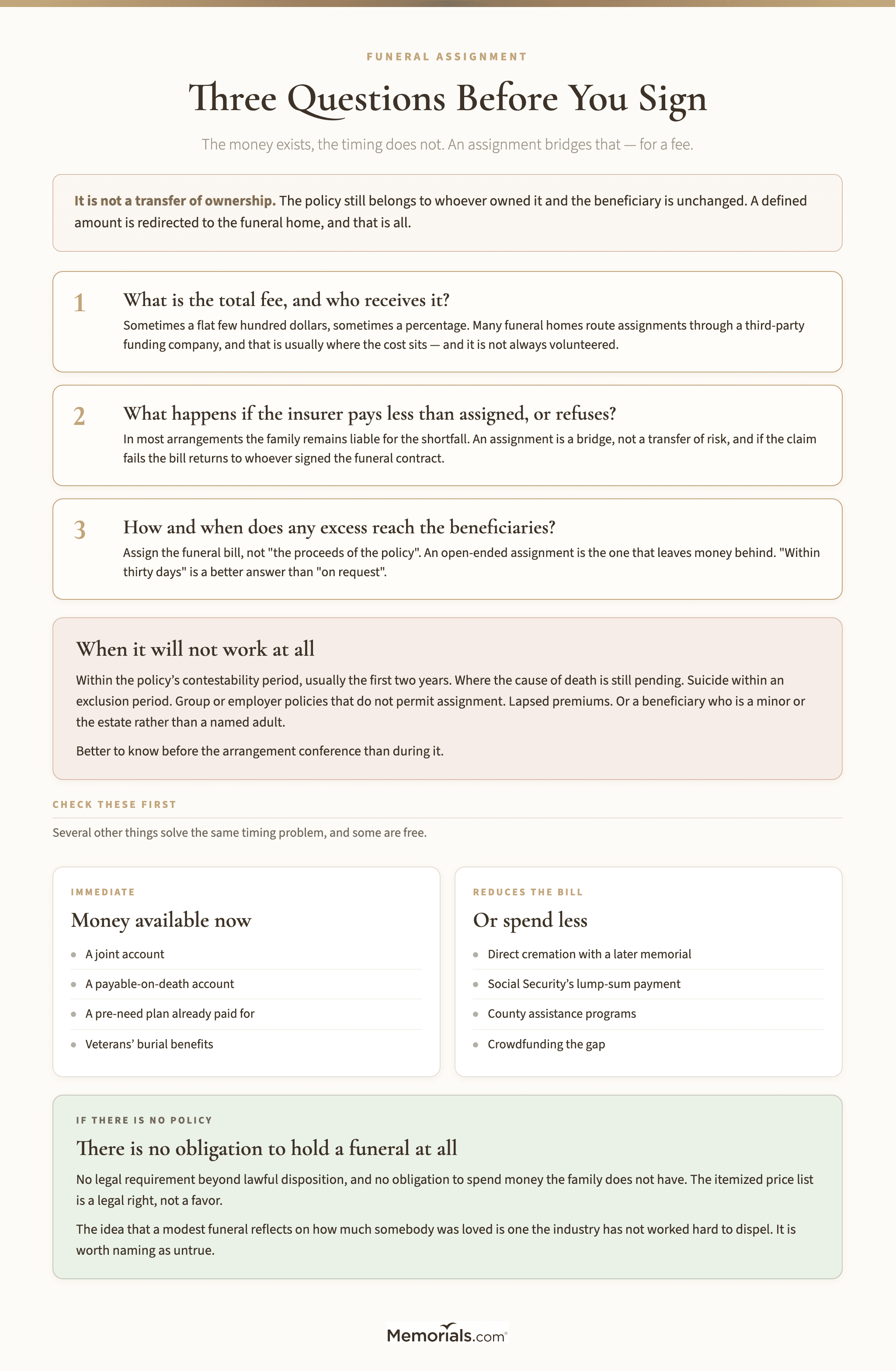
Ask three questions before signing. What is the total fee. Who receives it. What happens if the insurer pays less than the assigned amount, or refuses.
That last answer is the important one. In most arrangements the family remains liable for any shortfall. An assignment is not a transfer of risk — it is a bridge, and if the claim fails the bill returns to whoever signed the funeral contract.
Compare it against the alternatives before assuming it is the only route. If a beneficiary can wait two to six weeks and the funeral home will accept a deposit with the balance on payout, that avoids the fee entirely. Some homes will; it costs nothing to ask.
Assign the bill, not the benefit. And find the sentence about who covers a shortfall.
When It Will Not Work
Several situations where an assignment of life insurance to funeral home arrangements is refused, and it is better to know before the arrangement conference than during it.
The policy is within its contestability period, usually the first two years, when the insurer may investigate before paying. Most funding companies will not accept an assignment against a contestable policy.
The cause of death is pending. A certificate awaiting toxicology means the claim cannot be finalized, and funders are wary. This is the same delay covered in the death certificates page.
Suicide within the policy's exclusion period, typically two years, where the benefit may not be payable at all.
The policy is a group or employer policy, some of which do not permit assignment.
Premiums lapsed, and the policy is not in force. Worth verifying before building a plan around it.
The beneficiary is a minor or an estate rather than a named adult, which complicates who can sign.
The amount is small relative to the funeral. A $5,000 policy against a $12,000 funeral leaves a gap somebody has to cover regardless.
Can a Funeral Home Be a Life Insurance Beneficiary?
Asked often, and the answer is yes in principle and rarely a good idea in practice.
Can a funeral home be a life insurance beneficiary? Legally, in most states, yes — a policy owner may name whoever they like. Insurers may query it, because naming a business raises an insurable-interest question, but a properly executed designation usually stands.
Why it is a poor arrangement. Naming a funeral home as beneficiary hands them the entire benefit, not the cost of the funeral. If the policy pays $20,000 and the funeral costs $9,000, the difference does not automatically return to the family — recovering it depends on the home's willingness and on what was agreed in writing years earlier.
Funeral homes change hands. The business named in a designation twenty years ago may have been sold twice since, and the obligation does not always travel cleanly.
The better structures, in order: a pre-need contract with a funded trust or an insurance policy specifically designed for it, where the money is held for that purpose and regulated as such; a final expense policy naming a family member who intends to pay for the funeral; or an ordinary policy with an assignment made at the time, which is this page's subject and which pays only the actual bill.
Naming a funeral home as beneficiary hands over the whole benefit, not the cost of the funeral.
The Alternatives Worth Checking First
An assignment solves a timing problem. Several other things solve it too, and some are cheaper.
A joint account. Where a surviving spouse holds one, the money is available immediately and does not wait for anything — the point made in the financial accounts directory.
A payable-on-death account. Same effect, and often overlooked because it is invisible on a statement.
A pre-need plan already paid for. Ask before arranging anything. Families routinely arrange and pay for a second funeral because nobody knew one had already been bought.
Veterans' burial benefits, which can substantially reduce the bill.
Social Security's lump-sum death payment, small but real, for an eligible spouse or child.
Direct cremation. If cost is genuinely the constraint, the difference between a full funeral and a direct cremation is several thousand dollars, and there is no obligation to spend money the family does not have.
Assign the bill, not the benefit. A well-drafted assignment names a specific amount.
Reading the Paperwork Before You Sign
The arrangement conference is a bad place to read a contract carefully, which is exactly why it is worth knowing what to look for beforehand.
The assigned amount. It should be a number matching the funeral bill, not "the proceeds of the policy" or "such amount as may be required". An open-ended assignment is the one that leaves money behind.
Who the assignee actually is. If it is a funding company rather than the funeral home, that is normal — but it is a third party to a contract you are signing, and you are entitled to know its name and its fee.
The shortfall clause. What happens if the insurer pays less than assigned, or denies the claim. In most agreements the family remains liable, and you should be able to point at the sentence that says so.
The refund mechanism. How and when any excess reaches the beneficiaries, and who initiates it. "On request" is weaker than "within thirty days".
Whether interest accrues. Some agreements charge interest if payment is delayed beyond a period, which converts a fee into a growing debt.
Take it away and read it if you can. Funeral homes are used to this and a reputable one will not object. An hour is enough, and the family member who is least emotionally involved is the right person to read it.
Frequently Asked Questions
How long does the funeral home wait for payment? Two to six weeks in most cases, occasionally longer where a claim is queried. The home carries that delay, which is what the fee is for.
Can I assign only part of the policy? Yes, and you should — assign the funeral bill, not the benefit. A well-drafted assignment names a specific amount.
What if the funeral costs less than assigned? The excess should return to the beneficiaries. Confirm that in writing before signing, because recovering it afterward is harder than agreeing it beforehand.
Do I need the original policy document? Helpful, not usually essential. The insurer can locate a policy from the person's details, and the funeral home does this routinely.
We do not know whether a policy exists. Check the mail for premium notices, old tax returns, and employment records. The NAIC operates a free policy locator service that queries participating insurers on a family's behalf.
Is the payout taxable? Life insurance proceeds paid to a named beneficiary are generally not subject to income tax. Whether the estate's tax position is affected is a separate question and one for a tax preparer.
Ask about a pre-need plan before arranging anything. Paying twice for the same funeral is the one that stings longest.
If There Is No Policy At All
Most families arriving at this question do not have a policy to assign, and the honest version of this page has to say what happens then.
Ask the funeral home directly what a smaller funeral costs. The difference between what is first presented and what is possible is frequently several thousand dollars, and reputable homes will have that conversation without pressure. The itemized price list is a legal right, not a favor.
Direct cremation with a memorial later is the single largest saving available, and it separates the disposition from the gathering — which many families find they prefer anyway, because a service arranged three weeks later is one people can actually travel to.
County assistance exists in most places for families who genuinely cannot pay, and the funeral director will know the local program. Asking is not an admission of anything.
Veterans' benefits, union death benefits and fraternal organization benefits are all real and all frequently unclaimed, because nobody thinks to ask.
You are not obliged to hold a funeral at all. There is no legal requirement beyond lawful disposition of the body, and no obligation to spend money the family does not have. The idea that a modest funeral reflects on how much somebody was loved is one the industry has not worked hard to dispel, and it is worth naming as untrue.
In Closing
If the money exists and the timing does not, an assignment is a reasonable instrument and it is used every day. Ask what the fee is, who receives it, and what happens if the claim falls short — those three answers are the whole of what you need to decide.
And ask about a pre-need plan before arranging anything. Of all the ways families spend money they did not need to spend, paying twice for the same funeral is the one that stings longest.