🏬Supersize Online Funeral Retailer🪦1000's of Headstones⚱️Over 10,000 Cremation Urns⚰️Caskets Overnight Delivery🛒Funeral & Memorial Superstore🚚FREE Shipping on ALL Orders👨👩👧👦Helping Families for over 20 Years💰Lowest Price Guarantee🏬Supersize Online Funeral Retailer🪦1000's of Headstones⚱️Over 10,000 Cremation Urns⚰️Caskets Overnight Delivery🛒Funeral & Memorial Superstore🚚FREE Shipping on ALL Orders👨👩👧👦Helping Families for over 20 Years💰Lowest Price Guarantee
🏬Supersize Online Funeral Retailer🪦1000's of Headstones⚱️Over 10,000 Cremation Urns⚰️Caskets Overnight Delivery🛒Funeral & Memorial Superstore🚚FREE Shipping on ALL Orders👨👩👧👦Helping Families for over 20 Years💰Lowest Price Guarantee🏬Supersize Online Funeral Retailer🪦1000's of Headstones⚱️Over 10,000 Cremation Urns⚰️Caskets Overnight Delivery🛒Funeral & Memorial Superstore🚚FREE Shipping on ALL Orders👨👩👧👦Helping Families for over 20 Years💰Lowest Price Guarantee
The funeral director will ask how many death certificates do I need before you have any way of knowing, usually within a day or two of the death, and the honest answer is that almost everybody guesses low.
Order ten to twelve. That is more than most families expect and roughly what most families turn out to need, and the reason is simple: a good number of the organizations you have to deal with keep the copy you send them.
Ordering too few is the single most common delay in settling an estate. Every institution on your list waits while you reorder, and reordering takes weeks rather than days. Getting this one number right at the start saves more time than anything else in the estate affairs guide.
Work Out Your Own Number
Ten to twelve is the default. To sharpen it, count the accounts rather than the institutions — someone with three bank accounts, two insurance policies and a house needs more than someone with a checking account and a car.
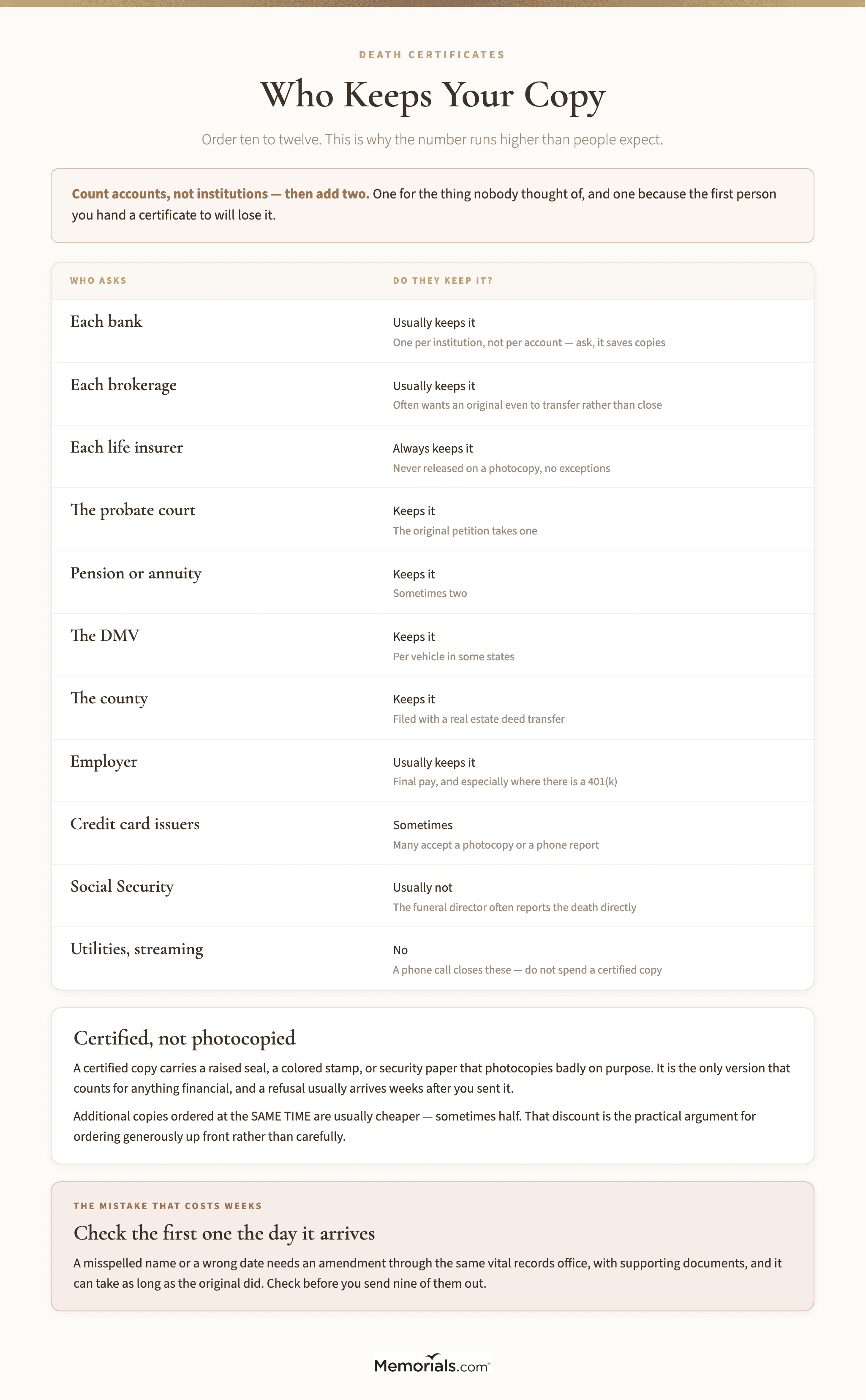
Count one for each of these, and assume it will not come back:
Who asks
Do they keep it?
Notes
Each bank and credit union
Usually yes
One per institution, not per account
Each brokerage or retirement account
Usually yes
Often wants an original even to transfer
Each life insurance policy
Always
Never released on a photocopy
Social Security
Usually not
The funeral director often reports the death directly
The pension or annuity provider
Yes
Sometimes two
The DMV, for a vehicle title
Yes
Per vehicle in some states
The county, for real estate
Yes
Filed with the deed transfer
Each credit card issuer
Sometimes
Many accept a photocopy or a phone report
The probate court
Yes
The original petition takes one
Employer, for final pay and benefits
Usually
Especially where there is a 401(k)
Then add two spares. One for the thing nobody thought of, and one because the first person you hand a certificate to will lose it.
Some will not need one at all. Utilities, streaming services and most subscriptions will close an account on a phone call — those belong on the digital accounts list, not on this one. Do not spend a certified copy on a cable company.
Two exceptions inside that group, in opposite directions. An Apple legacy contact request does want a certified copy, because Apple treats anything touching an account as a legal release rather than a cancellation — so budget one for it even though it looks like a subscription. The credit bureaus go the other way: an Experian death notification is a letter with a photocopy, and so are the other two, which is three originals you get to keep.
Count accounts, not institutions — then add two. The first person you hand one to will lose it.
Certified Copies, Not Photocopies
A certified copy is issued by the state or county vital records office and carries a raised seal, a colored stamp, or security paper that photocopies badly on purpose. It is the only version that counts for anything financial.
A photocopy of a certified copy is just paper. Banks, insurers and courts all refuse them, and the refusal often comes weeks after you sent it.
The two are not priced the same either. A first certified copy typically costs somewhere between fifteen and thirty dollars depending on the state, and additional copies ordered at the same time are usually cheaper — sometimes half. That discount is the practical argument for ordering generously up front rather than carefully.
How Long They Take
The answer to how long do death certificates take is: usually one to three weeks, and occasionally much longer.
The normal path. The funeral director files the paperwork with the state, a physician or medical examiner certifies the cause, the registrar records it, and copies are issued. Where a funeral home handles it — which is almost always — the family's part of how to file death certificate paperwork is mostly signing what the director puts in front of them.
What makes it slow. A death that needs a medical examiner, an out-of-state death, a death where the cause is not immediately clear, or simply a busy county office. None of these are unusual.
Ordering later takes longer than ordering now. A copy added to the original order arrives with the rest. A copy ordered three weeks later goes to the back of the queue and may take another two to three weeks, which is exactly the delay you are trying to avoid.
When the Certificate Is Delayed
Sometimes the death certificate is issued with the cause of death marked pending. This is routine where a medical examiner is involved and it is not a sign that anything is wrong.
A death certificate pending toxicology is the common version — toxicology results can take eight to twelve weeks, sometimes longer, and the certificate is issued in the meantime with the cause left open. You can order certified copies of the pending certificate and use them for most purposes.
The exception is insurance. A life insurance pending death certificate is the one place where "pending" causes real trouble: many insurers will not pay a claim until the cause is finalized, particularly within the policy's contestability period, which is usually the first two years.
So can you collect life insurance without a death certificate? Generally no — the certified certificate is the proof of loss every policy requires. But you can and should file the claim immediately with the pending certificate, so the file is open and the clock is running. When the amended certificate is issued, send it in and the claim proceeds. Waiting to file until the cause is finalized costs you months for nothing.
A pending cause is routine. File the insurance claim anyway — the clock only starts when the claim does.
How to Read a Death Certificate
Most people never look closely at one, and then need to. The layout varies by state but the content does not vary much, and knowing how to read a death certificate helps mainly because institutions ask about specific fields.
The identifying section — name, date of birth, Social Security number, parents' names, place of residence. This is what a bank matches against its records, and a mismatch here is the most common reason a certificate gets bounced.
The cause of death section. Usually written as a chain: the immediate cause, then the conditions leading to it, then any contributing factors. It reads oddly to a layperson because it is a medical sequence, not a summary. "Pending" or "deferred" here means the medical examiner has not finished.
Place of disposition. So what does place of disposition mean on a death certificate? It is simply where the body went — the cemetery, the crematory, or the facility receiving a donation. It is a records field rather than anything legal, and it is one people query because the phrase sounds more consequential than it is.
The informant. The person who supplied the personal details, usually the next of kin. If something in the identifying section is wrong, the informant is who the registrar contacts.
Errors are fixable but slow. A misspelled name or a wrong date needs an amendment through the same vital records office, with supporting documents, and it can take as long as the original did. Check the first copy carefully the day it arrives, before you send nine of them out.
Count accounts, not institutions, then add two. Most of these never give the copy back.
Why a Certificate Gets Rejected
It happens, it is infuriating, and it is nearly always one of four things. All four are worth checking on the day the copies arrive rather than discovering one at a time over six weeks.
The name does not match the account. A woman whose accounts are in a married name and whose certificate carries a maiden name, a certificate reading "Robert" against an account reading "Bob", a missing middle initial. Institutions match literally. If the names differ, you will usually need a marriage certificate or a court record bridging the two, so gather that at the same time.
It is a photocopy after all. Some funeral homes hand over a mixture — a few certified copies and several plain copies for your own reference. They look similar in a folder. Check for the raised seal on every one before you send any of them, and keep the plain copies separate.
The wrong jurisdiction issued it. A copy from the county where the person lived is not the same as one from the county where they died, and only one of those exists. This bites hardest when someone dies in a hospital two counties away from home.
The institution wants a recent issue. Some insurers and title companies ask for a copy issued within the last six or twelve months. There is nothing you can do about a policy like that except order fresh copies, which is another reason not to leave a long gap between the death and the paperwork.
Keep a Record of Where They Went
This sounds fussy and takes five minutes, and every family that skips it ends up reordering.
Write down which institution got which copy and on what date — a page in a notebook or a note on your phone is enough. Two reasons. First, when an institution says it never received the certificate, a date is what settles it. Second, when you have two copies left and six organizations still to deal with, the list tells you whether you genuinely need more or whether three of the six will take a photocopy.
Ask each institution whether they return it. Roughly a third do, and a returned copy goes straight back into the pile. Nobody volunteers this — you have to ask when you send it, and it is worth asking every time.
Keep one certificate back permanently. Long after the estate closes there will be a pension query, an unclaimed property claim, a title transfer that never quite completed. A copy in the file at home is worth the twenty dollars, and it is the one that stops this whole process starting again in three years.
Write down which institution got which copy. When one says it never arrived, a date is what settles it.
Who Can Order One
Not everyone can. Most states restrict certified copies to the spouse, parents, children, siblings, the executor, and anyone with a documented legal interest — an attorney or an insurer, for example. Who counts is a legal order rather than a family one, which is covered in next of kin hierarchy.
You will need your own photo ID and, if you are the executor, your letters testamentary or a small estate affidavit.
The funeral director is the easy route. They order on the family's behalf as a matter of course, and it is far simpler than going to the county yourself. Tell them the number before they place the order.
If the Person Was a Veteran
Add two to your count. Veterans' benefits run through their own paperwork and each strand wants its own certified copy.
A burial allowance claim, interment in a national cemetery, a government headstone or marker, and a surviving spouse's benefits are separate applications to the Department of Veterans Affairs, and they do not share documents between them. The discharge paperwork — the DD-214 — is wanted alongside the certificate for most of them, so it is worth locating early; it is the document families most often cannot find.
The funeral director will usually know which claims apply and will often file the burial allowance on the family's behalf. Ask, because it is not automatic and the deadlines on some of these are real.
Frequently Asked Questions
Is it worth ordering extra just in case? Yes, and the pricing agrees with you — additional copies on the original order usually cost less than the first one. Two spare certificates cost less than one reorder costs in delay.
Do they expire? No. A certified copy is valid indefinitely. Some institutions ask for one issued within the last year, which is a policy of theirs rather than a property of the document, and it is worth pushing back on.
Can I use one certificate for several accounts at the same bank? Usually yes — banks generally work at the relationship level rather than the account level. Ask when you call; it is the single easiest way to save copies.
What if the death was in another state? Order from the state where the death occurred, not where the person lived. This is the case that most often catches families out and it adds time.
Nobody will tell me the cause of death. The certificate will, once it is final. Until then the medical examiner's office can usually say how long they expect to take, which is more useful than repeated calls to the funeral home.
Can I get one electronically? A growing number of states issue an electronic certified copy with a verifiable seal, and some institutions accept them happily. Others still insist on paper, and you will not know which until you ask. Order paper as your default and treat an electronic copy as a useful extra rather than a replacement.
I have run out. Order from the vital records office of the state where the death occurred. Expect two to three weeks, and order more than you think you need this time as well.
Keep one back permanently. Years later there is a pension query or a title that never quite completed.
In Closing
There is no clever answer here. Ten to twelve, ordered at the same time, from the funeral director, before you know exactly who will ask.
The families who find this part painless are not the organized ones — they are the ones who guessed high. Once you have the stack, the directory of who to send them to is the next thing worth having.