🏬Supersize Online Funeral Retailer🪦1000's of Headstones⚱️Over 10,000 Cremation Urns⚰️Caskets Overnight Delivery🛒Funeral & Memorial Superstore🚚FREE Shipping on ALL Orders👨👩👧👦Helping Families for over 20 Years💰Lowest Price Guarantee🏬Supersize Online Funeral Retailer🪦1000's of Headstones⚱️Over 10,000 Cremation Urns⚰️Caskets Overnight Delivery🛒Funeral & Memorial Superstore🚚FREE Shipping on ALL Orders👨👩👧👦Helping Families for over 20 Years💰Lowest Price Guarantee
🏬Supersize Online Funeral Retailer🪦1000's of Headstones⚱️Over 10,000 Cremation Urns⚰️Caskets Overnight Delivery🛒Funeral & Memorial Superstore🚚FREE Shipping on ALL Orders👨👩👧👦Helping Families for over 20 Years💰Lowest Price Guarantee🏬Supersize Online Funeral Retailer🪦1000's of Headstones⚱️Over 10,000 Cremation Urns⚰️Caskets Overnight Delivery🛒Funeral & Memorial Superstore🚚FREE Shipping on ALL Orders👨👩👧👦Helping Families for over 20 Years💰Lowest Price Guarantee
Funeral costs arrive in the first week, before insurance pays and while the accounts are frozen. A great many families now bridge that with an appeal to the people around them, and the two questions that follow are always the same: are funeral donations tax deductible for the people giving, and is the money taxable to the family receiving it.
Usually no to both, and the reasoning is the same in each direction — donations to an individual are gifts, and gifts are neither deductible to the giver nor income to the recipient.
That is the short version. The details are worth knowing, particularly the fees, and this sits with the other money questions in the estate affairs guide.
General information rather than tax advice. Larger amounts, or anything involving a registered charity, are worth an hour with a tax preparer.
For the people donating: not deductible. A charitable deduction requires a gift to a qualified tax-exempt organization. A family, however deserving, is not one. Somebody who gives $200 toward a funeral is making a personal gift, and personal gifts are not deductible however generous or however sad the circumstances.
The exception is a genuine charity. Where a fund is run by a registered nonprofit — some religious congregations and community organizations do exactly this — donations may be deductible and the organization can issue a receipt. If deductibility matters to donors, that is the structure to use, and it has to be set up that way from the start.
For the family receiving: generally not taxable. Is GoFundMe taxable for funeral expenses? For an ordinary personal appeal, no. The money is a collection of gifts, and gifts are not income to the recipient. This holds whatever the total.
How much taxes do you pay on GoFundMe money in the normal case? None. The concern is common and usually misplaced.
Where it does become taxable, and these are the situations to watch:
Anything given in exchange for something. Selling memorial items, running a raffle, or offering anything in return converts gifts into sales.
A fund raised for a business rather than for a family.
Amounts a payment processor reports. Platforms may issue a Form 1099-K where thresholds are met. That form does not make a gift taxable, but it does mean the IRS has a record, and it needs explaining on the return rather than ignoring.
Keep the records regardless. The campaign page, the payout statements and a note of what the money was spent on. If a form arrives, that documentation is the whole of the answer.
Donations to a family are gifts — not deductible to the giver, not income to the family. The record is what settles it if a form arrives.
Most of these are unclaimed rather than unavailable. Several need only a phone call.
The Platforms, and What They Cost
Funeral crowdfunding runs on a handful of services and the differences are mostly in fees and in how funeral-specific they are.
GoFundMe is the general-purpose one and the one people know. GoFundMe funerals are among its largest categories. There is typically no platform fee on personal campaigns in the US, but payment processing is charged per donation — commonly around 2.9% plus a fixed amount of roughly 30 cents. On $10,000 raised that is a few hundred dollars.
Everloved is built specifically for funerals, and the difference in an Everloved vs GoFundMe comparison is less about price than about fit: it combines the fundraiser with an obituary and a memorial page, and it integrates with funeral homes so that money can go to the home directly. For a family who wants one link that serves as both the appeal and the announcement, that is a real advantage.
Some funeral homes have their own arrangements and will take payment directly from a fund. Ask, because it removes a step and sometimes a fee.
Check three things on any platform before you start: the processing fee, whether tips or optional platform contributions are added by default at checkout, and how quickly funds are released. That last one matters most — a funeral bill due in five days is not helped by a payout that takes ten.
Read the payout timing carefully. Most platforms require identity verification and bank details before releasing anything, and that verification can take several days on its own. Start it immediately rather than when the money arrives.
What It Does Well, and Badly
Worth being even-handed, because this is a decision made under pressure.
It is fast. A well-shared appeal can raise the gap amount within days, which is precisely the window insurance cannot serve.
It reaches people who want to help. This is underrated. A great many people want to do something and do not know what, and a link gives them a concrete way — which is often as valuable to them as it is to the family.
It creates a record of who cared. Families frequently say the messages left alongside donations mattered more than the money.
It is public, which cuts both ways. An appeal is visible to colleagues, distant relatives and strangers. Some families are entirely comfortable with that and some find it exposing, and it is worth asking whether everybody in the family is comfortable before it goes out.
It can arrive with expectations. People who gave sometimes feel entitled to a say in the arrangements, or to an account of the spending. Most do not. A short update afterward heads off nearly all of it.
It does not solve a large gap. Most funeral appeals raise hundreds to low thousands. If the shortfall is ten thousand, crowdfunding is part of an answer rather than the answer, and the rest of it is a smaller funeral — covered in assigning a life insurance policy, which sets out the other routes.
Families consistently say the messages left with donations mattered more than the money.
Running One Well
Practical, and most of it is about the first hour.
Name a single organizer, and make it somebody who is not the closest bereaved person. The organizer handles verification, questions and the payout, and that is not work for a grieving spouse. Check who it is against the next of kin hierarchy before you start, though: a cousin raising money for arrangements a spouse or an adult child has the legal right to decide is the version of this that ends badly, and it is easier to agree in the first hour than to unpick once the money has landed.
Say what the money is for, specifically. "Funeral costs" raises less than "the funeral is $6,400 and we have $2,000." Concreteness works, and it also caps expectations sensibly.
Set a real target and say what happens if you exceed it. Naming the overflow in advance — to a charity, to a headstone, toward the estate's debts — removes any later awkwardness entirely.
Post one update afterward with a total and a thank you. This is the single most effective thing for anybody who might otherwise wonder.
Share it once, properly. Repeated appeals wear out quickly. One clear post, shared by a few people with wide networks, does more than five posts from one account.
Turn off the default tip if you would rather donors were not asked. Most platforms add an optional contribution to themselves at checkout and it is adjustable, and some donors find it confusing.
Beware of impersonation. Fraudulent campaigns copying a real obituary are a documented problem. Post your own link from your own account early, so the family's version is the one circulating first — the same argument made about memorializing social accounts.
Name a single organizer, and not the closest bereaved person. Verification and questions are not work for a grieving spouse.
What Else the Money Could Come From
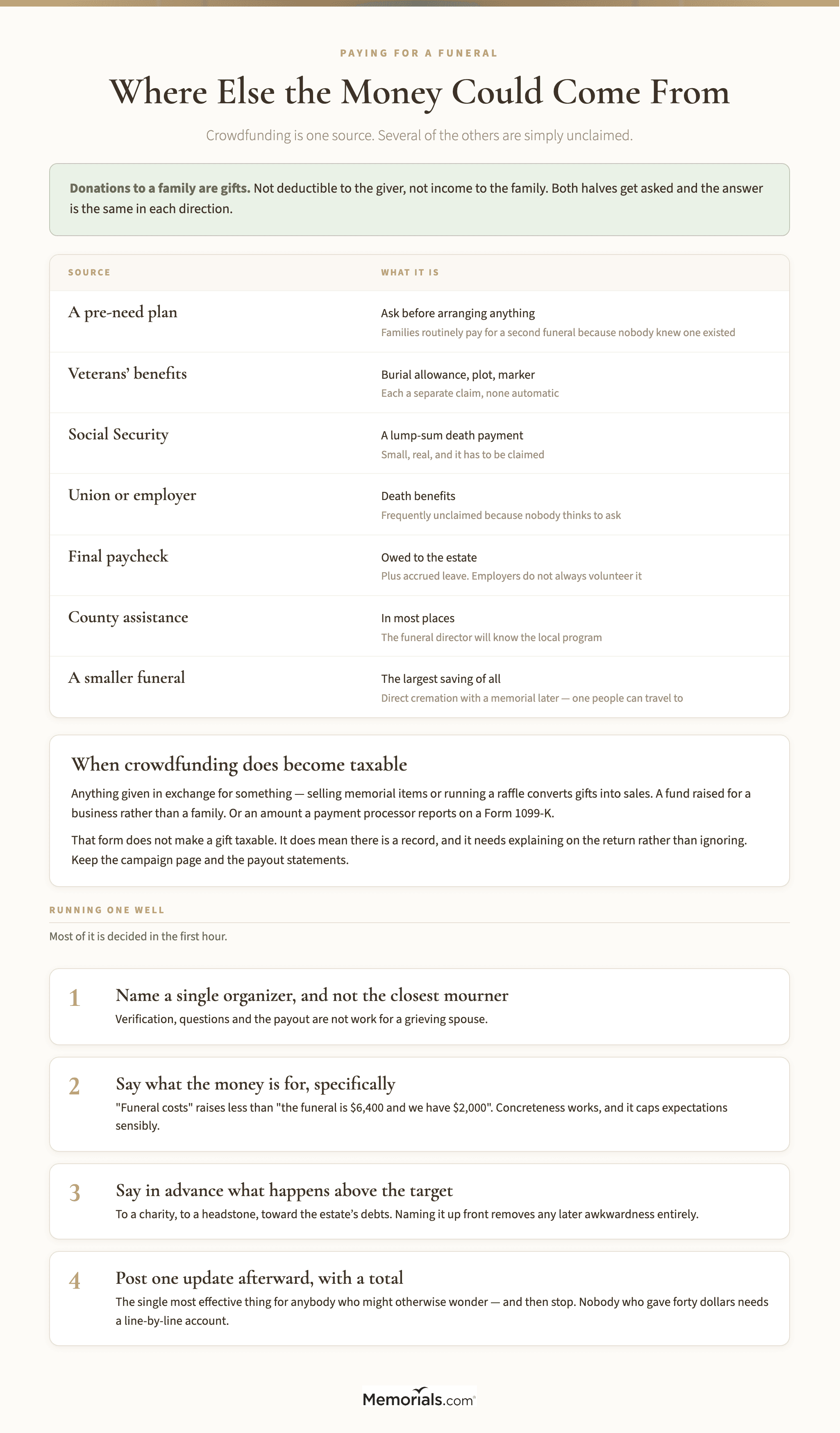
Crowdfunding is one source and it is rarely the only one, and several of the others are simply unclaimed rather than unavailable. Some of it is money the person already had — unclaimed money from deceased relatives is held by the state until somebody claims it, the search is free on the official sites, and it is worth ten minutes before asking anybody for anything.
A pre-need plan. Ask before arranging anything. Families routinely pay for a second funeral because nobody knew one had already been bought and paid for years earlier.
Veterans' burial benefits, which can cover a substantial part of the cost and include a plot in a national cemetery, a government headstone and a burial allowance — each a separate claim, none automatic.
Social Security's lump-sum death payment for an eligible surviving spouse or child. Small, real, and it has to be claimed.
Union or employer death benefits, and benefits from fraternal organizations. Frequently unclaimed because nobody thinks to ask, and a single phone call settles it.
A final paycheck and accrued leave, which an employer owes the estate and does not always volunteer.
County assistance, in most places, for families who genuinely cannot pay. The funeral director will know the local program and asking is not an admission of anything.
A smaller funeral. The largest single saving available, and the one nobody suggests. Direct cremation with a memorial gathering three weeks later costs a fraction, and many families find they prefer it — a service people can actually travel to, arranged by people who have slept.
Frequently Asked Questions
Does the money belong to the estate? Generally no. Gifts made to a named individual for a stated purpose belong to that person, not to the estate, and they are not usually available to creditors of the estate. Keep them in a separate account from estate money to keep that distinction clean.
Do I have to spend it all on the funeral? There is no legal obligation, and there is an ethical one. Money raised for a stated purpose should go to that purpose, and anything left over should be handled the way you said it would be at the outset.
Can I run one for someone who is dying, before the death? Yes, and for medical costs it is common. Be clear in the wording about what the money is for, because the purpose is what people are giving to.
Someone has started a campaign without asking us. Well-meaning friends do this often and occasionally strangers do it fraudulently. Contact the platform — they have processes for both, and for transferring a legitimate campaign to the family.
We were given cash and checks directly. Same treatment: gifts, not income. Record who gave what if you can, both for thank-you notes and for the account.
Can donations be sent to the funeral home directly instead? Often yes, and it is worth asking. Several homes will accept payments against an account in the family's name, which removes the platform fee entirely and means the money never has to be moved twice. It is less visible than a campaign page, which suits some families and not others.
Should I mention it in the obituary? Many families do, and a line saying where to give works better than a bare link. Read the section on what not to include in an obituary in notifying the credit bureaus first — an obituary is a public document and it gives away more than people realize.
One update afterward with a total and a thank you. It answers everybody who might otherwise wonder.
Afterward
The campaign ends and there is a short list of things worth doing while it is still fresh.
Post the total and a thank you. Publicly, once. This is the whole of what most donors want, and it closes the appeal cleanly rather than leaving it hanging open indefinitely.
Close the campaign rather than leaving it collecting. An open fund months later invites questions and occasionally invites fraud.
Download the donor list. Platforms do not keep it forever, and it is what the thank-you notes are written from. Names, amounts and messages, exported once, saved somewhere real.
Reconcile it against the funeral bill and write down the difference. Two lines in a notebook is enough, and it is the answer to any question anybody asks later.
Do the overflow thing you said you would do. If you named a charity or a headstone, do it and say you have. Nothing erodes goodwill faster than an unexplained surplus.
Then stop. There is no obligation to account line by line to people who gave forty dollars out of kindness, and the instinct to over-explain is one worth resisting. A total, a thank you and a closed page is a complete answer.
In Closing
Donations to a family are gifts. Not deductible to the giver, not taxable to the family, and worth keeping a clean record of in case a platform issues a form.
Beyond the tax question: it works best when it is specific, when somebody other than the closest mourner runs it, and when the family says at the outset what happens to anything above the target. Those three decisions take ten minutes and prevent nearly every difficulty this route produces.