🏬Supersize Online Funeral Retailer🪦1000's of Headstones⚱️Over 10,000 Cremation Urns⚰️Caskets Overnight Delivery🛒Funeral & Memorial Superstore🚚FREE Shipping on ALL Orders👨👩👧👦Helping Families for over 20 Years💰Lowest Price Guarantee🏬Supersize Online Funeral Retailer🪦1000's of Headstones⚱️Over 10,000 Cremation Urns⚰️Caskets Overnight Delivery🛒Funeral & Memorial Superstore🚚FREE Shipping on ALL Orders👨👩👧👦Helping Families for over 20 Years💰Lowest Price Guarantee
🏬Supersize Online Funeral Retailer🪦1000's of Headstones⚱️Over 10,000 Cremation Urns⚰️Caskets Overnight Delivery🛒Funeral & Memorial Superstore🚚FREE Shipping on ALL Orders👨👩👧👦Helping Families for over 20 Years💰Lowest Price Guarantee🏬Supersize Online Funeral Retailer🪦1000's of Headstones⚱️Over 10,000 Cremation Urns⚰️Caskets Overnight Delivery🛒Funeral & Memorial Superstore🚚FREE Shipping on ALL Orders👨👩👧👦Helping Families for over 20 Years💰Lowest Price Guarantee
If you are hunting for Bank of America Estate Services, the Wells Fargo Estate Care Center, or whatever Capital One calls its estate department this month, you have already found the hard part of this job: every institution names it differently, and none of the names is the one you would guess.
Nobody warns you that the rest is repetitive. You will make the same phone call eight or ten times, and each one will ask for very nearly the same four documents.
This page is the directory, so you can work down a list instead of starting from scratch each time. It covers the major banks, card issuers and brokerages, what all of them want, and — the part that actually saves time — where the three kinds of institution genuinely differ.
One thing worth saying at the top: you are not going to finish this in a day, and you should not try. The estate affairs guide is the wider map if you are at the very beginning. If the funeral itself is still ahead of you, the comes first — this can wait two weeks without anything going wrong.
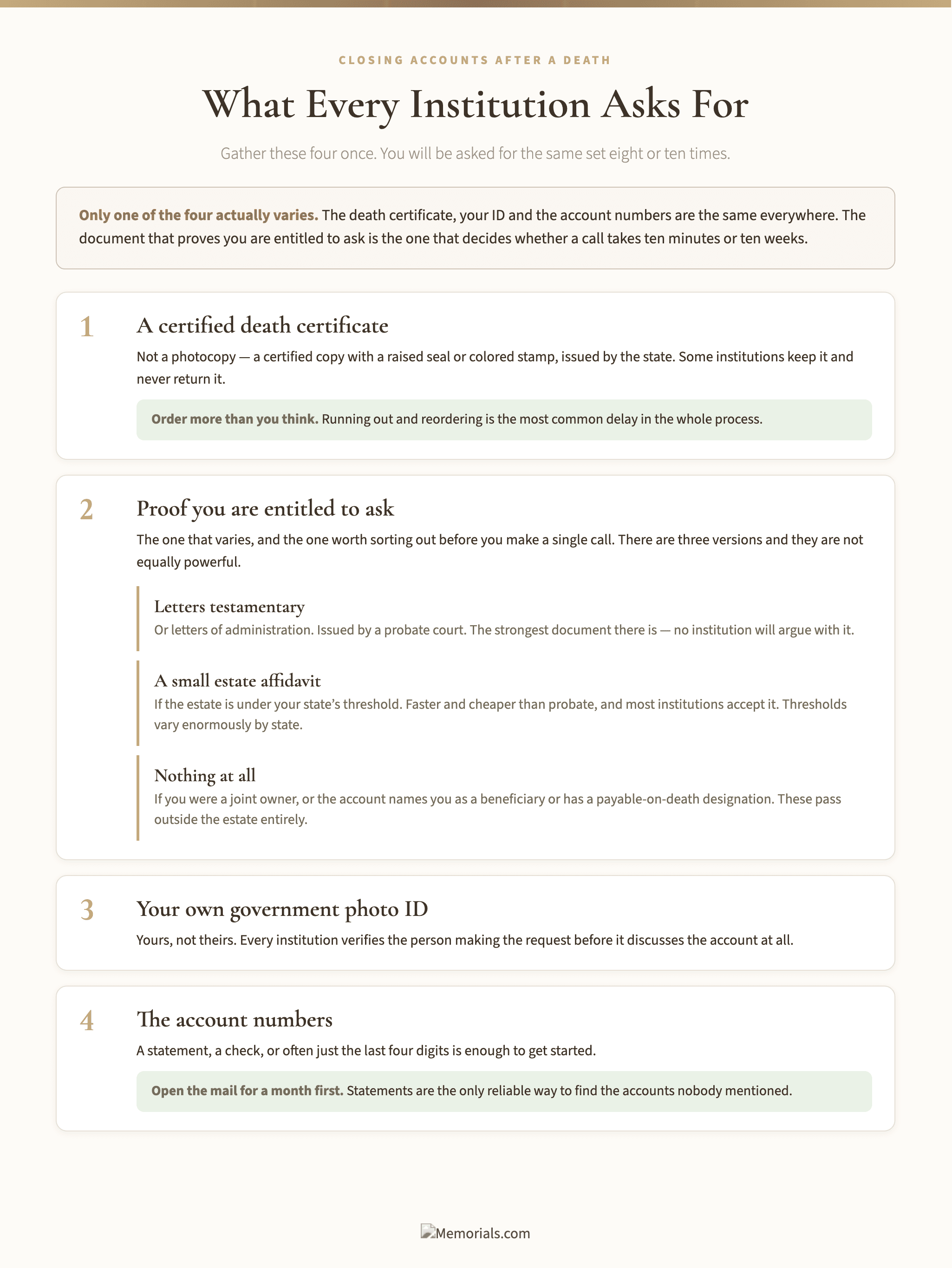
Nearly every one of them wants the same four things. Gather these once, make copies, and stop re-gathering.
A certified death certificate. Not a photocopy — a certified copy with a raised seal or colored stamp, issued by the state. Most institutions keep it. Some return it. This is the single reason people run out and have to reorder, which is why how many death certificates you need is worth reading before you order rather than after.
Proof you are entitled to ask. This is the document that varies most, and it is what decides whether the call takes ten minutes or ten weeks:
Letters testamentary or letters of administration, if the estate is going through probate. This is the strongest document there is and no institution will argue with it.
A small estate affidavit, if the estate is under your state's threshold. Faster and cheaper than probate, and most institutions accept it — see small estate affidavit for the limits, which vary enormously by state.
Nothing at all, if you were a joint owner or a named beneficiary. Joint accounts usually pass to the survivor outright, and a beneficiary designation beats a will.
Your own government photo ID.
The account numbers. A statement, a check, or the last four digits will usually do to get started.
Three of the four are the same everywhere. The second one decides whether a call takes ten minutes or ten weeks.
Four documents, gathered once. The second one — proof you are entitled to ask — is the one that decides whether a call takes ten minutes or ten weeks.
What They Call It, Which Is Half the Problem
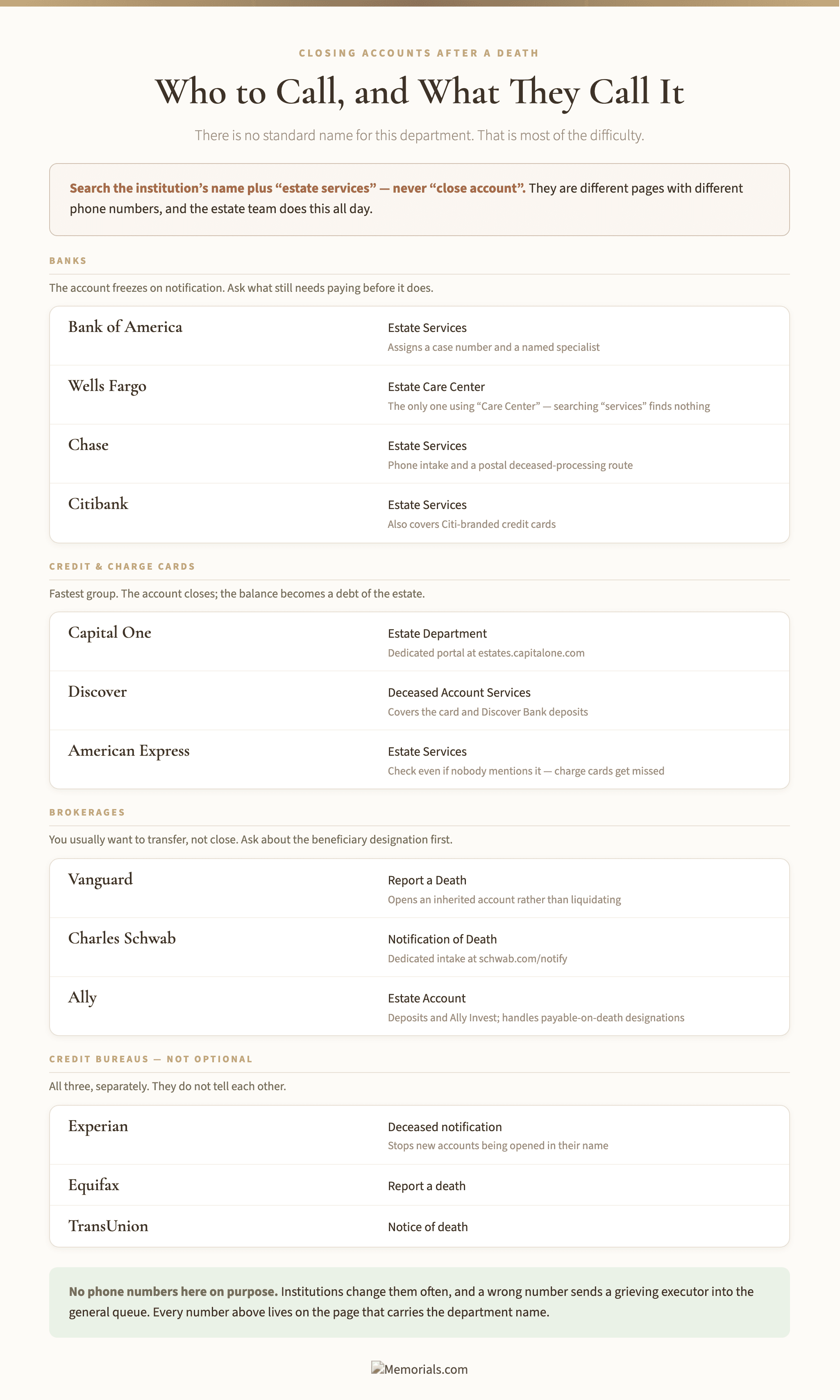
There is no industry-standard name for the department that handles this, and searching a bank's site for "close account" sends you to the ordinary consumer page rather than the one you need. The names in use:
What they call it
Who uses it
Estate Services
Bank of America, Citibank, Chase, American Express, Discover
Estate Care Center
Wells Fargo
Estate Department / Estate Account
Capital One, Ally
Deceased Account Services
Discover
Notification of Death / Report a Death
Vanguard, Charles Schwab, most brokerages
Bereavement Team
some retailers and carriers, rarely banks
If you take one thing from this section: search the institution's name plus "estate services" rather than "close account". It is a different page with a different phone number, staffed by people who do this all day and are markedly kinder than the general queue.
Eleven institutions, four groups, and no two using the same word for the same department.
The Banks
Retail banks are the most standardized of the three groups. All four below have a dedicated estate team, all four will freeze the account on notification, and all four want a certified death certificate plus your authority document.
Bank of America Estate Services is the most-searched of the lot, and the name is exact — not "bereavement", not "deceased accounts". Bank of America assigns a case number and a specialist, which makes follow-up considerably easier than at institutions that route you to whoever answers. If the account holder had several products, one notification of a Bank of America death of account holder covers the relationship rather than each account separately.
The Wells Fargo Estate Care Center is the only one of the four to use "Care Center" rather than "Services", which is exactly why searching for the wrong phrase finds nothing. Wells Fargo handles banking, mortgage and investment accounts through the same Wells Fargo Estate Care intake, so one call can cover several account types. People search for the Wells Fargo Estate Care Center phone number constantly and we deliberately do not print it here — these change, and a wrong number sends you into the general queue. It is on their site, on the page that carries the department name.
Chase Estate Services runs both a phone intake and a postal route. The Chase deceased processing mailing address is published on that same page, and for some account types Chase will want documents by mail rather than upload — ask which on the first call so you are not doing it twice.
Citibank Estate Services is the same shape as the others. Citibank's estate line also covers Citi-branded credit cards, so you may be able to close a card and a checking account in the same conversation.
A note on the smaller institutions. Credit unions, community banks and online-only banks have no dedicated estate team at all — you will get the general queue, and the person answering may never have handled one. This is not obstruction and it usually goes fine, but it takes longer and you should expect to explain the documents rather than have them anticipated. Ask early whether anyone there has done this before, and if not, ask politely to be passed to someone who has. There generally is somebody.
Search the bank's name plus "estate services", never "close account" — it is a different department with different people.
What to expect from all four: the account is frozen on notification, which stops incoming direct debits and standing orders as well as outgoing ones. Ask specifically about anything that still needs to be paid — a mortgage, an insurance premium, a utility bill — because a frozen account does not pay them and a missed mortgage payment is a problem you do not need.
The Accounts That Skip All of This
Before you work down the list, check which accounts are not on it. Three kinds pass directly to a person without probate, without letters testamentary, and often with nothing more than a death certificate and an ID:
Joint accounts with right of survivorship. The surviving owner keeps the account. In most cases it does not close, it does not freeze, and the money was never part of the estate. Take a death certificate in and have the name removed.
Payable-on-death and transfer-on-death accounts. A POD designation on a current or savings account, or a TOD on a brokerage account, sends the balance to the named person outright. Ally in particular uses these heavily on deposit accounts. No probate, no waiting.
Anything with a named beneficiary — retirement accounts, life insurance, most brokerage accounts. The beneficiary form governs, and it beats the will. A will that leaves everything to one child does not override an old 401(k) form naming a different one.
Check this first, because it can shorten the list dramatically. People routinely go through probate for an estate where most of the money was passing outside it anyway. It is also the reason to look at the paperwork before making any calls: once you know an account has a beneficiary, the conversation you are having is a completely different and much shorter one.
Two things that are not on anybody's list:
Safe deposit boxes. They are easy to miss because there is no statement and no balance — often the only trace is a small annual fee on a bank statement. Access rules vary by state and some banks will only open the box with a court order or a witness present, even for an executor. Ask about it on the same call.
The month-of-death Social Security payment. Social Security benefits are paid for the month before they arrive, and a person must live the entire month to be entitled to that month's payment. If a payment lands after the death, Social Security will reclaim it — usually by pulling it straight back out of the account, sometimes weeks later and sometimes after you thought the account was settled. Do not distribute that money, and warn whoever holds the account that it may vanish.
The Credit Cards
Cards are the fastest group, because there is nothing to transfer. The account closes and any balance becomes a debt of the estate. Closing one also breaks whatever was billing against it, which is untidier than it sounds — an Amazon deceased customer account does not quietly stop when the card dies, it keeps retrying and generating notices. Cancel the subscriptions at their own end, not by starving them.
The Capital One estate department publishes a dedicated portal at estates.capitalone.com, which is unusual and genuinely convenient — enough people search for that address directly that it turns up in keyword data as a query in its own right. Capital One will also open a Capital One estate account where a balance needs to be held rather than closed out immediately.
Discover Deceased Account Services handles both the card and Discover Bank deposits through one intake.
American Express Estate Services is worth checking even if you think there was no Amex, because charge cards often sit outside the main banking relationship and get missed. American Express treats charge and credit products separately, so ask about both.
The one that costs people money: stop using the card. If you were an authorized user on a card belonging to the person who died, your authority ended when they did. Continuing to use it — even for funeral expenses, even for groceries, even with the family's blessing — is card fraud, and issuers do pursue it. Authorized users are not liable for the balance, and that protection depends on not adding to it.
You are usually not liable for the balance. A credit card debt belongs to the estate. Exceptions: a genuine joint account holder, and community property states, where a surviving spouse may be liable for debts incurred during the marriage. If a collector tells you otherwise and you were only an authorized user, that is worth pushing back on in writing.
The Brokerages
This is the group where the standard advice goes wrong, because you usually do not want to close a brokerage account. You want to transfer it.
To Vanguard report a death through their notification form rather than the general service line. Vanguard will open an inherited account or transfer to a beneficiary rather than liquidate, which is nearly always what you want.
Charles Schwab death notification runs through a dedicated intake page at schwab.com/notify — and that Schwab death notification address is itself a common search, which is a fair sign it is stable and public. Charles Schwab will hold the positions while the transfer is arranged.
An Ally Bank estate account covers both deposits and Ally Invest. Ally also handles payable-on-death designations, which are common on their deposit accounts and bypass probate entirely.
Why liquidating can be an expensive mistake. Inherited investments generally receive a step-up in cost basis to their value on the date of death, which can eliminate a large capital gains liability. Sell first and you may hand back a benefit that was sitting there for free. This is genuinely a question for a tax professional and not for a memorial website — but it is worth knowing the question exists before somebody at a call center asks whether you would like to liquidate the position.
Beneficiary designations beat the will. If the account names a beneficiary, that person receives it regardless of what the will says, and usually without probate. Check the designation before assuming anything about who gets what.
Where the Three Groups Actually Differ
This is the part worth having in your head before the first call, because it changes what you are asking for.
Banks
Credit cards
Brokerages
What happens on notification
Account frozen
Account closed
Account frozen, positions held
What you want to happen
Close, and move the money to the estate
Close, and settle the balance
Transfer, not liquidate
Does probate matter?
Yes, unless joint or POD
Rarely — it is a debt, not an asset
Only if there is no named beneficiary
The trap
Frozen accounts stop paying the mortgage
Authorized users keep using the card
Selling before the step-up in basis
Typical speed
2–6 weeks
Days
4–12 weeks
The pattern underneath: a bank holds money that becomes part of the estate, a card is a debt the estate owes, and a brokerage holds an asset that usually passes outside the estate entirely. Three different legal objects, which is why one set of instructions cannot cover all three.
A bank holds money, a card is a debt, a brokerage holds an asset. Sorting the post into those three piles is the fastest hour you will spend.
The Credit Bureaus, Which Are Not Optional
Separate from every institution above: notify Experian, Equifax and TransUnion. This is what stops the identity of someone who has died being used to open new accounts, which is a real and unpleasant crime that spikes in the months after a death.
First, order the death certificates. Everything else waits on them, and ordering too few is the most common delay.
Second, get your authority document — letters testamentary, or a small estate affidavit if the estate qualifies.
Third, open the mail for a month before you decide the list is complete. Statements, and only statements, will tell you about the accounts nobody mentioned.
Fourth, notify the three credit bureaus. Do this early; it is the one with a real downside if you leave it.
Fifth, work down the institutions. Cards first — they are quick and they close cleanly. Then banks. Then brokerages, which take longest and benefit from unhurried decisions.
Cards first, then banks, then brokerages. The order is not arbitrary — it runs fastest-to-slowest, so the list shortens early.
Frequently Asked Questions
Do I need a death certificate for every institution? Assume yes, and assume some will keep it. That is why the count matters more than people expect.
Can I just keep using the account to pay for the funeral? No, and this is the mistake with the sharpest consequences. Once an institution knows, the account freezes; using it before you tell them is not a loophole. If the funeral needs paying before the estate is accessible, assigning a life insurance policy to the funeral home is the usual route.
What if I do not know where they banked? Open the post for a month, check the last tax return for interest and dividend statements, and look at the current-account statements you do have for transfers out. Then check your state's unclaimed property office.
Nobody is the executor and there is no will. Can I still do this? Sometimes. A small estate affidavit works in many states without any court appointment, and some institutions will release small balances to the next of kin directly. Who counts as next of kin is a legal order, not a family judgment — see next of kin hierarchy.
The bank is asking for something the others did not. Common, and usually genuine rather than obstructive. Ask them to name the document and put the request in writing, then ask whether a small estate affidavit would satisfy it instead.
How long does the whole thing take? Cards in days. Banks in two to six weeks. Brokerages in one to three months, longer if there is no named beneficiary. An estate of any size is a six-month job and there is no version of it that is quick.
In Closing
The phone numbers and web addresses in this territory change often enough that publishing them would be doing you a disservice — a wrong number is worse than no number. What does not change is the department name, and that is what this page is for: search the institution plus "estate services", and you will land on the right team.
The rest is repetition. Four documents, one list, and the knowledge that a bank, a card and a brokerage are three different problems wearing the same clothes.