🏬Supersize Online Funeral Retailer🪦1000's of Headstones⚱️Over 10,000 Cremation Urns⚰️Caskets Overnight Delivery🛒Funeral & Memorial Superstore🚚FREE Shipping on ALL Orders👨👩👧👦Helping Families for over 20 Years💰Lowest Price Guarantee🏬Supersize Online Funeral Retailer🪦1000's of Headstones⚱️Over 10,000 Cremation Urns⚰️Caskets Overnight Delivery🛒Funeral & Memorial Superstore🚚FREE Shipping on ALL Orders👨👩👧👦Helping Families for over 20 Years💰Lowest Price Guarantee
🏬Supersize Online Funeral Retailer🪦1000's of Headstones⚱️Over 10,000 Cremation Urns⚰️Caskets Overnight Delivery🛒Funeral & Memorial Superstore🚚FREE Shipping on ALL Orders👨👩👧👦Helping Families for over 20 Years💰Lowest Price Guarantee🏬Supersize Online Funeral Retailer🪦1000's of Headstones⚱️Over 10,000 Cremation Urns⚰️Caskets Overnight Delivery🛒Funeral & Memorial Superstore🚚FREE Shipping on ALL Orders👨👩👧👦Helping Families for over 20 Years💰Lowest Price Guarantee
Most people leave burial instructions in their will. It is the single most common way to do it, and it is very nearly the worst.
The problem is timing. A will is usually read after the funeral has already happened. It is an estate document — it goes to the executor, often through an attorney, sometimes only after probate opens, and probate can take weeks to begin. The funeral happens in three to seven days. By the time anyone reads the paragraph about your wishes, the decision it describes has been made by somebody else.
There is a second problem, and it surprises people more. In most states, a will is not what legally decides anyway. Who may direct a burial or a cremation is set by its own statute, with its own order of priority, and a will is at best one piece of evidence inside it.
This article covers what actually binds, what to write, and where to keep it.
It is read too late. Wills surface when the estate is being settled, not when the funeral is being arranged. Our guide to settling the affairs after a death sets out that sequence, and the funeral sits at the very front of it, before most paperwork exists.
It may be sealed behind probate. Where a will has to be filed and an executor formally appointed, nobody has authority to act on it for a while. Our probate process guide covers how long that can run.
It names the wrong person. An executor administers your property. The person who may authorize a burial or cremation is decided by a different statute, and it is frequently not the executor. Putting instructions in a will hands them to someone who may have no standing to carry them out.
People most often search for how to write cremation instructions in will documents, and the answer is the same as for burial: the will is the wrong instrument, for exactly this reason. It is typically read after the cremation has already taken place.
None of this means your will should be silent. Say what you want in it — it is useful corroboration, and it costs nothing. It just must not be the only place.
Every state has a statute setting out who may direct the disposition of your remains, in order. The orders differ, but they share a shape, and reading our state cremation research made the pattern clear.
At the top, in most states, is you — but only if you used the right document.
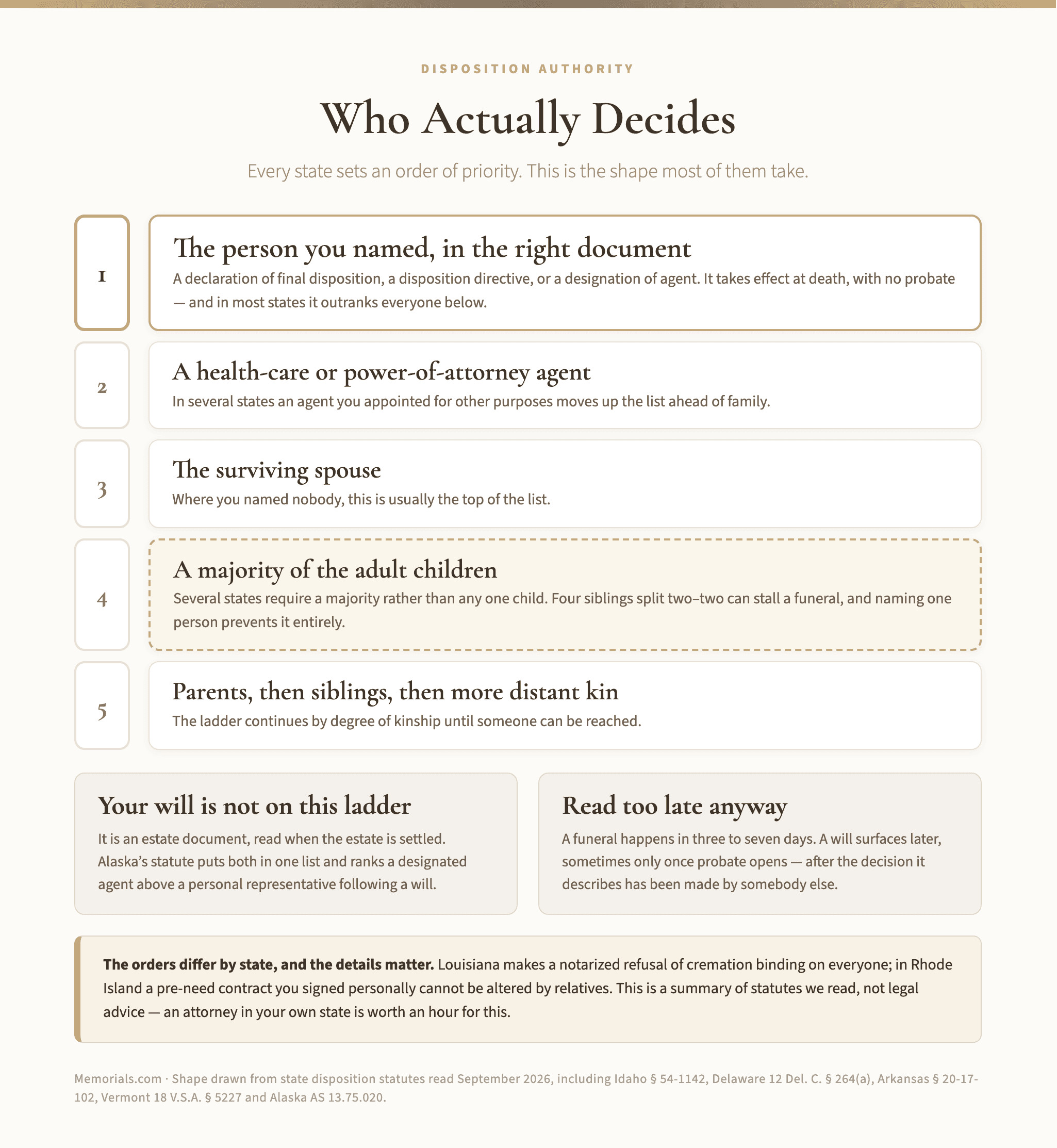
The ladder then runs down something like: a person you named in a written designation, then a health-care agent or power-of-attorney agent, then the surviving spouse, then a majority of adult children, then parents, then siblings, then onward through more distant kin.
Idaho (Code § 54-1142) starts with a person named in your own written designation, then a health-care agent, then a durable power-of-attorney agent, then a guardian, then the spouse.
Delaware (12 Del. C. § 264(a)) sets a nine-step ladder beginning with your own declaration instrument, then the surviving spouse.
Arkansas (§ 20-17-102) begins with the person named on a DD Form 93 for a service member, then a written declaration of final disposition, then the spouse.
Vermont (18 V.S.A. § 5227) puts your own written directive first, then an advance-directive agent, then the spouse.
Alaska (AS 13.75.020) names a designated disposition agent first, and only then a personal representative following written instructions in a will — a useful illustration, because it puts the two in the same list and ranks the agent above the will.
Two features of these ladders matter more than the rest.
A named agent usually outranks the spouse. That is the whole reason to name one. If you want someone other than your closest relative to decide — an adult child, a friend, a second spouse in a blended family — naming them is the only reliable way.
"A majority of adult children" is a real trap. Several states, Louisiana and Delaware among them, require a majority rather than any one child. Four siblings who split two-two can stall a funeral, and this is one of the commonest ways arrangements go wrong. Naming one person prevents it entirely.
Some states also make a written refusal absolute. Louisiana's R.S. 37:876(E) makes a notarized declaration refusing cremation binding on everyone, and in Rhode Island a pre-need contract you signed personally cannot be altered by relatives afterward.
This is a summary of statutes we read, not legal advice, and the details vary considerably. An attorney in your own state is worth an hour for this.
The ladder most state statutes take the shape of. The rung that matters is the first one, because it is the only one you control — and the majority-of-children rung is where funerals most often stall.
The Document You Actually Want
It goes by different names depending on where you live: a declaration of final disposition, a disposition directive, a designation of agent for disposition of remains, or in some states a section inside the advance health-care directive. Funeral homes and estate attorneys will know the local name.
What it does is simple. It names one person to make the decisions and, usually, states your wishes. It takes effect at death, immediately, with no probate and no waiting.
Get three things right.
Name a person, not just a preference. "I wish to be cremated" is a wish. "I appoint my daughter Anna Reyes as my agent for disposition of my remains" is an instruction with a name attached, and it is what resolves a disagreement.
Name a backup. The person you named may predecease you, be unreachable, or be too unwell to act.
Ask them first. This is the step people skip. Being handed this role without warning, in the first hours after a death, is hard. A five-minute conversation now is worth more than any document.
Many states require the form to be signed and witnessed, and some require notarization. Louisiana's absolute refusal provision, for example, turns on the declaration being notarized. Follow your state's formalities or the document may not do the job.
The step people skip. Being handed this role without warning, in the first hours after a death, is hard — and a five-minute conversation now is worth more than any document.
What to Put in Your Burial Instructions
Keep it to the decisions somebody has to make in the first week. Everything else is a preference, and preferences are a gift rather than a burden only if they are clearly labeled as such.
The decisions that must be made:
Burial or cremation. The single most important line. If burial, whether you want a specific cemetery, and whether a plot is already owned — and where the deed is.
The name of the funeral home, if you have a preference or a prepaid arrangement.
Whether you want a viewing, which determines whether embalming comes up at all.
Who has authority — the agent named above, restated here.
Where the money is coming from. Prepaid, insurance, a payable-on-death account, or the estate. This is the question that causes the most distress and it is rarely answered.
The preferences worth recording:
The kind of service, or none. Religious, secular, graveside only, or a celebration of life held later.
Readings, music, who you would like to speak.
What you want done with ashes, if cremated. Be specific — "scattered somewhere nice" is not actionable, and some places require permission.
Clothing, jewelry, or anything you want with you.
What you do not want. This is often the most useful part, and families frequently have no idea.
The obituary: whether you want one, and anything you want said or not said.
Write it as prose or a simple list, and date it. A dated document beats an undated one when two versions turn up.
What to Leave Out
Anything conditional or contingent. "Cremation unless my sister objects" creates the argument it was meant to prevent.
Anything that costs money without saying where the money is. Instructions describing a funeral the estate cannot afford put the family in an impossible position — the estate usually cannot reimburse them until probate closes, which is months later.
Anything legally impossible. Some things people want — burial on private land, scattering in particular places, certain body-disposition methods — are restricted by state or local law. If you want one of these, check it now rather than leaving your family to discover the restriction at the worst moment.
Instructions for your remains to go to someone who has no standing, without also naming them as your agent. The wish and the authority have to travel together.
Where to Keep Them
This is where good instructions most often fail.
Not in a safe deposit box. It may be sealed at death, and in several states it takes a court order to open. Your instructions can be locked inside the bank for weeks.
The commonest place good instructions go to die. A box may be sealed at death, and in several states it takes a court order to open — so your wishes sit inside the bank for weeks.
Not only with your attorney. Offices keep office hours, and deaths do not.
Give copies to the people who will act. The agent you named, a second family member, and your funeral home if you have chosen one. Keep the original somewhere ordinary and findable — a file at home, with the other important papers.
Tell people it exists. A document nobody knows about is the same as no document. Say it out loud once, to more than one person.
Revisit it after a life change. A divorce, a remarriage, a death in the family, or a move to another state can all invalidate or misdirect it. State law differs enough that a move genuinely matters.
If you are using an online service to prepare estate documents, our guide to online trust and will services covers what they handle well and what they do not — disposition authority is frequently one of the gaps.
Funeral instructions say what you want. A prepaid or preneed contract pays for it. They are separate, and doing one is not doing the other.
Prepaying removes the money question, which is the hardest one for a grieving family, and it locks in the arrangement in a way relatives generally cannot override. The cautions are portability — what happens if you move, or the firm changes hands — and whether the money is held in a trust or an insurance policy. Read what happens on cancellation before signing anything.
If you are weighing the underlying choice rather than the paperwork, our cremation versus burial comparison sets out the costs and practical differences, and green burials covers the option people most often want and most often fail to write down in time.
If You Are the Family and There Are No Instructions
This is the commoner situation, and it is survivable.
Find out who has authority. The funeral director will know your state's order and will ask. Sorting this first prevents everything else from unraveling.
Look in the obvious places before assuming there is nothing. A file with important papers, a preneed folder, an advance directive from a hospital stay, a cemetery deed. Call the funeral home the family has used before — a prepaid contract may already exist.
Before assuming there is nothing, look. A preneed folder, an advance directive from a hospital stay or a cemetery deed turns up more often than families expect — and the funeral home used before may already hold a contract.
Do not delay the funeral waiting for the will. It will not usually help, and it is rarely what decides.
Decide as a group and write down what you decided. Where the statute needs a majority of children, having it recorded prevents the decision being relitigated later.
Give yourself permission to choose. Families carry real guilt over guessing wrong. In practice the decision is usually clearer than it feels — what they said in passing, what they did for their own parents, what they would have found embarrassing. That is enough to go on, and nobody will ever tell you it was wrong.
Frequently Asked Questions
Are funeral instructions in a will legally binding?
Usually not in the way people expect. Most states have a separate statute deciding who may direct disposition, and a will is one piece of evidence within it rather than the controlling document. The bigger practical problem is timing: the will is generally read after the funeral.
What document should I use instead?
A declaration of final disposition, disposition directive, or designation of an agent for disposition of remains — the name varies by state, and in some states it sits inside the advance health-care directive. It takes effect immediately at death, with no probate.
Can my family overrule my burial instructions?
It depends on the state and the document. A properly executed designation naming an agent is generally binding, and some states go further — Louisiana makes a notarized refusal of cremation absolute. A wish written informally, with no agent named, is much easier to set aside.
Who decides if I leave nothing?
Your state's statutory order, which typically runs from a designated agent to the spouse, then a majority of adult children, then parents, then siblings. The funeral director will work through it with the family.
Where should I keep my burial instructions?
Somewhere findable, and in more than one place. Give copies to the person you named, another relative, and your funeral home. Avoid a safe deposit box, which may be sealed at death.
Should I tell my family what is in it?
Yes, and it is the highest-value thing on this page. A conversation prevents the arguments that documents only settle after the fact, and it gives your family the thing they actually want, which is to be sure.
Do I need a lawyer?
Not necessarily — many states publish a statutory form, and funeral homes often supply one. A lawyer is worth it for a blended family, an expected disagreement, or if you have moved between states recently.
The Short Version
Put your burial instructions in a document that takes effect at death, not in your will. Name one person, name a backup, ask them first, and tell the rest of the family it exists.
Then say the two or three things that actually matter to you, and stop. Your family does not need a script for the afternoon. They need to know what you wanted, who decides, and who is paying — and with those three answered, the rest they can do well on their own. Our funeral planning guide covers the arrangements themselves.