🏬Supersize Online Funeral Retailer🪦1000's of Headstones⚱️Over 10,000 Cremation Urns⚰️Caskets Overnight Delivery🛒Funeral & Memorial Superstore🚚FREE Shipping on ALL Orders👨👩👧👦Helping Families for over 20 Years💰Lowest Price Guarantee🏬Supersize Online Funeral Retailer🪦1000's of Headstones⚱️Over 10,000 Cremation Urns⚰️Caskets Overnight Delivery🛒Funeral & Memorial Superstore🚚FREE Shipping on ALL Orders👨👩👧👦Helping Families for over 20 Years💰Lowest Price Guarantee
🏬Supersize Online Funeral Retailer🪦1000's of Headstones⚱️Over 10,000 Cremation Urns⚰️Caskets Overnight Delivery🛒Funeral & Memorial Superstore🚚FREE Shipping on ALL Orders👨👩👧👦Helping Families for over 20 Years💰Lowest Price Guarantee🏬Supersize Online Funeral Retailer🪦1000's of Headstones⚱️Over 10,000 Cremation Urns⚰️Caskets Overnight Delivery🛒Funeral & Memorial Superstore🚚FREE Shipping on ALL Orders👨👩👧👦Helping Families for over 20 Years💰Lowest Price Guarantee
The opening words for a celebration of life have one job: to tell a room full of people what kind of afternoon this is going to be.
Everybody arrives uncertain. They do not know whether to be sad, whether laughing is allowed, whether the person at the front wants sympathy or company. The first two minutes answer that, and once answered the room settles and stays settled.
This is why the opening matters more than its length suggests. It is also why it is short — ninety seconds to two minutes is right, and anything past four is a eulogy that arrived early.
The Shape of an Opening
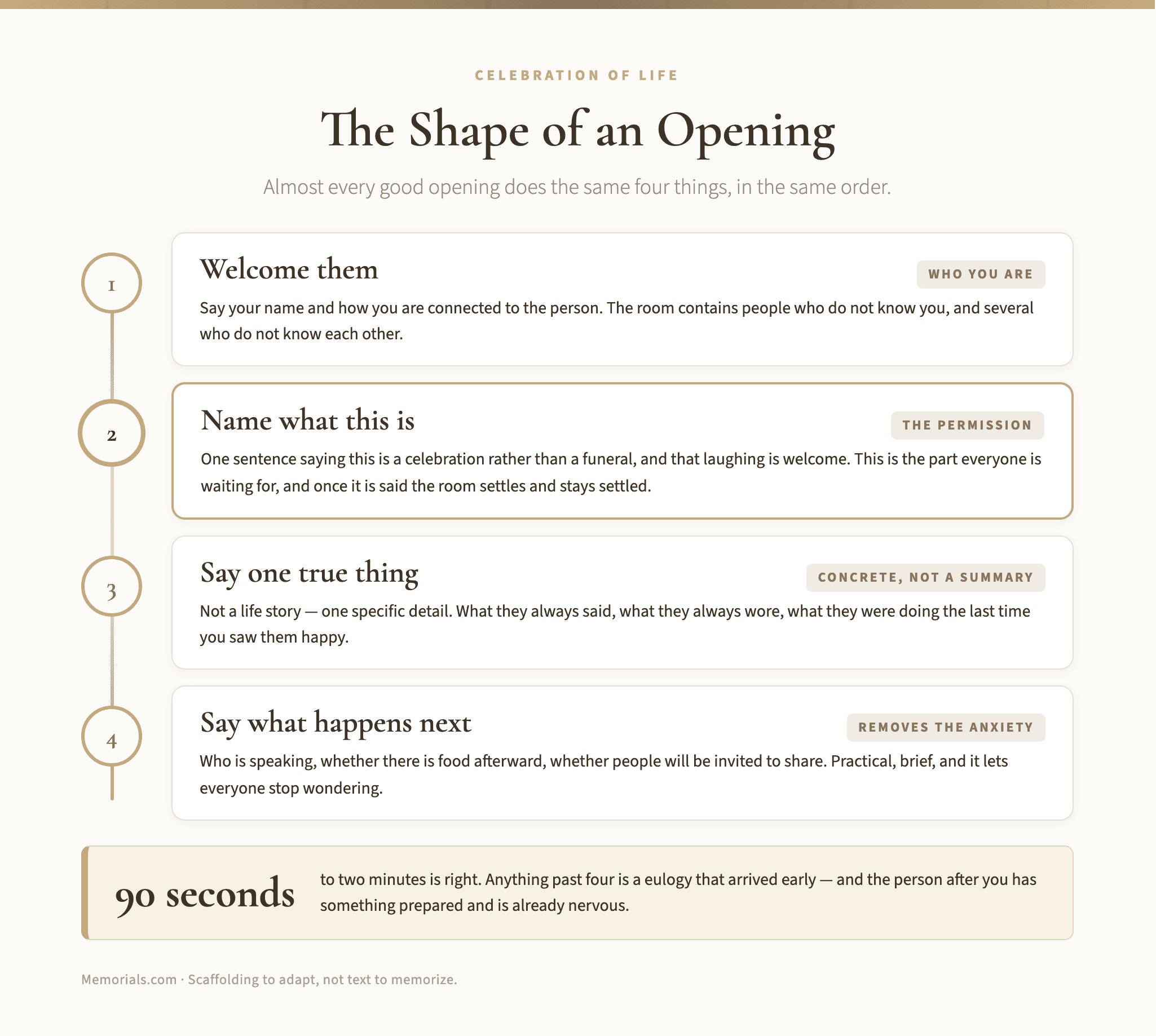
Almost every good opening does four things in the same order.
Welcome them. Say who you are and how you are connected to the person. The room contains people who do not know you.
One sentence saying this is a celebration rather than a funeral, and that laughter is welcome. This is the permission everyone is waiting for.
Say one true thing about the person. Not a summary of their life — one specific, concrete detail.
Say what happens next. Who is speaking, whether there is food afterward, whether people will be invited to share. Practical, brief, and it lets everyone stop wondering.
That is it. Four moves, two minutes.
Four moves, two minutes. The second one is the one the room is actually waiting for — once laughing has been allowed, everything after it goes better.
Celebration of life opening remarks are easier to adapt than to invent. Take any of these and change the details. They are scaffolding, not text to memorize.
If you are family
Thank you all for being here. For those who don't know me, I'm Sarah — Dad's eldest.
He was very clear about what he wanted today, and what he wanted was not a funeral. He wanted people in his garden, eating too much, telling the stories he wasn't around to object to. So that is what this is. Please laugh. He would be furious if you didn't.
Some of you knew him from the shop, some from the bowling league, some of you have known him since school. I don't think any of us knew all of him. That's what this afternoon is for.
We'll hear from a few people, then there's coffee and far too much food in the back room.
If you are a friend speaking for the family
Good afternoon, and thank you for coming. My name is James. Michael and I met in 1987 and I never quite got rid of him.
The family has asked me to say a few words to begin, because they'd like to be able to sit down and just be here today rather than run things.
This is a celebration of life, and Michael was specific about the word. He did not want anybody wearing black on his account and he did not want anybody being careful. Whatever you're feeling is allowed, including the funny bits.
We'll hear from Anna, then from his brother Tom, and then we'd love it if anyone who wants to say something would come up.
If you are an officiant or celebrant
Welcome. My name is Ruth and I have the privilege of leading our gathering today as we remember Eleanor Hughes.
We come together this afternoon not to mark an ending but to take stock of a life — eighty-one years of it, most of them spent making other people's lives easier and saying so very little about it.
There will be moments this afternoon when you feel like crying and moments when you feel like laughing, and both belong here. Eleanor had no patience for solemnity and I do not intend to introduce any on her behalf.
Let us begin.
If it is a small, informal gathering
I'm glad you're all here. I wasn't sure what to call this so I'm not going to call it anything.
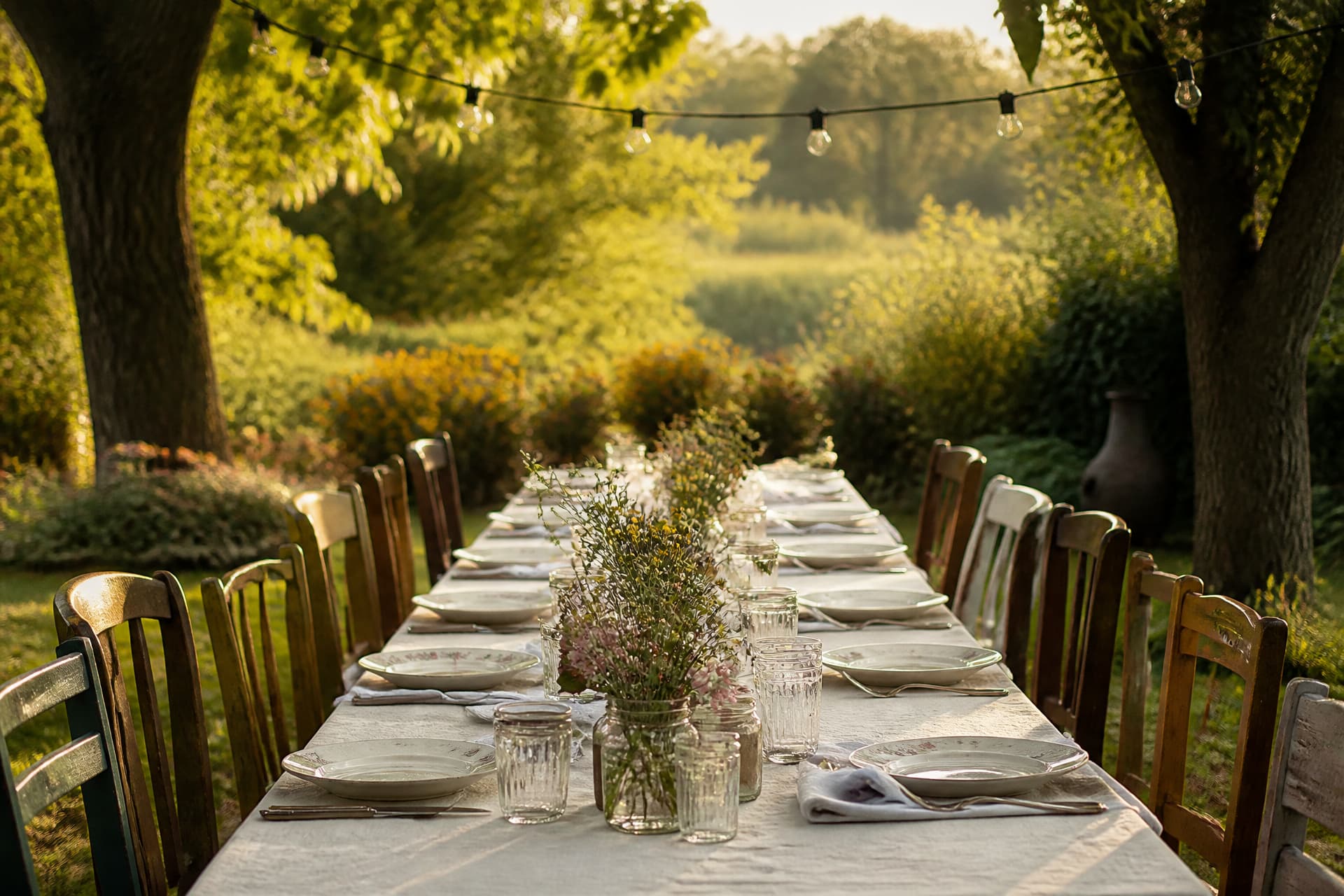
Mom liked this room, she liked these people, and she liked a full table. All three are true right now, which is about as good as it gets.
I'd like to say one thing about her, then I want to hear from you.
How to Begin a Celebration of Life Without a Script
How to begin a celebration of life without notes is a fair question, because some people speak better that way. If that is you, hold three things in your head rather than sentences.
The connection. Who you are to them.
The permission. This is a celebration; laughing is fine.
The detail. One concrete thing — a habit, a phrase, an object.
Then stop. Speaking without notes works precisely as long as you have three things to say and not a minute longer.
Sixteen point or bigger, on paper rather than a phone, on one side only so there is no shuffling. Reading is much harder under stress than people expect.
Opening Lines That Work
For the first sentence specifically, when you need somewhere to start:
"Thank you for being here. I know some of you have come a long way."
"My name is ———, and I had the good fortune to be her son."
"We are not here to be sad today. Or not only sad."
"He planned this himself, which tells you everything about him."
"I've been asked to open, and I'm going to keep it short, because he'd never have forgiven a long speech."
"There are people in this room from every part of her life, and most of you have never met each other."
That last one is one of the best openings available at a celebration of life, because it is almost always true and it tells the room what the afternoon is actually for.
What to Avoid
Reading a biography. Dates, schools, jobs, a chronological march. It is the commonest opening and it is the one that flattens a room fastest. Save the facts for the eulogy, and even there use fewer than you think.
Apologizing for the format. "We know this is unusual, but ——" No. If the family chose a celebration, present it as the right choice, because it was.
Being too careful. The over-cautious opening — every word weighed, nothing risked — signals to the room that this is a place to be careful, and then nobody says anything true for two hours.
Going long. Two minutes. The person after you has something prepared and is already nervous.
Too many quotations. One at most. Our list of celebration of life quotes is grouped by where each line belongs, and the opening is a place where one short line works and three do not.
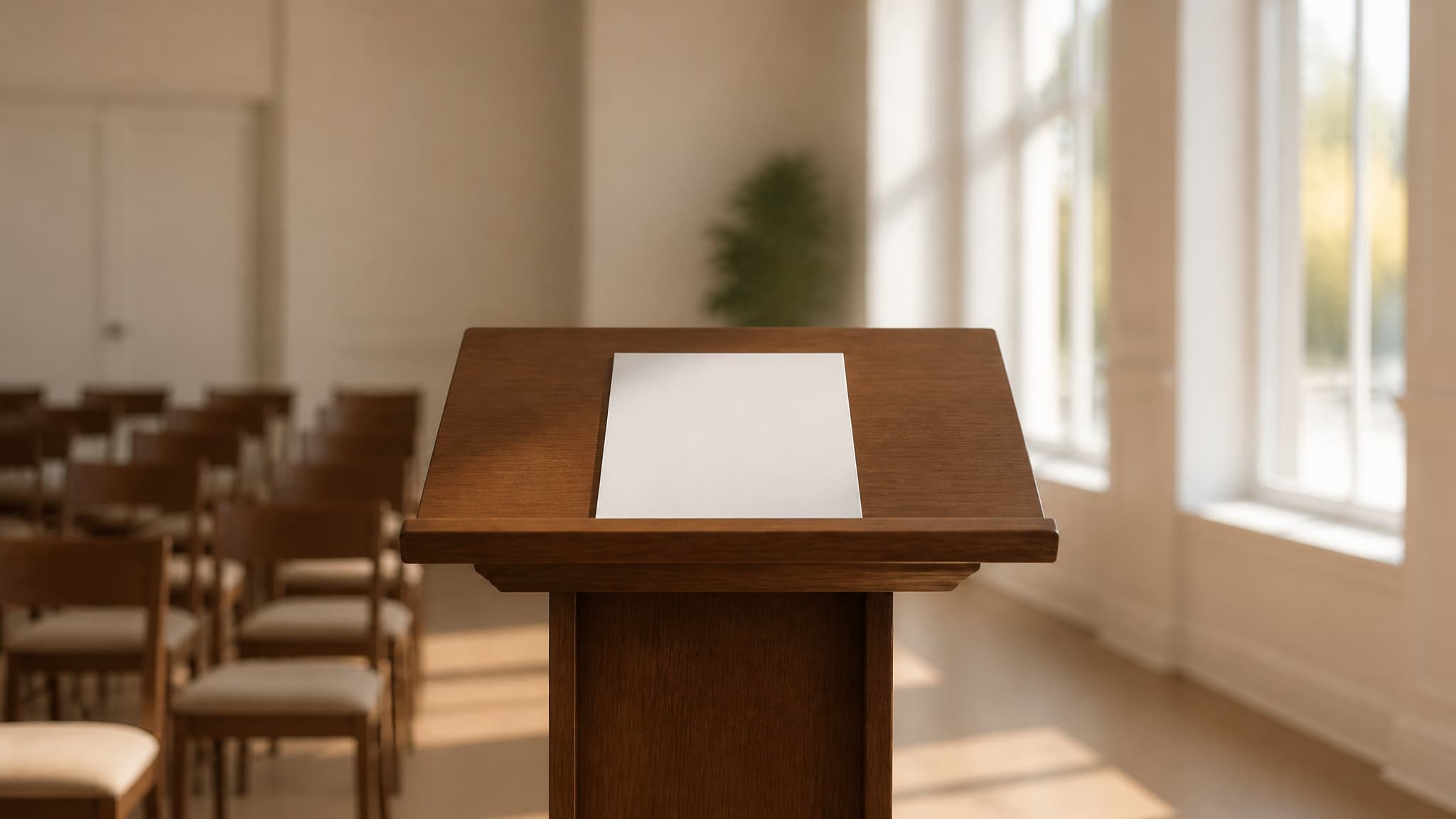
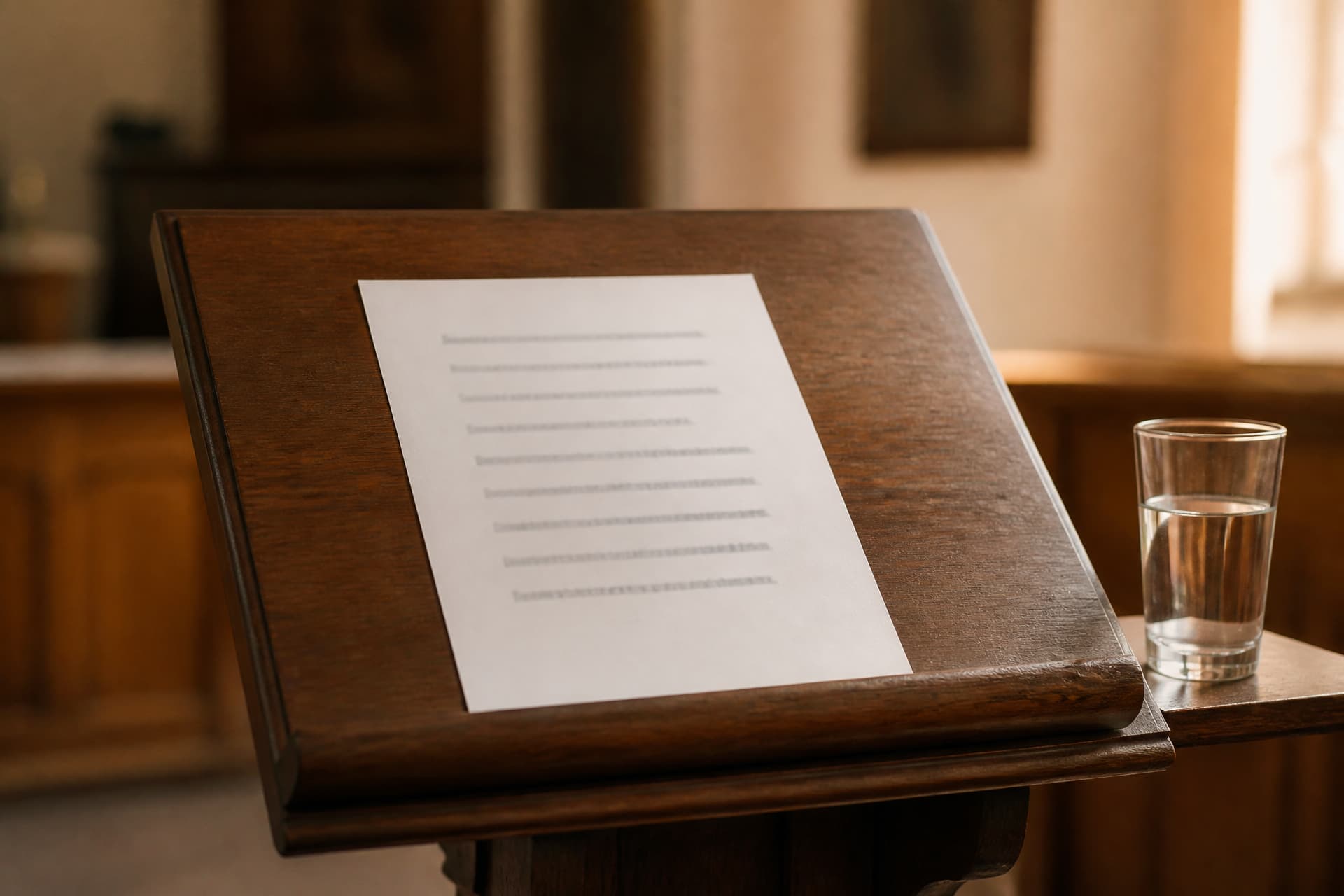
Check the microphone, or decide out loud not to use one — a half-used microphone is worse than none. The water is not for thirst; picking it up is the most natural way to buy ten seconds.
If Your Voice Goes
It might. It happens to most people who do this, and the room is entirely on your side.
Stop. Do not push through a breaking voice; it makes the listening harder, not easier. Pause, breathe once, and continue.
Have water at the lectern. Not for thirst — the pause while you pick it up is the most natural way to buy ten seconds.
Print it large. Sixteen point or bigger, on paper rather than a phone, on one side only so there is no shuffling. Reading is much harder under stress than people expect.
Have a second person ready. Agree with someone beforehand that if you cannot finish, they will come up and read the rest. Knowing there is a net usually means you will not need it.
It is fine to cry. Nobody in that room thinks less of you for it. Several of them are relieved that someone went first.
The room is doing some of this work before you open your mouth. Our celebration of life decoration ideas are organized by what the space has to do rather than by theme.
Practical Notes for the Person Running It
Arrive early enough to stand where you will speak and look at the room. It is a different view from the front.
Check the microphone, or decide out loud not to use one. A half-used microphone is worse than none.
Know who follows you and where they are sitting, so you can look at them when you hand over.
Keep the running order on the lectern, not in your head.
If people will be invited to speak, say so at the start rather than springing it. Invited spontaneity needs warning.
Increasingly the service is not in the week after the death. Families cremate first and gather when everyone can travel — often months later, sometimes on an anniversary or in better weather.
That changes the opening, and for the better. The room is no longer raw. People have had time, and what they want is not comfort but company and permission to remember out loud.
Two adjustments help:
Acknowledge the gap rather than ignoring it. "It has been five months, and some of you have been waiting all that time to do this properly" lands well. What does not land is pretending the death was recent.
Lean further into celebration. The delay usually means the family chose warmth deliberately. A joke in the first minute is safer at a five-month gathering than at a five-day one, and often more welcome.
The rest of the shape is unchanged: welcome, name what this is, one true detail, what happens next.
Increasingly the gathering is months after the death rather than days. The room is no longer raw, and a joke in the first minute is safer at a five-month gathering than at a five-day one.
If You Did Not Know Them Well
Sometimes the person best placed to run the afternoon is not the person who knew them best — a celebrant, a colleague who volunteered, a family friend standing in because nobody closer can face it.
The instinct is to compensate by researching hard and delivering a summary of the life. Resist it. A room full of people who knew them will hear a stranger reciting facts, and it flattens everything.
Do the opposite and say so plainly. "I met Ruth only twice, and both times she tried to feed me" is a better opening than four accurate paragraphs, because it is true, it is yours, and it tells the room you are not pretending.
Then hand the knowing to the people who have it: "There are people here who knew her for sixty years, and you are going to hear from them." The room relaxes immediately, because you have told them the afternoon is not going to be a performance by someone who was not there.
Frequently Asked Questions
How do you start a celebration of life?
Welcome the room, say who you are, name it as a celebration so people know that laughing is allowed, say one specific true thing about the person, and explain what happens next. Ninety seconds to two minutes.
Who gives the opening remarks?
Usually a close family member, a friend speaking on the family's behalf, or a celebrant. If the family would rather sit down and be present, ask a friend — nobody will think it odd.
How long should the opening be?
Two minutes at most. It exists to set the tone and hand over, not to cover the life.
Do you say a prayer at a celebration of life?
Only if the family wants one. Many celebrations are deliberately secular. If there is a prayer, it usually comes after the opening rather than as the first thing said.
What if I cannot get through it?
Stop, breathe, and carry on — or hand to the person you arranged beforehand. It happens constantly and no one minds. Print your words large on paper as insurance.
Should the opening be funny?
It can be, if the person was. A light first minute gives the room permission and often produces the best of the afternoon. Forced humor is worse than none, so use theirs rather than inventing any.
If the service is tomorrow and you have not started, this is the fastest honest route.
Set a timer for five minutes and write the one detail. Not a summary — one
concrete thing. What they always said, what they always wore, what they were doing the last time you saw them happy. Whatever comes first is usually right.
Write the practical sentence. Who speaks after you, and what happens
afterward. Thirty seconds of work and it removes the room's low-level anxiety.
Write the welcome last. It is the easiest part and writing it first is how
people stall. "Thank you all for coming. I'm ———, ———'s daughter" is a complete opening line and needs no improvement.
Read it aloud once, standing up. Not in your head. Sentences that work on
paper sometimes cannot be said, and you want to find that out now.
Print it in 16 point. Then stop working on it. Rewriting it a fourth time at
midnight makes it worse, not better.
Twenty minutes is genuinely enough. The opening does not have to be good. It has to be said by someone who knew them, which you are.
One Last Thing
You are not being judged. Everyone in that room is grateful it is not them standing up, and they will remember that you did it far more clearly than they remember what you said.
Say the person's name, tell the room what kind of day this is, and sit down. That is the whole job, and it is enough. Our funeral planning guide covers everything around it.