🏬Supersize Online Funeral Retailer🪦1000's of Headstones⚱️Over 10,000 Cremation Urns⚰️Caskets Overnight Delivery🛒Funeral & Memorial Superstore🚚FREE Shipping on ALL Orders👨👩👧👦Helping Families for over 20 Years💰Lowest Price Guarantee🏬Supersize Online Funeral Retailer🪦1000's of Headstones⚱️Over 10,000 Cremation Urns⚰️Caskets Overnight Delivery🛒Funeral & Memorial Superstore🚚FREE Shipping on ALL Orders👨👩👧👦Helping Families for over 20 Years💰Lowest Price Guarantee
🏬Supersize Online Funeral Retailer🪦1000's of Headstones⚱️Over 10,000 Cremation Urns⚰️Caskets Overnight Delivery🛒Funeral & Memorial Superstore🚚FREE Shipping on ALL Orders👨👩👧👦Helping Families for over 20 Years💰Lowest Price Guarantee🏬Supersize Online Funeral Retailer🪦1000's of Headstones⚱️Over 10,000 Cremation Urns⚰️Caskets Overnight Delivery🛒Funeral & Memorial Superstore🚚FREE Shipping on ALL Orders👨👩👧👦Helping Families for over 20 Years💰Lowest Price Guarantee
Celebration of life quotes do a different job from funeral quotes, and the difference is worth naming before you start choosing. A funeral reading acknowledges loss. A celebration of life reading is meant to sound like the person — which usually means warmer, often means funnier, and almost always means shorter.
The quotes below are grouped by where they go, because that is the decision you are actually making. A line for the front of a program has to work in six words. A line to open a eulogy has to survive being said aloud by someone whose voice is going.
One practical note that most lists skip: not everything you find online is free to reprint. There is a short section on that at the end, and it matters more than people expect for printed programs.
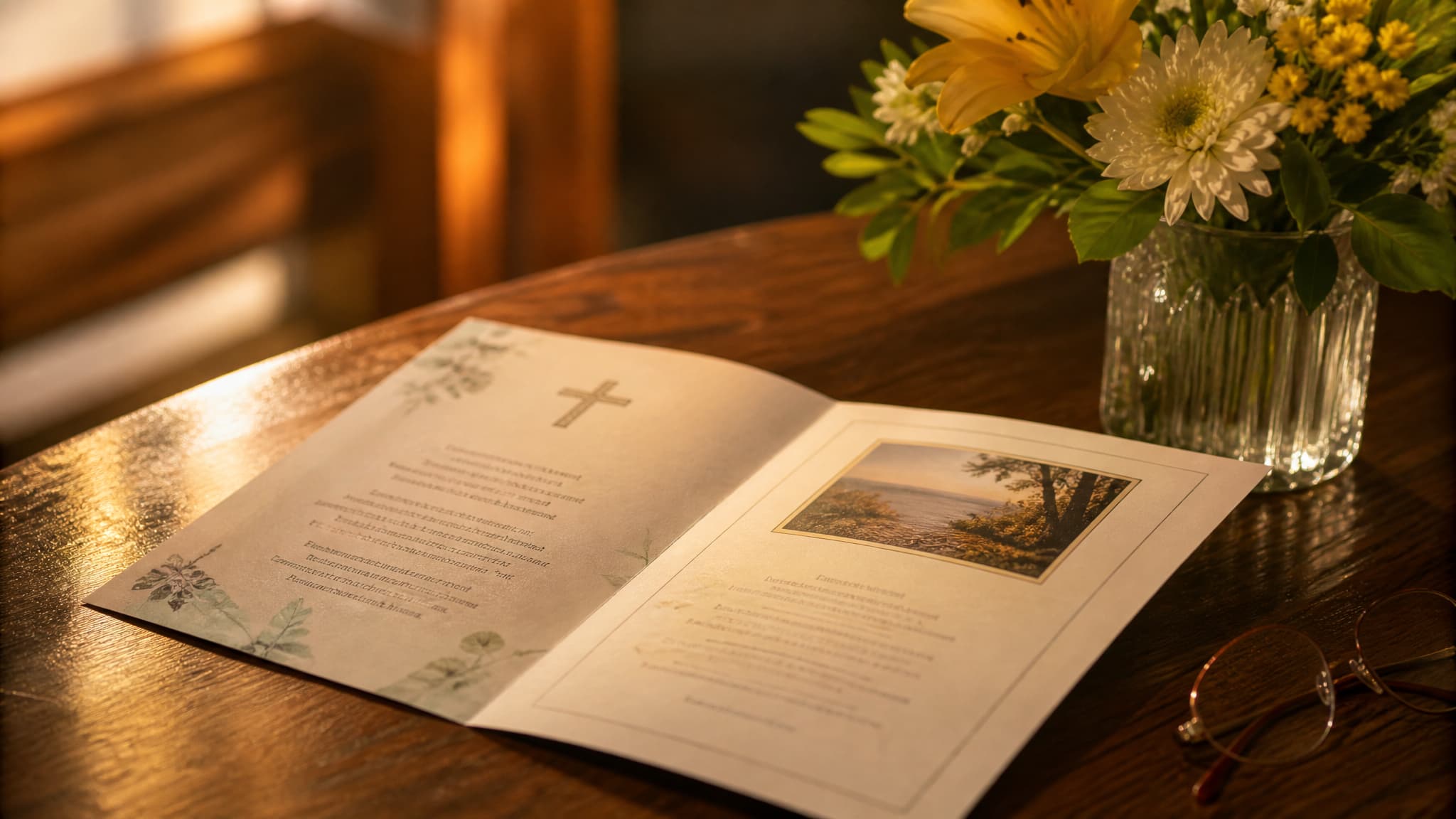
For the Front of a Program
Short, and it has to hold up in large type with nothing around it.
"To live in hearts we leave behind is not to die." — Thomas Campbell
"Say not in grief he is no more, but live in thankfulness that he was." — Hebrew proverb
"What we have once enjoyed we can never lose." — commonly attributed to Helen Keller
"The song is ended, but the melody lingers on." — Irving Berlin. A song title and lyric; in copyright.
"Grief is the price we pay for love."
"Well lived, well loved, well remembered."
"A life measured in love, not years."
"He did not leave. He simply finished."
The shortest ones are usually the best ones here, because the program already carries a name and two dates. The quote is not doing the work of introduction.
The highest-value slot you have. A line on the front of the program is read by everyone, alone, in silence, before anything begins.
Something with a little more room in it, and ideally something that sets up what you are about to say rather than standing alone.
"Do not stand at my grave and weep; I am not there, I do not sleep." — Mary Elizabeth Frye. Still in copyright — see the note below before reprinting it.
"Perhaps they are not stars, but rather openings in heaven where the love of our lost ones pours through and shines down upon us." — Inuit proverb
"The life of the dead is placed in the memory of the living." — Cicero
"Life is not measured by the number of breaths we take, but by the moments that take our breath away."
"To weep is to make less the depth of grief." — Shakespeare, Henry VI, Part 3
"Nothing that is worth doing can be achieved in our lifetime; therefore we must be saved by hope." — Reinhold Niebuhr
A quote at the top of a eulogy works best when you follow it with a sentence about why you chose it. "She had this on a card above the sink for thirty years" does more than the quote itself.
Uplifting Memorial Quotes for a Slideshow or a Display Board
Uplifting memorial quotes work hardest here. They sit under photographs and compete with them, so they need to be legible at a glance and not too solemn for a smiling picture.
"Not how did he die, but how did he live."
"She left the world better than she found it."
"Some people arrive and make such a beautiful impact on your life, you can barely remember what life was like without them."
"The best way to remember him is to do the things he loved."
"Every man's memory is his private literature." — Aldous Huxley
"There is no cure for birth and death save to enjoy the interval." — George Santayana
On a board or a slideshow a quote competes with the photographs and usually loses. One line, large, on its own.
Celebration of Life Sayings That Sound Like a Person
The best celebration of life sayings are not famous at all. Most families eventually discard the quotations and use something the person actually said. This is nearly always the better choice, and it is the one thing no list can supply.
Ways to find it:
The phrase they always used. Every family has one. It is usually funny and slightly exasperating and will make the room laugh in the right way.
A line from a letter, card or text message. People write more plainly than they speak, and a sentence from a birthday card can be the truest thing in the program.
Something from their work or hobby. A gardener's note about a plant. A coach's pre-game line. A recipe card in their handwriting, reproduced as an image.
A song lyric they loved — with the caveat in the next section.
If you are hesitating between a Cicero and something your father said about fishing, use the fishing line.
Life Celebration Words: Secular Options
Life celebration words do not have to be religious ones. Not every family wants scripture, and a celebration of life in particular is often chosen precisely to avoid a liturgical frame. These carry weight without religious content.
"We are all just walking each other home." — Ram Dass. Modern and in copyright.
"What is remembered, lives."
"To the world you may be one person, but to one person you may be the world."
"It is not length of life, but depth of life." — Ralph Waldo Emerson
"I would rather be ashes than dust." — Jack London
"The world is a better place because you were in it."
For Religious Services
If the celebration is held in a church or the family would like scripture, these are the passages most often read. All are public domain in the King James Version.
"The Lord is my shepherd; I shall not want." — Psalm 23:1
"To every thing there is a season, and a time to every purpose under the heaven." — Ecclesiastes 3:1
"I have fought a good fight, I have finished my course, I have kept the faith." — 2 Timothy 4:7
"Blessed are they that mourn: for they shall be comforted." — Matthew 5:4
"He shall wipe away all tears from their eyes; and there shall be no more death." — Revelation 21:4
Modern translations of scripture are under copyright even though the underlying text is ancient. The King James Version is public domain in the United States; the NIV, ESV and NRSV are not, and reprinting more than a short passage requires permission.
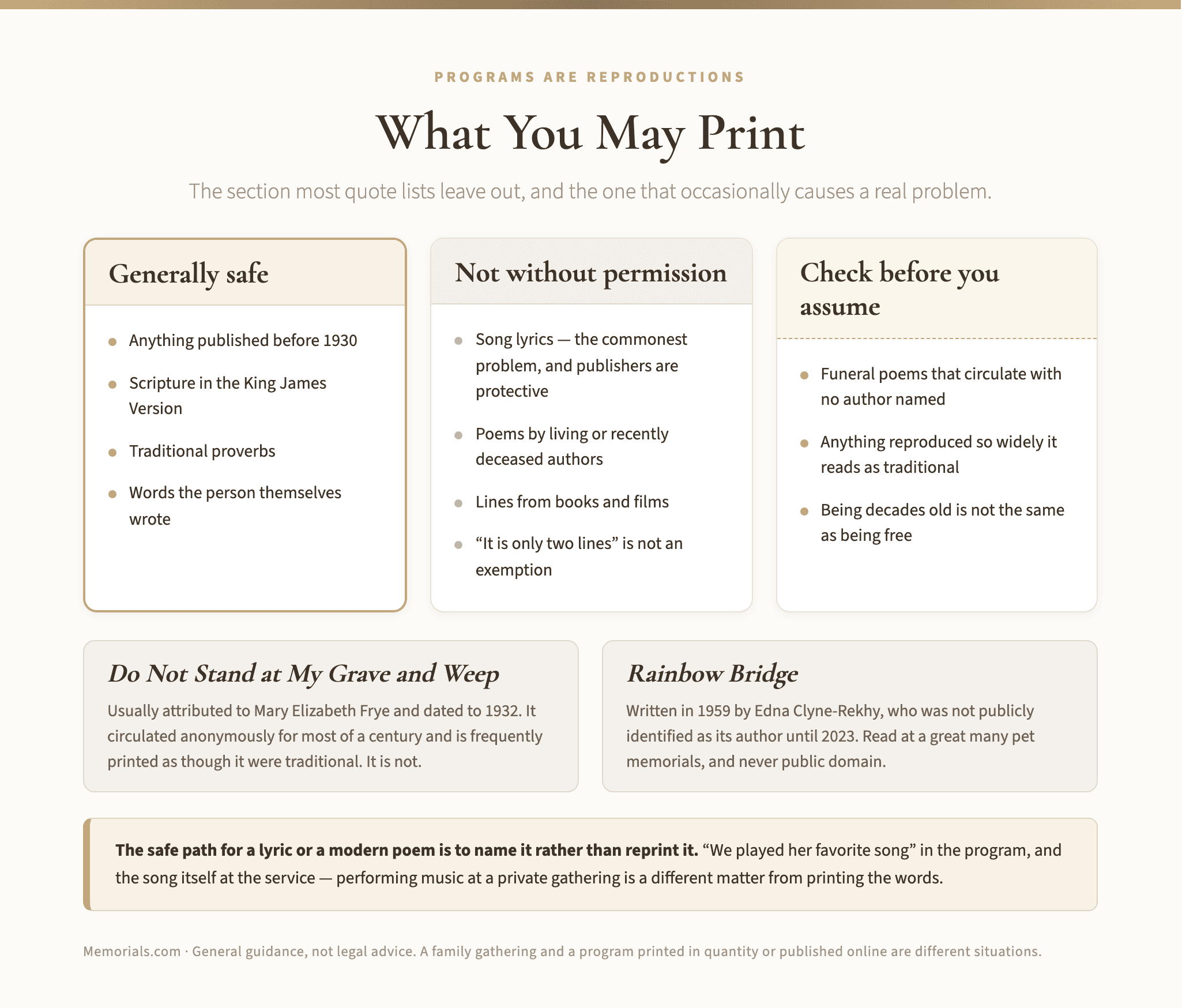
A Word About Copyright, Because Programs Are Printed
This is the section most quote lists leave out, and it is the one that occasionally causes a real problem.
A printed program is a reproduction. For a family gathering, nobody is going to object — but the rules are worth knowing, particularly if the program is going online, being printed in quantity, or reproduced by a business.
Generally safe: anything published before 1930, scripture in the King James Version, traditional proverbs, and words the person themselves wrote.
Not safe without permission: song lyrics, poems by living or recently deceased authors, and lines from books and films. Song lyrics are the commonest problem — music publishers are notably protective, and "it is only two lines" is not an exemption.
Frequently misunderstood: several of the most-shared funeral poems are still in copyright despite circulating for decades as though they were folk texts. If a poem is widely reproduced online with no author named, that is a sign to check rather than a sign it is free.
Two examples, both marked in the lists above. Do Not Stand at My Grave and Weep is usually attributed to Mary Elizabeth Frye and dated to 1932; it circulated anonymously for most of a century and is frequently printed as though it were traditional. It is not. The Rainbow Bridge poem, read at a great many pet memorials, is a similar case — written in 1959 by Edna Clyne-Rekhy, who was not publicly identified as its author until 2023, and it has never been public domain.
Quoting a line in an article like this one, with attribution, is ordinary editorial use. Reprinting a whole poem on a program you are producing in quantity is a different act, and the fact that everybody does it is not the same as being entitled to.
The safe path for a lyric or a modern poem is to name it rather than reprint it — "we played her favorite song" in the program, and the song at the service. Performing music at a private gathering is a different matter from printing the words.
A printed program is a reproduction. For a family gathering nobody will object, but the rules matter if the program goes online, is printed in quantity, or is produced by a business.
How Many Quotes Do You Actually Need?
Fewer than you think. A typical celebration of life uses:
One on the front of the program
One to open the eulogy, if the speaker wants one
One or two in a slideshow
Sometimes one on a memorial card or bookmark for guests to take
That is three or four in total. A program crowded with quotations reads as though nobody knew what to say, which is the opposite of the intended effect. Our guide to celebration of life cards covers the take-home piece, and the celebration of life planning guide covers the event itself.
If you are the person who has to stand up and say it, three things help.
Read it slowly, and once only. A quote read twice sounds like a lesson. Read once, then pause before you go on — the pause is what tells the room it mattered.
Do not explain it. The instinct is to justify the choice, and it deflates the line. If the quote needs explaining, it is the wrong quote.
Have it printed large, on its own card. Not on your phone, not at the bottom of a page of notes. Eyes fail under stress in ways that surprise people, and a 16-point line on an index card is the difference between saying it and searching for it.
And if your voice goes, stop and start again. Every room understands. Nobody has ever left a funeral thinking less of someone who could not get through it.
Spoken aloud, a line has to survive being said by a nervous person. Short, plain sentences work; anything with a subordinate clause does not.
Where to Put the One You Choose
A quote does different work depending on where it lands, and the same line can be perfect in one place and forgettable in another.
On the front of the program, it is read by everyone, alone, in silence, before anything starts. It sets the register for the whole afternoon and it is the highest-value slot you have.
Spoken aloud at the opening, it has to survive being said by a nervous person. Short, plain sentences work; anything with a subordinate clause does not.
At the end of a eulogy, it is a landing place, and its job is to let the speaker stop. This is the one spot where a slightly more formal line earns its keep.
On a display board or a slideshow, it competes with photographs and usually loses. One line, large, on its own slide.
Frequently Asked Questions
What is a good quote for a celebration of life?
One that sounds like the person rather than like a greeting card. If you are choosing between a famous line and something they actually used to say, use theirs. Where a famous quote is wanted, short is better — a program already carries the name and dates.
What is the difference between funeral quotes and celebration of life quotes?
Tone. Funeral readings tend to acknowledge grief directly; celebration of life readings tend to be warmer, sometimes funny, and focused on the life rather than the loss. Many of the same lines work for both, read differently.
Can I use song lyrics in a memorial program?
Legally, not without permission — lyrics are among the most tightly protected copyrighted material, and music publishers pursue reproduction. For a small family printing nobody is likely to object, but if the program goes online or is printed in volume, name the song rather than quoting it.
Are Bible verses free to use?
The King James Version is public domain in the United States and may be reprinted freely. Modern translations including the NIV and ESV are under copyright, and reprinting beyond a short passage requires permission from the publisher.
How long should a celebration of life quote be?
For a program cover, under ten words. For a eulogy opening, one or two sentences. Anything longer competes with the speaker rather than introducing them.
Where do the quotes go?
Usually the program cover, the opening of the eulogy, a slideshow, and a memorial keepsake. Three or four across the whole service is plenty.
The quote is the smallest decision on a long list, and families sometimes spend an evening on it because it is the one decision that feels like it can be got right.
It can be. But the room will remember the person who stood up and said something true about the deceased far longer than it will remember the line printed under their photograph. Choose something quickly, and spend the time on the eulogy instead. The quote is the frame; the eulogy is the picture.