🏬Supersize Online Funeral Retailer🪦1000's of Headstones⚱️Over 10,000 Cremation Urns⚰️Caskets Overnight Delivery🛒Funeral & Memorial Superstore🚚FREE Shipping on ALL Orders👨👩👧👦Helping Families for over 20 Years💰Lowest Price Guarantee🏬Supersize Online Funeral Retailer🪦1000's of Headstones⚱️Over 10,000 Cremation Urns⚰️Caskets Overnight Delivery🛒Funeral & Memorial Superstore🚚FREE Shipping on ALL Orders👨👩👧👦Helping Families for over 20 Years💰Lowest Price Guarantee
🏬Supersize Online Funeral Retailer🪦1000's of Headstones⚱️Over 10,000 Cremation Urns⚰️Caskets Overnight Delivery🛒Funeral & Memorial Superstore🚚FREE Shipping on ALL Orders👨👩👧👦Helping Families for over 20 Years💰Lowest Price Guarantee🏬Supersize Online Funeral Retailer🪦1000's of Headstones⚱️Over 10,000 Cremation Urns⚰️Caskets Overnight Delivery🛒Funeral & Memorial Superstore🚚FREE Shipping on ALL Orders👨👩👧👦Helping Families for over 20 Years💰Lowest Price Guarantee
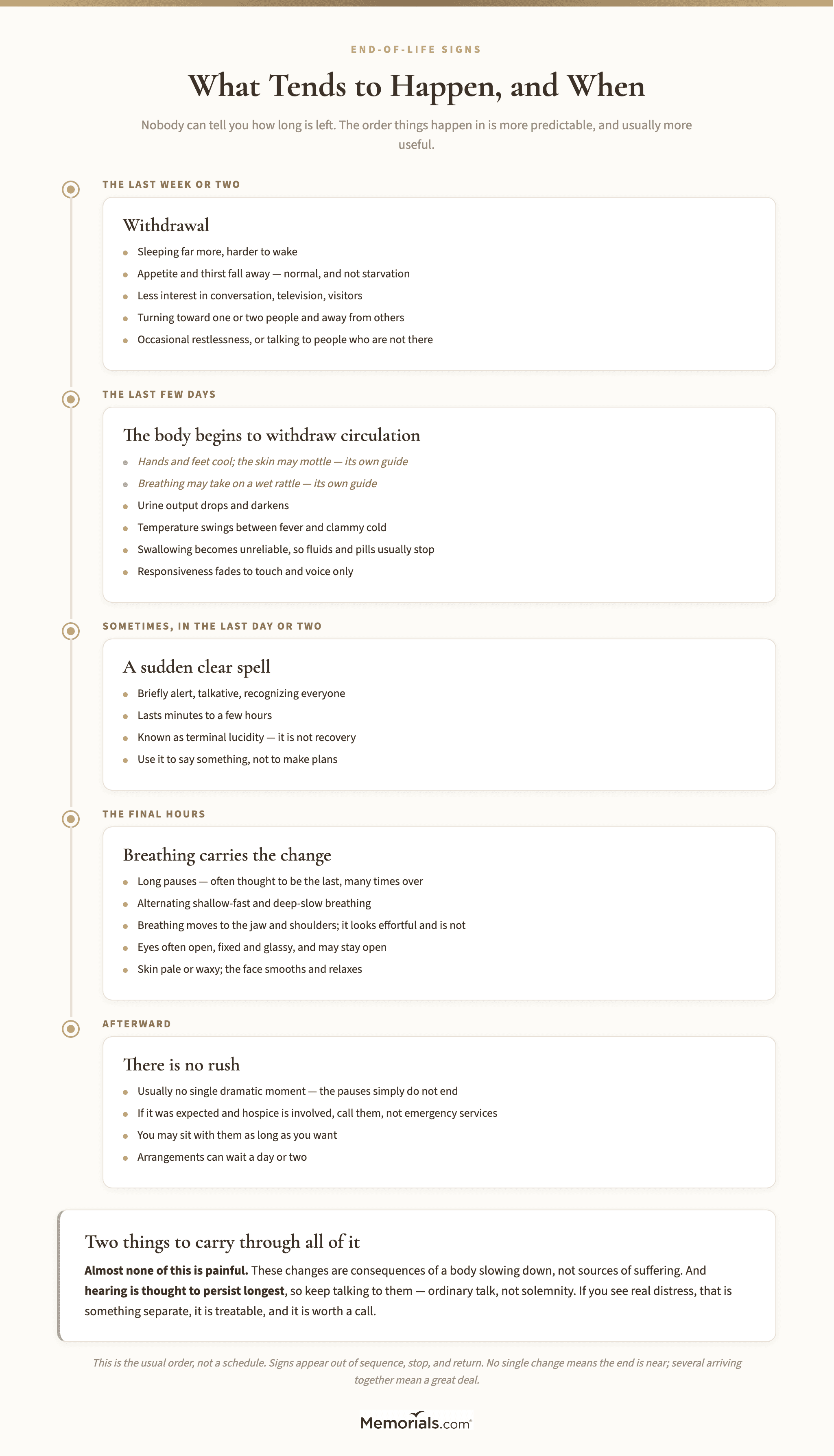
Nobody can tell you exactly how long is left, and anyone who offers a number is guessing. What can be described is the order things tend to happen in — and for most families that turns out to be the more useful thing anyway. In the 48 hours before death, a fairly consistent set of changes appears, and knowing what is coming makes each one less frightening when it arrives.
This article is part of our grief support guide. It walks forward through time rather than listing symptoms: the last week or two, the last few days, the final hours, and the minutes after. Individual signs appear where they usually fall.
Two things to carry through all of it. Most of these changes are not painful. And hearing is thought to persist longer than anything else, so it is always worth talking to them.
You may hear staff use the phrase, and most families are too polite to ask.
Actively dying is the clinical term for the final phase — usually the last few days, sometimes the last hours — when the body's systems are shutting down in a recognizable pattern. It is a description of where someone is, not a prediction of when they will get to the end. Nurses use it to mean "the changes we expect at the very end have begun," and it is a signal to gather people rather than a countdown.
Nobody minds being asked what they mean. "Is she actively dying?" is a normal question and staff answer it directly.
The Last Week or Two
Changes at this stage are mostly about withdrawal, and they are easy to misread as choice.
Sleep grows and waking shrinks. Long stretches asleep, harder to rouse, shorter periods of alertness. This is the body conserving what it has.
Appetite and thirst fall away. Food stops appealing, then stops being accepted. This is one of the hardest things for families, because feeding someone is love — but the body no longer processes food usefully, and forcing it causes discomfort rather than strength. Reduced intake at this stage is protective, not a cause of decline.
Interest narrows. Conversation shortens. The television goes off. Visitors become tiring rather than welcome. People often turn toward one or two individuals and away from everyone else. It is not rejection, and it is worth telling the family members who take it that way.
Restlessness or confusion may come and go. Some people become briefly agitated, pluck at bedding, or talk to people who are not in the room — often people who died long ago. This is common, usually not frightening to them, and many families later find it a comfort.
The Last Few Days
This is where the physical signs become visible, and where the question changes from is this happening to how close is it.
Circulation begins to withdraw from the extremities. Hands and feet turn cool, and the skin may show mottling — a lacy, purple-red pattern that starts at the feet and knees. Breathing becomes irregular, with pauses that can last many seconds, and may take on a wet, rattling sound families call the death rattle. Both have their own guides, because both look far worse than they are.
Alongside those:
Urine output drops and darkens. The kidneys are slowing.
Body temperature swings. Fever, then cool and clammy, sometimes within the same hour.
Swallowing becomes unreliable, which is why fluids and pills are usually stopped rather than pushed.
Responsiveness fades. Fewer words, then none; then response only to touch or voice.
If you are asking how to know when a hospice patient is dying, this cluster is the answer — several of these changes together, not any single one. One sign on its own tells you little. Four or five arriving in the same day tell you a great deal.
The Sudden Clear Spell
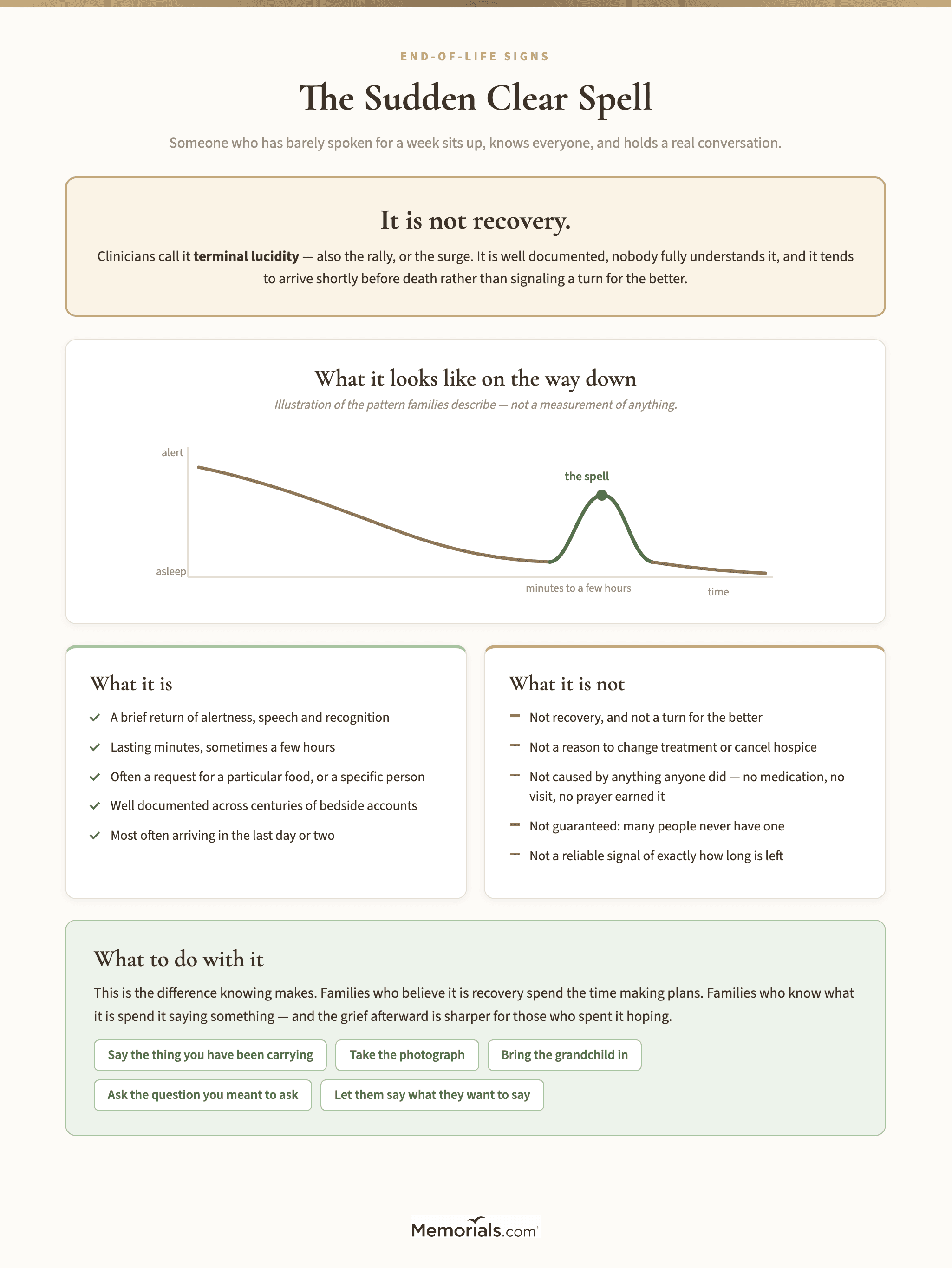
Sometimes, often in the last day or two, someone who has barely spoken for a week will sit up, ask for a particular food, recognize everyone in the room, and hold a real conversation. It can last minutes or a few hours.
Families almost universally read this as recovery. It is not.
The phenomenon is well recognized, and what is the burst of energy before death called is one of the most common questions asked about it. Clinicians call it terminal lucidity, or sometimes the rally or the surge. Nobody fully understands the mechanism. What is consistent is the timing: it tends to arrive shortly before death rather than signaling a turn for the better.
This is worth knowing in advance, because it changes what you do with it. Families who believe it is recovery use the time to make plans. Families who know what it is use it to say something. If it happens, say the thing you have been carrying. Take the photograph. Bring the grandchild in. It is a gift with a short window, and the grief afterward is sharper for people who spent it hoping.
The Eyes
Almost nobody warns families about the eyes, and it is one of the most distressing things to encounter unprepared.
The eyes of a dying person change in several ways at once. Blinking slows and then largely stops, so the surface dries and takes on a wet, filmy sheen. Glassy eyes before death are the result — not tears, not crying, simply an unblinking surface catching the light.
The gaze changes too. Fixed eyes — a stare that does not track, does not focus, and does not follow you around the room — are normal at this stage. The person is not ignoring you and is not frightened; the muscles and the attention that aim a gaze have simply gone quiet with everything else. You may also see the eyes drift apart slightly, or one lid sit lower than the other.
And the part that catches people hardest: the eyes often stay open, and often stay open after death. Lids that no longer close are a matter of muscle tone rather than awareness. It is extremely common. Staff will close them afterward if you would like, and you can ask for that without explaining why.
Keeping the eyes comfortable is simple — the care team can supply lubricating drops or gel, and a cool damp cloth over closed lids is soothing. There is nothing to fix here, only to ease.
There is nothing to fix here, only to ease.
The Final Hours
Breathing carries most of the change now.
Long pauses grow longer — fifteen, thirty, sometimes more than a minute — and families frequently think each one is the last, several times, over hours. Between pauses, breathing may be shallow and fast, or deep and slow. The pattern that alternates between the two has a name (Cheyne-Stokes) and is expected.
Breathing may also move to the jaw and shoulders, with the mouth opening on each breath. It looks effortful. It is not experienced as effort by someone unconscious, and it does not mean they are struggling.
The skin grows paler or waxy, sometimes bluish at the lips and fingertips. The mottling spreads. The body relaxes — the jaw slackens, the face smooths, and many families remark that the person looks younger.
And then the pauses simply do not end. There is very often no dramatic moment. Most people describe realizing gradually, over a minute or two, that the last breath has already happened.
Most of it happens quietly, and usually there is no single moment.
What You Can Do
Keep talking to them. Hearing is thought to persist to the very end, and there is no cost to assuming it does. Say the ordinary things.
Touch them. Hold a hand, stroke a forehead. Skin is fragile, so be gentle, but contact is welcome.
Keep the room quiet and low-lit, and keep the number of people manageable.
Take turns. Vigils run long, and people who do not sleep at all are not more useful.
Say what you need to say. There is no rule against telling someone it is all right to go, and many families find they wanted to.
Do not force food or fluids. Mouth care with a swab does more for comfort than anything you can pour.
Call. Teams expect it, and the commonest regret afterward is having waited so as not to be a bother.
Any sign of pain or distress — grimacing, restlessness, agitation, guarding. All treatable.
Breathing that changes character — gasping, a sudden struggle, or a new wet rattle.
You think it is very close and want someone present.
You are frightened, or alone, or cannot do this by yourself. A complete reason.
After the death. If it is expected and hospice is involved, you call them and not emergency services.
Afterward
There is no rush. This surprises almost everyone.
If the death was expected and hospice is involved, nothing has to happen in the next hour. You can sit with them. You can open a window, or say a prayer, or call one person and nobody else yet. The team will talk you through what comes next when you are ready, and the funeral home is not waiting on a clock.
Many families later say the thing they wish someone had told them was simply that they were allowed to stay a while.
The house fills and empties for days. None of it has to be dealt with today.
When you are ready to think about arrangements — a day or two later is normal — our funeral planning guide sets out the practical steps in the order they actually arise.
Frequently Asked Questions
What happens in the 48 hours before death?
Breathing becomes irregular with long pauses, responsiveness fades to little or none, the skin cools and may mottle, urine output drops, and the person sleeps almost continuously. A brief spell of unexpected alertness sometimes appears. Most of these changes are not painful, and hearing is thought to persist throughout.
What does actively dying mean?
It is the clinical term for the final phase, usually the last days or hours, when the body's systems are shutting down in a recognized pattern. It describes where someone is rather than predicting when the end will come. It is a reasonable thing to ask staff directly.
Why are the eyes open, and why do they look glassy?
Blinking slows and stops, so the surface dries and catches the light. Muscle tone fades, so the lids may not close and the gaze no longer tracks. Both are normal and neither indicates awareness or distress. Eyes very often remain open after death, and staff will close them if you ask.
What is the sudden burst of energy before death?
Terminal lucidity — sometimes called the rally or the surge. Someone who has been unresponsive becomes briefly alert, talkative and recognizable, for minutes or a few hours. It is well documented, it does not signal recovery, and it usually arrives shortly before death. Treat it as a chance to say something rather than a reason to hope.
How do I know when death is close?
By a cluster of changes rather than any single one. Several of these arriving together — deep unresponsiveness, long breathing pauses, cool mottled skin, minimal urine output, an inability to swallow — indicate the final phase. The care team can tell you what they are seeing, and asking them directly is better than reading the signs alone.
Is any of this painful for them?
The changes themselves are not. Reduced breathing, cooling skin, the sounds and the stillness are consequences of systems slowing rather than sources of pain. Genuine distress looks different — grimacing, restlessness, visible effort — it is treatable, and it should always be reported.
Should we keep talking to them?
Yes. Hearing is widely believed to persist longer than other senses, and there is no cost to assuming it does. Ordinary talk is fine and often better than solemnity. Say the things you want said.