🏬Supersize Online Funeral Retailer🪦1000's of Headstones⚱️Over 10,000 Cremation Urns⚰️Caskets Overnight Delivery🛒Funeral & Memorial Superstore🚚FREE Shipping on ALL Orders👨👩👧👦Helping Families for over 20 Years💰Lowest Price Guarantee🏬Supersize Online Funeral Retailer🪦1000's of Headstones⚱️Over 10,000 Cremation Urns⚰️Caskets Overnight Delivery🛒Funeral & Memorial Superstore🚚FREE Shipping on ALL Orders👨👩👧👦Helping Families for over 20 Years💰Lowest Price Guarantee
🏬Supersize Online Funeral Retailer🪦1000's of Headstones⚱️Over 10,000 Cremation Urns⚰️Caskets Overnight Delivery🛒Funeral & Memorial Superstore🚚FREE Shipping on ALL Orders👨👩👧👦Helping Families for over 20 Years💰Lowest Price Guarantee🏬Supersize Online Funeral Retailer🪦1000's of Headstones⚱️Over 10,000 Cremation Urns⚰️Caskets Overnight Delivery🛒Funeral & Memorial Superstore🚚FREE Shipping on ALL Orders👨👩👧👦Helping Families for over 20 Years💰Lowest Price Guarantee
If you have just heard it, here is the answer first, because the question underneath is frightening and it deserves not to wait: they are not drowning, they are not choking, and they are not suffocating. Death rattle breathing is the sound of saliva and secretions collecting at the back of the throat in someone too deeply unconscious to clear them. The sound is alarming. What is happening is not.
This article is part of our grief support guide. It explains what the sound is, what helps, what does not help, and the thing that most needs saying: this almost certainly distresses you far more than it distresses them.
What Is a Death Rattle?
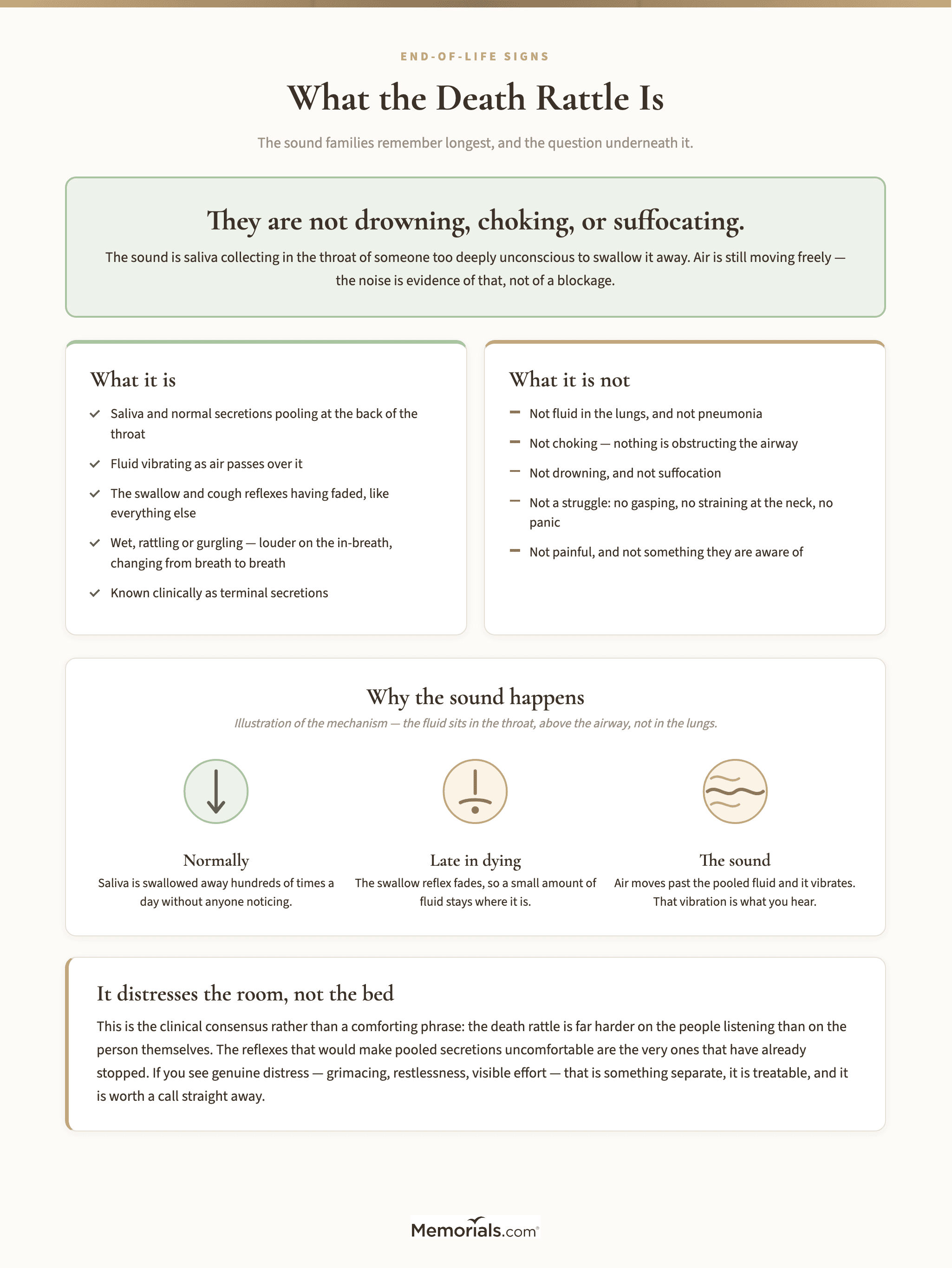
The short answer to what is a death rattle is that it is the sound of fluid the body can no longer clear. The longer answer starts with swallowing.
Swallowing is something the body does constantly without being asked — a small clearing of the throat perhaps hundreds of times a day. Late in the dying process, the reflexes that manage it fade along with everything else. Saliva and normal airway secretions keep being produced, but they are no longer being swallowed or coughed away, so a small amount pools in the upper airway.
Each breath then moves air past that pooled fluid, and the fluid vibrates. That vibration is the sound. Clinicians call the fluid itself terminal secretions, and the sound is often written in charts as noisy breathing at end of life.
Two things follow from that, and both matter:
The fluid is in the throat, not the lungs. This is not fluid filling the lungs and it is not pneumonia. It sits above the airway, in the space the person can no longer clear.
Air is still moving. The sound is proof of air passing, not of air being blocked. It is the opposite of an obstruction.
What It Sounds Like
There is no recording here, and that is deliberate — but the sound is describable, and most people find that recognizing it helps.
It is wet. A rattling, gurgling, or crackling noise that seems to come from the throat rather than the chest. It usually rises and falls with each breath, and is often louder on the in-breath than the out.
It is irregular. Volume changes from breath to breath. It can be loud for twenty minutes and then almost disappear. It very often changes when the person is repositioned, which is the single most useful thing to know about it.
It is not a wheeze, not a whistle, not a cough, and not a struggle. There is no gasping, no straining at the neck or shoulders, no panic on the face. If you are seeing any of those, that is something different and it should be reported straight away.
Many families say afterward that the sound was the hardest part of the whole vigil — harder than the silence that followed. If that is where you are, you are in ordinary company.
The sound is the part most families remember. Sitting with it is harder than anyone expects.
Is the Death Rattle Painful or Distressing to Them?
Almost certainly not, and this is the closest thing to consensus that exists in end-of-life care.
By the time this sound appears, the person is nearly always deeply unconscious. The reflexes that would make secretions uncomfortable — the urge to cough, the urge to clear the throat — are the very reflexes that have stopped working. There is no sensation of choking, because choking is a conscious experience of blocked air, and the air is not blocked.
Hospice and palliative teams are consistent on this: the death rattle is far more distressing to the people in the room than to the person in the bed. That is not a reassuring phrase invented for families. It is the clinical assessment, and it is why the treatment decisions below are made mostly for your sake rather than theirs.
If the person does show genuine distress — a furrowed brow, restlessness, agitation, visible effort — that is a separate matter, it is treatable, and it is worth a call immediately.
What Helps
Some of this is worth doing. Some of it is worth deliberately not doing, which is harder.
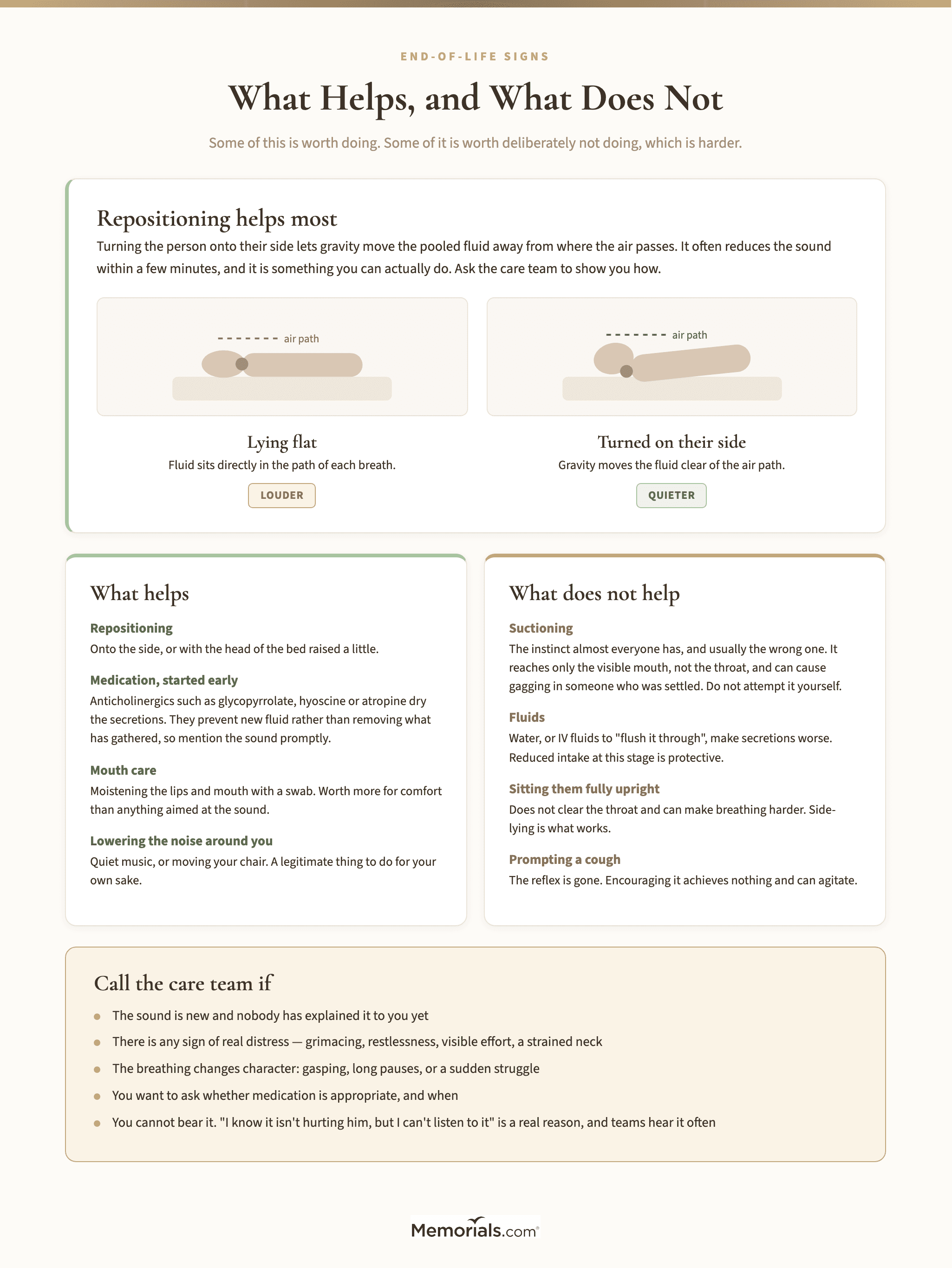
Repositioning helps most. Turning the person onto their side, or raising the head of the bed, lets gravity move the pooled fluid away from where the air passes. It often reduces the sound noticeably within a few minutes. Ask the care team to show you how to do it safely — it is usually easier than families expect, and it is something you can actually do.
Medication can reduce the secretions. Anticholinergic drugs such as glycopyrrolate, hyoscine (scopolamine) or atropine dry them up. They work better started early than late, because they prevent new secretions rather than removing what has already gathered — so if the sound has begun, it is worth mentioning promptly rather than waiting to see. They do not sedate, and they are not being given to hasten anything.
Mouth care helps, and gives you something to do. Gently moistening the lips and mouth with a swab keeps them comfortable and is worth more than anything aimed at the sound itself.
Lowering the room noise helps you. Some families find that quiet music, or simply moving their chair to the other side of the bed, makes the sound recede in their own attention. That is a legitimate thing to do for yourself.
What Does Not Help
Suctioning. It is the instinct almost everyone has, and it is usually the wrong one. Suction reaches only what is already visible in the mouth, does nothing about fluid lower in the throat, and the procedure itself can cause gagging and distress in someone who was not distressed before. Most hospice teams avoid it deliberately. Do not attempt it yourself.
Fluids. Giving water, or asking for IV fluids to "flush it through", makes secretions worse rather than better. Reduced intake at this stage is protective.
Sitting them fully upright. This does not clear the throat and can make breathing harder. Side-lying, or a modest head elevation, is what works.
Trying to make them cough. The reflex is gone; encouraging it achieves nothing and can agitate.
How Long Does It Last?
Usually hours to a day or two. The death rattle is generally a late sign, and once it is established, most people die within roughly that window.
As with every sign at this stage, the spread around that is wide. It can start and stop. It can be loud one evening and absent the next morning and then return. Some people never develop it at all, and its absence means nothing either way.
It is not a countdown, and if you need a genuine estimate — whether someone should get on a plane tonight — ask the nurse rather than reading the sound. They will give you a real answer, including "I don't know," which is sometimes the honest one.
Hours to a day or two is typical. It can stop and start, and it can be absent by morning.
This is one of several changes that tend to cluster in the last stretch. The skin often shows mottling around the same time, and the wider pattern of what to expect is covered in our guide to the final 48 hours.
When to Call the Care Team
Call. Hospice and palliative teams expect it, and consider it part of the work rather than an interruption.
Call promptly if:
The sound is new, and nobody has explained it to you yet. Getting it confirmed is worth the call on its own.
There is any sign of actual distress — grimacing, restlessness, agitation, visible effort to breathe, or a strained neck.
The breathing changes character — gasping, long pauses, or a sudden struggle rather than a steady wet rattle.
You want the medication discussed. You are allowed to ask whether an anticholinergic is appropriate, and when.
You cannot bear it. That is a real reason. Say it plainly: "I understand it isn't hurting him, but I can't listen to it and I need help." Teams hear that often and take it seriously.
When it happens, there is no rush in the first hours. If the death is expected and hospice is involved, you call the hospice line rather than emergency services, and they will guide the rest. You may sit with the person as long as you want first, and many families later wish someone had told them that.
The sound stops before the breathing does, usually — and a number of people describe the quiet that follows as its own shock. That reaction is common and it is not a failure of feeling.
When you are ready to think about arrangements, and that may not be for a day or two, our funeral planning guide sets out the practical steps in the order they actually arise.
Frequently Asked Questions
What is a death rattle?
The wet, rattling sound made when saliva and airway secretions collect at the back of the throat in someone too deeply unconscious to swallow or cough them away. Air moving past the pooled fluid causes it to vibrate. The fluid sits in the throat, not the lungs.
Is the person drowning or suffocating?
No. Nothing is blocking the airway — the sound itself is evidence that air is still moving freely. Drowning and choking are conscious experiences of obstructed breathing, and neither is occurring here. The person is almost always deeply unconscious by this stage.
Does the death rattle hurt?
There is broad agreement in palliative care that it does not. The reflexes that would make pooled secretions uncomfortable have already stopped working. It is consistently described as far more distressing to those listening than to the person themselves.
How long after the death rattle starts does death occur?
Most often within hours to a day or two, since it is typically a late sign. The range is wide, it can stop and start, and some people never develop it. It indicates a stage rather than a time.
Should we suction the secretions?
Generally no, and not by yourself. Suction only reaches the visible mouth, does not address fluid lower in the throat, and the procedure can cause gagging in someone who was previously settled. Most hospice teams avoid it. Repositioning is both safer and more effective.
Can medication stop it?
It can reduce it. Anticholinergics such as glycopyrrolate, hyoscine or atropine dry secretions, and they work better started early than after a lot has gathered — so mention the sound promptly. They do not sedate and are not given to hasten death. Ask the care team whether they are appropriate.
Does everyone get a death rattle?
No. It is common but far from universal, and plenty of people die quietly without it. Its absence does not mean death is further away.