🏬Supersize Online Funeral Retailer🪦1000's of Headstones⚱️Over 10,000 Cremation Urns⚰️Caskets Overnight Delivery🛒Funeral & Memorial Superstore🚚FREE Shipping on ALL Orders👨👩👧👦Helping Families for over 20 Years💰Lowest Price Guarantee🏬Supersize Online Funeral Retailer🪦1000's of Headstones⚱️Over 10,000 Cremation Urns⚰️Caskets Overnight Delivery🛒Funeral & Memorial Superstore🚚FREE Shipping on ALL Orders👨👩👧👦Helping Families for over 20 Years💰Lowest Price Guarantee
🏬Supersize Online Funeral Retailer🪦1000's of Headstones⚱️Over 10,000 Cremation Urns⚰️Caskets Overnight Delivery🛒Funeral & Memorial Superstore🚚FREE Shipping on ALL Orders👨👩👧👦Helping Families for over 20 Years💰Lowest Price Guarantee🏬Supersize Online Funeral Retailer🪦1000's of Headstones⚱️Over 10,000 Cremation Urns⚰️Caskets Overnight Delivery🛒Funeral & Memorial Superstore🚚FREE Shipping on ALL Orders👨👩👧👦Helping Families for over 20 Years💰Lowest Price Guarantee
Most people meet the word for the first time in a hallway, from a nurse who says it gently and keeps walking. Mottling end of life refers to the blotchy, purple-red pattern that appears on the skin when circulation begins to slow, and if you have just noticed it on someone's feet, you are almost certainly looking for two answers: what is this, and how long.
This article gives you both as honestly as they can be given. It is part of our grief support guide, and it is written for the person sitting in the chair at two in the morning rather than for a clinician.
The short version, before anything else: what you are seeing is a normal part of dying, it is not an emergency, and it does not hurt.
What Mottling Actually Is
As someone comes close to death, the heart pumps less forcefully and the body begins to prioritize its core — the brain, the heart, the lungs — over everything at the edges. The small blood vessels in the hands, feet, and legs receive less flow. Blood moves through them more slowly and pools in the capillaries just under the surface of the skin.
Blood that has given up its oxygen is a darker, bluer red than blood that has not. Seen through skin, in an uneven web where some vessels are still flowing and others are not, it reads as a purple, red, or bluish pattern with pale patches between. The medical name is livedo reticularis. Almost nobody uses it at a bedside.
This is worth being plain about: mottling is a sign of the circulatory system winding down, not a symptom of something going wrong that could be put right. It is not a wound, an infection, or a bruise, and it is not caused by anything anyone did or failed to do. It is what the body does at the end.
What Does Mottling Look Like?
The question families ask first — what does mottling look like — has a fairly consistent answer. Most descriptions reach for the same three words, and all three are useful: lacy, netted, marbled.
Picture a web or a net laid over the skin — irregular, branching lines of deeper color with lighter skin showing through the gaps. The edges are soft rather than sharp. It is not uniform like a bruise and not raised like a rash. The pattern often shifts over hours, appearing more strongly at some times than others.
The color varies more than most sources admit. It can look purple, dusky red, blue-gray, or brownish. The skin in the affected area is usually cool to the touch, sometimes noticeably cooler than the skin a few inches above it, and it may feel slightly damp.
If you press a finger gently on the area and lift it, healthy skin blanches white for a moment and then refills with color. Mottled skin often refills sluggishly, or barely blanches at all. You do not need to test this. It is simply what a nurse is checking if you see them do it.
On darker skin, mottling is harder to see and easy to miss entirely. Almost every photograph and description online was made using light skin, which is one of several reasons pictures mislead. On brown and black skin, look instead at the places where the skin is thinnest and least pigmented: the soles of the feet, the palms, the nail beds, the inner lips, and the area around the eyes. There the change in color shows more clearly, and it may read as gray, ashen, or darker than usual rather than purple.
Where It Starts and How It Spreads
Mottling of skin before death follows a fairly consistent path, because it follows circulation.
It almost always begins furthest from the heart. The soles of the feet and the toes are usually first, often along with the knees, where many families notice it initially because the knees are what is visible above the blanket. From there it tends to move upward and inward: the tops of the feet, the lower legs, the thighs, then the hands and forearms.
Later it may reach the torso, and the skin around the lips, nose, and fingertips can take on a bluish cast. That is a different thing being seen — reduced oxygen rather than pooling — but it usually appears around the same stage.
The progression is not orderly and it is not a schedule. Mottling can appear on one foot and not the other. It can be strong in the evening and faint by morning. It can appear, fade completely for a day, and return. None of that means anything has changed for better or worse, and it is one of the most common things families torment themselves reading into.
How Long After Mottling Appears?
This is the real question, and it deserves a straight answer rather than a comfortable one.
Usually hours to a few days. Mottling is generally considered a late sign, and for many people death follows within one to three days of it becoming established. That is the honest central range, and it is what hospice teams work from.
But the variation around it is wide, and you should know that before you build anything on the number. Some people show mottling for a week or more. Some show it briefly, stabilize, and it recedes for several days before returning. Someone who is otherwise strong can mottle earlier and longer. Someone with certain heart or circulatory conditions may mottle for reasons only loosely connected to how close they are.
Mottling is not a countdown. It tells you which part of the road you are on, not how far is left. Families who treat it as a clock tend to spend the remaining time watching feet instead of being present, and then feel that they missed something. If you need a better estimate — to decide whether a relative should get on a plane, for instance — ask the nurse directly. They see this constantly and they will give you a real answer, including "I don't know," which is sometimes the true one.
Does Mottling Hurt?
No. This is the question people are most afraid to ask, and the answer is genuinely reassuring.
The mottling itself involves no pain. There are no nerve endings being damaged and nothing is tearing or swelling. By the stage at which mottled skin before death appears, the person is usually deeply asleep, minimally responsive, or unconscious, and is not experiencing the skin change at all.
Skin at this stage can be fragile, so it is worth handling limbs gently and avoiding rubbing or massaging a mottled area — not because it hurts, but because the skin bruises and tears easily. If your instinct is to warm cold feet with a heating pad or hot water bottle, don't. The skin cannot feel heat reliably and burns easily, and warming the surface does not restore circulation underneath. A light blanket is the right amount of comfort.
If the person shows any sign of distress — grimacing, restlessness, guarding a limb — that is not the mottling and it should be reported. Pain at end of life is treatable, and the care team would rather hear from you than not.
Moistening the lips and mouth does more for comfort at this stage than anything that can be done about the skin.
What You Can Actually Do
Very little needs doing, which is its own kind of hard.
Cover them lightly. A blanket for comfort and dignity, not to warm the skin.
Keep the room quiet and the lights low, and keep talking to them. Hearing is widely thought to persist late, and there is no cost to assuming it does.
Do not rub or massage mottled areas.
No heating pads, hot water bottles, or electric blankets.
Moisten the lips and mouth if that is part of the care plan — this matters more to comfort than anything you can do about the skin.
Sit down. You do not have to be doing something to be doing enough.
You do not have to be doing something to be doing enough.
If you are the person holding all of this together, our guide on coping with a dying loved one and anticipatory grief covers the part nobody warns you about — that grief frequently starts well before the death does.
When to Call the Care Team
Call. That is the summary. Hospice and palliative teams expect these calls and consider them part of the work, not an interruption, and the most common regret families express afterward is having waited so as not to be a nuisance.
Call promptly if you notice:
Any sign of pain or distress — restlessness, grimacing, moaning, agitation.
Breathing that changes markedly, including long pauses or a wet, rattling sound. The death rattle is a separate sign with its own explanation, and it is also not painful, but it is worth having the team confirm rather than sitting alone wondering.
Skin that breaks, blisters, or opens, which needs proper dressing.
A rapid change — mottling that spreads noticeably within an hour or two.
That you need someone. "I think this is close and I don't want to be by myself" is a complete and legitimate reason to pick up the phone.
Where Mottling Sits Among the Other Signs
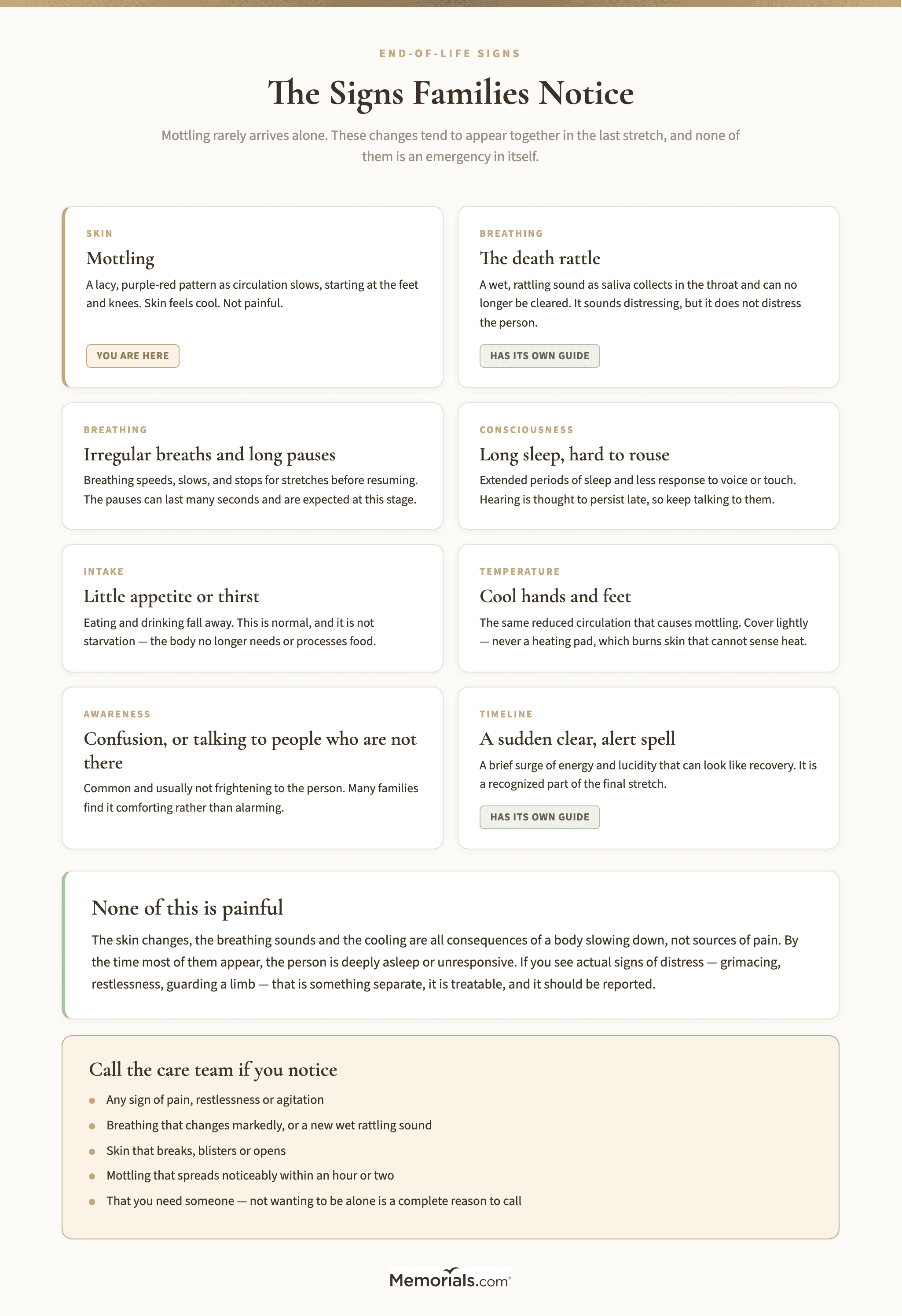
Mottling before death rarely arrives alone. It is one of a cluster of changes that tend to appear together in the last stretch, and seeing them listed sometimes helps more than seeing them one at a time.
Alongside the skin changes, families commonly notice long stretches of sleep and difficulty rousing; a marked drop in appetite and thirst, which is normal and not starvation; breathing that becomes irregular, with pauses; cooling hands and feet; reduced urine output, often darker; confusion or conversations with people who are not in the room; and sometimes a brief, startling period of clarity and energy.
Each of these has its own explanation, and none of them is an emergency in itself. We cover the last stretch in more depth, including what tends to happen in the final 48 hours, in a separate guide.
Afterward
Nothing about this section needs your attention today, and you can close the page here.
When the time comes, there is no rush in the first hours. If the death is expected and hospice is involved, there is no need to call emergency services; you call the hospice line, and they will guide what happens next. You are allowed to sit with the person for a while first. Many families find later that they wish they had known that, and had not felt hurried.
There is no rush in the first hours. You are allowed to sit with them for a while.
When you are ready to think about arrangements — and that may not be for a day or two — our funeral planning guide walks through the practical steps in the order they actually come up.
Frequently Asked Questions
What does mottling look like on the skin?
A lacy, netted, or marbled pattern of purple, dusky red, or bluish discoloration with paler skin showing between the lines. It is flat rather than raised, has soft edges, and the skin over it usually feels cool. On darker skin it is harder to see and shows best on the soles, palms, nail beds, and lips, where it may look gray or ashen rather than purple.
How long after mottling starts does death usually occur?
Most often within a few hours to a few days once mottling is established, though the range is wide. Some people show it for a week or more, and it can fade and return without anything having changed. It indicates a stage, not a time. Ask the care team if you need a real estimate for a practical decision.
Where does mottling start?
Almost always at the points furthest from the heart — the soles of the feet, the toes, and the knees — before moving up the legs and out to the hands and arms. Families often notice the knees first, simply because that is what is visible above the blanket.
Is mottling painful?
No. The skin change causes no pain, and by this stage the person is usually deeply asleep or unresponsive. Skin is fragile, so avoid rubbing mottled areas, and never use a heating pad — the skin burns easily and cannot reliably sense heat. Any sign of actual distress is something separate and should be reported.
Can mottling go away?
Yes, and it commonly does temporarily. Mottling can appear strongly, recede for hours or days, and come back. It can show on one limb and not the other. This fluctuation is normal and does not mean the person is improving or declining.
Does mottling always happen before death?
No. It is common but not universal. Plenty of people die without ever showing noticeable mottling, and its absence does not mean death is not close. It is one sign among several, and no single sign is required.
Should I warm their feet if the skin is cold and mottled?
Use a light blanket, and nothing more. Heating pads, hot water bottles, and electric blankets are unsafe here: the skin cannot sense heat reliably and burns easily, and warming the surface does not restore the circulation underneath. The coldness is not causing discomfort.