🏬Supersize Online Funeral Retailer🪦1000's of Headstones⚱️Over 10,000 Cremation Urns⚰️Caskets Overnight Delivery🛒Funeral & Memorial Superstore🚚FREE Shipping on ALL Orders👨👩👧👦Helping Families for over 20 Years💰Lowest Price Guarantee🏬Supersize Online Funeral Retailer🪦1000's of Headstones⚱️Over 10,000 Cremation Urns⚰️Caskets Overnight Delivery🛒Funeral & Memorial Superstore🚚FREE Shipping on ALL Orders👨👩👧👦Helping Families for over 20 Years💰Lowest Price Guarantee
🏬Supersize Online Funeral Retailer🪦1000's of Headstones⚱️Over 10,000 Cremation Urns⚰️Caskets Overnight Delivery🛒Funeral & Memorial Superstore🚚FREE Shipping on ALL Orders👨👩👧👦Helping Families for over 20 Years💰Lowest Price Guarantee🏬Supersize Online Funeral Retailer🪦1000's of Headstones⚱️Over 10,000 Cremation Urns⚰️Caskets Overnight Delivery🛒Funeral & Memorial Superstore🚚FREE Shipping on ALL Orders👨👩👧👦Helping Families for over 20 Years💰Lowest Price Guarantee
Every person who has ever lived has carried a pattern on their fingertips that belonged to no one else. Long after a loved one is gone, that pattern can still be held, worn, and displayed — pressed into silver, etched into glass, or inked onto skin. Fingerprint memorial ideas give families a way to preserve the most intimate physical detail a person leaves behind: the ridges and whorls of their own touch.
This guide walks through the full range of fingerprint memorials available, from wearable fingerprint jewelry to framed art and permanent tattoos. It also covers the practical side — how to capture a clear print, what to expect from jewelers and artisans, and which keepsake types work best for different families. If you are working through the broader process of choosing a meaningful remembrance for someone you've lost, covers the full picture. A print is one of two common memorial tattoos; the other is a bird, and covers the design decisions you cannot undo.
Fingerprints form before birth and remain unchanged throughout a person's entire life. No two fingerprints have ever been found to match — not among siblings, not among identical twins. That biological permanence is part of what makes a fingerprint memorial so emotionally resonant. A photograph captures how someone looked. A recording captures how they sounded. A fingerprint captures the physical texture of who they were.
For many families, a thumbprint memorial becomes a touchstone in the most literal sense. Running a finger over the engraved ridges of a pendant or ring creates a moment of physical connection that other memorials cannot replicate. The person is gone, but the pattern of their hand is right there, tangible and real.
Fingerprint memorials also carry a gentleness that many families appreciate during grief. Unlike larger decisions — choosing a headstone, planning a service, sorting through belongings — ordering a fingerprint keepsake is small, private, and deeply personal. It can be done quietly, on the family's own timeline.
How to Capture a Loved One's Fingerprint
The quality of any fingerprint memorial depends on the clarity of the original print. Jewelers and artisans need visible ridge detail — the tiny raised lines that form the loops, arches, and whorls of a fingerprint — to produce a keepsake that actually looks and feels like a real print rather than a gray smudge.
Ask the Funeral Home
Most funeral homes can capture fingerprints as part of their standard preparation process. Many keep inkless print kits or digital scanners specifically for memorial purposes. The key is timing: skin begins to change after death, and prints taken within the first 24 to 48 hours generally produce the sharpest ridge detail.
When speaking with a funeral director, ask directly whether the print will have enough clarity for engraving. A forensic-quality scan is not necessary — jewelers are skilled at enhancing partial prints — but a completely smudged or faded impression will limit what an artisan can produce.
Some funeral homes offer this service at no additional cost. Others may charge a small fee or provide a print kit that the family can use themselves.
Ink and Paper at Home
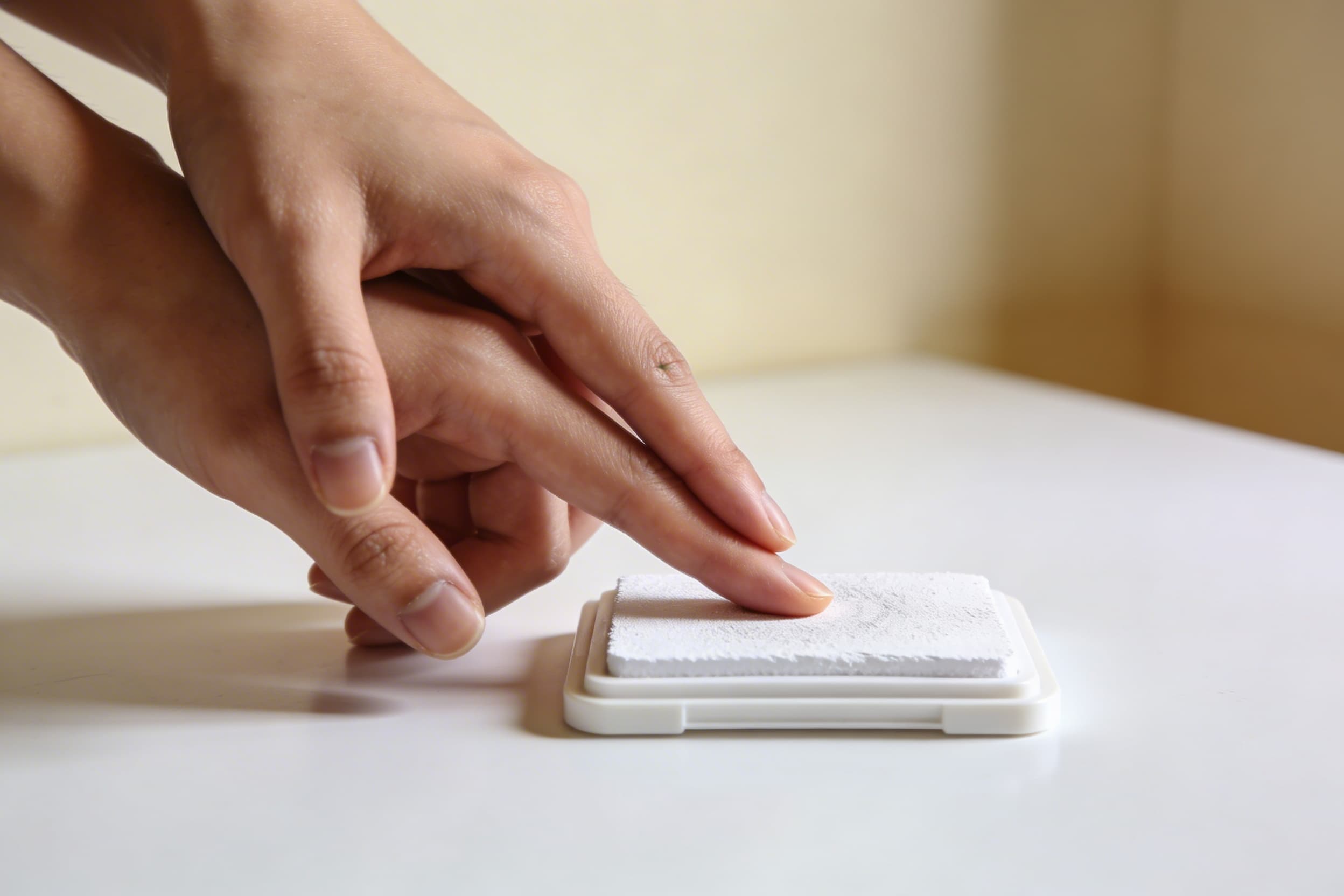
If you are capturing a fingerprint from a living loved one — a grandparent, a parent in hospice care, a child — the pencil graphite method is simple and effective. Shade a dark square onto white paper using a No. 2 pencil. Roll the fingertip over the graphite until the pad is evenly coated, then press the finger firmly onto a piece of clear tape. Peel the tape and stick it onto a clean sheet of white paper.
Inkless print kits, available from memorial keepsake companies and online retailers, produce cleaner results with less mess. They use a chemically treated paper that darkens on contact without traditional ink. These kits work well for families who want to capture prints from multiple fingers or from both parents in a couple.
Whichever method you use, take several samples. Fingerprint quality varies from press to press, and having options lets the jeweler choose the clearest pattern.
Using Existing Records
Fingerprints may already exist in places you have not considered. Anyone who worked in law enforcement, the military, education, or healthcare may have fingerprints on file with a former employer. Hospital birth records sometimes include infant hand and foot prints. Immigration paperwork, government security clearances, and professional licensing applications often require fingerprinting.
If no physical print exists and no capture is possible, some families have found usable fingerprints on personal items — a polished surface, a glass, a piece of pottery the person made. A skilled digital artist or engraver can sometimes work from a photograph of a latent print, though results vary.
Fingerprint Jewelry
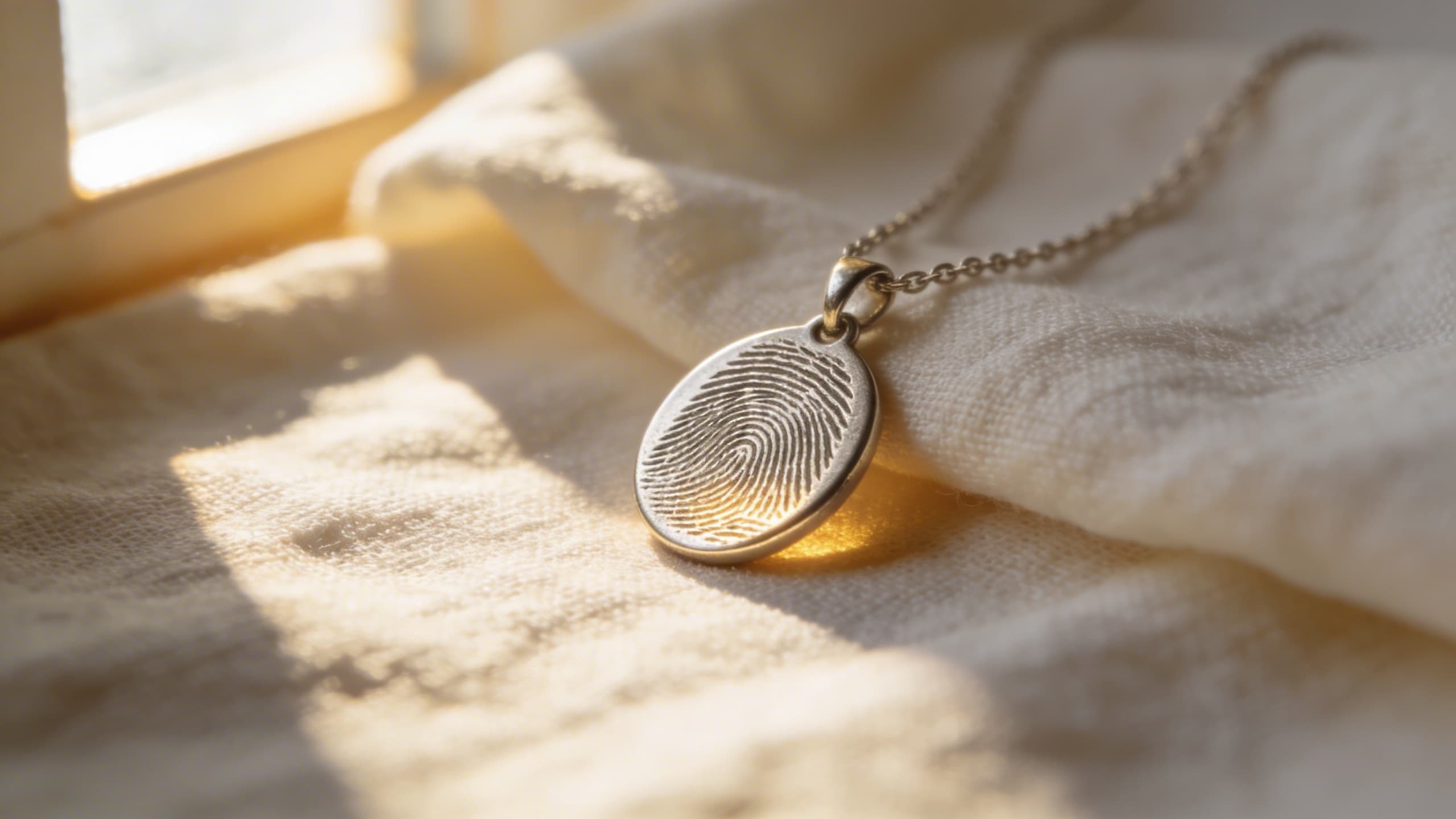
Wearable fingerprint memorials are the most popular category, and the range of styles has expanded dramatically over the past decade. Modern laser engraving and 3D scanning allow artisans to reproduce ridge detail with remarkable accuracy on metals ranging from sterling silver to solid 14k gold.
For a detailed breakdown of pendant styles, metal options, and how to evaluate engraving quality, our guide to fingerprint jewelry options and styles covers the full product landscape.
Necklaces and Pendants
Fingerprint pendants remain the most widely chosen style. Common shapes include teardrops, hearts, round discs, and military-style dog tags. Some pendants incorporate a small urn compartment for a tiny amount of cremated remains, combining two forms of memorial into one piece. Others add birthstones, handwriting samples, or short inscriptions alongside the print.
Rings
Fingerprint rings engrave the print onto the outer band, the inner band, or both. Wide-band rings allow for a larger section of the fingerprint pattern and produce a more tactile feel when worn. Couples sometimes order matching rings with each partner's print on the other's band — a living memorial or a remembrance piece after loss.
Bracelets, Keychains, and Dog Tags
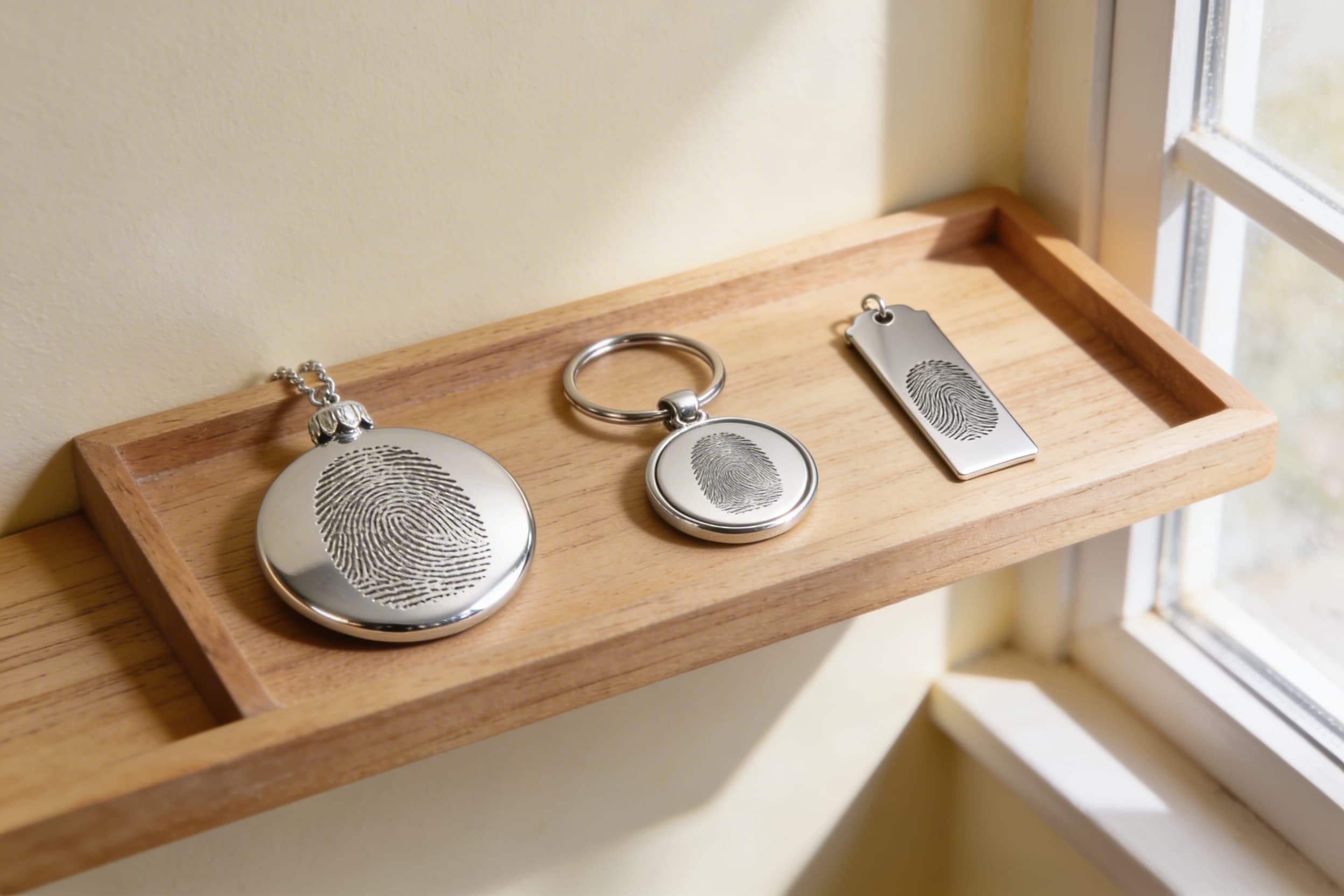
Families who prefer a less traditional approach may choose a fingerprint bracelet with the print on a charm, a sterling silver keychain that travels in a pocket every day, or a military-style dog tag engraved on both sides. These everyday-carry items keep the memorial physically present without the formality of jewelry.
Fingerprint Keepsakes Beyond Jewelry
Not every fingerprint memorial is worn. Some families want a piece that sits on a shelf, hangs on a tree, or lives in a pocket — something they encounter in daily life rather than put on each morning.
Memorial Ornaments
Fingerprint Christmas ornaments are among the most requested seasonal memorial keepsakes. Artisans engrave the print onto a sterling silver, brass, or ceramic disc that hangs on the family tree each year. For families navigating that first holiday season after a loss, an ornament can turn a painful absence into a quiet act of inclusion. The ornament goes on the tree alongside everything else — the person is still part of the tradition.
Bookmarks, Pocket Knives, and Everyday Items
Fingerprint bookmarks appeal to families honoring a reader or a teacher. Custom pocket knives engraved with a loved one's print have become popular for honoring fathers, grandfathers, and veterans. Guitar picks, money clips, and challenge coins round out the category of functional keepsakes that carry a fingerprint into daily routines.
These everyday items overlap with picture memorial keepsake ideas — many families combine a fingerprint on one side of an item with a photo or portrait on the other, layering two forms of remembrance into a single piece.
Home Display Pieces
Families who prefer a visible memorial that stays in one place may choose a framed fingerprint displayed on a mantel, a fingerprint pressed into a ceramic tile or clay ornament, or a glass paperweight with the print embedded inside. These work especially well as part of a broader memorial shelf or memory corner — a concept explored in our guide to at-home memorial ideas.
Fingerprint Art and Creative Tributes
Beyond manufactured products, fingerprints can become the raw material for one-of-a-kind artistic tributes that families create or commission.
Memorial Tattoos
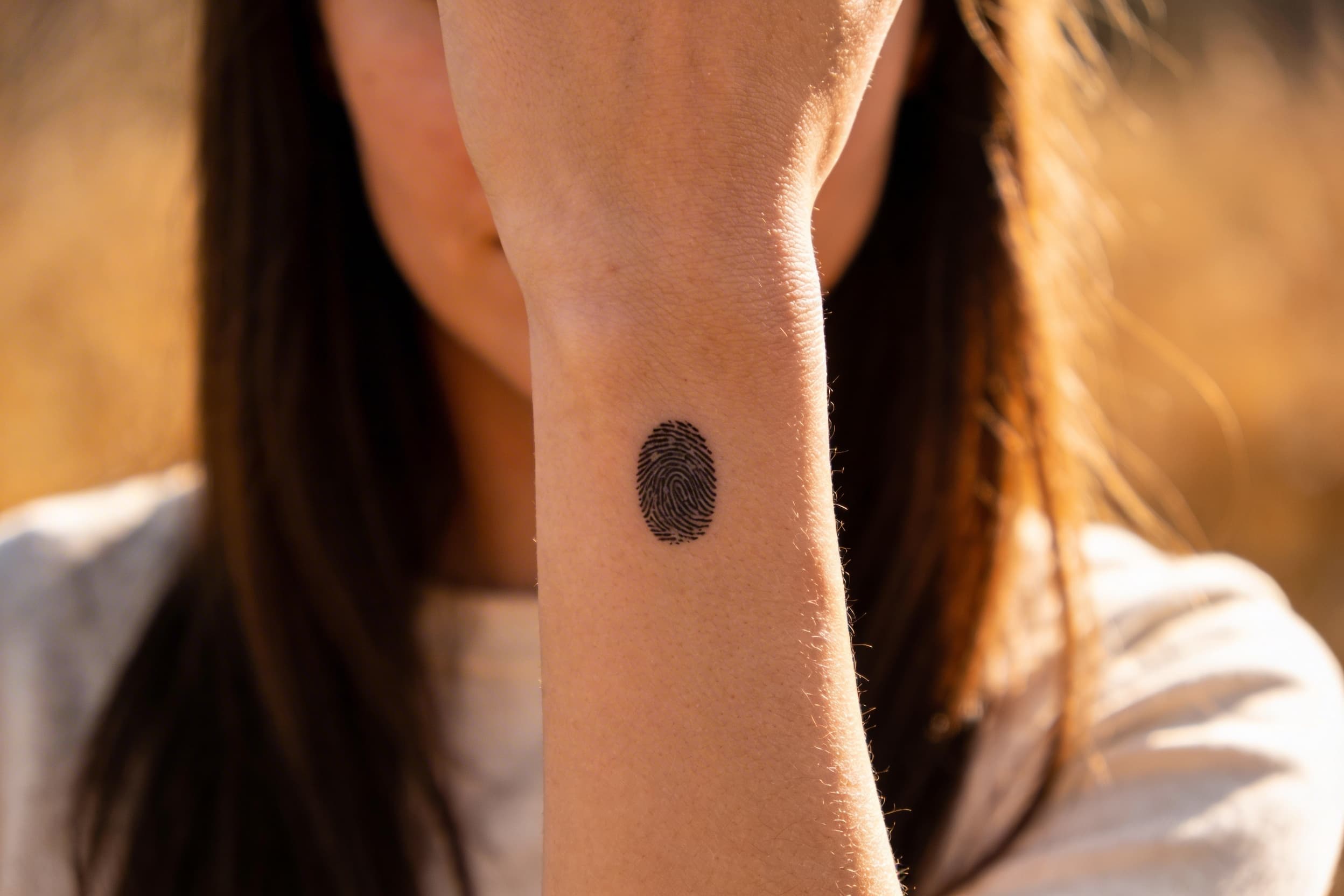
Fingerprint tattoos have become one of the fastest-growing memorial trends. A skilled tattoo artist can reproduce the actual ridge pattern from a clear scan or ink print, placing the loved one's fingerprint on the wearer's wrist, forearm, chest, or ring finger. Some designs incorporate the print into a larger piece — a heart shape filled with the fingerprint pattern, a tree whose trunk is formed from the print, or an angel wing textured with the ridge lines.
The emotional weight of a fingerprint tattoo is unique among memorial options. The loved one's touch is literally on your skin.
Framed Art Prints
Professional memorial art studios can transform a fingerprint scan into a large-format print suitable for framing. The ridges are enlarged, sometimes colorized, and printed on archival paper or canvas. Some studios create side-by-side prints of a parent and child's fingerprints, or overlay two prints to form a heart or other shape.
For families with artistic ability, a simpler DIY approach works well: enlarge a clear print scan to poster size at a local print shop, mount it in a quality frame, and display it alongside a small nameplate or date. The result is a striking, modern memorial that visitors immediately recognize.
Fingerprint Stamps and DIY Projects
Rubber stamps made from a loved one's fingerprint open up a wide range of creative possibilities. Families use them to mark holiday cards, seal letters, stamp the pages of a memory book, or decorate gift tags. A fingerprint stamp is also a meaningful addition to a memorial guest book at a celebration of life — guests stamp the print alongside their written message, carrying the loved one's identity throughout the book.
What to Expect When Ordering
Ordering a fingerprint memorial involves a few steps that are worth understanding upfront so the process feels smooth rather than stressful.
Submitting the Print
Most jewelers and keepsake companies accept fingerprints as a high-resolution photograph, a scanned image, or a physical ink card mailed to their studio. Digital submissions are fastest — a clear smartphone photo of a print on white paper is often sufficient. Some companies provide their own inkless print kits with prepaid return mailers.
Engraving and Production
The standard production process involves a digital artist cleaning up and enhancing the print image, then transferring it to the engraving equipment. High-definition laser engraving produces the deepest, most tactile results. Less expensive options may use chemical etching or screen printing, which produces a visible image but less physical texture.
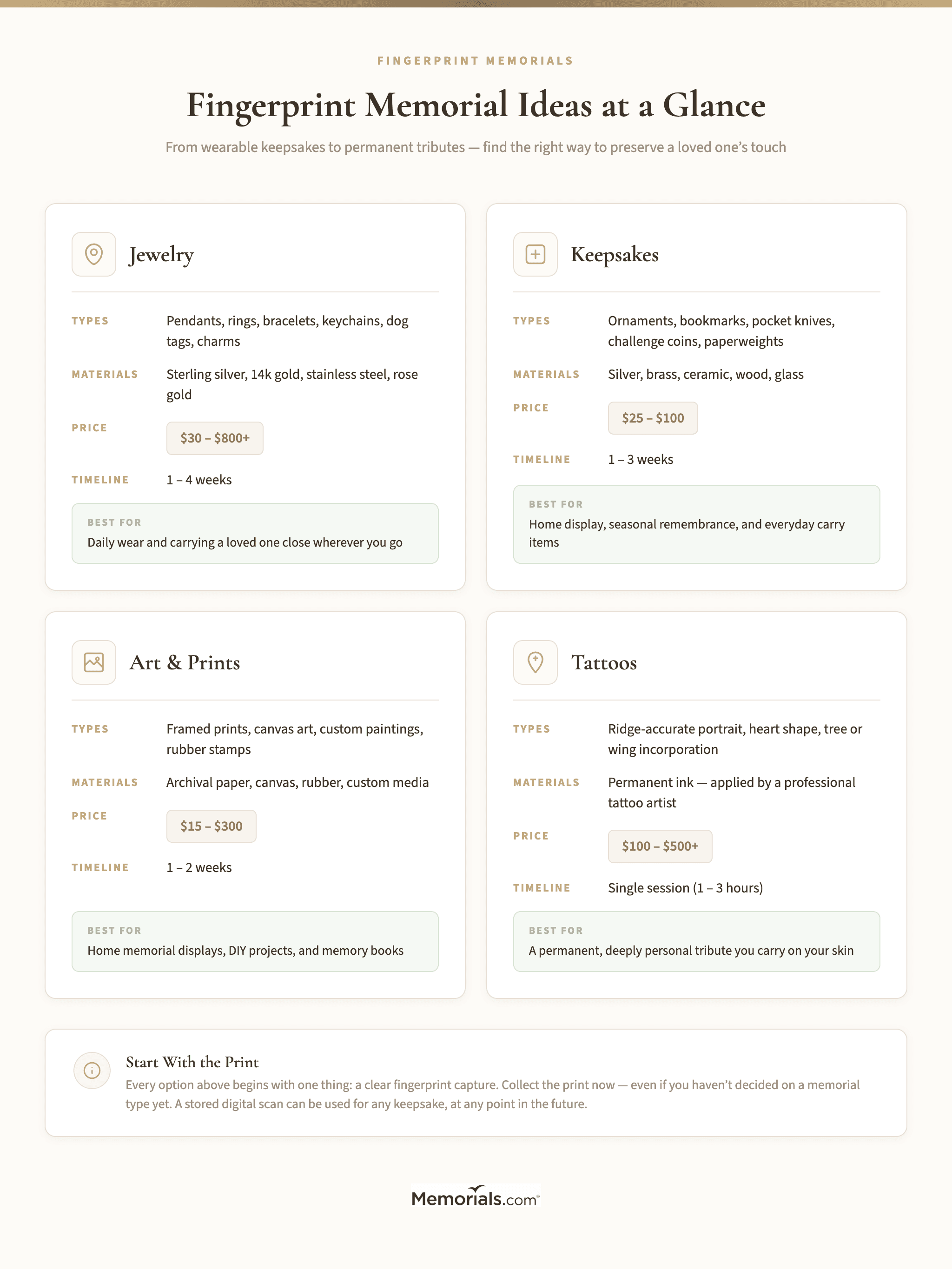
Production timelines typically range from one to four weeks depending on the complexity of the piece and whether customizations like handwriting, birthstones, or inscriptions are added. Some studios offer rush production for families who need a piece before a memorial service or visitation.
Pricing
Fingerprint memorial pricing varies widely by material, craftsmanship, and complexity. A stainless steel fingerprint pendant may start around $30 to $50, while a sterling silver piece with laser engraving and a birthstone might range from $80 to $200. Solid gold fingerprint rings and high-end custom pieces can run $300 to $800 or more. Non-jewelry keepsakes like ornaments, bookmarks, and keychains generally fall in the $25 to $100 range.
The most important factor is engraving quality. A lower-priced piece with crisp, deep engraving will be more meaningful than an expensive piece with shallow, blurry ridge reproduction. Ask to see sample photos of completed fingerprint work before committing to a vendor.
Frequently Asked Questions
Can you get a fingerprint from someone who has already been cremated?
If a fingerprint was not captured before cremation, the original ridge pattern is no longer available from the remains. However, fingerprints may exist in other forms — hospital records, employer files, immigration documents, personal items, or even old photographs where the hands are visible enough for digital enhancement. Checking with the funeral home is the best first step, as many routinely take prints before cremation.
How long after death can you take a fingerprint?
Prints taken within the first 24 to 48 hours after death typically produce the clearest ridge detail. Embalming can actually help preserve print quality by slowing skin changes. Beyond 48 hours, the skin may begin to dry or swell, reducing clarity. Funeral professionals have techniques for working with challenging skin conditions, so even late prints may be usable for memorial purposes.
Do fingerprint keepsakes look like real fingerprints?
High-quality laser-engraved keepsakes reproduce the actual ridge pattern with remarkable accuracy — you can feel the lines and whorls under your fingertip. The fidelity depends on the quality of the original print submitted and the skill of the engraver. Budget pieces using chemical etching or screen printing may show the general pattern but lack the tactile depth of laser work.
Can I combine a fingerprint with cremation ashes in one piece?
Yes. Many fingerprint pendants and necklaces include a small hollow compartment designed to hold a tiny amount of cremated remains. This combines two memorial elements — the visual and tactile print on the outside and a portion of ashes sealed inside. It is one of the most requested customizations in the fingerprint memorial category.
Is a thumbprint the same as a fingerprint for memorial purposes?
Thumbprints and fingerprints are both ridge patterns, and either works for memorial keepsakes. Thumbprints tend to have a larger surface area with bolder ridge lines, which can produce a slightly more dramatic engraving. Many families choose the thumb simply because it is the easiest finger to capture a clean print from. There is no functional difference in quality between a thumbprint and any other fingerprint for jewelry or keepsake purposes.
Choosing the Right Fingerprint Memorial for Your Family
The best fingerprint memorial is the one that fits the way your family grieves and remembers. Some families want a piece they can touch every day — a ring, a pendant, a keychain. Others want a quiet presence in the home — an ornament, a framed print, a memorial shelf display. Still others want something permanent on their own body — a tattoo that never comes off.
All of these options begin with the same thing: a clear print. If your loved one is still living, capturing their fingerprint now — even if you are not sure what you will do with it — removes the time pressure later. A print stored as a high-resolution digital file can be used for any memorial type, at any point in the future.
Browse the fingerprint jewelry collection and keepsake gifts catalog to see the range of options available, or start with a simple print capture kit and take the next step when you are ready.