🏬Supersize Online Funeral Retailer🪦1000's of Headstones⚱️Over 10,000 Cremation Urns⚰️Caskets Overnight Delivery🛒Funeral & Memorial Superstore🚚FREE Shipping on ALL Orders👨👩👧👦Helping Families for over 20 Years💰Lowest Price Guarantee🏬Supersize Online Funeral Retailer🪦1000's of Headstones⚱️Over 10,000 Cremation Urns⚰️Caskets Overnight Delivery🛒Funeral & Memorial Superstore🚚FREE Shipping on ALL Orders👨👩👧👦Helping Families for over 20 Years💰Lowest Price Guarantee
🏬Supersize Online Funeral Retailer🪦1000's of Headstones⚱️Over 10,000 Cremation Urns⚰️Caskets Overnight Delivery🛒Funeral & Memorial Superstore🚚FREE Shipping on ALL Orders👨👩👧👦Helping Families for over 20 Years💰Lowest Price Guarantee🏬Supersize Online Funeral Retailer🪦1000's of Headstones⚱️Over 10,000 Cremation Urns⚰️Caskets Overnight Delivery🛒Funeral & Memorial Superstore🚚FREE Shipping on ALL Orders👨👩👧👦Helping Families for over 20 Years💰Lowest Price Guarantee
The first week after losing a loved one is unlike anything else you will ever experience. Time bends. Hours feel like days and entire afternoons vanish in a breath. Grief and logistics collide without warning — one moment you are sobbing on the kitchen floor, the next you are on the phone with a funeral home asking about pricing. Both of those moments are part of the same week, and both are entirely normal.
This guide walks through what that first week actually looks and feels like, from the emotional waves to the practical tasks that need attention. For families navigating every stage of loss and remembrance, the complete grief support guide offers a broader look at how to move through grief with compassion and purpose.
Grief does not arrive in a neat sequence. You may have heard about the five stages — denial, anger, bargaining, depression, and acceptance — but in the first week, those stages pile on top of each other and rearrange themselves by the hour. Psychologists sometimes describe early bereavement as a "grief roller coaster," and that phrase captures the experience far better than any linear model.
Shock and Numbness
Most people describe the first 24 to 72 hours as a fog. Shock serves a protective purpose — your mind is shielding you from the full weight of what has happened. You may feel strangely calm, detached, or robotic. Some people move straight into logistics mode, making phone calls and handling arrangements with startling efficiency, only to wonder later why they did not cry.
This numbness is not a sign that something is wrong with you. It is your nervous system buying you time to absorb reality in smaller doses.
Waves of Emotion
Between stretches of numbness, grief tends to arrive in waves — sudden surges of sadness, anger, guilt, or fear that may last seconds or hours. You might feel intense anger at a doctor, at God, or at the person who died. You might feel guilty about something you said or did not say. You might feel relief, especially if your loved one endured a long illness, followed immediately by guilt about feeling relieved.
All of these reactions are normal. Grief is not a single emotion. It is a shifting landscape of feelings that coexist, contradict each other, and change without warning.
For families who were caregiving before the death, anticipatory grief and pre-loss coping may have started weeks or months before the actual loss. That pre-grieving does not cancel out the grief that follows — it simply means you have been carrying this weight longer than most people realize.
Physical Symptoms
Grief is not only emotional. In the first week, many people experience physical symptoms of grief that can feel alarming if they catch you off guard. Exhaustion, disrupted sleep, loss of appetite, nausea, chest tightness, headaches, and a weakened immune system are all common. Some people describe feeling a literal ache in their chest — the physical echo of heartbreak.
Your body is processing a massive stressor. Eating small meals, staying hydrated, and resting whenever you can will not fix the grief, but they will keep you standing through the hardest days.
The Practical Side: What Needs to Happen This Week
The cruel irony of the first week is that it demands the most from you at the exact moment you have the least to give. Funeral arrangements, phone calls, paperwork, and financial decisions cannot wait, even though your mind and body are begging for stillness. The tasks below are the first week of a job that runs for a year — the full sequence is in what to do when someone dies, and nothing in it needs to be done today.
You do not have to handle every task alone. Ask a trusted friend or family member to take notes, make calls, or simply sit beside you while you work through the list. Many of these tasks can be shared or delegated entirely.
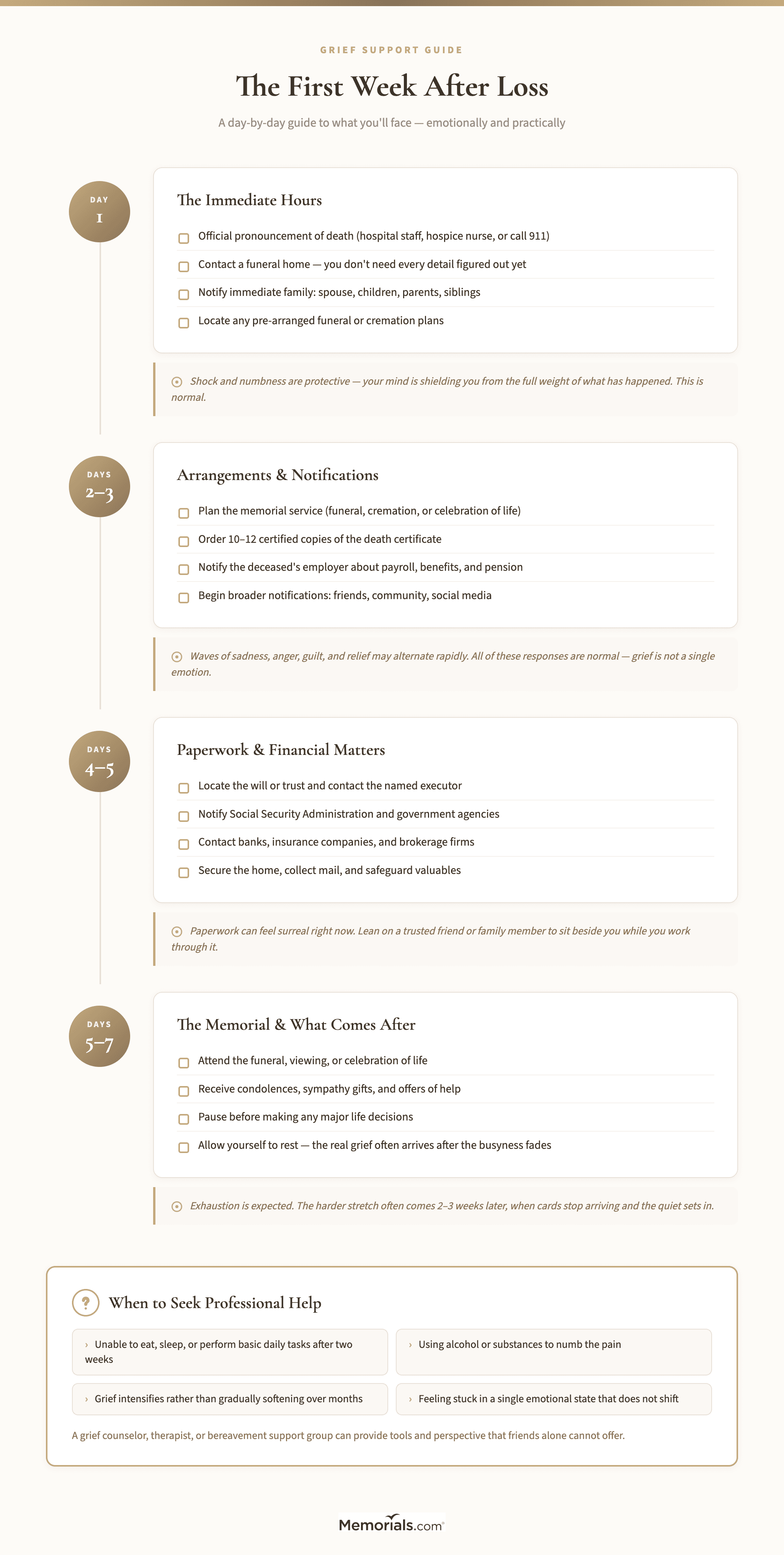
Day 1: The Immediate Hours
Pronouncement of death. Where your loved one died determines this step. If they passed in a hospital or nursing home, the staff handles the official declaration. If they died at home under hospice care, the hospice nurse will guide you. If the death was unexpected at home, call 911 — paramedics will transport the body to a hospital for official pronouncement.
Contact a funeral home. You do not need to have every detail figured out before calling. A reputable funeral home will walk you through the process and give you time to make decisions. If your loved one had a pre-arranged funeral or cremation plan, locate that documentation now.
Notify immediate family. Start with the people closest to the deceased — a spouse, children, parents, siblings. You do not have to call everyone yourself. Ask the first few people you reach to help spread the word. That order is not only courtesy: the same next of kin hierarchy decides who has the legal right to make the arrangements, and it is worth knowing before two relatives make different plans.
Days 2–3: Arrangements and Notifications
Plan the memorial service. Whether your family chooses a traditional funeral, cremation, or a celebration of life, this is when the major decisions take shape. Our funeral planning checklist covers the full scope of what to arrange — from selecting readings and music to choosing between burial and cremation.
Order death certificates. Request 10 to 12 certified copies. You will need them for insurance claims, bank accounts, Social Security, and probate. The funeral home can usually order these on your behalf. Ten to twelve is a sound default, and how many death certificates you need works the number out from your own list of institutions, which is cheaper than reordering.
Notify the employer. Contact your loved one's workplace to discuss final paychecks, retirement accounts, and any employer-sponsored life insurance. Ask about death benefits, pension plans, and 401(k) designations.
Begin broader notifications. Beyond family, you may need to inform friends, neighbors, religious communities, and social groups. A group text, email, or social media post can help reach people quickly. Include a brief note about memorial service plans if they are set.
Days 4–5: Paperwork and Financial Matters
Locate the will or trust. If your loved one had an estate plan, find the documents and contact the named executor. If there was no will, the estate will need to go through probate — consult an estate attorney for guidance specific to your state. Ask about the threshold first, though: most states let a modest estate be settled with a small estate affidavit and no court case at all.
Notify government agencies. The Social Security Administration should be informed promptly, and your funeral home may handle this on your behalf. If the deceased was a veteran, contact the VA about burial benefits and flag presentations. The rest of that list — the DMV, the IRS, the post office, the credit bureaus — is set out in forwarding the mail and notifying agencies, along with what each of them actually needs.
Contact financial institutions. Banks, brokerage firms, and insurance companies will each need a certified death certificate. Joint accounts with right of survivorship transfer automatically to the surviving account holder, but solely owned accounts may be frozen until the estate is settled.
Secure the home. If your loved one lived alone, make sure the property is locked, valuable items are safe, and mail is being collected. Hold off on cleaning out belongings — that task can wait until emotions are steadier.
Days 5–7: The Memorial and What Comes After
Attend the service. The funeral, viewing, or celebration of life typically happens within the first week. This gathering serves a dual purpose — it honors the person who died and it draws your support system together in one place. You may feel emotionally drained afterward. That is expected.
Receive condolences and gifts. Friends and coworkers often send flowers, food, memorial cards, or sympathy gifts during this period. Accepting help — a dropped-off meal, an offer to watch children, someone picking up groceries — is not a sign of weakness. Understanding sympathy gift etiquette can also help when you feel uncertain about how to acknowledge or respond to the gestures people extend.
Pause before making big decisions. Financial advisors and grief counselors consistently recommend against major life decisions — selling a home, relocating, changing jobs, or ending a relationship — during the first year of bereavement. Your judgment during acute grief is clouded by emotional exhaustion, and decisions made now may look very different six months from now.
What People Don't Tell You About the First Week
The Busyness Is a Shield
Many families report that the whirlwind of arrangements, visitors, and phone calls actually helps during the first week. It gives you a structure and a purpose when your inner world has collapsed. The harder stretch often comes two to three weeks later, when the cards stop arriving, the casseroles dry up, and the quiet sets in.
If you are wondering how long grief typically lasts, the honest answer is: longer than anyone around you expects, and in forms you may not recognize at first.
You Will Forget Things
Grief disrupts concentration, short-term memory, and decision-making. You may forget where you parked, miss a phone call you meant to return, or lose track of what day it is. Cognitive fog during bereavement is well-documented and temporary. Write things down, lean on others for reminders, and extend yourself the grace you would offer anyone else in your position.
Sleep Will Be Difficult
Insomnia, broken sleep, vivid dreams about the deceased, or the opposite — sleeping far more than usual — are all common in the first week and beyond. Your brain is working overtime to process a loss it cannot yet fully absorb.
Other People Won't Always Know What to Say
Some friends will say exactly the right thing. Others will offer well-meaning but hollow phrases — "everything happens for a reason," "they're in a better place," "at least they're not suffering." Try to hear the intention behind the clumsy words. Most people want to help; they just do not know how.
Returning to Daily Life
Going Back to Work
There is no universal rule for when to return to the workplace. Some people go back within days because they need the distraction. Others need weeks. Many employers offer bereavement leave — typically three to five days — though the emotional recovery extends far beyond that window. If you are dreading the return, our article on coping with grief at work offers practical strategies for managing emotions, conversations with coworkers, and the strange normalcy of sitting at a desk while your world has shifted.
Caring for Children
Children grieve differently at every age, and they take their cues from the adults around them. Simple, honest language works best: "Grandma died. Her body stopped working, and she can't come back. We are all very sad, and it's okay to feel sad." Avoid euphemisms like "passed away" or "went to sleep" with young children, as these can create confusion or fear.
Let children attend the memorial service if they want to. Give them a role — carrying a flower, drawing a picture, choosing a song — so they feel included rather than sidelined.
Accepting Help
One of the most repeated pieces of advice from grief counselors is also one of the hardest to follow: let people help you. When someone asks "what can I do?", give them a specific task — pick up groceries, drive the kids to practice, sit with you while you open mail. Concrete requests are easier for both of you than the open-ended offer that so often goes unanswered.
When to Seek Professional Support
Most people move through acute grief with the support of family, friends, and time. But some signals suggest professional help would be beneficial:
You feel unable to perform basic daily tasks — eating, bathing, sleeping — after the first two weeks. You are using alcohol or other substances to numb the pain. You experience persistent thoughts of self-harm or feel that life is not worth living. Your grief intensifies rather than gradually softening over months. You feel stuck in a single emotional state — anger, guilt, or numbness — that does not shift.
These patterns may point toward complicated grief or prolonged grief disorder, a recognized condition that affects roughly 7 to 10 percent of bereaved people. A grief counselor, therapist, or bereavement support group can provide tools and perspective that friends alone cannot offer.
Frequently Asked Questions
How long does the first wave of grief last?
Acute grief — the most intense emotional and physical response — typically peaks in the first one to two weeks and gradually softens over the following months. There is no fixed timeline, and grief often resurfaces around anniversaries, holidays, and milestones.
Should I take time off work after a death?
If your employer offers bereavement leave, use it. Most companies provide three to five days for an immediate family member's death, though you may need more. Some people benefit from returning to routine quickly; others need additional time. There is no wrong answer.
Is it normal to feel nothing after someone dies?
Yes. Emotional numbness and shock are among the most common early grief responses. Your mind is protecting you from the full weight of the loss. Feelings will surface when your nervous system is ready, and that timeline varies widely.
What paperwork do I need to handle in the first week?
The most time-sensitive tasks include obtaining the death certificate (request 10–12 copies), notifying the Social Security Administration, contacting the employer, locating the will or trust, and informing insurance companies and financial institutions.
How do I help someone who just lost a loved one?
Show up. Bring food. Offer specific help rather than asking "what do you need?" Mention the deceased by name — hearing their name spoken aloud is comforting, not painful. And check in again at the two-week, one-month, and three-month marks, when support from others tends to fade.
Moving Forward, One Day at a Time
The first week after losing someone you love is not a test you pass or fail. It is a stretch of days that demands everything from you while offering very little clarity in return. You will make phone calls you do not want to make, sign papers you cannot focus on, and sit through conversations that blur together by nightfall.
And somewhere in the middle of all of it, you will also remember a story that makes you laugh, or open a drawer and find a note they wrote, or catch a scent that brings them back so vividly it stops your breath. Grief and love live in the same space. The pain you carry this week is not separate from the connection you shared — it is proof of it.
There is no rushing through this. There is only moving through it, one hour and one task and one breath at a time.