🏬Supersize Online Funeral Retailer🪦1000's of Headstones⚱️Over 10,000 Cremation Urns⚰️Caskets Overnight Delivery🛒Funeral & Memorial Superstore🚚FREE Shipping on ALL Orders👨👩👧👦Helping Families for over 20 Years💰Lowest Price Guarantee🏬Supersize Online Funeral Retailer🪦1000's of Headstones⚱️Over 10,000 Cremation Urns⚰️Caskets Overnight Delivery🛒Funeral & Memorial Superstore🚚FREE Shipping on ALL Orders👨👩👧👦Helping Families for over 20 Years💰Lowest Price Guarantee
🏬Supersize Online Funeral Retailer🪦1000's of Headstones⚱️Over 10,000 Cremation Urns⚰️Caskets Overnight Delivery🛒Funeral & Memorial Superstore🚚FREE Shipping on ALL Orders👨👩👧👦Helping Families for over 20 Years💰Lowest Price Guarantee🏬Supersize Online Funeral Retailer🪦1000's of Headstones⚱️Over 10,000 Cremation Urns⚰️Caskets Overnight Delivery🛒Funeral & Memorial Superstore🚚FREE Shipping on ALL Orders👨👩👧👦Helping Families for over 20 Years💰Lowest Price Guarantee
People who are grieving almost always ask the same question: how long will this last? The truth is that grief has no fixed expiration date. It is not a problem to solve on a schedule, and there is no morning you will wake up and suddenly feel finished with it. But grief does change. It shifts in weight and texture, and the sharp edges that cut through every ordinary moment do eventually soften. Understanding what that process actually looks like — not the tidy version, but the real one — can offer a kind of relief on its own. For a broader look at how loss shapes decisions about remembrance, sympathy, and honoring someone you love, our the complete grief support guide covers every stage of that journey.
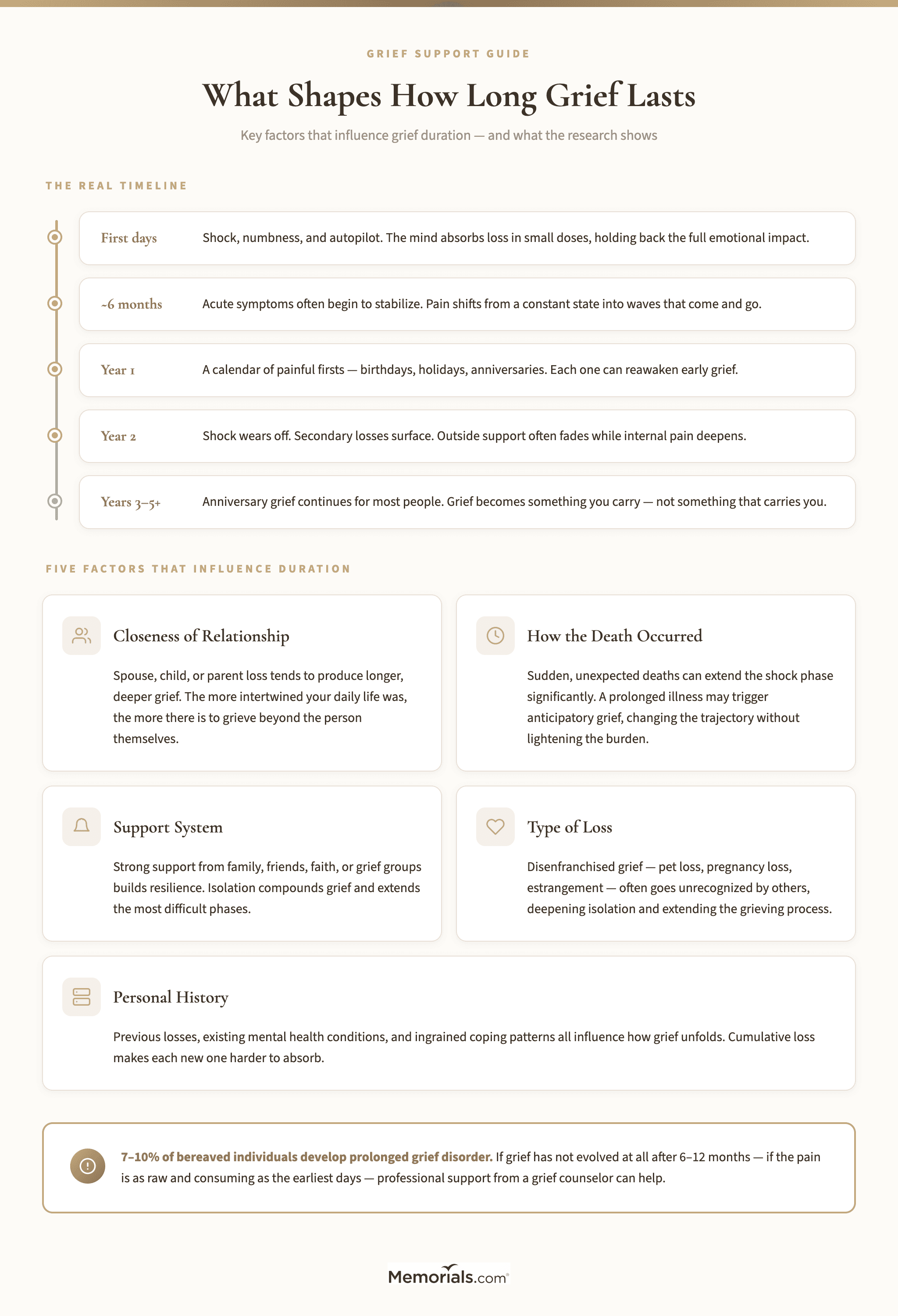
The experience of the first week after losing someone is often dominated by shock and logistics. Funeral arrangements, phone calls, paperwork — these tasks create a strange kind of busyness that can delay the full emotional impact. Many people describe the early days as operating on autopilot. Numbness is common, and it serves a purpose. The mind absorbs loss in small doses, holding back the flood until you can bear it. That protective fog can last days or weeks, and its eventual lifting is often what brings people to ask how long grieving really lasts — because the pain feels fresh just as the world expects them to be "getting back to normal."
What Research Actually Says About the Grief Timeline
There is no clinical consensus on a single grief timeline, because every loss is shaped by factors no chart can capture: who you lost, how they died, what your relationship looked like, and how much support surrounds you. That said, research does offer some general landmarks.
Many grief counselors and psychologists note that the most acute symptoms of grief — difficulty sleeping, inability to concentrate, overwhelming sadness, loss of appetite — tend to stabilize somewhere around six months after the loss. This does not mean grief ends at six months. It means the intensity of those symptoms often begins to shift from a constant state into something that comes and goes in waves. The grief roller coaster is a useful image here: the drops are steep and unpredictable early on, but over time they grow less frequent and less consuming.
The first year of bereavement is full of painful firsts. The first birthday without them. The first holiday season. The first time you reach for the phone to call them and remember you cannot. Each of those firsts can reawaken the rawness you felt in the earliest days. By the end of the first year, most people have encountered the full calendar of triggers, which means the second time around carries a different kind of weight — it is no longer shocking, but the permanence of the absence becomes undeniable.
Why the Second Year Can Be Harder Than the First
Many people are surprised to find that the second year of grief feels more difficult than the first. During the first year, shock provides a layer of insulation. Friends and family check in. People offer grace. There is an unspoken understanding that you are allowed to not be okay.
By the second year, that insulation fades. The emotional numbness lifts, and you begin to feel the full force of a loss you have been only partially absorbing. Meanwhile, the support around you often tapers off. People assume the worst is behind you. The texts slow down. The invitations resume with an implicit expectation that you will show up and be present. The gap between how you feel and how others expect you to feel can make the second year uniquely isolating.
Secondary losses also tend to surface in the second year. These are the smaller, cascading losses that follow the primary one — the inside jokes no one else understands, the financial shifts, the routines that no longer make sense, the identity questions that emerge when a central relationship disappears. These losses are real and deserve their own space.
Factors That Shape How Long Grief Lasts
No two people grieve the same loss in the same way. Several factors influence both the intensity and duration of the grieving process.
The closeness of the relationship. Losing a spouse, a child, or a parent tends to produce longer and deeper grief than losing a distant relative or acquaintance. The person's role in your daily life matters enormously — the more intertwined your routines, plans, and identity were, the more there is to grieve beyond the person themselves.
How the death occurred. Sudden, unexpected, or traumatic deaths can produce a more intense and prolonged grief response than deaths that followed a long illness. When death comes without warning, the mind has no time to prepare, and the shock component can extend the early stages significantly. On the other hand, a prolonged illness can produce anticipatory grief — mourning that begins before the death actually happens — which changes the trajectory of grief after death without making it any lighter.
Your support system. People who have strong social support, whether from family, friends, faith communities, or grief support groups, tend to navigate the grieving process with more resilience. Isolation compounds grief. When you feel alone in your pain, or when the people around you minimize your loss, healing takes longer.
The type of loss. Grief following a death is the most commonly discussed, but disenfranchised grief — grief that society does not fully acknowledge or validate — can be especially difficult. This includes grieving the loss of a pet, coping with pregnancy loss grief, mourning an ex-partner, or losing someone to estrangement rather than death. When the people around you do not recognize your loss as "legitimate," you are denied the permission to grieve openly, and the process can stretch and deepen as a result.
Your personal history. Previous losses, existing mental health conditions, and your own coping patterns all influence how grief unfolds. Someone who has experienced multiple losses in a short period may carry a cumulative weight that makes each new loss harder to absorb.
Whether the grief began before the death. Families who sat through a long final illness often start grieving well before it ends, watching the body change day by day. Many describe looking up what they were seeing — the cool, blotchy skin of mottling at end of life, for instance — at three in the morning. That anticipatory grief does not subtract from what follows, but it does change its shape: the early weeks afterward are frequently quieter, and the harder stretch arrives later.
Anniversary Grief: When the Pain Comes Back
One of the least expected parts of the grief timeline is anniversary grief — the resurgence of intense feelings around specific dates. A birthday. The date they died. A holiday you always spent together. A song that catches you off guard in a grocery store aisle.
Research suggests that roughly 92 percent of bereaved individuals experience some form of anniversary reaction within the first five years after a loss. These reactions do not mean you have failed at grieving or that you are moving backward. They are your emotional memory doing exactly what it was designed to do: remembering what mattered.
Anniversary grief typically becomes less intense over time, though it may never fully disappear. Many people find that planning ahead helps. Setting aside time on a difficult date to honor the person — lighting a candle, visiting a meaningful place, preparing their favorite meal, or placing remembrance stones in a garden — transforms a dreaded day into one with purpose.
The holiday season can be especially challenging, and families often benefit from building new traditions around remembrance. Articles like our guides to honoring loved ones at Thanksgiving, Christmas, and Mother's Day or Father's Day after loss offer specific ideas for navigating those dates.
When Grief Becomes Something More
Normal grief, even when it is agonizing, tends to evolve over time. The pain does not vanish, but it gradually occupies less of your waking life. You begin to have good days alongside the hard ones. You rediscover small pleasures. The grief becomes part of you rather than all of you.
For a small percentage of people — roughly 7 to 10 percent of those who experience bereavement — grief does not follow this pattern. The pain remains as intense months or even years later, significantly interfering with daily life, relationships, and the ability to function. This condition is known as prolonged grief disorder, sometimes called complicated grief.
Signs that grief may have shifted into something clinical include a persistent inability to accept the loss, intense longing that does not diminish, emotional numbness that blocks connection with others, feeling that life has no meaning or purpose without the person, and avoidance of any reminders of the loss. The physical effects of grief can also intensify — chronic fatigue, appetite changes, weakened immunity, and unexplained pain can all accompany prolonged mourning.
If you recognize these patterns in yourself, reaching out to a grief counselor or therapist is not a sign of weakness. It is a practical step toward healing. Specialized grief therapy, including approaches designed specifically for complicated grief, has shown effectiveness rates of 70 to 80 percent. The difference between grief versus depression is not always obvious from the inside, and a professional can help you understand what you are experiencing and what kind of support will help most.
How Long Does Grieving a Parent Last?
Losing a parent is one of the most universally experienced forms of grief, and one of the most misunderstood. People sometimes assume that if a parent lived a long, full life, the grief should be proportionally smaller. That assumption is wrong.
A parent is your first anchor in the world. Their death, regardless of your age when it happens, can shake foundational parts of your identity. Adult children who lose a parent in midlife often describe a strange and disorienting shift: the feeling that a layer of protection between themselves and their own mortality has been removed. You are now the oldest generation, and that realization carries emotional weight.
Research from developmental psychologists shows that the loss of a second parent can be particularly impactful, not because the first parent's death mattered less, but because the second death removes the last person who knew you from the very beginning. Grief after a parent's death has no typical timeline. Some people find their grief stabilizes within a year; others carry it actively for much longer. Both paths are normal.
Grief for Specific Types of Loss
Loss of a spouse or partner. Spousal loss often produces the longest and most complex grief, because it involves mourning both the person and the entire structure of your daily life. Meals, finances, sleeping arrangements, social identity, and future plans all change at once. The grief is compounded by the sheer volume of secondary losses.
Loss of a child. The death of a child is frequently described as the most devastating loss a person can endure. Parents who lose a child often report that grief remains an active, daily presence for years. Support groups specifically for bereaved parents can be profoundly helpful, because the grief of losing a child is difficult for anyone who has not experienced it to fully understand.
Pet loss. The grief that follows losing a pet is a common form of disenfranchised grief. People who are devastated by a pet's death sometimes feel they are not "allowed" to grieve as deeply as they do, because society tends to minimize animal bonds. But for many people, a pet was a daily companion, a source of unconditional comfort, and a presence woven into every part of their routine. That kind of loss deserves recognition.
Pregnancy loss. The grief timeline for pregnancy loss is shaped by the unique cruelty of mourning someone the world never had the chance to know. Friends and family may not know what to say — or may say nothing at all — leaving the bereaved parent to grieve in isolation. This form of grief can last months or years and is often complicated by feelings of guilt, confusion, and societal silence.
Growing Around Grief
One of the most helpful models for understanding how grief changes over time comes from psychotherapist Lois Tonkin. Rather than suggesting that grief shrinks, Tonkin proposed that our lives grow around it. The grief itself may not get smaller, but the space it occupies relative to the rest of your life changes. New experiences, relationships, routines, and sources of meaning slowly build up around the loss, so that grief is no longer the only thing that defines your days.
This model feels truer to most people's experience than the idea that grief simply fades. You do not forget. You do not "get over it." You grow, and the grief becomes something you carry rather than something that carries you.
Post-traumatic growth — the positive psychological changes that can emerge from struggling with a major loss — is reported by approximately 70 percent of bereaved individuals within five years. This does not mean the loss was "worth it" or that suffering is necessary for growth. It means that people are remarkably capable of finding meaning even in devastating circumstances. Sometimes that meaning comes through deepening relationships, reordering priorities, or discovering a resilience you did not know you had.
Things That Help (and Things That Do Not)
Grief cannot be rushed, but there are ways to support yourself through it.
What helps. Talking about your loss with people who listen without trying to fix it. Joining a grief support group where others understand what you are carrying. Moving your body, even when you do not feel like it — walks, stretching, anything that reconnects you to the physical world. Maintaining basic routines around sleep, meals, and hydration. Giving yourself permission to feel whatever you feel without judgment. Creating tangible connections to the person you lost through memorial gifts for loss, memory boxes, or photo displays that give your grief a physical home.
What does not help. Comparing your grief to someone else's timeline. Expecting yourself to "bounce back" by a certain date. Avoiding all reminders of the person, which can delay processing rather than accelerate it. Self-medicating with alcohol or other substances, which numbs pain temporarily but compounds it over time. Listening to people who tell you to "move on" or "stay strong" when what you need is space to be exactly where you are.
Frequently Asked Questions
Does grief ever fully go away?
Grief does not disappear entirely, but it does transform. Over time, the sharp, consuming pain of early loss typically gives way to something quieter — a tenderness that surfaces around certain memories, dates, or sensory triggers. Most people eventually reach a place where they can hold grief and joy simultaneously, where remembering the person brings warmth alongside the ache. The goal is not to stop grieving but to build a life that is bigger than your grief.
Is the second year of grief really harder than the first?
For many people, yes. The first year is cushioned by shock and supported by people who understand you are in the thick of it. The second year strips away both of those buffers. You feel the loss more acutely because the numbness has worn off, and the people around you often assume you have moved past the worst of it. This gap between internal experience and external expectations can make the second year feel uniquely lonely.
How do I know if my grief has become complicated or prolonged?
The key distinction is evolution. Normal grief, even when it is overwhelming, tends to shift over time. You have more functional days, more moments of genuine connection, and a gradually expanding ability to engage with life. Complicated grief stays stuck. If your grief has not evolved at all after six months to a year — if the pain is just as raw and consuming as it was in the earliest days, and you are unable to function in daily life — consider reaching out to a grief counselor who specializes in prolonged grief disorder.
How long does grieving a parent typically last?
There is no standard timeline. Some people find their grief reaches a manageable level within a year. Others carry active grief for several years, particularly if the relationship was deeply intertwined with their daily identity or if the death was sudden. Research confirms that the age of the adult child does not determine the depth of grief — losing a parent at 60 can be just as devastating as losing one at 20.
What is anniversary grief, and is it normal?
Anniversary grief is the return of intense grief feelings around specific dates — the anniversary of the death, a birthday, a holiday, or another date tied to the person you lost. It is extremely common, reported by over 90 percent of bereaved individuals within the first five years. Anniversary grief is not a setback. It is a sign that the bond you shared was meaningful enough to leave a lasting imprint on your emotional calendar.
Finding Your Own Timeline
Grief asks something difficult of you: to sit with pain you did not choose and cannot control, for a duration you cannot predict. There is no calendar that will tell you when it ends, because it does not end in the way most people mean when they ask that question. It changes. It softens. It becomes something you carry alongside everything else — your work, your relationships, your ordinary days.
If you are in the early months of grief and wondering when it will get easier, the most honest answer is: gradually, and not in a straight line. If you are years into your grief and wondering why certain days still hurt, the answer is: because love does not have an off switch. Both of those experiences are part of the same process, and both are completely normal.
Whatever stage of grief you are in, surrounding yourself with reminders of the person you love — through keepsakes, memorial displays, or small daily rituals — can help grief feel less like an emptiness and more like a connection that continues.