🏬Supersize Online Funeral Retailer🪦1000's of Headstones⚱️Over 10,000 Cremation Urns⚰️Caskets Overnight Delivery🛒Funeral & Memorial Superstore🚚FREE Shipping on ALL Orders👨👩👧👦Helping Families for over 20 Years💰Lowest Price Guarantee🏬Supersize Online Funeral Retailer🪦1000's of Headstones⚱️Over 10,000 Cremation Urns⚰️Caskets Overnight Delivery🛒Funeral & Memorial Superstore🚚FREE Shipping on ALL Orders👨👩👧👦Helping Families for over 20 Years💰Lowest Price Guarantee
🏬Supersize Online Funeral Retailer🪦1000's of Headstones⚱️Over 10,000 Cremation Urns⚰️Caskets Overnight Delivery🛒Funeral & Memorial Superstore🚚FREE Shipping on ALL Orders👨👩👧👦Helping Families for over 20 Years💰Lowest Price Guarantee🏬Supersize Online Funeral Retailer🪦1000's of Headstones⚱️Over 10,000 Cremation Urns⚰️Caskets Overnight Delivery🛒Funeral & Memorial Superstore🚚FREE Shipping on ALL Orders👨👩👧👦Helping Families for over 20 Years💰Lowest Price Guarantee
People searching for charities that help with funeral costs are usually a day or two into a situation nobody prepared them for, and they deserve a straight answer rather than a list of hopeful links. Here it is. There is no national charity that writes a check for a funeral. What exists instead is a scattered set of benefits, allowances, county funds and workplace payouts, most of them small, none of them covering a whole funeral on its own. One of them is worth thousands. And the single largest sum available to most families is not a grant at all, which is the part almost every article on this subject leaves out.
This page goes through every real source of help paying for a funeral, in rough order of what it is worth, with an honest note on what each one will and will not do.
Start with the total, not the shortfall
Before chasing money, find out what you are being asked to pay. That sounds obvious and almost nobody does it, because the arrangement conference happens first and the bill arrives after.
The figures are worth having in front of you. We read 461 General Price Lists published by funeral homes in September 2026. A burial with a viewing and a ceremony had a middle price of $5,475 across the 137 lists that offered one, and a cremation with the same viewing and ceremony $5,150 across 190. A direct cremation with no service at all had a middle price of $1,695 across 334. Those are the funeral home's charges only. The cemetery bills separately, and our guide to what a funeral costs sets out the full picture, including the charges that arrive on a second bill.
The distance between $5,475 and $1,695 dwarfs most of what follows. Keep that in mind while you read, because it decides the order you should do things in.
The Social Security Administration pays a one-time lump-sum death payment after the death of an insured worker. It goes to a surviving spouse who was living in the same household, or, if there is no such spouse, to a child eligible for benefits on the worker's record. It is a small fixed amount, set decades ago and never adjusted for inflation.
Two things about it matter more than the amount.
First, it is not a funeral fund. It is a death payment to a survivor, and the survivor can spend it on anything. A funeral home may offer to collect it on your behalf. You do not have to let it.
Second, there is a filing deadline and it is short. In most cases the funeral home reports the death to Social Security, but reporting a death and filing a claim are different actions, and only the second one pays anybody.
If the person who died was receiving monthly benefits, settle one more thing while you are on the phone: the payment for the month of death is generally not payable, and a benefit already deposited for that month usually has to be returned.
VA burial benefits are the largest entitlement here
Military service changes the arithmetic completely. This is the section worth the most money, and it is worth far more than the check.
The Department of Veterans Affairs pays a burial allowance toward funeral and burial expenses for eligible veterans. The amounts are set by the VA, are higher when the death is service-connected, and change from year to year, so take the current figures from the VA itself rather than from any article, including this one. There is usually a separate plot allowance when burial is not in a national cemetery.
The allowance is the small part. The large part is the national cemetery. An eligible veteran is generally entitled to a grave in a VA national cemetery at no charge, with the opening and closing of the grave, a government headstone or marker, a burial flag, a Presidential Memorial Certificate and perpetual care all included, and a committal service at the cemetery's shelter. Spouses and dependent children are generally eligible for burial there too.
Read that list against the second bill described in the hub article. The grave, the opening and closing fee, the outer burial container in most cases, the marker, the perpetual care charge: a national cemetery burial removes essentially all of it. Of the 774 burial packages we read, only 44 included the outer burial container at all, which tells you how routinely the cemetery side becomes a separate and unbudgeted expense. Our VA burial benefits guide covers eligibility, the documents to gather and how to request the honors.
Two practical notes. Graves are not reserved in advance, so eligibility is confirmed at the time of need and the discharge paperwork is what proves it. And the entitlement covers cremated remains as fully as a casketed burial.
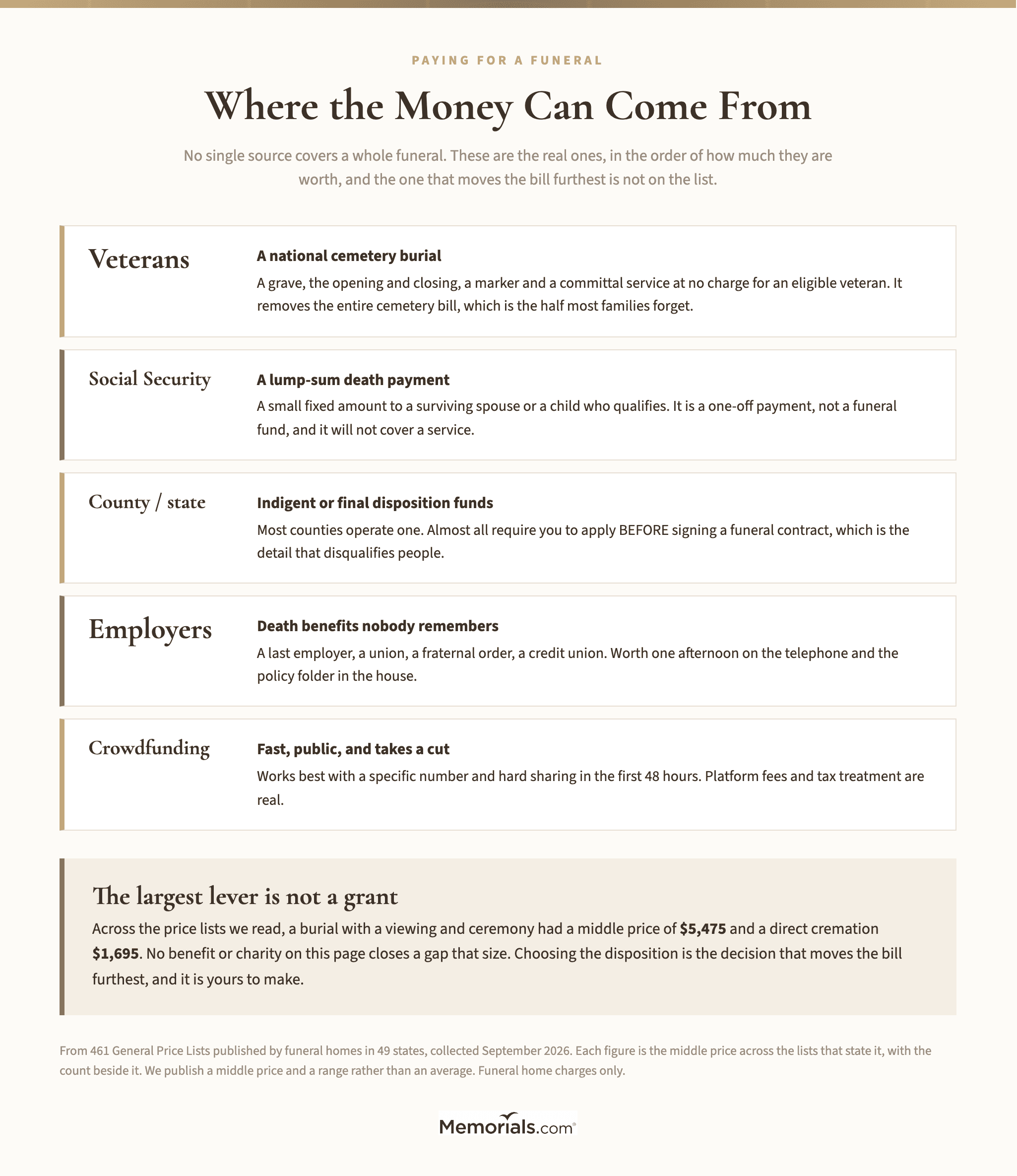
The ladder of real sources, ordered by what each is actually worth. The one that moves the bill furthest is not a grant at all.
County and state indigent burial funds
Every state handles this differently, and many leave it to the county, but some form of public provision exists almost everywhere. It goes by different names: indigent burial, pauper burial, county burial assistance, final disposition assistance. It is the answer to the question families ask most bluntly, which is who pays for a funeral if there is no money at all.
What these funds provide is modest and specific. Typically the county contracts with a local funeral home at a fixed rate and authorizes a direct cremation, or occasionally a simple burial in a designated section of a public cemetery. No viewing, no ceremony, no marker. Some counties release the cremated remains to the family; some inter them and will tell you where.
The rules are strict and the timing matters:
Eligibility is almost always means-tested on the estate of the person who died, not on the family's income, though several programs look at both.
Many programs will not pay if the family has already signed a contract with a funeral home. Apply before you sign anything.
Assets count. A modest bank balance or a paid-off vehicle can disqualify an estate outright.
Some states require that you first apply for, and be denied, other benefits.
Call the county coroner, medical examiner or department of social services, in that order. Ask for the indigent burial or final disposition program by name, ask what the application deadline is, and ask whether authorization has to come before the funeral home is engaged. That last question is the one that costs families the benefit.
Where a death was the result of a crime, look separately at your state's crime victim compensation program. Most include a funeral and burial component considerably larger than an indigent burial fund. They are not charity, they are a statutory benefit, and they are badly underclaimed.
Most counties operate an indigent or final disposition fund, and almost all of them require you to apply before you sign a funeral contract. That order is the detail that disqualifies people.
Death benefits nobody remembers
This is the category that most often produces a surprise, because the money is already owed and nobody thinks to ask.
Employer benefits. Many employers carry basic group life insurance on every employee at no cost to the worker, often a multiple of salary, and it does not lapse the moment someone stops working if they were still employed at death. Retirees sometimes keep a reduced version. Call the human resources department of the last employer and ask specifically about group life, accidental death coverage and any unpaid wages, vacation or pension death benefit.
Union benefits. Many unions pay a death benefit to members and retired members, and some maintain a separate fund for funeral expenses. The local office will know; the member's spouse frequently does not.
Fraternal organizations. Fraternal benefit societies were built around exactly this. Membership in a fraternal order, a benevolent association or certain religious societies often carries a small death benefit or a burial fund that has been quietly accruing for decades.
Credit union and bank accounts. Some credit unions attach a small life insurance benefit to member accounts, and some credit card balances carry credit life coverage that clears the debt.
Go through the wallet, the check register and the annual mail. A dues notice or a membership card is the thread to pull.
What charities actually do
Charitable help exists, but it rarely looks like the general-purpose funeral grant people search for. It comes in four shapes.
Disease and cause-specific foundations. Organizations built around a particular illness or circumstance sometimes hold a small emergency fund for families they already serve. Children's charities are the most likely to offer something, and eligibility usually depends on having been a patient or a client.
Religious congregations. A congregation the family belongs to is often the single most responsive source of funeral help for low income families, and the help is practical as much as financial: a waived facility fee, a meal after the service, musicians, printing, sometimes a contribution from a benevolence fund. Ask the clergy office rather than filling in a form.
Local community and civic funds. Community foundations, civic clubs and some township trustees hold hardship funds with broad discretion. These are genuinely local and not findable nationally. Your county's information and referral line, reachable by dialing 211 in most of the United States, is the fastest route to whatever exists where you live.
Cremation assistance. A small number of nonprofit organizations arrange low-cost or no-cost cremation for families who qualify. Availability is regional.
The honest summary is that charitable financial assistance for funeral expenses tends to be a few hundred dollars, arrives slowly, and is administered by organizations with a prior relationship to the family. It is worth pursuing. It is not worth waiting for.
The folder in the house is worth an afternoon. A last employer, a union, a fraternal order or a credit union carries a death benefit more often than families expect, and nobody is going to volunteer it.
Crowdfunding, and what it really nets
Crowdfunding works, and for many families it raises more than every benefit on this page put together. Understand three things before you start one.
Fees come off the top. Payment processing is deducted from every donation and some platforms add their own charge, so the total on the page is not the amount that reaches your bank account.
The money arrives early or not at all. Campaigns raise the large majority of their total in the first several days, driven almost entirely by how widely the first few people share it. A campaign nobody shares raises nothing, however sympathetic the story.
The tax and benefits questions are real. Money given to an individual in these circumstances is generally treated as a personal gift rather than taxable income, but a platform may still issue a tax form when processing volume crosses a reporting threshold, and a sudden lump sum in a bank account can affect eligibility for means-tested assistance, including the county programs above. If anyone in the household receives needs-based benefits, ask before you launch.
Name a specific target. A campaign asking for a named amount for a named purpose outperforms an open-ended appeal, and you will have the funeral home's written statement of goods and services to quote from.
Payment plans, financing and insurance you may already have
Most funeral homes will discuss a payment arrangement, and some work with third-party lenders who specialize in funeral financing. Judge these on one number only: the total you will repay. A monthly figure is designed to be comfortable, and it tells you nothing about the interest rate, the term or the fees. Ask for the total cost of credit in writing and compare it against the cash price.
If there is a life insurance policy, there is a faster route than waiting for a payout. An assignment of benefits directs the insurer to pay the funeral home directly, which lets arrangements proceed without the family bridging the gap. Our guide to assigning a life insurance policy to a funeral home explains what you are signing, because an assignment is not free and the fee is negotiable.
Check for a prepaid or preneed contract before anything else. Older people arrange these and then tell nobody. Look for a policy folder, a funeral home's name in the checkbook, or a small paid-up burial insurance policy, which used to be sold door to door and is still in force on a great many people.
For an eligible veteran this removes the entire second bill: the grave, the opening and closing, a marker and a committal service, at no charge. It is the largest entitlement on this page by a wide margin.
Body donation programs
Whole-body donation to a medical school or an accredited donation program generally costs the family nothing. Most programs cover transportation, the cremation that follows, and the return of the cremated remains, usually within a year, along with a death certificate.
Acceptance is not guaranteed. Programs decline donations for a range of medical and practical reasons, and they have geographic limits. A declined donation leaves the family arranging a funeral at short notice, so register in advance where possible and always have a second plan. Body donation also rules out a traditional viewing, since the body is transferred quickly.
The saving that beats every grant
Here is the arithmetic that matters more than everything above.
The difference between a full-service funeral and a direct cremation at the same funeral home is, at the middle price list we read, the difference between $5,150 and $1,695. No benefit, fund or charity on this page moves a bill that far. Choosing the simpler disposition does it immediately, with no application and no eligibility test.
That is not an argument for a cremation nobody wanted. It is an argument for separating two decisions that funeral homes present as one. What happens to the body and how the person is remembered are different questions with different price tags. A direct cremation followed by a memorial gathering the family arranges itself, in a church hall, a park or a living room, costs a fraction of the same event staged by a funeral home. Our comparison of cremation versus burial cost sets out where the money goes in each path.
Two federal rights support this, and both are free to use. A funeral home must give you an itemized price list on paper, before any discussion of arrangements, and must quote prices over the telephone, which means you can compare three homes without leaving the house. And a funeral home must accept a casket or urn you bought elsewhere, must use it, and may not charge you a handling fee for doing so. That second right is worth hundreds of dollars on its own, since a cremation urn bought outside the arrangement room is routinely a fraction of the captive price. Our guide to the General Price List every funeral home must show you goes through that document line by line.
What to do, in order
Ask for the itemized price list, and telephone two more homes for the same three items. The basic services fee alone ran from $125 to $7,500 across the price lists we read.
Decide the disposition before you chase money. It is the biggest lever you have.
Check for a veteran's service record. It is the largest entitlement on this page.
File for the Social Security lump-sum death payment promptly.
Call the county about indigent burial assistance before signing a funeral contract, and the state crime victim compensation program if that applies.
Work the phone list: last employer, union, fraternal order, credit union, and any policy folder in the house.
Ask the congregation, and dial 211 for whatever local hardship fund exists.
Launch a crowdfunding campaign with a specific number, and share it hard in the first 48 hours.
Nobody has to decide anything at the table. You are allowed to take the price list home, make these calls, and come back tomorrow. The funeral home is not entitled to rush that, and the money you find in a single afternoon of phone calls is usually larger than anything a search result will hand you.