🏬Supersize Online Funeral Retailer🪦1000's of Headstones⚱️Over 10,000 Cremation Urns⚰️Caskets Overnight Delivery🛒Funeral & Memorial Superstore🚚FREE Shipping on ALL Orders👨👩👧👦Helping Families for over 20 Years💰Lowest Price Guarantee🏬Supersize Online Funeral Retailer🪦1000's of Headstones⚱️Over 10,000 Cremation Urns⚰️Caskets Overnight Delivery🛒Funeral & Memorial Superstore🚚FREE Shipping on ALL Orders👨👩👧👦Helping Families for over 20 Years💰Lowest Price Guarantee
🏬Supersize Online Funeral Retailer🪦1000's of Headstones⚱️Over 10,000 Cremation Urns⚰️Caskets Overnight Delivery🛒Funeral & Memorial Superstore🚚FREE Shipping on ALL Orders👨👩👧👦Helping Families for over 20 Years💰Lowest Price Guarantee🏬Supersize Online Funeral Retailer🪦1000's of Headstones⚱️Over 10,000 Cremation Urns⚰️Caskets Overnight Delivery🛒Funeral & Memorial Superstore🚚FREE Shipping on ALL Orders👨👩👧👦Helping Families for over 20 Years💰Lowest Price Guarantee
Choosing between cremation and burial is one of the most significant decisions a family faces after losing a loved one. For many families, cost plays a decisive role, and the price difference between the two options can be substantial.
This guide breaks down every cost factor for cremation and burial, compares service types side by side, identifies hidden fees that catch families off guard, and offers practical ways to save. For a broader look at the process, cultural, and emotional dimensions of this decision, see our cremation versus burial comparison. If you are already in the early stages of making arrangements, our cremation planning guide walks you through every step from start to finish.
Cremation costs vary widely depending on the type of service you choose and where you live. The three most common cremation options are direct cremation, cremation with a memorial service, and full-service cremation with a viewing.
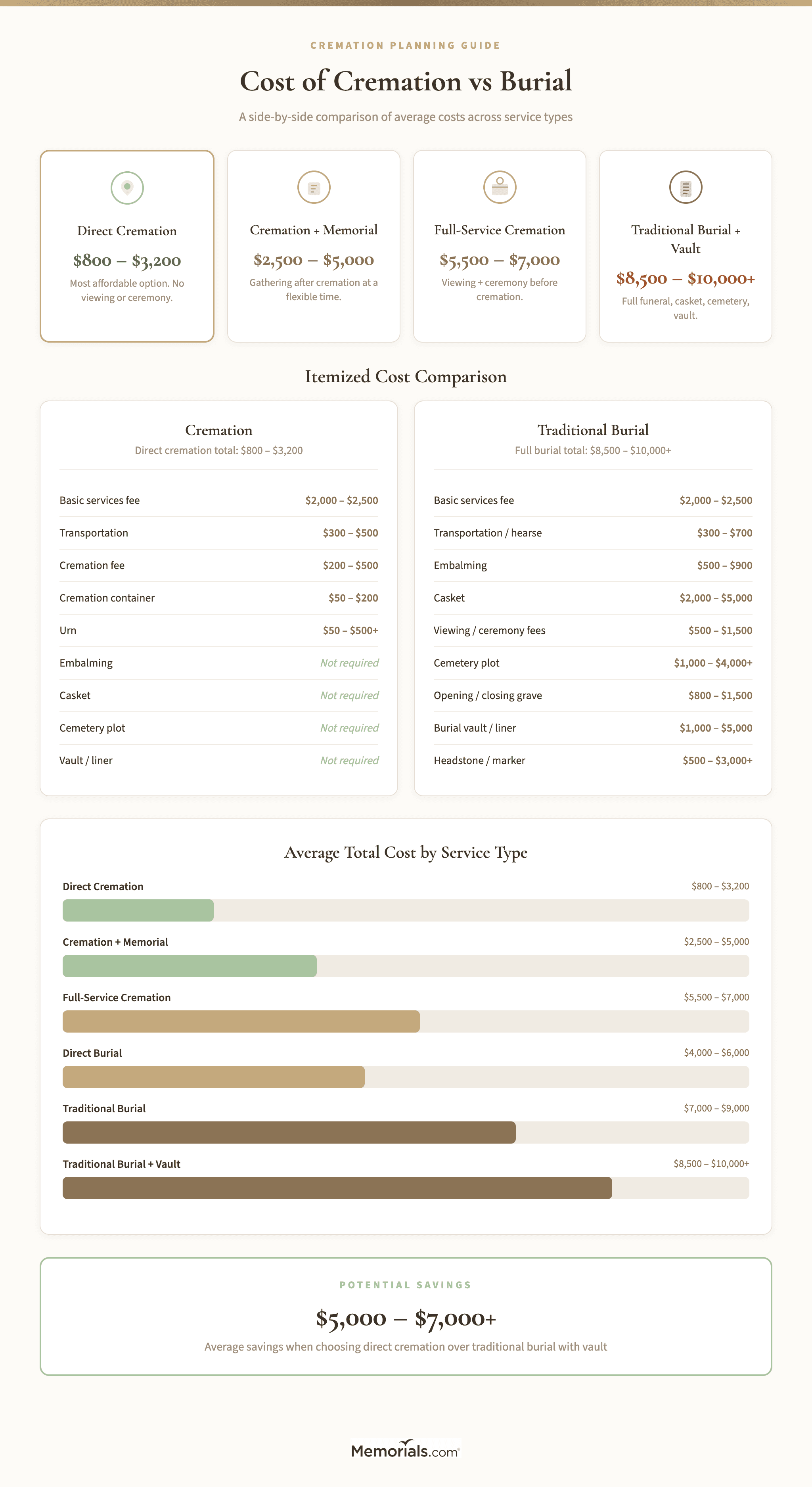
Direct cremation is the most affordable option. The body is transported directly to the crematory and cremated without a viewing or ceremony. Based on industry data and NFDA reporting, direct cremation averages between $800 and $3,200 nationwide, with the national average around $2,200. For a full breakdown of what this option includes and how it works, read our guide to direct cremation costs.
Cremation with a memorial service includes a gathering held after the cremation. Families receive the cremated remains and can plan a ceremony at a time and location of their choosing. This option typically costs between $2,500 and $5,000, depending on the venue, officiant fees, and printed materials.
Full-service cremation with a viewing most closely mirrors a traditional funeral. The body is embalmed and present for a visitation before cremation takes place. The National Funeral Directors Association (NFDA) reports the median cost of a cremation with viewing and ceremony at approximately $6,280.
What's Included in Cremation Costs
A standard cremation fee typically covers the following:
Basic services fee — The funeral home's professional services charge for coordinating paperwork, permits, and logistics. This is a non-declinable fee that typically runs $2,000 to $2,500.
Transportation — Transfer of the body from the place of death to the crematory or funeral home, typically $300 to $500.
Cremation fee — The actual cremation process, charged by the crematory, usually $200 to $500.
Cremation container — A simple combustible container used during cremation, required in most states. Basic containers cost $50 to $200.
Urn — A permanent container for the cremated remains. Prices range from under $50 for a basic urn to several hundred dollars for handcrafted cremation urns. For a full breakdown by material and style, see our guide on how much a cremation urn costs.
Optional additions that raise the cost include embalming (if a viewing is held, typically $500 to $900), facility rental for services ($500 to $1,000), a printed memorial package ($150 to $350), and a rental casket for the viewing ($500 to $1,500).
Regional Price Differences
Cremation costs vary significantly by location. They do not, though, track the cost of living the way most families expect. Reading the price lists published in all fifty states, we found median direct-cremation prices running from $1,175 in Washington to $3,295 in Wisconsin — with Alabama at $2,495 against California's $1,642.50. The gap between the cheapest and the most expensive provider inside one state is wider than the gap between the cheapest and the most expensive state. Metropolitan areas tend to charge 30% to 50% more than rural providers in the same state.
Always compare prices from multiple providers. Under the FTC's Funeral Rule, funeral homes are required to provide itemized pricing over the phone and in person through a General Price List, so families can compare quotes before committing.
How Much Does Burial Cost?
Traditional burial is generally the more expensive option. The NFDA estimates the median cost of a funeral with viewing and burial at approximately $7,848, and that figure climbs to around $9,400 or more when a burial vault is included. These totals do not include cemetery fees, which add another significant layer of expense.
Burial Cost Breakdown
Here is what a typical burial involves and what each component costs:
Basic services fee — Similar to cremation, this covers the funeral home's administrative and coordination services, typically $2,000 to $2,500.
Embalming and body preparation — Required for open-casket viewings, embalming typically costs $500 to $900.
Casket — One of the largest single expenses. A mid-range casket costs between $2,000 and $5,000, though prices range from a few hundred dollars for simple models to $10,000 or more for premium materials.
Viewing and funeral ceremony — Facility fees and staffing for the visitation and service, typically $500 to $1,500.
Hearse and transportation — Transporting the body to the funeral home, ceremony, and cemetery, typically $300 to $700.
Cemetery plot — Varies enormously by location, from $1,000 in rural areas to $4,000 or more in metropolitan cemeteries. Urban plots in major cities can exceed $10,000.
Opening and closing the grave — The physical work of digging and filling the grave, typically $800 to $1,500.
Burial vault or grave liner — Most cemeteries require one to prevent the ground from settling. Burial vaults range from $1,000 to $5,000, while basic grave liners start around $500.
Headstone or grave marker — A lasting memorial at the gravesite. Basic flat markers start around $500, while upright headstones range from $1,000 to $3,000 or more.
For a broader look at every funeral-related expense beyond just the cremation-versus-burial comparison, see our complete guide on total funeral costs.
Cremation vs Burial Cost: Side-by-Side Comparison
The following table summarizes average costs for the most common service types. Actual prices vary by provider and region.
Service Type
Average Cost Range
Direct cremation
$800 – $3,200
Cremation with memorial service
$2,500 – $5,000
Full-service cremation with viewing
$5,500 – $7,000
Direct burial (no service)
$4,000 – $6,000
Traditional burial with viewing
$7,000 – $9,000
Traditional burial with vault
$8,500 – $10,000+
These ranges do not include optional extras like flowers, obituary notices, or a reception. Cemetery costs for burial (plot, opening/closing, vault) can add $3,000 to $8,000 or more to the burial total.
Why Cremation Costs Less
The cost gap between cremation and burial comes down to the number of required products and services. Burial requires a casket, embalming, a cemetery plot, grave opening and closing, and usually a vault or liner. Cremation eliminates most of these expenses. A direct cremation requires only transportation, the cremation itself, a simple container, and a basic urn.
Even when families choose a full-service cremation with a viewing, the total is typically $2,000 to $3,000 less than a comparable burial because the cemetery-related costs are avoided entirely, unless the family chooses to inter the urn.
Hidden Costs to Watch For
Both cremation and burial can include charges that catch families off guard:
Cash advance items — Expenses the funeral home pays on your behalf, including death certificates ($10 to $30 each, and most families need 5 to 10 copies), clergy honoraria ($200 to $500), flowers ($200 to $600), and obituary notices ($200 to $500 in print).
Cemetery surcharges — Endowment care fees, weekend or holiday surcharges ($200 to $500 extra), and monument installation fees ($200 to $400).
Columbarium niche fees — If you choose to place the urn in a columbarium rather than keeping it at home, expect to pay $1,000 to $5,000 depending on location and niche position.
Urn burial costs — Many families choose cremation followed by urn burial, combining the affordability of cremation with a permanent gravesite. This adds cemetery plot, urn vault, and opening/closing fees. For a detailed price breakdown, read our guide on the cost to bury cremated ashes.
Cremation jewelry — Some families choose wearable memorial pieces to keep a small portion of remains close. These are typically $50 to $300 per piece and are an additional cost beyond the urn.
Under the FTC's Funeral Rule, funeral homes must provide an itemized General Price List so you can see every charge before committing. Always request this document and compare quotes from at least three providers.
What Do Alternative Disposition Methods Cost?
Several newer options fall between or outside the traditional cremation-and-burial price spectrum:
Green burial eliminates embalming, uses biodegradable caskets or shrouds, and forgoes concrete vaults. Prices typically range from $2,000 to $6,000, making green burial competitive with mid-range cremation options. What a family actually pays inside that range turns on whether a dedicated natural burial ground sits within driving distance and whether it publishes a price at all — our guides to green burial in Wisconsin and green burial in Iowa show both ends of that, one state with several dedicated grounds and a published municipal price, the other with none in state and the nearest options across a state line. Families choosing the cremation path can use biodegradable urns for earth or water burial at a fraction of traditional urn costs.
Aquamation (alkaline hydrolysis) uses water and alkalinity rather than flame, consuming roughly 85% less energy than traditional cremation. As of 2026, it is legal in over 25 states, and pricing typically runs $2,000 to $5,000. For a full breakdown of how this process works and where it is available, see our guide to aquamation costs and availability.
Natural organic reduction (human composting) is now legal in a growing number of states. This process transforms the body into nutrient-rich soil over approximately 30 to 45 days. Pricing currently runs $5,000 to $7,000, placing it in the mid-range between cremation and traditional burial.
How to Pay for Cremation or Burial
Understanding your financing options can ease the immediate financial burden:
Burial insurance (final expense insurance) is a whole life policy designed specifically to cover end-of-life costs. Monthly premiums typically range from $30 to $200 depending on age, health, and coverage amount. Policies usually cover $5,000 to $25,000, enough to handle either cremation or burial. For help deciding whether a policy makes sense for your situation, read our guide to burial insurance considerations.
Veterans benefits can significantly reduce costs for eligible veterans and their spouses. The Department of Veterans Affairs provides a free burial plot at national cemeteries, a government headstone or marker, and a burial allowance for service-related deaths. Learn more in our guide to VA burial benefits.
Prepaid funeral plans allow families to lock in current prices and remove the burden of last-minute financial decisions from surviving family members. These plans are available through most funeral homes, and funds are typically held in an insurance-backed trust or a state-regulated preneed account.
Crowdfunding and community support have become increasingly common. Platforms like GoFundMe report that funeral fundraisers are among their most frequent and most supported categories, with successful campaigns raising $5,000 to $15,000 on average.
How to Save on Cremation and Burial Costs
Regardless of which option you choose, there are practical ways to reduce expenses:
Compare providers. The FTC's Funeral Rule requires funeral homes to give you prices over the phone. Call at least three to five providers in your area before making a decision. Price differences of $1,000 to $3,000 for the same service are common.
Consider direct cremation or direct burial. Eliminating the viewing and formal ceremony reduces costs by thousands of dollars. You can still hold a memorial gathering separately, at home or in a meaningful location, at little or no additional cost. Many families find that hosting a memorial for cremation weeks or even months later allows distant relatives time to attend and costs far less than a formal funeral.
Ask about package pricing. Many funeral homes offer bundled packages that cost less than purchasing each service individually. Compare the bundled price to the itemized total to confirm the savings are real.
Purchase urns and caskets independently. Funeral homes are required by law to accept urns and caskets purchased from third-party retailers without charging handling fees. A mid-range urn from a retailer like Memorials.com often costs a fraction of what funeral homes charge for comparable options.
Use keepsake urns instead of multiple full-size urns. Families who want to divide ashes among several members can use small keepsake urns ($25 to $60 each) rather than purchasing multiple standard urns. Each keepsake holds a small portion of ashes, giving every family member their own memorial piece.
Pre-plan and prepay. Locking in current prices through a prepaid funeral plan protects against future cost increases. The NFDA reports that funeral costs have risen 2% to 4% annually in recent years, so pre-planning even a few years ahead can yield meaningful savings.
Cremation Rate Trends and Cost Context
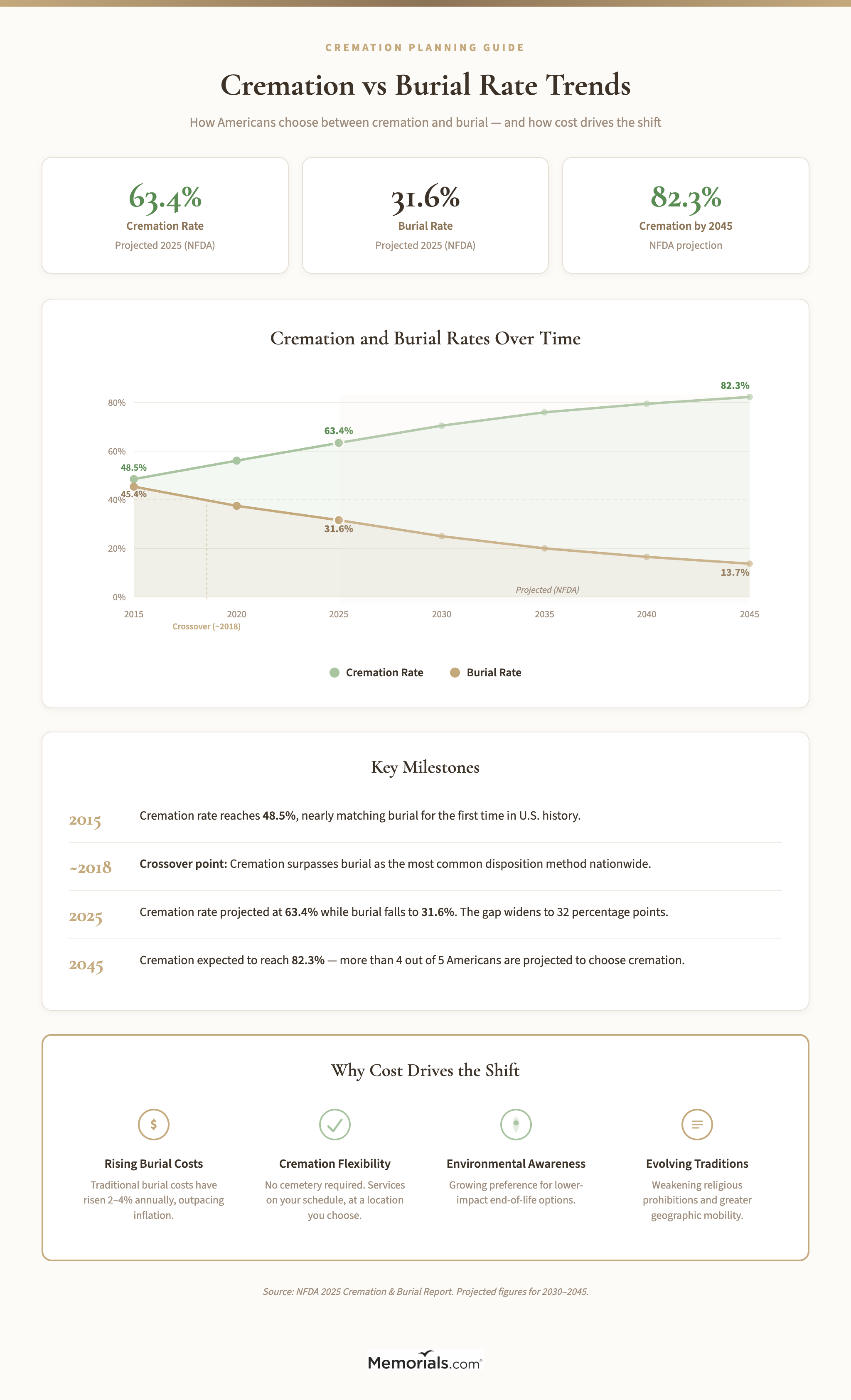
Understanding how cremation rates have shifted provides useful context for the cost discussion. According to the NFDA's 2025 Cremation and Burial Report, the projected cremation rate for 2025 is 63.4%, while the burial rate stands at 31.6%. By 2045, the cremation rate is expected to reach 82.3%.
The rising cost of traditional burial is one of several factors driving this shift. As burial costs continue to outpace inflation, more families are choosing cremation as a practical alternative that still allows for meaningful memorialization, whether through home display, urn burial, scattering, or memorial keepsakes like cremation art.
Frequently Asked Questions
Is cremation or burial cheaper?
Cremation is almost always cheaper than burial. A direct cremation can cost as little as $800, while a traditional burial with a vault typically runs $8,500 to $10,000 or more. Even a full-service cremation with a viewing is generally $2,000 to $3,000 less than a comparable burial because it eliminates cemetery-related expenses like the plot, vault, and grave opening.
Can you have a funeral service with cremation?
Yes. Cremation does not prevent you from holding a formal funeral service. Many families hold a visitation with the body present before cremation, or they plan a memorial service after receiving the cremated remains. For ideas on planning a post-cremation gathering, see our guide to hosting a memorial for cremation.
What is the cheapest cremation option?
Direct cremation is the most affordable. It skips the viewing, embalming, and formal ceremony entirely. The body is cremated shortly after death, and the remains are returned to the family. National averages for direct cremation run around $2,200, though some providers offer this service for under $1,000.
Do you need a casket for cremation?
No. Cremation does not require a traditional casket. Most crematories require a rigid, combustible container, but this can be a simple cardboard or fiberboard box costing $50 to $200. If the family wants a viewing before cremation, a rental casket is available at most funeral homes for $500 to $1,500. You can also choose a dedicated cremation casket designed specifically for this purpose.
What does it cost to bury an urn?
Burying cremated remains is less expensive than a full casket burial, but it still involves several fees. You will typically need a cemetery plot ($500 to $2,000 for a cremation plot), an urn vault ($100 to $500), and an opening and closing fee ($300 to $800). Our detailed guide on urn vault requirements for burial explains what cemeteries require and what to expect price-wise.
Making the Right Financial Decision for Your Family
The cost difference between cremation and burial can range from a few thousand dollars to more than $10,000, depending on the services and products you choose. Understanding the itemized costs, comparing providers, and exploring financing options can help your family make a decision that honors your loved one without creating unnecessary financial strain.
Memorials.com is here to help. We carry a wide selection of cremation urns, caskets, headstones, and sympathy gifts to honor your loved one's memory at every price point. If you need guidance selecting the right urn size, our cremation urn size guide can help you find the perfect fit.