🏬Supersize Online Funeral Retailer🪦1000's of Headstones⚱️Over 10,000 Cremation Urns⚰️Caskets Overnight Delivery🛒Funeral & Memorial Superstore🚚FREE Shipping on ALL Orders👨👩👧👦Helping Families for over 20 Years💰Lowest Price Guarantee🏬Supersize Online Funeral Retailer🪦1000's of Headstones⚱️Over 10,000 Cremation Urns⚰️Caskets Overnight Delivery🛒Funeral & Memorial Superstore🚚FREE Shipping on ALL Orders👨👩👧👦Helping Families for over 20 Years💰Lowest Price Guarantee
🏬Supersize Online Funeral Retailer🪦1000's of Headstones⚱️Over 10,000 Cremation Urns⚰️Caskets Overnight Delivery🛒Funeral & Memorial Superstore🚚FREE Shipping on ALL Orders👨👩👧👦Helping Families for over 20 Years💰Lowest Price Guarantee🏬Supersize Online Funeral Retailer🪦1000's of Headstones⚱️Over 10,000 Cremation Urns⚰️Caskets Overnight Delivery🛒Funeral & Memorial Superstore🚚FREE Shipping on ALL Orders👨👩👧👦Helping Families for over 20 Years💰Lowest Price Guarantee
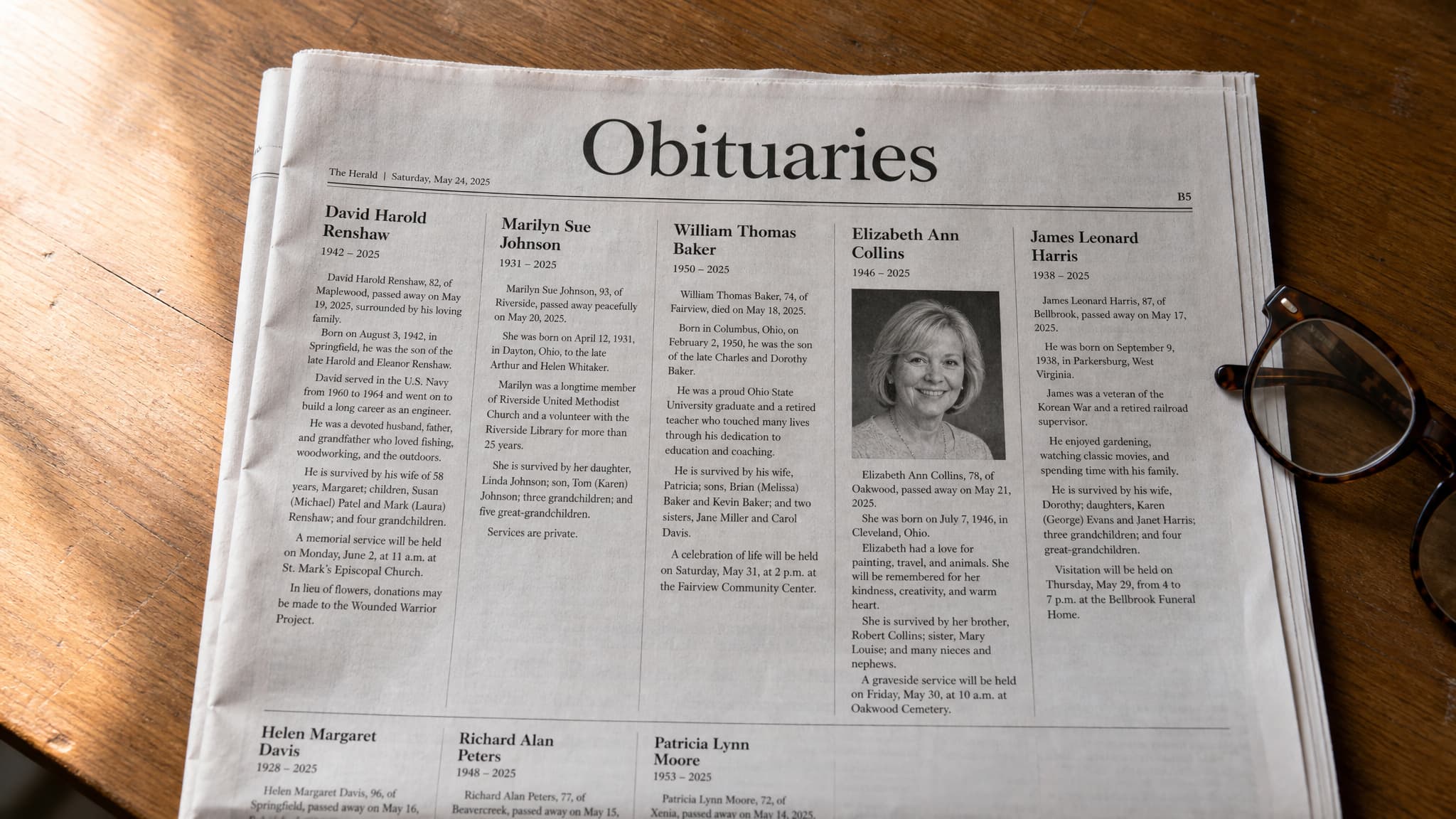
Of all the questions families ask while arranging a service, how much does an obituary cost is the one where the funeral home is not the party setting the price. A paid notice in a newspaper is billed at that newspaper's own advertising rate. The funeral home usually places it for you and passes the charge through at cost, which is why the same notice can be cheap in one town and startling in another. A short announcement in a large metropolitan daily often costs more than a long, unhurried tribute in a small-town weekly, and neither figure has anything to do with what the funeral itself cost.
We are not going to hand you a national number, because there is not one to hand you. Every paper publishes its own rate, sets its own minimum, and charges its own fee for a photograph. Anywhere you see a single confident dollar figure for a newspaper obituary, someone has quoted one paper's rate card and called it the country. What we can do is explain exactly how these charges are built, so that when you call the paper, or read the line on the funeral home's statement, you know what you are looking at and what you can change.
The Price Is the Newspaper's, Not the Funeral Home's
This distinction matters more than it sounds, and it changes what you should do about the number.
When a funeral home prints the obituary charge on your statement, it is almost always a cash advance item: something the home buys on your behalf from a third party and bills through to you. Clergy honoraria, death certificates, flowers, musicians and newspaper notices all sit in that category. They are not the funeral home's services, they are not priced on the home's own list of services, and they are not a fair basis for comparing two funeral homes against each other. When we read 461 General Price Lists to work out what a funeral costs, the obituary was never one of the charges we could measure, for exactly this reason: it is not the home's price to set.
Two practical consequences follow.
First, you are entitled to see what the paper actually charged. Federal rules require the funeral home to give you a written statement of everything you selected before you sign, and cash advance items belong on it. If the obituary appears as a round lump sum with no breakdown, ask which paper, how many lines, and whether a service fee has been added on top. Some homes pass the charge through at cost and some add a handling fee for placing it. Both are legal, and only one is what most families assume is happening. Our guide to the General Price List every funeral home must show you walks through where these items appear on the document.
Second, you can place it yourself. Nothing obliges you to have the funeral home submit the notice. Newspapers take obituaries directly from families, usually through an online form or an obituary desk, and doing it yourself removes any placement fee and lets you see the price before you commit to the wording. The trade-off is time and proofreading at a moment when you have little of either.
How Newspapers Actually Bill
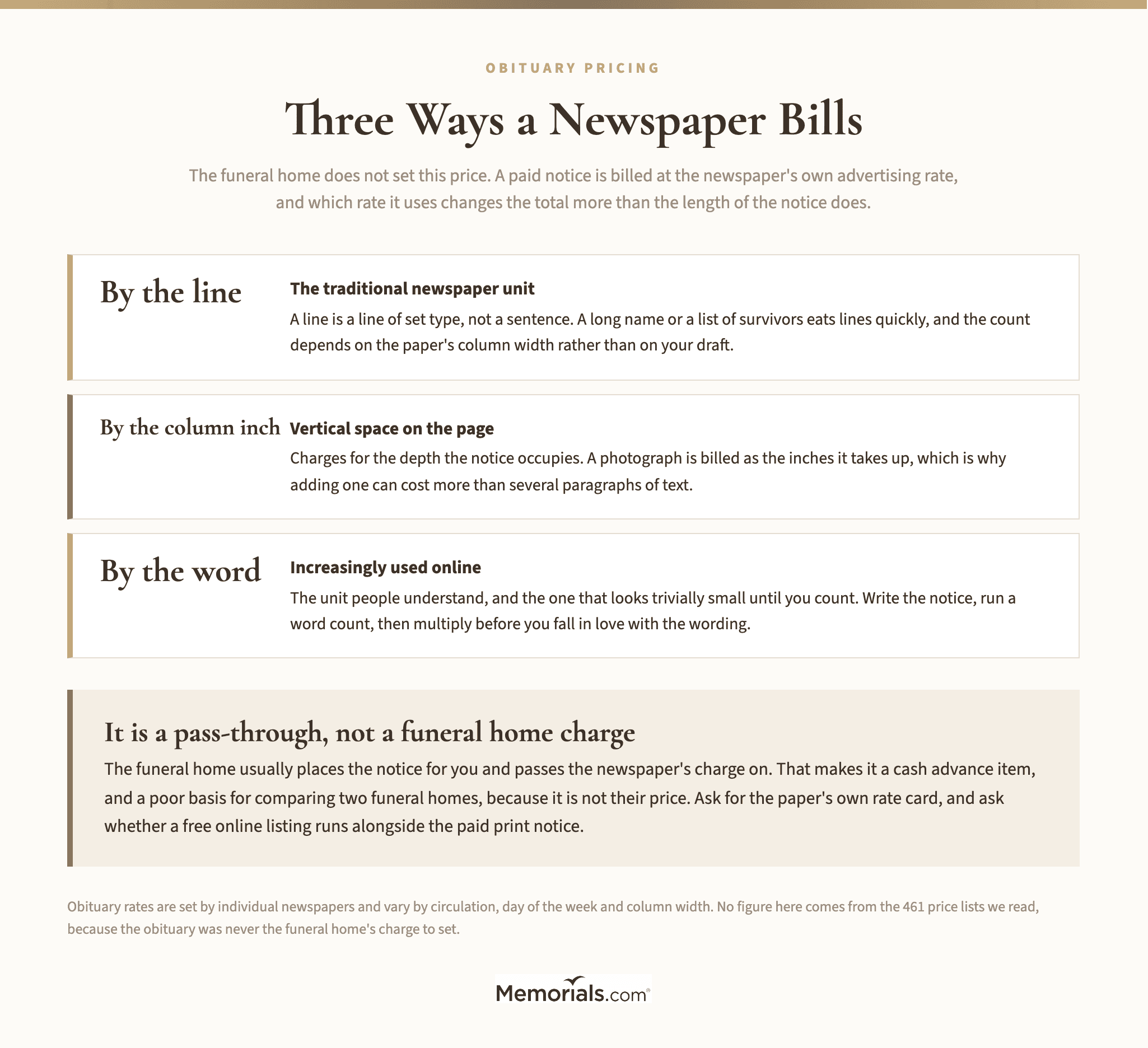
Three billing units are in common use, and a paper will use one of them.
By the line
The oldest method, and still the most common at established dailies. The paper counts typeset lines, not the lines in your document, so the count depends on the column width and the type size the paper uses. A name in full, a long list of surviving relatives, and any line short enough to leave white space on the right all cost the same as a line packed with words. There is normally a minimum charge covering the first several lines, which is why a very brief notice rarely costs proportionally less than a moderate one.
By the column inch
Common at papers that treat the obituary as display advertising. The notice is measured as a block: its width in columns multiplied by its depth in inches. A photograph is simply more inches, which is why the photo fee is often quoted separately at line-rate papers and absorbed into the measurement here.
By the word
Increasingly used by online-first and regional papers because it is the unit people understand. Where the obituary cost per word is quoted, the number looks trivially small until you count the words, and a full tribute with a career summary and a list of survivors runs far longer than families expect. Write the notice first, run a word count on it, and multiply. Do that before you fall in love with the wording.
Ask the paper which unit it uses before you write anything, because the unit changes what you should edit. At a per-line paper, a long list of names formatted one per line is expensive and the same names run together as a paragraph are not. At a per-word paper, formatting is free and every adjective is not.
Which unit the paper uses changes the total more than the length of your notice does.
What Moves the Price
Searches for the cost of obituary in newspaper pages return wildly different answers, and most of them are correct, because each one is quoting a different paper. These are the variables behind the spread.
Circulation. Obituary rates track advertising rates, and advertising rates track readership. A metropolitan daily reaching hundreds of thousands of households charges accordingly. A county weekly does not. Where the person lived their life matters more to this bill than anything about the funeral.
Length. The single lever you fully control, and the one families use least. More on cutting it below.
A photograph. Almost always a separate charge, and usually a substantial one relative to the text. Some papers charge a flat fee per photo, some charge for the space it occupies, and some charge one rate in print and another to carry it online. Ask specifically. A photo is the most common reason a family's estimate comes back higher than they expected.
Day of the week. Weekend editions carry higher advertising rates at many papers, and Sunday is often the most expensive day of the week to run anything. If the service date allows it, ask whether a weekday run costs less. It frequently does.
How many days it runs. A notice can run once or repeat across several editions. Repeats are usually discounted against the first insertion but they are not free, and a second run buys less than families imagine.
Print, online, or both. Most papers now sell a print notice with an accompanying page on their website, and the two may be bundled or billed separately. In a growing number of cases the online page is included at no extra charge with a paid print notice, and it is often unlimited in length. That combination is the most useful thing in this article, and the next section is about using it.
Write the notice first and count the words. Every billing method rewards the same discipline, and the cutting is easier before you have fallen in love with the wording.
Free and Low-Cost Places an Obituary Can Live
The paid newspaper notice is a tradition, not a requirement. Nothing legally obliges a family to publish an obituary anywhere. What you actually need is for the right people to learn that the person died and where the service will be, and there are several ways to accomplish that at little or no cost.
The newspaper's own online page. Ask whether a paid print notice includes a web page, and whether that page has a length limit. Where it does not, you have somewhere to put the whole story at no additional cost, and the printed notice can shrink to the facts. This is the single largest saving available to most families and it costs nothing but a question.
The funeral home's website. Nearly every funeral home now hosts an obituary page for each service it handles, at no charge, with a guest book and the service details. It is indexed by search engines, it is easy to share, and it has no word limit. For many families it has quietly replaced the paper as the place people actually go to look.
Social media. A post on the person's own account or a family member's reaches the people who knew them, immediately and for free. It also reaches people a newspaper never would, particularly anyone who moved away. The caution is that it is public and permanent, so keep the home address out of it and be careful about naming survivors who would rather not be named.
Community channels. Church bulletins, union newsletters, alumni magazines and neighborhood groups usually carry a death notice free for a member. If the person belonged to something, ask the something.
A sensible pattern for most families: the full tribute online, wherever it is free and unlimited, and a short, correct, inexpensive notice in print that points to it.
Death Notice or Obituary?
The two words are used interchangeably in conversation and mean different things at a newspaper, which is the source of a good deal of confusion about price.
A death notice is a paid announcement placed by the family or the funeral home. It carries the name, the date of death, and the details of the service, sometimes with an age and the names of survivors. It is advertising, the paper prints what you submit, and you pay for the space.
An obituary, strictly speaking, is an article a newspaper's own staff writes about someone whose life the paper judges newsworthy. Nobody pays for it, nobody can buy it, and the paper decides both whether to run it and what it says. Most papers run very few.
In practice, almost every paper now sells long-form paid notices and calls them obituaries, and the editorial obituary has become rare outside larger publications. When you call to ask about rates, say what you want in plain terms rather than by name: a paid notice of roughly this length, with or without a photograph, running on this date. That avoids a conversation in which two people use the same word for two different products.
If you are uncertain how to structure what you write for either destination, our guide on how to write an obituary covers the sections and the order they usually take.
Circulation is most of the price. The same notice can be cheap in a small-town weekly and startling in a metropolitan daily, and neither figure has anything to do with what the funeral cost.
Cutting the Length Without Cutting the Meaning
Length is the only variable you control completely, and most notices can lose a third of their words without losing anything a reader would miss. These are the reductions that do the least damage.
Run the survivors together. A list of relatives formatted one name per line is the most expensive paragraph in most notices at a per-line paper. Set as running prose, the same names occupy a fraction of the space and read no worse.
Group rather than enumerate. "Survived by seven grandchildren and four great-grandchildren" carries the same information to almost every reader as naming all eleven, at a fraction of the length. Name them in the online version, where the space is free.
Cut the dates that are not load-bearing. A full birth date, a full marriage date, a full date for every job change and every move adds up quickly. The year is usually enough in print.
Drop the formula. Phrases like "passed away peacefully surrounded by loving family" and "will be deeply missed by all who knew him" appear in a large share of notices, say nothing specific about this person, and cost the same as words that do. One concrete detail about how they actually were is worth a paragraph of that language.
Move the long version online. Say the essential facts in print and add a single line pointing to the funeral home's page or the paper's own web page, where the full tribute lives at no charge.
Proofread twice before you submit. A correction usually means paying to run it again, and a misspelled name is the mistake families regret most. Read the names aloud against a written list, and check the service time against the funeral home's schedule rather than your memory of it.
What to keep, in every version: the full name, including a maiden name and any name people actually knew them by; the town; the date of death; the service details with date, time and place; and where to send memorial gifts if the family is directing them somewhere.
Questions Worth Asking Before You Place It
Which unit do you charge by, and what is the minimum charge?
Is the photograph a separate fee, and how much is it?
Does a paid print notice include an online page, and does that page have a length limit?
Does the price change by day of the week, and is a weekday cheaper?
What is the deadline for the edition we need?
If the funeral home places it, is the paper's charge passed through at cost, or is a placement fee added?
You can place a notice yourself. The funeral home will do it and pass the charge through, but nothing requires you to go through them, and the paper will quote you its own rate.
Frequently Asked Questions
How much do obituaries cost?
When people ask how much do obituaries cost, the honest answer is that it depends far more on which newspaper than on how long the notice is.
There is no national figure, because each newspaper sets its own rate. The price depends on the paper's circulation, the length of the notice, whether a photograph runs, which day it appears, and how many editions it runs in. Call the paper, ask for its rate and its minimum charge, and count the words or lines in your draft. That takes about ten minutes and gives you a real number rather than an estimate.
Does the funeral home charge extra to place it?
Sometimes. The newspaper's charge is a cash advance item passed through to you, and some homes add a fee for handling the placement. You are entitled to a written statement of what you selected before you sign, so ask for the obituary line to be itemized.
Is a photograph worth the extra charge?
That is a family decision, but it is worth knowing that the photo is very often the largest single addition to a modest notice. One option is a photograph in the free online version and text only in print.
Can I place an obituary myself instead of through the funeral home?
Yes. Most papers accept notices directly from families through an obituary desk or an online form. You will see the price before you commit to the wording, and you avoid any placement fee.
Do I have to publish an obituary at all?
No. There is no legal requirement to publish anything. Families who skip the paid notice typically use the funeral home's own obituary page, social media, and word of mouth, at no cost at all.
Where This Sits in the Rest of the Bill
An obituary is one of the smaller lines on a funeral statement, but it belongs to a category of charges that families consistently overlook when budgeting: the ones that come from somewhere other than the funeral home. The cemetery sends its own bill. The headstone or grave marker is usually chosen weeks later and bought separately, and you can see what markers cost outside a cemetery's own list in our headstones range. The newspaper sends an invoice or takes a card. None of these appear on the price list you were handed at the funeral home, and all of them arrive.
Knowing which charges belong to whom is most of what makes a funeral bill legible. Our funeral planning guide covers the decisions in the order they usually arrive, so that the obituary deadline is not the first time you learn a newspaper was involved at all.
An obituary is a small line on a large bill, and the reasons the rest of it runs to four figures are mostly structural rather than greedy. Why are funerals so expensive takes that question seriously, starting with a fee no family can decline that ranges from $125 to $7,500 for the same administrative work.