🏬Supersize Online Funeral Retailer🪦1000's of Headstones⚱️Over 10,000 Cremation Urns⚰️Caskets Overnight Delivery🛒Funeral & Memorial Superstore🚚FREE Shipping on ALL Orders👨👩👧👦Helping Families for over 20 Years💰Lowest Price Guarantee🏬Supersize Online Funeral Retailer🪦1000's of Headstones⚱️Over 10,000 Cremation Urns⚰️Caskets Overnight Delivery🛒Funeral & Memorial Superstore🚚FREE Shipping on ALL Orders👨👩👧👦Helping Families for over 20 Years💰Lowest Price Guarantee
🏬Supersize Online Funeral Retailer🪦1000's of Headstones⚱️Over 10,000 Cremation Urns⚰️Caskets Overnight Delivery🛒Funeral & Memorial Superstore🚚FREE Shipping on ALL Orders👨👩👧👦Helping Families for over 20 Years💰Lowest Price Guarantee🏬Supersize Online Funeral Retailer🪦1000's of Headstones⚱️Over 10,000 Cremation Urns⚰️Caskets Overnight Delivery🛒Funeral & Memorial Superstore🚚FREE Shipping on ALL Orders👨👩👧👦Helping Families for over 20 Years💰Lowest Price Guarantee
A memorial plaque carries a responsibility that few other keepsakes share: the words you choose will remain visible for decades, greeting visitors, passersby, and future generations long after the dedication ceremony ends. Whether the plaque marks a park bench, a garden stone, a columbarium niche, or a building entrance, the inscription needs to feel both personal and timeless. Short memorial plaque quotes work best because they can be read at a glance and remembered long after someone walks away.
This article collects proven inscription ideas organized by setting and relationship, along with practical guidance on length, formatting, and tone. For a broader look at engraving across every memorial type, see our guide to memorial inscriptions, which covers headstones, urns, and markers as well.
The strongest memorial plaques share a few qualities. First, brevity: most plaques offer between two and five lines of text, so every word must earn its place. Second, clarity: visitors should understand the tribute without needing context. Third, emotional truth: the quote should sound like something the family would actually say, not a phrase chosen because it sounded poetic in a catalog.
A useful test is to read the inscription aloud. If it takes longer than a single breath to say, it may be too long for the available space. Most engravers recommend keeping plaque inscriptions under thirty words, and many of the most enduring examples are far shorter than that.
Secular vs. Religious vs. Personalized
Memorial plaque inscriptions generally fall into three categories. Secular quotes draw from literature, poetry, or universal sentiments about love and remembrance. Religious inscriptions reference scripture or faith-based comfort. Personalized inscriptions use the individual's own words, a family motto, or a phrase that captures a specific trait or memory. The best choice depends on where the plaque will be displayed and who will read it — a church columbarium calls for different language than a public park bench.
Short Memorial Plaque Quotes for General Use
These inscriptions work in nearly any setting — from a grave marker to a garden memorial stone. They are brief enough to fit standard plaque dimensions and meaningful enough to stand alone without explanation.
Classic Remembrance Phrases
Forever in our hearts
Always loved, never forgotten
Gone from our sight, never from our hearts
In loving memory
A life beautifully lived, a heart dearly loved
Until we meet again
Rest in eternal peace
Your memory is our keepsake
Timeless Literary and Poetic Lines
"To live in hearts we leave behind is not to die" — Thomas Campbell
"What we have once enjoyed we can never lose" — Helen Keller
"The song is ended, but the melody lingers on" — Irving Berlin
"Unable are the loved to die, for love is immortality" — Emily Dickinson
"Love is immortal, and death is only a horizon" — Rossiter W. Raymond
Dedication Plaque Wording for Public Spaces
Dedication plaques serve a dual purpose: they honor an individual while explaining why a space, bench, or garden feature has been named in their memory. These inscriptions tend to include the person's name, dates, and a brief phrase connecting them to the location.
Park Bench and Garden Inscriptions
In memory of [Name], who loved this garden
[Name] — beloved friend, devoted gardener, forever at home among the flowers
Dedicated to [Name], whose laughter filled this park
For [Name], who found peace in every sunrise
This bench is placed in loving memory of [Name], 1945–2024
Garden and bench plaques are among the most common memorial inscriptions for a friend, because they create a public gathering place where people can sit, reflect, and remember someone they cared about. Many families also commission bench or garden plaques as inscriptions for grandparents who spent years tending a particular yard or visiting a favorite park.
Building and Institutional Dedications
In recognition of [Name], whose generosity made this possible
This [room/wing/library] is dedicated to [Name], whose vision shaped our community
[Name], 1940–2023 — teacher, mentor, friend
In honor of [Name], who gave so much to so many
Formatting Tips for Dedication Plaque Wording
Dedication plaques often have more room than a small bench plate, but restraint still matters. Lead with the name, follow with a brief descriptor or relationship, and close with a short sentiment or dates. If the plaque commemorates a donation or bequest, a line acknowledging the gift should appear after the personal tribute — not before it.
Bronze Plaque Inscriptions for Grave Markers and Memorials
Bronze plaques are a popular choice for cemetery memorials because of their durability and dignified appearance. Bronze weathers gracefully and can hold engraved text for over a century, making the inscription choice especially important.
Most bronze plaques carry an emblem alongside the words, and the emblem takes room the lettering can no longer use. Our guide to religious imagery on memorials covers what each symbol signifies and where a tradition or a cemetery restricts it.
A heart of gold stopped beating, two shining eyes at rest
Earth has no sorrow that heaven cannot heal
Safe in the arms of God
Asleep in God's beautiful garden
Military and Service-Oriented Bronze Inscriptions
In honored memory of [Name], who served with courage and distinction
[Name], [Rank], [Branch] — duty, honor, country
They gave their tomorrow for our today
Greater love hath no one than this
Bronze plaque inscriptions should account for the lettering method. Cast bronze lettering has a raised profile that catches light differently than flat engraving. Shorter lines with wider spacing tend to be the most readable on bronze surfaces, especially in outdoor settings where rain and shadows affect visibility.
Niche and Columbarium Plaque Inscriptions
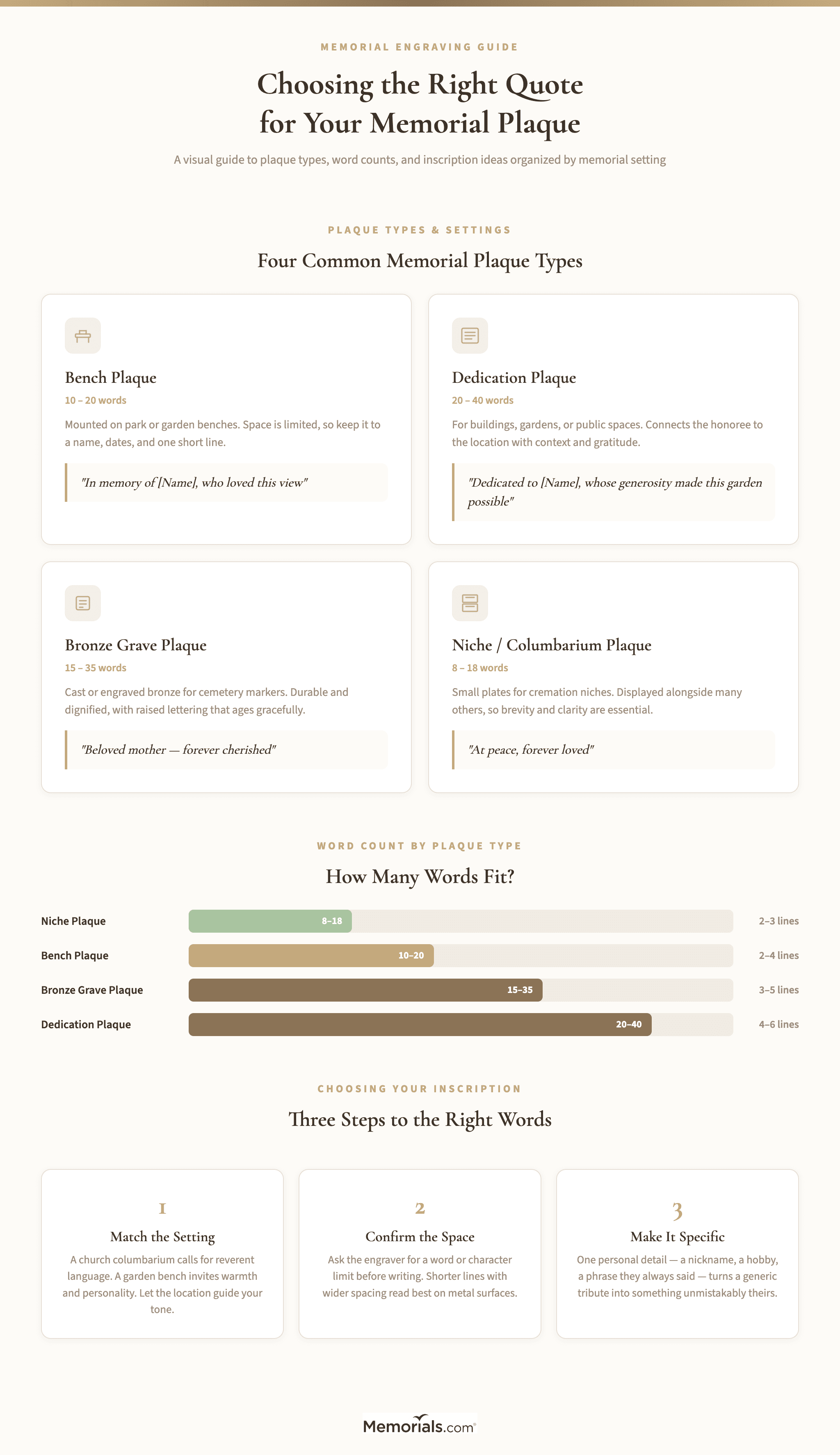
Niche plaques present a unique constraint: the available engraving area is typically smaller than a standard grave marker. Most columbarium niche plates accommodate two to four lines of text plus the name and dates, which means every word counts.
Short Quotes for Cremation Niche Plaques
Together again in God's light
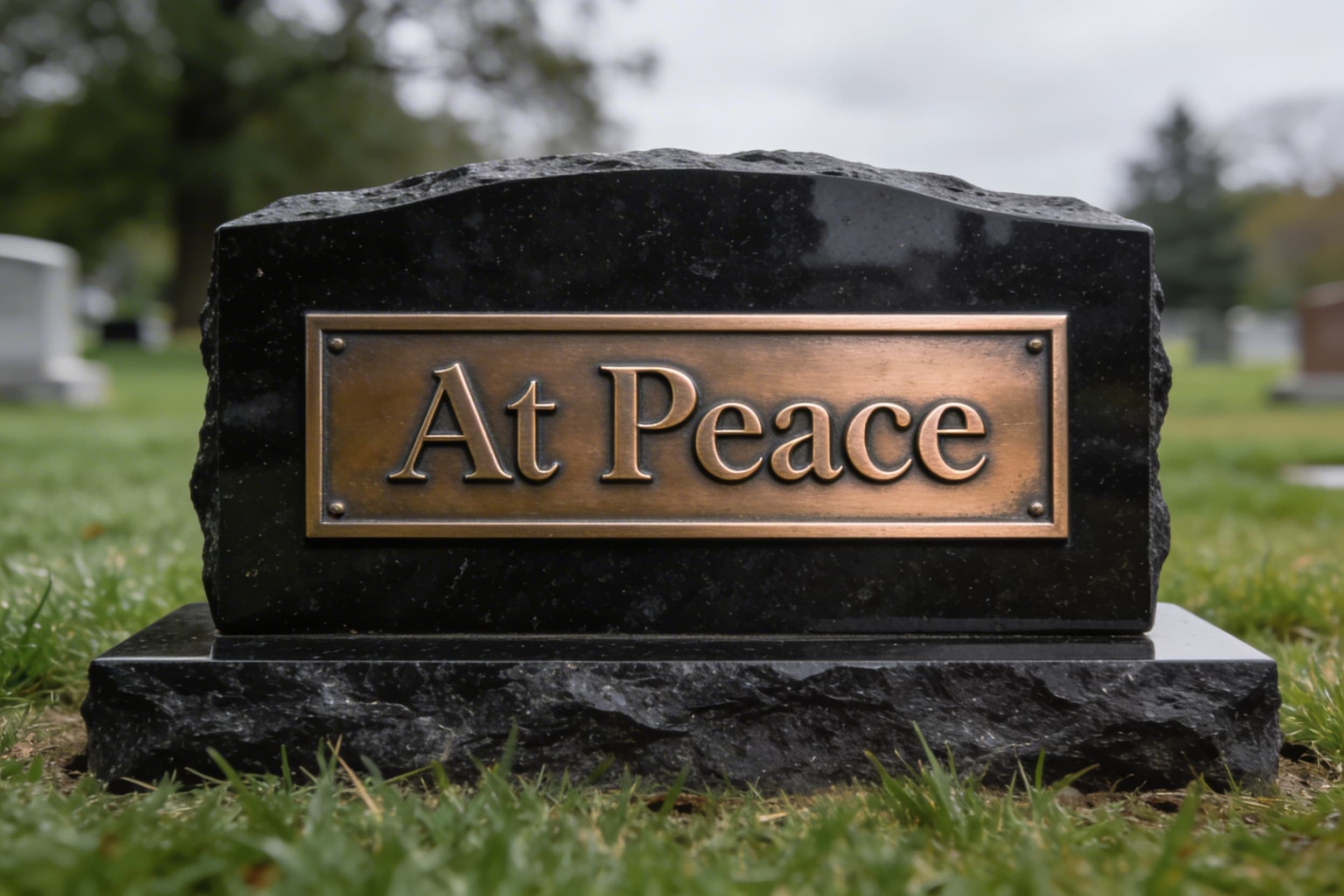
At peace, forever loved
Soaring free at last
Resting where the angels sing
Into the light
Reunited in heaven
When choosing a niche inscription, consider that columbarium walls display many plaques side by side. A message that reads well on its own also needs to hold its own among dozens of neighboring tributes. Simple, direct quotes tend to be the most visually effective in this setting.
Memorial Plaque Sayings by Relationship
The relationship to the person being honored often shapes the tone of the inscription. A plaque for a parent carries different emotional weight than one for a colleague, and the language should reflect that.
Language matters as much as relationship. For a Spanish-speaking family, rest in peace in spanish gives the four forms, the abbreviations that appear in obituaries, and the choice between descanse and descansa — which decides whether the plaque speaks about the person or to them.
For a Mother
A mother's love knows no end
Her warmth lingers in every room she touched
The world was brighter because she was in it
Families looking for short-form inscription ideas specifically for a mother's cremation urn or keepsake may also find urn quotes for mom helpful, as many of those same phrases translate well to plaque settings.
For a Father
His strength was quiet, his love was not
He taught us how to live
A good man leaves an inheritance of memories
For a Spouse
My love, my life, my everything
Side by side or miles apart, you are always in my heart
What we shared will never fade
For a Child
Too beautiful for earth
Our little angel
Small in stature, immense in love
For a Pet
Loyal companion, faithful friend
You made every day better
Forever in my heart, little one
How to Choose the Right Quote for Your Plaque
Consider the Setting
A garden memorial in a private backyard allows for more personal, informal wording than a granite marker in a formal cemetery. A church columbarium may call for a religious inscription, while a secular memorial wall invites universal sentiments. Match the quote to the audience — will only family see this plaque, or will strangers read it daily?
Account for Space and Material
Plaque size dictates word count. A small bench plate may hold fifteen to twenty words; a full-size bronze dedication plaque can accommodate forty or more. Ask your engraver for a character limit before finalizing the inscription. The material matters as well — fine-line engraving on brass allows for slightly more text than raised cast lettering on bronze.
Personalization Options Beyond Text
Many families complement a short quote with additional engraving elements: a small cross, a floral motif, a military emblem, or a custom symbol that represented the person's passion. For other memorial items that pair well with plaque tributes, exploring urn engraving and personalization ideas can offer additional inspiration for nameplate wording, font selection, and design elements.
Writing Your Own Memorial Plaque Inscription
Sometimes the most meaningful inscription does not come from a list — it comes from the family's own words. A phrase the person always said, a line from a letter they wrote, or a single word that captures who they were can be more powerful than any published quote.
Tips for Original Inscriptions
Start by writing down three words that describe the person. Build outward from those words into a short phrase. Read it aloud to hear how it sounds. Ask another family member whether the words ring true. Avoid overcomplicating the message — the simplest tributes are usually the ones that last.
A few examples of personalized inscriptions that families have used:
"She could make anyone laugh"
"He never met a stranger"
"Builder of fences, mender of hearts"
"Happiest with dirt on her hands"
"Always the first to arrive, the last to leave"
These phrases work because they are specific. They paint a picture of a real person rather than expressing a generic sentiment, and that specificity is what makes visitors pause, smile, and feel something.
Frequently Asked Questions
What should I write on a memorial plaque?
A memorial plaque typically includes the person's name, dates of birth and death, and a short quote or sentiment. Choose words that reflect the individual's personality, faith, or the relationship you shared. Classic choices like "Forever in our hearts" or "In loving memory" work well, but a personal phrase that captures who the person was can be equally powerful.
How long should a memorial plaque inscription be?
Most plaques accommodate fifteen to forty words depending on size and material. Small bench plates and niche plaques suit inscriptions of two to three lines, while larger dedication and bronze cemetery plaques can handle four to six lines. Always confirm the character limit with your engraver before finalizing the text.
What is the most common memorial plaque quote?
"In loving memory" is the most frequently used phrase on memorial plaques and headstones worldwide. Other widely used inscriptions include "Forever in our hearts," "Rest in peace," and "Gone but never forgotten." These phrases endure because they are universal — they express love and loss in language everyone understands.
Can I use a quote from a song or poem on a memorial plaque?
Yes, many families use lines from poems, hymns, or literary works. Short excerpts from published works are generally acceptable for private memorial use. Popular choices include lines from Emily Dickinson, Tennyson, and traditional Irish blessings. Keep the excerpt brief — one to two lines is ideal — and confirm the wording with your engraver, as longer passages may not fit.
Are memorial plaque inscriptions different from headstone inscriptions?
Memorial plaque inscriptions tend to be shorter and more focused on a single sentiment, because plaque surfaces are smaller than most headstones. Headstones often include full names, dates, and a brief epitaph, while plaques — especially bench and garden plaques — frequently use just a name and a short quote. The principles of choosing meaningful, concise wording apply equally to both.
A memorial plaque inscription does not need to be perfect — it needs to be true. The words that honor someone best are the ones that sound like they belong, the ones a family member can read ten years from now and still feel they got it right. Start with what you know about the person, keep it short, and trust that a few honest words will carry more weight than a paragraph ever could.