🏬Supersize Online Funeral Retailer🪦1000's of Headstones⚱️Over 10,000 Cremation Urns⚰️Caskets Overnight Delivery🛒Funeral & Memorial Superstore🚚FREE Shipping on ALL Orders👨👩👧👦Helping Families for over 20 Years💰Lowest Price Guarantee🏬Supersize Online Funeral Retailer🪦1000's of Headstones⚱️Over 10,000 Cremation Urns⚰️Caskets Overnight Delivery🛒Funeral & Memorial Superstore🚚FREE Shipping on ALL Orders👨👩👧👦Helping Families for over 20 Years💰Lowest Price Guarantee
🏬Supersize Online Funeral Retailer🪦1000's of Headstones⚱️Over 10,000 Cremation Urns⚰️Caskets Overnight Delivery🛒Funeral & Memorial Superstore🚚FREE Shipping on ALL Orders👨👩👧👦Helping Families for over 20 Years💰Lowest Price Guarantee🏬Supersize Online Funeral Retailer🪦1000's of Headstones⚱️Over 10,000 Cremation Urns⚰️Caskets Overnight Delivery🛒Funeral & Memorial Superstore🚚FREE Shipping on ALL Orders👨👩👧👦Helping Families for over 20 Years💰Lowest Price Guarantee
Memorial lanterns come in two kinds, and the difference is not decorative.
The kind you release — searched for as memorial lanterns to release in sky, or just memorial lanterns to release — is a paper shell over an open flame, lifted by hot air and carried by wind nobody can predict. It is the image everyone has in mind, it photographs beautifully, and it is restricted or prohibited across much of the United States — for reasons that are worth understanding before you order fifty.
The kind you keep, sometimes sold as memory lanterns, is a lantern-form object: a garden lantern, a candle lantern, or an urn shaped like one. It does the same job at a memorial and it is still there next year.
This page covers what the rules actually are, why they exist, and — since most people arriving here want the release rather than the object — the versions of that ceremony that work and are legal.
Not because anyone dislikes them. Because of what they are: an unattended open flame, attached to a frame, traveling somewhere you cannot control.
They start fires. A lantern stays lit after it descends. Dry grass, standing crops, thatch and forest all ignite from them, and there is a documented history of large fires traced to lantern releases.
The frame kills livestock. Traditional lanterns use wire or bamboo. Wire ends up in silage, gets eaten by cattle, and perforates the gut. This is why farming organizations campaign against them, and it is the part most people have never heard.
They cannot be recovered. Whatever you release lands on someone else's land, and it is litter by the time it does.
They interfere with aviation and coastguard. Lit objects drifting at altitude get reported, and a lantern release near a coast reliably produces a lifeboat launch for a suspected distress flare.
This is why safe alternatives to sky lanterns is a search in its own right, and why the honest version of this page spends more words on the alternatives than on the lanterns.
Balloon releases have the same problem with the sea instead of a field. `Balloon release ideas` is a common search and the honest answer is the same one.
Assume they are not permitted, and check. Sky lanterns are banned outright in a number of US states, restricted in others, and prohibited by many individual counties, fire districts, parks and cemeteries even where the state allows them. The rules also change with conditions — a county with no ban in March will have a burn ban in August.
Three calls settle it:
The venue. Cemeteries and funeral homes almost universally say no, and they will say so quickly.
The local fire authority. They will tell you the current position and any burn ban in force.
The landowner, if it is not your land.
Nobody will be angry that you asked. People are angry when fifty lanterns go up unannounced and the fire service gets forty calls.
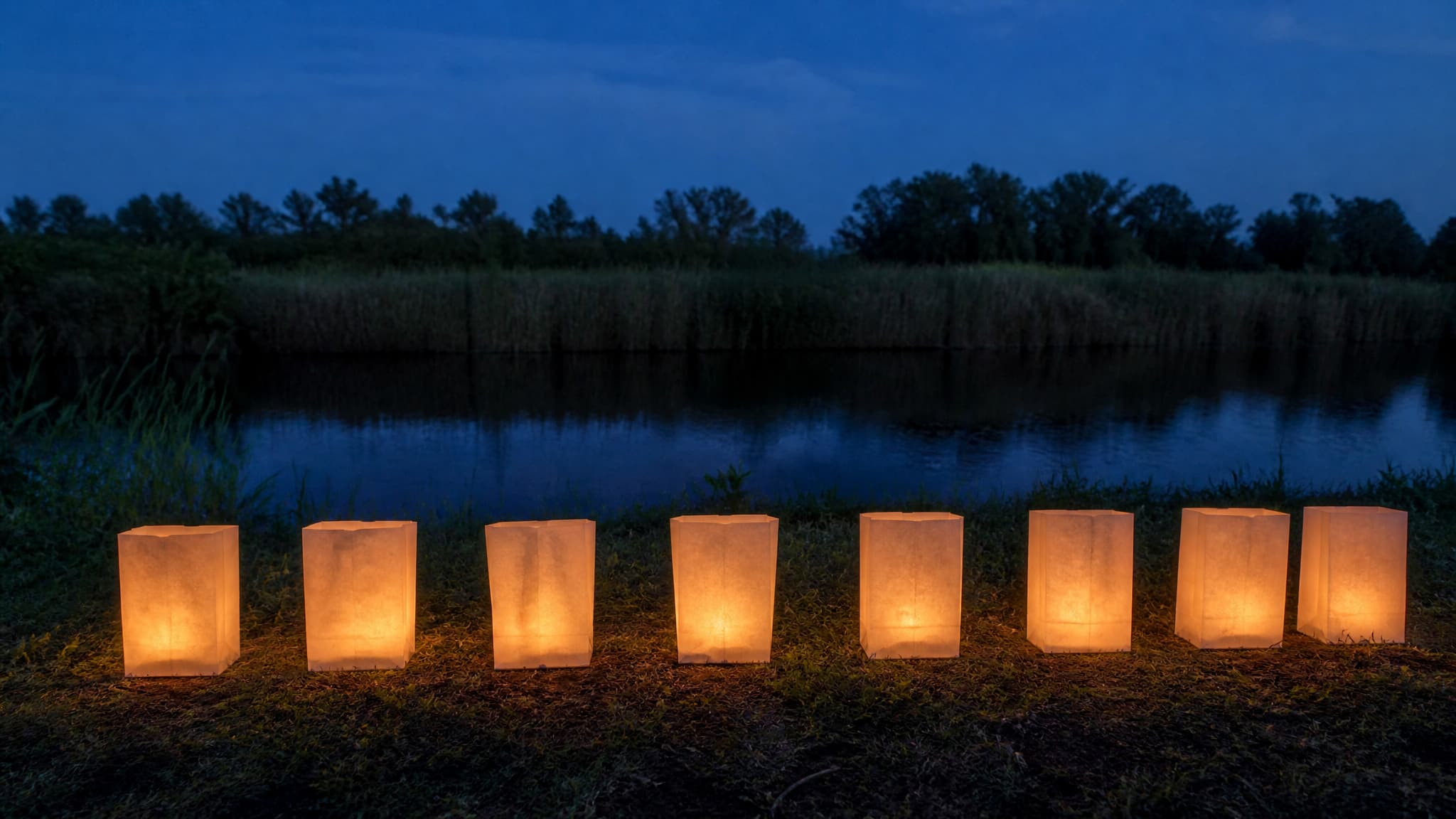
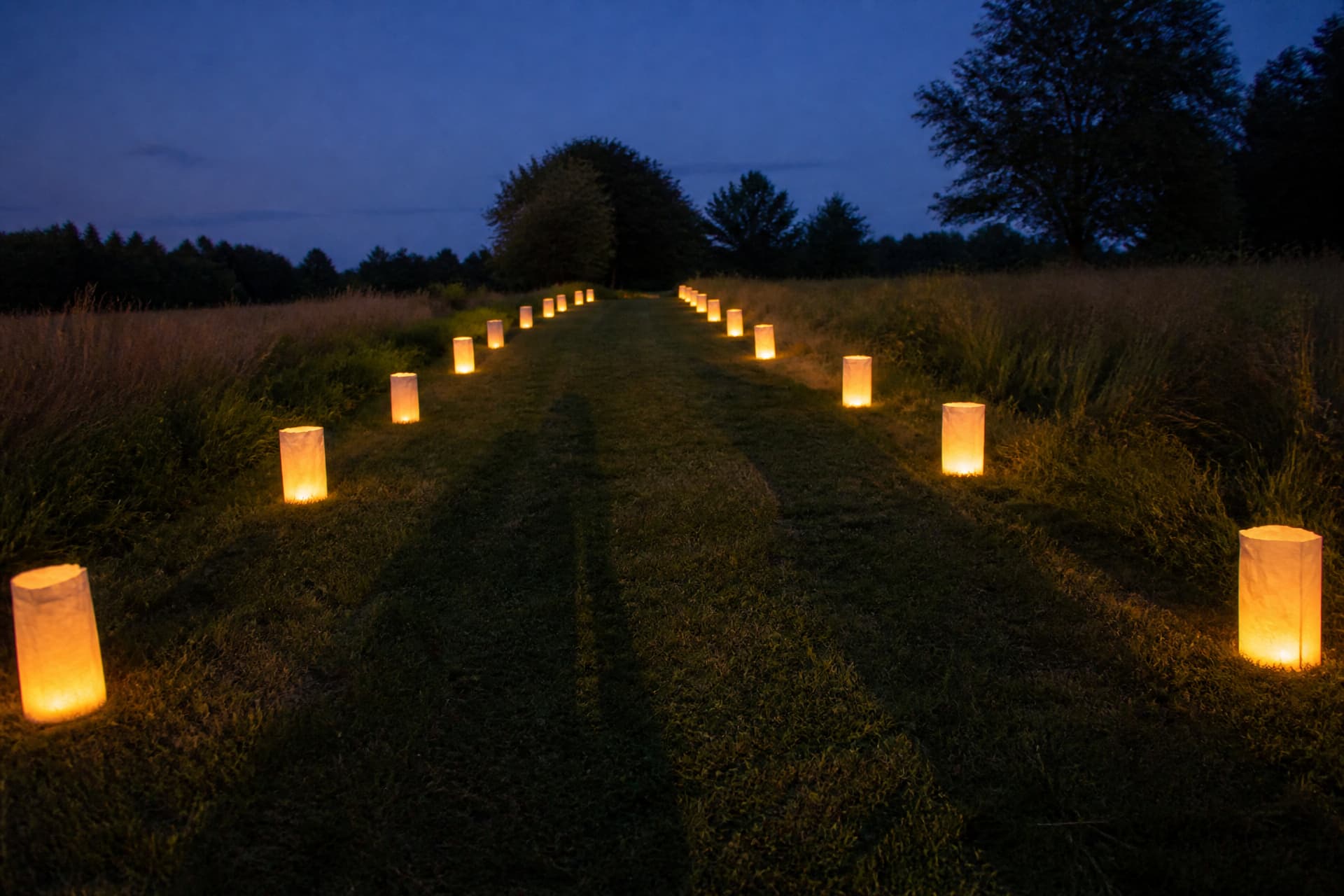
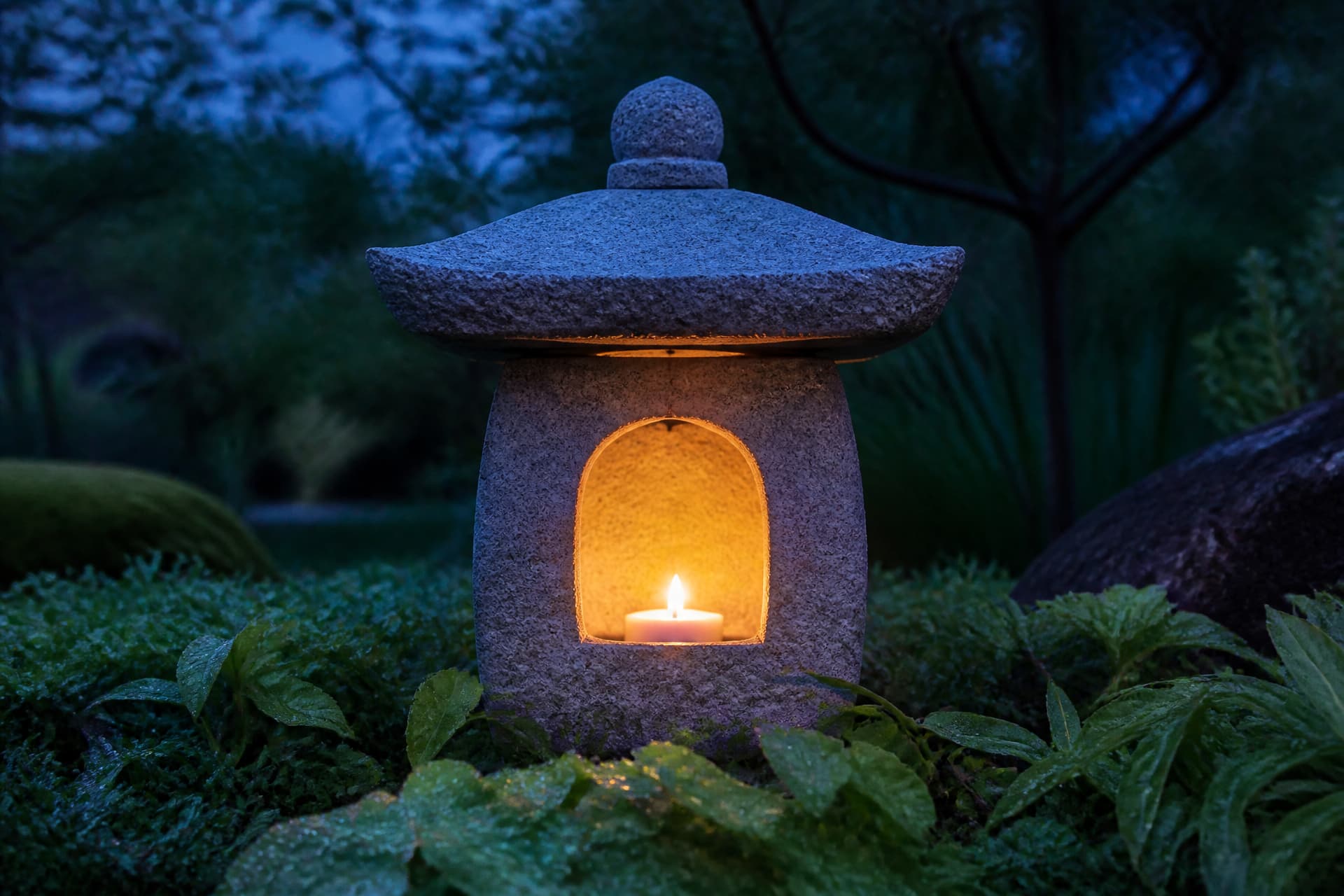
The version nobody objects to. Lanterns lit and left standing along a path give you the same light and the same photographs, with no flame going anywhere. For most families this turns out to be what they wanted from the idea in the first place.
What to Release Instead
Every one of these gives you the moment — a countdown, a held breath, something leaving — without the part that lands in a field.
Instead of a sky lantern
What happens
Where it works
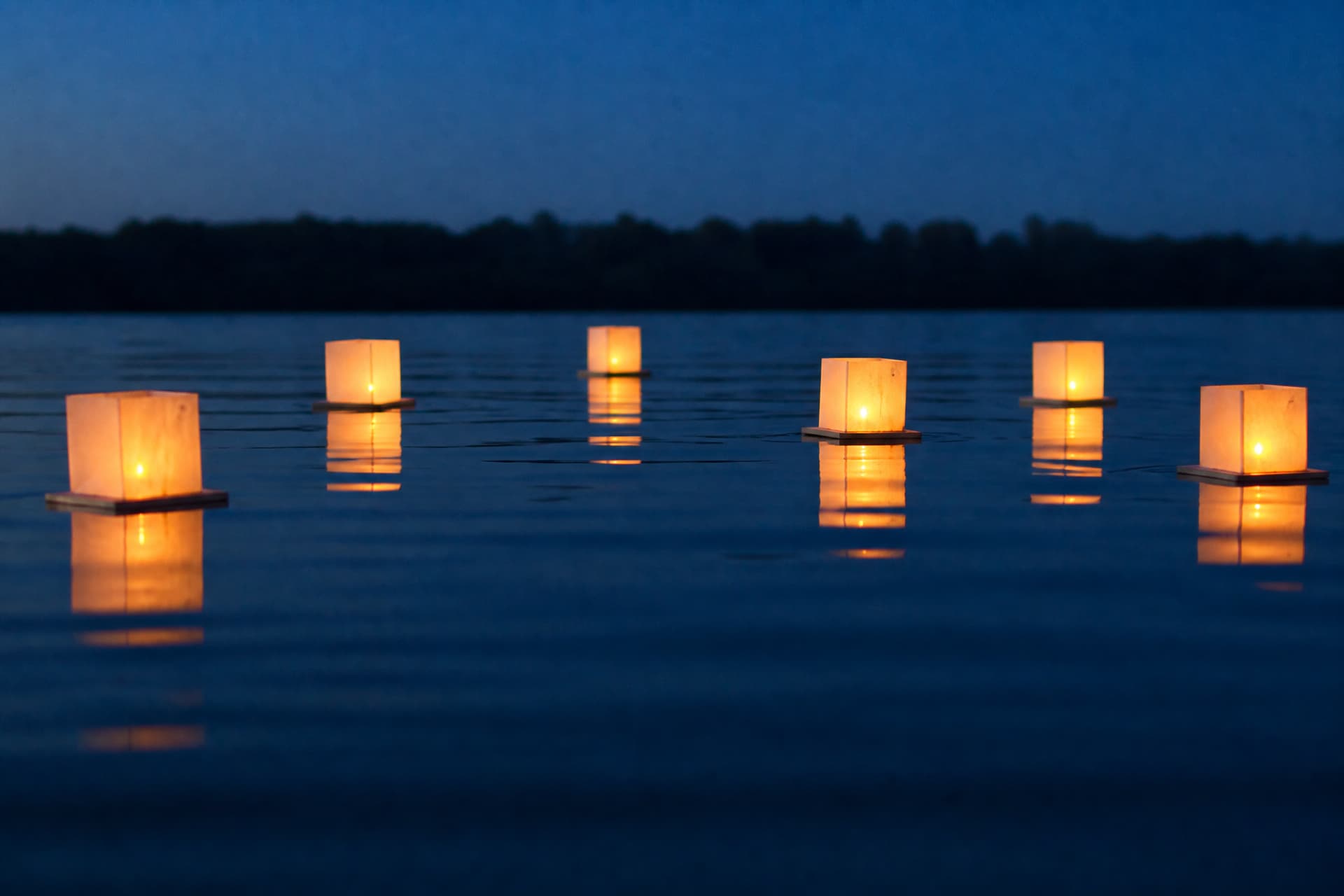
Floating water lanterns
A small candle on a biodegradable float, on still water
Lake, pond, slow river; retrieve them downstream
A biodegradable water urn
Dissolves within minutes, releasing ashes into the water
Any water scattering, and it is genuinely beautiful
Wildflower seed paper
Written on, then planted or scattered
Anywhere; children like this one most
Bubbles
Released together on a count
Indoors, and at services with young children
A bell, or a single note
Rung once by each person
Anywhere, including venues that forbid everything else
Ground lanterns, lit and left
The lanterns, without the flying
Exactly where a release was planned
A lantern release memorial on water rather than in the air is the closest substitute, and it carries its own rule: only on water you can retrieve from, and never on a river running out to sea. A float that reaches open water is the same litter problem in a different medium.
The biodegradable urn is the one people underestimate. Set on water it holds its shape for a minute or two, then opens and sinks — which gives a ceremony an actual shape, with a beginning and an end, instead of a scattering that is over before anyone has arranged their face. Our biodegradable urns include water urns designed exactly for this, and scattering ashes laws and etiquette covers where you may do it. If nobody has decided who speaks, what to say when scattering ashes has wording.
The water version needs more planning than the sky version and goes wrong less often. Most of it is decided in the week before.
Choose the water first, and go and look at it in the evening. Still is what you need — a lake, a pond, a slow backwater, a harbor on a calm night. Moving water takes the lanterns out of sight in under a minute, which is not the ceremony anyone imagined. Wind matters more than current: a breeze pushes floats straight back into the bank.
Check who owns it. Public lakes usually have a managing authority, and most will say yes to a small evening ceremony with retrieval arranged. Cemeteries with ponds nearly always say no. Ask the same week you choose the date.
Have a retrieval plan before you have anything else. Somebody with a net, a rake or a boat, downstream or downwind, and a bag. This is the single decision that separates a ceremony from littering, and it is also what makes the landowner say yes.
Count on one lantern per person, not per family. The moment is each person setting theirs down, and a shared float is a person watching.
Light on the bank, not at the water's edge. People crouching over water with a lighter is how somebody goes in. Light them in a row on the grass, then carry them down.
Go at true dusk, about twenty minutes after sunset — the same rule as a vigil. Earlier and the flames disappear against the sky; much later and nobody can see the bank.
Somebody says one line, then everyone sets theirs down together. Not in turn. A staggered launch takes twenty minutes and the moment dissolves.
Then stand there. Ten minutes of nobody saying anything, watching the lights move apart, is the whole point and the part most likely to get cut short by an organizer who feels responsible for filling silence.
Still water, true dusk, and one lantern per person rather than per family. The reflections are what make these photographs, which is why you shoot from low and across the water rather than down at it.
Getting the Light Right
Families remember the photographs from these evenings for a very long time, and the difference between the ones that work and the ones that do not is entirely timing.
True dusk is a twenty-minute window. Before it, the sky is too bright and the flames read as nothing. After it, you get bright points on total black and no faces.
Ask one person to photograph and release them from everything else. Somebody trying to do both gets neither.
No flash. It kills the candlelight and it startles everyone.
Shoot from low and across the water, not down at it. Reflections double the light and are what makes these pictures.
Take the wide one first. Everyone standing at the bank holding a lit lantern, before the release, is the photograph the family actually wants — and it only exists for about ninety seconds.
If You Are Going Ahead Anyway
Sometimes it is legal, the venue agrees, and it is genuinely right for the person. In that case:
Buy fully biodegradable, with no wire. What is sold as eco friendly sky lanterns or biodegradable lanterns to release means a bamboo-and-paper frame with no metal in it. They still land somewhere, but they rot rather than ending up in feed. A biodegradable lantern release is the least bad version of this, not a safe one.
Never in wind above a light breeze, and never when a burn ban is in force. If you are unsure whether it is too windy, it is too windy.
Not over crops, woodland, thatch, livestock or a coastline.
Have water and a phone to hand, and someone whose job is only that.
Release together, once. A staggered release turns a ceremony into a fireworks queue.
Tell the fire service beforehand. One call prevents a turnout.
Memory Lanterns You Keep
The other meaning of the phrase, and the one that lasts.
A garden lantern is the version that stays where you put it. Ours sits in garden statues — carved granite, lit with a candle or a solar light, and it becomes the fixed point in a memorial garden rather than an event that is over in four minutes.
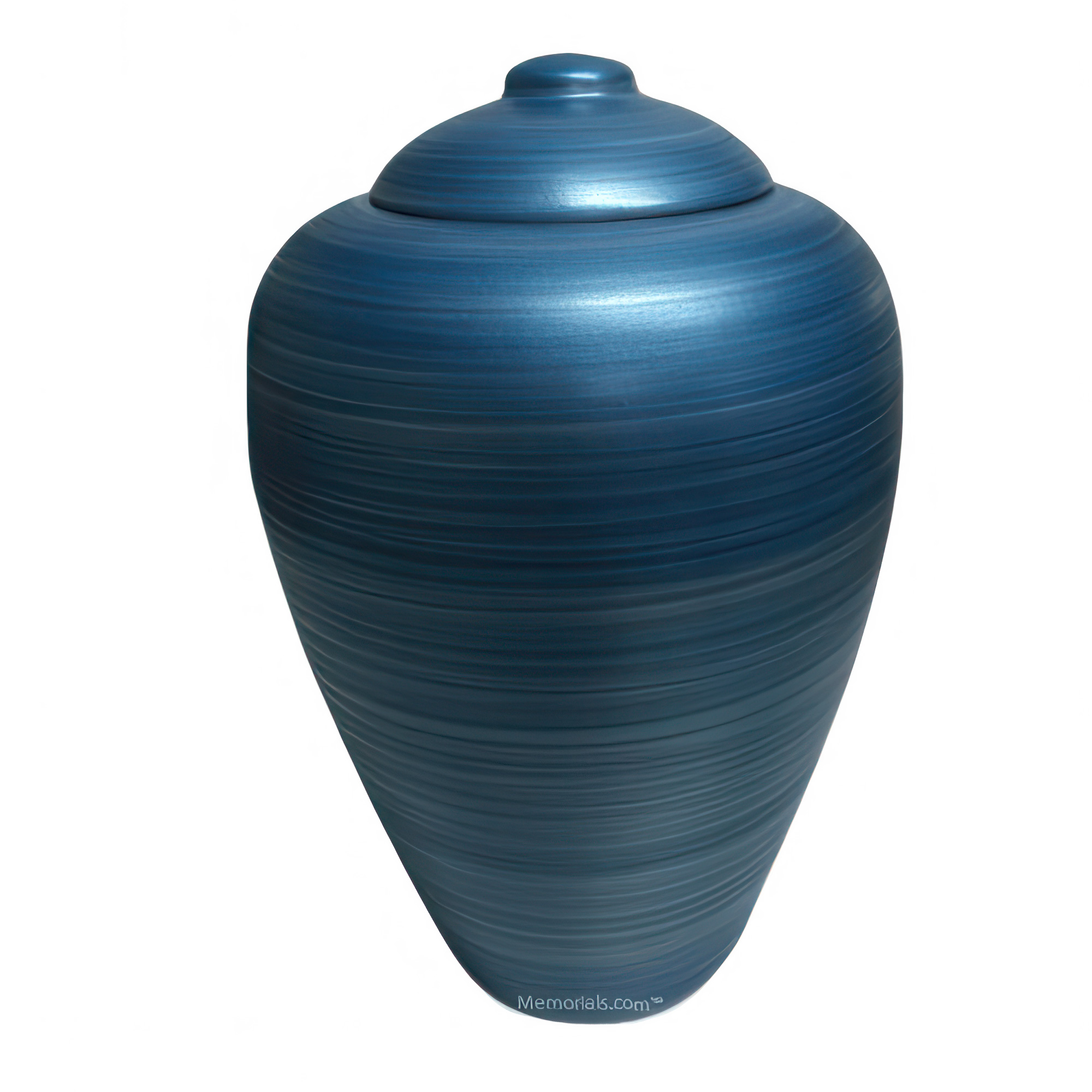
A lantern-form urn does both jobs at once. The Lanterna in our unique urns is a ceramic lantern shape that holds ashes, which suits a family who liked the lantern idea and wanted something to keep.
A candle lantern indoors is the smallest version and gets used the most — memorial candles and candlelight vigils covers the holders and the days families light them.
All of this assumes a portion rather than the whole, and once a family is dividing ashes the question tends to widen — a keepsake urn, a pendant, and at the far end of it ashes in tattoo ink, which is the only version nobody can undo. Set the portion aside early either way. The ceremony almost always happens before anyone has decided what is being kept.
The lantern that is still there next year. A release lasts about four minutes; this one becomes the thing people walk to on the anniversary, which is a different and longer-lived kind of memorial.
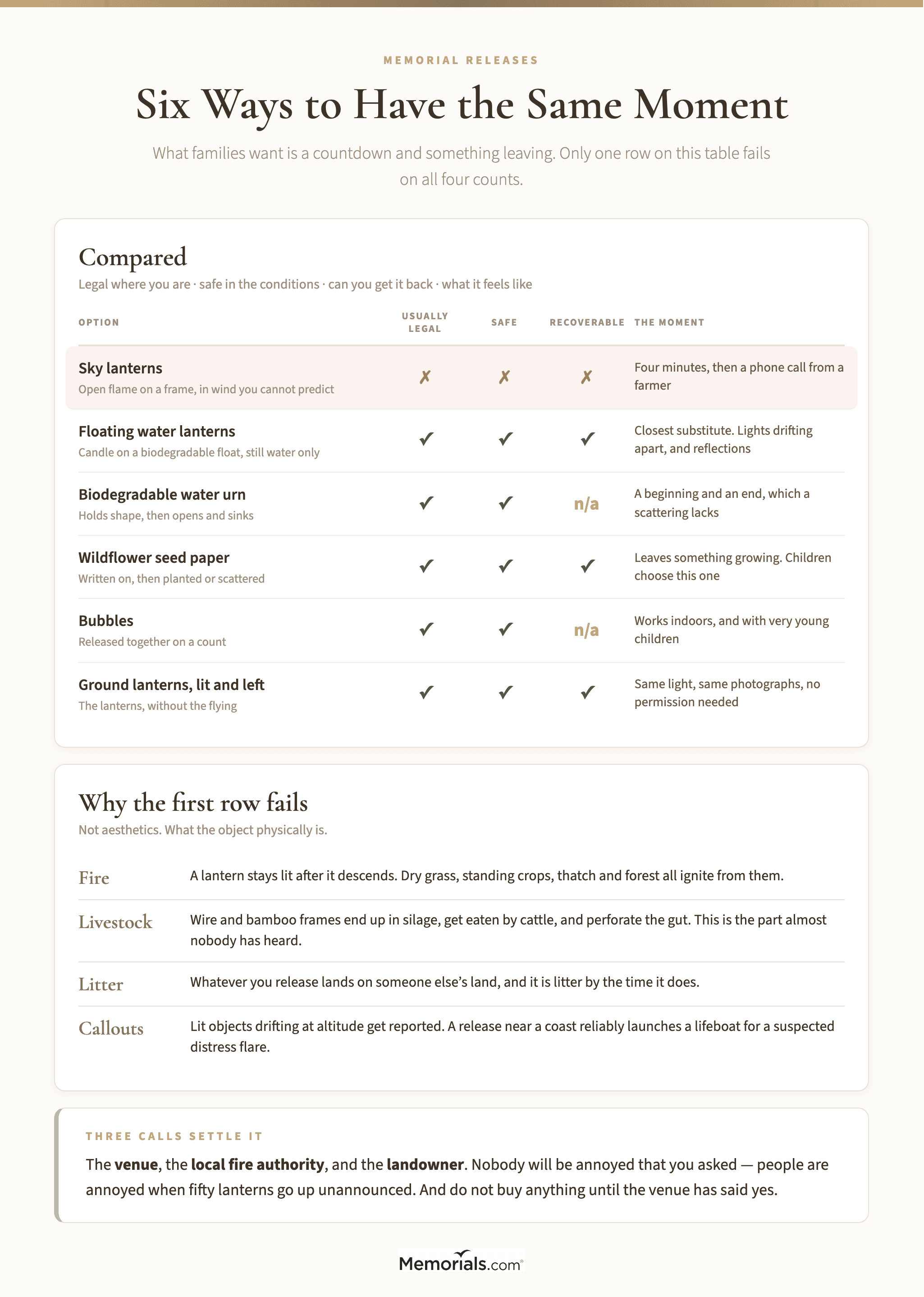
Six ways to have the same moment, scored on legality, safety and whether anything is recoverable. Sky lanterns are the only row that fails on every one — and the ground-lantern row, which nobody thinks of, scores as well as anything and needs no permission at all.
Obon and the Floating Lantern Tradition
The floating lantern is not a modern invention. Toro nagashi, part of the Japanese Obon festival, sets paper lanterns on a river to guide the spirits of the dead back after their annual visit home. Obon runs in mid-August across most of Japan, and the lanterns are released on the final evening.
Two things are worth borrowing from it, whatever your own tradition:
The lanterns go on water, not into the air. The tradition that has done this for centuries floats them.
They mark a departure, not a loss. The Obon lantern is for a visit that is ending, which is a gentler frame than a release that says goodbye once and for good.
Rough, and worth knowing before a family commits to the idea rather than the object.
Sky lanterns are the cheapest per unit and the most expensive if anything goes wrong. Assume nothing goes wrong and it is still the option most likely to be refused by the venue after you have bought them.
Floating water lanterns cost a little more each and need the retrieval kit, which is a net and a bin bag.
A biodegradable water urn is a single item rather than a per-person one, and it replaces the urn you were buying anyway rather than adding to it. That last point is the one families miss.
Seed paper is the cheapest option on the list and the only one that leaves something growing.
A garden lantern costs the most and is the only one still there in ten years, which is a different kind of value from a ceremony.
Do not buy anything until the venue has said yes. The most common wasted expense on this page is a box of fifty lanterns bought before a phone call that took four minutes.
Frequently Asked Questions
Are sky lanterns illegal? In much of the United States, yes — banned outright in a number of states and restricted by many counties, fire districts, parks and cemeteries elsewhere. Assume not permitted and check with the venue and the local fire authority.
Why are memorial lanterns banned? They are unattended open flames that travel where the wind takes them. They start fires, and the wire frames end up in animal feed and kill livestock.
Are biodegradable sky lanterns safe? Safer, not safe. A bamboo-and-paper lantern still lands lit and still lands on someone's property. Biodegradable means it rots afterward, not that it cannot start a fire.
What can I release instead of a sky lantern? Floating water lanterns, a biodegradable water urn, wildflower seed paper, bubbles, or a single bell. Ground lanterns lit and left in place give you the same light with no permission needed.
Are balloon releases better? No. Same problem, at sea instead of in a field.
What is a memory lantern? Usually a lantern kept rather than released — a garden lantern, a candle lantern, or an urn made in a lantern shape.
Can I float lanterns on a river? Only where you can retrieve them, and never on water running out to sea.
The Moment, Without the Wire
What families actually want from a lantern release is a shared act with a countdown in it — everyone doing one thing at the same time, and then watching it go.
You can have all of that on water, or with seed paper, or with a single bell, and you can have it without a phone call from a farmer three days later. And if what you liked was the lantern itself, buy one that stays.