🏬Supersize Online Funeral Retailer🪦1000's of Headstones⚱️Over 10,000 Cremation Urns⚰️Caskets Overnight Delivery🛒Funeral & Memorial Superstore🚚FREE Shipping on ALL Orders👨👩👧👦Helping Families for over 20 Years💰Lowest Price Guarantee🏬Supersize Online Funeral Retailer🪦1000's of Headstones⚱️Over 10,000 Cremation Urns⚰️Caskets Overnight Delivery🛒Funeral & Memorial Superstore🚚FREE Shipping on ALL Orders👨👩👧👦Helping Families for over 20 Years💰Lowest Price Guarantee
🏬Supersize Online Funeral Retailer🪦1000's of Headstones⚱️Over 10,000 Cremation Urns⚰️Caskets Overnight Delivery🛒Funeral & Memorial Superstore🚚FREE Shipping on ALL Orders👨👩👧👦Helping Families for over 20 Years💰Lowest Price Guarantee🏬Supersize Online Funeral Retailer🪦1000's of Headstones⚱️Over 10,000 Cremation Urns⚰️Caskets Overnight Delivery🛒Funeral & Memorial Superstore🚚FREE Shipping on ALL Orders👨👩👧👦Helping Families for over 20 Years💰Lowest Price Guarantee
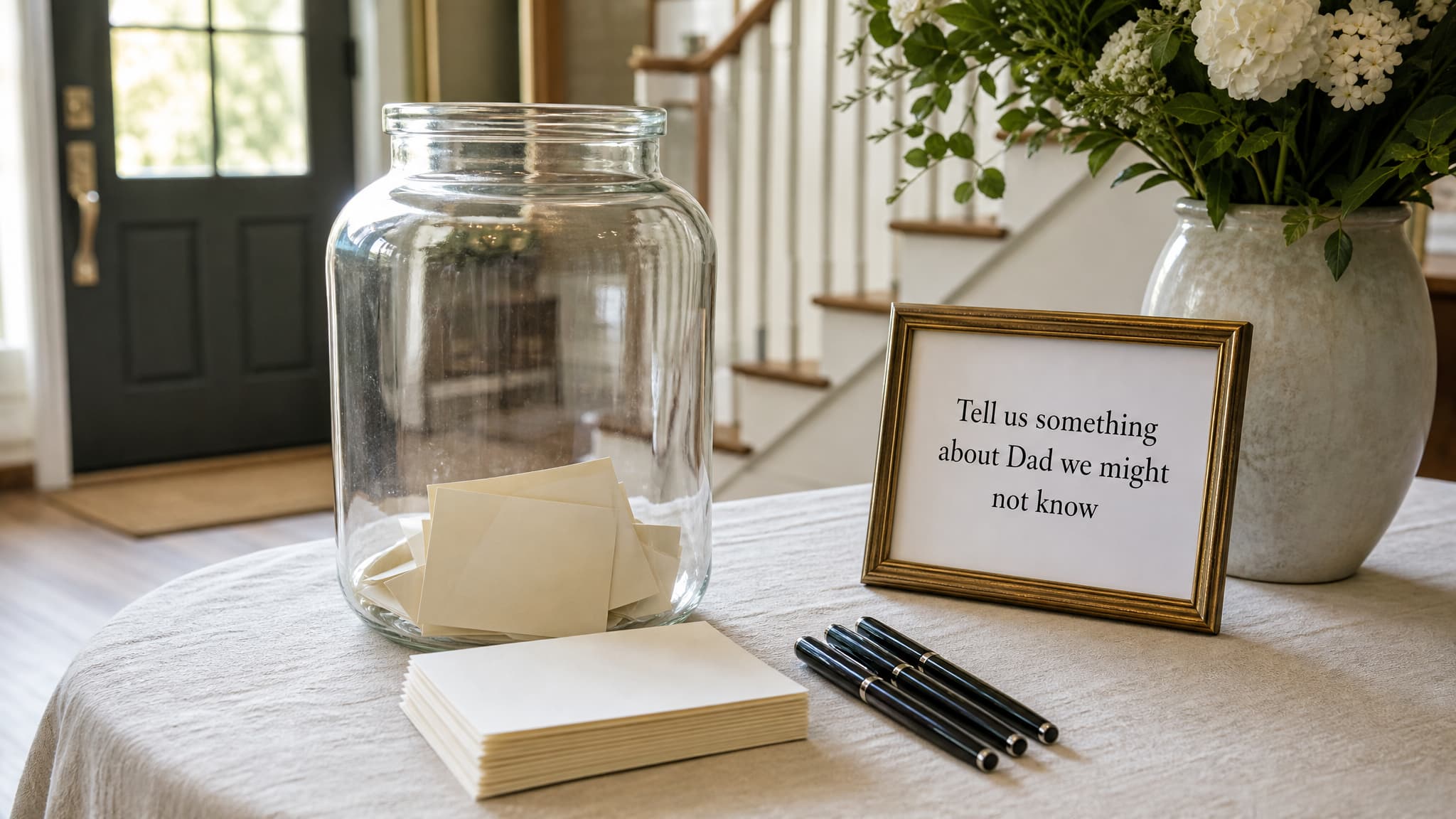
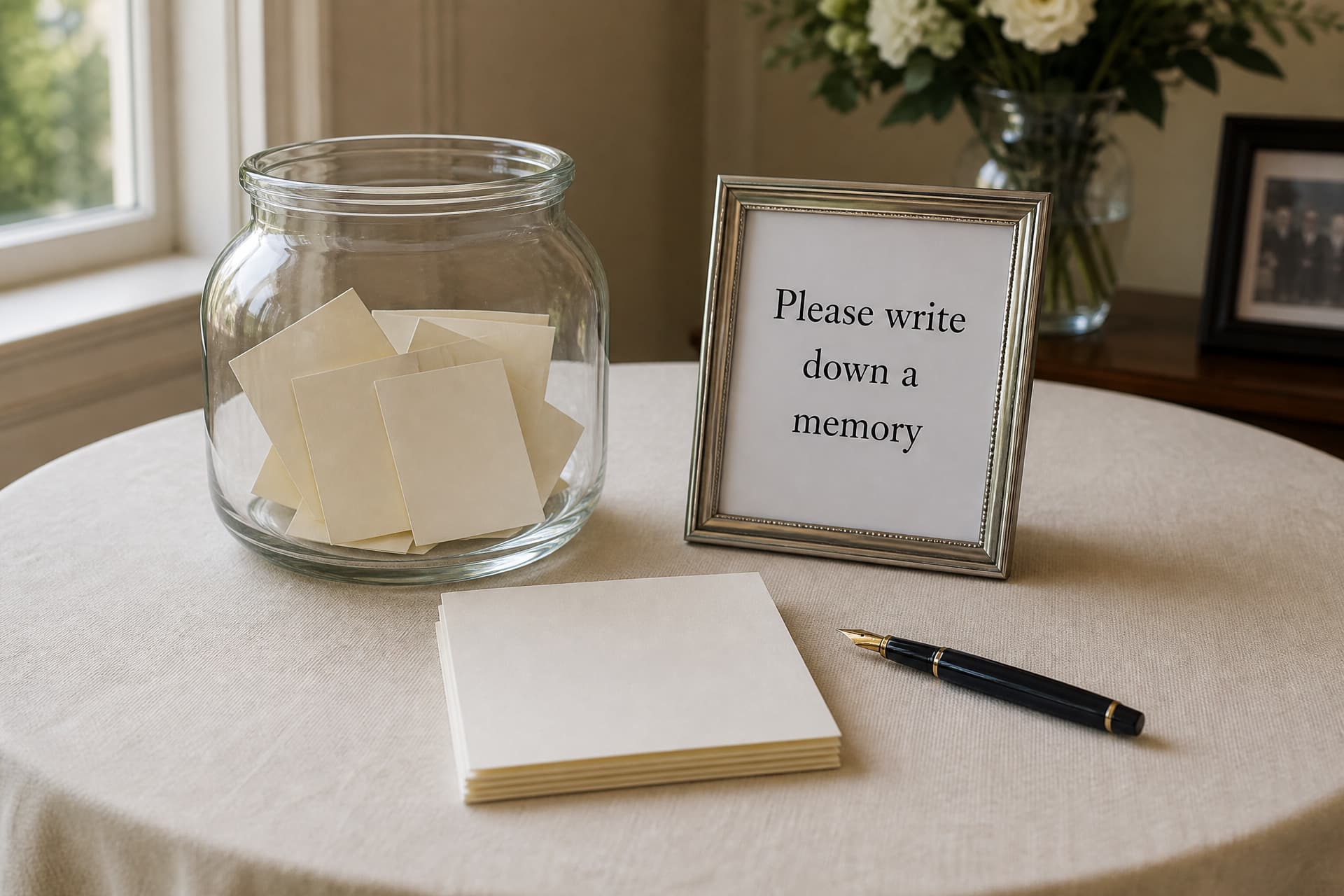
A memory jar for funeral use is a glass jar, a stack of cards and a pen, set on a table near the entrance. Guests write down something they remember and drop it in, and the family reads them later — usually weeks later, which is the point.
The jar is the easy part. What decides whether you end up with a hundred slips or eleven is the card beside it, and almost everybody gets that wrong by leaving it blank. A blank slip produces "thinking of you at this difficult time" eleven times. A specific prompt produces stories.
Most memory jar ideas are about the jar — the label, the ribbon, the shape. This page is about the prompt that works, how to set the jar up so people actually stop, and the three things that usually sit on the same table — a memory box, a memory table, and the guest book.
It works when there are people present who knew the person in ways the family did not — colleagues, old friends, neighbors, the crowd at a long life's funeral. Those are exactly the stories that otherwise leave the room at the end of the afternoon and never come back.
It works less well at a very small service, where everyone already knows everything, and at a service for someone young, where guests are too shaken to write.
Do not read them on the day. Families who open the jar at the wake read four, cry, and put the lid back on. The jar's real value arrives at three weeks, when the house has gone quiet and there is suddenly a container of people saying specific things about someone.
Everything on this table exists to make a stranger stop for forty seconds. The sign does more work than the jar — without it, most guests walk past assuming it is for somebody else, or that they are supposed to already know what it is.
The Prompt Is the Whole Thing
Write it on a card, print it large, and put it where the pen is.
Prompts that produce stories:
Tell us something about Dad we might not know.
What is the first thing you think of when you think of her?
When did he make you laugh?
Write down one thing she taught you.
Where were you the last time you saw him?
What would you thank her for?
Prompts that produce nothing:Share a memory.Leave a message for the family.Write a few words. All three are invitations to write "so sorry for your loss," because they ask for a category rather than a thing.
Ask one question, not four. A card with four prompts gets none of them answered — people read all four, feel it is homework, and put the pen down.
Ask guests to sign."...and put your name so we know who to thank" raises both the response rate and the specificity, because an anonymous slip is easy to write carelessly.
The label is where convention beats invention. Most jars carry the name and a set phrase, and in memory of is the usual choice — the differences between it and the alternatives are smaller than they look, so settle it in a minute and spend the time on the prompt instead.
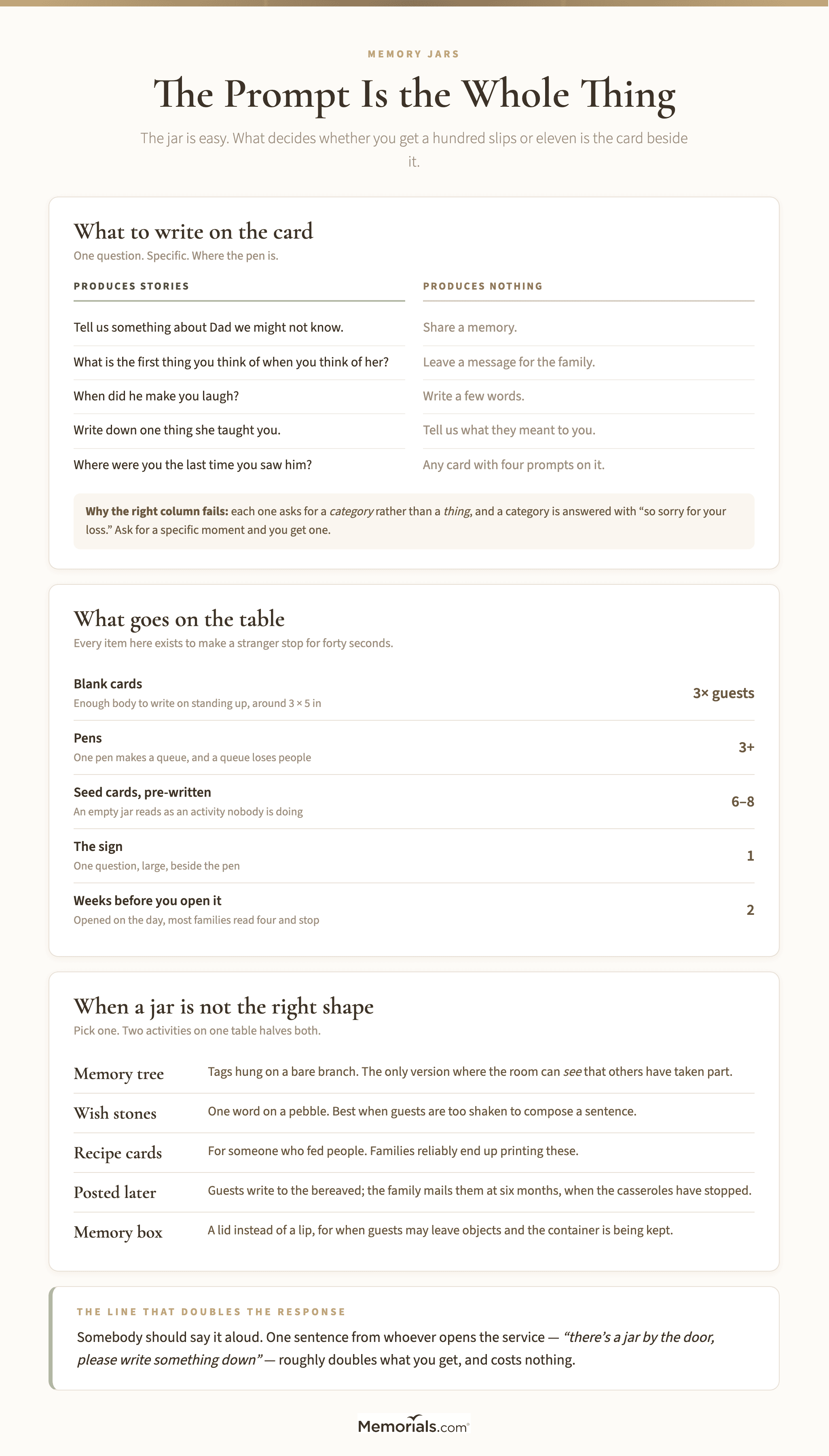
What is on the table and what each part does. The prompt is the variable that matters — the left column produces specific stories and the right column produces "thinking of you," and the difference is that the left asks for a thing while the right asks for a category.
Setting It Up So People Actually Stop
Put it before the seating, not after. Guests arrive early with nothing to do and leave in a hurry. The window is the ten minutes before, and a jar placed on the way out catches almost nobody.
Cards, not slips of paper. Something with enough body to write on while standing up. Around 3 × 5 inches, and pre-cut — nobody uses scissors at a funeral.
More than one pen. Three at least. A single pen creates a queue, and a queue makes people decide against it.
A wide-mouthed jar. A narrow neck means folding, and folding means hesitating.
Seed it. Put six or eight already-written cards in the jar before anyone arrives. An empty jar reads as an activity nobody is doing; a jar with something in it reads as one that is already working. Family members write these the night before.
Someone should mention it. One line from whoever opens the service — "there's a jar by the door, please write something down" — roughly doubles what you get.
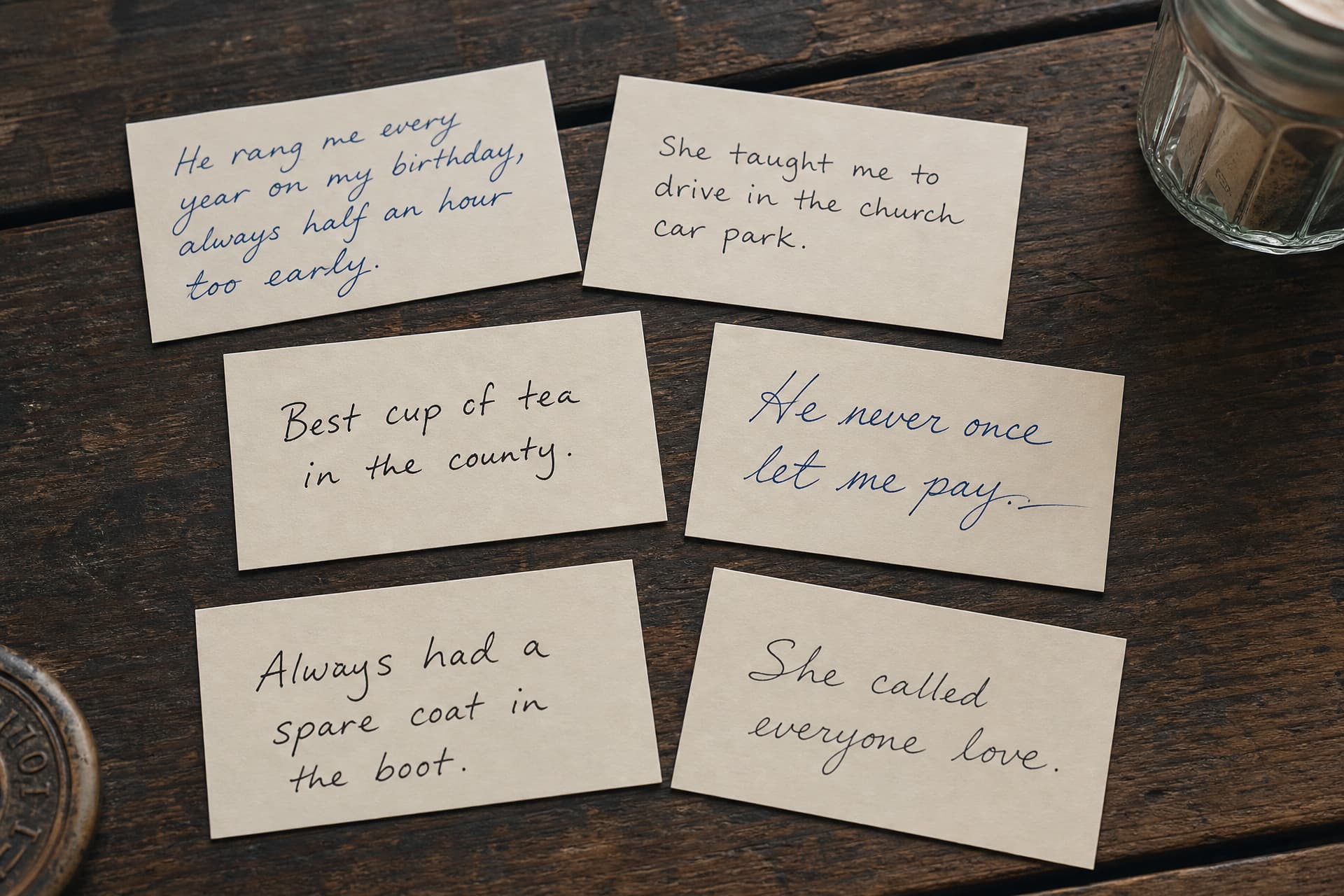
Memory jar messages, for the seed cards: keep them short and concrete, and make at least one of them funny. "He rang me every year on my birthday, always half an hour too early." That card tells the next twenty guests what kind of thing is wanted, and it does it faster than any sign.
Seed cards written by family the night before. The one that is slightly funny is the one that does the work — it gives permission, and permission is what most guests are waiting for before they write anything real.
What Is a Memory Box?
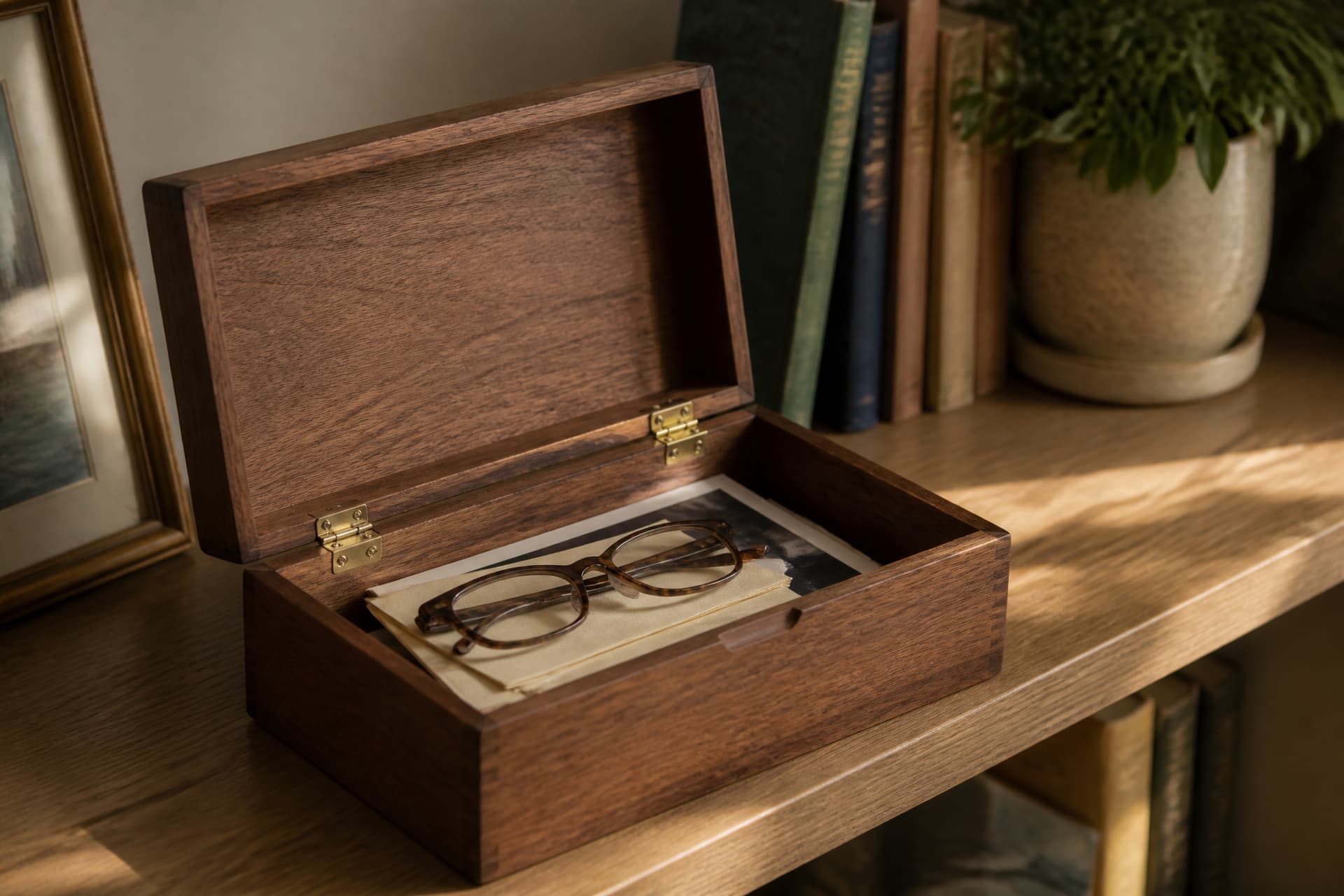
A memory box is the same idea with a lid instead of a lip, and it is the better choice in two situations: when you want guests to leave objects as well as notes — a photograph, a ticket, a badge — and when the box itself is going to be kept.
A jar is a collector. A box is a keepsake. Ours in memory boxes are made to be kept and engraved, which a mason jar is not, and that is really the whole distinction: the jar gets emptied, the box gets put on a shelf.
A funeral memory box at the service works best kept shallow — guests will not dig. Afterward it becomes the place the slips, the order of service, the pressed flower and the newspaper notice all live, which otherwise means a carrier bag in a wardrobe.
The Memory Table
Whatever you put out, it works better as a memory table than as one object alone. A memory table funeral setup is not a separate project — it is the jar plus three things you already have. A jar on an empty table gets twenty seconds; a table with four things on it gets two minutes, and the difference is that a table gives people a reason to stand there.
A memory table at a funeral usually holds:
Element
What it does
The jar or box
Gives guests something to do
The guest book
Records who came, which the family will want later
A framed portrait
Tells people whose table this is
Two or three objects
Their glasses, a trophy, a well-used tool, the hat
A photo board
The thing people actually queue for
The objects matter more than they look like they should. A worn pair of gardening gloves does more than another photograph, because it is the one thing on the table that was genuinely theirs.
Set it near the entrance, leave room for three people to stand at it, and keep it away from the doorway itself. Our guide to making a funeral picture board covers the board that usually stands behind it.
A box rather than a jar when what goes in is meant to stay. That is the practical difference: the jar gets emptied onto a kitchen table within the month, and the box goes on a shelf with everything still in it — which is also why the box is the one worth engraving.
Variations That Suit Different Services
The jar suits a long life and a full room. When it does not fit, one of these usually does.
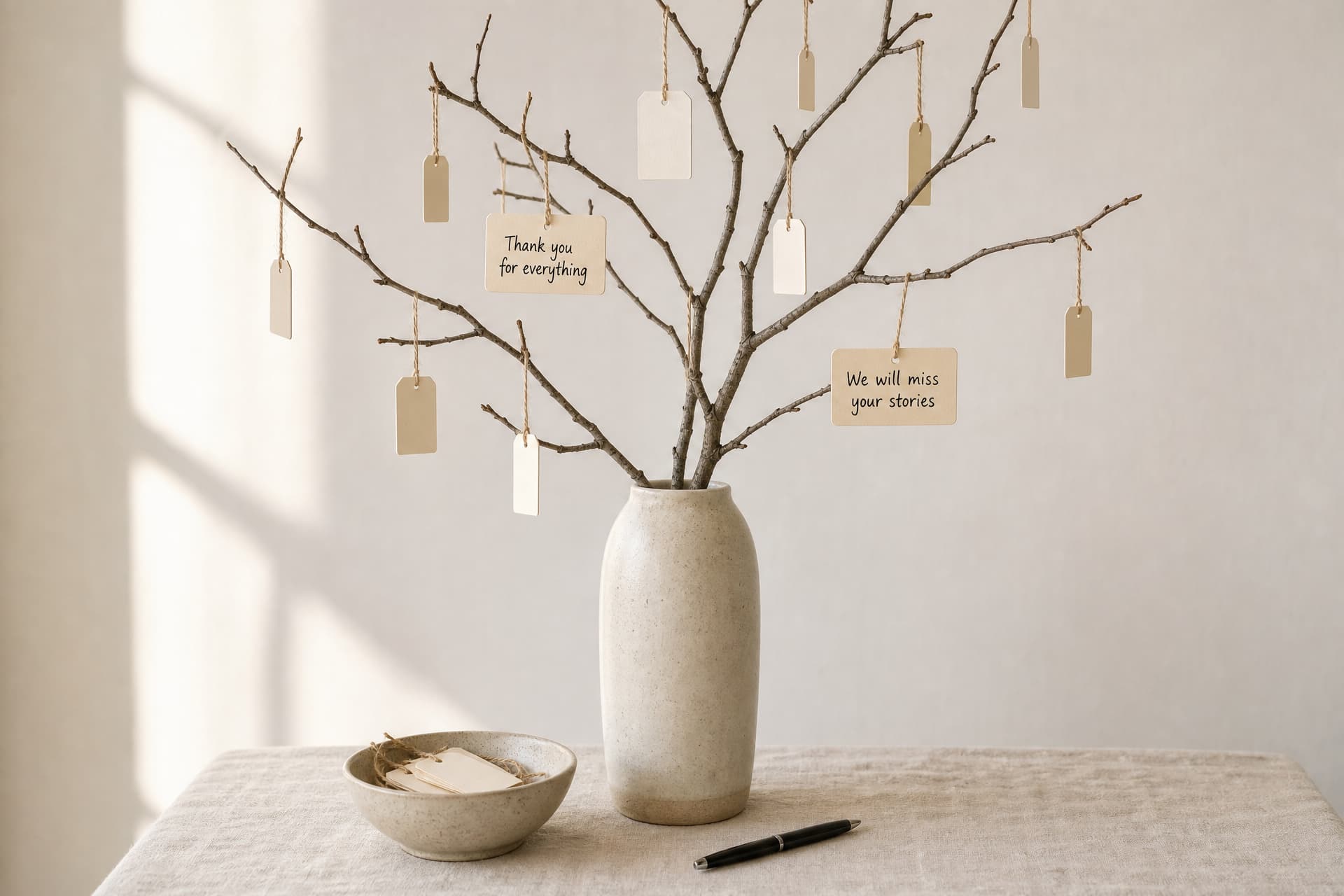
A memory tree. A bare branch in a vase and paper tags on string. Guests hang theirs, so the tree visibly fills through the afternoon — which is its advantage over a jar, where nobody can see that anyone has taken part. Best outdoors or at a celebration of life.
Wish stones. Smooth pebbles and a fine marker; guests write one word and add it to a bowl. The one-word limit makes this the best option when guests are too upset to compose a sentence, and it works well for a young person's service.
Recipe cards, for someone who fed people. Guests write down the dish they associate with them. Families reliably end up printing these.
A postcard the family mails later. Guests write to the bereaved, address it to themselves, and the family posts them at six months — when the casseroles have stopped and the house is quiet. It takes more organizing and it is the one people remember.
A voice recording. A phone on a stand in a side room with a printed prompt. Produces far fewer responses and far better ones, and hearing a voice describe someone is not comparable to reading it.
Pick one. Two activities on one table halves both, because guests treat it as a choice rather than an invitation.
A memory tree does the one thing a jar cannot — it shows the room that other people have already written something. Visible participation is most of what persuades a hesitant guest, which is also why seeding the jar matters so much.
Funeral Guest Book Ideas
Most funeral guest book ideas treat the book as a formality. It is not: the guest book and the memory jar do different jobs and it is worth having both. The book records who came; the jar records what they knew. Families reliably want the first one later, when writing thank-you notes and realizing they cannot remember who was there.
Leave a wide column for a note, not just a name and address. Most guests will use it if the space exists.
Ask for a relationship, not an address — "Margaret Hale, worked with Dad at the mill." This is the single most useful column and almost no printed book has it.
Two books at a large service, one at each entrance, or you will get a queue and a half-empty book.
Someone should staff it for the first twenty minutes. A person saying "would you mind signing?" gets four times what a sign gets.
An online guest book collects from people who could not travel, and it keeps collecting for months.
Afterward
Do not open it for two weeks. Sooner and you cannot read them; much later and the jar becomes a thing you avoid.
Read them with someone. These are stories about a shared person and reading them alone is much harder.
Type them up. The slips will fade and the handwriting is half the value — scan them, then transcribe. Grandchildren will read the transcript.
Thank the specific ones. Somebody wrote three paragraphs about a holiday in 1987. That person should hear from you.
Keep a few out. Three or four framed, or tucked behind a photograph, or kept in keepsake gifts — a keepsake dome will hold a folded card and a small object together.
If the same photograph is going onto the memorial cards handed out at the service, choose it once and use it on the table, the cards and the program.
Frequently Asked Questions
What is a memory jar at a funeral? A jar, blank cards and a pen on a table near the entrance. Guests write down a memory and drop it in; the family reads them weeks later.
What do you write on the memory jar sign? One specific question, not an invitation. "Tell us something about Dad we might not know" works; "share a memory" does not.
How many cards should I put out? Two or three times the expected guest count. They are cheap and running out mid-service is the one failure with no fix.
Should the memory jar be opened at the wake? No. Two weeks is about right. Opened on the day, most families read four and stop.
What is a memory box, and how is it different? A lidded box rather than an open jar. Use one when guests may leave objects as well as notes, or when the container itself is going to be kept and engraved.
What goes on a memory table at a funeral? The jar or box, a guest book, a framed portrait, two or three of their own objects, and usually a photo board behind it.
Do I need a guest book as well? Yes. The book records who came — which the family wants when writing thank-you notes — and the jar records what they knew.
The Table Is an Invitation
Everything here is one idea: give people who are standing awkwardly in a foyer something specific to do, and they will hand you things nobody else could.
Ask one real question, put out more pens than you think, and do not open it for two weeks. For the rest of what families put together, the memorial tribute ideas guide covers the other pieces, and creating a home memorial space is where the jar and its contents usually end up.