🏬Supersize Online Funeral Retailer🪦1000's of Headstones⚱️Over 10,000 Cremation Urns⚰️Caskets Overnight Delivery🛒Funeral & Memorial Superstore🚚FREE Shipping on ALL Orders👨👩👧👦Helping Families for over 20 Years💰Lowest Price Guarantee🏬Supersize Online Funeral Retailer🪦1000's of Headstones⚱️Over 10,000 Cremation Urns⚰️Caskets Overnight Delivery🛒Funeral & Memorial Superstore🚚FREE Shipping on ALL Orders👨👩👧👦Helping Families for over 20 Years💰Lowest Price Guarantee
🏬Supersize Online Funeral Retailer🪦1000's of Headstones⚱️Over 10,000 Cremation Urns⚰️Caskets Overnight Delivery🛒Funeral & Memorial Superstore🚚FREE Shipping on ALL Orders👨👩👧👦Helping Families for over 20 Years💰Lowest Price Guarantee🏬Supersize Online Funeral Retailer🪦1000's of Headstones⚱️Over 10,000 Cremation Urns⚰️Caskets Overnight Delivery🛒Funeral & Memorial Superstore🚚FREE Shipping on ALL Orders👨👩👧👦Helping Families for over 20 Years💰Lowest Price Guarantee
A memorial shelf is the smallest permanent memorial there is: a single surface in a room you already use, holding a few things that were theirs. As a memorial space in home terms, it asks for no room, no permission and no budget — which is why it is usually the first one a family builds and the one most likely to still be there in a decade.
It is also the one most likely to quietly stop working. A shelf assembled in the first weeks tends to accumulate — the order of service, the funeral flowers dried out, three more photographs, a card somebody sent — until it is a pile rather than a place, and people stop seeing it the way you stop seeing your own hallway.
Most memorial shelf ideas are lists of objects. The objects are the easy part. The arrangement is what decides that, and it comes down to four things: where it is, how high, how many objects, and whether anything on it ever changes.
The instinct is a quiet room. The instinct is wrong.
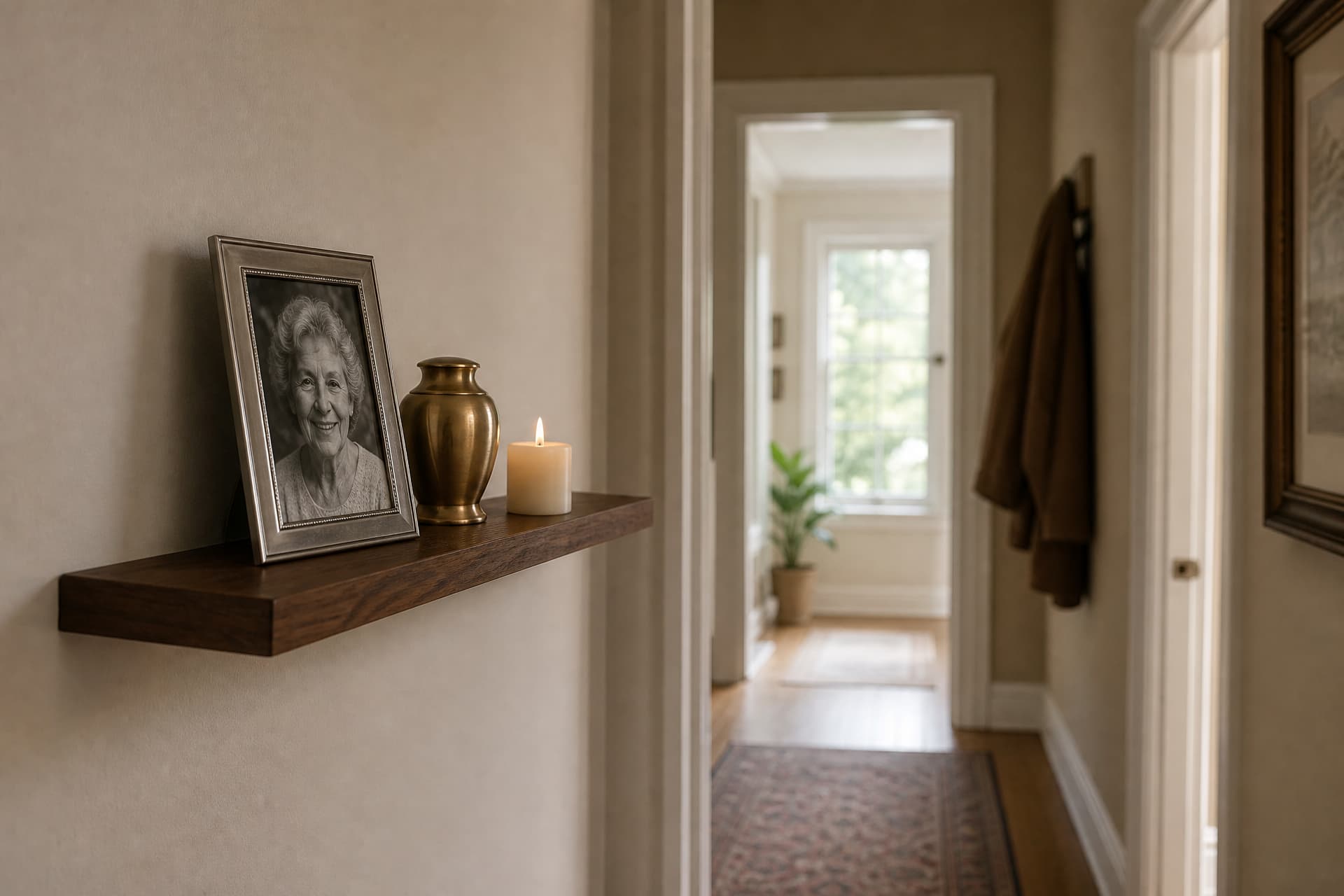
Put it where you already go. A shelf in a spare bedroom gets visited for a month. A shelf beside the kettle, in the hallway you pass four times a day, or at the end of the kitchen counter gets a glance every morning — and a glance every morning is the entire point.
Three practical constraints:
Not in direct sun. Photographs fade in months on a south-facing sill, and it is the one damage you cannot undo.
Not above a radiator or a stove. Heat warps frames, ruins photographs, and makes candles slump.
Not somewhere the door swings. Anything that gets knocked gets moved, and anything that gets moved gets moved again into a cupboard.
Height matters more than people expect. A memorial altar or shelf works best with the main photograph at roughly standing eye level. Below waist height it reads as storage; above head height it reads as unreachable, and reachable is what makes people touch things, which is most of what a memorial space is for.
Eye level, in a hallway rather than a spare room. The test is simple: if you would not walk past it on an ordinary Tuesday, it is in the wrong place, and moving it three feet does more than anything you could add to it.
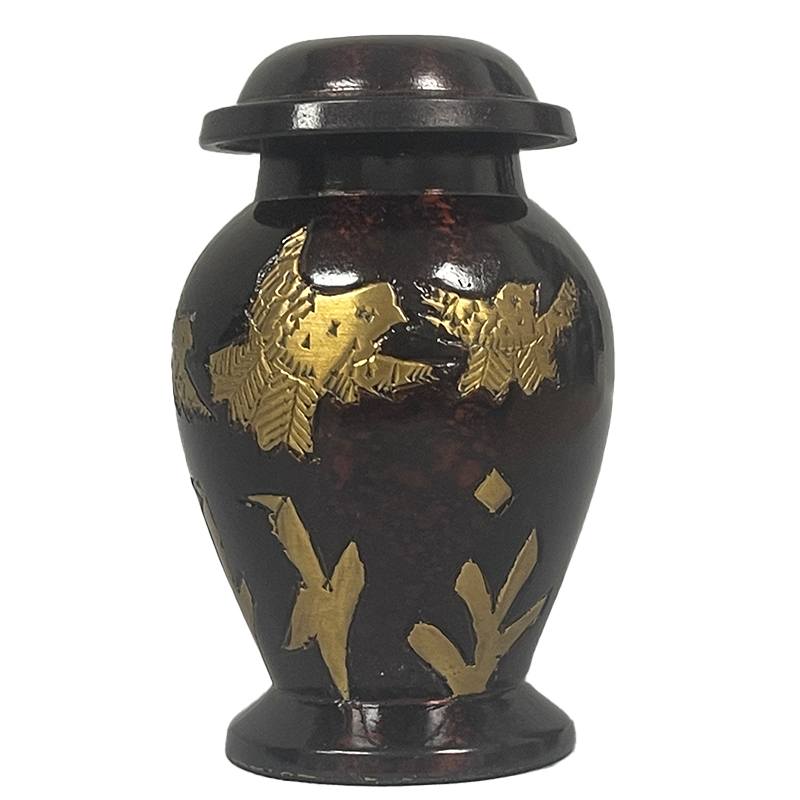
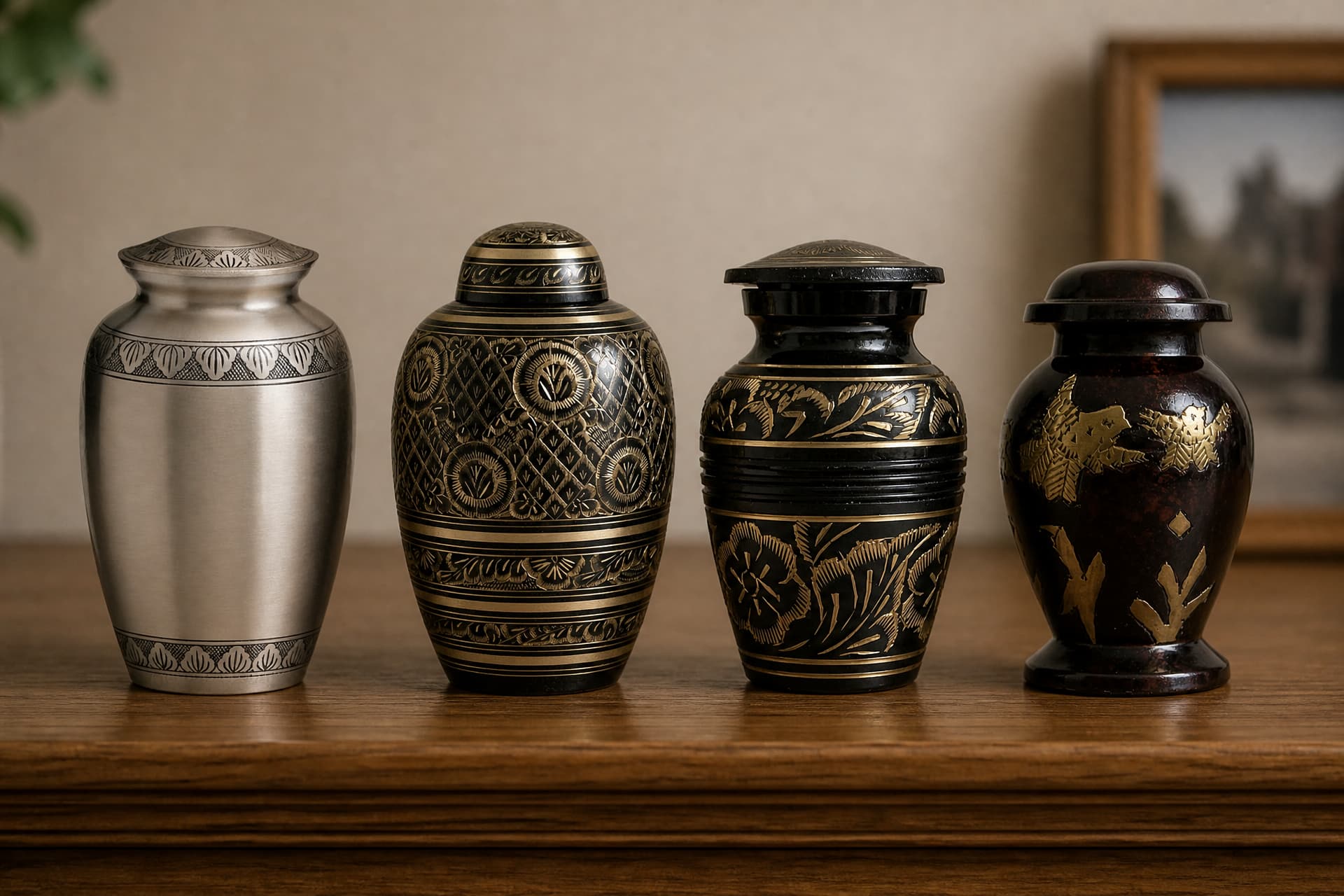
Shop Keepsake Urns
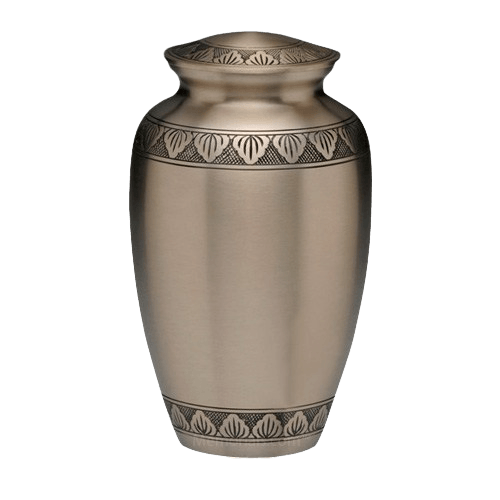
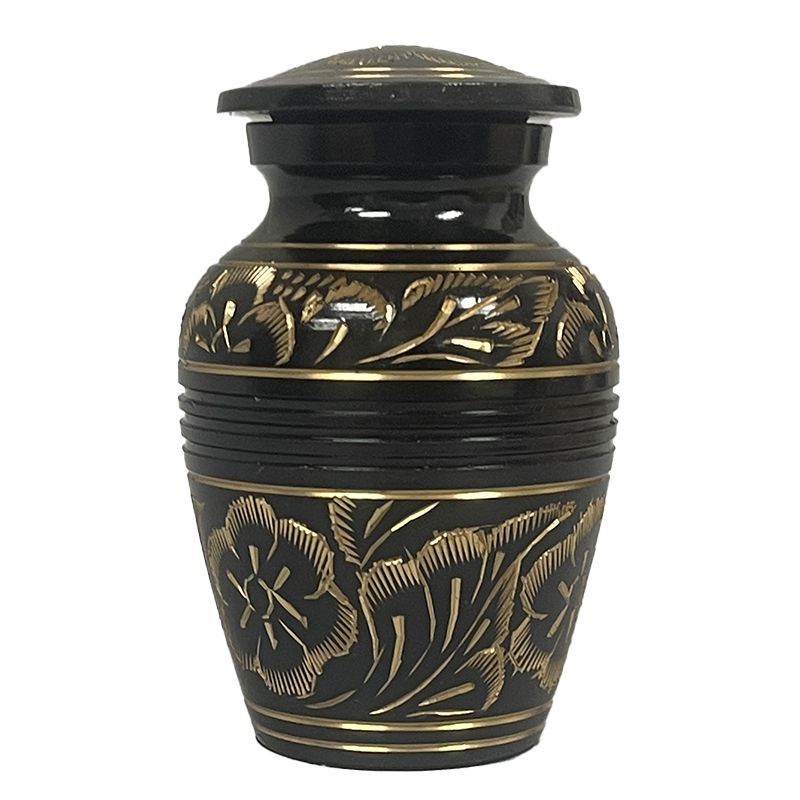
Portion-size urns that sit at the scale of a shelf
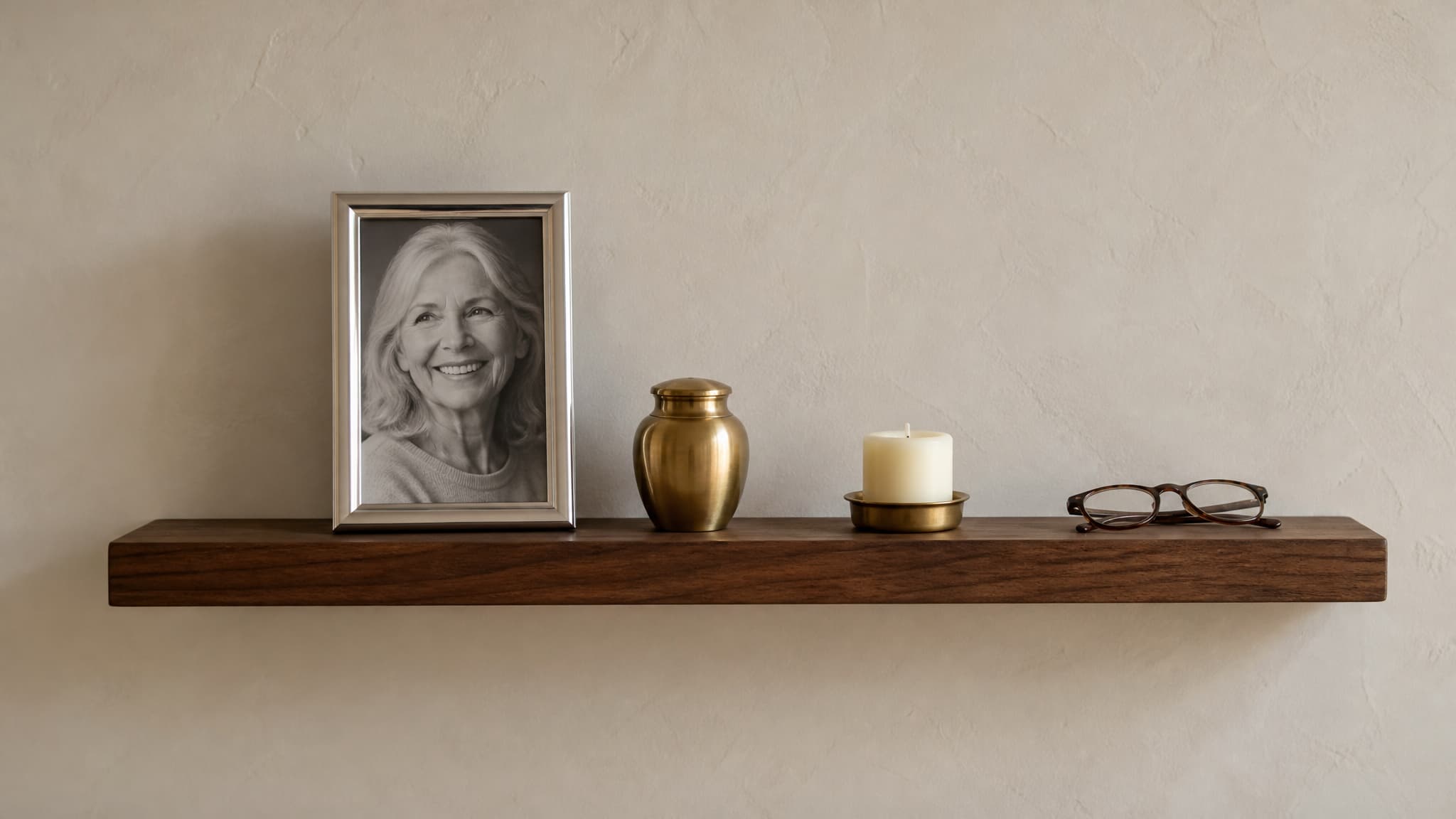
This is the single most useful rule on the page and the hardest to keep. Every additional object reduces the weight of the ones already there, and a shelf with fourteen things on it is a surface, not a memorial.
A working arrangement:
What
Why it earns its place
One photograph
The anchor. One, large, chosen deliberately — not four small ones
Something that was theirs
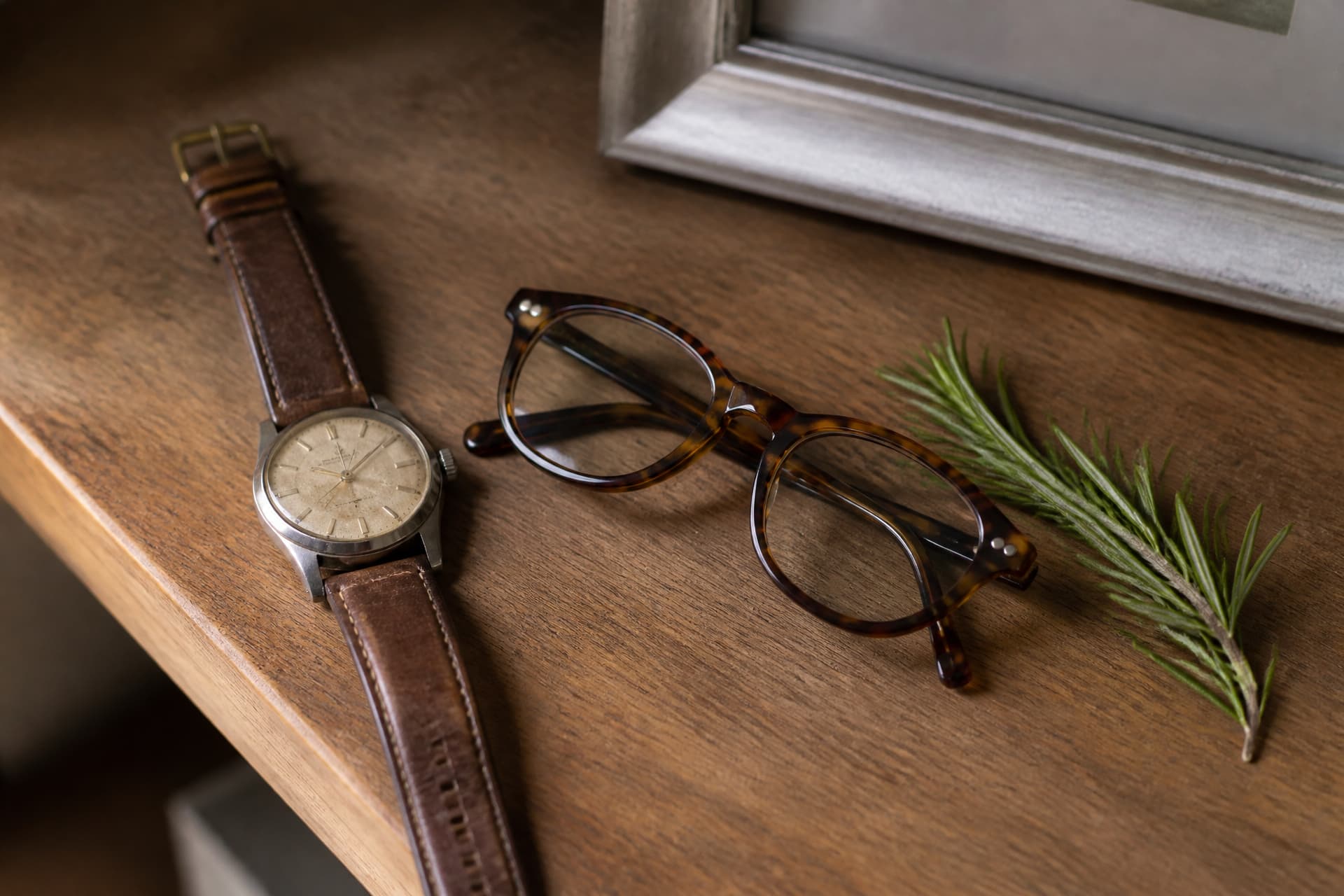
Glasses, a watch, a tool, a hairbrush. This does more than everything else combined
A light
A candle or a small lamp. It is the thing you can do on a difficult day
The urn, or a keepsake portion
If they were cremated and it belongs here
One seasonal thing
Flowers, a sprig, a leaf. The only item that changes
The object that was theirs is the one that matters. Visitors stop at photographs politely and stop at a worn pair of gardening gloves genuinely, because the gloves are evidence of a person rather than a picture of one. If you are choosing between another frame and something they actually used, use the thing.
Leave empty space. The shelf should look under-filled. That is what gives the objects room to be individually looked at, and it is what stops the pile starting.
The Urn on the Shelf
If ashes are on the shelf, two questions come up that are worth settling early.
Does it have to be an urn? No. A memorial shelf for ashes frequently uses a keepsake urn holding a portion rather than the full-size one, which is smaller, less imposing on a shelf, and leaves the rest available for burial or scattering. A photo urn does two jobs at once and saves a frame.
Will guests be uncomfortable? Some will, and the honest answer is that most people take their cue from you. A shelf where the urn is one object among several reads very differently from a shelf where it is centered and elevated. Our guide to displaying a cremation urn at home covers this properly, including room-by-room placement and what to say when somebody asks.
The watch and the glasses do more work than the photograph beside them. A picture shows what someone looked like; a worn object is evidence they were here, and it is the thing visitors actually reach for permission to pick up.
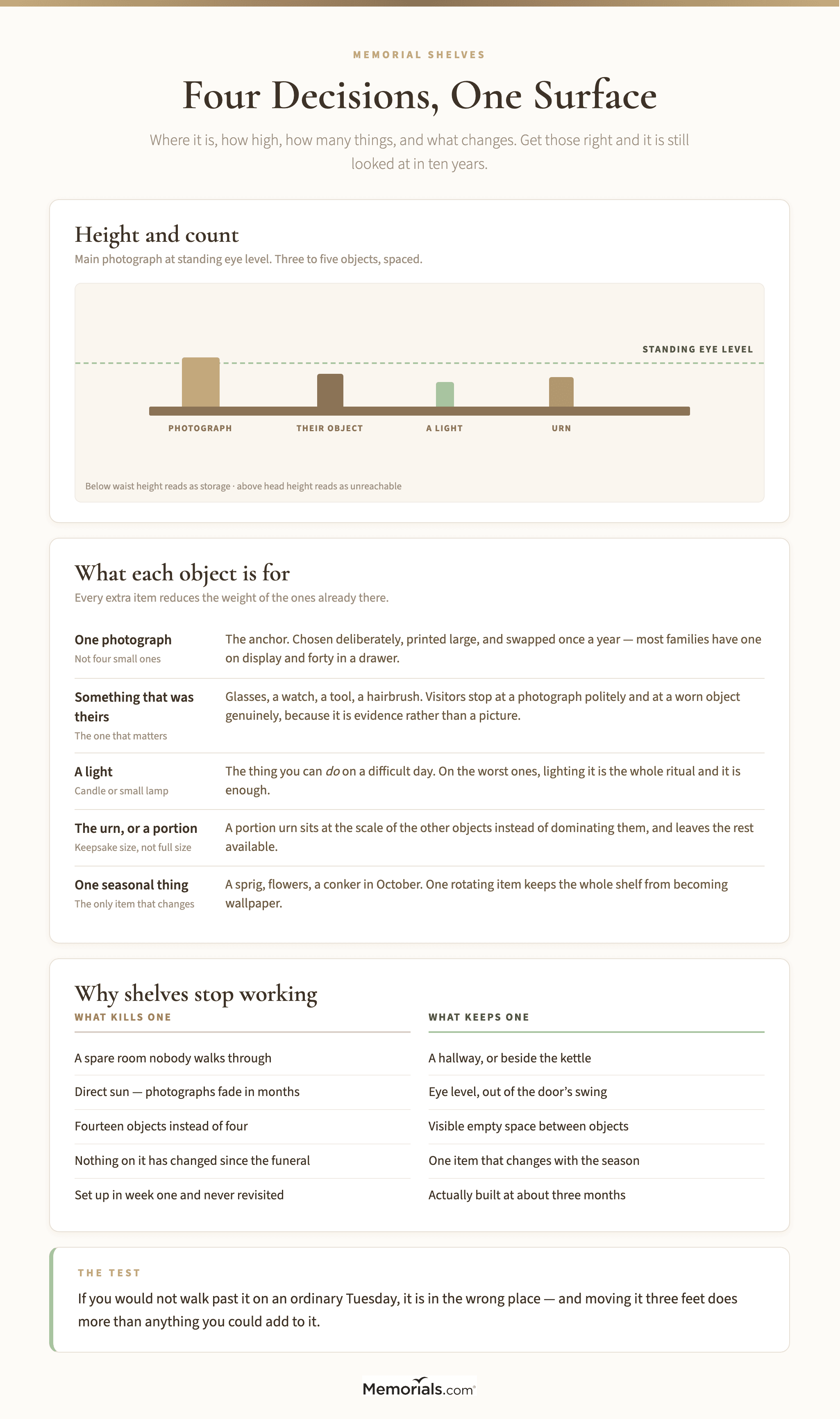
Height, count and roles. The rule doing the most work is three to five objects — every extra item reduces the weight of the ones already there, and the difference between a memorial and a surface is almost entirely restraint.
Making It Not a Shrine
People search for the shrine of someone they have lost and then worry about the word. Families sometimes worry that a memorial shrine at home is unhealthy — that keeping a place set aside means not moving on. It is worth separating two things.
A place you visit is not the same as a place you are stuck in. A shelf that gets a glance in the morning and a candle on an anniversary is a healthy thing, and the research on continuing bonds broadly supports the idea that maintaining a relationship with someone who has died is normal rather than pathological.
What is worth watching for is different: a space that cannot be changed, cleaned or moved; distress when someone else touches it; or a room kept exactly as it was for years. Those are worth mentioning to a doctor or a counselor — not because a memorial shelf caused them, but because they are signs of grief that has become stuck, and the shelf is where it shows.
The practical version of that: if you can dust it, rearrange it and move it to a different room, it is a memorial. If none of those feels possible, that is worth noticing.
Keeping It Alive
A memorial space dies of neglect or of never changing. Both are avoidable.
Change one thing with the season. A sprig, flowers from the garden, a conker in October. One rotating item keeps the whole shelf from becoming wallpaper.
Swap the photograph once a year. Most families have one photograph on display and forty in a drawer. Rotating it is the cheapest way to see them again rather than see the picture.
Dust it yourself. It sounds trivial and it is the ritual most people report actually keeping.
Add on the anniversary rather than continuously. One considered addition a year beats four impulse ones, and it gives the date something to be for.
Let children put things on it. A drawing, a shell, a thing from a pocket. A shelf a child has contributed to is a shelf that family talks about.
On the harder days, lighting the candle is the whole ritual and it is enough. Memorial candles and candlelight vigils covers the holders and the days families mark, and if there is a jar of written memories from the service, this shelf is where it ends up — see memory jars, boxes and tables.
Building It: The Practical Part
The shelf itself should disappear. A plain floating shelf in a wood that matches the room does more than a decorative bracket, because anything ornamental competes with what is on it. Depth of about six inches is enough for a frame, an urn and a candle without things sitting behind each other.
Mount it properly. A shelf holding an urn is holding something irreplaceable, and a fixing pulled out of plasterboard is the one failure with no recovery. Find the stud, or use fixings rated well above the weight.
Check the depth against the urn first. Full-size urns are often deeper than a standard shelf, and discovering that after drilling is a bad afternoon.
A lip or a low rail matters if there are children, dogs or a door nearby.
Light it if the spot is dim. A shelf in a dark hallway is invisible from lunchtime onward. A small warm bulb or a battery puck under the shelf above changes it completely.
Felt pads under everything. Ceramic on wood scratches, and a scratched shelf is a shelf that gets replaced and never rebuilt.
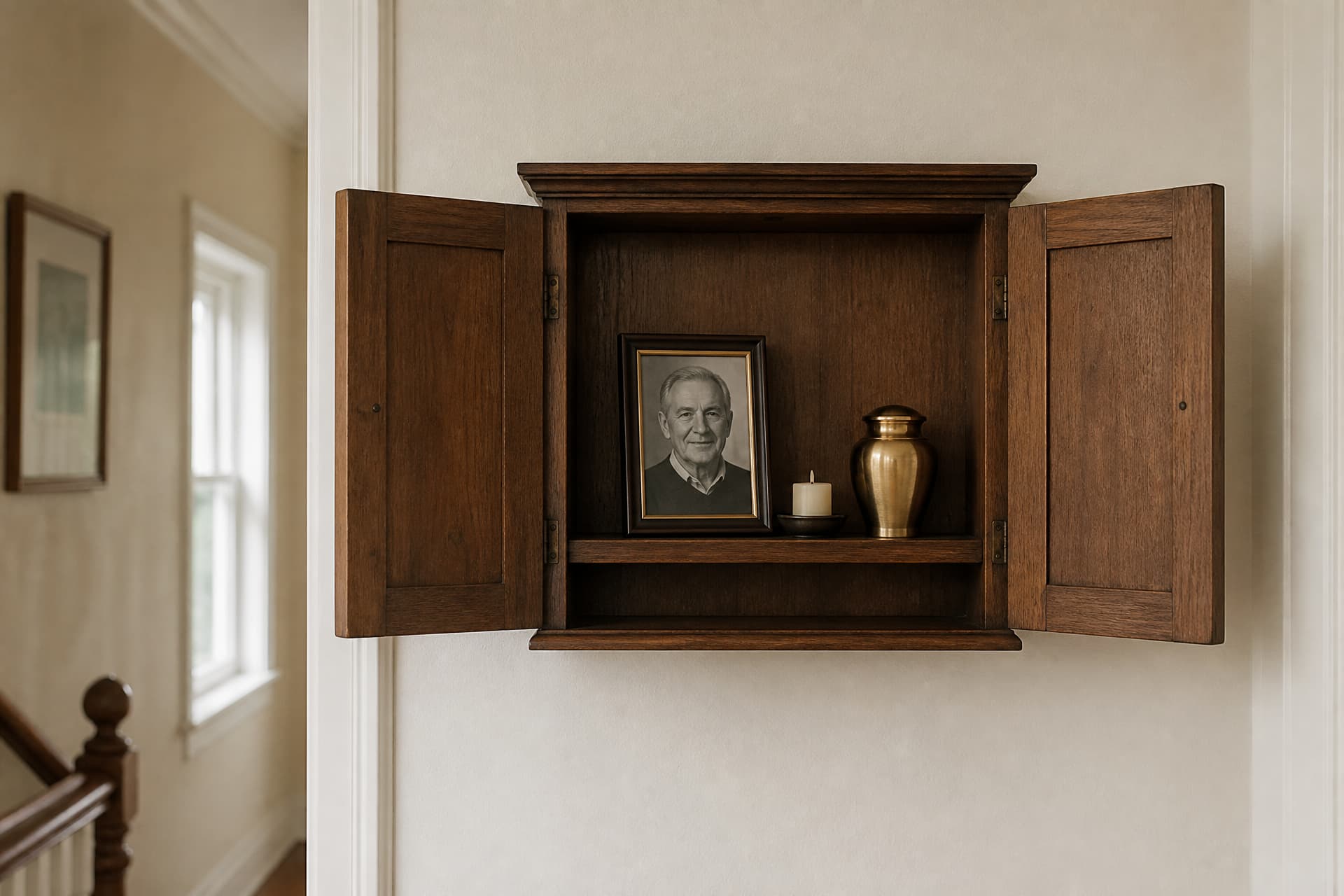
A cabinet instead of a shelf solves several problems at once: it closes, it keeps dust off, and it lets you decide who sees it. This is what most traditional home altars actually are, and it suits anyone who wants the space to exist without it being on display to every visitor.
The shelf changes shape, and knowing that in advance stops the changes feeling like failures.
The first weeks it will be too full. Everything arrives at once — flowers, cards, the order of service — and the shelf becomes the place they land. That is fine and it is temporary. Do not try to design it yet.
The funeral picture board is the object that most often turns up in that pile, and it is the one that will never fit. A trifold is built to be read from six feet by people standing in a foyer; a shelf is read from two, by one person. Take it apart and the two or three photographs guests kept stopping at are the ones worth framing.
Around three months is the right time to actually build it. The immediate objects have stopped arriving, you know which photograph you keep looking at, and you can tell which of their things you want at eye level rather than in a drawer.
At a year most families find they want fewer objects rather than more, and that the one they thought was central has been replaced by something smaller nobody chose deliberately — a pen, a key ring, a mug.
After that it should be allowed to shrink. A shelf that reduces to two objects and a candle has not failed. It has become the thing it was always heading toward, which is a small permanent fact in a room rather than an event that keeps being staged.
Several traditions have done this for centuries and do it better than a shelf assembled from instinct.
A Japanese butsudan is a cabinet holding a memorial tablet, with daily offerings of water, rice and incense. A Mexican ofrenda is built for Día de los Muertos with photographs, food the person liked, marigolds and candles that guide the dead home, and taken down afterward. Both are specific religious practices with their own rules, and they are worth reading about properly rather than borrowing pieces of. The ofrenda has its own vocabulary of objects, and the decorated skulls that sit on it are the most misread of them — what a sugar skull actually means is not what most English-language coverage says.
What a secular shelf can take from them, respectfully: the daily gesture rather than the annual one, and the idea that offering something — even a glass of water — is a different act from displaying something.
A cabinet does what a shelf cannot — it closes. That solves dust, it solves children, and it lets a family decide who sees the space and when, which is the version most traditional home altars have always used.
Frequently Asked Questions
What is a memorial shelf? A single surface in the home holding a few objects that belonged to someone who died, usually a photograph, something they used, and a light.
How many things should go on a memorial shelf? Three to five. Every extra object reduces the weight of the ones already there.
Where is the best place for a memorial shelf? Somewhere you already pass daily — a hallway, a kitchen, beside the kettle. Not a spare room, not direct sunlight, not above a radiator.
How high should it be? Main photograph at roughly standing eye level. Lower reads as storage; higher reads as unreachable.
Can I keep an urn on a memorial shelf? Yes, and a keepsake urn holding a portion often sits better than a full-size one.
Is having a memorial shrine at home unhealthy? A place you visit is not a place you are stuck in. What is worth watching for is a space that cannot be changed, cleaned or moved.
What is the difference between a memorial shelf and an altar? Mostly intention. An altar implies an offering — a light, water, flowers — rather than only a display.
One Surface, Four Decisions
Where it is, how high, how many things, and what changes. Get those right and a memorial shelf is still being looked at in ten years; get them wrong and it is a dusty surface within one.
If you are building the rest of it too, the memorial tribute ideas guide covers the other pieces, and memorial ideas at home covers the whole-house version of the question rather than the single shelf.