🏬Supersize Online Funeral Retailer🪦1000's of Headstones⚱️Over 10,000 Cremation Urns⚰️Caskets Overnight Delivery🛒Funeral & Memorial Superstore🚚FREE Shipping on ALL Orders👨👩👧👦Helping Families for over 20 Years💰Lowest Price Guarantee🏬Supersize Online Funeral Retailer🪦1000's of Headstones⚱️Over 10,000 Cremation Urns⚰️Caskets Overnight Delivery🛒Funeral & Memorial Superstore🚚FREE Shipping on ALL Orders👨👩👧👦Helping Families for over 20 Years💰Lowest Price Guarantee
🏬Supersize Online Funeral Retailer🪦1000's of Headstones⚱️Over 10,000 Cremation Urns⚰️Caskets Overnight Delivery🛒Funeral & Memorial Superstore🚚FREE Shipping on ALL Orders👨👩👧👦Helping Families for over 20 Years💰Lowest Price Guarantee🏬Supersize Online Funeral Retailer🪦1000's of Headstones⚱️Over 10,000 Cremation Urns⚰️Caskets Overnight Delivery🛒Funeral & Memorial Superstore🚚FREE Shipping on ALL Orders👨👩👧👦Helping Families for over 20 Years💰Lowest Price Guarantee
In Loving Memory is intimate — it says the person writing it loved the person who died. In Memory Of is neutral and works for anyone, including people you respected but did not know well. In Memoriam is formal and a little literary, and it belongs on programs, plaques and published notices far more than on a headstone.
That is the whole distinction, and it matters more than it sounds, because most of the places these phrases go are permanent. Granite is cut once.
This page covers which phrase fits which situation, how to write the full line without the grammar going wrong, how to spell memoriam (the single most common mistake), where each phrase belongs on an urn or a marker or a card, and thirty alternatives for when none of the three sounds like the person you are writing about.
The Short Answer
Phrase
Register
Use it when
Avoid it when
In Loving Memory
Personal, warm
You loved them — family, close friends
A colleague, a public figure, a formal notice
In Memory Of
Neutral, universal
Anyone at all; donations; group tributes
You want warmth and this reads cool
In Memoriam
Formal, literary
Programs, plaques, published notices, annual tributes
A grandparent's headstone, where it reads distant
When in doubt, use In Memory Of. It is the phrase that is never wrong.
In Loving Memory is the most common headstone opening in the United States, and it is the right one for a spouse, parent, child or sibling.
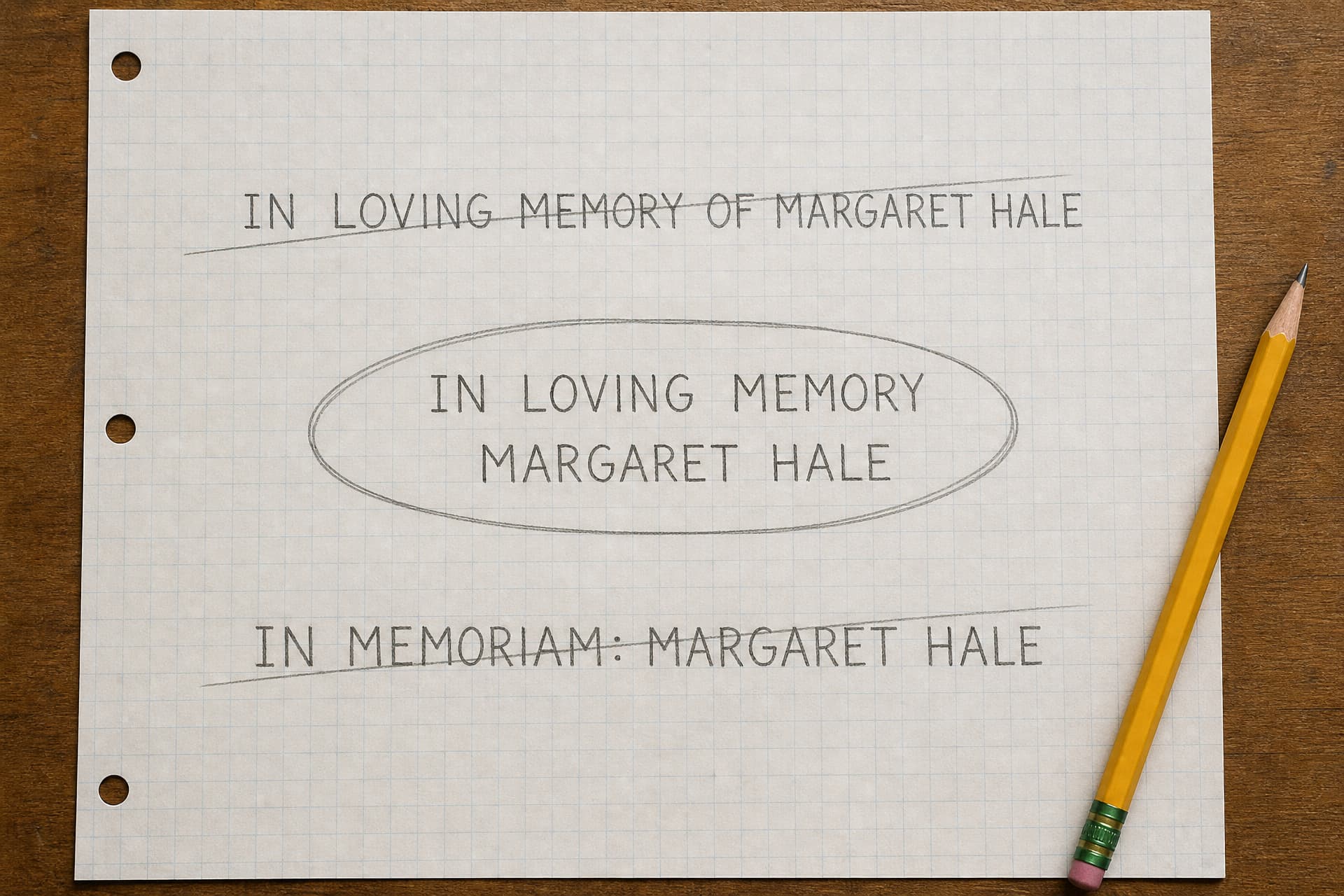
In Memoriam is Latin, singular, and takes no "of". Write In Memoriam: Margaret Hale, not In Memoriam of Margaret Hale.
In loving memory means the memory itself is held with love. The love belongs to the person remembering, not to the person who died — a distinction nobody notices until they try to use the phrase for someone they respected rather than loved, and it sits oddly.
That is why it works on a family headstone and does not work on a company's condolence notice. The phrase makes a claim about the relationship. When the claim is true it is the warmest of the three; when it is not, readers feel the stretch even if they cannot name it.
The in loving memory meaning people are reaching for is that one: the memory is held with love. It is also the phrase searched for most — and, unhelpfully, the one where a song of the same name dominates the results. If you arrived here after wading through music, this is the page you wanted.
Use it for: a spouse, parent, child, sibling, grandparent, or a friend who was family in everything but name. It is the standard opening line on headstones, on engraved urn nameplates, and on the memorial cards handed out at a service.
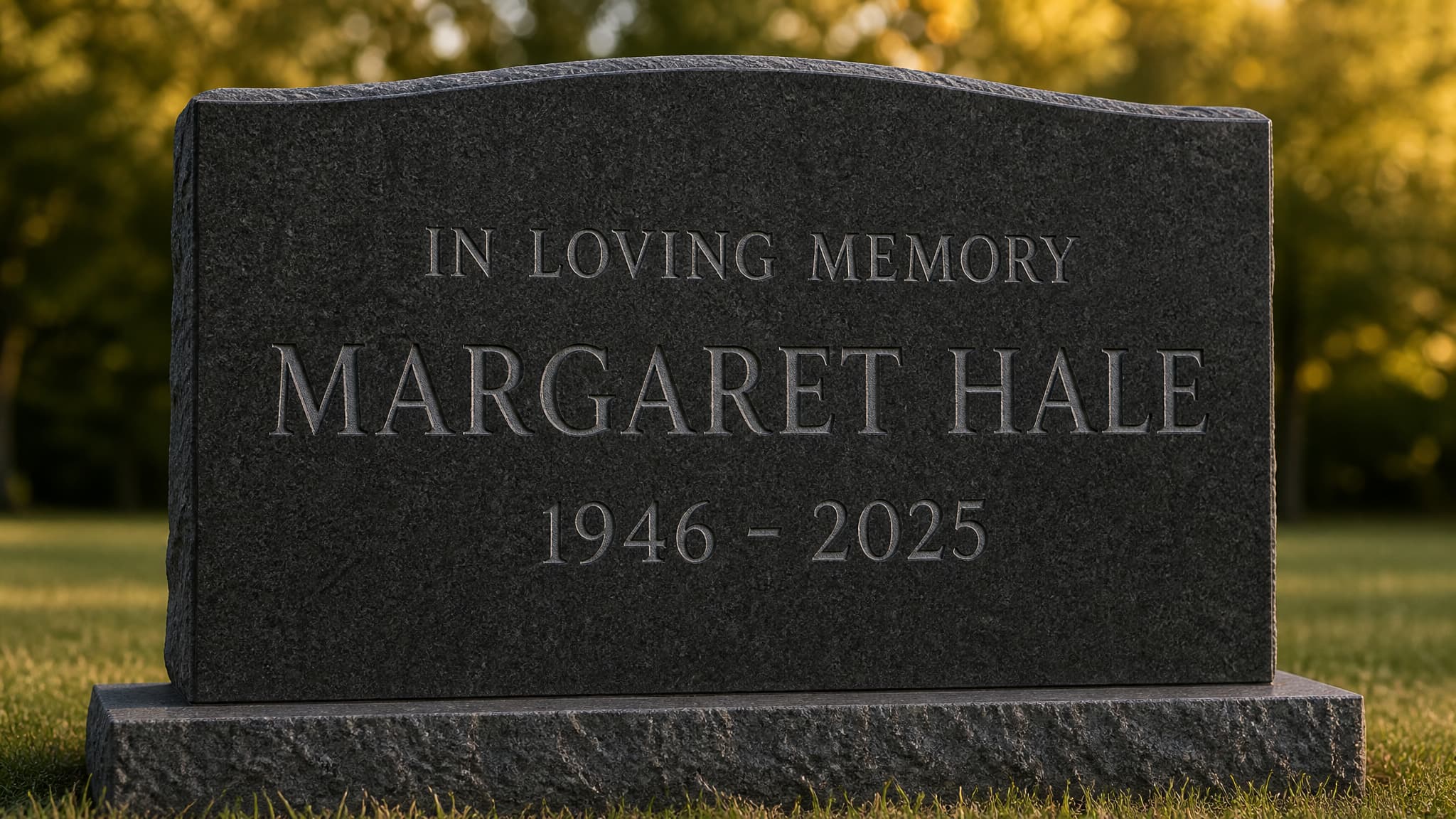
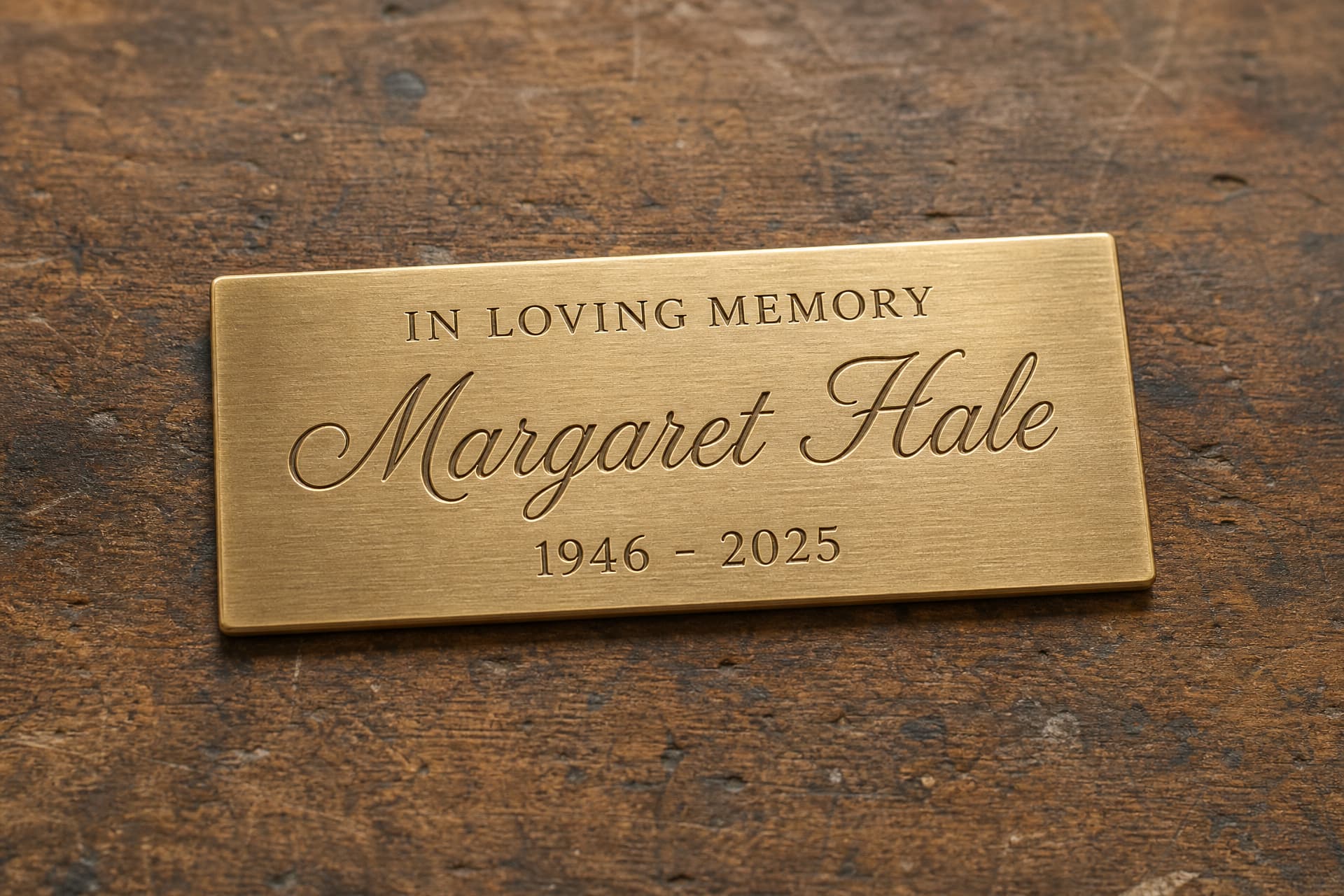
The heading-then-name arrangement, which is what most engravers will set by default. Note that the name is the largest thing on the plate and the phrase is the smallest — reverse that and the plate starts to read as being about the sentiment rather than about the person.
What "In Memory Of" Means
In memory of means the act — a donation, a bench, a scholarship, a moment of silence — is being made because of someone who died. It carries no claim about closeness, which is exactly why it is the most useful of the three.
It is the phrase to use when:
You are giving rather than inscribing. A donation is made in memory of someone. In lieu of flowers requests are almost always worded this way.
You did not know them well. A colleague, a neighbor, a friend's parent.
A group is speaking. A team, a congregation, a workplace. In loving memory from an organization sounds like it is trying too hard; in memory of sounds correct.
The tribute is public. A dedication plaque, a park bench, a stadium seat, a tree.
It is also grammatically the most forgiving. In memory of is followed by a name and nothing else has to agree with anything.
The short version: if you are choosing between the two and you have to think about it for more than a few seconds, the answer is in memory of. Hesitation is the signal.
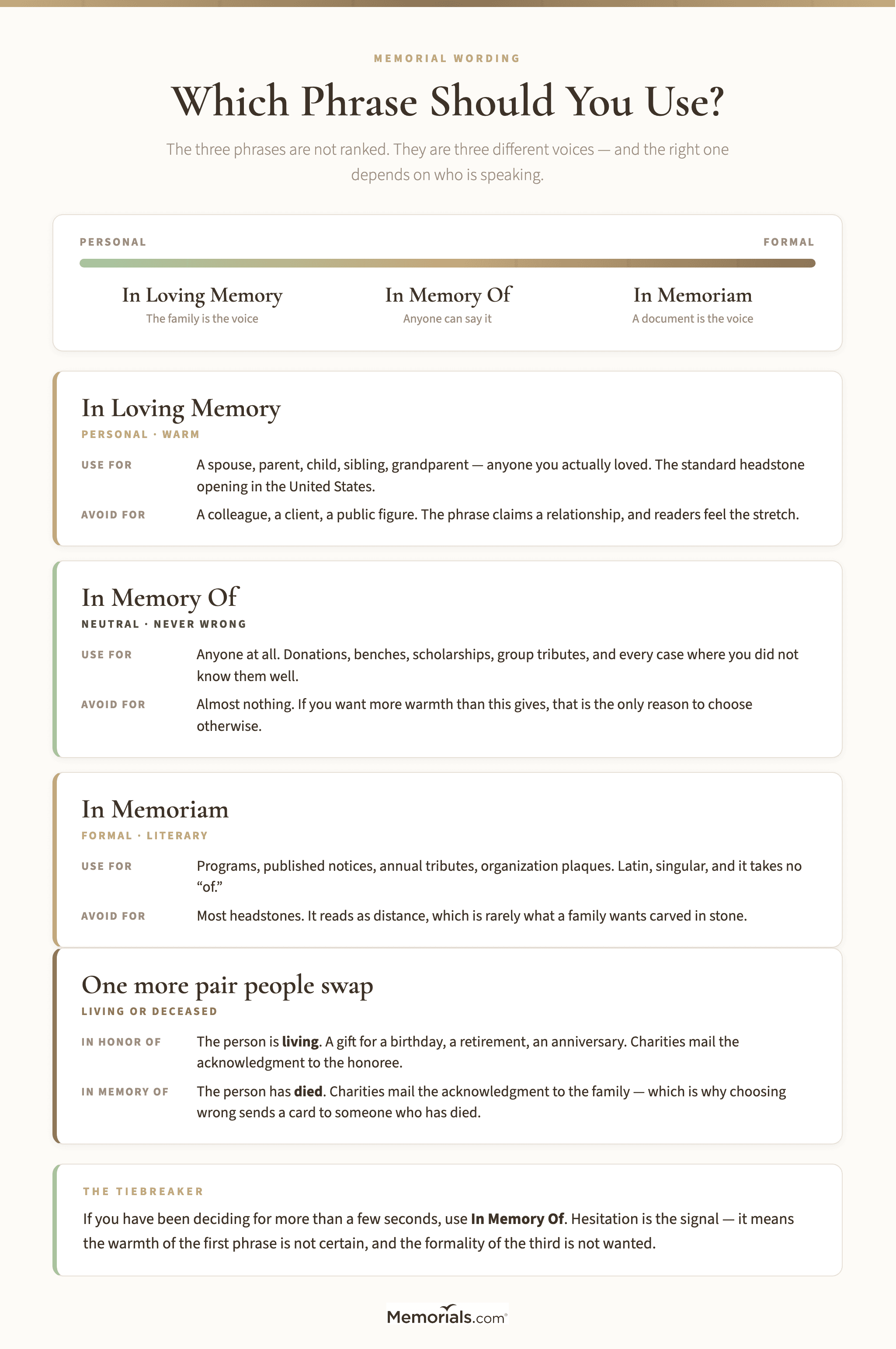
The three phrases arranged by register rather than by rank. "In Loving Memory" claims a relationship, "In Memoriam" claims a document, and "In Memory Of" claims neither — which is why it is the one that is never wrong. The fourth card is the pair that costs people real money: choose "in honor of" for someone who has died and the charity mails the acknowledgment to them.
What "In Memoriam" Means — and How to Spell It
The memoriam meaning is straightforward once you see the Latin: in memoriam means "into memory," and English borrowed it in the nineteenth century, largely on the strength of Tennyson's In Memoriam A.H.H. It still carries that literary weight, which is a feature on a program and a problem on a grandmother's marker.
The spelling is the thing people get wrong. It is:
in memoriam — m-e-m-o-r-i-a-m
Not in memorium. Not in memorian. Not in memoradum. The ending is -iam, and the mistake is so common that in memorium is searched hundreds of times a month on its own. The word is a Latin accusative; there is no English word memorium to be confused with, only the pull of -ium endings like auditorium and memorandum.
Two more rules that follow from it being Latin:
It takes no "of".In Memoriam: James Okoro — a colon or a line break, then the name. In memoriam of is a redundancy, the way "ATM machine" is.
It does not pluralize. Several people are still remembered in memoriam, not "in memoriams".
Where it belongs: an order of service, a yearbook or annual report page, a published death notice, a memorial concert program, an organization's dedication plaque, a remembrance segment at an awards ceremony. Anywhere with a printed formality to it.
Where it does not: most headstones. It reads as distance, and distance is rarely what a family wants carved in stone.
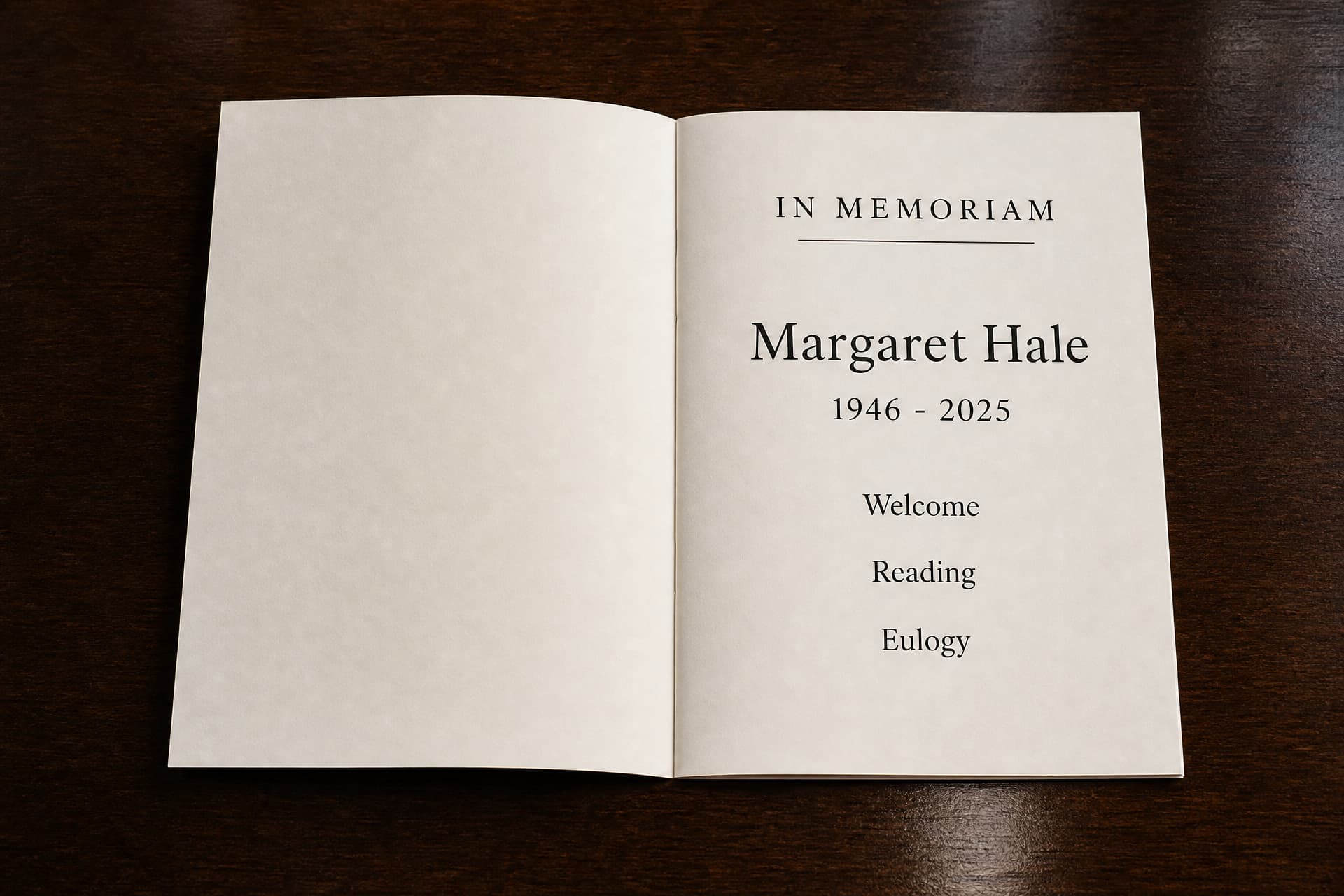
A program is where "In Memoriam" is at home: a printed document with a formal register, a heading rather than a sentence, and no "of" after it. The same three words on the headstone outside would read as distance.
"In Honor Of" vs "In Memory Of"
Search in honor of vs in memory of and you will find these two are constantly swapped, and the rule is simple and absolute:
In honor of — the person is living.
In memory of — the person has died.
Donation forms usually offer both as a radio button for exactly this reason. A gift in honor of your mother on her eightieth birthday; a gift in memory of your mother the year after she dies. Charities send an acknowledgment card to the honoree in the first case and to the family in the second, so choosing the wrong one has a real and unhappy consequence — a card arriving addressed to someone who has died.
In honor of can also mark an occasion rather than a person: in honor of our fiftieth anniversary. In memory of cannot; it always points at someone.
Where Each Phrase Belongs
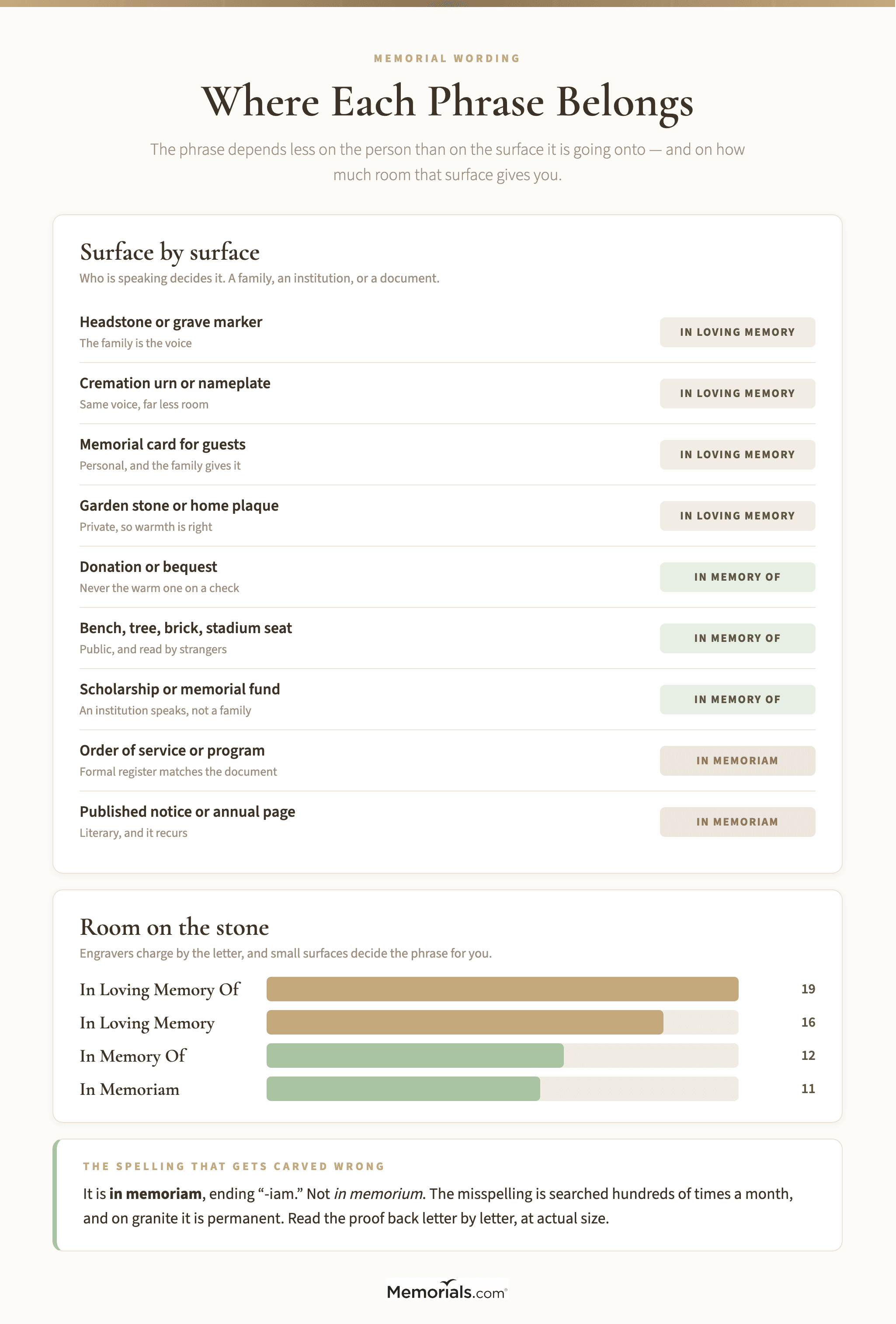
The phrase you choose depends less on the person than on the surface it is going onto. Here is where each one actually lands.
Where it goes
Best phrase
Why
Headstone or grave marker
In Loving Memory
The standard, and the family is the voice
Cremation urn or nameplate
In Loving Memory
Same voice, less room — often just the phrase and a name
Memorial card handed to guests
In Loving Memory
Personal, and the family is giving it
Order of service / program
In Memoriam
Formal register matches the document
Donation or bequest
In Memory Of
Never in loving memory on a check
Bench, tree, brick, stadium seat
In Memory Of
Public, and read by strangers
Garden stone or plaque at home
In Loving Memory
Private, so warmth is right
Scholarship or fund
In Memory Of
An institution is the voice, not a family
Annual notice or anniversary page
In Memoriam
Literary, and it recurs
Space decides more than people expect. On a full-size marker there is room for a phrase, a name, two dates and a line of verse; on a memory stone for a garden bed there may be room for four words. In Memory Of is four characters shorter than In Loving Memory, and seven shorter than In Loving Memory Of, and on small surfaces that is the difference between fitting and not.
Not every surface is permanent, and the temporary ones are where families can relax. The label on a memory jar, the sign on a memory table, the header on an order of service — all read once, by people who are standing up. The shorter phrase wins there for the same reason it wins on stone, but nothing is being cut and you can change your mind at eleven at night.
If you are choosing a surface as well as a phrase, our cremation urns, memorial rocks and headstones all take engraving, and each has its own practical limits on line length.
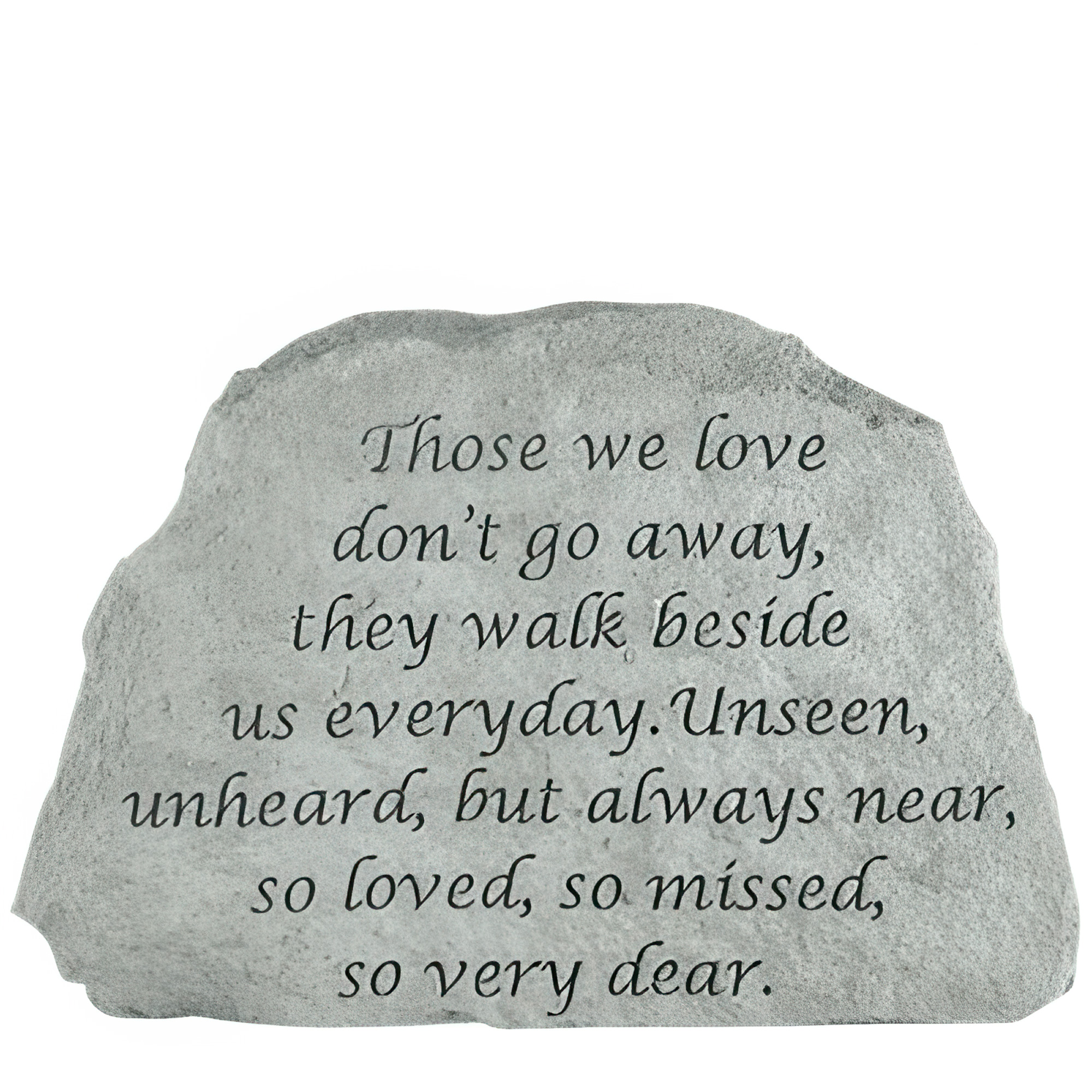
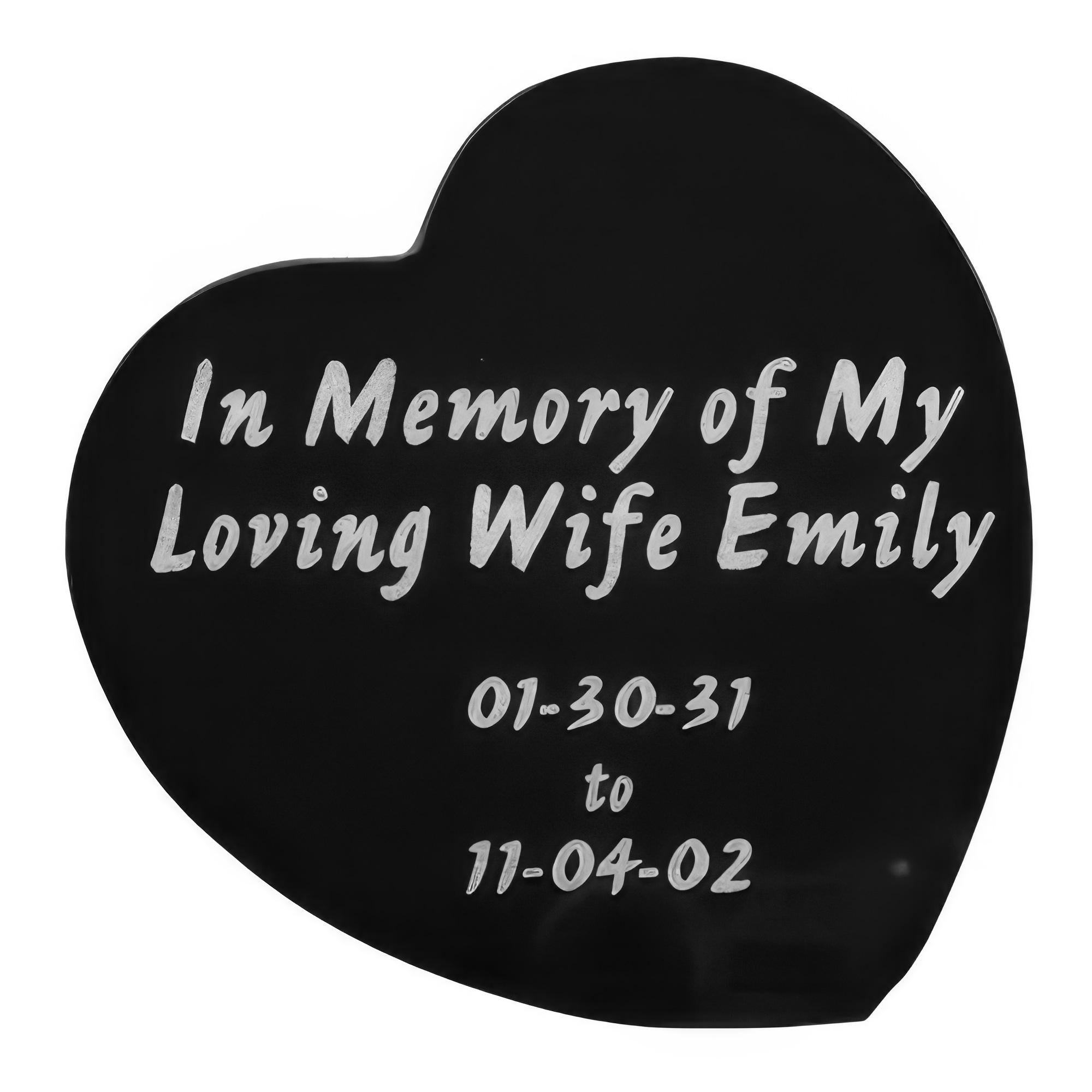
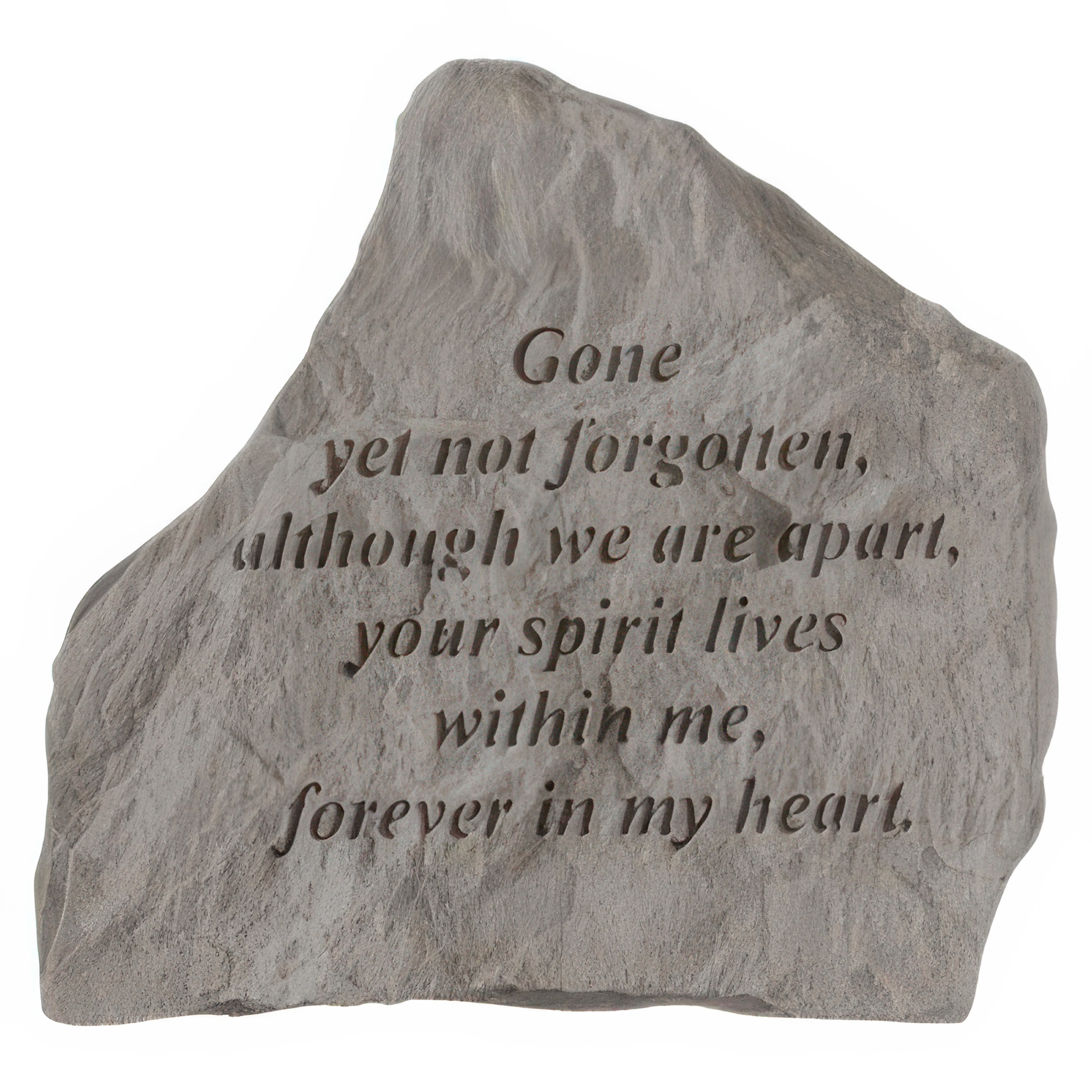
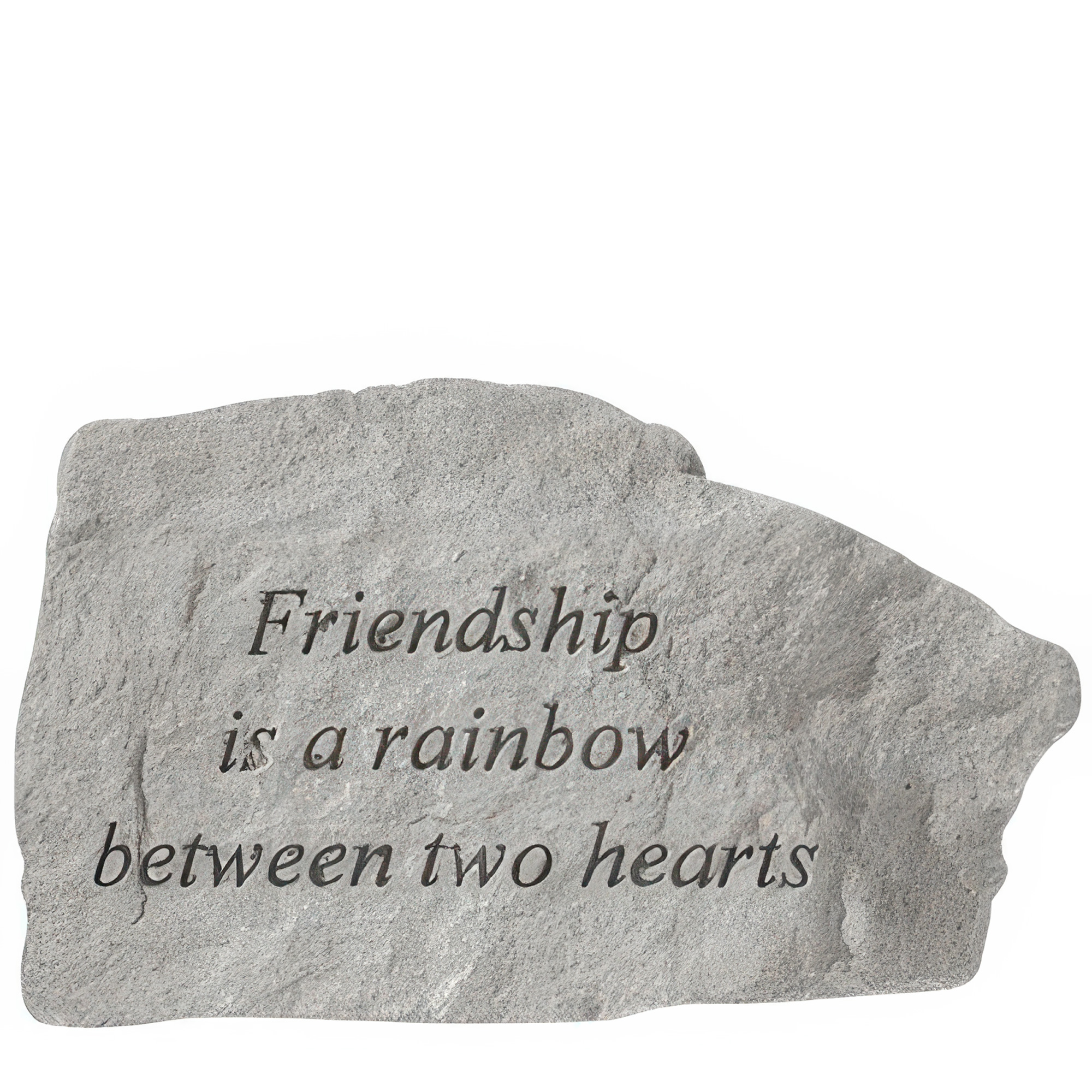
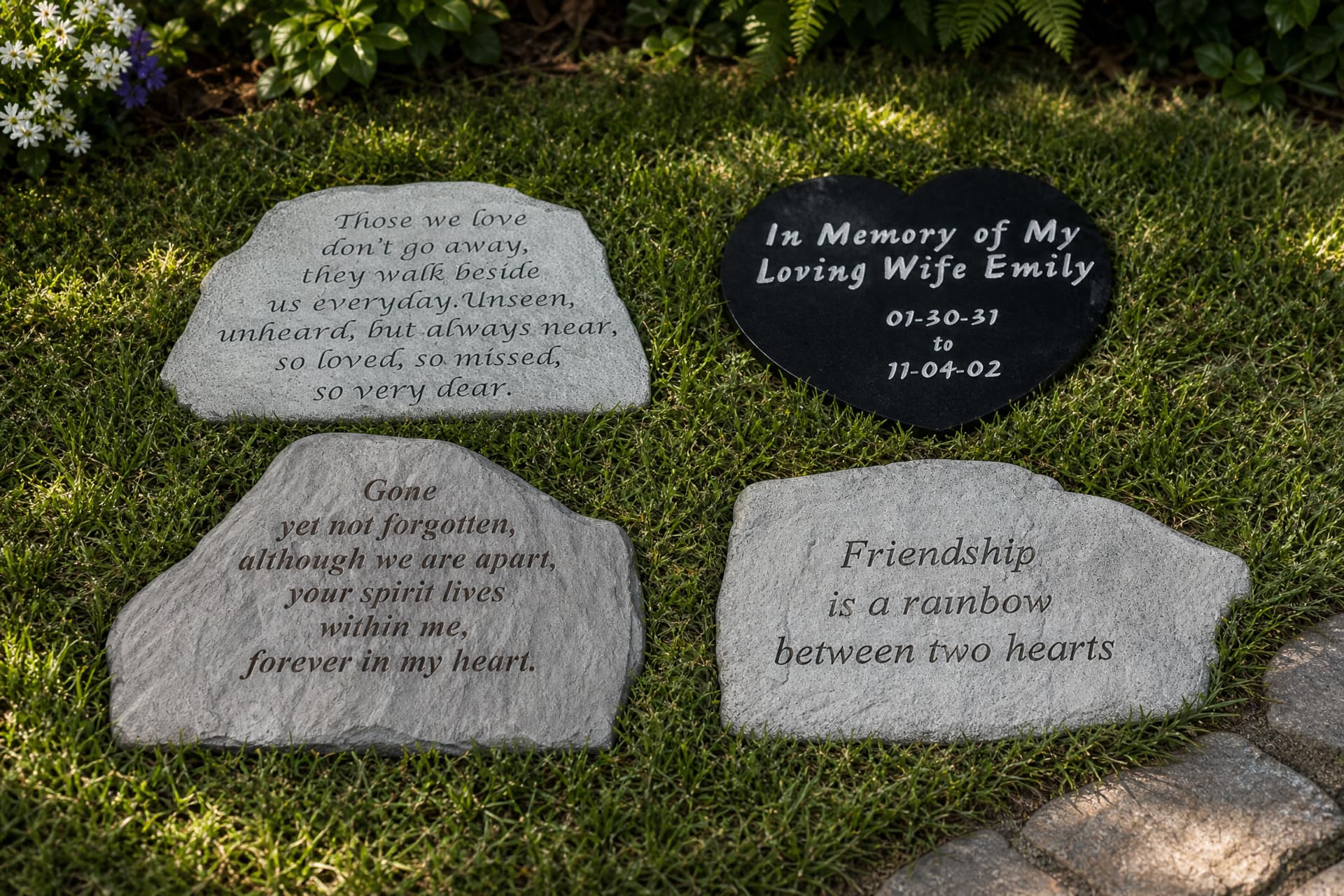
Garden stones are where the phrase question gets answered in practice. Three of these carry a verse and no phrase at all; the fourth opens with "In Memory of" and names a relationship. Both are ordinary, and the stone that names the relationship is doing something the verses cannot — it tells a visitor who this was. Products from left to right: Those We Love Keepsake Rock, Marble Heart Memorial Rock, Gone Yet Not Forgotten Rock and Friendship Is A Rainbow Rock.
Nine surfaces and the phrase each one wants, plus the count that decides it when room runs out. "In Loving Memory Of" is nineteen characters and "In Memoriam" is eleven — on a garden stone with room for four words, that gap is the whole decision, and engravers charge by the letter besides.
How to Write the Full Line
The phrase is the opening. What follows it is where lines go wrong.
In Loving Memory takes "of", and then either the name alone or the name with a relationship:
In Loving Memory of Margaret Hale
In Loving Memory of Our Mother, Margaret Hale
Both are correct. The second is warmer and needs more room.
A common construction drops the "of" entirely and lets the phrase stand as a heading above the name:
In Loving Memory
Margaret Hale
1946 – 2025
This is the most common layout on headstones and nameplates, because it reads cleanly at a distance and the name gets the largest type. If you are unsure, this is the safe arrangement.
Watch the possessive.In loving memory of our beloved mother Margaret is doing two jobs: "loving" and "beloved" say the same thing twice. Pick one.
Dates: a hyphen or en dash between years is standard. Full dates are increasingly common on modern markers and were rare on older ones. Both are correct; consistency across a family plot matters more than either.
All three of these are correct. That is the point of drafting them out — you are not choosing between right and wrong but between three registers, and seeing them stacked on one page is the fastest way to hear the difference. Count the characters while you are there.
30 Alternatives to "In Loving Memory"
Sometimes none of the three fits — the person was funny, or private, or the family is not religious, or in loving memory has been used on every other marker in the plot and this one should sound like them.
Warm and personal
1. Forever in our hearts
2. Always remembered, never forgotten
3. Loved beyond words
4. Held close, always
5. Our beloved
6. Cherished always
7. Deeply loved, deeply missed
8. Loved every day
Quiet and understated
9. Remembering
10. In remembrance
11. Gone from our sight, never our minds
12. Until we meet again
13. Rest well
14. At peace
15. Safe home
16. Her light remains
Formal and public
17. In grateful memory
18. In lasting memory
19. In tribute to
20. Dedicated to the memory of
21. Honoring the life of
22. In recognition of a life well lived
23. Presented in memory of
Celebrating a life rather than mourning it
24. Celebrating the life of
25. A life well loved
26. He lived well and laughed often
27. She left the world kinder
28. Well played
29. Still teaching us
30. The story continues
The last few are deliberately informal. They are right for a bench, a memorial garden marker, or a celebration-of-life program, and wrong for a cemetery that has design guidelines — many do, and it is worth asking before you commission anything.
Mistakes That Are Hard to Undo
Spelling "memoriam" as "memorium". By a wide margin the most common, and it is permanent on stone. Read it back letter by letter: m-e-m-o-r-i-a-m.
Using "in loving memory" for someone you did not love. A colleague, a client, a public figure. It reads as performance. In memory of is the correct register and costs nothing.
Writing "in memoriam of". The of is redundant. Colon, line break, or nothing.
Choosing "in honor of" for someone who has died. Or the reverse. Check the radio button.
Not counting the characters. Engravers charge by the letter on many products and the line has to physically fit. Ask for a proof and look at it at actual size, not on a screen.
Approving a proof you have only read once. Read it aloud. Read it backwards. Have someone who was not involved read it. Names and dates are the fields that get transposed, and the family is the last group of people who will notice, because they already know what it is supposed to say.
Frequently Asked Questions
Is it "in loving memory" or "in loving memory of"? Both are correct. Use of when the name runs on in the same line. Drop it when the phrase sits as a heading above the name on its own line.
What does "in memoriam" mean? Latin for "into memory." In English it means a formal tribute to someone who has died, and it is used as a heading rather than a sentence.
Is it "in memoriam" or "in memorium"?In memoriam, ending -iam. In memorium is a misspelling, though a very common one.
Can I use "in memory of" for a pet? Yes, and it is the phrase most often chosen. All three work, but in memory of and in loving memory read most naturally on a pet marker.
What is the difference between "in honor of" and "in memory of"?In honor of is for the living, in memory of is for someone who has died. Charities treat them differently and will send acknowledgments to different people.
What is the plural of "in memoriam"? There isn't one. Several people are remembered in memoriam; the phrase does not change.
Which phrase is best for a headstone?In Loving Memory for family. In Memory Of if you want something shorter or more neutral. In Memoriam is usually too formal for a grave marker.
Choosing the One That Sounds Like Them
The three phrases are not ranked. They are three different voices, and the right one depends on who is speaking — a family, an institution, or a document — and on how much room the surface gives you.
If nothing here has settled it: use In Memory Of. It is never wrong, it fits where the others do not, and no one has ever looked at a marker and thought it was the wrong choice.
For the rest of the tribute — the garden, the photo display, the candle at the service — start with the memorial tribute ideas guide, which covers the ways families put these phrases to use.