🏬Supersize Online Funeral Retailer🪦1000's of Headstones⚱️Over 10,000 Cremation Urns⚰️Caskets Overnight Delivery🛒Funeral & Memorial Superstore🚚FREE Shipping on ALL Orders👨👩👧👦Helping Families for over 20 Years💰Lowest Price Guarantee🏬Supersize Online Funeral Retailer🪦1000's of Headstones⚱️Over 10,000 Cremation Urns⚰️Caskets Overnight Delivery🛒Funeral & Memorial Superstore🚚FREE Shipping on ALL Orders👨👩👧👦Helping Families for over 20 Years💰Lowest Price Guarantee
🏬Supersize Online Funeral Retailer🪦1000's of Headstones⚱️Over 10,000 Cremation Urns⚰️Caskets Overnight Delivery🛒Funeral & Memorial Superstore🚚FREE Shipping on ALL Orders👨👩👧👦Helping Families for over 20 Years💰Lowest Price Guarantee🏬Supersize Online Funeral Retailer🪦1000's of Headstones⚱️Over 10,000 Cremation Urns⚰️Caskets Overnight Delivery🛒Funeral & Memorial Superstore🚚FREE Shipping on ALL Orders👨👩👧👦Helping Families for over 20 Years💰Lowest Price Guarantee
If your family is exploring cremation for a veteran, you may have heard that the VA provides free urns. The reality is more nuanced than that headline suggests — and the details matter, because choosing the wrong benefit path can permanently close the door on other honors your loved one earned through military service. This guide explains exactly what the VA offers, what it does not cover, and the critical trade-offs every family should understand before filing paperwork. For a broader look at all , start with our comprehensive guide.
The Department of Veterans Affairs administers several burial and memorial programs for eligible service members. Knowing which benefits to claim — and which to preserve — can save families thousands of dollars and prevent irreversible decisions. A complete VA burial benefits overview covers the full range of entitlements, but this article zeroes in on the urn-specific programs and what families often misunderstand about them.
What the VA Actually Provides: The Commemorative Urn Program
The VA's National Cemetery Administration (NCA) offers a commemorative urn for eligible veterans whose cremated remains are not interred at any location. This is not the same as a traditional cremation urn you would purchase from a memorial products retailer.
The VA commemorative urn is a walnut container with a cuboid design. It measures approximately 7.125 inches high, 7.25 inches wide, and 9.25 inches long, with an interior capacity of about 280 cubic inches. One side features an etched emblem of a folded flag, the word "Veteran," and the veteran's branch of service. A black plate on the top carries a brass inscription with the veteran's name, date of birth, and date of death.
The VA also offers a commemorative plaque as an alternative. The walnut plaque measures 10 inches by 8 inches and includes the same folded flag emblem and inscribed nameplate. A keyhole notch on the back allows wall mounting. Families may choose either the urn or the plaque — not both.
Eligibility Requirements
To qualify for the commemorative urn or plaque, the veteran must meet all of these criteria:
Served in the Armed Forces on or after April 6, 1917
Received a discharge under conditions other than dishonorable (or died on active duty)
Cremated remains must not be interred at any location — no portion of ashes may be buried, placed in a columbarium niche, or scattered at a national cemetery
That last requirement is critical. If any part of the veteran's ashes has already been placed, the family is no longer eligible for the commemorative urn or plaque.
How to Apply
Families apply by completing VA Form 40-1330UP (Claim for Commemorative Urn or Plaque for Veterans' Cremains Not Interred). The form can be submitted online through the VA's QuickSubmit tool via AccessVA, or mailed to the NCA FP Evidence Intake Center in Janesville, Wisconsin. A copy of the veteran's DD214 or other discharge documentation must accompany the application. For a detailed walkthrough of processing steps and expected wait times, see our VA benefits timeline guide.
The Trade-Off Most Families Do Not Expect
Here is where the VA commemorative urn program diverges sharply from what many families assume it offers: accepting a VA commemorative urn or plaque permanently forfeits other major benefits.
Once the VA furnishes a commemorative urn or plaque for a veteran, federal law prohibits:
Burial in a VA national cemetery — the veteran can no longer be interred at any national cemetery, including placement in a columbarium niche
Government headstone, marker, or medallion — the VA will not provide any grave marker for the veteran at any cemetery, public or private
No reversal — the law does not provide a method to restore these benefits once the urn or plaque is issued
This is not a temporary hold or a bureaucratic formality. It is a permanent and irreversible forfeiture. Many veterans and their families consider national cemetery burial and a government headstone to be among the most meaningful honors earned through military service — benefits with significant monetary and symbolic value.
What Remains Available After Accepting the Urn
Accepting the commemorative urn does not affect these separate benefits:
Burial flag — families can still receive a U.S. flag to drape over a casket or place with an urn
Presidential Memorial Certificate (PMC) — a certificate signed by the President honoring the veteran's service. Multiple copies can be requested for family members.
Military funeral honors — flag folding and presentation, playing of Taps, and a rifle salute remain available
State and tribal veterans cemetery burial — the law does not prohibit interment at non-VA cemeteries, though individual cemeteries set their own policies. Many state cemeteries rely on VA-provided headstones, so the family may face additional costs for a privately purchased marker.
When the Commemorative Urn Makes Sense
The program best serves families in specific situations:
The veteran's ashes will remain with the family permanently and will never be interred
The family has no plans to use a national cemetery gravesite or columbarium niche
The veteran specifically requested that ashes stay with family rather than be placed at a cemetery
The family wants an official government-issued memorial item honoring the veteran's service
If there is any uncertainty about future plans — even years down the road — preserving the national cemetery benefit is almost always the wiser choice. A columbarium niche at a national cemetery comes at no cost and includes perpetual care, making it one of the most valuable benefits available to veteran families.
What the VA Does Not Provide
The VA commemorative urn program fills a narrow niche. For the majority of veteran families who choose cremation, the VA does not provide:
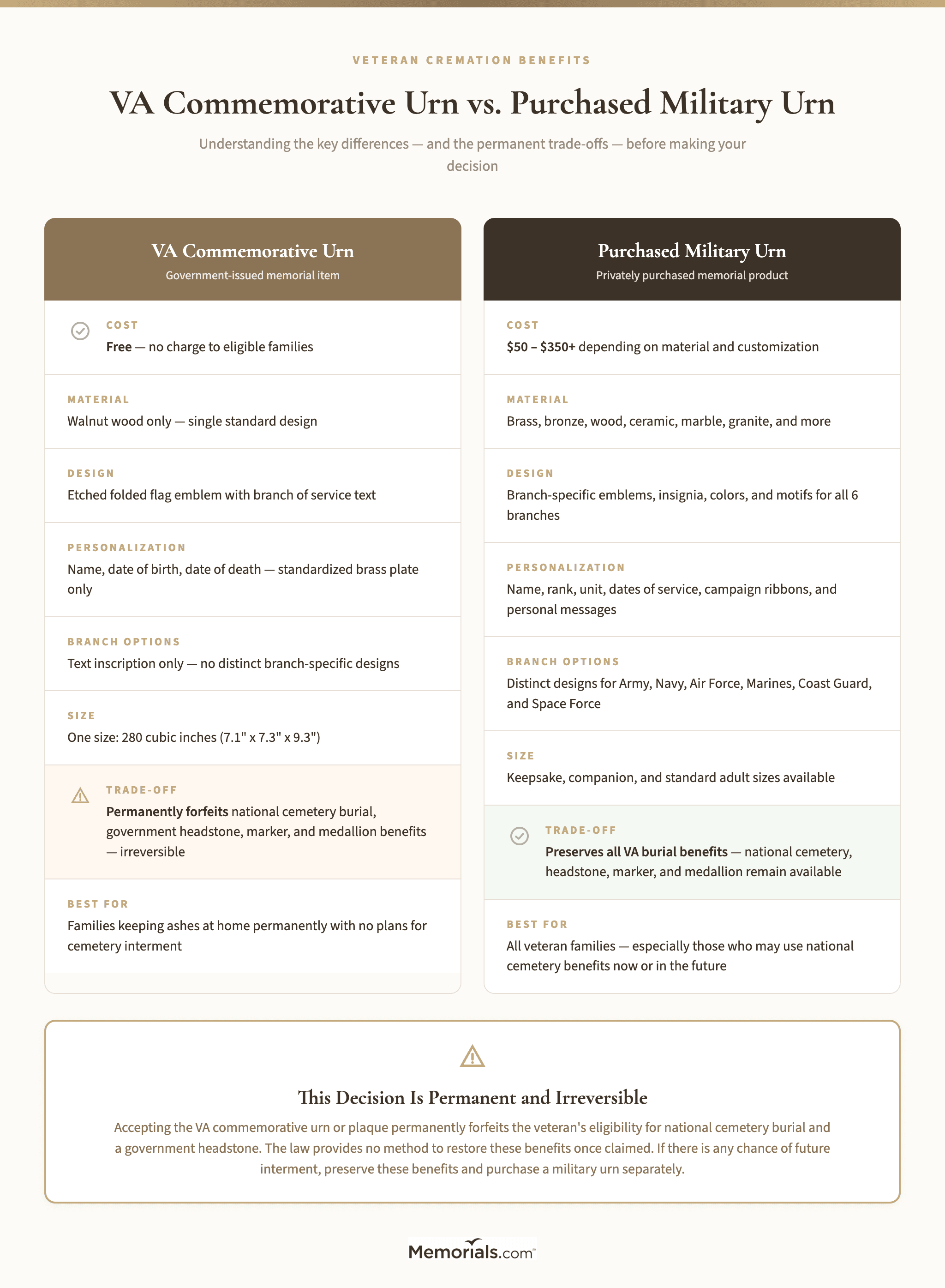
A traditional cremation urn — the commemorative urn is a single walnut design. It cannot be customized beyond the standard inscription, and it may not reflect the veteran's personality, branch identity, or family preferences.
Urn styles by branch of service — there are no separate Army, Navy, Air Force, Marine Corps, or Coast Guard urn designs offered through the VA program
Keepsake urns for sharing ashes — the VA provides one container. Families who wish to divide ashes among multiple relatives need additional urns.
Urn medallions — while the VA does provide headstone medallions for privately purchased markers in cemeteries, no medallion program exists specifically for urns. However, military medallion display options are available through private retailers for families who want branch-specific emblems on their chosen urn.
This is where many families discover the gap between what they expected and what the VA actually delivers. A government-issued walnut box serves an important symbolic purpose, but most families want an urn that reflects the individual — their branch, rank, personality, hobbies, or the way they lived.
How Families Fill the Gap: Purchasing a Military Urn
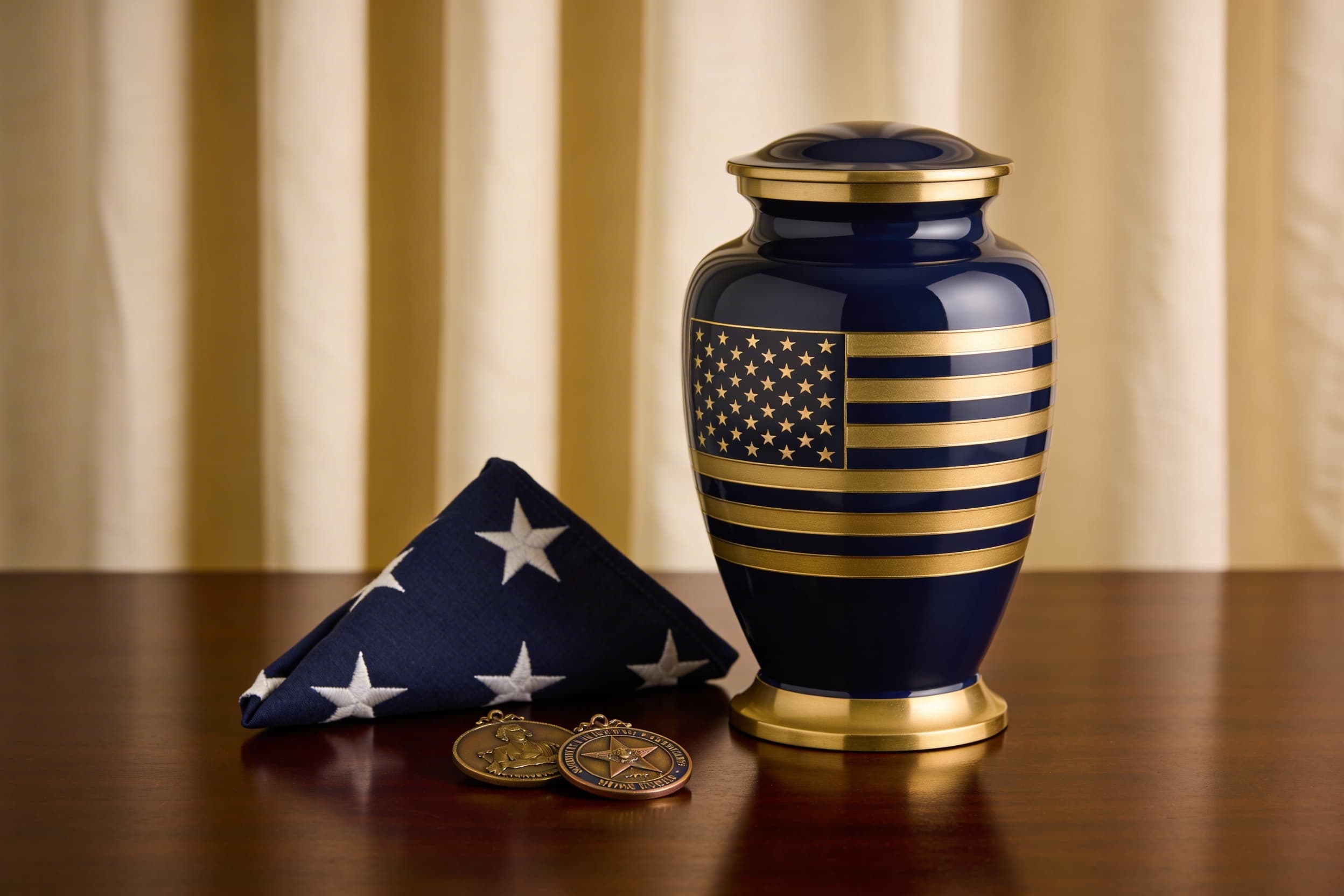
Most veteran families who choose cremation end up purchasing an urn separately, whether or not they use the VA commemorative urn program. Private military urns offer what the VA program cannot: branch-specific designs, multiple materials, custom engraving, and a range of sizes including keepsake options.
Branch of service designs. Urns featuring official or inspired emblems for the Army, Navy, Air Force, Marine Corps, Coast Guard, and Space Force. Many include branch colors, mottos, and insignia etched or inlaid into the urn surface.
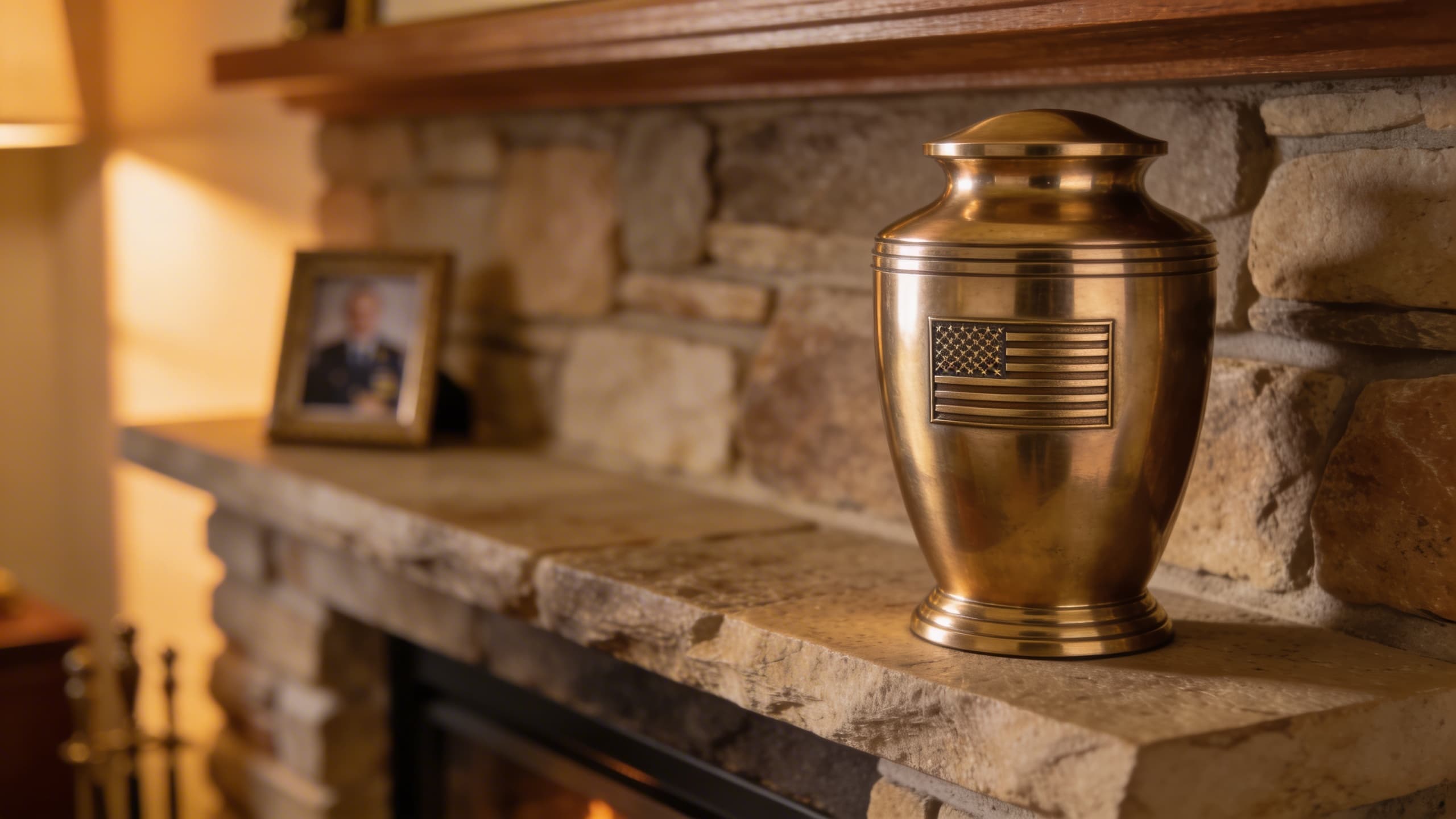
Material options. Military-themed cremation urns come in brass, bronze, wood, ceramic, marble, and other materials. Metal urns with a brushed or polished finish are especially popular for their durability and dignified appearance.
Personalization. Custom engraving can include the veteran's name, rank, dates of service, unit, campaign ribbons, and a personal message. This level of detail goes far beyond the standardized inscription on the VA commemorative urn.
Sizing. Standard adult cremation urns hold approximately 200 cubic inches of cremated remains — enough for most adults. The VA commemorative urn holds 280 cubic inches, which provides extra capacity, but families should verify sizing based on their specific needs.
National cemetery requirements. If the family plans to inter the urn at a national cemetery, the urn must fit within the dimensions specified by the cemetery's columbarium niche or urn burial requirements. Some national cemeteries restrict urn materials — always confirm policies before purchasing.
The "Free Urns for Veterans" Nonprofit
A separate program — unrelated to the VA — also appears in searches for free veteran urns. Free Urns for Veterans is a 501(c)(3) nonprofit organization founded in 2014 in Saint Francis, Minnesota. The organization handcrafted oak urns personalized with military service seals and nameplates, providing them at no cost to veteran families.
After helping over 2,200 veterans, the nonprofit scaled back operations in 2022 when key volunteers retired. It currently operates in partnership with the Minnesota Department of Veterans Affairs (MDVA), supplying urns to three Minnesota State Veterans Cemeteries in Little Falls, Preston, and Duluth. Urns are provided at the time of need and cannot be ordered in advance.
This program is geographically limited to Minnesota state veterans cemeteries. Families outside Minnesota — or those burying in national cemeteries or private cemeteries — cannot access these urns.
Other VA Benefits That Support Cremation
Even without the commemorative urn, veteran families choosing cremation have access to substantial VA benefits:
National cemetery inurnment. Eligible veterans receive a free gravesite or columbarium niche at any VA national cemetery, including opening and closing of the niche, and perpetual care at no cost to the family.
Government headstone or marker. The VA provides a free headstone, grave marker, or niche plaque for veterans buried in national or private cemeteries. For private cemeteries, the VA will furnish a medallion to attach to a privately purchased marker. Bronze veteran grave markers with military headstones branch emblems are among the most requested memorial products for veteran families.
Burial allowance. The VA reimburses eligible families for a portion of cremation costs, including basic services, transportation, and cremation containers. The amount varies based on whether the death was service-connected and where the veteran is buried.
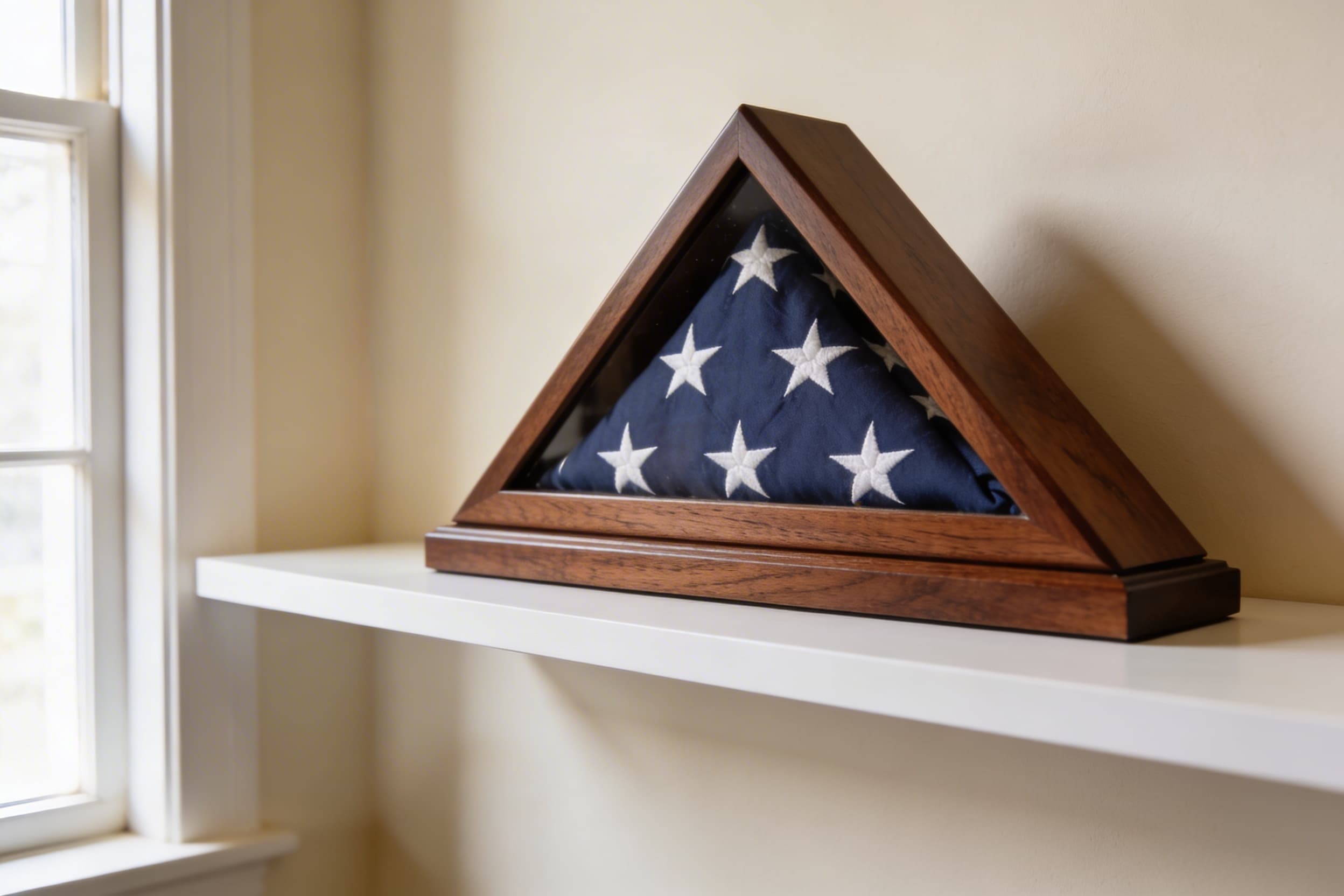
Burial flag. Every eligible veteran receives a U.S. flag to drape over the casket or accompany the urn. After the service, the flag is presented to the next of kin. Many families preserve the flag in a flag display case alongside other service memorabilia.
Presidential Memorial Certificate. A certificate signed by the sitting President, recognizing the veteran's service. Families can request multiple copies at no charge.
Step-by-Step: Making the Right Decision for Your Family
Navigating veteran cremation benefits requires careful thought. Use this framework to avoid costly mistakes:
Step 1: Confirm eligibility. Gather the veteran's DD214 or discharge documentation. Verify honorable discharge status. If you are unsure about eligibility, contact the VA's Applicant Assistance Unit at 800-697-6947.
Step 2: Decide on final disposition. Will the veteran's ashes be interred at a national cemetery, placed in a columbarium niche, kept at home, or scattered? This decision determines which benefits you should claim and which you should preserve.
Step 3: Evaluate the commemorative urn trade-off. If you plan to keep ashes at home permanently with no future interment, the commemorative urn may be a meaningful option. If there is any chance of national cemetery placement — now or in the future — do not apply for the commemorative urn.
Step 4: Choose a personal urn. Whether or not you claim the VA commemorative urn, most families prefer an urn that reflects the veteran's individual service and personality. Branch-specific designs, custom engraving, and quality materials create a lasting tribute.
Step 5: Apply for all other eligible benefits. Burial flag, Presidential Memorial Certificate, military funeral honors, burial allowance, and — if applicable — national cemetery gravesite and government headstone. These benefits stand independently of each other.
Frequently Asked Questions
Does the VA give you a free urn for cremation?
The VA offers a commemorative walnut urn for veterans whose cremated remains will not be interred at any location. However, accepting this urn permanently forfeits the veteran's eligibility for national cemetery burial and a government headstone. It is not a standard cremation urn — it is a memorial item with significant trade-offs.
Can I get a VA urn and still be buried in a national cemetery?
No. Federal law prohibits the VA from providing both a commemorative urn and national cemetery burial for the same veteran. If any part of the veteran's ashes has been interred or if the family intends future interment, the commemorative urn is not available.
What is the difference between the VA commemorative urn and a military urn I can buy?
The VA commemorative urn is a single walnut design with a standardized inscription. Privately purchased military urns offer branch-specific emblems, multiple material choices (brass, bronze, wood, ceramic, marble), custom engraving with name, rank, unit details, and various sizes including keepsake urns for sharing ashes among family members.
Is the "Free Urns for Veterans" nonprofit still operating?
The nonprofit scaled back in 2022 and now partners with the Minnesota Department of Veterans Affairs, providing handcrafted oak urns to three Minnesota state veterans cemeteries. It is not available nationwide.
What VA benefits can I still get if I choose cremation?
Cremation does not disqualify a veteran from VA burial benefits. Eligible families can receive a free national cemetery gravesite or columbarium niche, military funeral honors, a burial flag, a Presidential Memorial Certificate, a government headstone or marker, and a burial allowance — as long as they do not claim the commemorative urn.
Honoring a Veteran's Service with the Right Urn
Choosing how to memorialize a veteran who chose cremation is deeply personal. The VA commemorative urn program exists for a specific situation — families who will keep ashes at home permanently and have no plans for cemetery interment. For everyone else, the smarter path preserves national cemetery eligibility and the government headstone benefit while choosing a privately purchased urn that truly reflects the veteran's branch, rank, and life of service.
Browse our complete collection of military urns designed to honor every branch of the Armed Forces, or explore flag display cases to preserve the burial flag alongside your chosen memorial.