🏬Supersize Online Funeral Retailer🪦1000's of Headstones⚱️Over 10,000 Cremation Urns⚰️Caskets Overnight Delivery🛒Funeral & Memorial Superstore🚚FREE Shipping on ALL Orders👨👩👧👦Helping Families for over 20 Years💰Lowest Price Guarantee🏬Supersize Online Funeral Retailer🪦1000's of Headstones⚱️Over 10,000 Cremation Urns⚰️Caskets Overnight Delivery🛒Funeral & Memorial Superstore🚚FREE Shipping on ALL Orders👨👩👧👦Helping Families for over 20 Years💰Lowest Price Guarantee
🏬Supersize Online Funeral Retailer🪦1000's of Headstones⚱️Over 10,000 Cremation Urns⚰️Caskets Overnight Delivery🛒Funeral & Memorial Superstore🚚FREE Shipping on ALL Orders👨👩👧👦Helping Families for over 20 Years💰Lowest Price Guarantee🏬Supersize Online Funeral Retailer🪦1000's of Headstones⚱️Over 10,000 Cremation Urns⚰️Caskets Overnight Delivery🛒Funeral & Memorial Superstore🚚FREE Shipping on ALL Orders👨👩👧👦Helping Families for over 20 Years💰Lowest Price Guarantee
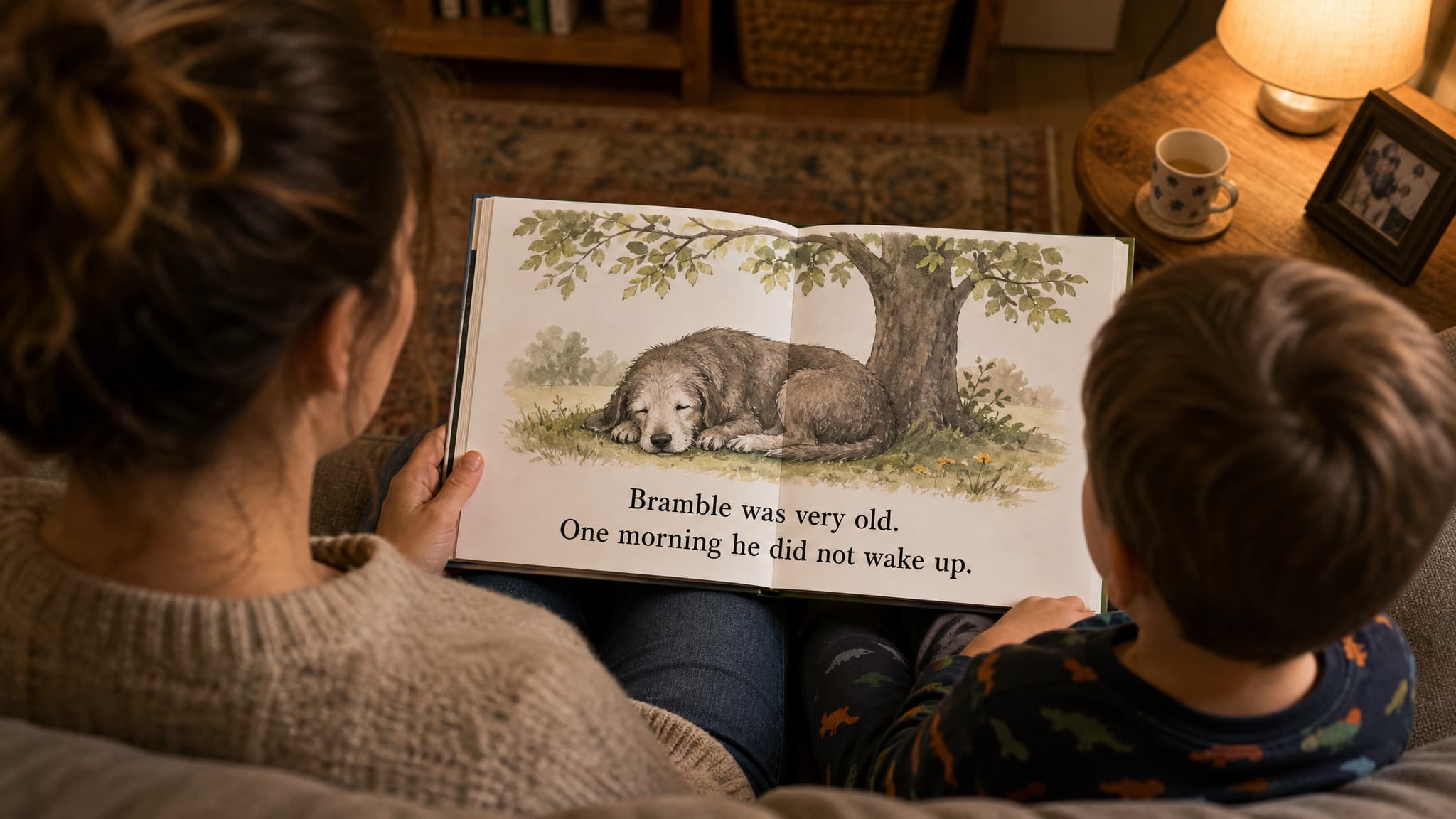
Looking for a book to help children with the death of a dog is a good instinct, and it is usually the right one. A story gives a child a way into a subject they cannot approach head-on, and it gives you something to do together at a moment when you have run out of things to say.
Parents look for this in a dozen slightly different ways — a book to help kids with the death of a dog, books to help kids with the death of a pet, a book to help children with the death of a pet — and every phrasing lands on roughly the same twenty titles, presented in the same undifferentiated pile.
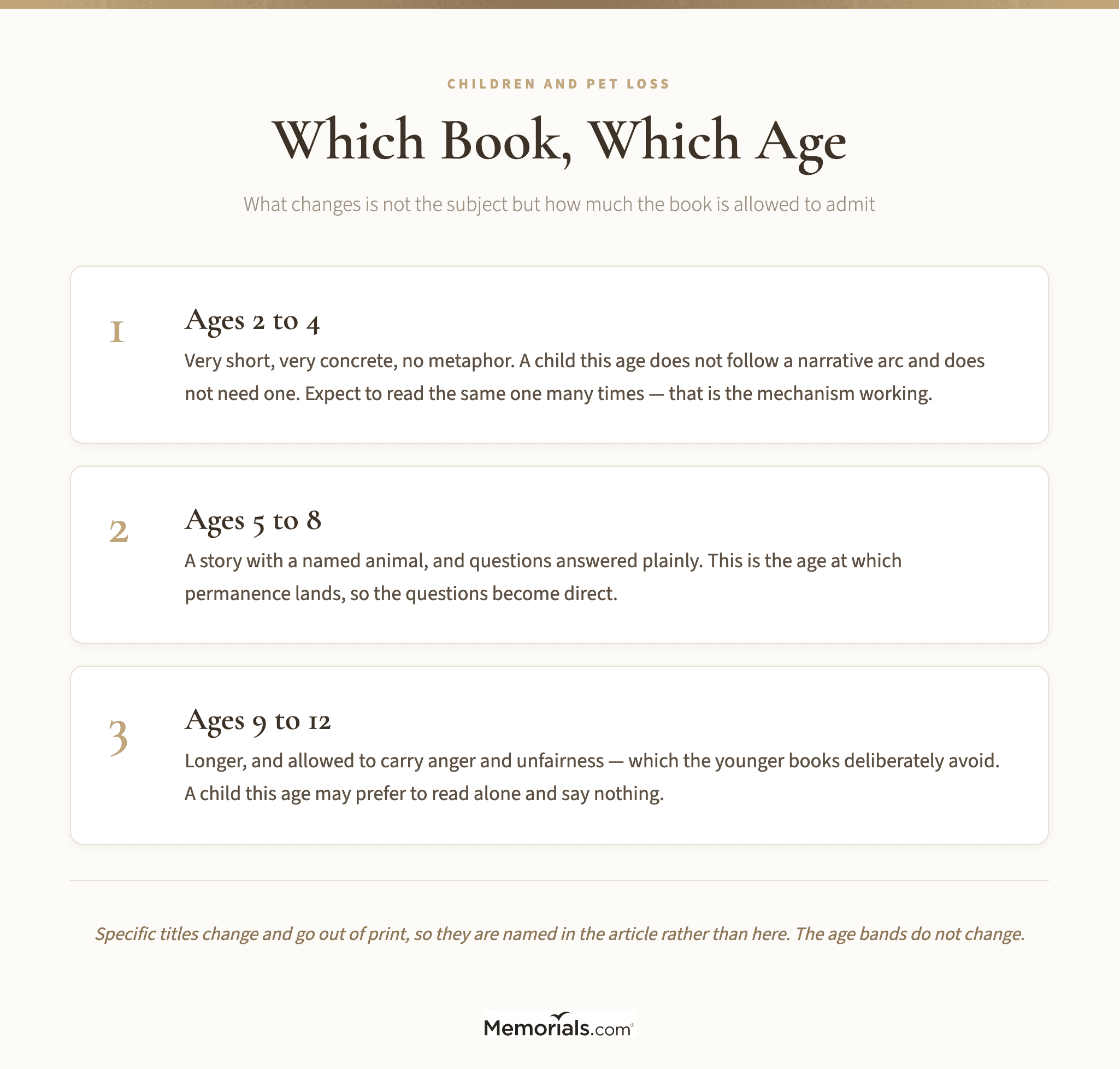
The one thing that matters more than any individual title is the child's age, and almost every list ignores it. A book written for a three-year-old will bore a nine-year-old and a book written for a nine-year-old will frighten a three-year-old. Everything below is sorted that way. All titles are named in text rather than linked, so check your library or your usual bookseller for editions and availability. The covers the rest of what a loss involves.
At this age a child does not follow a narrative arc and does not need one. What they need is short, concrete, and repeated. Books about pet death for toddlers work when they use the plain word — died — and do not reach for metaphor.
Lifetimes: The Beautiful Way to Explain Death to Children by Bryan Mellonie and Robert Ingpen is the standard here and the one most veterinary practices recommend. It does not tell a story at all. It sets out that everything living has a beginning, a middle and an end, using plants and animals rather than people, and it is calm to the point of being almost matter-of-fact. That is exactly right for a very young child, and it works equally well for a pet or a person.
Dog Heaven by Cynthia Rylant is the other standard, and the tone is completely different — warm, exuberant, and unmistakably comforting. There are fields, biscuits, and angels. It is a religious framing in a soft form, so it fits some households and not others. Rylant wrote a companion, Cat Heaven, in the same voice.
At this age, expect to read whichever you choose many times over. That is the mechanism working rather than a sign it is not landing.
The largest group, and where most of the good writing is. Children this age understand that death is permanent, which is the developmental step that makes the subject genuinely difficult, and they ask direct questions.
The Tenth Good Thing About Barney by Judith Viorst, illustrated by Erik Blegvad, is the oldest title still on every list and deserves it. A boy's cat dies and his mother asks him to think of ten good things to say at the funeral. He manages nine. The tenth arrives later, in the garden, and it is about the cat becoming part of the ground and helping things grow — an answer that is neither religious nor bleak. It is a cat book that works perfectly for a dog.
Of all the books to help kids with the death of a dog, I'll Always Love You by Hans Wilhelm is the one most often handed over. A boy grows up alongside his dog Elfie, who ages faster than he does, and every night he tells her he loves her. When she dies, what carries him is that he had said it. The lesson lands without being stated.
The Rough Patch by Brian Lies is a Caldecott Honor book and the best of the recent ones. A fox and his dog do everything together until the dog dies, and the fox lets his garden go to ruin. It takes grief seriously — the anger, the withdrawal, the long middle — before it turns toward anything hopeful. For a child who is not bouncing back, this is the one.
The Invisible Leash by Patrice Karst, illustrated by Joanne Lew-Vriethoff, is a companion to The Invisible String and uses the same device: an unseeable connection that persists after the dog is gone. If your child already knows and likes The Invisible String, this will do more work than a title they have to learn from scratch.
Age is the variable that matters most and the one every list ignores — the same book cannot serve a three-year-old and a nine-year-old.
Books for Ages 9 to 12
Older children need less reassurance and more honesty, and several picture books still work at this age if they are not presented as picture books. Children's books about the death of a dog for this group can carry anger and unfairness, which younger titles deliberately avoid.
The Rough Patch carries up well into this range for exactly that reason. So does The Fall of Freddie the Leaf by Leo Buscaglia, which is a parable about a leaf through the seasons — it reads as slight to an adult and lands surprisingly hard with a thoughtful ten-year-old.
Most of the good children's books about the death of a dog are written for younger readers, so at this age you are often adapting downward rather than choosing up. A child this age may also prefer to read alone and not discuss it, and that is a legitimate way to use a book. Leave it somewhere and say nothing.
Be prepared for a different question, too. Younger children ask where is he now. Older ones ask why did we have to — and if there was a euthanasia decision, they may ask who made it and whether it was necessary. Answer that one straight; see below.
What changes with age is not the subject but how much the book is allowed to admit — anger and unfairness belong in the older titles and nowhere near the youngest.
Books for When the Dog Was Put Down
Almost every list skips this, and it is the hardest version. A child who knows the death was a decision has a different question, and most pet loss books quietly do not address it.
There is essentially one book to help kids with the death of a pet that was put down, and it is Jasper's Day by Marjorie Blain Parker. Jasper is an old golden retriever with cancer, and the family plans a last good day — his favorite things, his favorite places — before the appointment. It shows what planned euthanasia is, why a family might choose it, and what the day can look like. It suits roughly four to eight, and it is worth reading yourself first.
Saying Goodbye to Lulu by Corinne Demas covers the slower version, where an aging dog gradually stops being able to do the things she loved. It is about decline rather than a single decision, which fits some families better.
If you have not made the decision yet, or you are second-guessing it, when to put a dog down covers the quality-of-life questions, and there is no version of this where a book replaces telling your child the truth in your own words.
How to Read It With Them
The book is a door, not the conversation.
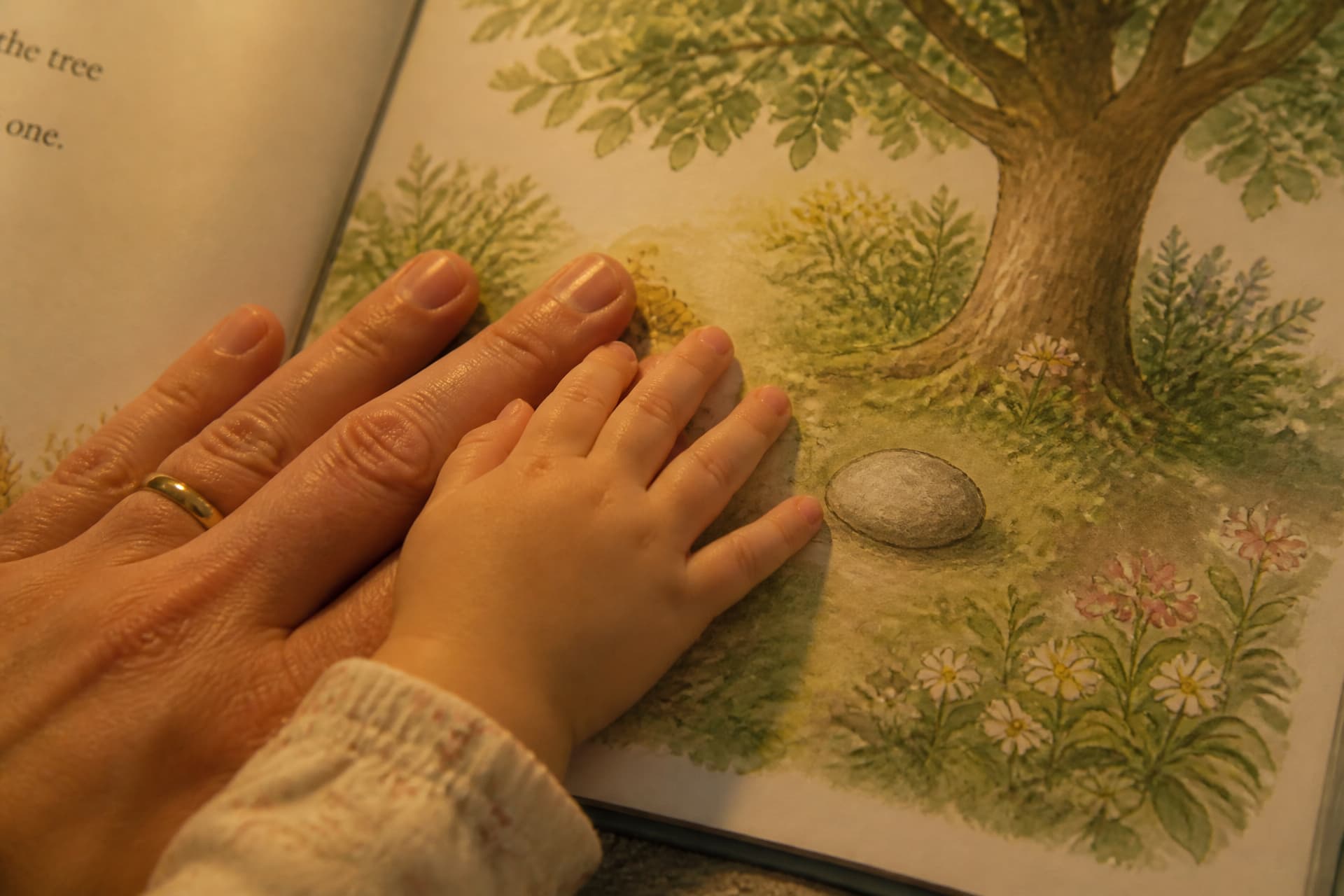
Read it together the first time if the child is under about eight. Sit close, go at their pace, and let them stop it. If they want to talk halfway through, abandon the book — that was the point of it.
Expect the same question more than once, sometimes for weeks, and answer it the same way each time. Repetition is how children this age check that an answer is stable. Changing your wording is what unsettles them.
Do not add a moral at the end. The urge to close with "and that's why we should be grateful for the time we had" is strong and it converts a story into a lesson. Let the book do its own work.
Answer what is asked and stop. A five-year-old asking "where is he" usually wants to know where the body went, not a theology. Say what happened to the body, plainly, and wait for the next question.
The published guide to how to help a child deal with a pet's death covers the conversation itself in far more depth — including what children understand at what age, whether to let them see the body, and the questions that come weeks later.
Read it together the first time. If they want to talk halfway through, abandon the book — that was the point of it.
When a Book Is Not the Right Tool
Worth saying, because a book is the thing adults reach for and it is not always what is needed.
If the child has not asked. Handing over a book about a dead dog to a child who has not raised it can introduce a distress that was not there. Wait.
If they are too young to follow a story at all. Under about two and a half, a book is for you rather than for them. What helps at that age is routine and a plain sentence repeated.
If the child would rather do something. Many children process this through activity rather than narrative — drawing him, choosing where the stone goes, putting something in the ground. Let that be the whole response if it is what they want. If they want to say something at a burial, dog eulogy examples has short pieces, and a child's own three words are better than any of them.
If the adults are the ones struggling. Children take their cue from the household. A parent who is not coping is a bigger factor than any book, and pet grief counseling covers free hotlines and support groups for exactly that.
Something to Keep Afterward
Children do better with a physical thing than adults do. A framed photograph they choose themselves, a paw print, a small marker with his name on it — something they can hold or visit rather than only remember.
Let them pick it if you can. A child who chose the dog memorial marker, or where in the garden it goes, has done something rather than only had something happen to them, and that difference matters more than the object.
If the family is deciding about ashes, pet urns for dogs come in every size, and there is no rush — that decision can wait weeks. And if what your child is reaching for is the idea that he is somewhere and waiting, the pet rainbow bridge has a real history that is worth knowing before you read it aloud.
Many children process this by making something rather than by reading. Let that be the whole response if it is what they want.
Frequently Asked Questions
What is the best book for a child whose dog died?
It depends entirely on age. Lifetimes for the youngest, I'll Always Love You or The Tenth Good Thing About Barney for roughly five to eight, The Rough Patch for a child who is taking it hard, and Jasper's Day if the dog was put down.
Should I tell my child the truth about euthanasia?
Yes, in age-appropriate words. Children very often work it out anyway, and discovering they were misled is worse than the original fact. "He was very sick and not going to get better, and the vet helped him die without hurting" is true and complete.
At what age do children understand pet death?
Broadly, permanence arrives around five to seven, though it varies a lot. Younger children may seem unaffected and then ask about it months later, which is normal rather than delayed.
Should my child see the dog's body?
Many children find it helps and it is generally worth offering rather than insisting. The published guide on helping a child cope covers this properly.
What if my child does not seem upset at all?
Common, and usually not a problem. Young children process in bursts and may go and play ten minutes after being told. Some ask nothing for weeks and then raise it at bedtime months later. Absence of visible distress is not denial and does not need drawing out.
Is it okay to cry in front of my child?
Yes. A parent crying and saying "I'm sad because I loved him" teaches a child that the feeling is allowed and has a name. Hiding it teaches the opposite.
You Do Not Have to Get This Perfect
The best children's books for loss of pet are useful, and they are not the thing that determines how your child comes through this. What determines it is that somebody told them the truth in plain words, let them be sad out loud, and did not rush them.
A book helps you do that. It is a script for a conversation you did not want to have, on a day you are also grieving. Pick one for the right age, read it with them, and answer what they ask.