🏬Supersize Online Funeral Retailer🪦1000's of Headstones⚱️Over 10,000 Cremation Urns⚰️Caskets Overnight Delivery🛒Funeral & Memorial Superstore🚚FREE Shipping on ALL Orders👨👩👧👦Helping Families for over 20 Years💰Lowest Price Guarantee🏬Supersize Online Funeral Retailer🪦1000's of Headstones⚱️Over 10,000 Cremation Urns⚰️Caskets Overnight Delivery🛒Funeral & Memorial Superstore🚚FREE Shipping on ALL Orders👨👩👧👦Helping Families for over 20 Years💰Lowest Price Guarantee
🏬Supersize Online Funeral Retailer🪦1000's of Headstones⚱️Over 10,000 Cremation Urns⚰️Caskets Overnight Delivery🛒Funeral & Memorial Superstore🚚FREE Shipping on ALL Orders👨👩👧👦Helping Families for over 20 Years💰Lowest Price Guarantee🏬Supersize Online Funeral Retailer🪦1000's of Headstones⚱️Over 10,000 Cremation Urns⚰️Caskets Overnight Delivery🛒Funeral & Memorial Superstore🚚FREE Shipping on ALL Orders👨👩👧👦Helping Families for over 20 Years💰Lowest Price Guarantee
Pet Sympathy: What to Say, Write, and Do When a Pet Dies
pet
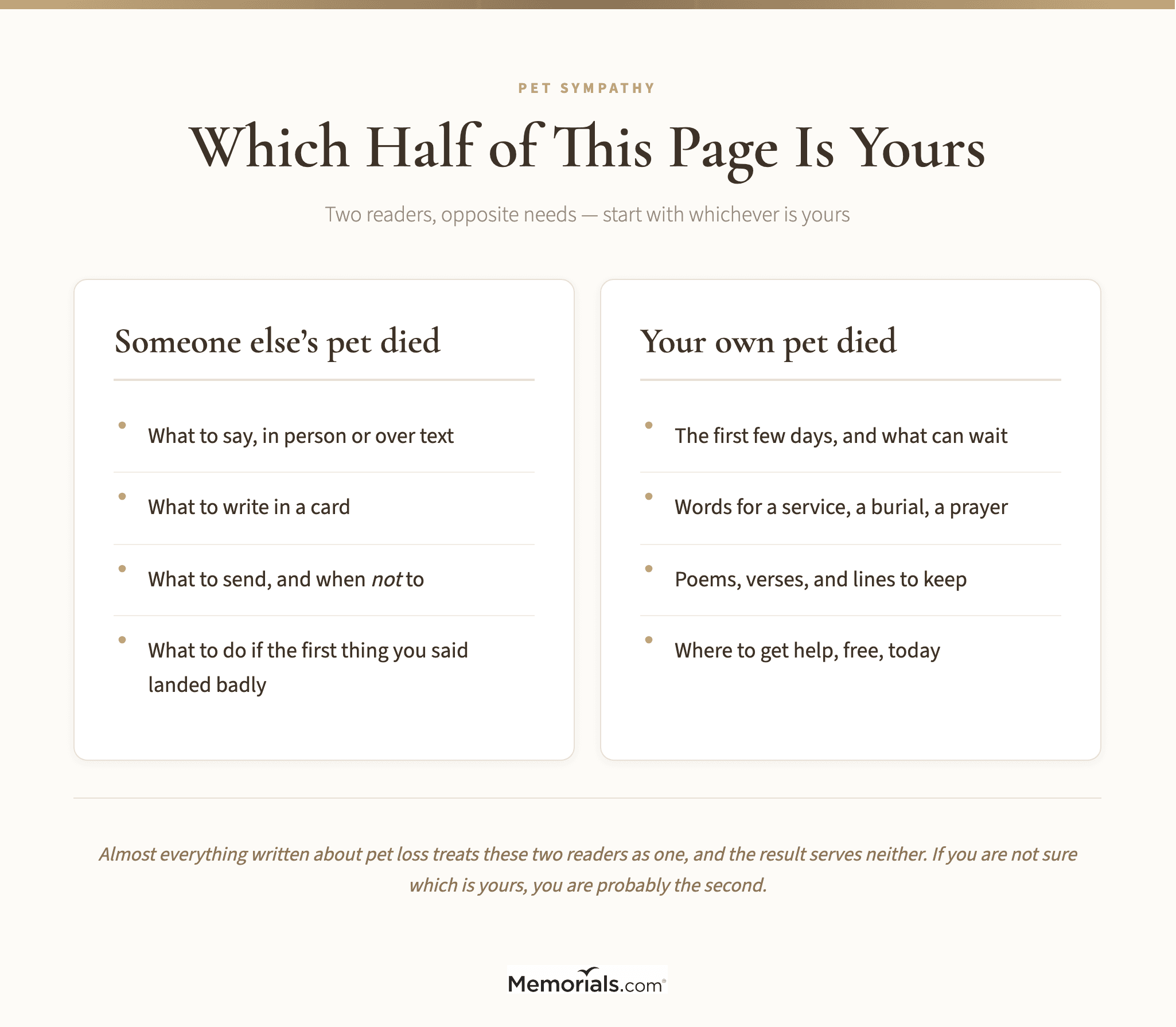
Pet sympathy is really two different problems wearing one name, and you almost certainly have one of them rather than both. Searches for pet loss sympathy come from two people with opposite needs, and this page is built to send each of them somewhere useful in one scroll.
If somebody you know has lost a pet, you need words — for a card, a text, or a conversation you are dreading — and possibly something to send. Start at the first section below.
If your own pet has died, you need something else entirely: words for a service, somewhere to put the feeling, and in the first week probably just the reassurance that this is as bad as it feels. Skip down to the second section.
Almost everything written about this treats those two readers as one, and the result serves neither. This guide keeps them apart, and the rest of this page is organized around that split.
The two readers want opposite things — one needs a sentence in the next ten minutes, the other needs somewhere to put a feeling that is not going anywhere.
The fear that brings most people here is that there is a correct thing to say and they will miss it. There is not. What reliably works is short: name the animal, do not make the loss smaller, and offer one specific thing. Everything else is variation.
Learning how to comfort someone who lost a pet is mostly learning that short and early beats polished and late. What reliably fails is any sentence that resizes the grief — at least it wasn't a person, only a dog, are you getting another one. Those are the ones people remember years later, and every one of them is well meant.
What to say out loud
Face to face, on the phone, or at the vet's office, and there is a version for each. This also covers the harder half nobody writes about: what to do when the first thing you said landed badly, which is where people actually get stuck and then go quiet for two weeks out of embarrassment.
A different job from speaking, because you get to revise it and they get to keep it. The most useful way to sort card messages is not by tone but by who you are — a close friend, a coworker, a neighbor, the relative who never really understood the dog, or a veterinary practice writing to a client. Each of those can honestly say different things.
The timing rule matters more than the budget: nothing permanent in the first days. The family may not have settled on burial or cremation yet, and an engraved keepsake arriving before that decision reads as pressure. Food, flowers and a donation in the animal's name are always safe; keepsakes belong in the second window, once the ashes are home.
When a friend's dog or cat dies, presence beats phrasing — the people they remember are the ones who said something imperfect early rather than something polished never.
Different needs entirely, and mostly not about other people.
There is no correct way to do this and no schedule. Advice on how to grieve the loss of a pet is mostly advice to stop apologizing for it. The first thing worth saying, because almost nobody will say it to you: this is a real bereavement and the size of the animal has nothing to do with the size of the hole. Grief for a pet is distinctively hard not because it is more intense than other grief but because it arrives with no structure — no funeral most people attend, no time off, no cards from anyone outside a small circle, and frequently nobody at work who registers that anything happened at all.
The first few days
There is very little to do and a great deal of time in which to do it. Decisions about burial or cremation usually have to be made faster than you would like; almost everything else can wait, including what to do with the ashes.
Even a small ceremony helps, and it can be four people in a garden for five minutes. If you have to speak, the structure is four sentences: who they were to you, one specific thing only they did, what the house is like now, and thank you.
For something formal to say out loud — at a graveside, or before a euthanasia appointment, which is the moment almost nothing is written for — dog prayer has original blessings written short enough to finish while crying.
If your frame is Christian, bible verses for dog lovers sets out what Scripture does and does not say about animals — including an honest answer to whether it promises them an afterlife.
Poems, and the Rainbow Bridge
If someone has told you your dog crossed the rainbow bridge and you are not sure whether that is a tradition, a scripture or a greeting-card invention: it is a poem, written in 1959 by a nineteen-year-old in Scotland about her own Labrador, and it took sixty years to find out who wrote it. The story is better than most people know — pet rainbow bridge.
For words to engrave or put under a photograph, soulmate dog love quotes has short original lines and a straight answer to whether a dog can really be a soulmate.
When you need to talk to somebody
Free hotlines exist, staffed by people trained specifically in this, and hardly anyone knows about them. You do not have to be in crisis to call — people call because the house is quiet.
Pet grief counseling lists the free numbers, explains what counseling actually involves and costs, and covers how to find a support group.
The Decisions Nobody Warns You About
Between the death and the grief there is a short administrative stretch that nobody prepares people for, and being blindsided by it makes the first days worse than they need to be.
Burial or cremation, and quickly. This is the one genuine time pressure. If the animal died at a veterinary practice, they will ask, sometimes within hours, and the options are usually communal cremation (ashes not returned), private or individual cremation (ashes returned to you), or taking the body home for burial. Prices and terminology vary between practices and the words are not standardized — ask specifically whether "individual" means your animal alone, because at some providers it does not.
Home burial is legal in most places, with conditions. Depth is the usual requirement, and some localities restrict it. Check locally rather than assuming, particularly if you rent or expect to move. People who bury a pet at a house they later leave often describe that as the hardest part of moving.
Ashes take one to three weeks to come back. This is a second small bereavement that arrives without warning, often just as the first shock is wearing off. They will come in a plain sealed container inside a bag or a box — serviceable, not something most people want on a shelf, and nobody tells you that in advance either.
Almost nothing else is urgent. The urn, the marker, the photographs, what to do with the bed and the bowls. Every one of those can wait weeks or months. The common regret is not waiting too long; it is clearing everything out on day three while numb and then wishing you had kept something.
The collar. Mentioned separately because it comes up more than anything else. Take a photograph of it before you decide anything, including the tag with the name on it. People who did not do this consistently wish they had.
When It Was a Decision
A large share of pet deaths are euthanasia, and that produces a specific and heavy version of this that deserves naming rather than folding into general grief.
The questions are always the same three. Did I do it too soon. Did I wait too long and let him suffer because I was not ready. Did I do it partly for my own convenience, or because of the money.
Two things are worth knowing. The first is that almost everyone asks these, including people who made the decision unhurriedly and with good veterinary advice — counselors who work in this field report it as the single most common thing they hear. The second is that the doubt is not evidence. A person who agonizes over whether they acted too soon is demonstrating the opposite of the carelessness they are accusing themselves of.
It is also worth being clear that cost is a legitimate factor and thinking about it does not make you a bad owner. Veterinary care is expensive, most people do not have unlimited funds, and pretending otherwise helps nobody. A decision shaped partly by what was affordable is still a decision made with love.
If you are still in the deciding phase rather than the aftermath, when to put a dog down sets out the quality-of-life questions people actually use, which is more useful than anything a page like this can offer.
Guilt that will not shift is also the version of pet grief that responds best to talking to somebody, because it is a loop rather than a wound.
Take a photograph of the collar today, tag and all. Everything else on this page can wait; that one thing cannot.
Helping a Child Through a Pet's Death
Usually a child's first experience of death, and the advice is consistent and slightly counterintuitive: use the word "died." Not "went to sleep," not "we lost her." Soft words reliably produce a frightened child who will not go to bed or who waits at the window.
Answer what is asked and stop. Expect the same question again in a week and answer it identically. Let them do something to mark it — a drawing, choosing where the stone goes, saying a sentence at a burial.
Almost everything written about pet loss assumes a dog or a cat, and people who lose anything else spend the first week braced for somebody to imply it does not count.
It counts. A guinea pig held on a lap every evening for four years is a large relationship. So is a rabbit, a horse, a bird, a hamster that belonged to a seven-year-old. The grief tracks the relationship rather than the size of the animal, and the practical questions — how to tell a child, what to do about the cage-mate left behind, why a small animal seems to die so suddenly — have real answers.
Loss of guinea pig quotes covers the small-animal case, including why prey animals conceal illness until the last hours, which is the answer to most of the guilt people carry afterward.
Not a timeline — there is no timeline — but a description of what people commonly report, offered because knowing it is ordinary helps.
The first week is loud and short. Practical tasks, messages, the collection of the body or the ashes. Many people describe functioning well and then being surprised by that.
The second and third weeks are usually worse. The messages stop, everyone else moves on, and the ordinary hours arrive — the walk that no longer happens, the evening the animal used to occupy. Most people who describe the "worst" period name this one, not the first days.
Grief attaches to specific hours rather than to whole days. Almost everybody names one time — six in the morning, the moment they come through the door — where it is reliably bad, and finds the rest of the day manageable. Filling that particular slot with something works better than trying to fill the day.
The other animals in the house are adjusting too. A surviving pet may search, call, go off food or become clingy. Watching the food intake is the practical part, and it matters most for small animals, who deteriorate fastest.
It comes back on dates. The anniversary, the birthday, the day you brought them home. That is normal years later and is not a sign of anything being unresolved.
People will say the wrong thing. Often, and usually meaning well. That is worth expecting rather than being wounded by each time.
None of this is a schedule you are behind on. If it is not lifting at all after weeks and you are not eating, sleeping or working, that is a different situation and there is free help for it.
Choosing Something to Keep
No hurry on any of this. Nothing here needs deciding in the first week, and decisions made in the first week are often not the ones people would make in the second month.
When you are ready: pet urns come in every size and material, from keepsake sizes for a small animal upward. A pet memorial for the garden — a stone, a plaque, a marker — gives the spot a purpose, and people consistently report being glad of one a year later. And pet ashes jewelry holds a small portion rather than the whole, for anyone who would rather carry it than place it.
A version of this that gets no coverage at all: being the person in the household who is expected to hold it together.
If you were the one who made the euthanasia appointment, drove there, or carried the body, you may find that everyone treats you as the competent one and directs their own grief at you. Parents get this from children, and one partner usually gets it from the other. It is exhausting and it tends to delay your own grief by weeks — a great many people describe falling apart a month later, once everyone else has recovered and there is finally room.
There is no clever solution. But it helps to know it is a pattern rather than a personal failure, and it helps to say one sentence out loud to somebody: I have not actually dealt with this yet. The free phone lines are useful for exactly this reason — they are a place to be the grieving one rather than the capable one, with somebody who has no stake in you being fine.
For Anyone Reading This at Work
A short practical note, because a lot of people find this page from a desk while trying not to be seen crying.
Most workplaces have no policy for this and most managers will not know what to say. You are not obliged to explain or to justify the scale of it. "I had a death in the family this weekend" is true; a pet is family and you are not required to itemize.
If you can take a day, take it — the practical tasks alone often need one. If you cannot, the thing that helps most is telling one colleague rather than none, so that somebody in the building knows why you are quiet.
And if you are the colleague: say something once, early, keep it short, and absorb something practical if you can. "I heard about your dog, I'm sorry — I moved the Thursday call" is worth more than a paragraph of sympathy.
The second and third weeks are usually worse than the first — the messages stop and the ordinary hours arrive.
Frequently Asked Questions
Is it appropriate to send a sympathy card for a pet?
Yes, and it is far more welcome than most people expect. The common worry is that it will seem excessive; the far more common experience on the receiving end is that hardly anybody sent anything.
What do you say to someone whose pet died?
Use the animal's name, do not qualify the loss, and offer one specific thing you will actually do. "I'm so sorry about Rosie" is a complete response.
Is grief for a pet the same as grief for a person?
Different, and not smaller. For many people it is harder to carry, because it comes with none of the ritual and none of the social permission that a human death does.
How long does pet grief last?
There is no standard. Months is ordinary after a long relationship, and it typically comes in waves rather than fading steadily.
What can I do for someone who just lost a pet?
Say the animal's name, send something that requires no decision from them in the first days, and check in again in a month — when everyone else has stopped, and the person is most likely to feel forgotten.
Should I get another pet?
Eventually, if you want one, and on nobody's schedule but your own. It is not a betrayal and it is not a replacement — it is a separate relationship. The only firm case for moving sooner is a social animal left alone, where the survivor's welfare is a real consideration rather than a preference.
Do I need to decide about the ashes straight away?
No. The container can be chosen weeks later, and scattering can happen whenever you are ready. Very little about this is urgent.
However You Came to This Page
If you are here because somebody else's animal died, the useful summary is: say the name, do not shrink the loss, offer one concrete thing, and come back in a month.
If you are here because your own has, the useful summary is different. Grieving for an animal is not disproportionate, the absence of any ritual around it is the hardest structural part rather than a sign that you are overreacting, and there are free phone lines staffed by people who will not need it explained. Comforting words for loss of pet are easier to find than permission to need them, and the permission is the part worth taking away. Sympathy for pet loss is not a lesser category of sympathy; it is the same thing, offered less often.
Whichever half of this page was yours, take your time with the decisions. Almost none of them are urgent, and the animal is not going to be less remembered for a slow decision about a stone.
If you are not sure where to start, start with the collar. Take a photograph of it today, tag and all. Everything else on this page can wait for as long as you need it to, and that one thing cannot be recovered later.