🏬Supersize Online Funeral Retailer🪦1000's of Headstones⚱️Over 10,000 Cremation Urns⚰️Caskets Overnight Delivery🛒Funeral & Memorial Superstore🚚FREE Shipping on ALL Orders👨👩👧👦Helping Families for over 20 Years💰Lowest Price Guarantee🏬Supersize Online Funeral Retailer🪦1000's of Headstones⚱️Over 10,000 Cremation Urns⚰️Caskets Overnight Delivery🛒Funeral & Memorial Superstore🚚FREE Shipping on ALL Orders👨👩👧👦Helping Families for over 20 Years💰Lowest Price Guarantee
🏬Supersize Online Funeral Retailer🪦1000's of Headstones⚱️Over 10,000 Cremation Urns⚰️Caskets Overnight Delivery🛒Funeral & Memorial Superstore🚚FREE Shipping on ALL Orders👨👩👧👦Helping Families for over 20 Years💰Lowest Price Guarantee🏬Supersize Online Funeral Retailer🪦1000's of Headstones⚱️Over 10,000 Cremation Urns⚰️Caskets Overnight Delivery🛒Funeral & Memorial Superstore🚚FREE Shipping on ALL Orders👨👩👧👦Helping Families for over 20 Years💰Lowest Price Guarantee
Someone at the veterinary clinic said it, or it was printed inside a sympathy card, or it appeared under a photograph on a friend's feed: your dog has crossed the pet rainbow bridge. If you had not met the phrase before this week, it can be hard to tell whether it is a real tradition, a piece of scripture you have somehow missed, or something a greeting card company invented.
It is none of those. It is a poem, written by one grieving person about one specific dog, and for sixty years nobody knew who. The pet sympathy guide covers the wider question of what to say and send when a pet dies; this page is about where this particular idea came from, why it works on people, and what to do with it.
What the Rainbow Bridge Describes
The picture is simple, which is most of its power.
Just short of heaven there is a meadow — grass, hills, sun, enough room to run. Animals who died arrive there and are restored: the old are young again, the sick are well, the injured are whole. There is food and water and warmth, and there is company. They are not alone and they are not in pain.
But something is missing for each of them, and they wait. When the person they belonged to finally dies and comes along that same road, the animal sees them, and there is a reunion — and the two of them cross the bridge together into whatever is on the other side.
That is the whole thing — a meadow, a wait, and a reunion. The rainbow bridge pets are described as waiting in is deliberately ordinary: grass, sun, water, other animals. It takes about ninety seconds to read aloud. The text itself is not reproduced here, and the reason is at the end of the next section.
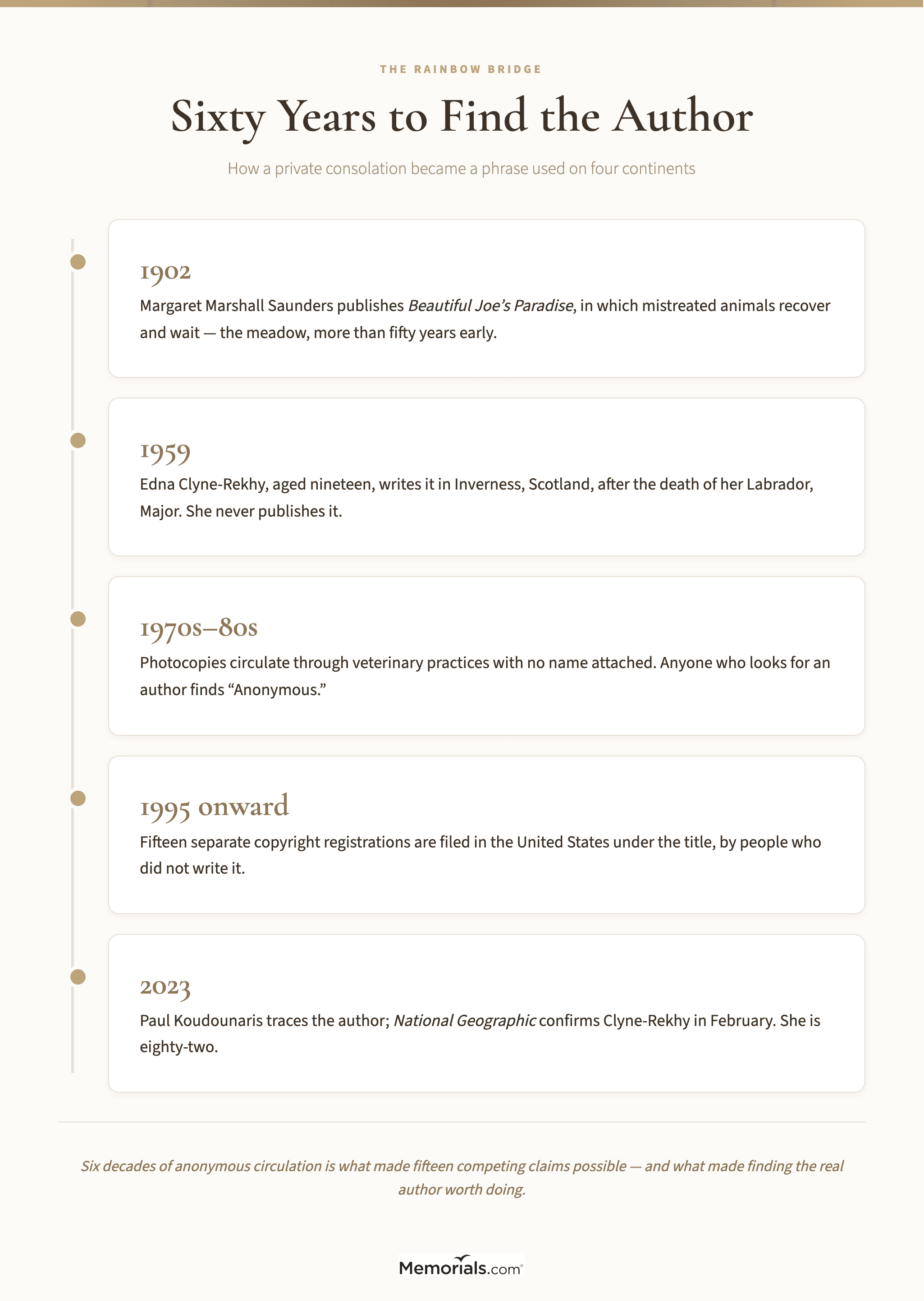
In 1959, a nineteen-year-old in Inverness, Scotland, lost her Labrador. His name was Major. Grieving, she sat down and wrote something about where he had gone.
Her name is Edna Clyne-Rekhy. She did not publish it. She showed it to people, and copies were made, and then copies of copies — typed, photocopied, pinned to noticeboards in veterinary practices, handed across counters to people who had just lost an animal. By the 1980s the piece was circulating across the English-speaking world with no name on it at all, and it stayed that way for decades. Anyone who looked for an author found "Anonymous."
That was still the accepted position until very recently. The art historian and researcher Paul Koudounaris decided to actually find out. He assembled a list of around twenty-five names with any plausible connection to the text and worked through them one at a time until one was left. In February 2023, National Geographic published the result and confirmed her authorship. Clyne-Rekhy was eighty-two, still living, and had no idea that a thing she wrote at nineteen for her own dog had spent six decades comforting strangers on the other side of the world.
Koudounaris also turned up something that says a great deal about how the piece traveled: since 1995 there have been fifteen separate copyright registrations filed in the United States under the title. Fifteen different people, at various points, registering a claim on a poem none of them wrote.
That is why the words are not printed on this page. It is a real poem by a real and recent author, its ownership has been actively contested, and reproducing it commercially is not ours to do. This is a case where the story is better than the text anyway — and almost every other page you will find on this subject reprints the poem and tells you none of it.
Six decades of anonymous circulation is what made fifteen competing copyright claims possible — and what made the real author's identity worth finding.
The meadow predates the poem by more than fifty years — Saunders put mistreated animals in one in 1902.
Why It Comforts People
Plenty of consoling ideas exist and most of them do not travel. This one has crossed continents on photocopies. It is worth asking what it is actually doing.
It removes pain first. The single most common thing a grieving owner is carrying is not "where is she now" but "was she suffering, and did I let it go on too long." The restoration to health is the first thing the picture does, and it answers the worst question before it is asked.
It removes loneliness. Nearly every account of pet grief includes some version of she is on her own out there. The meadow is populated. The animal has company.
It makes the reunion a promise rather than a hope. This is the part that does the heavy lifting. The animal is not merely somewhere pleasant — it is waiting, specifically, for one person. That reframes the owner from someone who has been left behind into someone who is expected.
It requires no theology. You do not have to believe anything in particular to find it bearable. It sits comfortably alongside almost any faith and alongside none, which is why a veterinary practice can hand it to anyone.
There is one more thing it does that is easy to miss. It gives the loss a shape — a place, a wait, an ending — at the exact moment when grief for an animal has no shape at all. There is no funeral most people attend, often no body to sit with, frequently no one at work who registers that anything happened. A human death arrives with a structure around it whether you want one or not. A pet's death arrives with nothing, and people describe that absence of ritual as one of the hardest parts. A hundred and fifty words about a meadow are, for a lot of people, the only ceremony there is.
That also explains why it irritates a minority of people, and it is worth saying so plainly rather than pretending the reaction is universal. If you find it saccharine, or if being handed it felt like being handed a script, that is a legitimate response and not a failure of feeling on your part. Some people want the shape and some want the plain fact.
The comfort is aimed precisely at the two things owners actually say — that the animal was in pain, and that it is somewhere alone.
Where the Idea Came From Before 1959
The image did not arrive from nowhere, and two older sources are usually named.
The first is Norse: Bifröst, the burning rainbow bridge connecting Asgard to Midgard — a bridge between the world of gods and the world of people. The visual borrowing is obvious, though there is nothing in the Norse material about animals waiting.
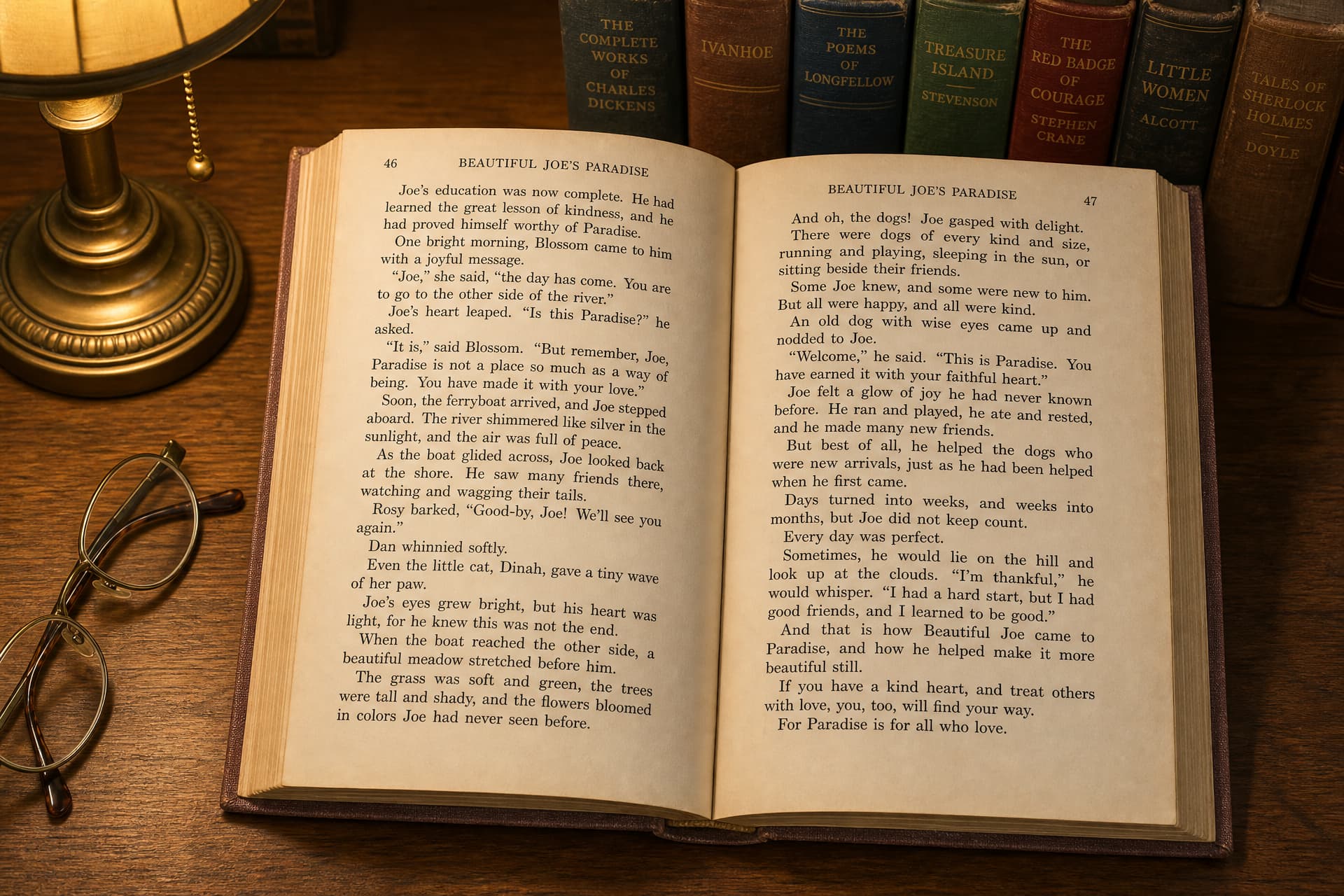
The second is closer and more interesting. In 1902, Margaret Marshall Saunders published Beautiful Joe's Paradise, a sequel to her novel about a rescued dog. It contains a paradise where mistreated animals recover and wait — the meadow, essentially, more than fifty years before Inverness.
Our published guide to where dogs go when they die covers those antecedents and the wider belief question in more depth than there is room for here.
A note on that page and its sibling. Both were written before February 2023 and both describe the poem's origins as they were then understood — one dates it to the 1980s and 1990s, the other calls the author unknown. Both were reasonable at the time and both are now out of date. They are being corrected.
What People Do With It
Knowing where it came from does not change what it is for, and there are three common uses.
Saying it. "He crossed the rainbow bridge" has become ordinary shorthand, and it is the gentlest available way to tell someone an animal has died. It is worth a small caution when writing to someone else: use the phrase if you know they already use it, and otherwise say it plainly. Borrowed imagery in a sympathy card can read as a stock phrase, which is the one thing a short note cannot afford. Short message for loss of pet has wording that works either way.
Reading it at a service. Reading a poem aloud at a private burial in your own garden is not the situation copyright law is aimed at, and people do it constantly. If you would rather have something that is unambiguously yours, dog eulogy examples has full examples to adapt, and dog prayer has original words written for a graveside.
Engraving a line from it. Extremely common, and the place to be careful. A short line on a marker or a keepsake is one thing; understand that you are engraving someone's copyrighted writing, and that the version circulating online may not match what she actually wrote. Writing your own line about your own animal is both safer and, honestly, better — soulmate dog love quotes covers how to do that when the words will not come.
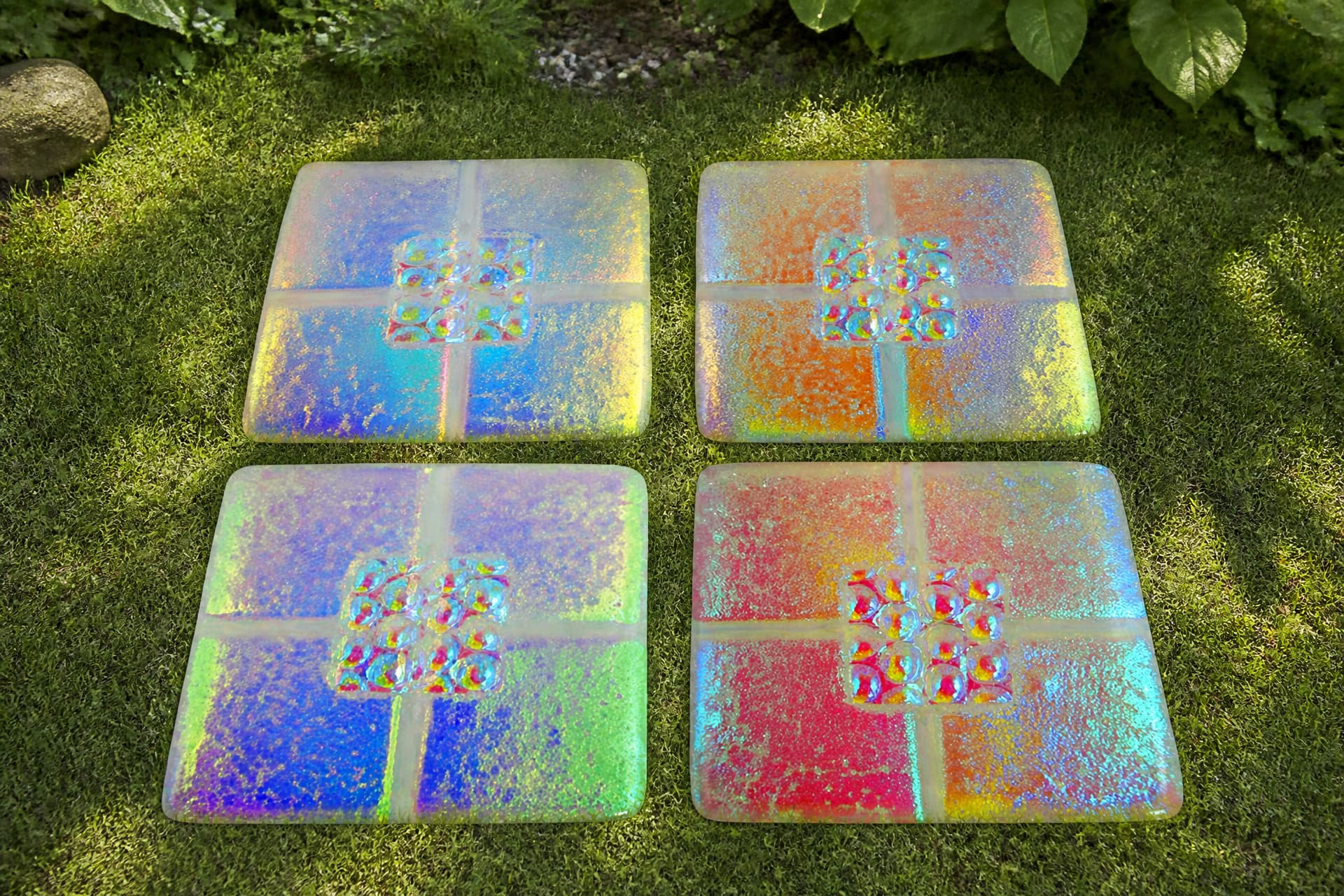
For a dog specifically, the rainbow bridge imagery turns up on everything from garden stones to collar tags. If you are choosing something to keep, a pet urn is the usual starting point, and a pet ashes keepsake holds a small portion rather than the whole. Neither decision needs making this week.
People ask, and it deserves a straight answer rather than a deflection.
It is a poem. It is not scripture, it is not a tradition with any institutional backing, and no religion teaches it. Anyone telling you it is ancient is mistaken — it is younger than the moon landing.
Whether something like it is true is not a question this page can settle, and anyone who tells you they can is selling something. What can be said is narrower and, for a lot of people, enough: a nineteen-year-old in Scotland lost her dog in 1959 and could not accept that Major was simply gone, so she wrote down where she thought he was. Millions of people have since found that they thought the same thing and had not had words for it.
The rainbow bridge story is really about that — not about the metaphysics of a meadow, but about the fact that this particular grief is so widely shared that one teenager's private consolation fit almost everybody.
Frequently Asked Questions
Who wrote the Rainbow Bridge poem?
Edna Clyne-Rekhy, in 1959, aged nineteen, in Inverness, Scotland, about her Labrador Major. She was identified by researcher Paul Koudounaris and confirmed by National Geographic in February 2023 after sixty years of anonymous circulation.
Is the Rainbow Bridge in the Bible?
No. It has no scriptural basis and is not part of any religious tradition. If you are looking for scripture that speaks to losing an animal, bible verses for dog lovers covers what the text does and does not say.
When was the Rainbow Bridge poem written?
It was written in 1959, and circulated anonymously from roughly the 1970s onward, which is why many sources still date it to the 1980s or 1990s — that is when it became widespread, not when it was written.
Can I read the Rainbow Bridge poem at my pet's service?
Reading it aloud at a private family burial is what people do, and it is not the situation copyright is aimed at. Publishing it, printing it in a program you distribute, or putting it on a product is different. We do not reproduce the text on this site for that reason.
Do pets wait for us?
That is a question about belief rather than fact, and different people answer it differently and sincerely. What is true is that a great many people find the idea bearable, and that finding it bearable is not naive.
Why do so many websites say the author is unknown?
Because it was unknown until February 2023, and most pages predate that or were copied from pages that do. It is one of those facts that changed and has not finished propagating.
A Poem Written for One Dog
The thing most worth holding onto is the smallest detail in the whole story. Before it was a phrase used by veterinary practices on four continents, before fifteen people tried to register it, before it was printed on a million sympathy cards, it was a teenager in Inverness who had lost her dog and sat down to write something about him.
She was not trying to comfort anyone else. She was writing about Major.
If you have just lost an animal and someone has offered you the rainbow bridge, that is what you have been handed: not a doctrine, but somebody else's private consolation that turned out to fit. You are welcome to take it, adapt it, or set it aside and write your own. For what comes next — the practical parts, and the days after this one — grieving the loss of a pet is the place to start.
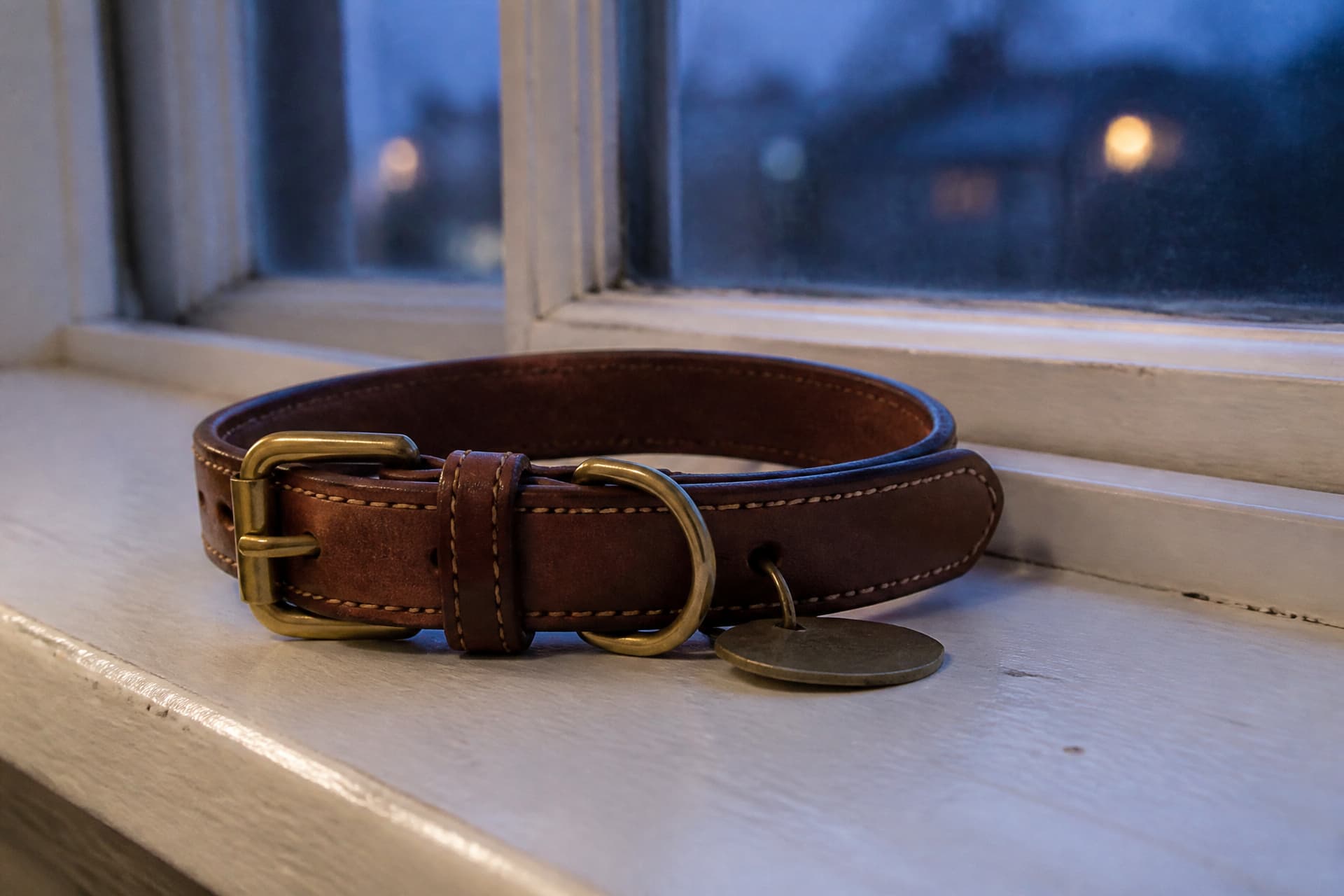
The collar is the object people most often wish they had photographed before it was put away.