🏬Supersize Online Funeral Retailer🪦1000's of Headstones⚱️Over 10,000 Cremation Urns⚰️Caskets Overnight Delivery🛒Funeral & Memorial Superstore🚚FREE Shipping on ALL Orders👨👩👧👦Helping Families for over 20 Years💰Lowest Price Guarantee🏬Supersize Online Funeral Retailer🪦1000's of Headstones⚱️Over 10,000 Cremation Urns⚰️Caskets Overnight Delivery🛒Funeral & Memorial Superstore🚚FREE Shipping on ALL Orders👨👩👧👦Helping Families for over 20 Years💰Lowest Price Guarantee
🏬Supersize Online Funeral Retailer🪦1000's of Headstones⚱️Over 10,000 Cremation Urns⚰️Caskets Overnight Delivery🛒Funeral & Memorial Superstore🚚FREE Shipping on ALL Orders👨👩👧👦Helping Families for over 20 Years💰Lowest Price Guarantee🏬Supersize Online Funeral Retailer🪦1000's of Headstones⚱️Over 10,000 Cremation Urns⚰️Caskets Overnight Delivery🛒Funeral & Memorial Superstore🚚FREE Shipping on ALL Orders👨👩👧👦Helping Families for over 20 Years💰Lowest Price Guarantee
You have something arranged — a burial in the garden on Saturday, a few people coming, a moment at the crematorium — and you have to speak. Most pages that promise dog eulogy examples give you a framework instead and leave you to fill it in at eleven at night. So here are two complete ones first, written to be adapted, and the method afterward for anyone who would rather write their own.
Change the names, cut what does not apply, and do not worry about making it yours from scratch. Adapting something is what almost everyone does, and nobody listening will know or care. If you also need words for a burial itself, dog prayer has short original blessings, and the pet sympathy guide covers the rest.
About a minute to read aloud. This is the length most people actually want.
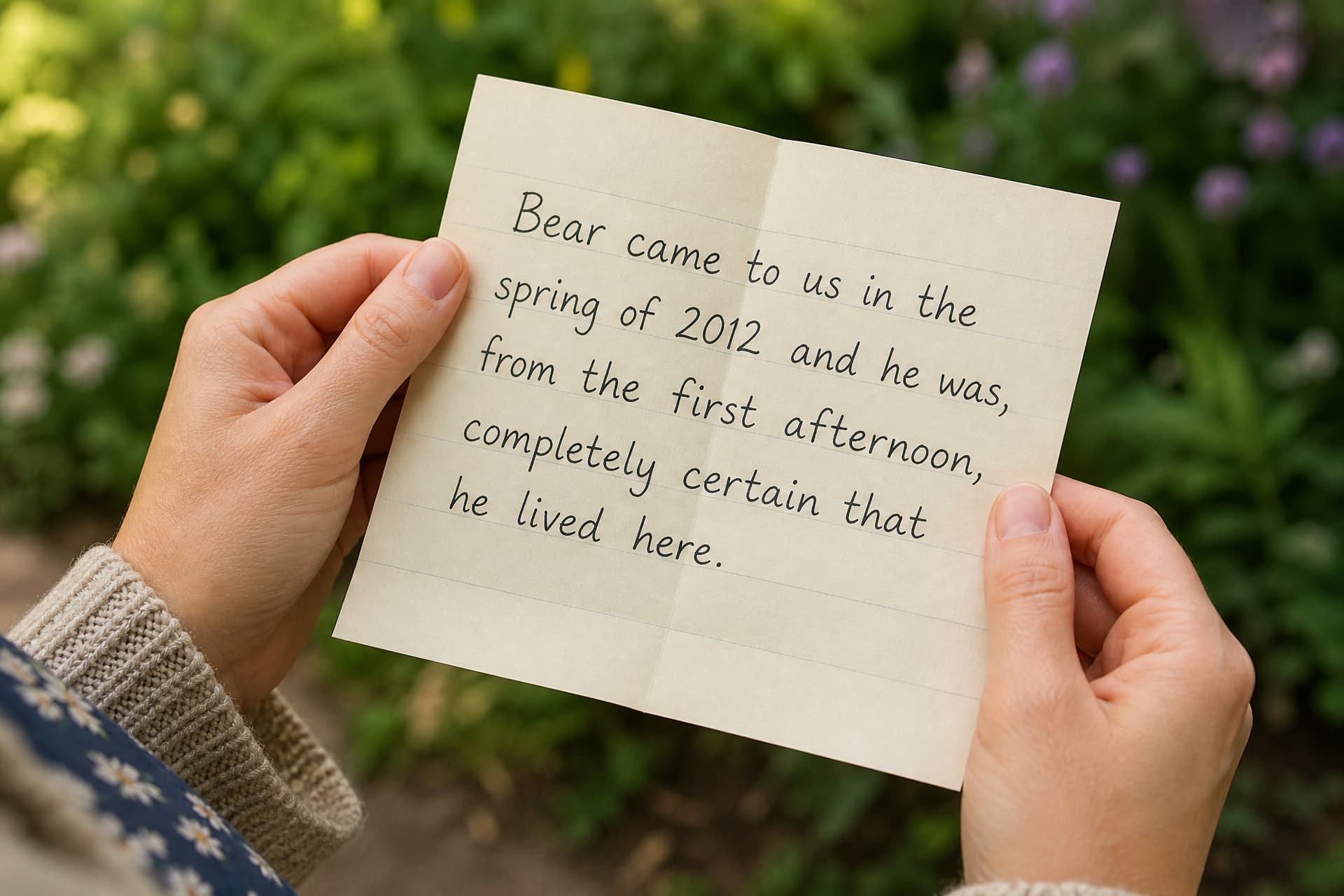
Bear came to us in the spring of 2012 and he was, from the first afternoon, completely certain that he lived here.
He was not a well-behaved dog. He stole food off the counter for thirteen years and never once looked sorry about it. He barked at the recycling truck as though it were a personal matter. He took up two thirds of a three-seat sofa and he did it with a clear conscience.
What he was, was present. He was at the door every time anyone came home. He sat outside the bathroom in case something happened. When anyone in this house was ill, or crying, or just quiet, he moved and put himself against them, and stayed there.
He got old the way dogs do, quickly at the end. We had a good last week with him. He had chicken and a lot of company and he went in his own house with his own people, which is the most any of us can hope for.
Thank you for coming out to say goodbye to him. He would have been delighted at the crowd and he would have jumped on all of you.
If there are more people, or the dog had a bigger place in the family, this runs to about three minutes.
We are here for Maggie, who was with us for eleven years, and who I think most of you knew.
She was a rescue and she was five when we got her, so we never knew the first part. What we knew was a dog who flinched at raised voices for the first six months and then, somewhere in the second year, stopped — and turned into the most confident animal I have ever met. I have always been proud of that. Not of us. Of her.
She had a routine and she enforced it. Out at seven whatever the weather. A biscuit at eleven, which she asked for by standing in the kitchen and staring. The good spot on the rug at four, when the sun came across it. If we were late for any of these, we heard about it.
She was extraordinary with the children. They climbed on her, dressed her up, used her as a pillow, and she looked at us over their heads with an expression of enormous patience. She never once snapped. Not once, in eleven years, including the times she would have been entitled to.
The last year was harder. Her back legs went first and then her hearing, and she got confused in the evenings. We got very good at carrying her up the stairs. She did not seem unhappy — she seemed like an old dog, which is what she was, and we had the vet out to the house at the end so she did not have to go anywhere she did not like.
What I keep thinking about is that she spent five years somewhere we know nothing about, and eleven years here, and that she was happy for eleven of the sixteen. That is the thing I am proudest of in my whole life.
The house is far too quiet. We will get used to it and I do not want to yet.
Thank you, Maggie. Good girl.
Almost everyone writes it out and reads it — holding a page is easier than remembering, and stopping to find your place is normal.
How to Write One About Your Dog
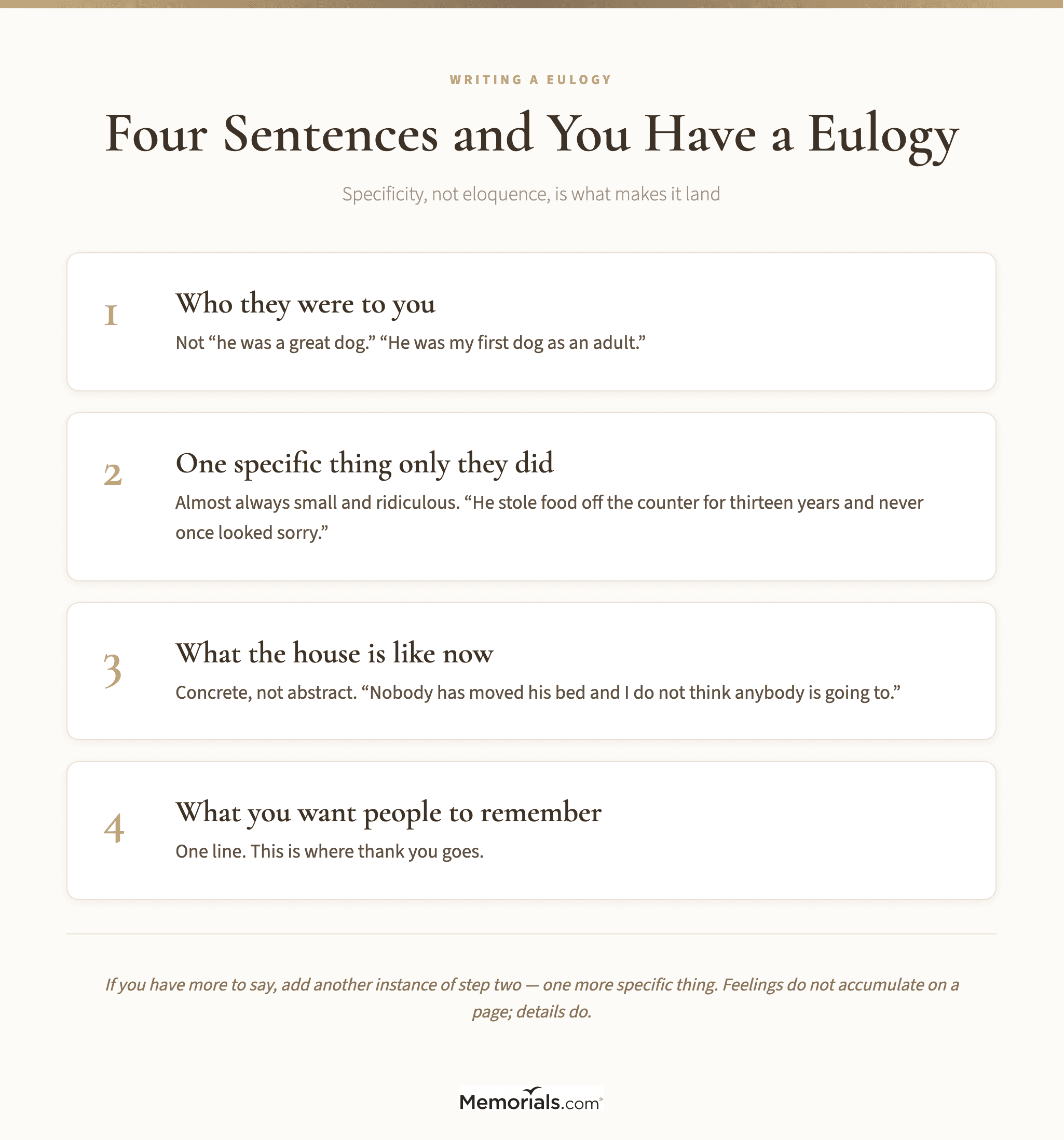
Four sentences will do it, and specificity is the whole technique.
One: who they were to you. Not "he was a great dog" — everyone says that, and it tells the room nothing. "He was my first dog as an adult." "She was the reason I left the house that year."
Two: one specific thing only they did. This is the sentence people remember, and it is almost always small and ridiculous. The shoe he brought every visitor. The way she screamed at the vacuum. The particular chair. Resist the urge to make it dignified.
Three: what the house is like now. Concrete, not abstract. Not "we miss him" but "nobody has moved his bed and I do not think anybody is going to."
Four: what you want people to remember. One line. This is where "thank you" goes.
That is a complete pet eulogy. If you have more, add another instance of sentence two — one more specific thing — rather than more feeling. Feelings do not accumulate on a page; details do.
Specificity, not eloquence, is what makes a eulogy land — the second step is the one people remember and the one most drafts leave out.
Thirty Seconds at the Graveside
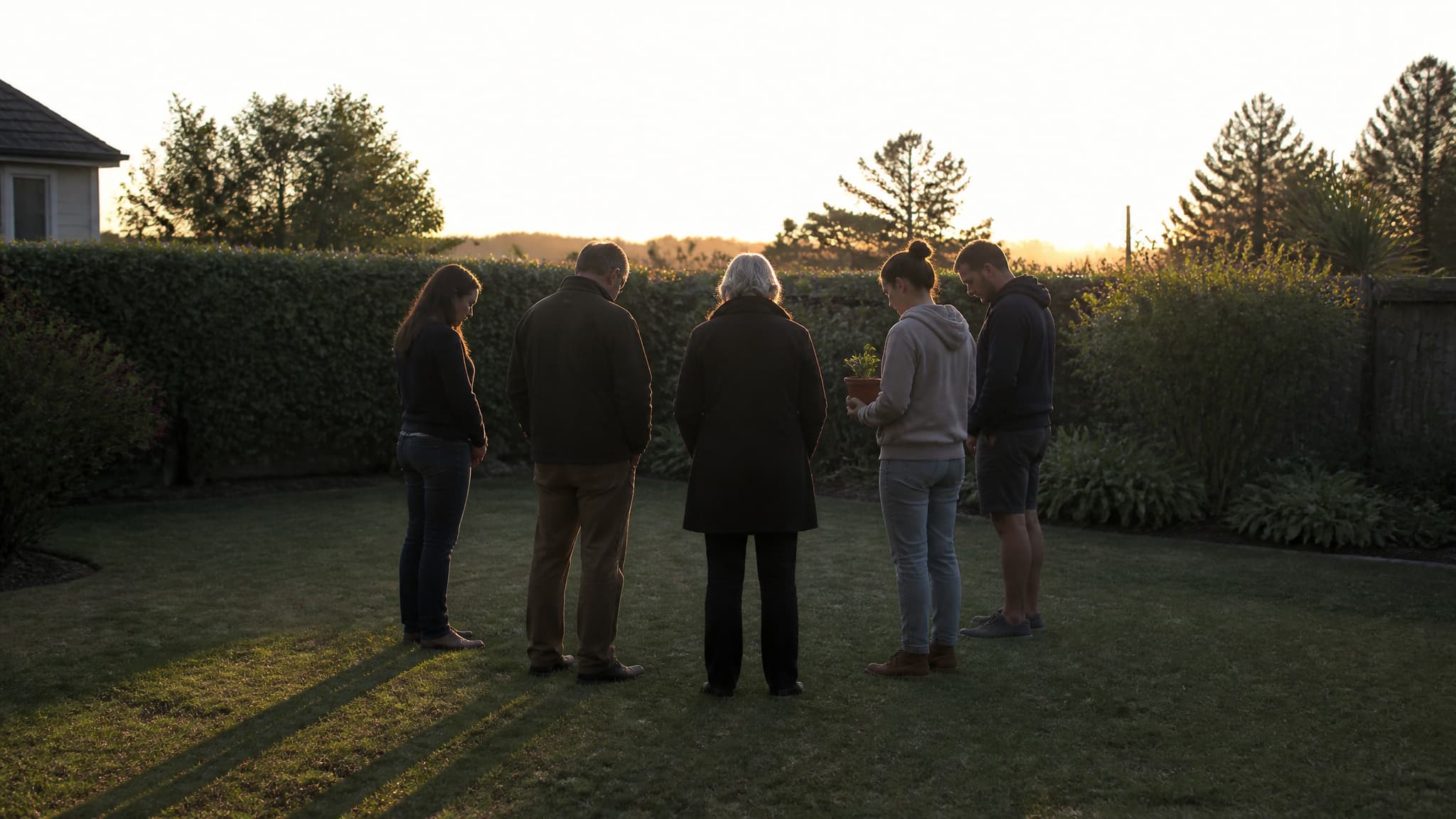
Most eulogies for pets are not delivered to a room. They are two or three people standing in a garden with a hole dug, and somebody says something because the silence needs ending.
Thirty seconds is a complete eulogy in that situation:
This is Bear. He was ours for thirteen years and he was very good company. He liked this garden and he can stay in it. Thank you, mate.
That is genuinely enough. There is no minimum length and no audience keeping score. If you can only manage the name and "thank you," say the name and thank you.
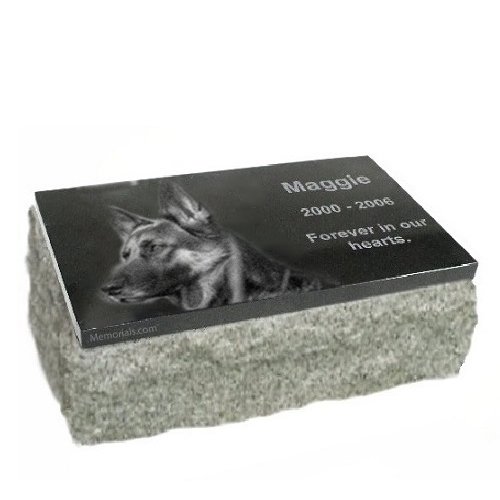
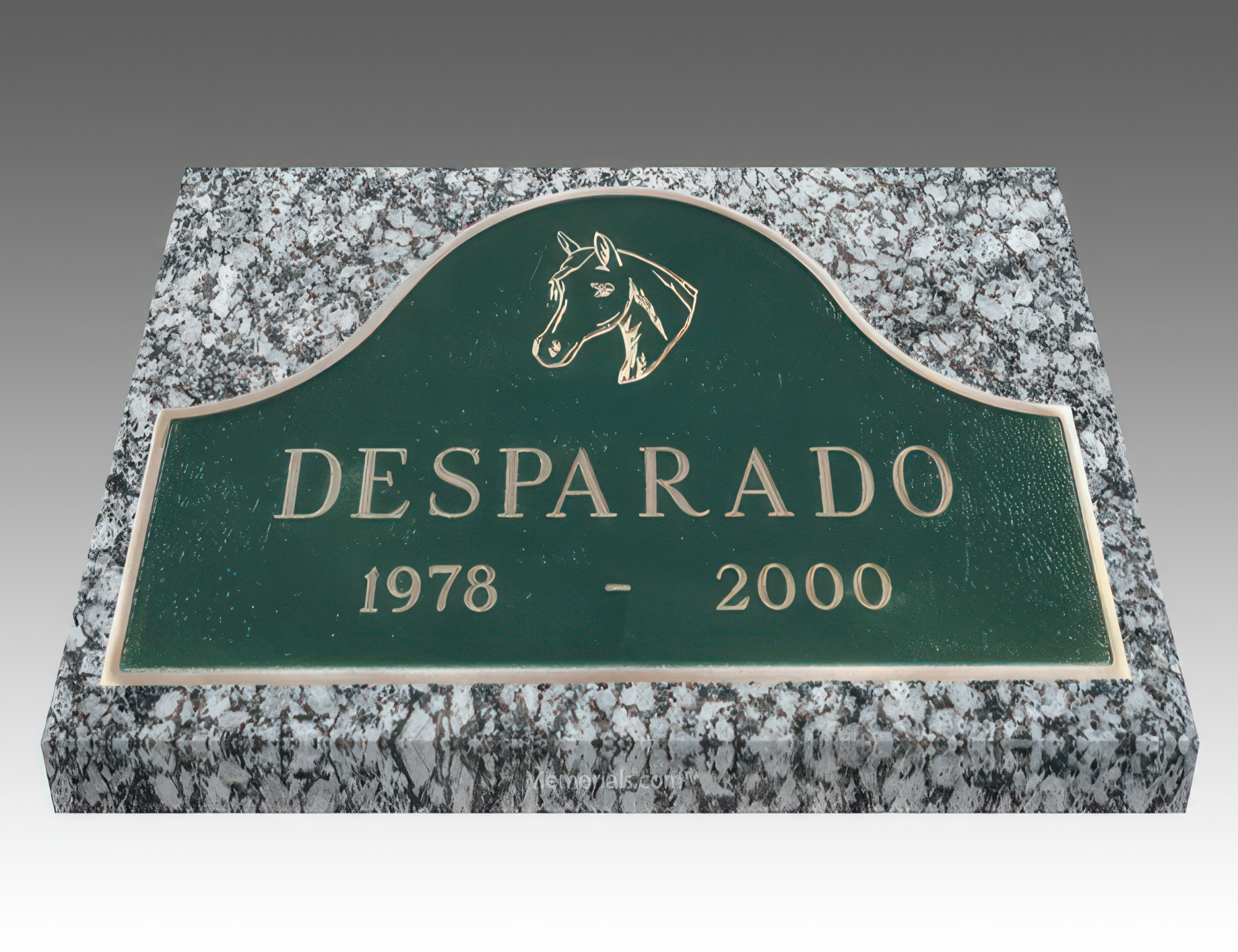
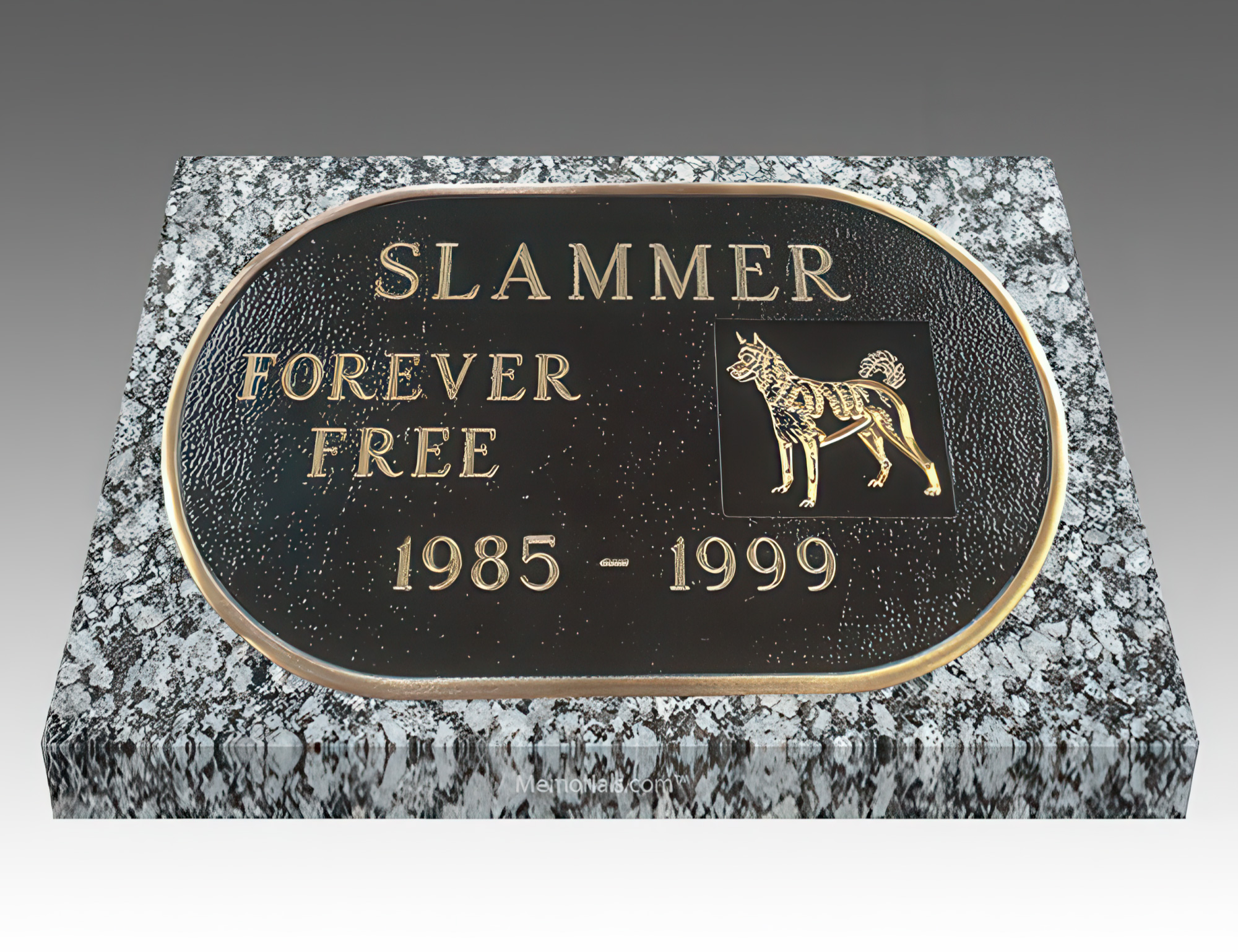
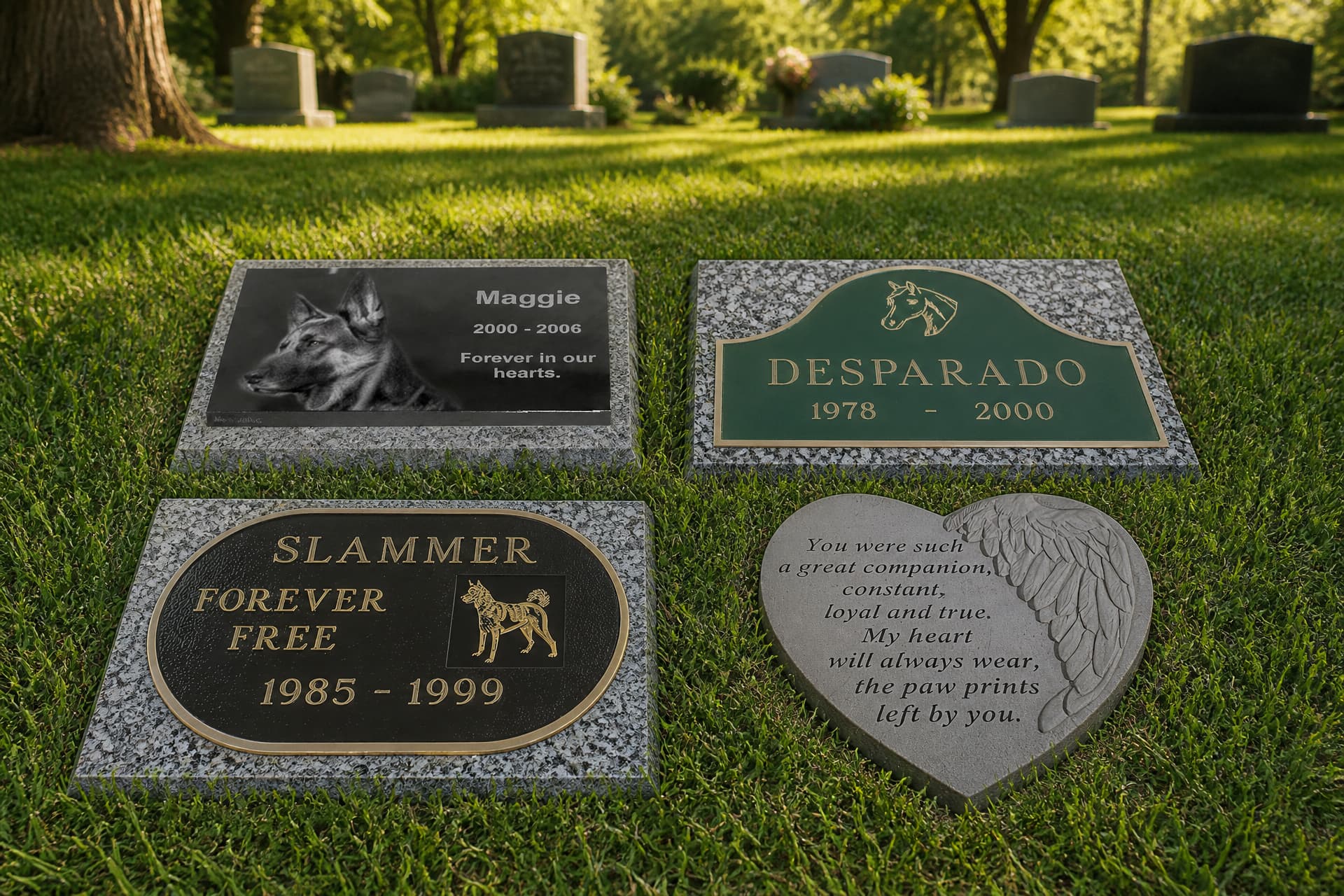
Whatever is said, mark the spot afterward — a stone, a plant, a marker with his name on it. People consistently report being glad of that later, and it is easier to arrange in the first week than to come back to in a year.
When You Were Not Given a Service
Not every dog gets one, and the people who find that hardest are usually the ones who did not get to choose. The dog died at the clinic and the practice handled everything. It happened while you were away. Somebody else made the arrangements and you were told afterward.
You can hold something anyway, at any distance from the event. Weeks later is fine. A month later is fine. Nothing about a private ceremony depends on the body being present or on the timing being close — people scatter ashes years afterward, and it works.
The shortest version is to stand somewhere he liked, say his name out loud, say one true thing, and leave something there. That is a complete service. If it helps to have others present, ask two people; if it does not, do it alone, which is what most people actually do.
The reason it is worth doing at all, even late and even alone, is that pet death comes with almost no structure around it — no time off, no cards from most people, nobody at work who registers that anything happened. Making a small formal moment yourself is the only ritual on offer, and people who do it consistently report being glad they did.
Reading It Without Falling Apart
Nobody warns you about this part, and it is the part people are actually frightened of.
Write it out and read it. Do not attempt to speak from memory. Print it large, hold the page, and do not be embarrassed about holding it.
Short sentences. They give you places to breathe. Long ones are where people run out of air and have to stop mid-clause, which is much harder to recover from.
Practice it out loud once, the night before. Not to polish it — to find out which line is the one that gets you. There is always one, it is usually not the one you expect, and knowing where it is means you can brace before it instead of being ambushed.
Have somebody ready. Hand a copy to another person in advance and agree that if you stop, they pick it up. Just knowing that is arranged makes it far less likely you will need it.
Stopping is fine. If you cannot finish, say "I can't" and sit down. Everyone present will understand entirely, and nobody has ever thought less of a person for crying at a funeral for their dog.
Print it large and hold the page. Reading is easier under pressure than remembering, and nobody minds.
If Children Are There
Let them speak if they want to, and do not coach them. A child saying "bye Bear, you were my friend" is doing exactly what the adults are doing, and doing it better.
Give them a job if they would rather not talk — carrying something, putting a flower in, choosing where the stone goes. Participation matters more than words, and it is what they will remember about the day.
A eulogy usually sits alongside something else — a prayer, a poem, a verse.
For something to say out loud that is not a speech, the collection of original blessings linked in the introduction is written short enough to finish. For scripture, bible verses for dog lovers has the passages that fit and an honest note on the ones that do not. And if someone has mentioned the meadow where pets wait, the pet rainbow bridge has a real history worth knowing before you read it aloud.
For planning the service itself rather than the words, our published guide to how to plan a dog funeral service covers the order of things, who does what, and the practical decisions.
Once it is done there are decisions that can wait and one that cannot: where he goes. If it is burial, the spot and a marker. If it was cremation, the ashes will come back in a plain sealed container in a week or two, and an urn for dog ashes is a choice you can make unhurried once they are home. Pet cremation urns come in every size, and nobody needs to decide this on the day of the service.
If the days after are worse rather than better — and for a lot of people the week after the funeral is harder than the week before it — pet grief counseling exists specifically for this.
Mark the spot while it is easy. People consistently report being glad of it a year later.
Frequently Asked Questions
What do you say at a dog's funeral?
Say who he was to you, one specific thing only he did, what the house is like now, and thank you. Four sentences is a complete eulogy and shorter is easier to finish.
How long should a pet eulogy be?
One to three minutes. Most are shorter than people expect, and thirty seconds at a graveside is entirely normal.
Is it weird to have a funeral for a dog?
No, and far more people do it than mention it. It can be four people in a garden for five minutes. A ritual exists to mark a change, not to impress anyone.
What do you write for a dog that died suddenly?
Do not try to make sense of the ending — you will not, and the eulogy is not the place. Spend the whole thing on the life and give the death one sentence.
Can children speak at a pet's service?
Yes, and let them use their own words. Do not rehearse them. If they would rather not, give them something to carry or place instead.
Should I write it or speak from memory?
Write it. Print it large and hold the page. Reading is easier under pressure, and nobody minds.
Say the One True Thing
The instinct when writing a eulogy is to reach for words big enough for what you feel, and they are not available. Nothing you say will be adequate to thirteen years of a dog, and that is not the standard anyone is holding you to.
The standard is that you said his name out loud in front of people, that you told them one thing about him that was true and specific and slightly ridiculous, and that you said thank you. That is what a eulogy is. Everything else is decoration on top of it.
Write four sentences, hold the page, and let yourself stop if you need to.