🏬Supersize Online Funeral Retailer🪦1000's of Headstones⚱️Over 10,000 Cremation Urns⚰️Caskets Overnight Delivery🛒Funeral & Memorial Superstore🚚FREE Shipping on ALL Orders👨👩👧👦Helping Families for over 20 Years💰Lowest Price Guarantee🏬Supersize Online Funeral Retailer🪦1000's of Headstones⚱️Over 10,000 Cremation Urns⚰️Caskets Overnight Delivery🛒Funeral & Memorial Superstore🚚FREE Shipping on ALL Orders👨👩👧👦Helping Families for over 20 Years💰Lowest Price Guarantee
🏬Supersize Online Funeral Retailer🪦1000's of Headstones⚱️Over 10,000 Cremation Urns⚰️Caskets Overnight Delivery🛒Funeral & Memorial Superstore🚚FREE Shipping on ALL Orders👨👩👧👦Helping Families for over 20 Years💰Lowest Price Guarantee🏬Supersize Online Funeral Retailer🪦1000's of Headstones⚱️Over 10,000 Cremation Urns⚰️Caskets Overnight Delivery🛒Funeral & Memorial Superstore🚚FREE Shipping on ALL Orders👨👩👧👦Helping Families for over 20 Years💰Lowest Price Guarantee
It was not just a guinea pig, and you should not have to say that out loud before anyone takes this seriously. Most people looking for loss of guinea pig quotes are looking for two things at once: words to put somewhere, and some evidence that they are allowed to feel this. Both are below.
Very little is written for this. The memorial industry writes about dogs and cats, and the guinea pig forums are where people go because nowhere else treats it as a real bereavement. It is one. The pet sympathy guide covers the wider ground for any animal.
Words for a Guinea Pig That Died
Short lines, written here, free to use on a card, a marker, a photograph or a caption. Change the name.
He knew the sound of the fridge and the sound of my car
Little one, thank you
The quietest member of this family, and the one everyone will miss most
Not just a guinea pig. Never was.
Popcorned until the very last week
She was somebody
That last one does more work than its length suggests, and it is worth writing down somewhere permanent if you are the only person in your life treating this as a death.
If a child is the one grieving — which is very often the case — let them write their own line and use it exactly as written, spelling included. A child's sentence about their own animal is better than anything on this page.
Because the relationship was daily, physical, and quiet.
A guinea pig is a lap animal. Unlike a dog, the interaction is not walks and games; it is sitting still with a warm animal on you for an hour at a time, most days, for years. That is a particular kind of intimacy and it is the thing you notice missing first — not the noise, but the weight.
They are also audible in a way that fills a house. Guinea pigs wheek for food, rumble at each other, and popcorn when they are pleased. The silence afterward is disproportionate. People consistently describe the quiet as the worst part, and describe feeling foolish for saying so.
And for a great many people, a guinea pig is either a child's first pet or their own first pet — the first death they have had responsibility for. First deaths are heavier than later ones, whatever the animal.
None of this needs justifying to anybody, but if you are looking for the reason it hurts more than you expected, that is the reason.
The absence people describe first is not the noise but the weight — a lap animal is missed physically before it is missed emotionally.
Why They Die So Suddenly
This is the section most people actually came for, and it is the one that answers the guilt.
Guinea pigs are prey animals, and prey animals conceal illness. Showing weakness in the wild attracts predators, so the instinct is to behave normally for as long as physically possible. A guinea pig can be seriously ill for days or weeks and still eat, still come to the front of the hutch, still seem like himself — and then decline over a matter of hours.
That means the common experience is: fine yesterday, dead today. And the common reaction is: I should have noticed.
You almost certainly could not have noticed. Experienced owners and veterinary staff miss it too, because the animal is actively concealing it. The signs that do appear are subtle and late — slightly less food eaten, sitting hunched, a change in the noises they make, weight loss you would only catch by weighing them weekly.
Guinea pig stress death is a real category rather than a folk explanation, and stress is a genuine factor here more than in most pets — a move, a predator scare, a lost cage-mate, or extreme heat can each do real harm. That is a reason to be gentle with the survivor, not a reason to reread the last month looking for your mistake.
If you have a living guinea pig and are wondering how to comfort a guinea pig who seems unwell or distressed, that is a veterinary question rather than a grief one, and it needs a vet who sees exotics rather than an article. Not every practice does; ask before you need to.
When It Is a Child's First Death
Very often this is the first funeral a family holds.
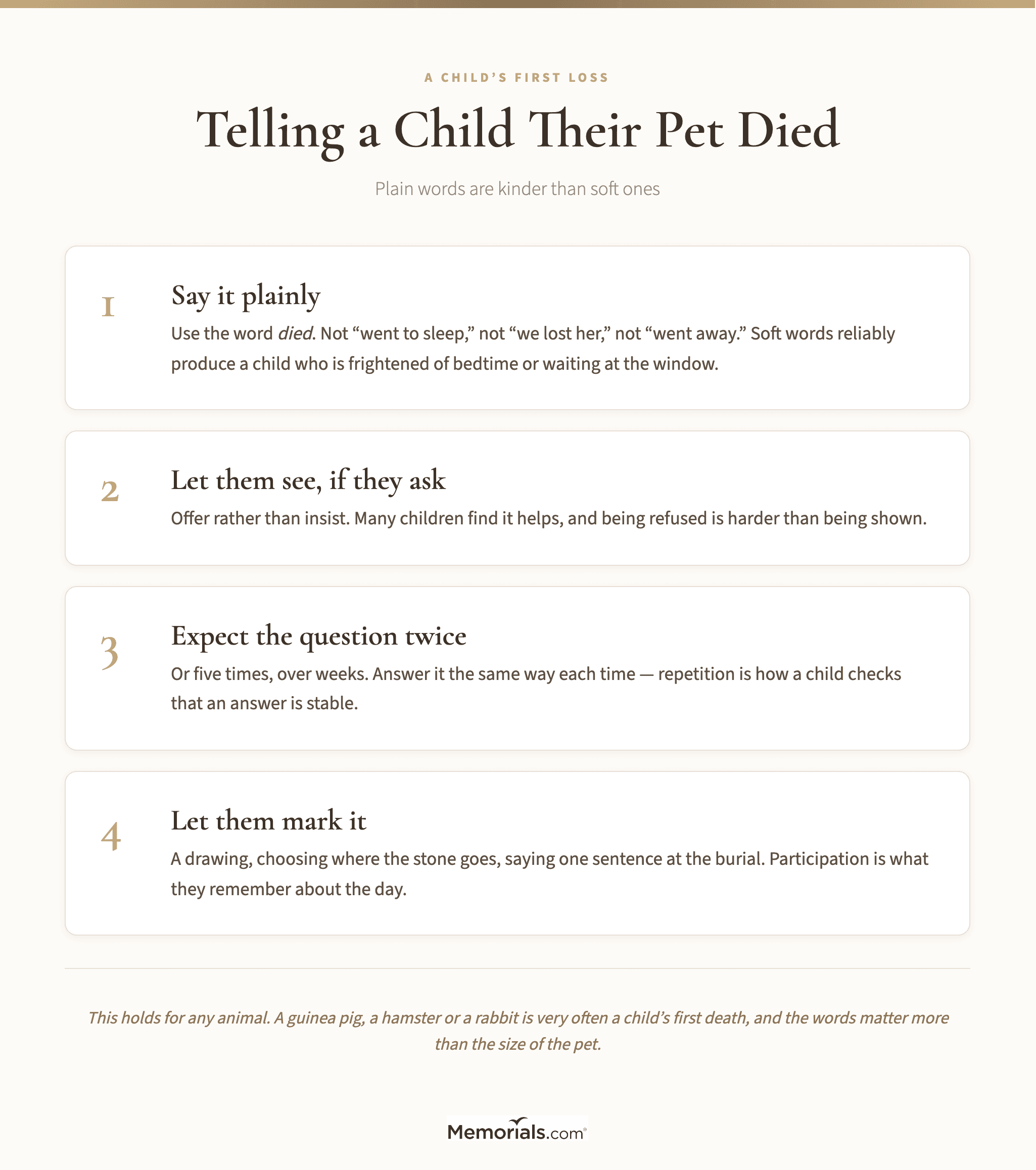
Use the word died. Not "went to sleep," not "we lost her," not "went away" — those produce a child who is frightened of bedtime or who waits at the window. Plain words are kinder than soft ones and this is the consistent advice of everyone who works in the field.
Let them do something. Choosing where the grave goes, drawing her, putting something in the ground, saying a sentence — participation is what children remember about the day, and it matters far more than anything you say.
Expect the same question repeatedly for a few weeks, and answer it the same way each time. That is how children check that an answer is stable.
Plain words are kinder than soft ones — "died" prevents the frightened confusion that "went to sleep" reliably produces.
The most practically useful section here, and one nobody writes.
Guinea pigs are social animals and are usually kept in pairs or groups, which means a death leaves a survivor. That animal will often grieve visibly: eating less, calling for the one that is gone, becoming withdrawn or unusually clingy. It is not imagination.
Let the survivor see the body if you can. The consistent advice from rescues and exotic vets is that a few minutes with the deceased cage-mate reduces the searching behavior afterward. It looks grim and it helps.
Watch the food intake closely for a week or two. A guinea pig that stops eating deteriorates fast, and a grieving one may go off food. This is the practical risk after a death and it is worth taking seriously.
Do not leave a lone guinea pig alone indefinitely. They are not solitary animals and a single guinea pig is a welfare problem rather than a preference. Getting another is not a betrayal of the one who died, whatever it feels like in the first week — and rescues will often help with pairing, which is not straightforward to do yourself.
Give yourself a little time before deciding. A few weeks is fine. Months is not, for the survivor's sake.
If You Cannot Stop Crying
There is a particular loneliness to this one. People type my guinea pig died and I can't stop crying into a search bar at one in the morning, and they do it because there is nowhere else to put the sentence — they have already had somebody react as though they had lost a houseplant.
The other thing people search, and it is somehow worse, is simply sad guinea pig died. Four words, no question, nothing asked for. If that was you, this is the answer: it is a real loss, and the reaction you are having is the ordinary one.
The feeling is proportionate. You spent years with a warm animal on you every evening, and the fact that it was small does not make the hole small. Almost everything written about pet grief applies exactly, and where it says "dog" you can read the name of yours.
And if you are the person writing to somebody whose guinea pig has died, short message for loss of pet has wording that works — the only rule specific to a small animal is to use the species name and the animal's name, and never the phrase "just a."
What Not to Say to Someone Whose Guinea Pig Died
Short, because the list is short and the offenses are specific.
"It's just a guinea pig." Or a rodent, or a small animal, or "only" anything. This is the one, and it is said constantly.
"You can get another one for twenty dollars." True and irrelevant, and it converts a family member into a commodity in one sentence.
"At least it wasn't the dog." People genuinely say this.
"Well, they don't live very long anyway." A known lifespan is not a reason grief was unnecessary. Nobody says this about an elderly relative.
"Was it your daughter's?" Asked to establish whether the grief is legitimately yours. It is.
What works is exactly what works for any animal: use the name, do not qualify the loss, and offer one specific thing. "I'm so sorry about Biscuit" is a complete sentence and it is more than most people will say.
Marking It
A small animal deserves the same marking as a large one, and the practical options are the same at a smaller scale.
Most people bury a guinea pig at home, which is legal in most places and is worth checking locally. Depth matters more than people expect — deep enough that nothing digs it up. A stone, a plant, or a marker with the name gives the spot a purpose.
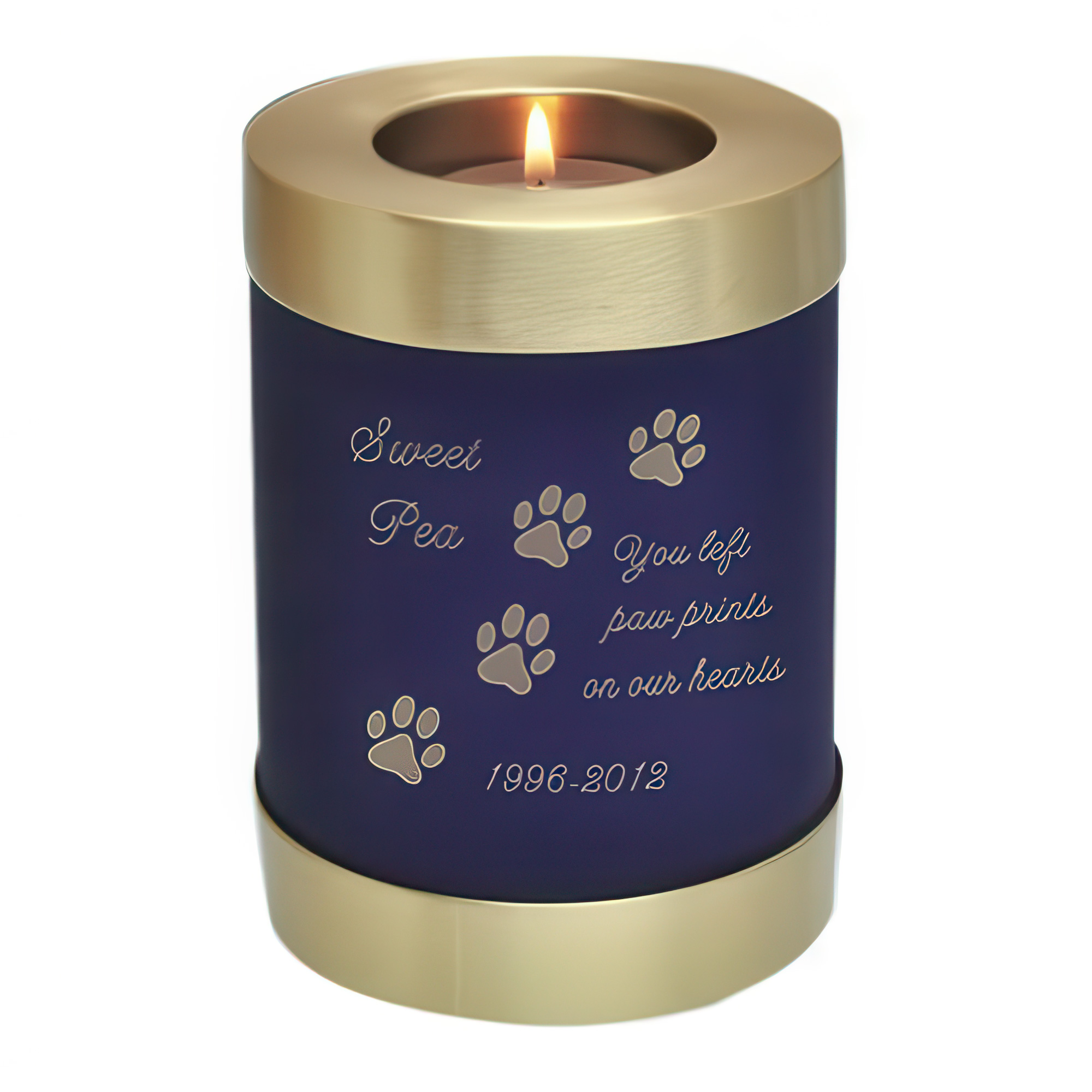
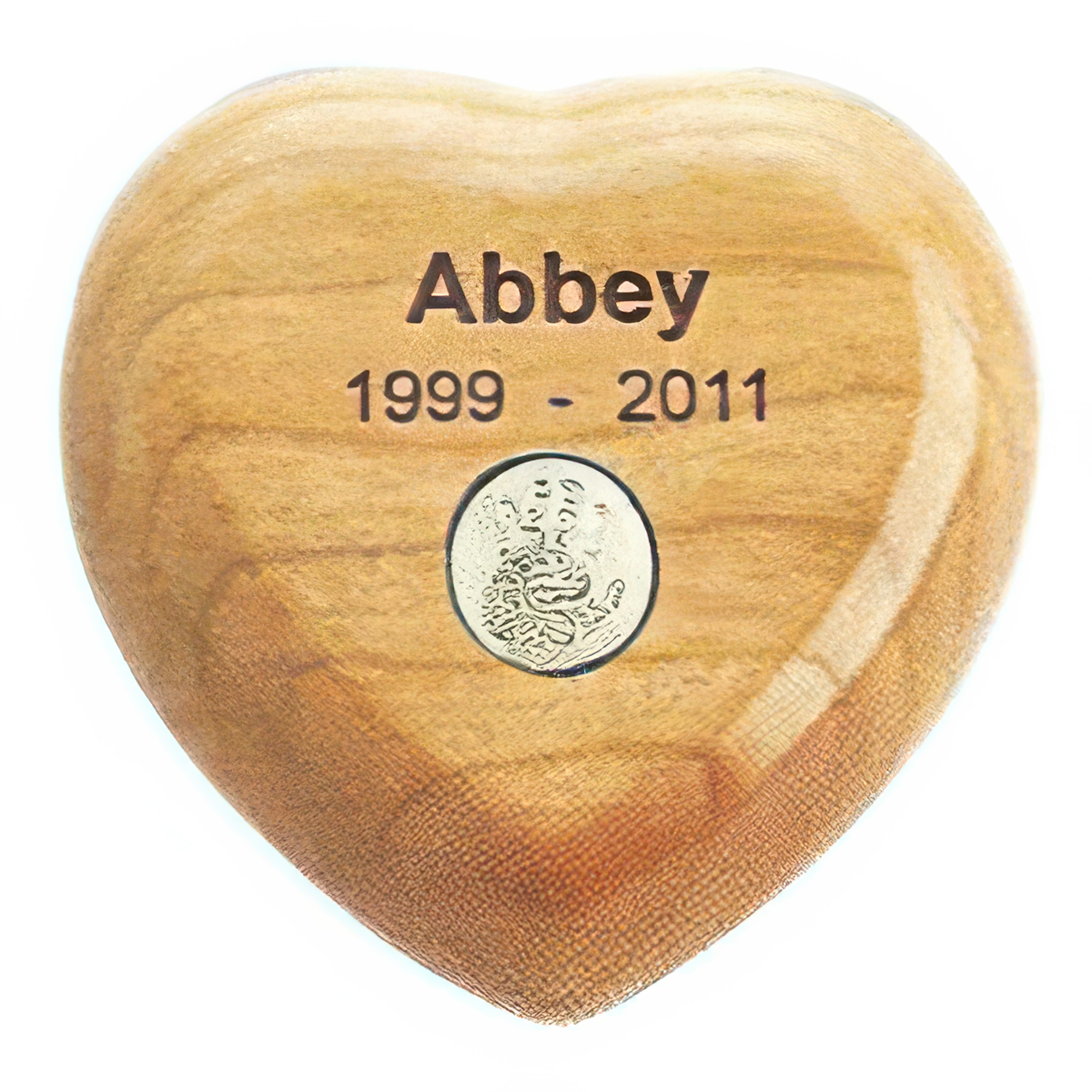
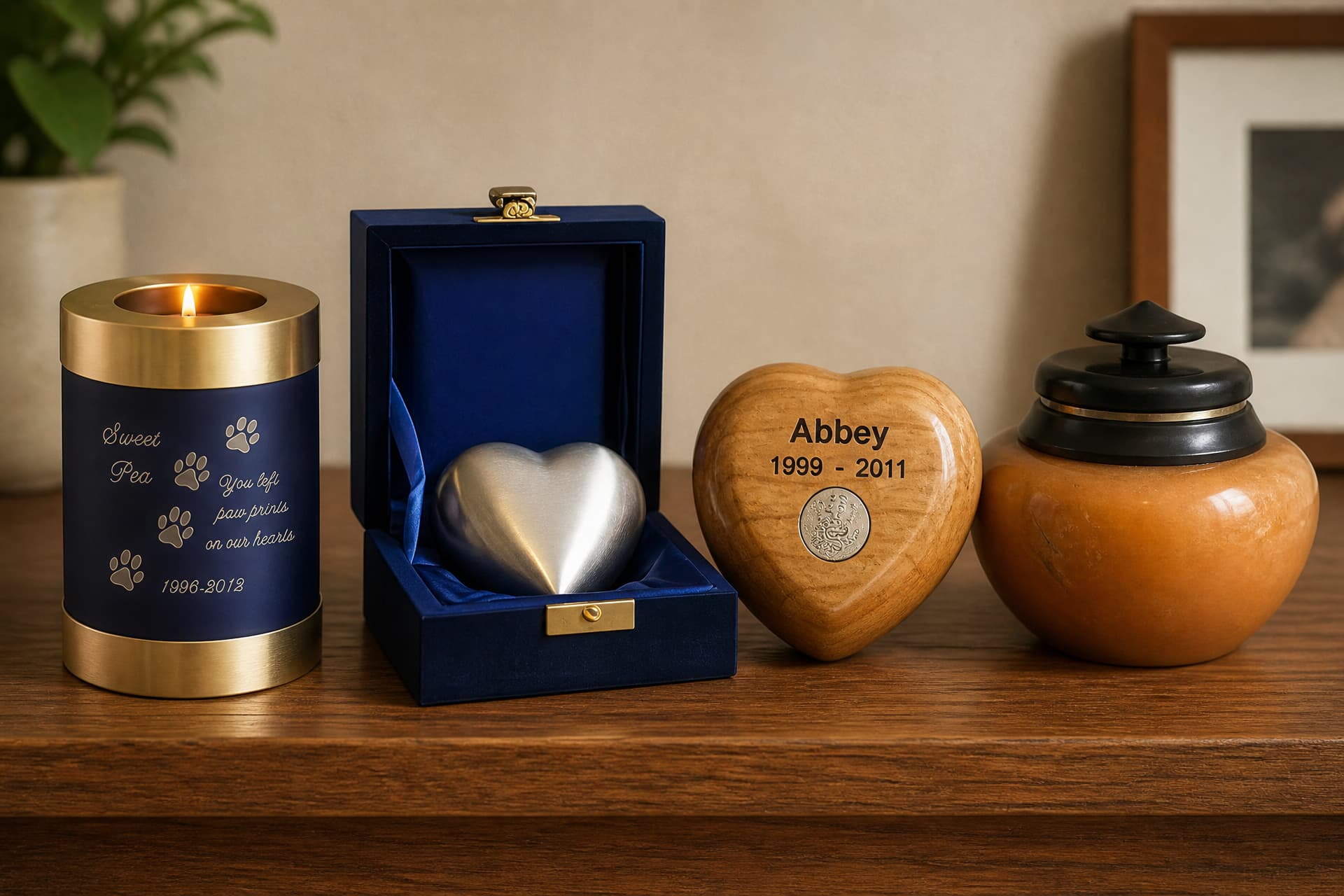
If you choose cremation, the ashes come back in a very small quantity, and small urns for pet ashes are made for exactly this. Keepsake sizes suit a guinea pig far better than anything dog-sized, and a plain container on a shelf is a perfectly good answer if nothing else appeals.
The survivor is the practical problem after a death — watch the food intake, and do not leave a social animal on its own for long.
A plain garden stone is a complete marker for a small animal — no engraving required. Dig deeper than feels necessary; depth matters more than people expect.
Frequently Asked Questions
How long do guinea pigs live?
Typically five to seven years with good care, sometimes eight. If yours reached that range you did well; if it did not, that is common too and usually not attributable to anything you did.
Why did my guinea pig die suddenly?
Because they hide illness until they cannot. As prey animals they conceal weakness by instinct, so a serious problem often becomes visible only in the final hours. This is the usual answer and it is not a failure of attention on your part.
Should I get another guinea pig for the one left?
Yes, in time. They are social animals and living alone is genuinely bad for them. Take a few weeks, then ask a rescue about pairing — introductions are not simple and they will help.
How do I tell my child?
Use the word "died," keep it short, answer only what is asked, and let them do something to mark it. Expect the question again and answer it the same way.
Can you bury a guinea pig in the garden?
Usually yes, and rules vary by locality, so check. Bury deep enough that nothing disturbs it, and mark the spot.
Do guinea pigs know when another one dies?
They react to the absence, certainly — searching, calling, withdrawing, going off food. Whether that constitutes understanding is not something anyone can answer, but the behavior is well documented enough that letting the survivor see the body is standard advice from rescues.
Is it normal to be this upset over a guinea pig?
Yes. Duration and intensity of grief track the relationship rather than the size of the animal, and a lap animal you held every evening for years is a large relationship.
A Small Animal, A Real Loss
If you take one thing from this page, make it the part about hiding illness. The most common thing people carry after a guinea pig dies is the conviction that they missed something obvious, and in almost every case there was nothing obvious to miss. That is how the animal is built.
The rest of it — the quiet, the weight not being there in the evening, feeling stupid for crying about a rodent — is ordinary, and everyone who has kept one recognizes it.
She was somebody. Write it down, mark the spot, and look after the one who is left.