🏬Supersize Online Funeral Retailer🪦1000's of Headstones⚱️Over 10,000 Cremation Urns⚰️Caskets Overnight Delivery🛒Funeral & Memorial Superstore🚚FREE Shipping on ALL Orders👨👩👧👦Helping Families for over 20 Years💰Lowest Price Guarantee🏬Supersize Online Funeral Retailer🪦1000's of Headstones⚱️Over 10,000 Cremation Urns⚰️Caskets Overnight Delivery🛒Funeral & Memorial Superstore🚚FREE Shipping on ALL Orders👨👩👧👦Helping Families for over 20 Years💰Lowest Price Guarantee
🏬Supersize Online Funeral Retailer🪦1000's of Headstones⚱️Over 10,000 Cremation Urns⚰️Caskets Overnight Delivery🛒Funeral & Memorial Superstore🚚FREE Shipping on ALL Orders👨👩👧👦Helping Families for over 20 Years💰Lowest Price Guarantee🏬Supersize Online Funeral Retailer🪦1000's of Headstones⚱️Over 10,000 Cremation Urns⚰️Caskets Overnight Delivery🛒Funeral & Memorial Superstore🚚FREE Shipping on ALL Orders👨👩👧👦Helping Families for over 20 Years💰Lowest Price Guarantee
If you are watching your pet take slow, deep, open-mouthed gasps with long pauses between them, what you are seeing is almost certainly agonal breathing — and the thing to understand first is that it is a reflex of the dying brainstem, not an attempt to recover. Agonal breathing in dogs and cats looks like a struggle and is not experienced as one.
That distinction is the whole reason this page exists. Owners describe this as the worst thing they have ever watched, and a great many of them spend the following months believing their pet suffocated in front of them. The clinical understanding is that by the time this reflex appears, consciousness has gone.
This page explains what it looks like, why it happens, how long it lasts, what to do while it does, and how to tell it apart from the things that are emergencies. It sits within our pet memorial guide.
Not like breathing, which is why it is so frightening — the pattern is wrong in a way you notice immediately even if you cannot name it.
Slow and far apart. Often only a few breaths a minute, with pauses of ten, twenty, thirty seconds between them. Each pause feels like the end, and then another breath comes.
Deep, open-mouthed, and whole-body. The head may extend, the neck may stretch, the abdomen may heave. It can look like an enormous effort.
Sometimes noisy. A gasp, a gurgle, a snore, occasionally a sound closer to a groan. The noise is air moving past a slack throat, not distress.
Often with other signs. Unresponsiveness, fixed or glassy eyes, a slack jaw, loss of bladder or bowel control, twitching, and a body that is going cool at the extremities.
It is irregular and it slows. The gaps lengthen. This is the pattern that tells you it is agonal rather than labored breathing from something treatable.
A dying dog breathing this way is not fighting for air in any sense they can perceive. The engine is running on a reflex loop in the brainstem after the parts of the brain that generate experience have stopped.
There is no medical intervention at this point, and that is not the same as nothing to do. Stay, keep a hand on them, and let the other animals be present if they want to be.
The brainstem is the oldest and most robust part of the brain and it is the last to stop.
Breathing is generated there, below the level of conscious control, by a cluster of cells that fire rhythmically on their own. When circulation fails and oxygen falls, the cortex — the part that produces awareness, pain and fear — shuts down early, because it is metabolically expensive and fragile. The brainstem keeps going for a while on almost nothing.
What you are watching is that cluster still firing, with nothing left above it. The breaths are deep and spaced because the reflex has lost the fine regulation that normally keeps breathing smooth, and the whole-body effort is the diaphragm and accessory muscles recruited in a pattern that no longer serves any purpose.
This is the basis for saying your pet does not feel it. The structure that would be required to experience breathlessness is not working. It is the same reasoning applied to agonal breathing in humans, where it is well described, and the neuroanatomy involved is not meaningfully different.
Does My Pet Feel It
No, as far as anything can be said with confidence about another animal's experience.
Breathlessness — air hunger — is a conscious sensation produced in the cortex and the structures feeding it. Agonal breathing occurs after those have failed. An animal in this state does not respond to its name, to touch, or to light in the eye, and the absence of those responses is the same absence that rules out the experience of suffering.
What it does not mean is that your pet felt nothing earlier. If there was distressed breathing before this — fast, shallow, anxious, with the animal awake and trying to position itself to breathe — that part may well have been unpleasant, and it is a reason to call a vet urgently when you see it rather than waiting. By the time the pattern is slow and gasping with long pauses, that window has closed.
If you took anything from this page, take this: the hardest part of agonal breathing is almost entirely borne by the person watching.
How Long It Lasts
Usually a few seconds to a few minutes. Occasionally longer — fifteen or twenty minutes is documented and is not rare enough to be shocking.
It feels much longer than it is. Owners routinely estimate an hour for something a clock would have put at four minutes, and that mismatch is worth knowing in advance, because during it you will be asking yourself whether this is going to continue all night.
It ends on its own. The breaths get further apart until one does not come.
The dividing line is responsiveness. If your pet reacts to you at all, go now.
Cats Specifically
Agonal breathing in cats follows the same pattern and differs in two ways that matter at the time.
Cats are quieter about everything, including this. A cat may show a much subtler version — shallower gasps, less whole-body movement — and owners sometimes do not register it as a distinct event at all until afterward.
Open-mouthed breathing in a cat is an emergency at any other time. Cats are obligate nose breathers in normal life; a cat breathing through its mouth while awake and alert needs a vet immediately, because it usually means real respiratory or cardiac trouble. Cat gasping for air before death and a cat panting in distress are different situations with the same surface appearance, and the difference is responsiveness.
So: agonal breathing cat — unresponsive, eyes fixed, long pauses, slowing. Emergency — awake, aware, trying to position itself, breathing fast rather than slow.
What to Do While It Is Happening
Nothing medical. There is no intervention, and CPR on an animal in this state does not change the outcome.
What is left to do is all for the animal's comfort and your own, and it is not nothing.
Stay and talk. Hearing and the brainstem response to familiar sound persist late. Whether your pet perceives your voice at this point is genuinely unknown, and it costs nothing to assume they might.
Keep contact. A hand on the chest or the head. People who did this almost never regret it; people who left the room often do.
Do not try to close the mouth, lift the head, or reposition the chest. It will not help and it tends to make the sounds worse.
Let the other animals be present if they want to be. Dogs and cats frequently react to a dead companion by searching the house for days. An animal that is understood to have gone is easier for them than one that vanished.
If you are alone and frightened, ring the emergency vet and stay on the line. They will talk you through it. This is a call they take often and nobody will think it is a waste of their time.
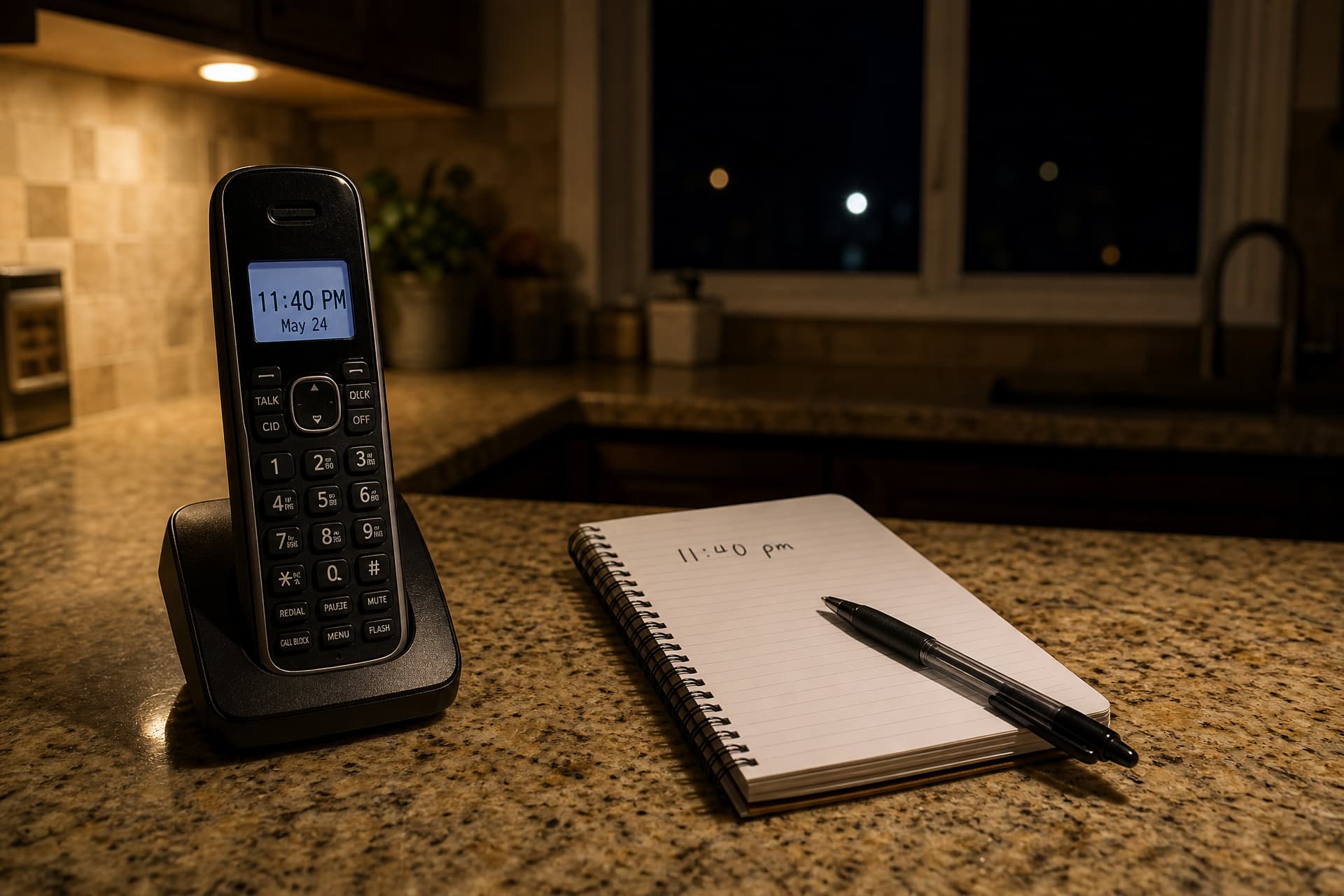
Note the time it stopped, if you can. Not for any official reason — it is simply a thing people later want to know and cannot remember.
Note the time it stopped if you can. Not for any official reason — it is simply a thing people later want to know and cannot remember.
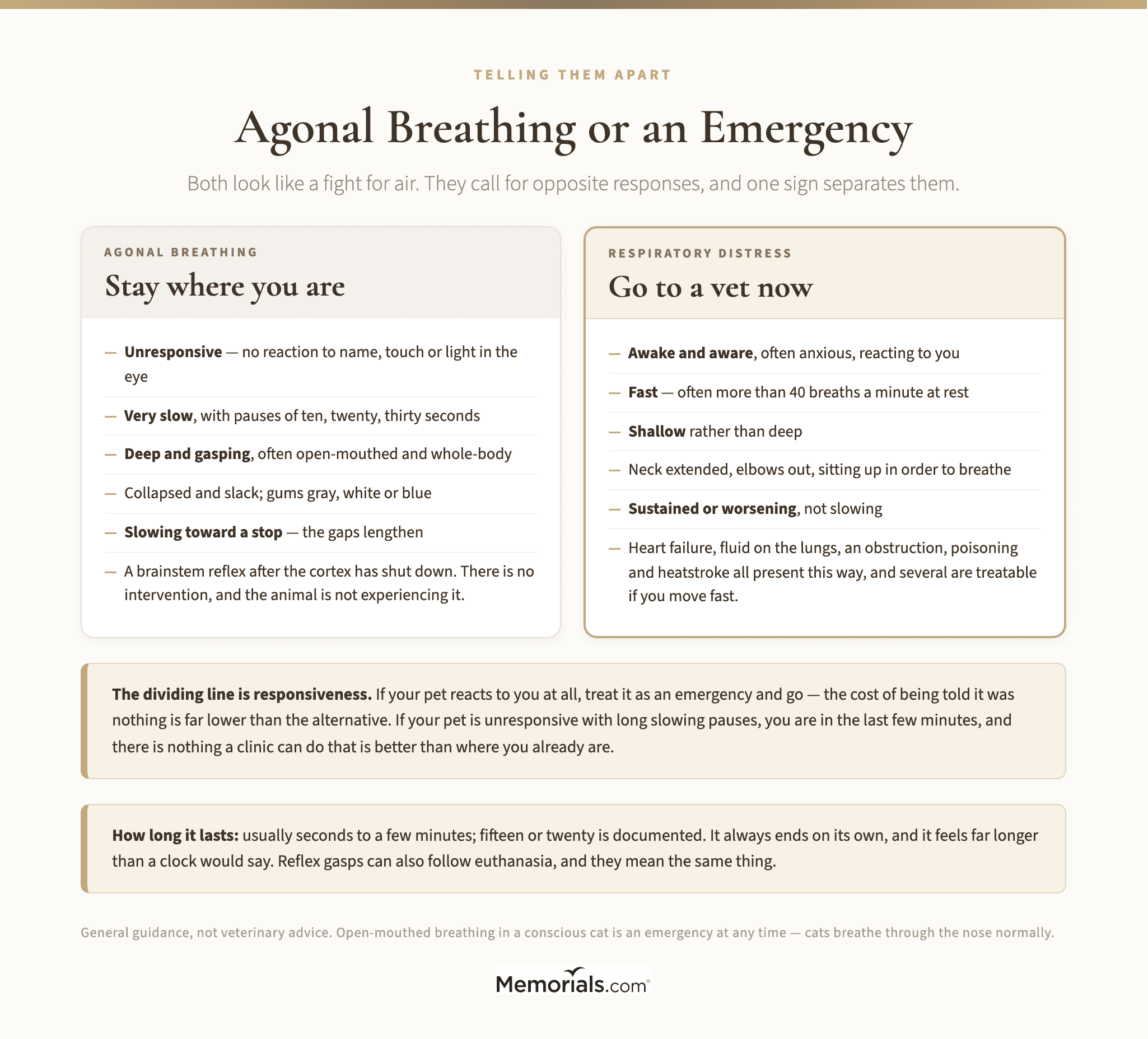
Telling It Apart From Something Treatable
This is the section to read if your pet is currently alive and you are not sure which of these you are watching, because the two call for opposite responses.
Agonal breathing
Respiratory distress
Responsiveness
none — no reaction to name or touch
awake, aware, often anxious
Rate
very slow, long pauses
fast, often over 40 a minute at rest
Depth
deep, gasping
shallow
Posture
collapsed, slack
neck extended, elbows out, sitting up to breathe
Gums
gray, white or blue
may be pale or blue, but the animal is conscious
Direction
slowing toward a stop
sustained or worsening
If your pet is responsive at all, treat it as an emergency and go now. Heart failure, fluid on the lungs, airway obstruction, poisoning and heatstroke can all present as desperate breathing and several of them are treatable if you move fast. The cost of going in and being told it is nothing is far lower than the alternative.
If your pet is unresponsive with long slowing pauses, you are not in an emergency any longer. You are in the last few minutes, and there is nothing a clinic can do that is better than where you are.
Afterward
The breathing stops and then, confusingly, the body may still do things. A twitch, a muscle tremor, a last sigh of air leaving the lungs as the chest settles, eyes that do not close. All of it is normal and none of it is life.
There is also no rush. Pets do not need to be moved immediately, and sitting with your animal for an hour is both allowed and, for many people, the thing that made it bearable. When you are ready, the practical questions — whether you want the ashes, whether to bury, who to call — all keep until morning, and how long can a dead pet be kept in a freezer has a reassuring answer if nothing is open.
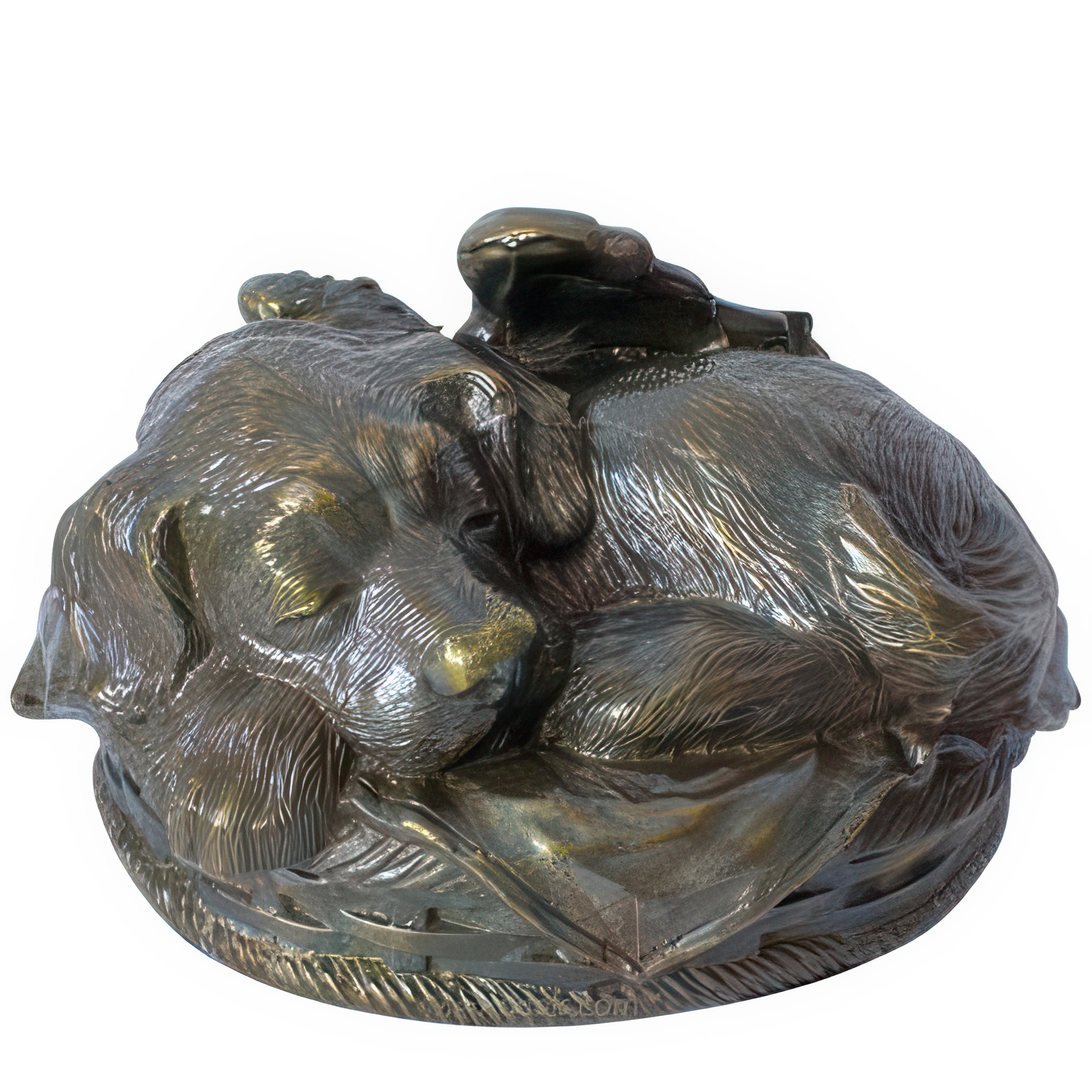
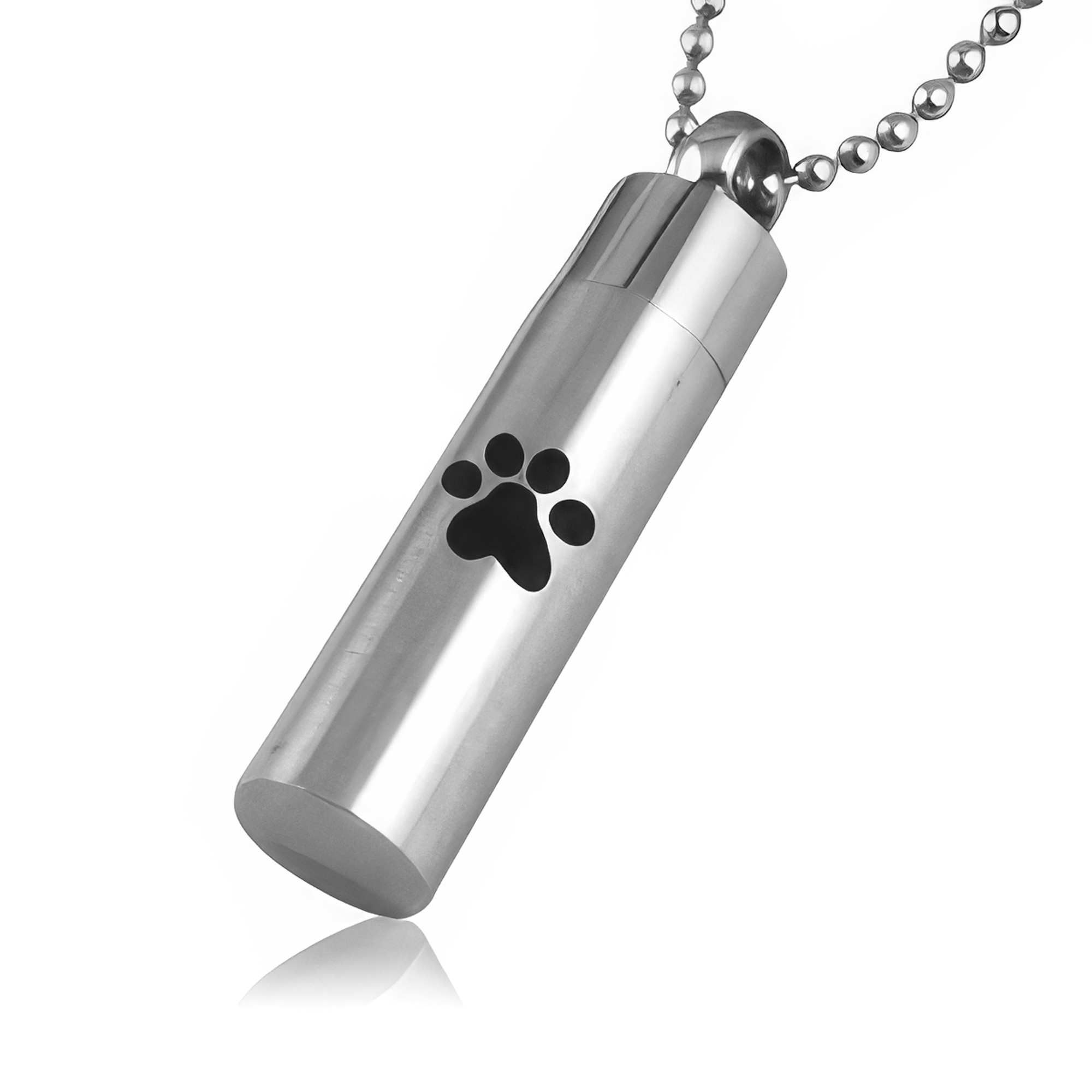
When you do come to it, a container is a decision to take slowly rather than on the night. Urns for dogs and a ceramic dog urn will both still be there in a month, and so will a pet ashes necklace if you want something to carry rather than something to place. Our pet cremation process guide covers what happens between now and then.
A large share of the people reading this were out of the room, asleep, or at work, and found their pet afterward.
You can rarely tell from the body whether this happened. A slack jaw, an extended neck, a tongue slightly out, eyes open, the body in a position that looks like struggle — all of these are what a body does as muscle tone goes, and none of them is evidence of a bad death. People who find their pet in what looks like a contorted position often conclude something terrible happened in their absence, and the posture does not support that reading.
Dying animals commonly move away to somewhere small and dark. Under a bed, behind furniture, into a cupboard. This is a very old instinct and it is not a judgment on you or a sign your pet wanted to be alone in any sense they could have articulated.
Being absent at the end is not abandonment. This is said often enough to sound like a platitude, and it is also simply true: the part of the process you missed is the part the animal was not experiencing.
If the Death Was Expected
Where there has been a diagnosis and a decline, two things are worth having settled before the last night, because they are miserable to work out at 3am.
Know who you would call. An out-of-hours vet number on the fridge, and whether they do home visits. Many do. Knowing it in advance changes how the night goes.
Decide in advance whether you want euthanasia on the table. Plenty of owners intend a natural death at home and then find the last hours harder to watch than they expected, and having already thought about the alternative makes that a decision rather than a panic. Equally, plenty of owners are glad they let it happen at home. There is no correct answer and both are acts of care.
Know that agonal breathing can happen after euthanasia too. Occasionally a few reflex gasps occur after the injection, which distresses owners badly because they were told it would be peaceful. It is the same brainstem reflex and it means the same thing: the animal is already gone. A good vet will warn you it is possible; many do not.
Frequently Asked Questions
What is agonal breathing in dogs? A brainstem reflex in the last minutes of life: slow, deep, open-mouthed gasps with long pauses, in an animal that is already unconscious. It is not an attempt to breathe and not a sign of recovery.
Is agonal breathing dog suffering? No. The part of the brain that produces the sensation of breathlessness has already stopped working. The animal is unresponsive because it is unaware.
How long does agonal breathing last in a cat? Usually seconds to a few minutes, occasionally fifteen or twenty. It always slows and stops on its own.
Should I take my pet to the vet if it is agonal breathing? If your pet is completely unresponsive with long slowing pauses, no — there is nothing to be done and the journey costs you the last few minutes. If your pet reacts to you at all, go immediately; distressed breathing in a conscious animal can be treatable.
Can a dog recover from agonal breathing? No. By definition it occurs after circulation has failed and the cortex has shut down. Breathing that looks dramatic but comes from a conscious animal is a different thing and may well be treatable.
Is open-mouthed breathing in a cat always serious? Yes, outside this context. Cats breathe through the nose normally, so a conscious cat breathing through its mouth needs a vet the same day.
Why did my pet gasp after I thought they had died? Air leaving the lungs as the body relaxes, or one last reflex breath. Both are common and neither means your pet was still alive.
Almost everyone who searches this is doing so afterward, trying to work out whether they watched their animal suffocate.
You did not. You watched a reflex in a brain that had already let go, and you stayed while it happened, which is the part your pet would have wanted if they had been in any condition to want anything.