🏬Supersize Online Funeral Retailer🪦1000's of Headstones⚱️Over 10,000 Cremation Urns⚰️Caskets Overnight Delivery🛒Funeral & Memorial Superstore🚚FREE Shipping on ALL Orders👨👩👧👦Helping Families for over 20 Years💰Lowest Price Guarantee🏬Supersize Online Funeral Retailer🪦1000's of Headstones⚱️Over 10,000 Cremation Urns⚰️Caskets Overnight Delivery🛒Funeral & Memorial Superstore🚚FREE Shipping on ALL Orders👨👩👧👦Helping Families for over 20 Years💰Lowest Price Guarantee
🏬Supersize Online Funeral Retailer🪦1000's of Headstones⚱️Over 10,000 Cremation Urns⚰️Caskets Overnight Delivery🛒Funeral & Memorial Superstore🚚FREE Shipping on ALL Orders👨👩👧👦Helping Families for over 20 Years💰Lowest Price Guarantee🏬Supersize Online Funeral Retailer🪦1000's of Headstones⚱️Over 10,000 Cremation Urns⚰️Caskets Overnight Delivery🛒Funeral & Memorial Superstore🚚FREE Shipping on ALL Orders👨👩👧👦Helping Families for over 20 Years💰Lowest Price Guarantee
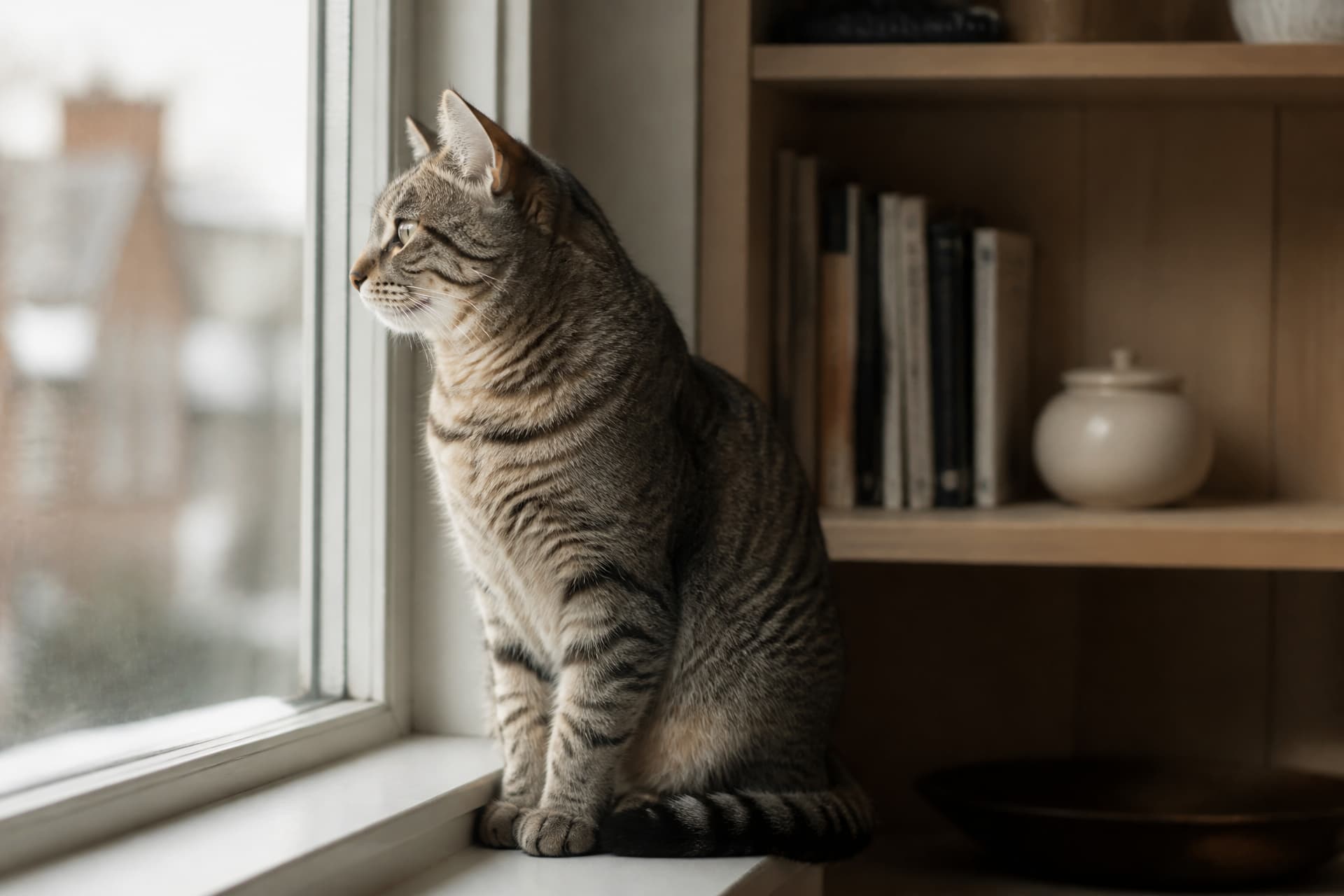
Can cats smell cremated ashes is usually asked for one of two reasons: either a surviving cat has started behaving oddly around the urn, or someone is deciding whether having ashes in the house is a good idea at all.
The short answer is that there is very little left to smell. Cremation runs at temperatures that destroy organic material completely, and what comes back is sterile bone mineral — essentially calcium phosphate. The scent compounds a cat would use to recognize another animal are gone, not faint.
But cats and dogs do sometimes react to an urn, and the explanation is more interesting than scent. This page covers what is actually in the container, what your pet is probably responding to, and the question underneath most of these searches: whether keeping ashes at home is a problem.
It sits within our pet memorial guide, and our covers how the remains are produced.
A cremation chamber runs hot enough and long enough that soft tissue, fluid and the volatile compounds that carry scent are destroyed outright rather than merely denatured. What remains is the mineral fraction of bone, which is then processed into the coarse pale granules families receive.
That material is sterile and essentially odorless. Most people report no smell at all; a few describe a faint mineral or slightly burnt note in the first days after collection, which fades. There is no decomposition, nothing biological, and nothing for a scavenging instinct to find interesting.
So the honest answer to can dogs smell ashes is: there is no meaningful scent signature of the individual animal left in there. A dog's nose is extraordinary — tens of thousands of times more sensitive than ours by most estimates — but sensitivity does not help when the molecule is not present.
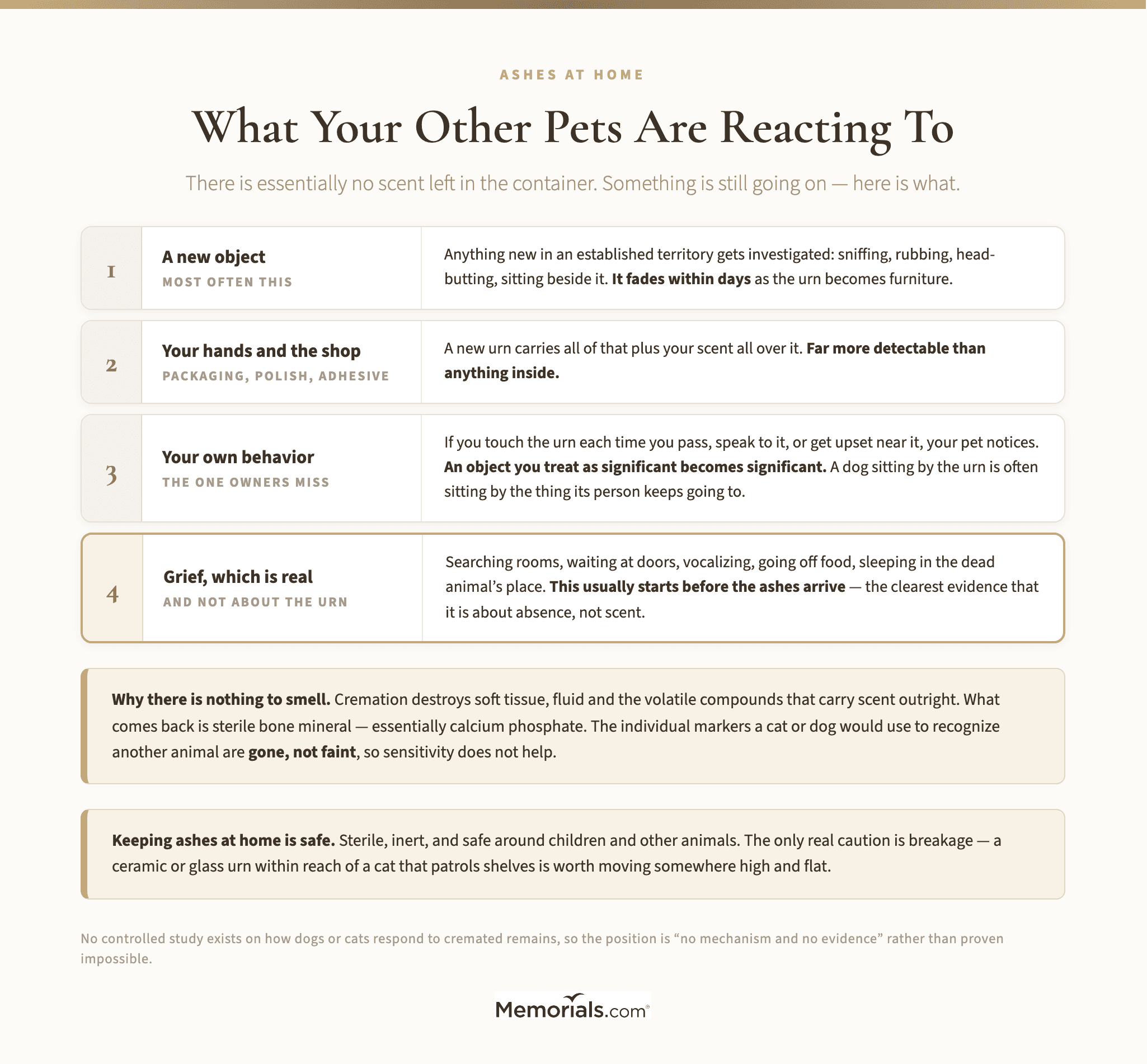
Because something is going on, and owners are not imagining it. Four explanations, roughly in order of how often they are the real one.
The container is new, and that is enough. A new object in an established territory gets investigated. Sniffing, rubbing, head-butting, sitting beside it — this is ordinary object-inspection behavior, and it fades within days as the urn becomes furniture.
It smells of you and of the shop. A new urn carries packaging residue, polish, adhesive, and your hands all over it. All of that is far more detectable than anything inside.
Your own behavior around it. This is the one most owners miss. If you touch the urn each time you pass, speak to it, or get upset near it, your pet notices — dogs and cats are acutely tuned to human attention and emotion, and an object you treat as significant becomes significant. A dog that sits by the urn is often sitting by the thing its person keeps going to.
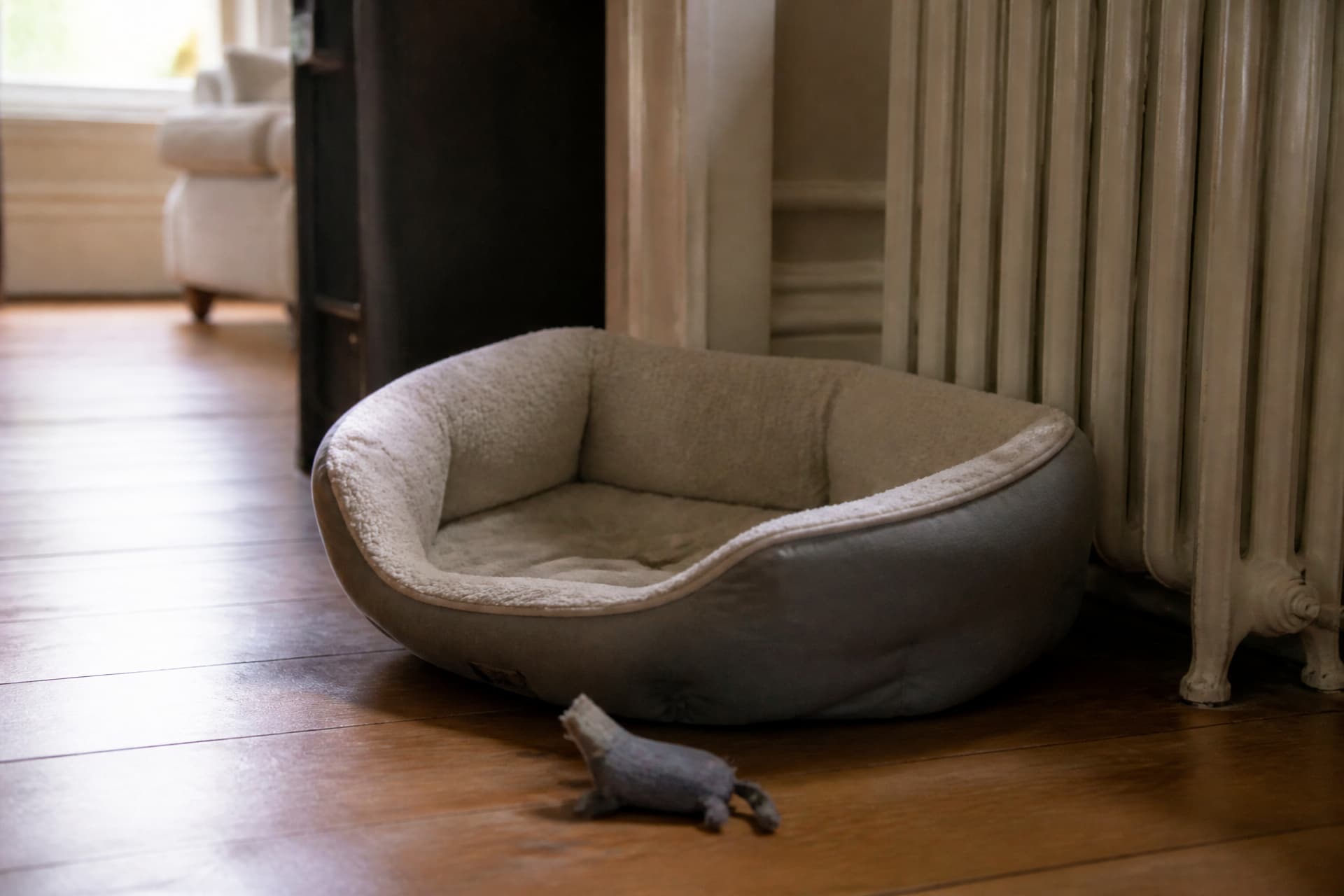
Grief, which is real and is not about the urn. Surviving pets frequently change after a death in the household: searching rooms, waiting at doors, vocalizing, going off food, sleeping in the dead animal's place. That behavior usually starts before the ashes arrive, which is the clearest evidence that it is about absence rather than about scent.
A new object in an established territory gets investigated, and then becomes furniture. That is usually the whole of what is happening.
Can Dogs Recognize Cremated Ashes
This is the sharper version of the question, and the honest answer is: almost certainly not by scent, and there is no evidence they can.
Can dogs recognize cremated ashes as belonging to a specific individual would require individual scent markers to survive cremation, and they do not. No study demonstrates it. The accounts that circulate — a dog that whined at an urn, a cat that would not go near one — are real observations with the four explanations above available before you need to reach for anything else.
That said, two things are worth saying rather than dismissing.
Nobody has tested this properly. There is no controlled work on canine or feline responses to cremated remains, so the position is "no mechanism and no evidence" rather than "proven impossible". It is reasonable to hold that lightly.
It would not make the behavior less meaningful if they could. Owners who find comfort in the idea that their other dog knows are not making a factual error that needs correcting. The animal's attention to a thing you care about is real regardless of what is driving it.
Is It Bad to Keep Dog Ashes at Home
Taking the practical question first, because it is the one with a clean answer.
No, there is no health or hygiene reason not to. The remains are sterile — nothing survives the process — and they are safe to handle, safe around children and safe around other animals. They do not degrade, attract insects, or smell. An urn on a shelf is inert.
Pets will not be harmed by it, and are not usually bothered by it. If your cat is knocking things off shelves, that is a cat, not a reaction to the contents.
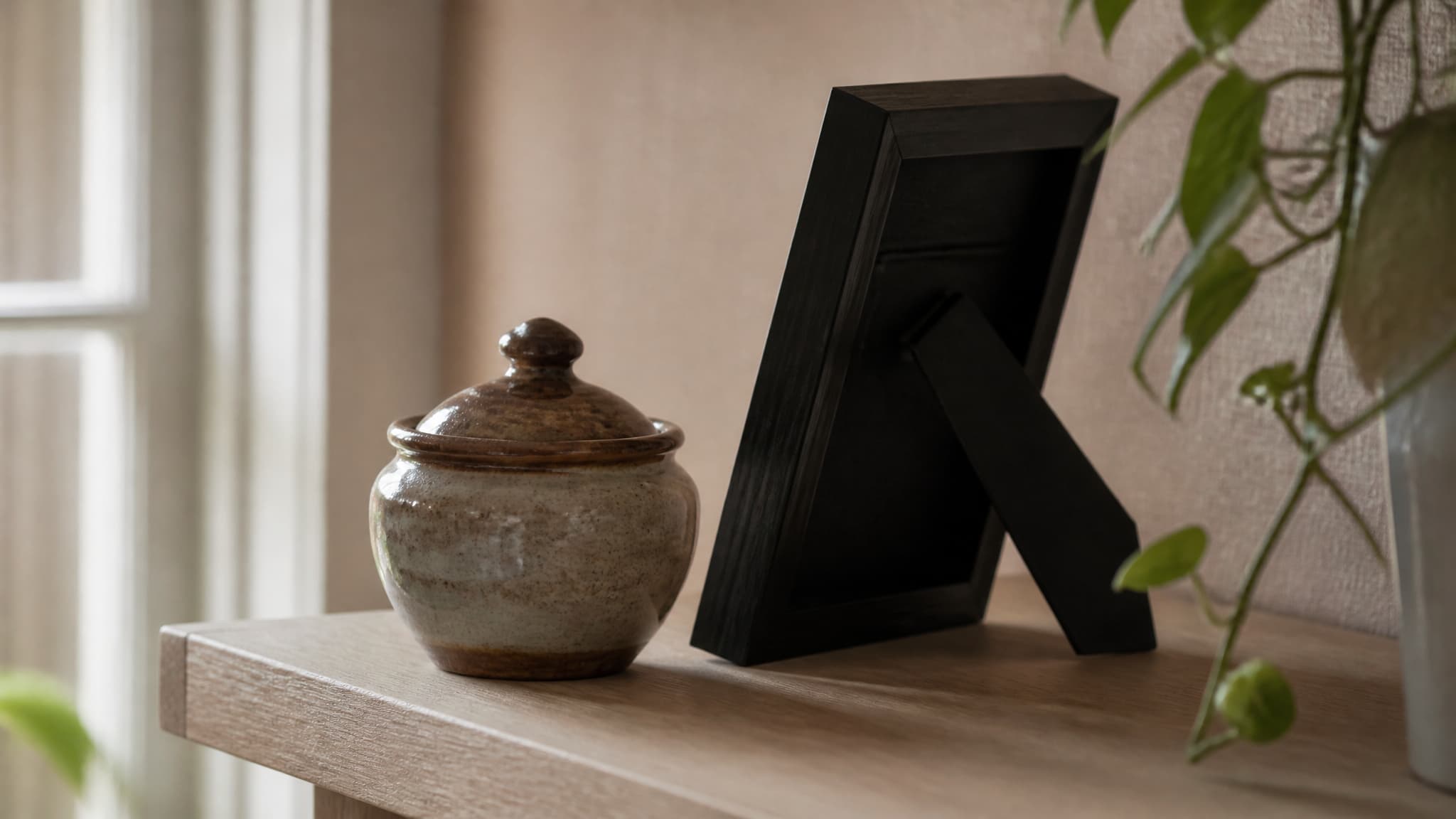
The only practical caution is breakage. A ceramic or glass urn within reach of a cat that patrols shelves is a risk worth thinking about, and the recovery from that is far worse than the original problem. A fitted base, a closed cabinet, or a heavier vessel solves it. If you want the urn visible but out of range, high and flat beats eye-level and precarious.
So is it bad to keep dog ashes at home has no physical dimension at all. What it actually asks, most of the time, is something else.
Should I Keep My Dog's Ashes
Stripped of punctuation, the way people actually type it — should i keep my dogs ashes — this is the real question under a lot of these searches, and it deserves more than reassurance.
Keeping them helps some people and not others, and that is not a character test. Some find an urn a comfort and a focus. Others find it a daily reminder that keeps the loss fresh, and feel guilty for wanting it out of sight. Both are common and neither is the correct response to a dead animal.
You are not locked in. Ashes keep indefinitely, so a decision deferred costs nothing. If you cannot decide, leave them in the sealed bag they arrived in and revisit in six months — a great many people who thought they wanted an urn on the mantel end up scattering, and the reverse happens just as often.
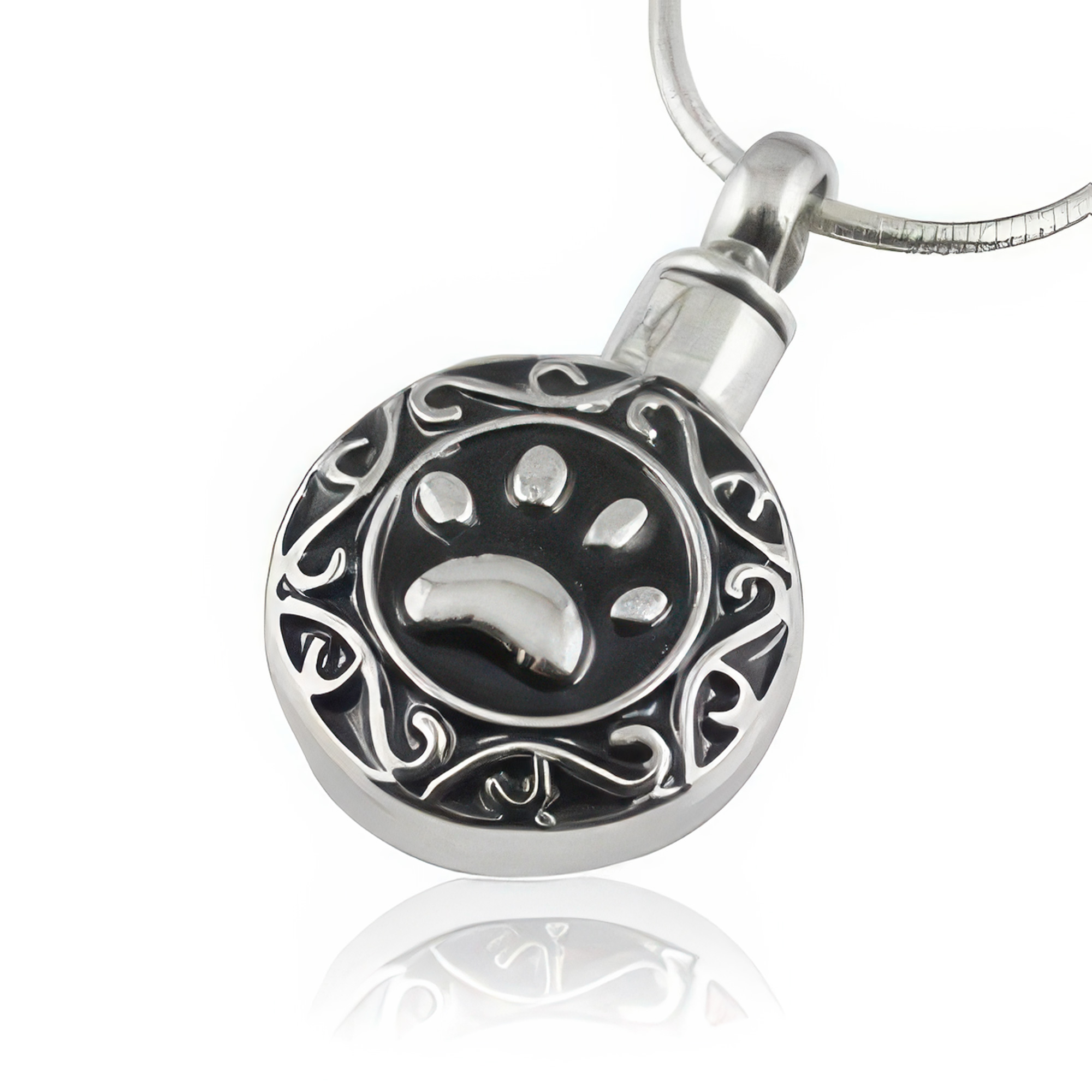
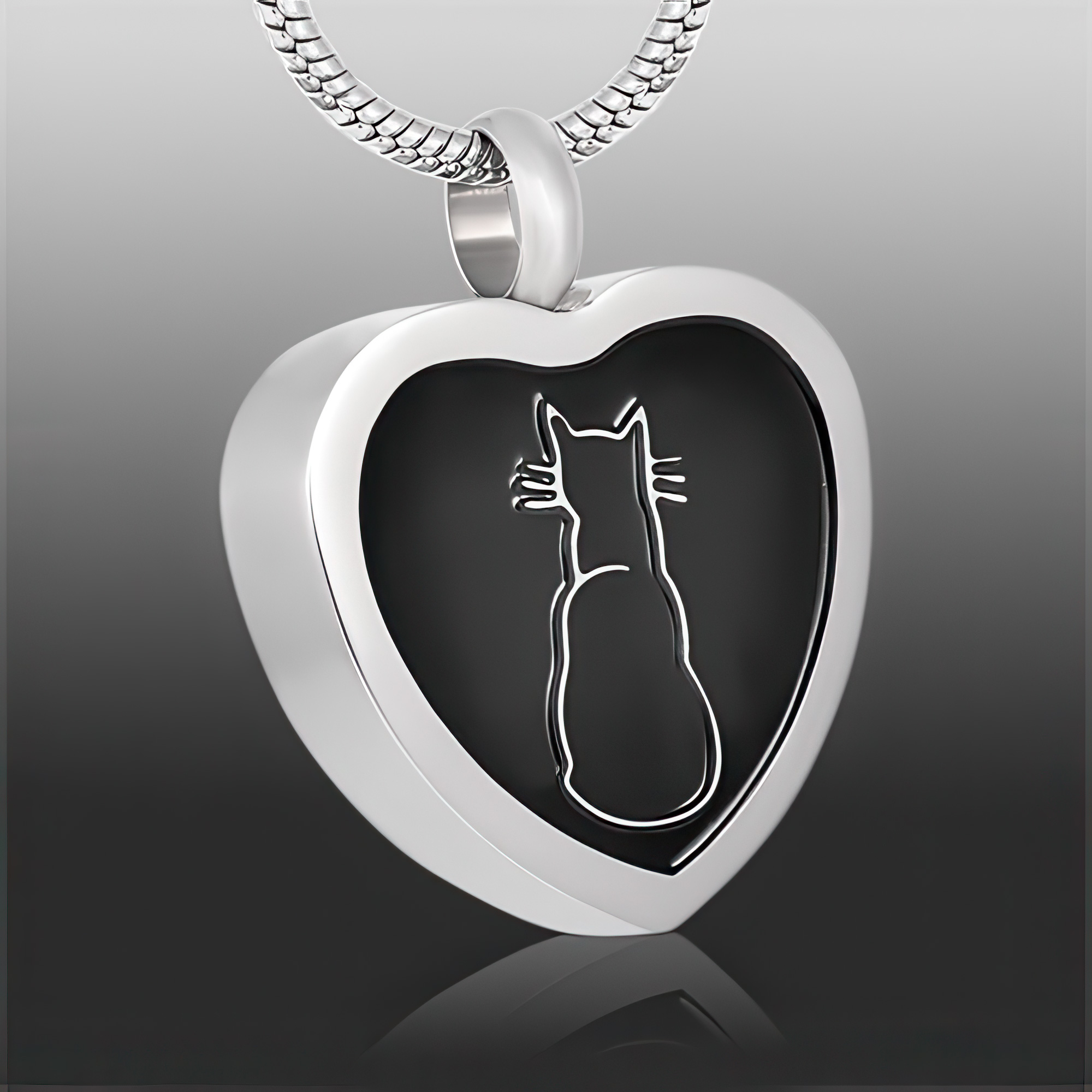
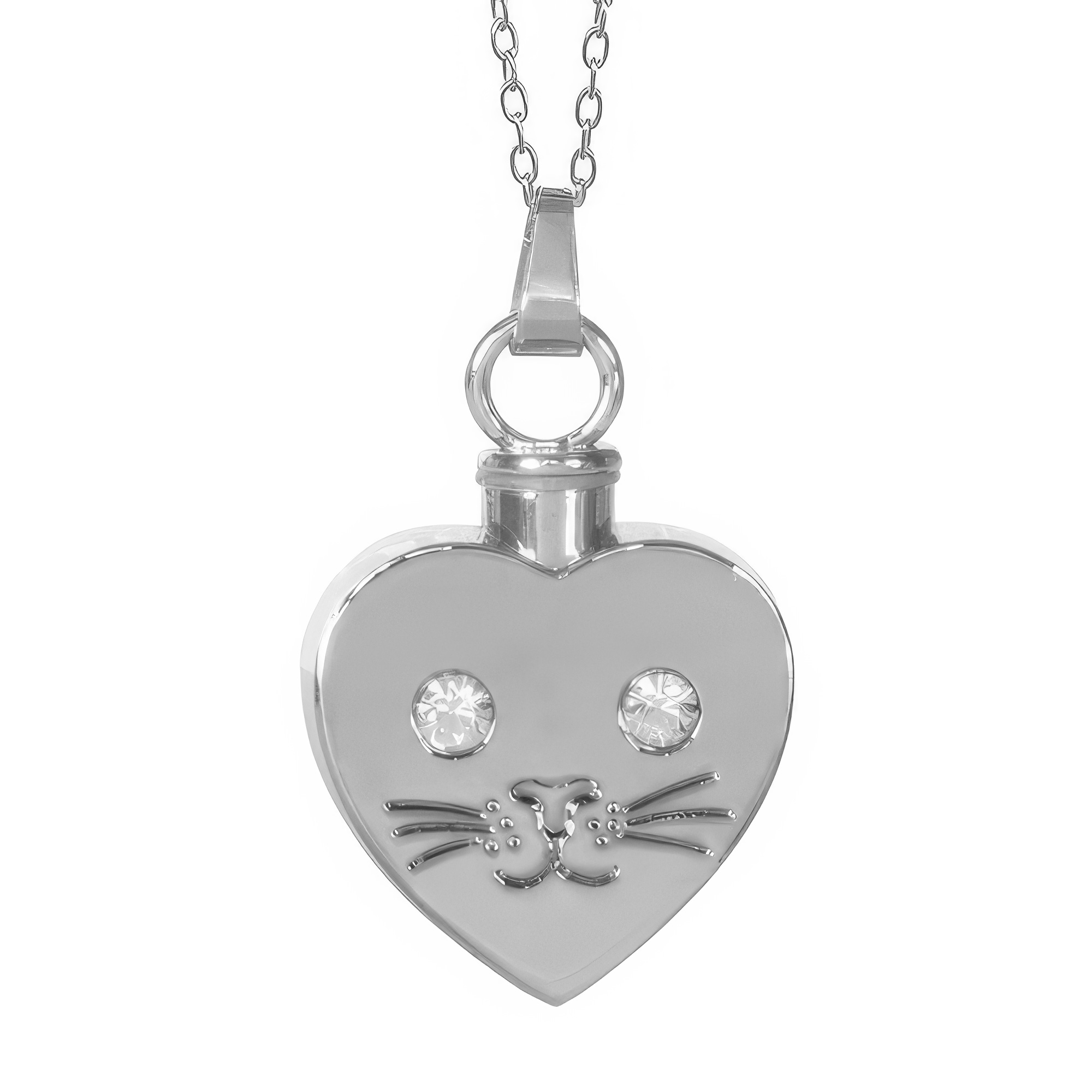
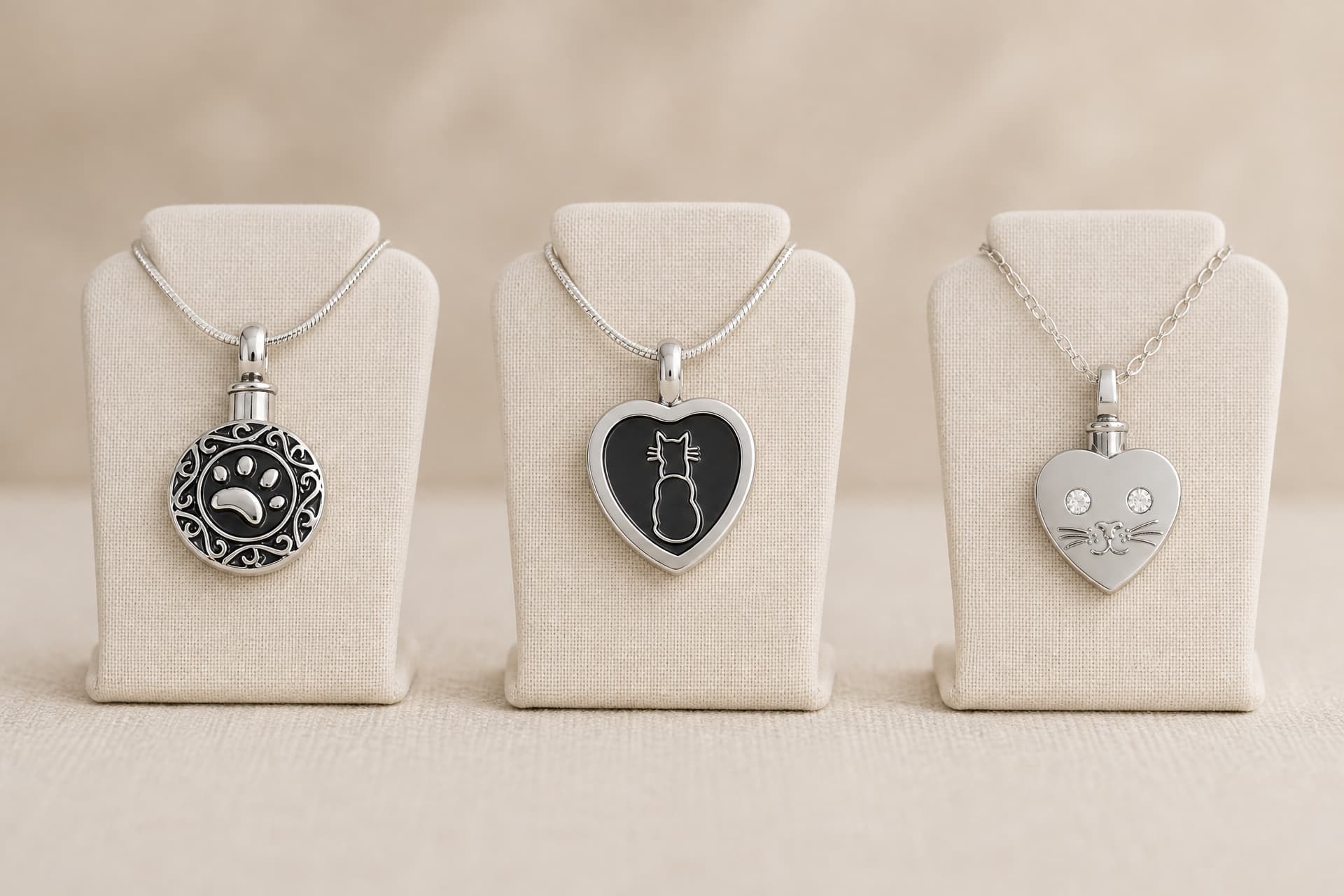
You can split the difference, and most people do not realize it. Scatter some and keep a little. Bury most and put a spoonful in something small. A cat ashes keepsake holds a fraction, which lets the rest go somewhere that matters while something stays with you. Dividing ashes is completely ordinary and nothing about it is disrespectful.
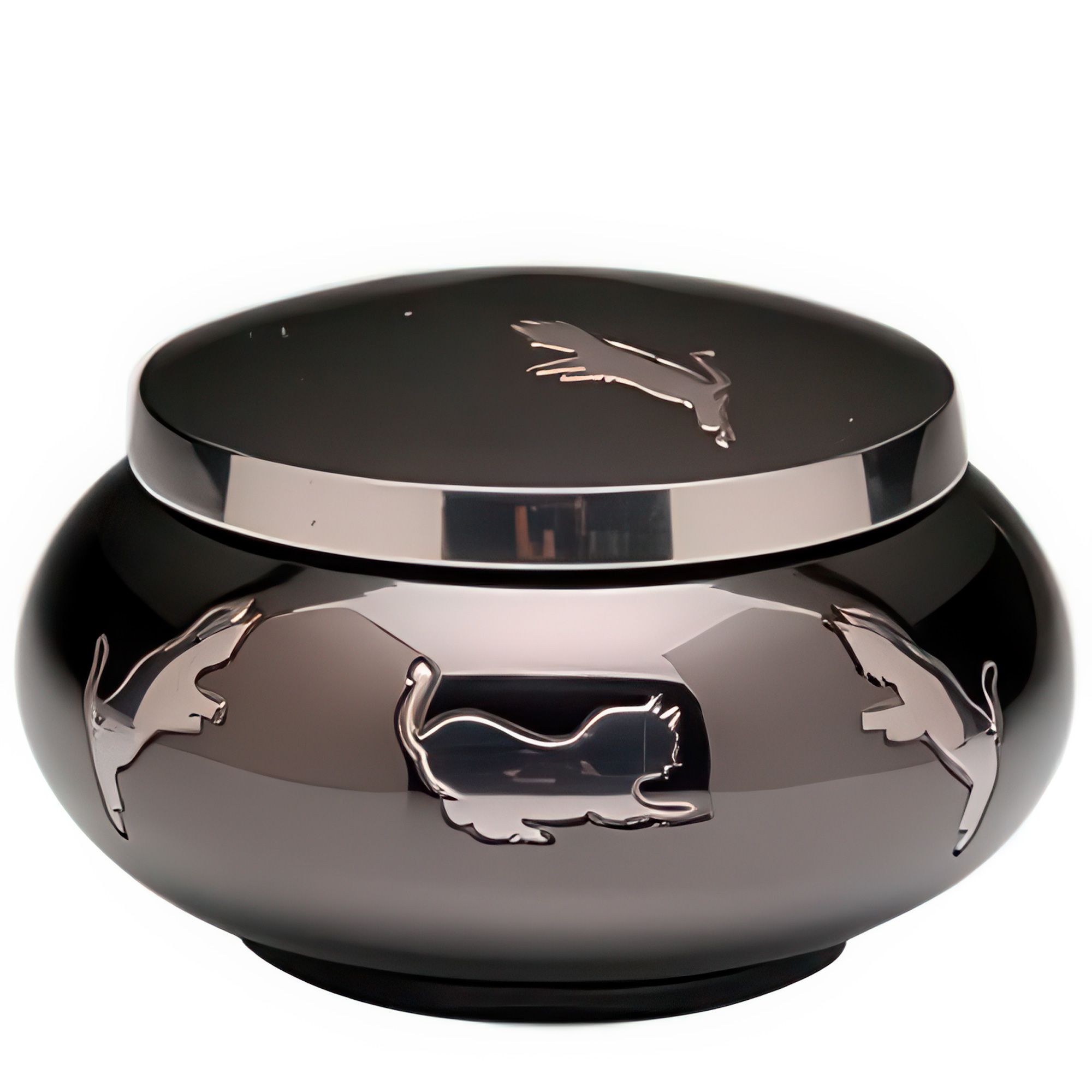
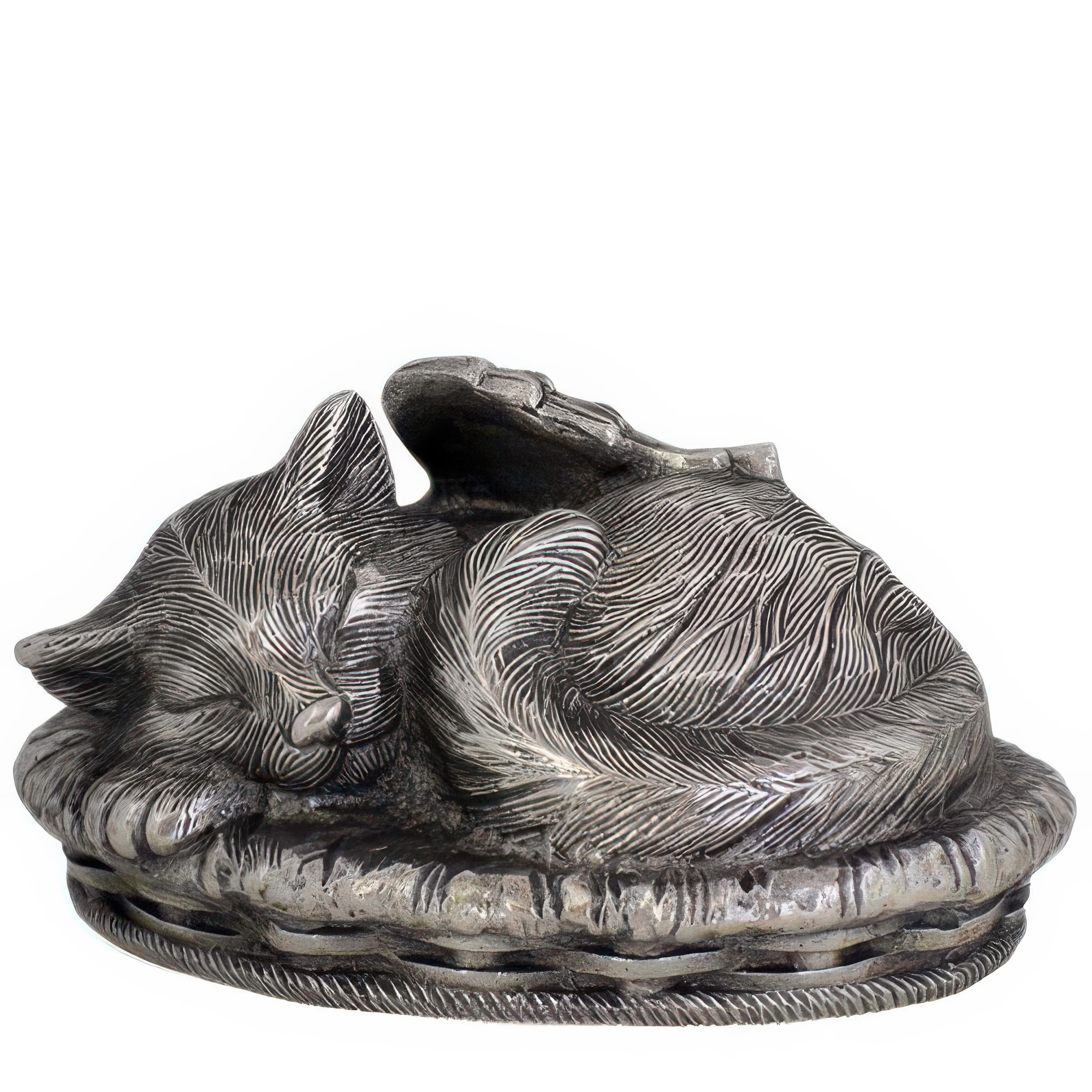
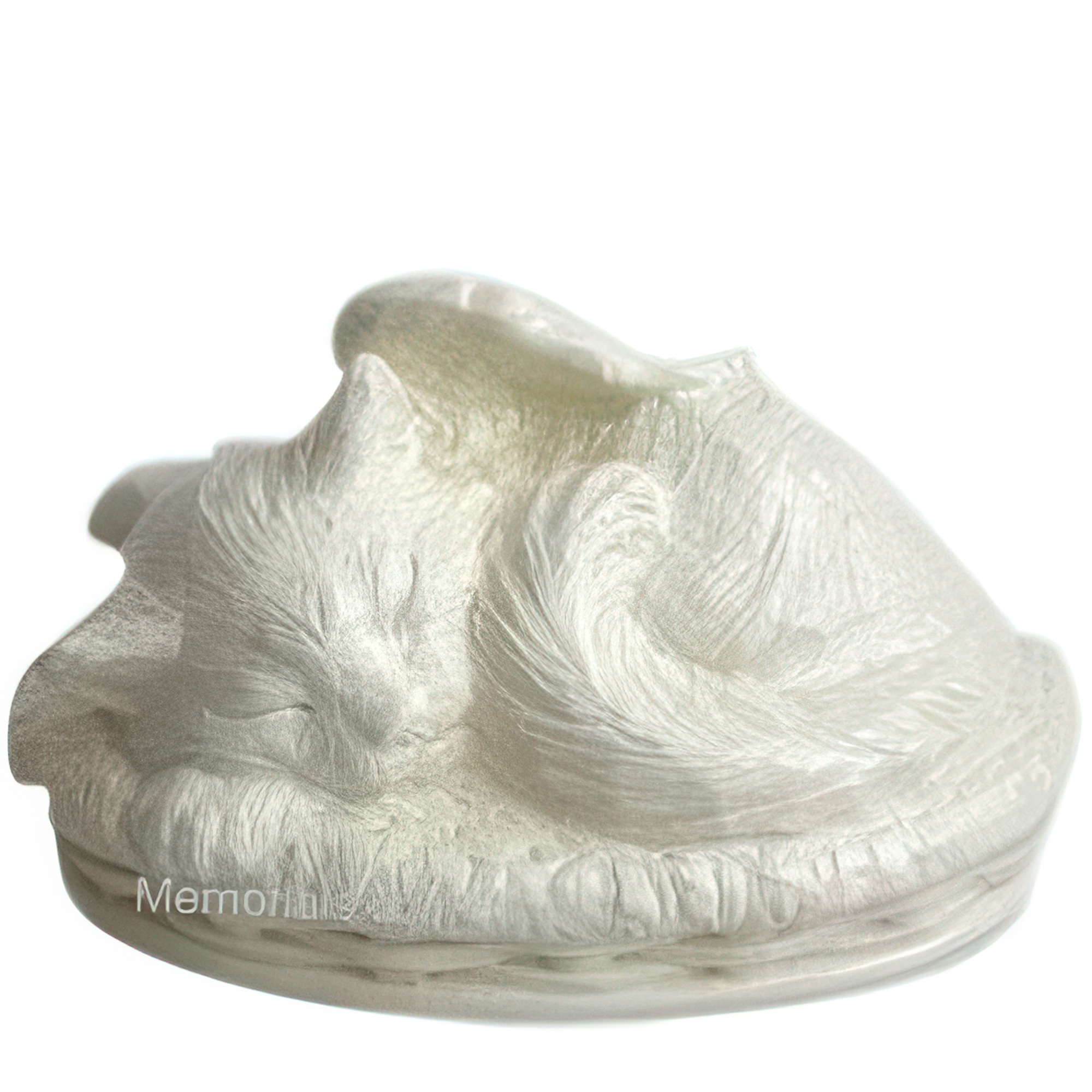
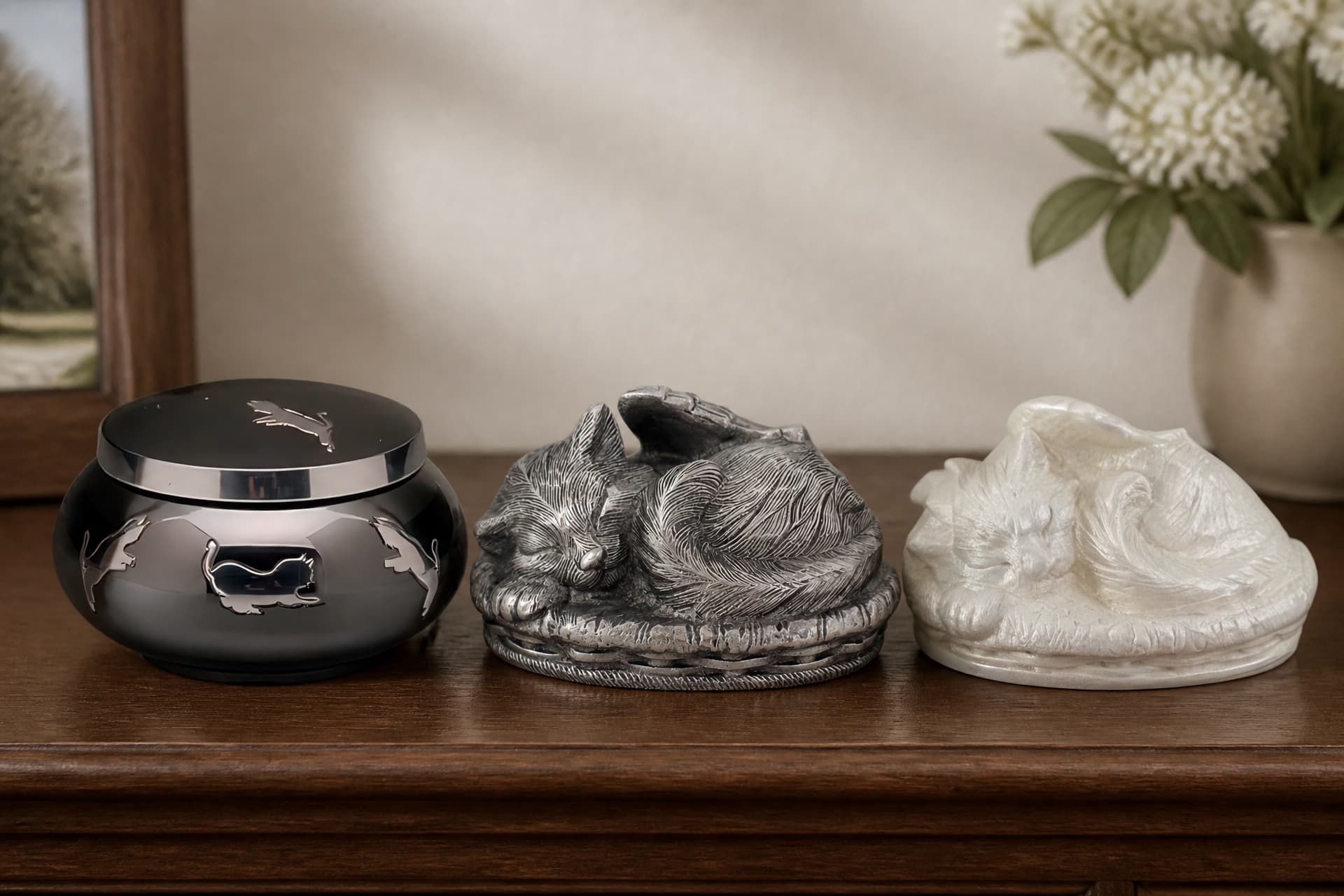
If the urn itself is the problem, change the urn. A plain box that reads as a box is easier to live with than something obviously funerary, and the opposite is true for people who want the animal present. A cat shaped urn is a different object in a room from a cat urn in a classic shape, and the choice between them is about what you want to feel when you look at the shelf.
Four explanations, and the last one is usually the real one.
The change you will see is about absence, not about the urn — it generally starts before the ashes come home. Keep the routine, and give it weeks rather than days.
Helping a Surviving Pet
Worth separating from the urn question, because this is the part that genuinely needs attention.
Keep the routine. Walks, meals and bedtime at the same times. Animals cope with absence considerably better than with a household that has stopped functioning.
Expect a few weeks, not a few days. Searching, vocalizing, appetite changes and clinginess are normal and usually resolve. If appetite loss runs beyond a couple of days, that is a vet call rather than grief management — cats in particular decline fast when they stop eating.
Do not rush a new animal in. A replacement introduced while a surviving pet is still unsettled frequently makes things worse. Let the household settle first.
Let them investigate what they want to. The dead animal's bed, the urn, the room. Removing everything at once is for the human's benefit; most pets do better with a gradual fade.
If the surviving animal seems genuinely low for weeks, see a vet. Grief and illness look similar from the outside, and animals that have lost a companion sometimes have a condition that was masked by the other one being the sick one.
What Ashes Will and Will Not Do Over Time
A few practicalities, because people worry about these and they are rarely written down.
They do not degrade. Bone mineral is stable. Ashes kept in a sealed bag inside an urn will be exactly the same in thirty years, and nothing needs doing to them — no resealing, no climate control, no checking.
They are not harmed by heat, cold or damp. An unheated loft, a garage, a cupboard by a radiator: none of it matters. The only enemy is a container that leaks or breaks.
They can be moved as often as you like. Between urns, between houses, divided and recombined. Nothing is spoiled by handling.
Scattering is final in a way keeping is not, which is worth saying for symmetry. Families who scatter and later wish they had kept some are a real category, and the usual advice — keep a small amount back even if you intend to scatter the rest — costs nothing and closes that door more gently.
If you move house, they travel in the car with you, not in a removal van. This sounds obvious and is the single most common ashes-related regret in house moves.
When the Ashes Belong to More Than One Person
The quiet problem in a lot of households, and nothing else on the internet addresses it.
A pet is usually shared, and after a separation, a bereavement, or simply a disagreement between family members, the ashes become a thing two people both feel entitled to. There is no legal framework worth invoking and no neutral arbiter.
Dividing is almost always the answer, and people resist it because it feels like a desecration. It is not. The ashes are a material, not the animal, and two people each having somewhere to grieve is better than one person having everything. A small keepsake for one and the main vessel for the other resolves most of these.
Scattering together, if that is possible, resolves the rest. A shared act in a place that meant something leaves nobody holding the object and nobody excluded.
If neither is possible, the person who cannot have them can still have a place. A marker, a plaque, a tree. The thing people actually want is somewhere to direct it, and ashes are only one way to provide that.
Frequently Asked Questions
Can cats smell cremated ashes? There is essentially nothing left to smell. Cremation destroys the organic compounds that carry scent, leaving sterile bone mineral. A cat investigating an urn is reacting to a new object, to your handling of it, or to your behavior around it.
Can dogs smell cremated ashes of another dog? No individual scent markers survive the process, so there is no mechanism for it. A dog's nose is remarkable and cannot detect a molecule that is not there.
Do pets know when another pet has died? They clearly respond to the absence — searching, waiting, changes in appetite and sleep are all well documented. Whether they understand death as a concept is unknown and probably unanswerable.
Is it safe to keep ashes in the house with pets and children? Yes. The remains are sterile and inert. The only real risk is a container being knocked off a shelf and broken.
Will my other dog be upset by the urn? Very unlikely by itself. If a dog seems unsettled near it, consider whether you are unsettled near it — they read that far more easily than they read the contents.
Should I let my surviving pet see the body before cremation? Many behaviorists suggest it helps, on the grounds that a companion who is understood to have gone is easier to process than one who vanished. It is worth offering and not worth forcing.
My cat keeps sitting on the urn. Should I stop it? Only if it might fall. Otherwise it is a cat finding a solid object in a warm spot, and a lot of owners find they rather like it.
There is no scent of your pet left in the container, and your surviving animals are responding to something simpler — a new object, your hands on it, your attention going to it, and a house with somebody missing.
Which leaves the question that was underneath: whether to keep them. Nobody else can answer it, nothing about the ashes forces a deadline, and there is no version of this where loving the animal less is the explanation for either choice.