🏬Supersize Online Funeral Retailer🪦1000's of Headstones⚱️Over 10,000 Cremation Urns⚰️Caskets Overnight Delivery🛒Funeral & Memorial Superstore🚚FREE Shipping on ALL Orders👨👩👧👦Helping Families for over 20 Years💰Lowest Price Guarantee🏬Supersize Online Funeral Retailer🪦1000's of Headstones⚱️Over 10,000 Cremation Urns⚰️Caskets Overnight Delivery🛒Funeral & Memorial Superstore🚚FREE Shipping on ALL Orders👨👩👧👦Helping Families for over 20 Years💰Lowest Price Guarantee
🏬Supersize Online Funeral Retailer🪦1000's of Headstones⚱️Over 10,000 Cremation Urns⚰️Caskets Overnight Delivery🛒Funeral & Memorial Superstore🚚FREE Shipping on ALL Orders👨👩👧👦Helping Families for over 20 Years💰Lowest Price Guarantee🏬Supersize Online Funeral Retailer🪦1000's of Headstones⚱️Over 10,000 Cremation Urns⚰️Caskets Overnight Delivery🛒Funeral & Memorial Superstore🚚FREE Shipping on ALL Orders👨👩👧👦Helping Families for over 20 Years💰Lowest Price Guarantee
A burial vault is a reinforced container placed in the ground that fully encloses a casket after interment. It shields the casket from soil pressure, moisture, and the weight of heavy cemetery maintenance equipment that passes over the grave for decades after burial. If you are navigating cemetery decisions for a loved one, understanding how vaults work — and whether you actually need one — can save you from unexpected costs and last-minute confusion at a time when clarity matters most.
Most families first hear the term "burial vault" during arrangement conference planning at a funeral home, often alongside phrases like "outer burial container" and "grave liner." These terms overlap, but they are not interchangeable. Knowing the difference helps you make a confident purchase that fits your values and your budget.
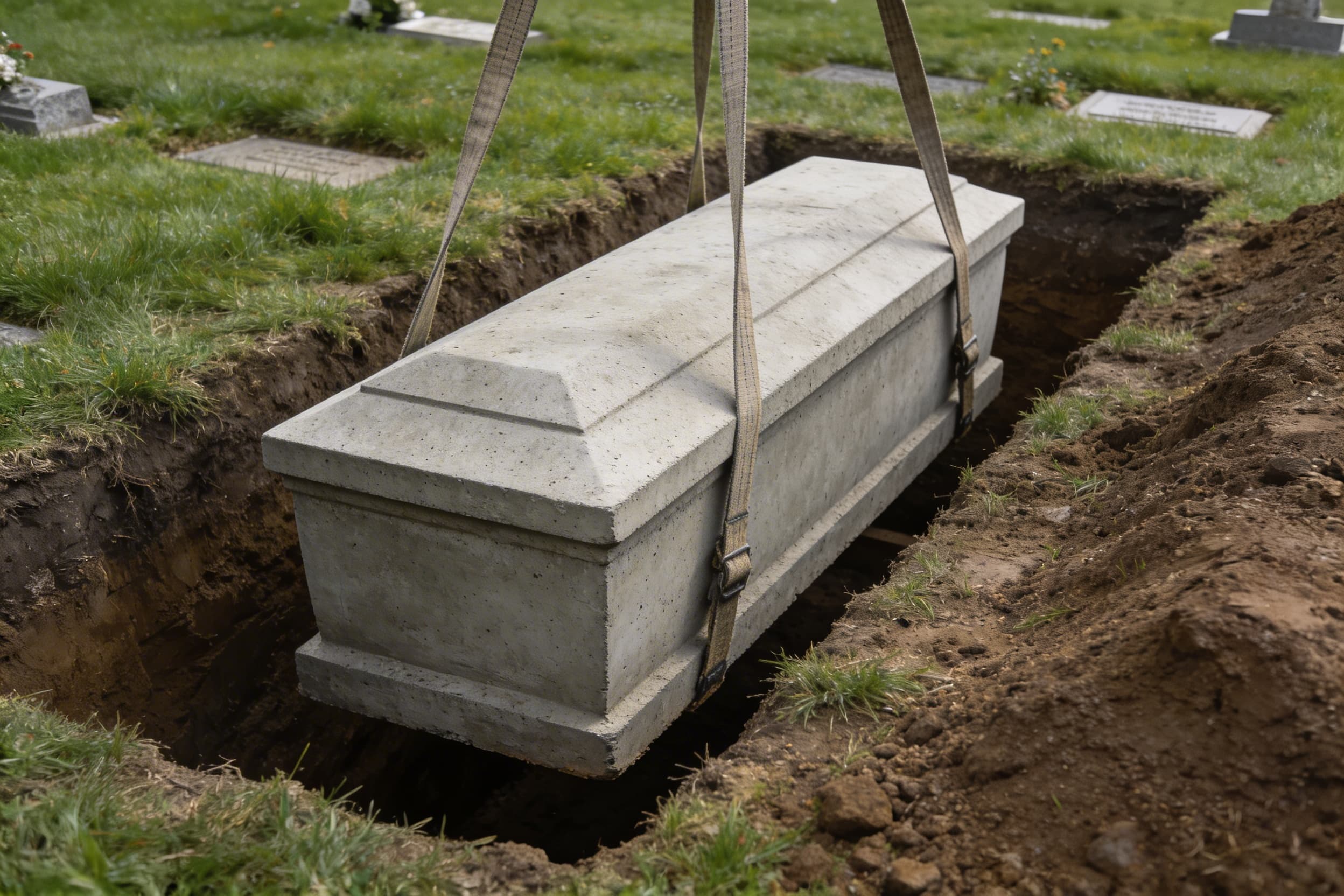
A burial vault is lowered into the excavated grave before the casket arrives. Once the casket is placed inside, a heavy lid is set on top to seal the unit. The vault's walls, floor, and lid create a continuous barrier around the casket, resisting downward soil pressure and preventing groundwater from reaching the exterior of the casket itself.
Most modern vaults are manufactured using a pre-cast concrete process. High-strength concrete — typically rated at 5,000 PSI or above after 28 days of curing — is poured into molds reinforced with wire mesh or rebar. After curing, the vault is transported to a storage facility until a cemetery requests delivery.
The sealed design is what separates a burial vault from a simpler outer burial container. A true vault uses a tongue-and-groove joint between the base and the lid, often enhanced with a gasket or butyl sealant, to resist water intrusion from all six sides.
Burial Vault vs. Grave Liner: What Is the Difference?
The two terms come up together so often that many families assume they mean the same thing. They do not.
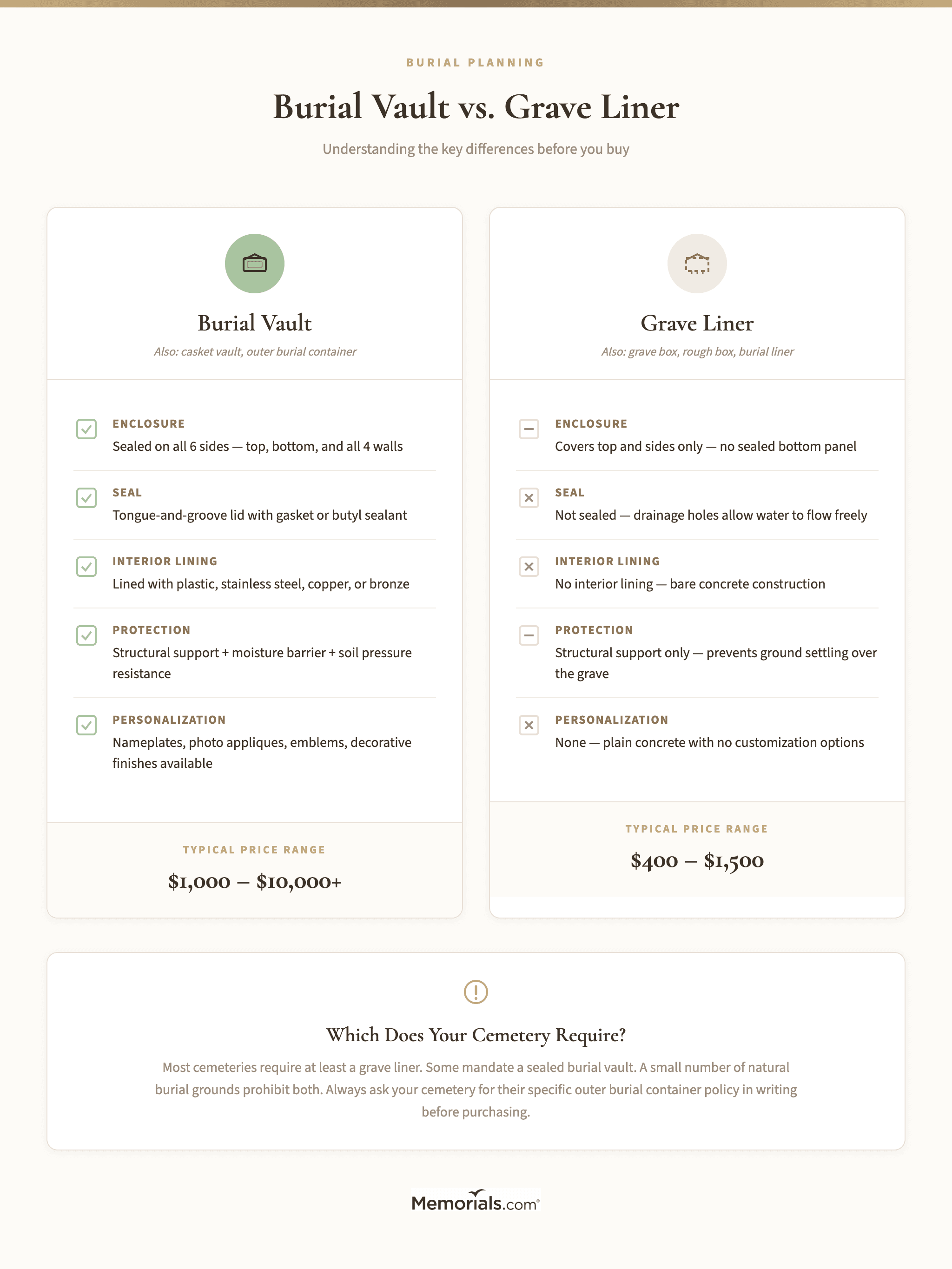
A grave liner (sometimes called a grave box or rough box) is an unsealed concrete shell that covers the top and sides of the casket. It usually has drainage holes in the bottom, which means groundwater can flow freely in and out. Its only job is structural: it prevents the ground above the casket from settling into a visible depression as the casket deteriorates over time.
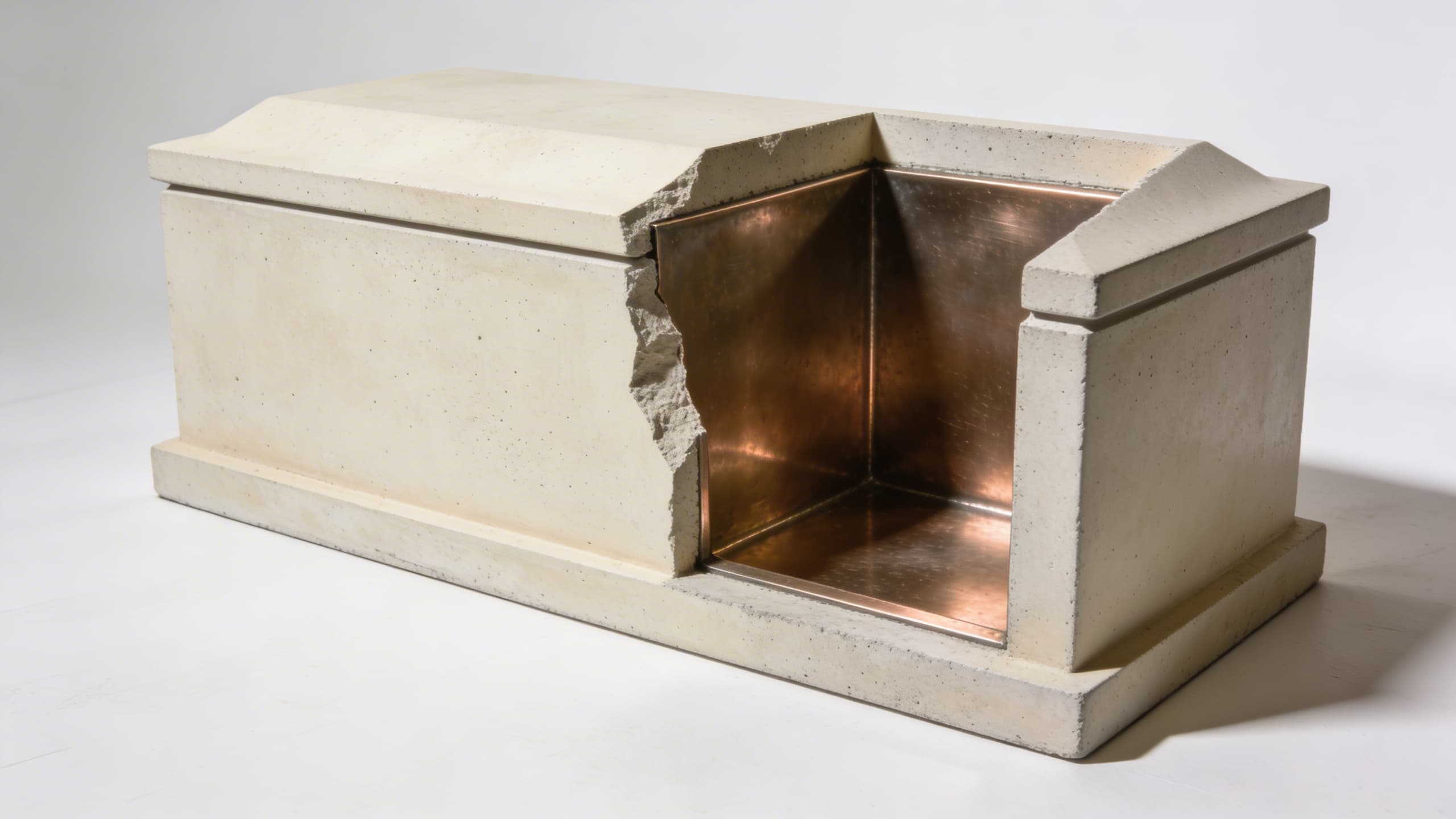
A burial vault does everything a grave liner does and more. It encloses the casket on all six sides — top, bottom, and all four walls — and is sealed against moisture. Interior linings made from materials like ABS plastic, polystyrene, stainless steel, copper, or bronze add an extra layer of protection and often determine the vault's price tier.
The practical takeaway: a grave liner satisfies the structural requirement that most cemeteries enforce, while a burial vault provides both structural integrity and environmental protection for the casket.
Why Do Cemeteries Require Burial Vaults?
Cemetery vault policies exist for maintenance and liability reasons, not legal ones. In most U.S. states, no law requires an outer burial container for burial. The requirement comes from individual cemetery rules, and nearly every modern cemetery enforces some version of it.
Without an outer container, a wood or metal casket underground will eventually weaken and collapse under the weight of the soil above it. When that happens, the earth settles into a noticeable depression — sometimes several inches deep. Sunken graves create tripping hazards, complicate mowing and landscaping, and require the cemetery to haul in fill dirt repeatedly. A vault or liner prevents this cycle by maintaining structural support long after the casket itself would have failed.
Some cemeteries accept either a vault or a liner. Others mandate a sealed vault specifically. A few — particularly green burial grounds — prohibit vaults entirely, requiring only a biodegradable casket or shroud placed directly in the earth. The only way to know your cemetery's rule is to ask. Request the requirement in writing before you purchase anything, because policies can differ even between sections within the same cemetery.
For a broader look at what cemeteries regulate beyond vaults, our guide to understanding cemetery regulations covers marker sizes, material restrictions, and decoration policies.
Types of Burial Vault Materials
Burial vault construction falls into three broad categories, each offering a different balance of protection, longevity, and cost.
Concrete vaults are the most common choice in the United States. A basic unlined concrete vault provides solid structural protection at the lowest price point. Lined concrete vaults add an interior shell — typically ABS plastic or polystyrene — that creates a secondary moisture barrier between the concrete and the casket. Premium concrete vaults use metal linings (stainless steel, copper, or bronze) for maximum protection and are often finished with decorative exteriors.
Metal vaults are constructed entirely from steel, stainless steel, or occasionally copper or bronze. They are lighter than concrete, resist corrosion, and offer excellent water resistance. Steel vaults tend to fall in the mid-range of pricing, while bronze vaults sit at the top tier.
Polymer and fiberglass vaults are a newer option. Lightweight and resistant to water and soil chemicals, they are gaining traction in regions where soil conditions are particularly wet or acidic. Their long-term track record is shorter than concrete, but manufacturers rate them for the same multi-decade protection window.
What About Cremation? Do Urns Need a Vault Too?
If your family has chosen cremation and plans to bury the urn in a cemetery, many cemeteries require an urn vault — a smaller version of the same concept. An urn vault protects the cremation urn from soil pressure and prevents ground settling over the much smaller burial space. Urn vaults are typically made of polymer, concrete, or cultured marble and cost significantly less than full-size casket vaults.
Our detailed guide on urn vault requirements for burial covers sizing, material options, and how to confirm what your specific cemetery requires before you buy.
For families comparing cremation-specific vault styles, dimensions, and cost ranges, our guide on types and sizes of cremation vaults walks through every option available.
How Much Does a Burial Vault Cost?
Burial vault prices vary widely depending on the material, liner type, and level of customization. Here is a general range based on current industry pricing:
Grave liners (unsealed, no bottom): $400–$1,500. These satisfy the minimum structural requirement at most cemeteries.
Basic concrete vaults (unlined or plastic-lined): $1,000–$2,000. Standard protection with a sealed design. This is the most popular choice for families balancing protection with budget.
Mid-range concrete vaults (metal-lined): $2,000–$4,000. Stainless steel or copper linings add meaningful moisture resistance and durability.
Premium vaults (bronze-lined concrete or solid metal): $4,000–$10,000+. These provide the highest level of protection and often include decorative exteriors, custom nameplates, and emblem options.
Beyond the vault itself, expect additional fees. Vault delivery to the cemetery typically runs $100–$400. Installation — setting the vault in the grave and sealing the lid after the casket is placed — is usually included in the cemetery's opening and closing fee, which ranges from $500–$1,500 depending on the cemetery. Some cemeteries charge vault handling as a separate line item.
When budgeting for a burial, the vault is one of several costs that add up alongside the plot, the casket, the headstone, and service fees. For a full breakdown of cemetery costs, our pricing guide covers every expense families should plan for.
Do You Legally Need a Burial Vault?
In the vast majority of U.S. states, no law requires a burial vault or any outer burial container. The Federal Trade Commission's Funeral Rule requires funeral homes to disclose this fact. If a funeral director tells you a vault is "required," ask whether that requirement comes from state law or from the specific cemetery's policy. In almost every case, it is a cemetery policy.
That said, cemetery policies carry real weight. If the cemetery where your loved one will be interred requires a vault, you must comply to proceed with burial at that location. Refusing the vault means choosing a different cemetery — which is an option, but not always practical when a family plot or religious cemetery is involved.
A small but growing number of natural burial grounds reject vaults entirely. These cemeteries are designed to allow natural decomposition, so they permit only biodegradable containers or shrouds with no outer burial container at all.
How to Choose the Right Burial Vault
Selecting a vault comes down to three factors: what the cemetery requires, what level of protection matters to your family, and what fits your budget.
Start with the cemetery. Call the cemetery office and ask: Do you require a vault, a liner, or either? Do you mandate a specific brand or type? Are there restrictions on vault size or material? Get the answers in writing.
Decide on protection level. If meeting the minimum requirement at the lowest cost is the priority, a basic concrete grave liner or unlined vault will do the job. If long-term protection from moisture and soil chemicals matters to you, a lined or sealed vault is worth the upgrade. There is no wrong answer — this is a values-based decision, not a technical one.
Compare prices carefully. Under the FTC's Funeral Rule, funeral homes must provide an itemized price list for outer burial containers when you ask. You are not required to buy a vault from the funeral home — you can purchase one from the cemetery or from a third-party provider, though shipping costs for a 2,000-pound concrete vault can be significant.
Personalizing a Burial Vault
Modern burial vaults offer more personalization than most families expect. Many manufacturers allow custom features including:
Nameplates engraved with the loved one's name, dates, and a short phrase or scripture verse. Photo appliqués — full-color images printed onto the vault lid, visible during the graveside service before the vault is sealed. Emblems and insignias for military service, fraternal organizations, or religious affiliation. Decorative exteriors with hand-painted finishes, marble-look textures, or sculpted designs on the lid.
These customization options add to the cost — often $100–$500 per feature — but they allow the vault to serve as one more expression of a life lived, even though it will not be visible after burial. Some families find comfort in knowing the entire burial environment reflects their care.
Frequently Asked Questions
Is a burial vault the same as a casket vault? Yes. "Casket vault" and "burial vault" refer to the same product — a sealed outer container that encloses the casket underground. "Outer burial container" is the broader term that includes both sealed vaults and unsealed grave liners.
Can you be buried without a vault? In most states, yes — no law prevents it. However, most cemeteries enforce their own vault or liner requirement. Natural burial grounds are the main exception, as they typically prohibit vaults to allow natural decomposition.
How long does a burial vault last? A quality concrete vault can last 50 years or more. Premium lined vaults with metal or polymer interiors are designed to provide structural and moisture protection for several generations, though no manufacturer guarantees indefinite preservation.
Does the VA provide burial vaults for veterans? The Department of Veterans Affairs does not provide or pay for burial vaults. Veterans buried in national cemeteries receive a gravesite, opening and closing of the grave, headstone or marker, and a burial liner at no charge. If a family wants a sealed vault instead of the standard liner, they pay the difference.
What is the difference between a burial vault and a mausoleum? A burial vault is an underground container placed in a grave. A mausoleum is an above-ground structure with interior compartments (crypts) where caskets are placed. Both protect the casket from the elements, but they serve completely different burial formats.
Making the Decision
Whether or not a burial vault is right for your family depends on cemetery requirements, your personal values around casket protection, and the budget you have set for the burial as a whole. For many families, a basic concrete vault meets the cemetery's policy and provides decades of structural support at a reasonable price. Others find peace of mind in a higher level of protection.
Whatever you decide, getting the cemetery's specific vault policy in writing before you begin shopping is the single most useful step you can take. It narrows your options to what is actually accepted, eliminates guesswork, and puts you in control of the conversation when a funeral provider presents their price list.