🏬Supersize Online Funeral Retailer🪦1000's of Headstones⚱️Over 10,000 Cremation Urns⚰️Caskets Overnight Delivery🛒Funeral & Memorial Superstore🚚FREE Shipping on ALL Orders👨👩👧👦Helping Families for over 20 Years💰Lowest Price Guarantee🏬Supersize Online Funeral Retailer🪦1000's of Headstones⚱️Over 10,000 Cremation Urns⚰️Caskets Overnight Delivery🛒Funeral & Memorial Superstore🚚FREE Shipping on ALL Orders👨👩👧👦Helping Families for over 20 Years💰Lowest Price Guarantee
🏬Supersize Online Funeral Retailer🪦1000's of Headstones⚱️Over 10,000 Cremation Urns⚰️Caskets Overnight Delivery🛒Funeral & Memorial Superstore🚚FREE Shipping on ALL Orders👨👩👧👦Helping Families for over 20 Years💰Lowest Price Guarantee🏬Supersize Online Funeral Retailer🪦1000's of Headstones⚱️Over 10,000 Cremation Urns⚰️Caskets Overnight Delivery🛒Funeral & Memorial Superstore🚚FREE Shipping on ALL Orders👨👩👧👦Helping Families for over 20 Years💰Lowest Price Guarantee
The cost of cremation in Alaska starts from one published number: $1,795 for a direct cremation. That is the only price list we could find published anywhere in the state in 2026, and it sits close to the national median of $1,925 across all fifty states.
One document is the practical problem here. Alaska families cannot comparison-shop from a screen the way families elsewhere can, so what you pay depends far more on which kind of firm you call, and how far your loved one has to travel, than on which of two websites looked cheaper. So this guide covers what a direct cremation price does and does not buy, and the difference between the two kinds of business that sell cremation here — because that choice, more than any comparison, is what sets the bill.
The Published Alaska Price
Of all the Alaska cremation price lists published online in 2026, we found one. It prices a direct cremation with a container provided at , and that is the whole of what is published in this state.
One price list is the whole published record for the state. Asked how much does cremation cost in Alaska, that document is the only sourced answer anyone in the state can point you to today, and everything below it on this page is about how to get a second number by telephone. It is also a price as published rather than a quote: a price list carries an effective date and changes, so confirm the figure before you commit.
A single price is not a market and we are not going to present it as one. There is no Alaska range on this page, no median and no average, because one document cannot produce any of them. When somebody quotes you an average cost of cremation in Alaska, ask them what it is an average of.
Two things about that $1,795 are worth knowing before you use it as a benchmark.
It is over three years old on its face. The price list is dated February 2023. It is the most recent published Alaska figure we could find, so it is a real price — but it is not a 2026 quote, and only a phone call will tell you what the number is today.
A figure on a web page and a figure on a price list are not the same thing. A web page describes a package in a sentence; the general price list is the itemized document, and the same quoted number can cover different items on the two. So ask for the price list rather than reading a price off a website. Federal law entitles you to it, and our guide to the general price list explains what it must contain and what you may demand.
What the Price Includes, and What to Ask
Price lists describe what they cover inconsistently. The crematory fee, the first transfer into the provider's care, and the container each sit inside the quoted figure on some lists and on a separate line on others, and a permanent urn is almost never inside a direct cremation price anywhere. None of that makes a list wrong — it makes two quoted numbers impossible to compare until you have both itemizations in front of you. Which is the practical point here: the comparison is a phone call, not a browsing session.
So ask for the numbers in this order, and ask for them as line items:
What is in the quoted direct cremation figure, item by item?
Is bringing your loved one from the place of death inside it, or billed separately?
Is the crematory fee inside it, or a pass-through?
Is any permit or filing fee inside it?
What container does the price assume, and what does the next one up cost?
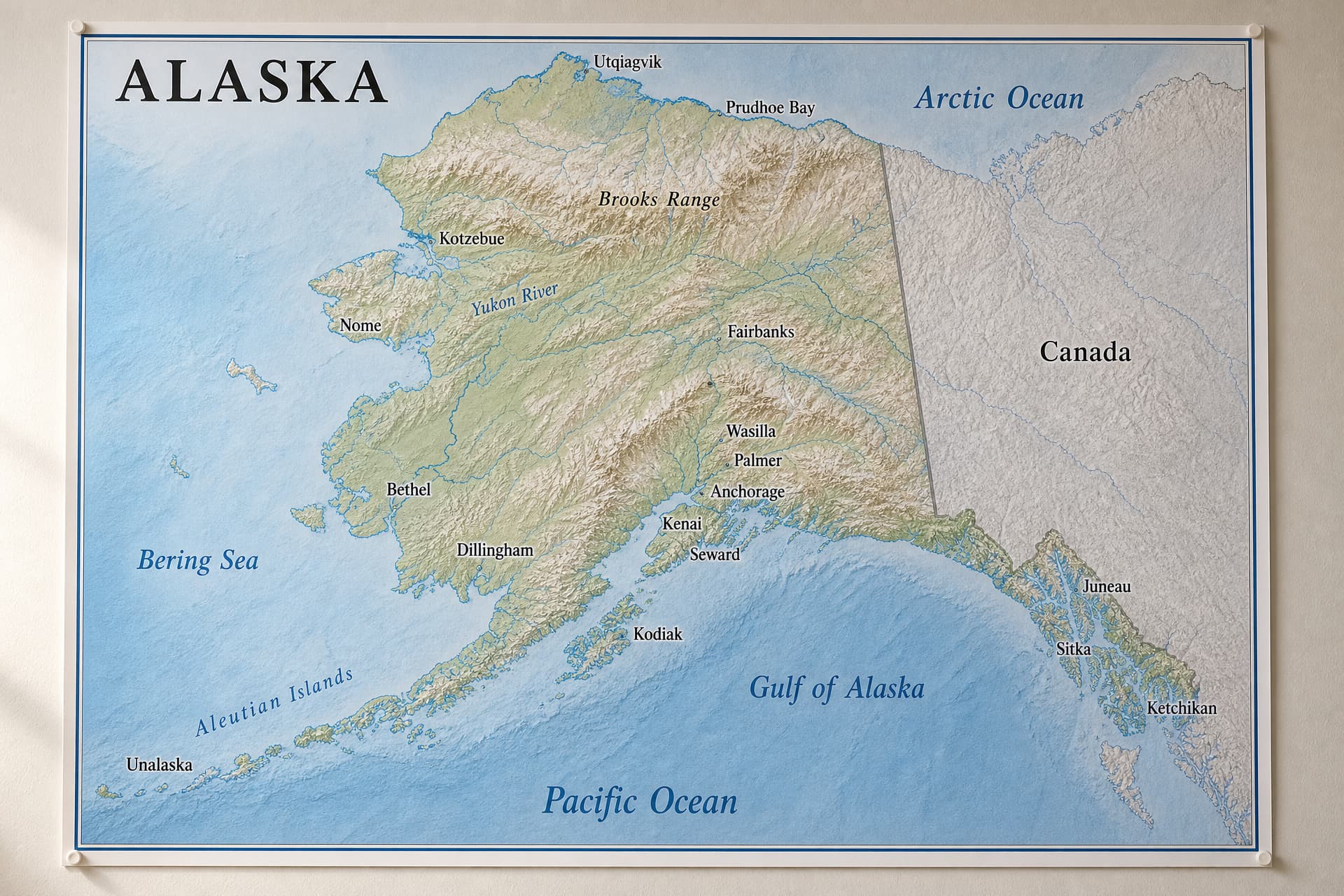
The scale of the problem. The one published Alaska price list covers a single pocket of this map. We could find no published prices at all — and often no web presence at all — for Sitka, Kodiak, Nome, Bethel, Valdez, Cordova, Unalaska, Utqiagvik, Dillingham, Petersburg or Wrangell, so nothing on this page describes what a cremation costs in those communities.
Urns for After a Direct Cremation
The one Alaska price list names a temporary urn, not a permanent one
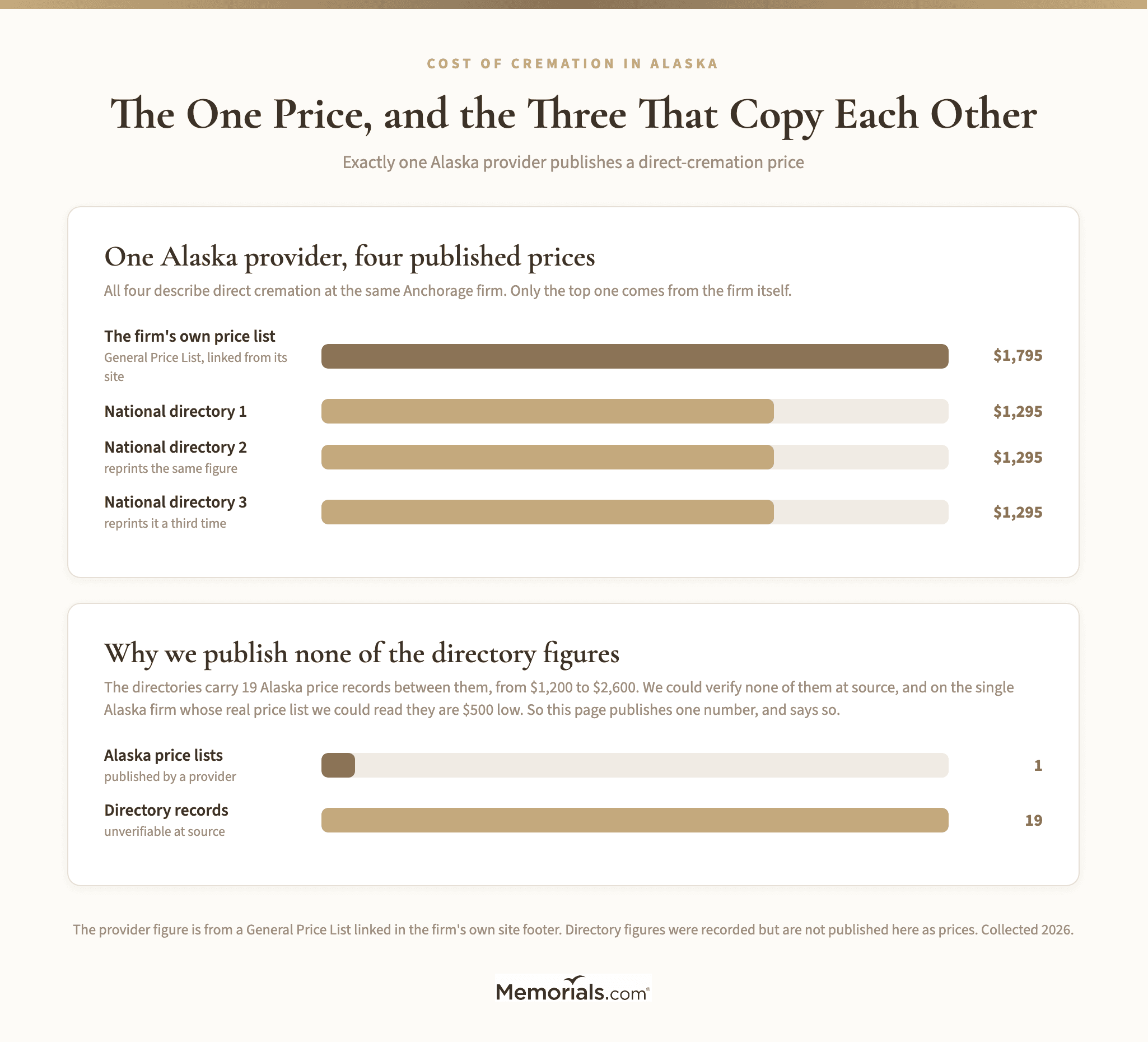
Search for how much is cremation in Alaska and you will get numbers. They come from national funeral-price directories — the comparison sites that collect and republish prices for funeral homes they have no part in running — and there is exactly one published Alaska price to check them against.
On that single checkable figure, three national directories are $500 low. All three print the same wrong number, which is what you would expect from one figure copied twice rather than three independent measurements.
The only Alaska price that can be checked against a published price list, set beside what three national directories print for it. They disagree by $500 — which is why we do not publish the directories' figures for the rest of the state.
Those same directories carry nineteen Alaska price records between them, ranging from $1,200 to $2,600. We are not publishing any of them as prices: none can be verified at source, the only one that could be checked was wrong, and the listings carry other errors — out-of-state funeral homes filed under Alaska towns, a city that does not exist, and a pet aquamation business listed as a human cremation provider.
That is not a claim that anybody is being dishonest. A directory is a scraped aggregation, and Alaska is the hardest state in the country to scrape, because there is so little published to scrape. Treat a directory figure as a hint that a provider exists, then call and ask for the price list.
A Cremation Society or a Funeral Home: The Choice That Sets Your Price
The largest single difference in what an Alaska family pays is not which firm they call. It is which kind of firm they call, and there are two.
A cremation-only provider sells one thing. It owns or contracts a retort, arranges almost everything by phone or online, and has no chapel and no viewing rooms. Its price list is short because its business is short: bring your loved one into its care, file the paperwork, cremate, return the ashes. Firms of this kind set the floor of the price range in every state we looked at, and they are also the firms most likely to publish a number at all. Alaska's one published price list belongs to exactly this kind of business.
A full-service funeral home sells a building and a staff as well. It has a chapel, viewing rooms, refrigeration and preparation facilities, vehicles, and people on call at three in the morning. Direct cremation appears on its price list as one line among dozens. Firms of this kind occupy the middle and the top of the range, and in Alaska they are the overwhelming majority of the market — we could not find a published price from any of them.
The cheaper firm is not undercutting anybody — it is selling less. The chapel, the staffed hours, the fleet and the preparation room are real costs, carried by the services a full-service firm actually sells. Buy a direct cremation from a funeral home and that line has to help carry a building you did not use; buy it from a cremation-only provider and there is no building to carry. The gap is not a discount and it is not a markup. It is a different product.
And the cheaper product cannot do some things at any price. A firm with no chapel and no viewing room cannot hold a viewing, and a firm with no preparation room cannot make your loved one ready for a service beforehand. There is no graveside committal either, and no straightforward change of mind to burial once you have engaged a provider set up only for cremation.
Which is why the decision comes before the comparison. Decide first whether the family will want time with your loved one, a service with them present, or the option of burial. If the answer is no, a cremation-only provider is the right kind of firm and price is a fair way to choose between them. If the answer is yes, the two quotes are for two different purchases — and the cheaper one cannot give you the viewing at any price.
In Alaska this matters more than elsewhere, because the cheap tier barely exists. Most of the state is served by full-service funeral homes, so there is less downward pressure on price, fewer firms with a reason to publish one, and a real chance that the nearest cremation-only provider is not in your community at all.
What Actually Drives an Alaska Cremation Bill
Once you know which kind of firm you want, the rest of the Alaska bill is mostly geography.
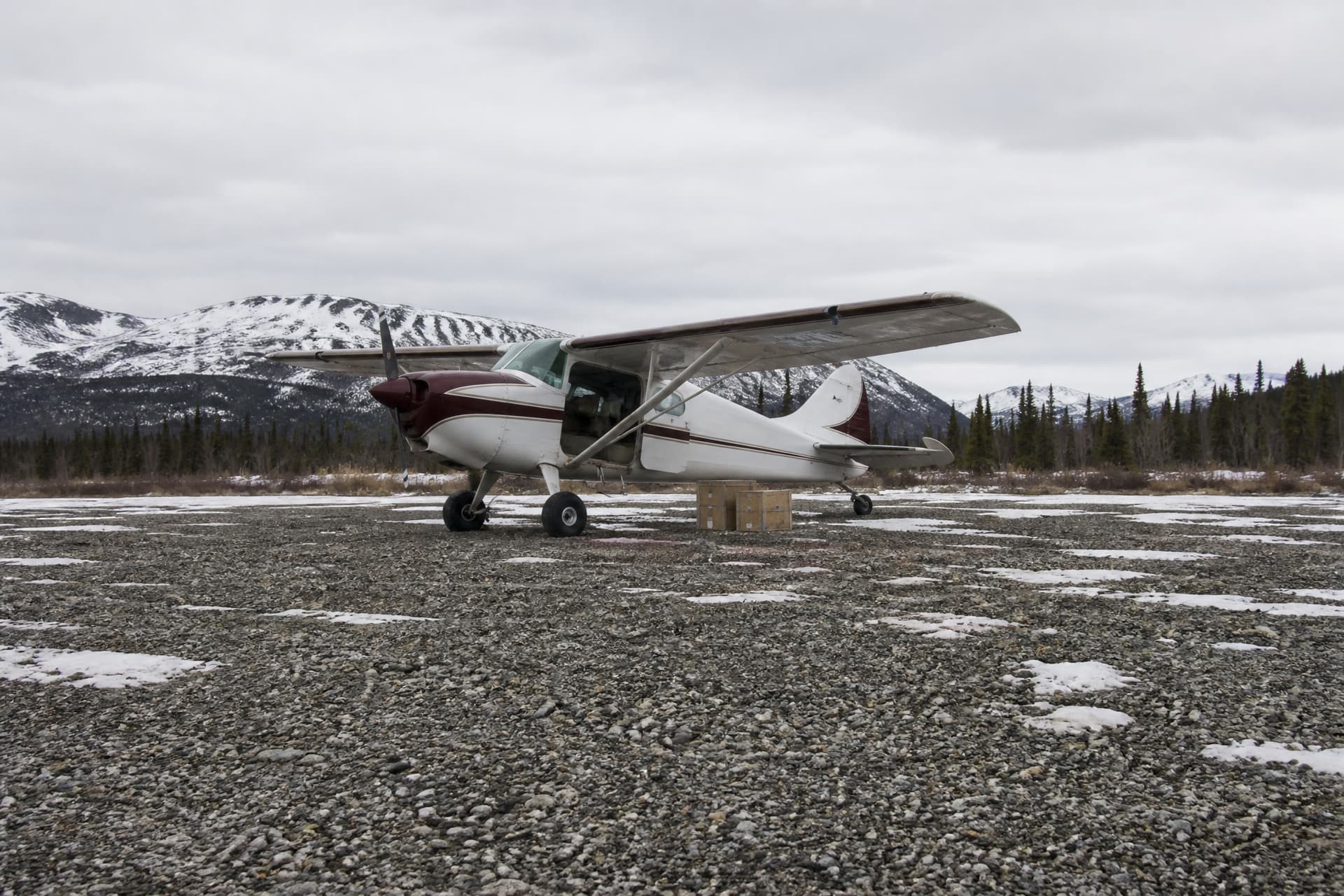
Transport is the largest variable, and it is not always yours to pay. In a state where a death may occur hundreds of air miles from the nearest crematory, bringing your loved one there is the cost that separates one Alaska cremation from another. No published price list can quote it in advance, because it depends on where the death occurred, and no directory can either. It is a number you have to ask for.
One Alaska cost will not appear on any price list, because it is not a provider charge. Where a death falls under the State Medical Examiner's jurisdiction, the state charges the family nothing — nothing for the examination, nothing for bringing your loved one to the state facility, and nothing for the return to the community nearest the death. The family pays only for onward transport from there and for the funeral home's own services. In a state this size that is the single largest item in a cremation bill, and in these cases it is publicly absorbed. If you are in that situation, know it before you start comparing transport figures.
The medical examiner also holds remains until the examination concludes and releases them only after the family submits a signed Release Authorization. If no authorization arrives within ten days, the remains go to a rotation funeral home as unclaimed. That is a deadline worth knowing.
Weather is the other Alaska variable. Ask what happens to the quoted price if a flight is delayed, and get the answer in writing alongside the transport figure.
There is help for low-income families, and we could not price it. The State of Alaska publishes a Burial Assistance Application (form GEN-60), and the medical examiner's office says the Division of Public Assistance may provide aid where the deceased qualifies. We could not retrieve the benefit amount or the eligibility rule, so we will not print a figure. It is worth a phone call.
In most states the biggest variable in a cremation bill is which firm you call. In Alaska it is how far your loved one has to travel. Where the State Medical Examiner takes jurisdiction, the state pays for that flight and for the return — a cost families are rarely told is covered.
Alaska Cremation Laws That Affect Cost
Alaska's law is thinner than most states' on cremation specifically, and we are going to be careful about the difference between "Alaska permits this" and "we could not find a rule."
Who may authorize. Alaska lets a person set out directions in a disposition document — AS 13.75.010: "A person may provide directions for the person's remains by placing the directions in a disposition document." Absent one, AS 13.75.020 sets the priority: a designated disposition agent, then a personal representative following written instructions in a will, then the surviving spouse, then adult children, then parents, then onward through the next degrees of kindred.
The permit that always applies. Alaska's Bureau of Vital Statistics issues a burial-transit permit, required under AS 18.50.250 for essentially every movement, holding or final disposition of remains in the state, and for a public funeral — but not where the State Medical Examiner takes jurisdiction. We could not establish the fee; the state's own service page does not state one, so we are not printing a number. Ask whether your provider's quote includes it.
On the widely repeated "48-hour waiting period" — we found no statute, and we are not repeating the claim. A national directory states that Alaska has "a mandatory 48-hour waiting period unless waived by a medical examiner," and cites nothing. We could not find it in Alaska statute in either direction, so we will not tell you Alaska has a waiting period and we will not tell you it has none. If the timing matters to your plans, ask the provider to point at the rule.
No casket is required. The federal Funeral Rule governs: a provider offering a direct cremation must make an alternative container available, and you may supply your own. The one published Alaska price list carries that minimum alternative container at no charge.
On scattering, home funerals and family-directed disposition, we have nothing verified to tell you. We looked for an Alaska statute or regulation on scattering cremated remains and did not find one; not finding a prohibition is not the same as finding permission, and we are not going to convert one into the other. The same applies to whether an Alaska family may conduct a funeral without a licensed director — AS 08.42.010 gives the state jurisdiction over the practice of mortuary science, and we could not verify whether families are exempt. Our general guide to scattering ashes laws and etiquette covers the federal position on scattering at sea, which does apply in Alaska waters.
How to Approach the Cost in Alaska
Call, and ask for the general price list by name. Federal law requires every funeral provider in the country to give you an itemized price list and to quote prices over the phone, whether or not they publish anything online. Alaska providers largely do not publish. They still have to tell you. This is the state where that right is worth the most.
Decide the kind of service first, then the firm. A viewing, a service with your loved one present, or the possibility of burial rules out the cheapest tier before price enters the conversation. Deciding it first also stops you comparing two quotes that were never for the same thing.
Get three quotes even though it is harder here. Alaska has fewer providers per community than anywhere else in the country, but the larger population centers have enough of them that a real comparison is possible.
Ask what transport costs from where the death occurred, separately from everything else. Then ask whether the medical examiner has taken jurisdiction, because if so the state has already paid for the longest leg.
And arrange it in advance if you can. Alaska's shortage of published prices is exactly the condition under which advance planning is worth most: the comparison is slow work, and it is not work a grieving family can do in a day.
Choosing an Urn
A direct cremation price almost never includes a permanent urn; what comes back is a temporary container. The vessel is a separate decision, made afterwards, at home, with no funeral director in the room. That is the one part of this process where an Alaska family has exactly the same choice as a family anywhere else.
If you want the fuller version of that decision, how much a cremation urn costs works through materials and price bands, and our full range of cremation urns is organized by how you plan to keep them.
Frequently Asked Questions
What is the cost of cremation in Alaska? One Alaska price list is published, and it says $1,795 for a direct cremation. We could not find a second published Alaska price, so there is no Alaska range, median or average we are willing to print. The national median across all fifty states is $1,925.
Is a cremation society cheaper than a funeral home? Usually, and the reason is what each one sells. A cremation-only provider has no chapel, no viewing rooms and no staffed hours to pay for, so its direct cremation price carries less — but it cannot hold a viewing, a service with your loved one present, or a burial if the family changes its mind. Decide which of those you need before you compare prices.
Why do other sites show a different Alaska cremation cost? Because they are reprinting directory data. On the single Alaska figure that can be checked against a published price list, three national directories are $500 low.
Is there a waiting period before cremation in Alaska? We do not know, and we would rather say so. A widely reprinted claim of a mandatory 48-hour wait cites no statute, and we could not find one in Alaska law. Ask your provider to point at the rule.
Does Alaska charge for the medical examiner? Not to the family. Where the State Medical Examiner takes jurisdiction, the state covers the examination, the journey to the state facility, and the return to the community nearest the death. The family pays for onward transport and the funeral home's services.
Do I have to buy a casket for a cremation in Alaska? No. The federal Funeral Rule requires providers to make an alternative container available, and the one published Alaska price list carries its minimum alternative container at no charge.
Can I scatter ashes in Alaska? We could not find an Alaska statute or regulation on scattering, and we are not going to tell you it is permitted on the strength of not having found a prohibition. Federal rules apply at sea. For anything on land, ask the landowner and the relevant agency.
In Short
There is one published cremation cost Alaska families can look up, and it is $1,795 on a price list dated 2023. That is the whole of the verifiable cremation cost in Alaska; the national directory figures could not be checked at source, and on the one that could be, they were $500 low.
What decides the cost of cremation Alaska families actually pay is which kind of firm they call and how far your loved one has to travel. Settle the first before you shop: a cremation-only provider sets the floor and cannot hold a viewing, and a funeral home can do both but prices the building into everything it sells.
Then use the right federal law gives you: call and ask for the general price list, item by item. In a state where almost nobody publishes, that phone call is the whole comparison. And ask about transport first, because in Alaska it is the number that moves.