🏬Supersize Online Funeral Retailer🪦1000's of Headstones⚱️Over 10,000 Cremation Urns⚰️Caskets Overnight Delivery🛒Funeral & Memorial Superstore🚚FREE Shipping on ALL Orders👨👩👧👦Helping Families for over 20 Years💰Lowest Price Guarantee🏬Supersize Online Funeral Retailer🪦1000's of Headstones⚱️Over 10,000 Cremation Urns⚰️Caskets Overnight Delivery🛒Funeral & Memorial Superstore🚚FREE Shipping on ALL Orders👨👩👧👦Helping Families for over 20 Years💰Lowest Price Guarantee
🏬Supersize Online Funeral Retailer🪦1000's of Headstones⚱️Over 10,000 Cremation Urns⚰️Caskets Overnight Delivery🛒Funeral & Memorial Superstore🚚FREE Shipping on ALL Orders👨👩👧👦Helping Families for over 20 Years💰Lowest Price Guarantee🏬Supersize Online Funeral Retailer🪦1000's of Headstones⚱️Over 10,000 Cremation Urns⚰️Caskets Overnight Delivery🛒Funeral & Memorial Superstore🚚FREE Shipping on ALL Orders👨👩👧👦Helping Families for over 20 Years💰Lowest Price Guarantee
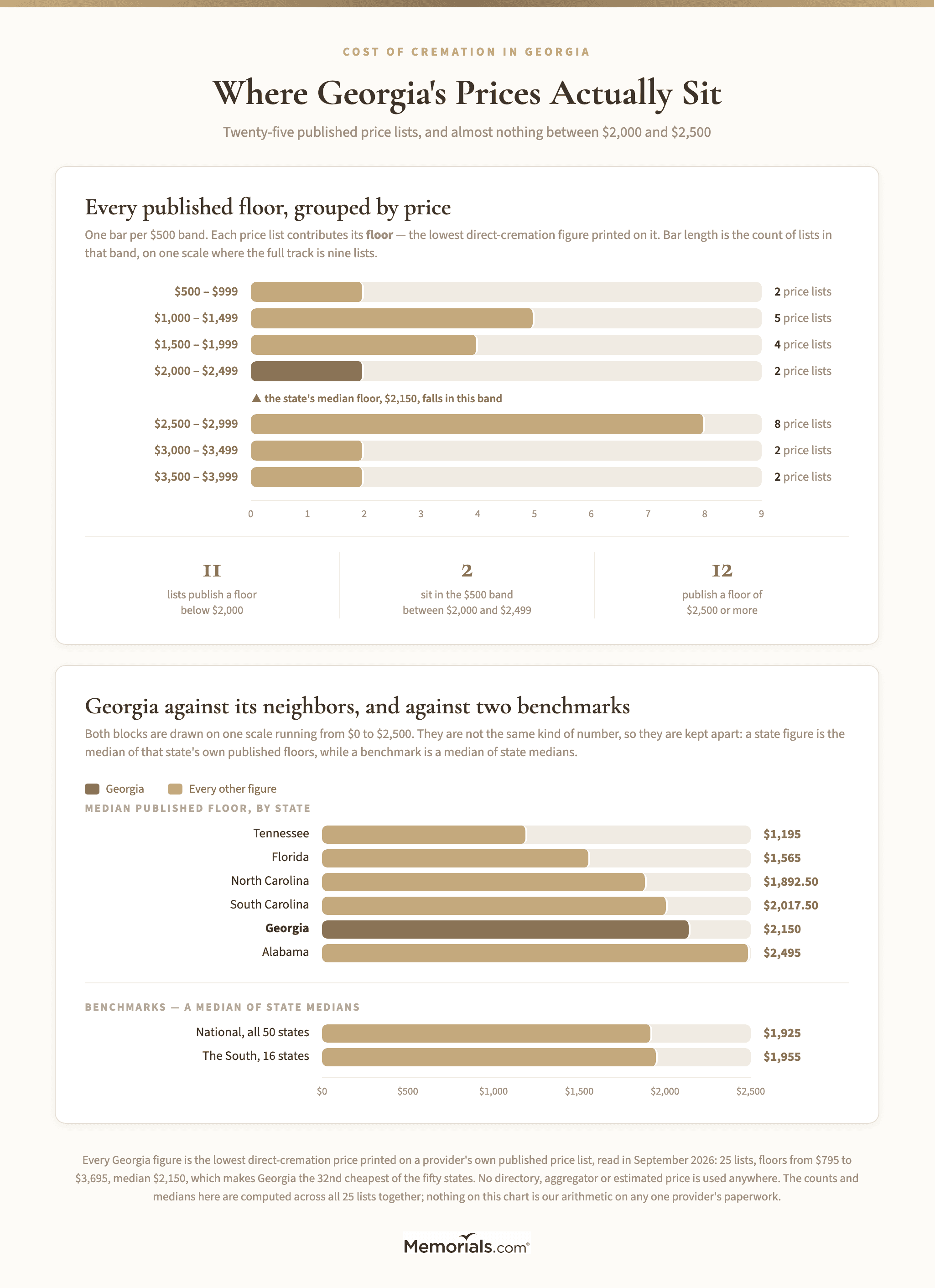
The cost of cremation in Georgia starts between $795 and $3,695 depending on who you call, with a median of $2,150. That comes from reading 25 published Georgia price lists in 2026 and taking the lowest direct-cremation figure on each one.
Ask how much is cremation in Georgia and you will be quoted a package price. Every cremation cost Georgia providers publish is a package, so what it contains decides what the number means. Georgia is the 32nd cheapest of the fifty states and the 11th cheapest of the sixteen in the South, $225 above the national median and $195 above its own region's. The map makes that awkward: four of its five neighbors are cheaper — Tennessee, the second least expensive state in America, is $1,195, Florida is $1,565, North Carolina $1,892.50 and South Carolina $2,017.50, and only Alabama, at $2,495, is more expensive. Cross the line at Chattanooga and the median drops by $955.
So cremation costs in Georgia divide sharply, and not by geography. The split is the kind of business you call: the same inclusion list — transport, cremation, refrigeration, a container, staff — sits near the bottom of the state's range at a cremation-only provider and near the top at a full-service funeral home with its own crematory.
What Cremation Costs in Georgia
The shape of the state, in five numbers:
Cheapest published floor: $795, at a cremation-only provider.
Median floor: $2,150.
Most expensive published floor: $3,695, at a full-service funeral home.
Georgia's national rank: 32nd cheapest of 50 states.
Georgia's Southern rank: 11th cheapest of 16.
Every figure here is a floor — the lowest direct-cremation price on the provider's own document, which usually assumes the family supplies the container or accepts the cheapest one on offer. It is one document per provider, so anything a firm explains elsewhere on its site or over the phone is not in front of us.
If a Georgia firm's prices are not on its website, ask for them. Federal law makes every Georgia funeral home hand you an itemized general price list and quote prices over the phone, but nothing requires them to publish one online, so the web is never the whole market.
Across the 25 price lists we read, the pattern is not the map. The cheapest published floors in the state belong to cremation-only operators; the most expensive belong to full funeral homes with a building to keep open.
Georgia's 25 published floors do not spread evenly. Eleven sit below $2,000 and twelve at $2,500 or more, with only two in the $500 band between them. The state median of $2,150 sits above the national median, above its own region's, and above four of its five neighbors.
Cremation Urns to Choose Later, at Home
A permanent urn is never part of a direct-cremation price -- it is a later decision, made at home
Cremation Services and Funeral Homes: Why One Is Cheaper
Almost all of the $795-to-$3,695 spread comes from one thing: the firms at the bottom of Georgia's range and the firms at the top are not the same kind of business. They perform an identical cremation. They are selling very different amounts of everything else.
A cremation-only provider owns or contracts a retort and sells little besides. Several arrange entirely by phone or online, there is no chapel to walk into, and the price list is short because the product list is short. Providers like these fill the lower half of Georgia's range and set the state's floor at $795.
A full-service funeral home is a building. Viewing rooms, an arrangement office staffed through the weekend, a fleet, a licensed director on site — and direct cremation as one line on a list that also runs to visitations, graveside services and burials. Firms of that kind occupy the middle and the top of the range, up to the state's highest published floor of $3,695.
The cheaper firm is not undercutting anyone. It is selling less. The chapel, the staffed hours and the salaried director are real costs, and they are carried by the services that firm does sell.
What the cheaper option cannot do is the part families discover late. A viewing, a service with your loved one present, an open-casket goodbye, a change of mind to burial — a firm with no chapel and nowhere to care for your loved one beforehand cannot arrange those at any price. So decide first whether the family will want time with your loved one. That answer, not the price, decides which kind of firm you are calling, and a family that picks on price and settles the service afterwards frequently pays twice.
Georgia does not draw the line with a license. § 31-21-5 and Ga. Comp. R. & Regs. r. 250-6-.01 license the crematory facility, and the rules we read hold no Georgia equivalent to Florida's separately licensed direct disposal establishment. Here the difference is business model rather than credential.
Geography explains less than it looks like it does. Every floor under $1,750 in the state sits in one of two metro areas — not because those markets are cheap, but because that is where the cremation-only operators are. Statewide operators quote a single flat rate at every branch they run, well under the state median, so a family in a small market can often buy at metro prices simply by calling one.
The most expensive line is often not the cremation. A handful of Georgia lists include the cremation fee in the package and then offer no container cheaper than a cremation casket — so a family that does not supply its own container is buying two large numbers, not one. Ask what the least expensive container costs before you compare two packages.
The ceiling is a box, not a service
Georgia's lists print some very large direct-cremation numbers, several of them into five figures, and we publish none of them. None is a service price. The federal Funeral Rule makes the direct-cremation line disclose the price with every container the firm stocks, from a fiberboard box to a hardwood casket, so the top of a printed range is the casket and nothing else — the same cremation with a different box around it. This page therefore publishes the range of floors across providers, never the span to the most expensive ceiling. Our national cremation cost by state guide explains the mechanism at length.
Georgia's version is unusually sharp, because on a few lists the cheapest container on offer is a casket. A package can itemize cleanly — basic services, removal, the cremation fee genuinely inside it — and then state that the only alternative containers stocked are cremation caskets. A family that does not supply its own container is buying both of those numbers, and the second can be larger than the first.
Two live documents, two prices, one firm
Several Georgia providers publish more than one live price for the same cremation, and the cheaper one is rarely the document handed over first. A general price list and a separately published package sheet can differ by a couple of hundred dollars for an identical service, sometimes with the container included on the cheaper of the two. Discounts hide the same way: a one-time membership fee, or a requirement to arrange online rather than in person, can sit behind a headline number that looks like the state's best. And a document can carry an effective date years in the past while remaining the current one on the firm's own website.
So ask for both documents — the itemized general price list and any package or simple-cremation sheet — and read the effective date on each. Neither is discoverable from the other.
What Is Included, and What Is Not
A cremation cost in Georgia is a package price, and the package is where the difference lives. Georgia's lists describe what they cover inconsistently, which is exactly why the itemized list is the thing to ask for.
Start with the cremation itself. It sounds absurd to have to ask, and Georgia's documents make it necessary anyway. Several lists we read name "transportation to the crematory" among the things the price covers and stop there — standard Funeral Rule form language, and moving your loved one to a crematory is not the same purchase as operating the retort. Other firms settle it in plain words and say the crematory fee is included. Where the document does not answer the question, the phone call has to.
Refrigeration is the second thing to ask about, because the charge when it sits outside the package is real. Some Georgia lists include it outright, some include the first day or the first several days and then bill by the day, and some bill from the start; where it is billed separately the daily rate runs around $50 to $75.
Then ask what else sits outside the headline. The charges that recur across Georgia's lists are certified death certificates, each with a fee, plus a service fee to collect and mail them; home-call and after-hours removal; mileage beyond a transfer radius, at $2.75 to $5.00 a mile with radiuses running from 25 to 75 miles; identification viewing; expedited cremation; weekend and holiday surcharges; mailing the ashes; card processing fees of 3% to 3.5%; and a surcharge above a stated weight, which some Georgia firms say plainly that they do not charge at all.
Our guide to how many death certificates you need is worth reading before you order them, because the per-copy fee compounds faster than families expect.
What the state charges on top: we could not establish it, and will not print a number
Most state pages on this hub can tell you the government's own fee. Georgia is one where we cannot.
O.C.G.A. § 31-10-20 requires a disposition permit for cremation or removal from the state and states no fee for it, and we found no permit price on the Georgia Department of Public Health's vital records pages. So a chargeable step exists — Georgia providers routinely bill "permits and authorizations" inside the price and file them for you — but we found no statute and no published schedule setting a Georgia permit price, so we are not printing one.
Georgia fee figures do exist in statute, and none of them is a cremation charge a family pays. § 45-16-27 entitles a coroner to an investigation fee of $175, or $250 where a jury is impaneled, paid from the county treasury; § 45-16-25 likewise puts the cost of embalming or refrigeration ordered by a medical examiner on the county. Quoted without that context, either reads as a line on your bill. Neither is.
Several states also require a coroner or medical examiner to sign off before a cremation. We found no such rule in Georgia's coroner statutes — but that is not the same as its absence. Ask your county.
Georgia Cremation Laws That Affect Cost
No waiting period appears in Georgia's law. We read the cremation, vital-records and funeral-service statutes and the crematory rules in full, and none imposes a 24-hour or 48-hour delay. That is a bounded finding rather than an exhaustive one, and it is narrower than the flat claim made by directory pages — the comparison sites that publish prices and rules for funeral homes they do not run.
What sets the timeline is paperwork, and Georgia is unusually good at one half of it. Under § 31-10-20 the crematory cannot proceed without a disposition permit from the local registrar, and the same section requires registrars to make permits available "24 hours a day, seven days a week," responding "immediately," with rules letting hospitals and funeral homes issue them locally. That duty is why a Georgia family does not lose days waiting for an office to open. A permit issued by another state is honored here.
The slow half is the signature. Under § 31-10-15 the person first assuming custody must file the death certificate within 72 hours, and the attending physician has 72 hours after death to complete the cause-of-death certification. Where one has still not done it in 30 days, the funeral director may report them to the Georgia Composite Medical Board.
Georgia also asks families to decide quickly, which is the opposite of a waiting period. Under § 31-21-7 whoever holds the right of disposition forfeits it by not exercising it "within two days of notification" or "three days of death." Very few states run a clock in that direction.
Who may authorize, and it does not begin where you would expect. § 31-21-7 puts the decedent's health care agent first, then the person named on military DD Form 93, then someone designated in a notarized affidavit — and only then the spouse, the children by majority vote, the parents and so on down a thirteen-step order. An adult may also direct their own disposition by preneed contract. Two other chapters define the authorized person differently, so work from § 31-21-7.
No casket is required, and the definitions do the work. § 43-18-1 defines a casket by encasement and viewing, and an alternative container merely as one "of sufficient strength to be used to hold and to transport a dead human body." Strength and transport, not viewing. 16 CFR § 453.2(b)(4)(ii)(B) requires every General Price List in the country to carry the sentence "If you want to arrange a direct cremation, you can use an alternative container." A provider who tells you Georgia requires a casket is contradicted by their own list.
Scattering: at sea Georgia legislates in detail, and on land we found nothing.§ 31-21-4(a) allows ashes to be taken by boat from any harbor, or by air, for burial at sea at a site not less than three miles from the nearest shoreline, with the ashes removed from their container. The service must be completed within 50 days of the cremation and then documented with the local vital records registrar. A 50-day deadline and a filing duty are two obligations no competitor page mentions. For land we found no Georgia statute addressing scattering on private ground, public ground or in a state park in the sections we read; that is silence in our reading rather than a permission, so landowner consent and local rules govern. Our guide to scattering ashes laws and etiquette covers the general position.
Georgia legislates burial at sea more precisely than most states. Under O.C.G.A. section 31-21-4(a) the site must be at least three miles from the nearest shoreline, the ashes must be taken out of their container, and the service has to be completed within 50 days of the cremation and then filed with the local registrar.
Unclaimed ashes run two clocks. The establishment must take an address and notify the family by first-class mail when the ashes are ready; unclaimed 60 days after that notice, they pass to the coroner (§ 31-21-4(b)). A parallel clock in § 43-18-80 lets the firm itself inter or store them in a marked and recorded location once 60 days after the cremation have passed with no claim and a further 30 days after a second notice, for a charge that "shall not exceed $100.00."
Georgia now licenses human composting, and the rule is three months old. Ga. Comp. R. & Regs. Ch. 250-6 was retitled effective June 10, 2026 to cover the "Organic Human Reduction Facility" as a separately licensed category, with certified operators, laboratory testing of the reduced remains against specified limits, and five-year container inspections. Whether a facility near you is operating yet is a different question.
And a licensing rule that shows up in the price. Under § 43-18-71 no funeral establishment or crematory may be licensed unless a licensed funeral director in full and continuous charge lives in Georgia, serves that one facility only, and spends at least 40 hours a week there. That is a full-time licensed salary attached to every location in the state regardless of how many cremations it does — which is why single-location funeral homes sit at the top of Georgia's range, while statewide operators spread the same fixed cost across several branches and publish well below the state median.
Home funerals: genuinely unsettled. Georgia's vital-records statutes repeatedly say "the funeral director or person acting as such," which reads as contemplating a family member. But § 43-18-3 makes it unlawful to practice funeral directing without a license and reaches anyone who "actively engages or participates in any way," and we found no exemption in the sections we read. The two point opposite ways on their face, and we will not resolve that from a secondary source — nor should a directory that tells you Georgia does or does not allow it.
How to Lower the Cost in Georgia
Ask whether the crematory fee is inside the price. Georgia's documents answer that inconsistently, and it is the line likeliest to move the bill. This question comes ahead of price.
Then ask what the cheapest container they sell costs. On most Georgia lists an alternative container is named inside the package; on a few, the only containers offered are cremation caskets, and that answer can cost more than the cremation. The two questions together separate the real floors from the printed ones.
Ask for the price list and the package sheet, both. Georgia's clearest saving is free. Where a firm publishes both, the package sheet is sometimes a couple of hundred dollars below its own general price list, occasionally with the container included, and neither document is discoverable from the other.
Call outside your own town. Statewide operators publish one flat rate at every branch and will take the call from anywhere in Georgia, and the state's cheapest floor is not in its largest city. Transfer radiuses of 40 to 75 miles are normal on Georgia lists, so check the radius and the per-mile rate before you assume the nearest firm is the cheapest.
Check the date on the document. Georgia lists that are live, linked from a firm's own navigation and current in every other respect carry effective dates as old as 2019. A list dated 2019 is not a 2026 quote.
Do not assume a Georgia package includes even a temporary container for the ashes, and assume it does not include an urn. A few packages do include a real one, sometimes alongside a certified death certificate, and they are not always the expensive packages — two lists from the same corner of the state can sit more than a thousand dollars apart with the cheaper one containing strictly more. Ask rather than assume.
Everywhere else the provider hands over a plastic or cardboard box and the family chooses the vessel afterwards, at home, with nobody waiting. Georgia's lists price urns openly when they price them at all, and the bands run from a couple of dozen dollars to five figures. You are not obliged to buy from any of them.
When several family members each want to keep a portion, keepsake urns hold a small share rather than the whole. They are also what a family buys when the rest is being scattered — which, given Georgia's 50-day filing clock on a burial at sea, is a decision worth making before the boat is booked. Products from left to right: Red Orb Ceramic Keepsake Urn, Dignity Bronze Keepsake Urn and Pewter Heart Keepsake Cremation Urn.
If you want the fuller version of the decision, how much a cremation urn costs works through materials and price bands, and our full range of cremation urns is organized by how you plan to keep them.
Frequently Asked Questions
How much does cremation cost in Georgia? Families asking how much does cremation cost in Georgia are looking at a median published floor of $2,150, in a range of $795 to $3,695 — the 32nd cheapest of the fifty states and the 11th cheapest of the sixteen in the South.
What is the average cost of cremation in Georgia? We publish the median, because a handful of $3,000-plus funeral homes pull an average upward and describe nobody. Treat any single average cost of cremation in Georgia with suspicion unless the page says where its number came from — including the averages quoted on providers' own blogs, which are often national figures sitting above that same firm's own published Georgia price.
Is there a waiting period before cremation in Georgia? We found none in Georgia's cremation, vital-records or crematory statutes, or in Ga. Comp. R. & Regs. Ch. 250-6. Your timeline is set by the death certificate: the certifying physician has 72 hours, while the disposition permit is available from the local registrar around the clock.
What does a cremation permit cost in Georgia? We could not establish a figure and will not print one. § 31-10-20 requires a disposition permit and sets no fee, and we found no published state schedule. The $175 and $250 coroner investigation fees in § 45-16-27 are paid by the county, not the family.
Can I scatter ashes at sea off the Georgia coast? Yes, and the rules are specific: § 31-21-4(a) requires a site at least three miles from the nearest shoreline, the ashes removed from their container, the service completed within 50 days of the cremation, and documentation filed with the local registrar.
Does Georgia allow human composting? It licenses it. Ga. Comp. R. & Regs. Ch. 250-6, retitled effective June 10, 2026, covers the organic human reduction facility as a separately licensed category with certified operators, laboratory testing and five-year container inspections. Whether a facility near you is operating yet is a different question.
In Short
The cost of cremation Georgia families face has a median of $2,150 — above the national figure, above its own region's, and above four of its five neighbors. The reason is not that Georgia is expensive. It is that the cremation-only operators who set a state's floor are clustered in two of its markets, so a family outside them is choosing from a shorter and more expensive list — and a statewide operator will still take the call.
The dollars worth chasing are not in the headline. Ask whether the crematory fee is inside the price, ask what the cheapest container costs, ask what else the firm publishes, and check the date on whatever you are handed. Our national guide sets Georgia beside the other forty-nine states — Tennessee sits near the bottom of that table, and Florida, South Carolina and Alabama are the pages to read next if you are calling across a state line.