🏬Supersize Online Funeral Retailer🪦1000's of Headstones⚱️Over 10,000 Cremation Urns⚰️Caskets Overnight Delivery🛒Funeral & Memorial Superstore🚚FREE Shipping on ALL Orders👨👩👧👦Helping Families for over 20 Years💰Lowest Price Guarantee🏬Supersize Online Funeral Retailer🪦1000's of Headstones⚱️Over 10,000 Cremation Urns⚰️Caskets Overnight Delivery🛒Funeral & Memorial Superstore🚚FREE Shipping on ALL Orders👨👩👧👦Helping Families for over 20 Years💰Lowest Price Guarantee
🏬Supersize Online Funeral Retailer🪦1000's of Headstones⚱️Over 10,000 Cremation Urns⚰️Caskets Overnight Delivery🛒Funeral & Memorial Superstore🚚FREE Shipping on ALL Orders👨👩👧👦Helping Families for over 20 Years💰Lowest Price Guarantee🏬Supersize Online Funeral Retailer🪦1000's of Headstones⚱️Over 10,000 Cremation Urns⚰️Caskets Overnight Delivery🛒Funeral & Memorial Superstore🚚FREE Shipping on ALL Orders👨👩👧👦Helping Families for over 20 Years💰Lowest Price Guarantee
The cost of cremation in Texas starts between $699 and $3,700 depending on who you call, with a median of $1,395. That comes from 25 published Texas price lists read in 2026.
Ask how much is cremation in Texas and the answer is that Texas is cheaper than most of the country. It ranks 10th least expensive of the 50 states against a national median of $1,925, and it sits $560 below the median of the sixteen Southern states.
Texas is also 800 miles across, so the second variable after which firm you call is distance: almost every Texas price list buys a transfer inside a radius and charges by the mile beyond it. Texas has a real 48-hour waiting period, and in its largest counties a medical examiner must sign a certificate before any cremation. Both cost money, both usually sit outside the quoted package, and that is why two Texas quotes rarely measure the same thing.
Direct cremation in Texas starts between $699 and $3,700, with a median of $1,395 — the low end at a cremation-only provider, the high end at a full-service funeral home. Texas cremation prices rank 10th cheapest of the 50 states and 4th cheapest of the sixteen Southern states.
Every figure on this page is a floor: the lowest direct-cremation price on a provider's own document.
A firm that publishes nothing online may still be the cheapest one near you. Federal law makes every Texas funeral home hand you an itemized general price list and quote prices over the phone, but nothing requires them to put one on a website. Call the ones nearby that publish nothing and ask for the document.
A directory will tell you something different — a comparison site that quotes prices for funeral homes it has no hand in running. National funeral directories publish metro averages built from a handful of firms, and they sit well above what providers publish themselves — one directory's floor for a large Texas metro is more than double the lowest figure a provider in that city puts on its own site. Go to the provider's document.
Urns for After a Texas Direct Cremation
Only 5 of the 28 Texas price lists include even a temporary container
Cremation Services vs Funeral Homes: Why One Is Cheaper
Most of the gap has one explanation: the firms at the bottom of the Texas range and the firms at the top are not the same kind of business. Which kind you want is a decision to make before you compare numbers.
A cremation service sells one thing. It arranges online or by phone, it owns or works directly with a retort, and there is no chapel and no visitation room. Those are the businesses at the cheap end of the range, and they set the state's $699 floor.
A full funeral home sells a building and the hours inside it. A chapel, viewing rooms, staff who answer at two in the morning, a hearse, a preparation room and a casket showroom — with direct cremation listed as one line among dozens. Those firms hold the middle and the top of the range, and what the extra money buys is mostly time with your loved one.
The cheaper firm is not undercutting anybody — it is selling less. The chapel, the staffed hours and the preparation room are real costs, paid for by the funerals and burials that firm sells. A direct cremation from a business that maintains all of that carries a share of it; one from a business that maintains none does not. The retort time is the same either way.
What the cheap price cannot do. No viewing, no service with your loved one present, and no changing your mind toward burial once the arrangement is made — that means starting again with a different firm. Where the cheapest Texas providers offer an identification viewing or a witnessed cremation at all, they price it as a separate package on top.
In Texas that is a difference of business model, not of license. Occupations Code § 651.656(b) will not license a crematory unless its owner also holds a funeral establishment license or owns a perpetual care cemetery. So the cheap online brands are not standalone crematories; they are trading names over licensed funeral homes, and the price lists themselves show it: the brand you searched for sits on a document filed under a funeral establishment's own name.
The practical version is one question. Decide first whether the family will want time with your loved one beforehand. If nobody will, the top of the Texas range is capacity you will pay for and never use. If somebody might, say so on the first call — a viewing is not something the cheapest package adds later at the counter.
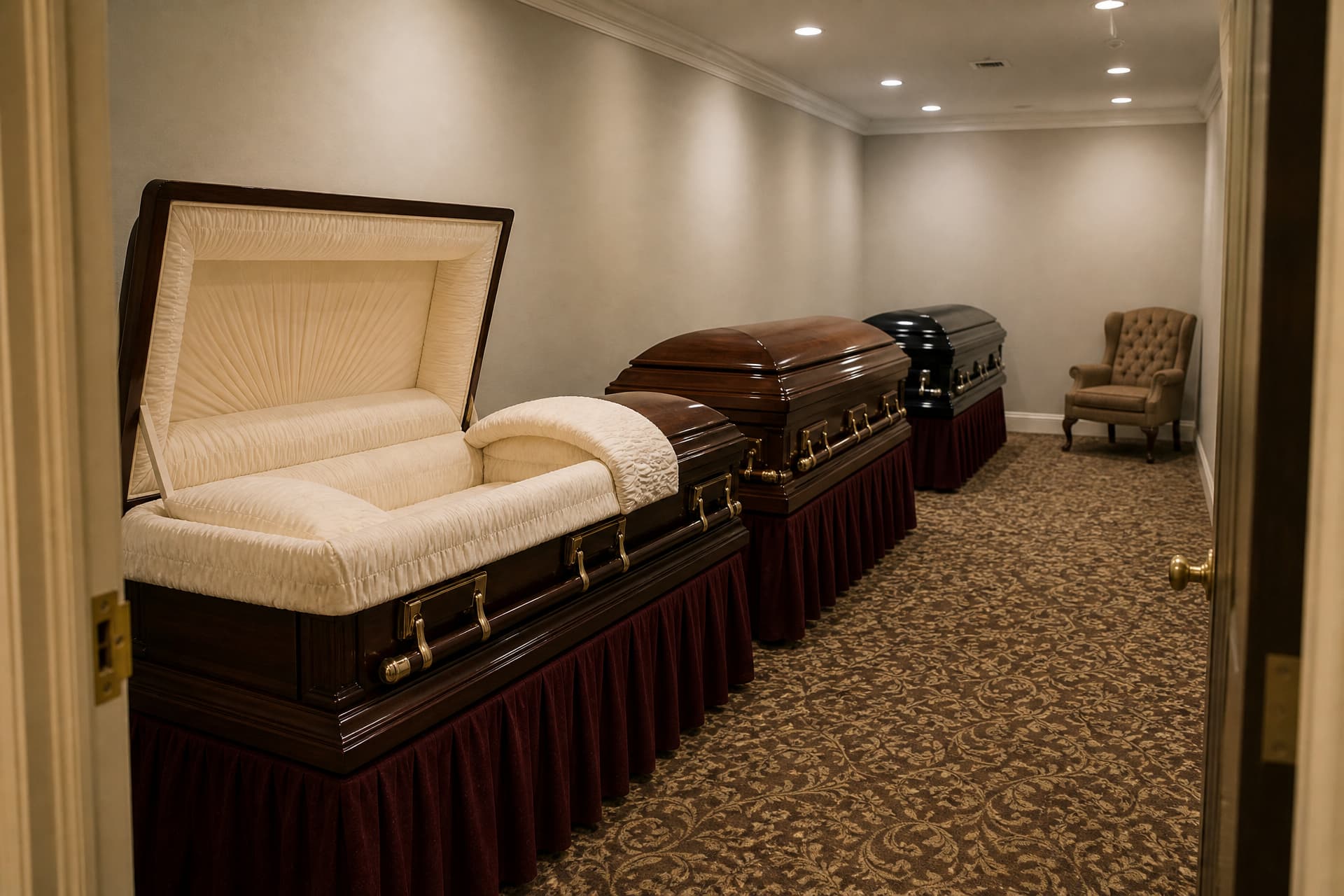
The room behind the cheapest cremation in Texas. The state will not license a crematory unless its owner also holds a funeral establishment license (Occ. Code § 651.656(b)), and a funeral establishment must display at least five adult caskets, two of them full-size (§ 651.351(d)(7)) — so the online brands selling the lowest direct-cremation prices are attached to businesses that keep a showroom like this. Three of the required caskets are in frame.
Two mechanics stretch the Texas range further.
The crematory fee is often outside the price, and so is the second price sheet. Some Texas lists print the arithmetic themselves — a package, then a tray, then a crematory fee, then a total several hundred dollars higher — and plenty never say either way. A firm with two locations may publish a different figure for each, and a third again on the General Price List the federal Funeral Rule makes them hand over. Ask what the crematory fee is, and which sheet you are being quoted from.
And the container can multiply the printed range. Some Texas lists state a top price several times their bottom one, because the Funeral Rule makes the direct-cremation line cover every container they stock, from a fiberboard box to a hardwood casket. Health & Safety Code § 716.151(b) requires the crematory to cremate the container with the remains, so a casket bought for a Texas cremation is a consumable. We explain that ceiling in our cremation cost by state guide.
What Is Included, and What Is Not
Texas lists describe what they cover inconsistently, so the useful question is not "what does a Texas cremation include?" but "what does this one include?" Read the document for each of these:
The basic services of the funeral director and staff.
The cremation itself — the item most often billed on top.
Filing the death certificate, and how many certified copies come with it.
The transfer into the provider's care, and the transportation to the crematory — two separate lines on many Texas lists.
Refrigeration or sheltering: how many days, and the rate after that.
The container your loved one is cremated in, and the price with something other than the basic one.
A temporary container for the ashes.
Mileage is the Texas item. Every package buys a transfer inside a radius, and the radii are all different: published ones run from 15 to 60 miles, with rates of $2.00 to $5.00 per mile beyond, one way. A provider may also market into a metro well outside its own no-mileage area, so the advertised price is not the price at your address. Ask for the radius and the rate first.
Weight is the second one. Most Texas lists that price it add between $200 and $500; the steepest step into four figures at the higher weights, and some providers decline the case rather than price it.
Other charges Texas providers keep outside the headline, all from their own documents: an expedite fee, storage or extended refrigeration once the included days run out, mailing the ashes, an insurance-assignment or card-processing fee, and pacemaker removal. Texas death certificate filing is electronic and mandatory and is billed too — typically around $20 including the first certified copy, with further copies a few dollars each. Our guide to how many death certificates you need is worth reading before you order.
What the county charges on top
Texas has no state permit fee to quote you, because it has no state permit. Health & Safety Code § 193.008, "Burial-transit Permit," does one thing: it recognizes permits issued outside Texas.
What there is instead is county money. Code of Criminal Procedure art. 49.25, Sec. 13A lets a medical examiner charge reasonable fees "including cremation approvals," with the commissioners court approving the amount first, so there is no statewide number by design. Most Texas providers that bill it print something between $25 and $35, in the metropolitan counties where an examiner signs. Treat that as typical rather than as a published government schedule, and ask the funeral home for the figure in the county where the death occurred. Certified copy fees work the same way — § 191.0045(b) sets them by rule and names no dollar figure — so ask the local registrar.
Texas Cremation Laws That Affect Cost
Texas has a 48-hour waiting period. Health & Safety Code § 716.004(a) bars a crematory from cremating within 48 hours of the time of death shown on the death certificate, unless waived in writing by a justice of the peace or medical examiner of the county where the death occurred, or by court order.
The waiver is meant to be obtainable at two in the morning. A 2015 amendment makes every office authorized to grant one adopt a written policy covering requests "during regular business hours and outside of regular business hours, including on a weekend day or holiday." Almost nobody knows to ask. Get that policy from the county before you agree to an expedite fee — the waiver itself costs nothing.
In a county with a medical examiner, a certificate is required before every cremation, not only for suspicious deaths (Code of Criminal Procedure art. 49.25, Sec. 10). Which counties have one is a patchwork: the office is mandatory above 2.5 million people and optional elsewhere. Where there is none, the justice of the peace signs, but only for a death requiring an inquest — so which gate you face depends on the county.
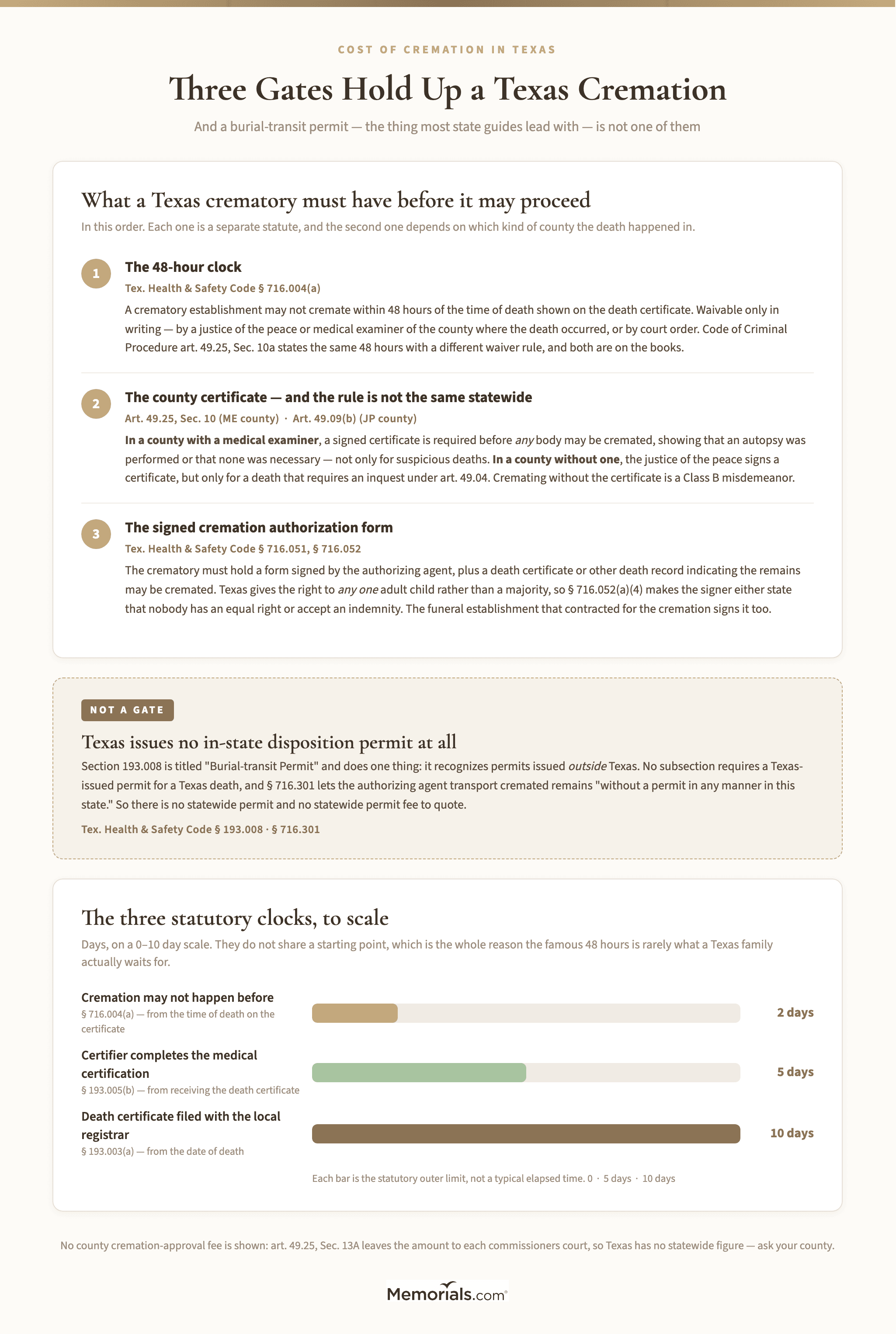
What actually holds up a Texas cremation, and the thing that does not. Most state guides lead with a burial-transit permit; § 193.008 only recognizes permits issued outside Texas, and § 716.301 lets cremated remains be transported in state without one. The gates that do exist are the 48-hour clock, the county certificate, and the signed authorization form.
Any one adult child can sign. Section 711.002 gives the right to control disposition to whoever the decedent named in writing, then the spouse, then any one of the adult children, then either parent, then any one adult sibling, then an executor. Because Texas says "any one" and not a majority, § 716.052(a)(4) makes the signer state that nobody has an equal or superior right, or that somebody does and every reasonable effort has been made to reach them. The right also lapses within days if its holder goes silent, and passes down the list.
No casket is required, and Texas says so out loud. Section 716.151(c) forbids a crematory from requiring a casket or refusing remains that are not in one, and § 716.001(7) defines a cremation container as "a casket or other container." The federal rule at 16 C.F.R. § 453.3(b)(2) makes it a deceptive act to say otherwise.
A funeral director must direct the pickup, and refrigeration can start before the paperwork does. Occupations Code § 651.401(b) requires a licensed director to direct every transfer — a real difference from states where a family may transport its own dead, and one reason a Texas transfer is always somebody's billable line. Section 716.0035 does let a crematory take your loved one into refrigerated care before it has authorization to cremate, which matters while the 48-hour clock is running.
Scattering is a closed list in Texas. Section 716.302(e) allows cremated remains only in a crypt, niche, grave or scattering area of a dedicated cemetery; over uninhabited public land, sea or other public waterways; or on private property with the written consent of the property owner. Public land must be uninhabited, which is not permission to scatter in any park, and § 716.304 requires the ashes to come out of the container first unless it is biodegradable. Our guide to scattering ashes laws and etiquette covers the general position.
The Texas variable. Every Texas package we read buys a transfer inside a radius — the published ones run from 15 to 60 miles — and charges $2.00 to $5.00 a mile beyond it. Some providers advertise into metropolitan areas more than a hundred miles outside their own no-mileage zone, so ask for the radius and the rate before you compare two quotes.
How to Lower the Cost in Texas
Ask whether the crematory fee is inside the price. Plenty of Texas lists never say either way, and some state outright that the headline excludes it.
Then ask for the radius and the per-mile rate. In a state this size that single question moves more money than any other.
Ask whether the price is the online price. Some Texas firms publish a figure available only for online arrangements and add a surcharge if you want to sit down with somebody — more again on a weekend or a holiday.
Call the county, not just the funeral homes. Whether your county has a medical examiner, and what its commissioners court has approved for a cremation approval, appear on no price list. Ask for the written 48-hour waiver policy while you are there.
Read the effective date. Occupations Code § 651.4055 makes it a required element of a Texas crematory price list, so a list without one is out of compliance. Several still in circulation are five or more years old. An old sheet is not a quote.
Call four providers and ask them all the same questions, making one a cremation service and one a full funeral home so you can see what the difference costs. Ask each: is the crematory fee inside, what is the transfer radius and the rate beyond it, how many death certificates are included, what is the weight limit and surcharge, and can you arrange a viewing at this price. Then read the cheapest quote all the way down — the lowest headline figures are often the ones that price the county permit and the mandatory electronic filing as separate lines.
And do it early if you can. Arranging in advance means comparing providers with nobody grieving in the room and no expedite fee on the table.
Ask whether even a temporary container for the ashes is inside your quote. Typically the provider hands over a plastic or cardboard box and the family chooses the vessel afterwards, at home, without anybody standing over them. Where Texas price lists sell urns at all, the ranges run from inexpensive up to several hundred dollars, and plenty of packages state flatly that no urn is included. You are not obliged to buy one from the funeral home.
How much is cremation in Texas? Direct cremation in Texas starts between $699 and $3,700, with a median of $1,395, across published Texas price lists read in 2026 — 10th least expensive of the 50 states.
What is the average cost of cremation in Texas? We publish the median rather than the mean: a figure above $3,500 drags an average upward and describes nobody. The median is $1,395, and any average cost of cremation in Texas tells you little unless you know which kind of firm sits behind it.
How much does a cremation funeral cost in Texas? More than the figures on this page: every number here is for direct cremation with no viewing and no service. Texas providers that price a cremation with a family viewing, or with a public service, commonly publish two to four times their own direct-cremation line.
Is there a waiting period before cremation in Texas? Yes — 48 hours from the time of death shown on the death certificate (Health & Safety Code § 716.004), waivable in writing by a justice of the peace, a medical examiner or a court.
Does a medical examiner have to approve a cremation in Texas? In a county with a medical examiner, yes — for every cremation, not only suspicious deaths (Code of Criminal Procedure art. 49.25, Sec. 10). Where there is no medical examiner, the justice of the peace signs only for an inquest death.
What is the Texas cremation permit fee? There isn't a state one: § 193.008 only recognizes burial-transit permits issued outside Texas. What exists is a county medical examiner fee for cremation approvals, which art. 49.25, Sec. 13A leaves to each commissioners court. Providers commonly bill $25 to $35, which is their charge, not the county's rate.
Do I have to buy a casket for cremation in Texas? No. Section 716.151(c) forbids a crematory from requiring one or refusing remains that are not in a casket. Because § 716.151(b) burns the container with the remains, anything you buy is consumed.
Can I scatter ashes on private property in Texas? Yes, with the written consent of the property owner — § 716.302(e)(3). The other two lawful destinations are a dedicated cemetery and uninhabited public land, sea or public waterways. In every case § 716.304 requires the ashes to come out of a container that is not biodegradable.
Why is the cremation cost in Texas so different from one town to the next? Mostly it is not the town. A cremation service and a full funeral home in the same city are selling different amounts of business, and two firms a few miles apart can be nearly three times apart on price. Business model, mileage and where each list draws the line around its package explain far more than geography.
In Short
Texas cremation costs a median of $1,395 at the published floor, 10th least expensive in the country and $560 below the median of the South. What decides your bill is not the headline number: it is which kind of firm you call, because a cremation service and a funeral home sell different amounts of business; the crematory fee, inside the package at some firms and billed on top at others; the mileage, where every package sets its own radius and rate; and the 48-hour clock, which a justice of the peace can waive in writing at no charge if you know to ask.