🏬Supersize Online Funeral Retailer🪦1000's of Headstones⚱️Over 10,000 Cremation Urns⚰️Caskets Overnight Delivery🛒Funeral & Memorial Superstore🚚FREE Shipping on ALL Orders👨👩👧👦Helping Families for over 20 Years💰Lowest Price Guarantee🏬Supersize Online Funeral Retailer🪦1000's of Headstones⚱️Over 10,000 Cremation Urns⚰️Caskets Overnight Delivery🛒Funeral & Memorial Superstore🚚FREE Shipping on ALL Orders👨👩👧👦Helping Families for over 20 Years💰Lowest Price Guarantee
🏬Supersize Online Funeral Retailer🪦1000's of Headstones⚱️Over 10,000 Cremation Urns⚰️Caskets Overnight Delivery🛒Funeral & Memorial Superstore🚚FREE Shipping on ALL Orders👨👩👧👦Helping Families for over 20 Years💰Lowest Price Guarantee🏬Supersize Online Funeral Retailer🪦1000's of Headstones⚱️Over 10,000 Cremation Urns⚰️Caskets Overnight Delivery🛒Funeral & Memorial Superstore🚚FREE Shipping on ALL Orders👨👩👧👦Helping Families for over 20 Years💰Lowest Price Guarantee
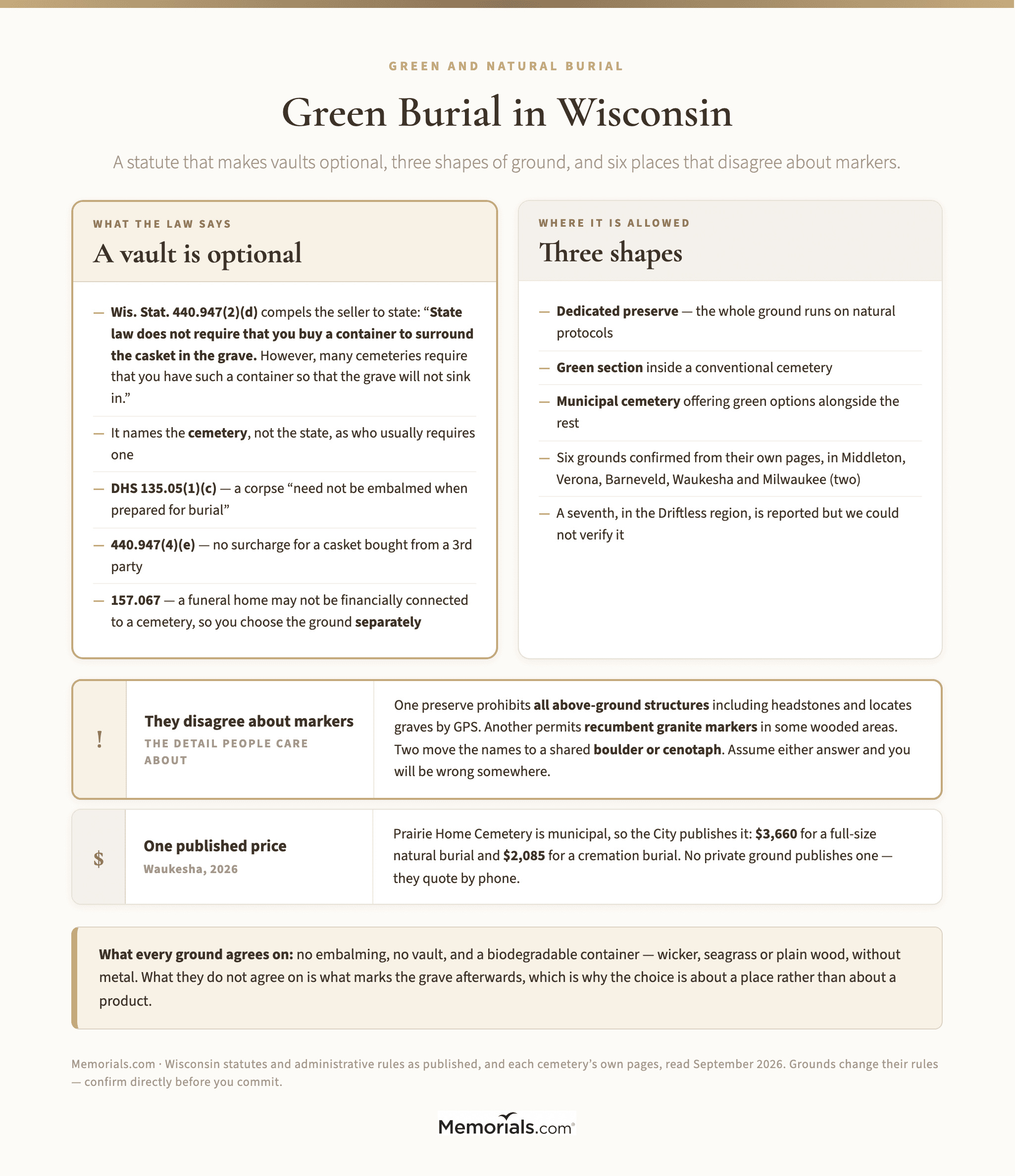
Green burial wisconsin is an unusual search in one respect: the state actually has somewhere to do it. Many states have no dedicated natural burial ground at all. Wisconsin has several, in three different shapes, and one of them has been operating since 1995.
It also has something rarer — a statute that makes the seller tell you a burial vault is not required. That single sentence resolves most of what stops families from asking.
What follows is drawn from the Wisconsin statutes and administrative rules we read for our cremation cost research, and from each cemetery's own published pages, read in September 2026. It sits inside our wider cremation planning guide, which covers the arrangements around any disposition method.
Nothing in Wisconsin law requires embalming, a casket, or a vault for burial. Green burial is legal here by the absence of a requirement rather than by a permission, and that distinction is worth stating plainly rather than dressing up as a right.
Embalming is not required. Wisconsin Administrative Code § DHS 135.05(1)(c) provides that "A corpse need not be embalmed when prepared for burial, entombment or cremation" except in narrow circumstances. Embalming is the practice green burial is most often assumed to require, and the state's own rule says otherwise.
No vault is required, and the seller has to say so. Wisconsin Statutes § 440.947(2)(d) compels anyone who ordinarily offers an outer burial container for sale to give this exact statement:
"State law does not require that you buy a container to surround the casket in the grave. However, many cemeteries require that you have such a container so that the grave will not sink in. Either a grave liner or a burial vault will satisfy these requirements."
Read it twice, because it does two jobs. It says the state does not require a vault — and it names the cemetery, not the state, as the party that usually does. That reframes the whole question from "is this legal" to "which cemetery permits it", which is the question the rest of this page answers.
A third-party casket cannot be surcharged. Under § 440.947(4)(e) a seller may not "Require a buyer to pay an additional fee or surcharge if the buyer purchases a casket, outer burial container or cemetery merchandise from a 3rd party." That matters here because a shroud or a woven casket is usually bought from somebody other than the funeral home.
Families may direct the disposition themselves, within limits. Wisconsin permits family-directed disposition explicitly, but embalming is reserved to a licensed funeral director, so "no funeral director needed" is wrong as a flat claim.
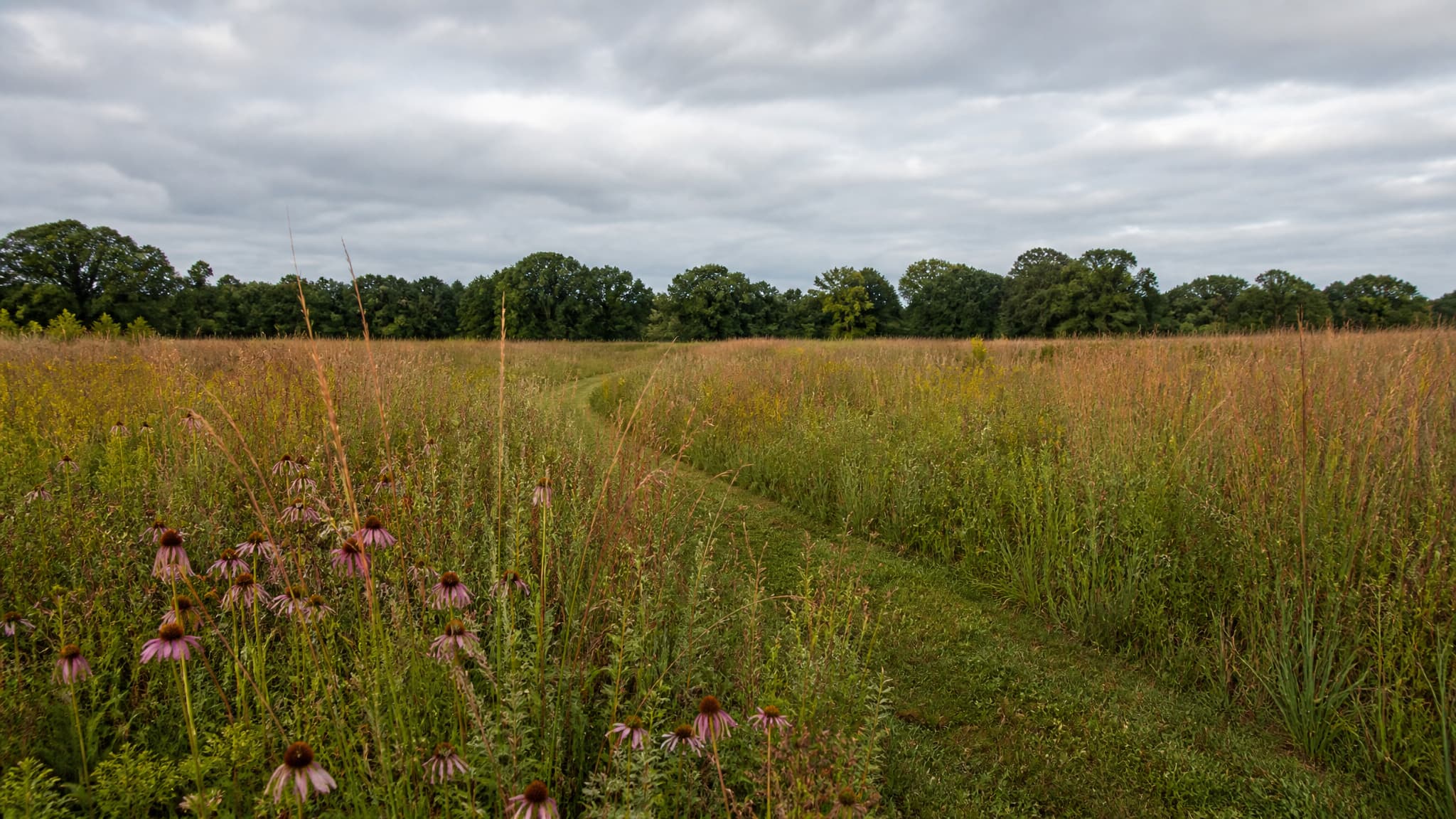
A green section inside a conventional cemetery is the commonest shape in Wisconsin. The planting is the point, and markers sit low or move to a shared stone.
One more statute belongs here because nobody writes about it, and it changes how a Wisconsin family shops.
Wisconsin Statutes § 157.067 separates funeral homes from cemeteries. No funeral establishment may be located in a cemetery or be financially connected with one, and no licensee may take "any commission, fee, remuneration or benefit of any kind from any cemetery, mausoleum or crematory."
The bundled funeral-home-plus-cemetery sale is therefore unavailable in Wisconsin by law. A family choosing a natural burial ground is choosing it separately from the funeral home, and has to. That is more work and better for you — the cemetery is a decision you make on its own merits, and the funeral home has no financial stake in which one you pick.
Where You Can Actually Be Buried
Wisconsin's grounds come in three shapes, and the difference decides what the place will look like in twenty years.
A dedicated natural burial preserve operates on natural protocols throughout. A green section inside a conventional cemetery applies them to one area. A municipal cemetery may simply offer green options alongside everything else. The Green Burial Council's own vocabulary calls the first two "natural" and "hybrid", and reserves "conservation" for grounds held under an easement with a partner conservation organization.
Ground
Where
Shape
Sòlas Natural Burial Preserve
Middleton
20-acre dedicated preserve
Circle Cemetery, Circle Sanctuary
north of Barneveld
20-acre cemetery inside a 200-acre nature preserve, established 1995
Natural Path Sanctuary
Verona
25 acres of woods and meadow on the Farley Center land
Prairie Green, Greenwood Cemetery
Milwaukee
natural section within a Jewish cemetery
Prairie Rest, Forest Home Cemetery
Milwaukee
green section within a conventional cemetery
Prairie Home Cemetery, Section 12
Waukesha
prairie section in a municipal cemetery
Read from each cemetery's own published pages in September 2026. Grounds open, fill and change their rules — confirm directly before you commit.
A seventh, a natural burial section at the historic Viroqua Cemetery in the Driftless region, is described by local reporting as opening to plot sales in February 2022. We could not reach the cemetery's own website to confirm it, so treat that one as worth a phone call rather than as established.
Wisconsin's position is unusual enough that it is worth seeing what a neighbor looks like without it. Iowa has no dedicated natural burial preserve at all, and its statutes are permissive in much the same way Wisconsin's are — our guide to green burial in Iowa covers what a family does when the law allows a natural burial and no ground has been set aside for one.
They Do Not Agree With Each Other, and That Is the Useful Part
The temptation is to treat "green burial" as one product. In Wisconsin it plainly is not, and the sharpest difference is markers.
At one end, a preserve near Madison prohibits "embalming, caskets, vaults, treated wood, metals, concrete, plastic, and all other non-biodegradable materials" and also "all above-ground structures … including traditional headstones", locating graves by GPS instead.
At the other, the 1995 ground near Barneveld states that "Recumbent granite markers with names, dates, and memorial messages are options for marking gravesites in some of the wooded areas." A flat granite marker is permitted there and forbidden at the first.
In between, the two Milwaukee grounds move the names to a shared stone — one uses "granite boulders, strategically placed on the prairie" with an inscription artist recording name and years, and the municipal cemetery in Waukesha places names on cenotaphs in a committal area rather than at the graveside.
So a family that assumes no headstone anywhere will be wrong about at least one of these, and a family that assumes a headstone is fine will be wrong about another. Ask the specific ground before you decide, because this is the detail people care most about afterwards.
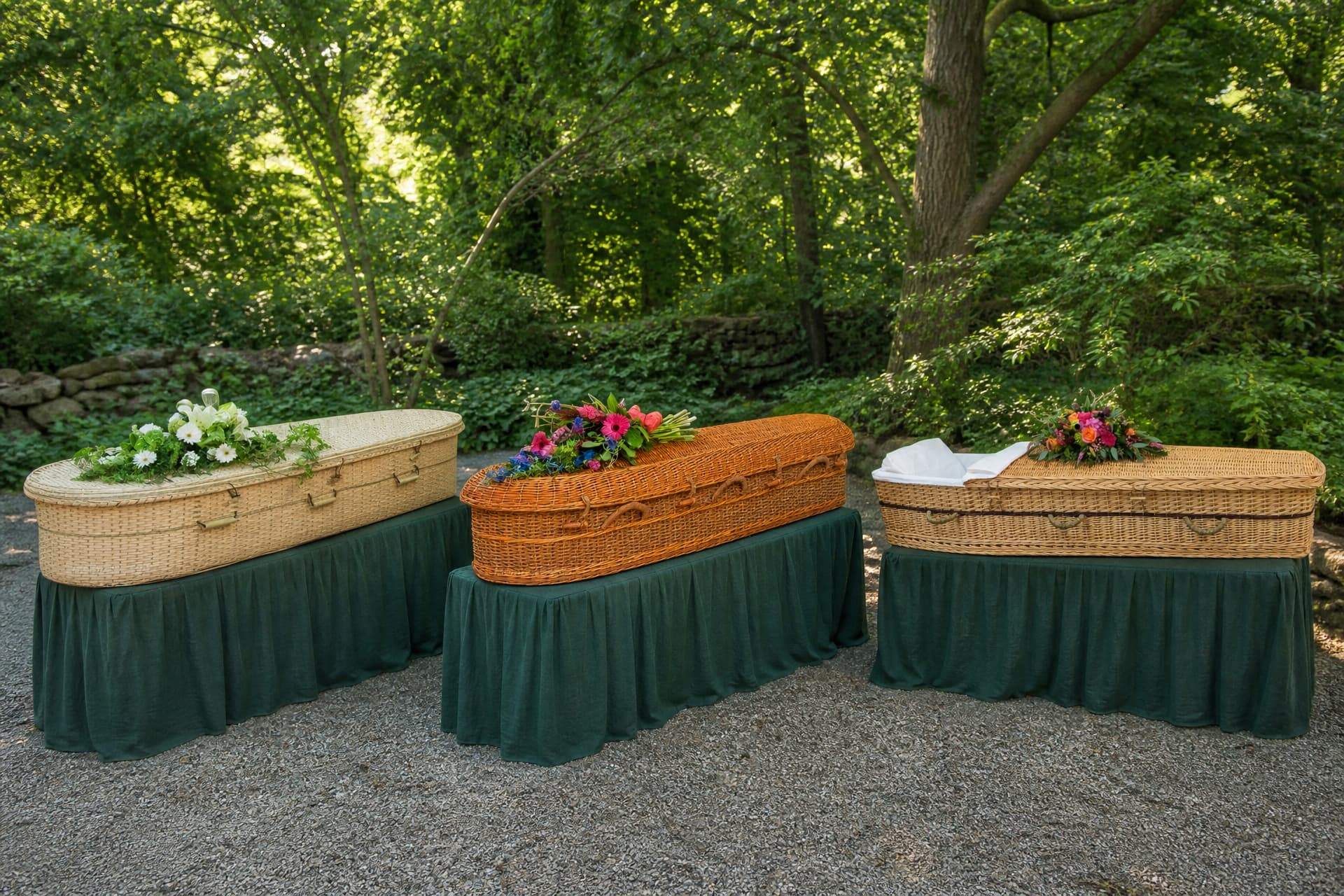
What they broadly agree on: no embalming, no vault, and a biodegradable container. The Milwaukee Jewish ground states it as "Biodegradable caskets or burial shrouds with a rigid biodegradable container", with "embalming fluids and burial vaults … excluded" and cremated remains welcome in a biodegradable urn. Waukesha allows caskets "made of wicker, seagrass, or wood (or similar solid material), without any metal" and confirms "No burial vault is used". The Barneveld ground requires a body to be "unembalmed and in a shroud, pine box, wicker casket, or other biodegradable container".
The Green Burial Council certifies grounds, and its name appears on Wisconsin sites in three noticeably different forms. The wording is worth reading closely because it is not interchangeable.
The Middleton preserve describes itself as "an officially certified Natural Burial Cemetery by the Green Burial Council". The Milwaukee Jewish cemetery says "Greenwood Cemetery is an approved cemetery provider by The Green Burial Council, as Prairie Green was developed in accordance with The Green Burial Council guidelines." The other Milwaukee ground says it "proudly meet[s] the standards of certification by the Green Burial Council" — which is a claim about meeting standards rather than about holding a certification. The Verona sanctuary displays the Council's logo without stating a level, and neither the Barneveld ground nor the Waukesha municipal section makes any Council claim on its own pages at all.
None of that means any of them is doing anything wrong. It means certification is not a single yes-or-no signal in this state, and a page that presents it as one is flattening something real. If certification matters to you, ask the ground directly what it currently holds and at what level — and note that a municipal cemetery with a genuine vault-free prairie section may simply never have applied.
What It Costs
Most Wisconsin grounds do not publish prices. One does, because it is municipal, and it is the only Wisconsin green burial figure we can cite to a public source.
The City of Waukesha publishes its 2026 schedule for Prairie Home Cemetery: $3,660 for a full-size natural burial, and $2,085 for a cremation burial. Those are the city's own published figures at the time of reading.
Treat that as a reference point rather than a state average — one municipal cemetery is not a market, and a green burial cost quoted anywhere else in Wisconsin will be a private ground's phone quote rather than a published figure. What it does establish is the order of magnitude, and it is a useful number to take into a conversation with a private ground that will only quote you by phone.
Four things to ask any ground for separately, because a single quoted figure usually hides them: the plot itself, the opening and closing of the grave, any perpetual care or endowment charge, and whether the ground requires anything you would otherwise skip. Our guide to cremation costs explains how price lists separate a provider's own charges from pass-through items, and the same reading applies here.
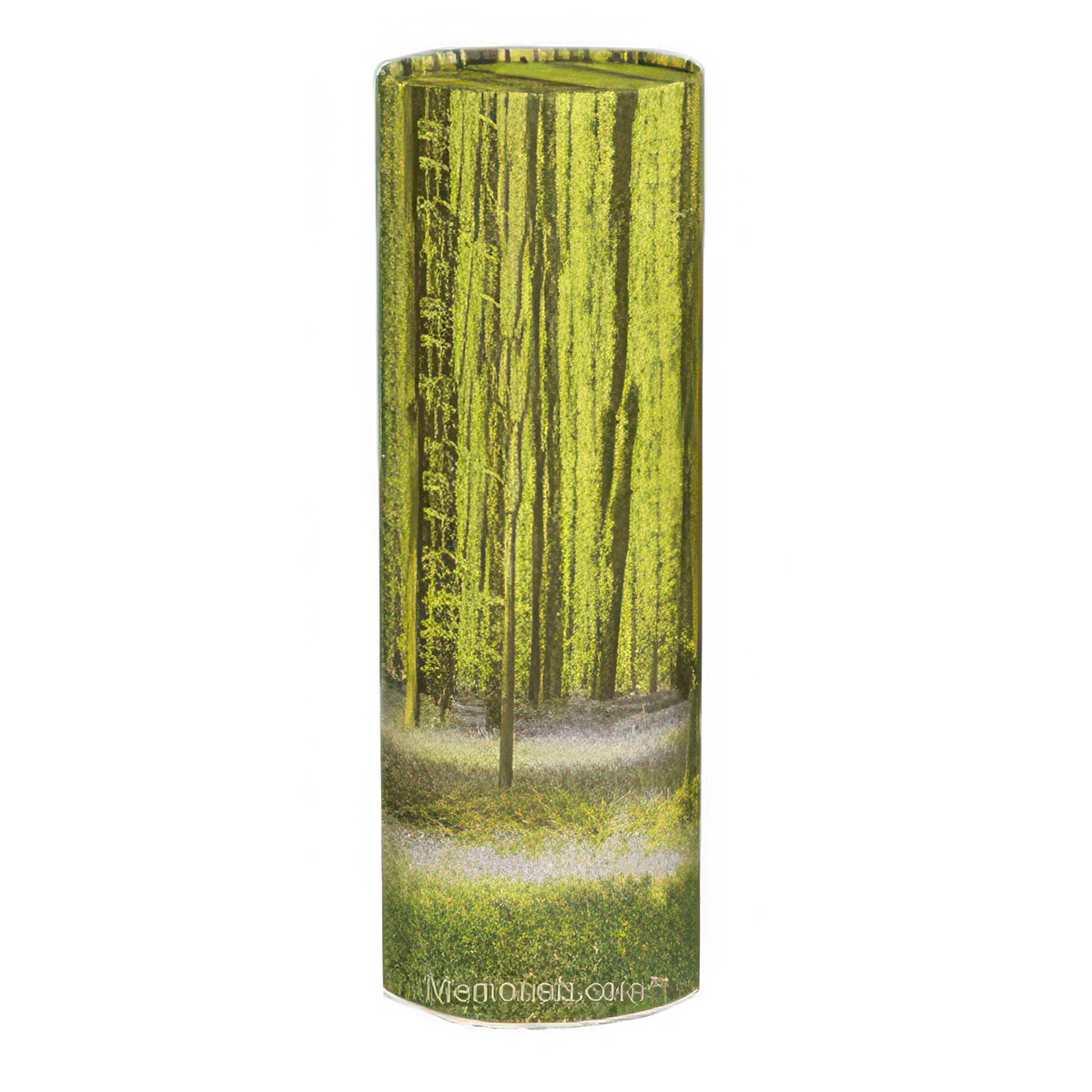
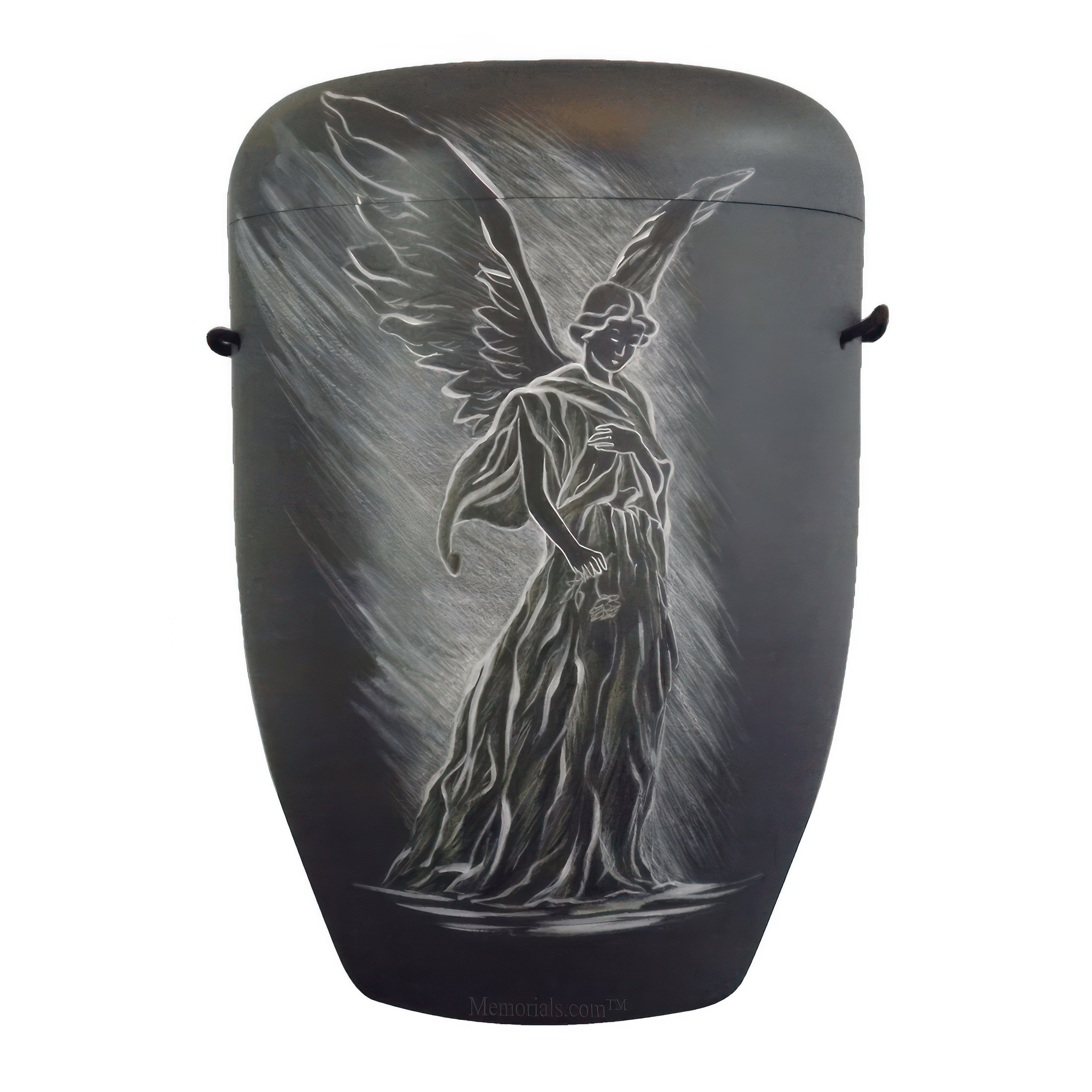
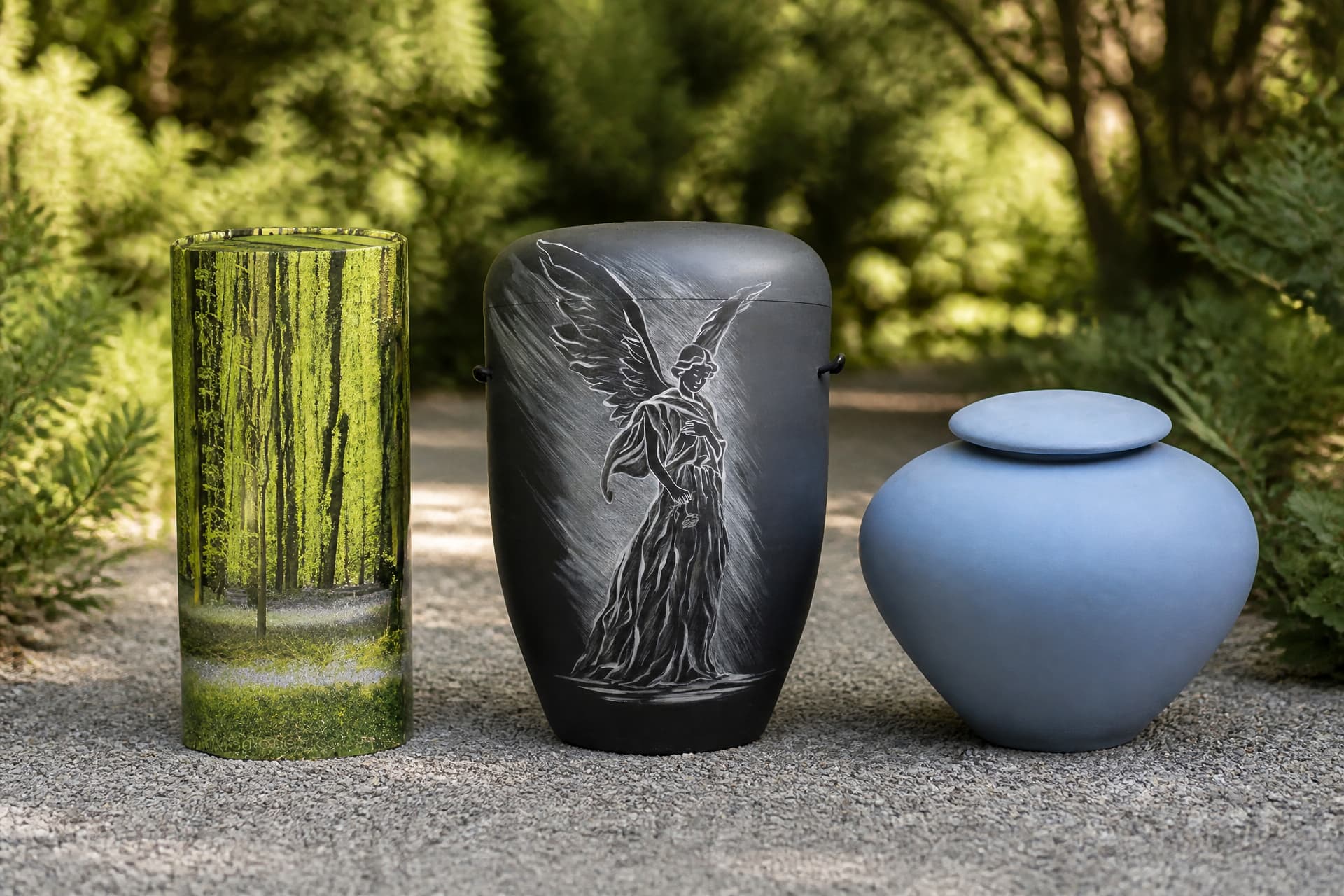
The container is the line you control. A biodegradable urn for a cremation burial, or a shroud or woven casket for a full-size one, can be bought from whoever you like — and § 440.947(4)(e) means nobody may surcharge you for doing so. Our wider range of cremation urns covers the conventional options if part of the family wants one.
Three shapes of ground, one statute that makes vaults optional, and six places that do not agree about markers.
What Happens on the Day
Worth knowing before you choose, because a natural burial runs differently from a conventional one and the differences are practical rather than ceremonial.
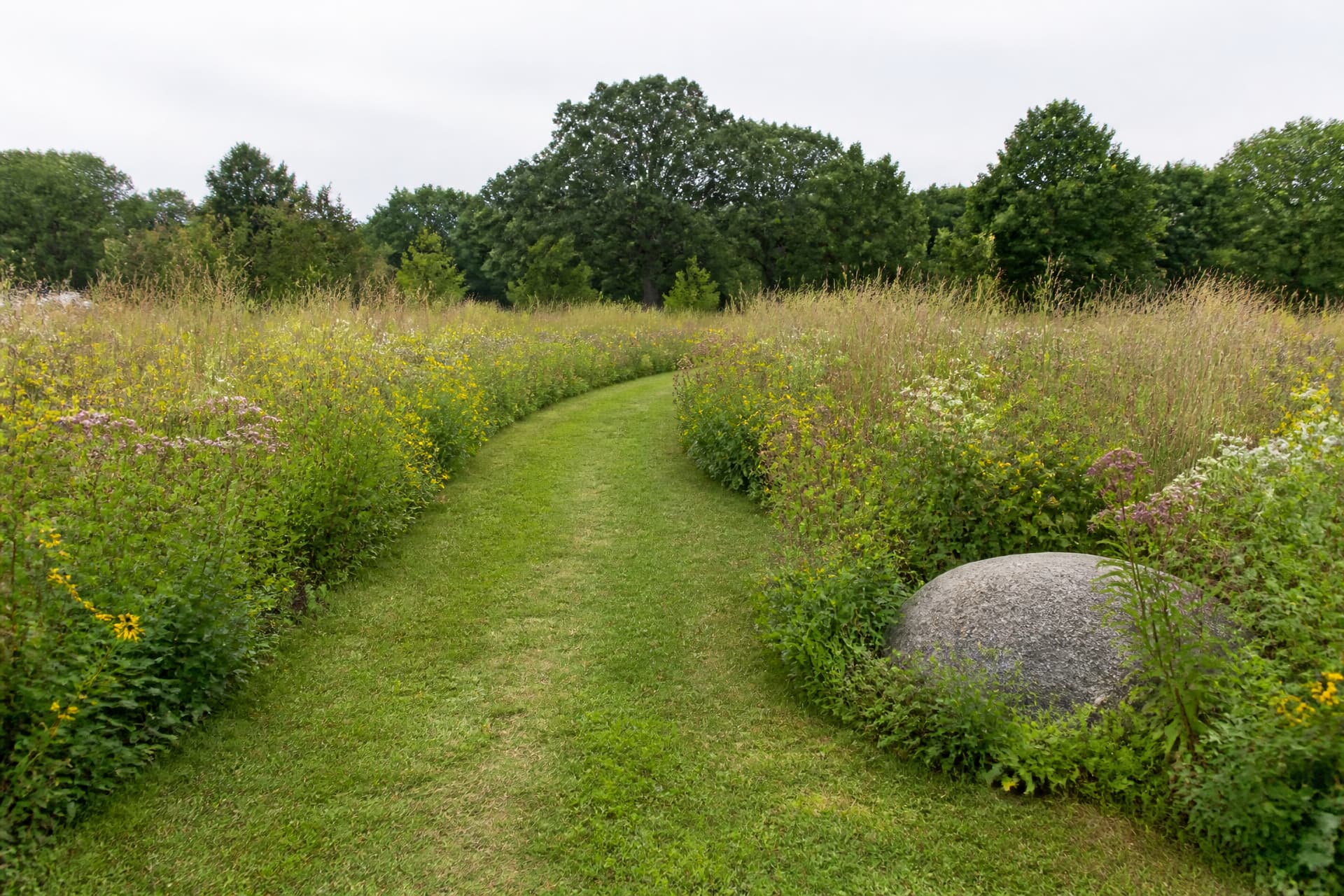
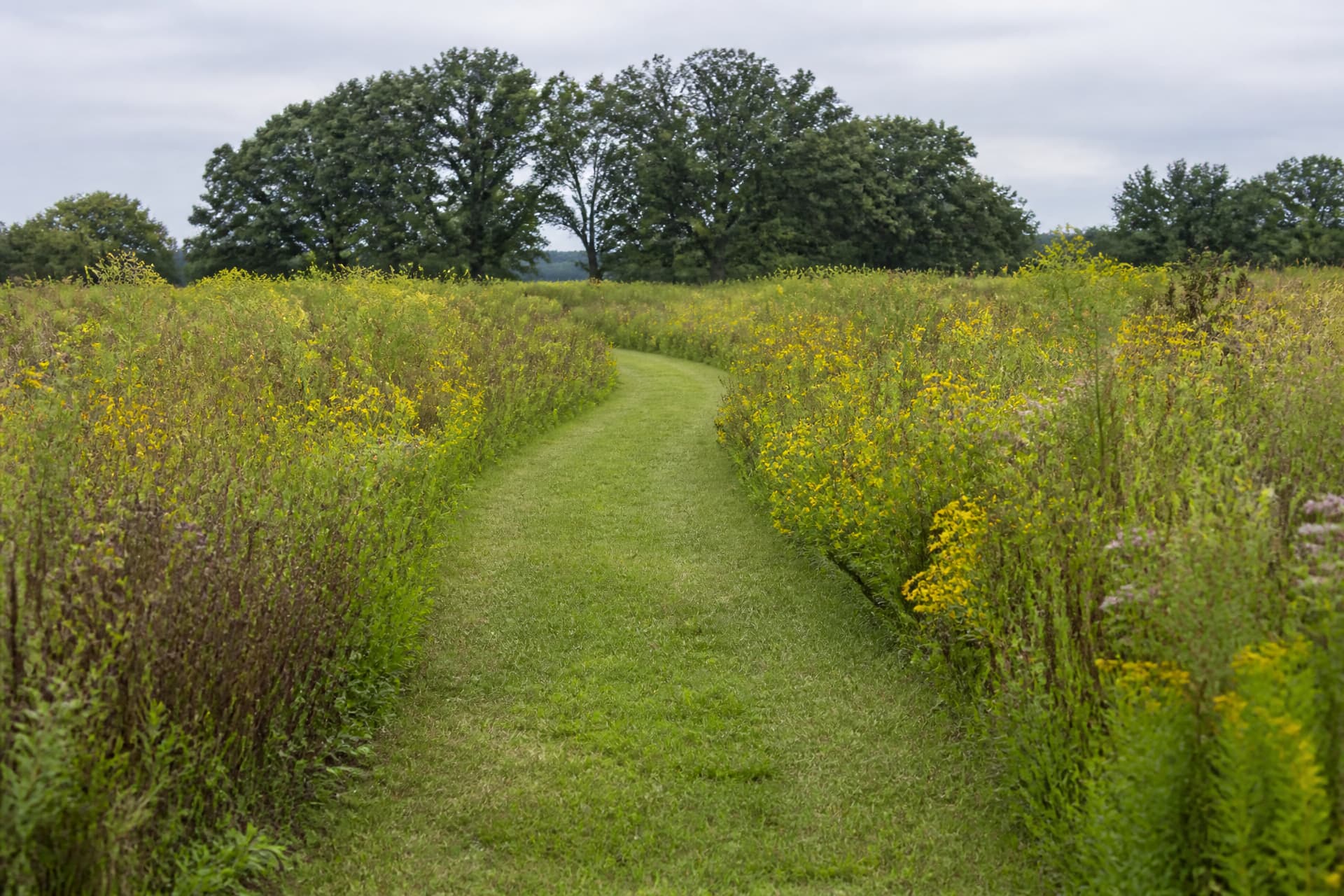
There is usually no hearse to the graveside. Many natural grounds are reached on foot along a mown path, and the body is carried. Grounds that expect this will say how far and over what terrain, and it is a real question if the family includes people who cannot walk it.
Many natural grounds are reached on foot and the casket is carried. Ask how far and over what ground before the day, because it is a real question for some families.
The grave is shallower than you expect, deliberately. Natural burial aims for the aerobic layer of soil where decomposition actually happens, which is nearer three to four feet than six. That is a feature, not a shortcut — our guide to why we bury people six feet deep explains where the six-foot figure came from and why almost nothing uses it.
Refrigeration replaces embalming, so timing is tighter. Without embalming, the interval between death and burial is governed by refrigeration rather than by chemistry. Wisconsin's cremation rules impose a 48-hour wait that does not apply to burial, but the practical constraint is the same either way: plan for days rather than a week, and say so to relatives traveling in.
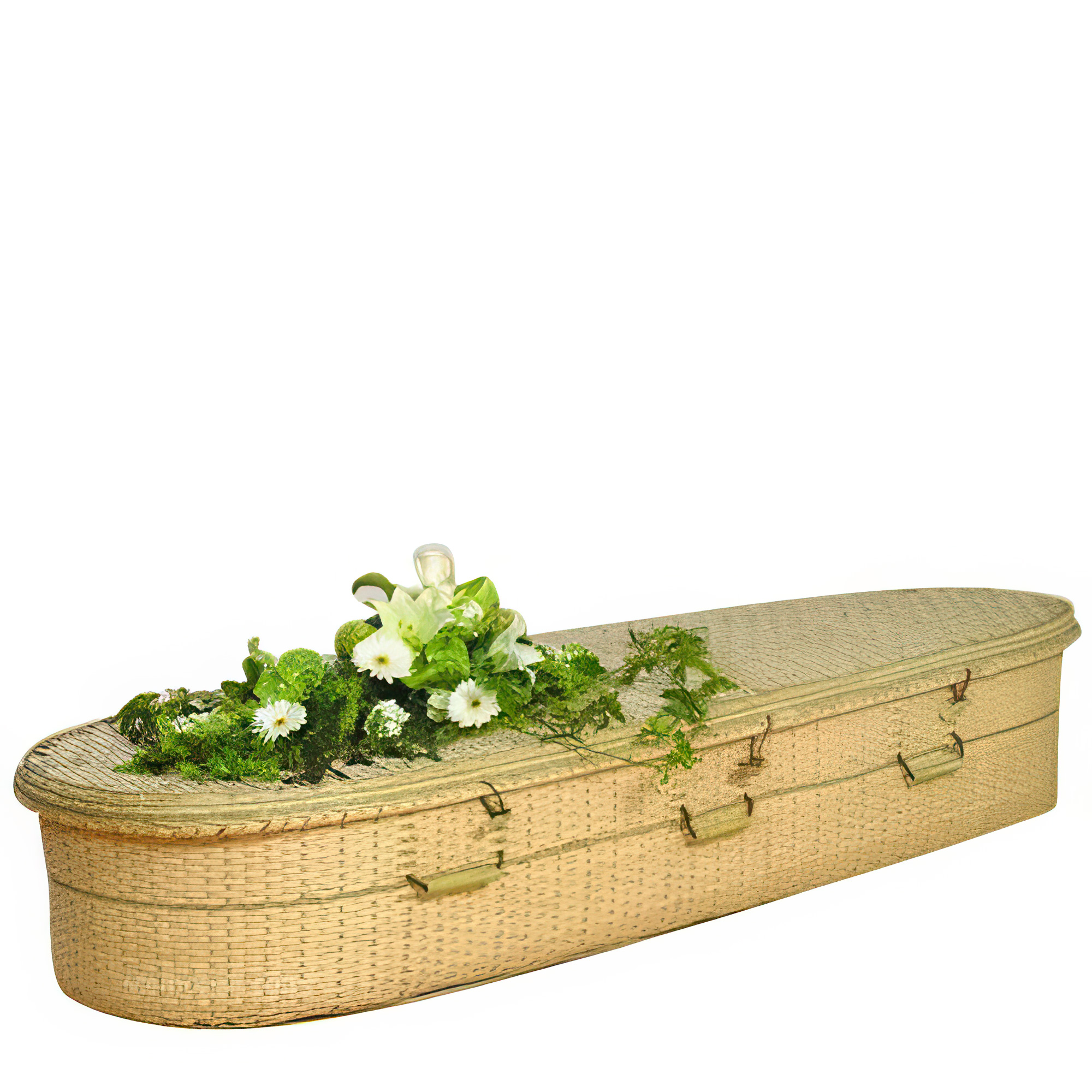
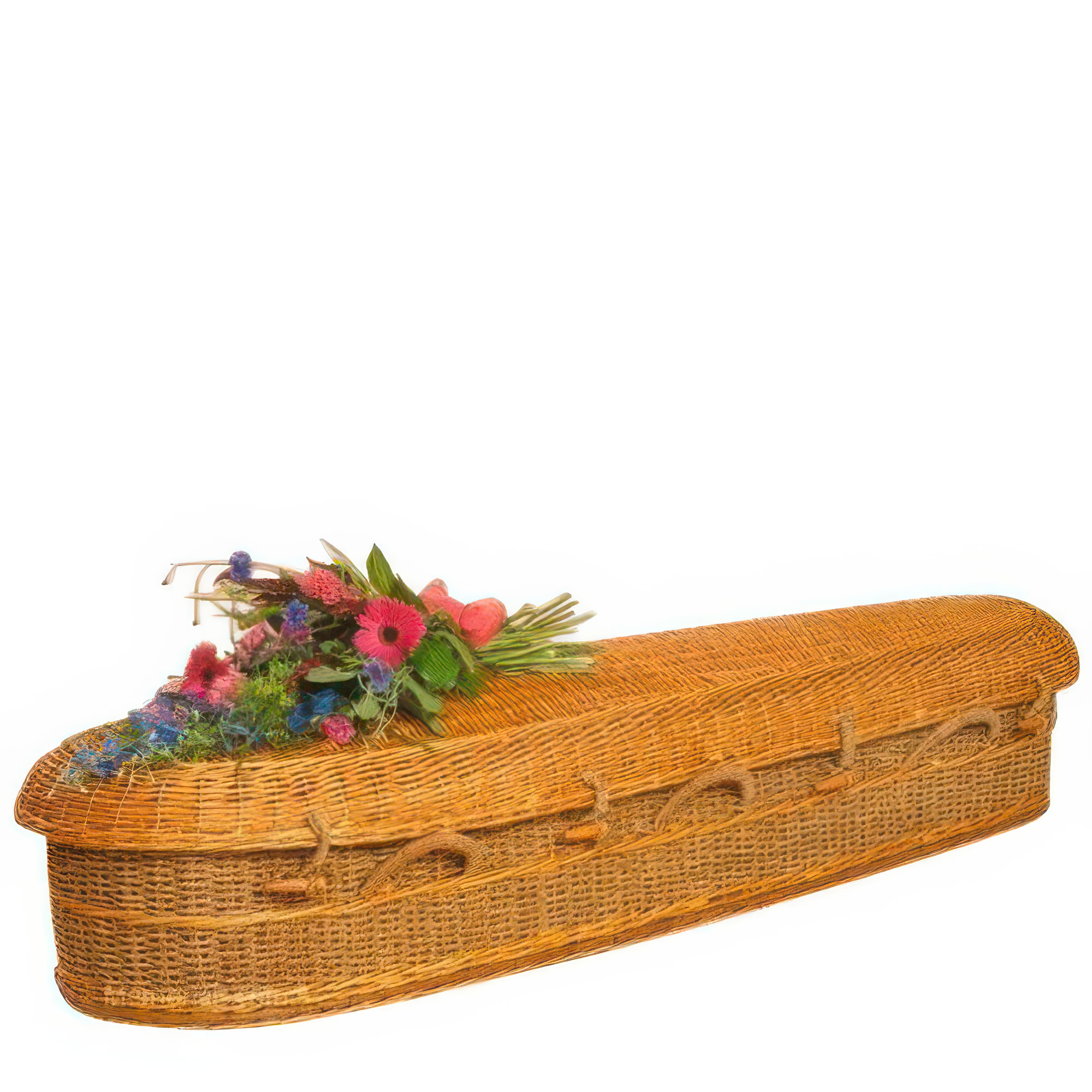
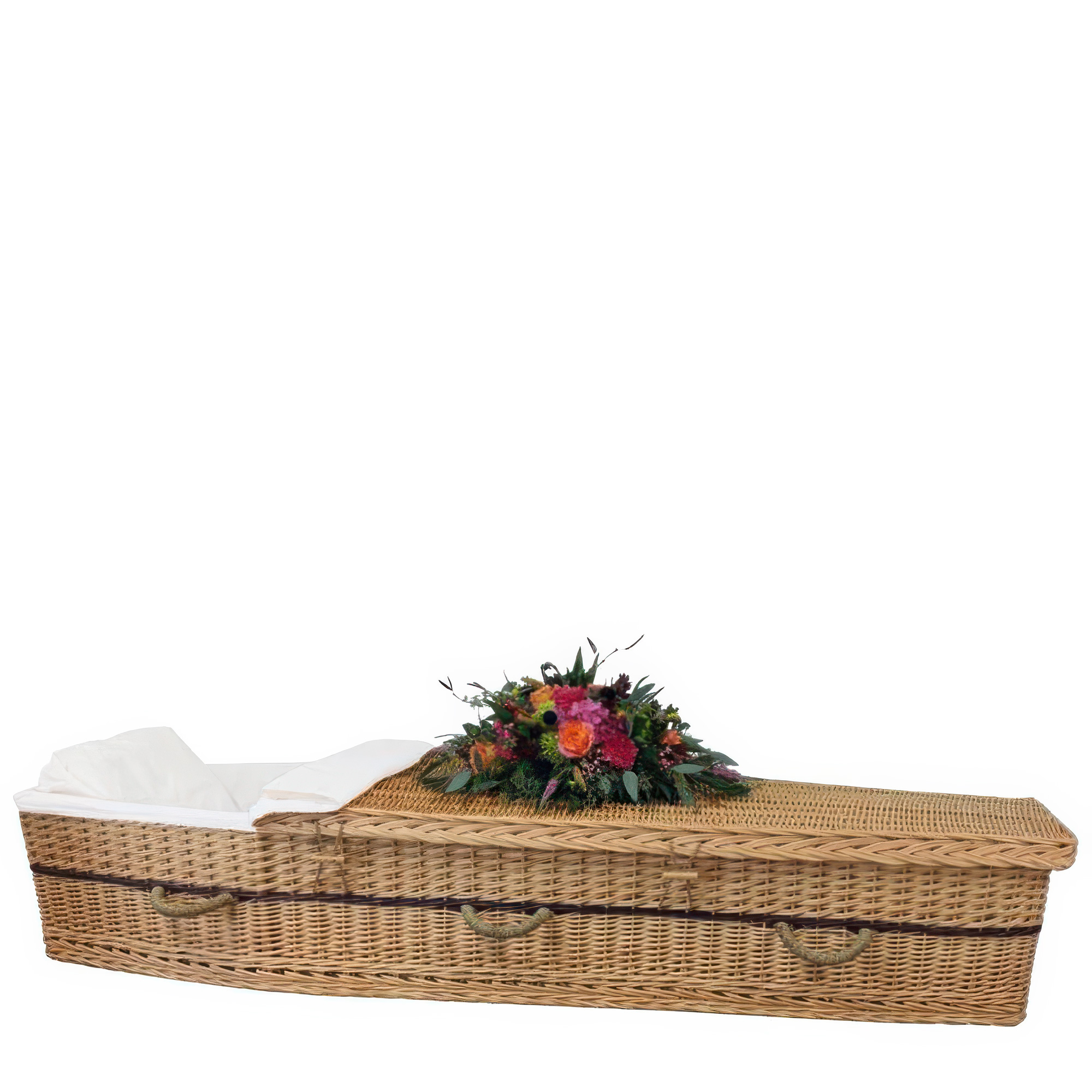
For a full-size natural burial the container is a shroud or a woven or plain wooden casket, and Wisconsin's grounds are specific that it must carry no metal. Our green caskets are built to that description.
The ground may look unkempt, and that is the management plan. A restored prairie is cut once or twice a year, not weekly. Families used to mown lawn sometimes find the first summer alarming. Visiting in August rather than April tells you what you are actually choosing.
Families often do more of it themselves. Wisconsin permits family-directed disposition, and natural grounds tend to welcome a family that wants to carry, lower or backfill. If that matters to you, ask the ground what it allows rather than assuming; if it does not, nobody will make you.
Is Cremation Greener?
A fair question, and the honest answer is that it depends what you are measuring. Cremation uses fossil fuel and releases carbon; a natural burial uses land and a grave. Neither is free.
What a natural burial ground offers that a cremation does not is land held in a particular state — restored prairie or woodland that the burials themselves pay to maintain. What cremation offers is that it needs no land at all. Our guide to green burials works through the comparison, and is cremation bad for the environment takes the cremation side of it in detail.
Several Wisconsin grounds accept both, which is worth knowing if the family is split.
Frequently Asked Questions
Is green burial legal in Wisconsin? Yes. No Wisconsin law requires embalming, a casket or a vault. § DHS 135.05(1)(c) makes embalming optional, and § 440.947(2)(d) requires the seller to tell you in writing that state law does not require an outer burial container.
Do I need a vault? Not by law. Many conventional cemeteries require one as their own policy, which is exactly what the statutory disclosure says. A natural burial ground will not.
How many green cemeteries are there in Wisconsin? We could confirm six from the grounds' own published pages, in three shapes — dedicated preserves, green sections within conventional cemeteries, and a municipal cemetery's prairie section. A seventh in the Driftless region is described by local reporting and we could not verify it directly.
Can I have a headstone? It depends entirely on the ground, and Wisconsin's differ more than anywhere else in this subject. One preserve prohibits all above-ground structures and locates graves by GPS; another permits recumbent granite markers in some wooded areas; two move the names to a shared boulder or cenotaph. Ask before you choose.
What does natural burial wisconsin cost? Only one ground publishes a price: Waukesha's municipal cemetery, at $3,660 for a full-size natural burial and $2,085 for a cremation burial in 2026. Private grounds quote by phone.
Can cremated remains go in a green cemetery? Generally yes, in a biodegradable urn. Several Wisconsin grounds say so explicitly, and one permits scattering in its restored prairie and woodland as well.
A Final Thought
The thing that makes Wisconsin easier than most states is not the number of grounds. It is that the legislature wrote down the one fact families most often get wrong — that a vault is a cemetery's requirement and not the state's — and then made the seller say it out loud.
After that, this stops being a legal question and becomes a question about places. Six of them, an hour or two apart, that disagree about markers and agree about everything else. Go and look at two before you decide.