🏬Supersize Online Funeral Retailer🪦1000's of Headstones⚱️Over 10,000 Cremation Urns⚰️Caskets Overnight Delivery🛒Funeral & Memorial Superstore🚚FREE Shipping on ALL Orders👨👩👧👦Helping Families for over 20 Years💰Lowest Price Guarantee🏬Supersize Online Funeral Retailer🪦1000's of Headstones⚱️Over 10,000 Cremation Urns⚰️Caskets Overnight Delivery🛒Funeral & Memorial Superstore🚚FREE Shipping on ALL Orders👨👩👧👦Helping Families for over 20 Years💰Lowest Price Guarantee
🏬Supersize Online Funeral Retailer🪦1000's of Headstones⚱️Over 10,000 Cremation Urns⚰️Caskets Overnight Delivery🛒Funeral & Memorial Superstore🚚FREE Shipping on ALL Orders👨👩👧👦Helping Families for over 20 Years💰Lowest Price Guarantee🏬Supersize Online Funeral Retailer🪦1000's of Headstones⚱️Over 10,000 Cremation Urns⚰️Caskets Overnight Delivery🛒Funeral & Memorial Superstore🚚FREE Shipping on ALL Orders👨👩👧👦Helping Families for over 20 Years💰Lowest Price Guarantee
Cremation has overtaken traditional burial as the most common form of disposition in the United States, with more than 60 percent of families now choosing it. Many assume it is the more environmentally responsible choice, and compared to conventional vault burial, it does carry a lighter footprint in several important ways. But cremation is not without environmental costs. Understanding exactly what those costs are — and what alternatives exist — puts you in a stronger position to make a decision that reflects both your values and your practical needs. For a broader look at every stage of the process, our complete cremation planning resource walks through costs, timelines, and options from start to finish.
A standard flame cremation takes place inside a specially designed furnace called a retort. The body is exposed to temperatures between 1,400°F and 1,800°F for roughly two to three hours. This intense, sustained heat is fueled almost entirely by natural gas, a fossil fuel whose combustion releases carbon dioxide and other greenhouse gases directly into the atmosphere.
The energy required for a single cremation is roughly equivalent to the fuel burned during a 500-mile car trip. Multiply that across the approximately 2.2 million cremations performed in the U.S. each year, and the collective energy demand becomes significant. Unlike many other industries, cremation technology has been slow to transition away from fossil fuels, though some newer facilities are beginning to explore electric-powered retorts and improved insulation to reduce fuel consumption.
Carbon Dioxide Emissions: The Cremation Carbon Footprint
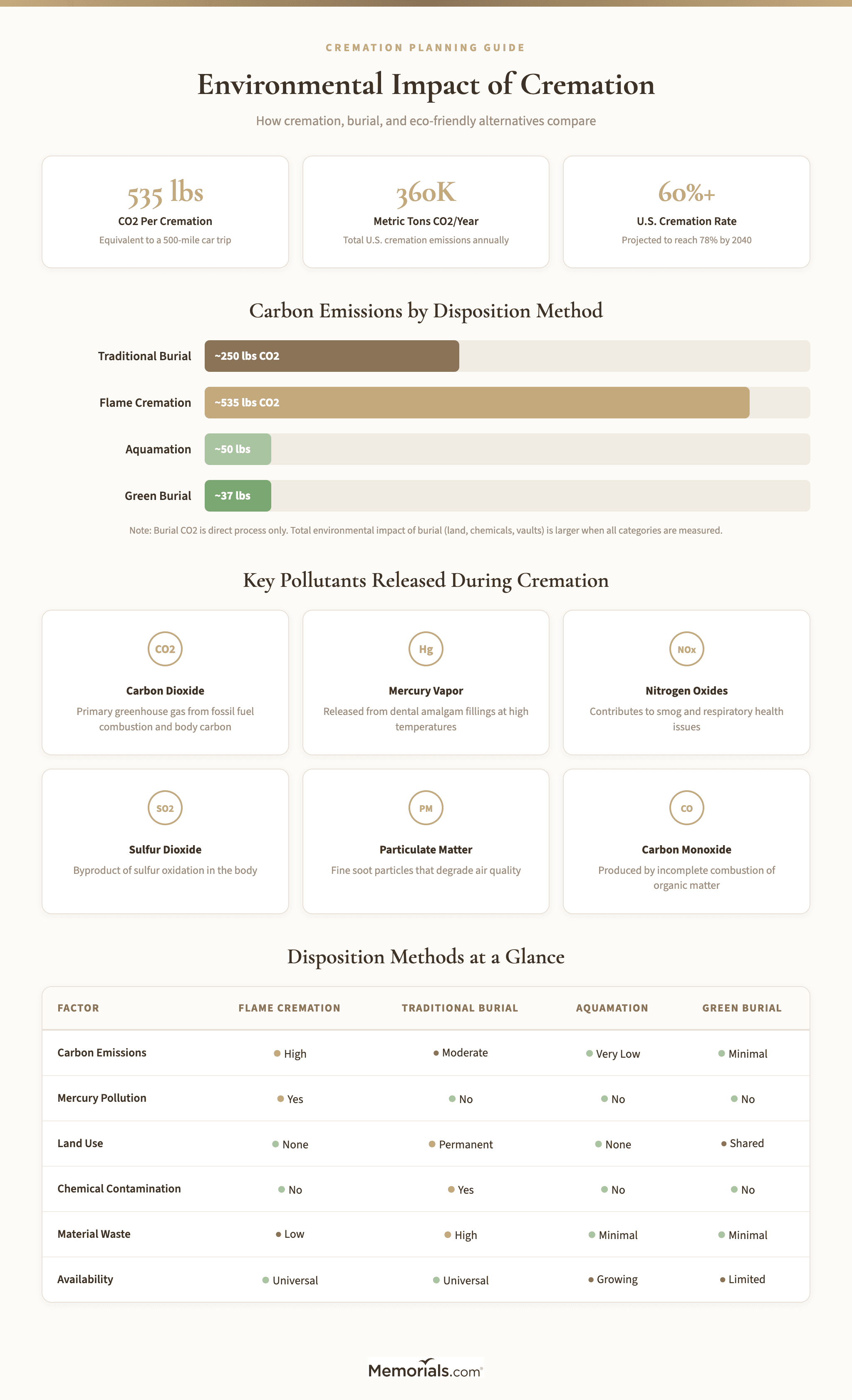
The most widely cited environmental concern with cremation is its carbon footprint. Industry estimates from Matthews Environmental Solutions place the average output at approximately 534.6 pounds of carbon dioxide per cremation. Across all cremations performed in the United States each year, that adds up to roughly 360,000 metric tons of CO2 released annually — a figure that will continue to climb as the cremation rate is projected to reach 78 percent by 2040.
To put that in perspective, one cremation produces about as much CO2 as powering a three-bedroom home for an entire week. These emissions come from two sources: the natural gas burned to maintain the retort temperature and the organic carbon released as the body itself is combusted.
It is worth noting that a single cremation's carbon footprint, when measured against a person's total lifetime emissions, is relatively small. The average American produces roughly 16 metric tons of CO2 per year over a lifespan of many decades. A cremation adds about a quarter of a metric ton. But when millions of people make the same choice, the cumulative impact matters — especially when lower-impact alternatives are available.
Air Pollutants Beyond CO2
Carbon dioxide is the largest emission by volume, but it is not the only pollutant released during cremation. The process also generates nitrogen oxides, sulfur dioxide, carbon monoxide, fine particulate matter, and soot. These pollutants contribute to local air quality degradation and can have health implications for surrounding communities.
One of the most concerning byproducts is mercury vapor. Dental amalgam fillings contain mercury, and when a body with these fillings is cremated at high temperatures, the mercury vaporizes and enters the atmosphere. Mercury is a persistent environmental toxin that accumulates in water systems, soil, and the food chain. Some modern crematories have installed filtration systems designed to capture mercury and reduce particulate emissions, but these systems are not universal, and they do not address CO2 output.
Cremation caskets and containers introduce additional pollutants when they contain metals, plastics, synthetic linings, or adhesives. These materials release compounds during incineration that would not be present if the body were cremated in a simple cardboard or wood container.
How Cremation Compares to Traditional Burial
A common question is whether cremation or burial has a larger environmental footprint. The answer depends on what you measure.
Traditional vault burial involves embalming with formaldehyde-based chemicals, manufacturing and transporting hardwood or metal caskets, pouring concrete burial vaults, and maintaining cemetery grounds year after year with mowing, irrigation, and chemical treatments. The amount of metal buried in American cemeteries each year has been compared to the quantity used to build the Golden Gate Bridge. Formaldehyde and other embalming chemicals can leach into surrounding soil and groundwater over time.
By comparison, cremation eliminates the need for embalming, a casket vault, and a full burial plot. It requires far less land and avoids the long-term chemical contamination associated with conventional burial.
However, a comprehensive 2017 Dutch study by researcher Elisabeth Keijzer found that when all 18 environmental impact categories were measured — not just carbon emissions — traditional burial actually scored worse than cremation overall, even though cremation emits roughly double the CO2 of a ground burial. The study highlighted that burial's impacts on land use, resource depletion, and groundwater contamination are substantial and ongoing.
Neither option is truly "green." Both carry measurable environmental costs. The question is which costs matter most to you and your family, and whether a third option might fit better.
What Happens to Cremated Remains in the Environment
The environmental impact of cremation extends beyond the process itself. Cremated remains — often called ashes, though they are technically processed bone fragments — have their own ecological effects when scattered or buried.
Cremated remains are highly alkaline, with a pH of approximately 11, and contain elevated sodium levels. In concentrated amounts, these properties can damage plant roots, alter soil chemistry, and harm marine organisms in enclosed waterways. This is why scattering ashes in one thick pile on a garden bed or dumping them into a small pond can kill vegetation and disrupt local ecosystems.
When ashes are dispersed widely — scattered thinly over a large area or into a flowing body of water — the impact is minimal. The key is dilution. Wide, gradual dispersal allows the minerals to integrate into the environment without overwhelming any single spot.
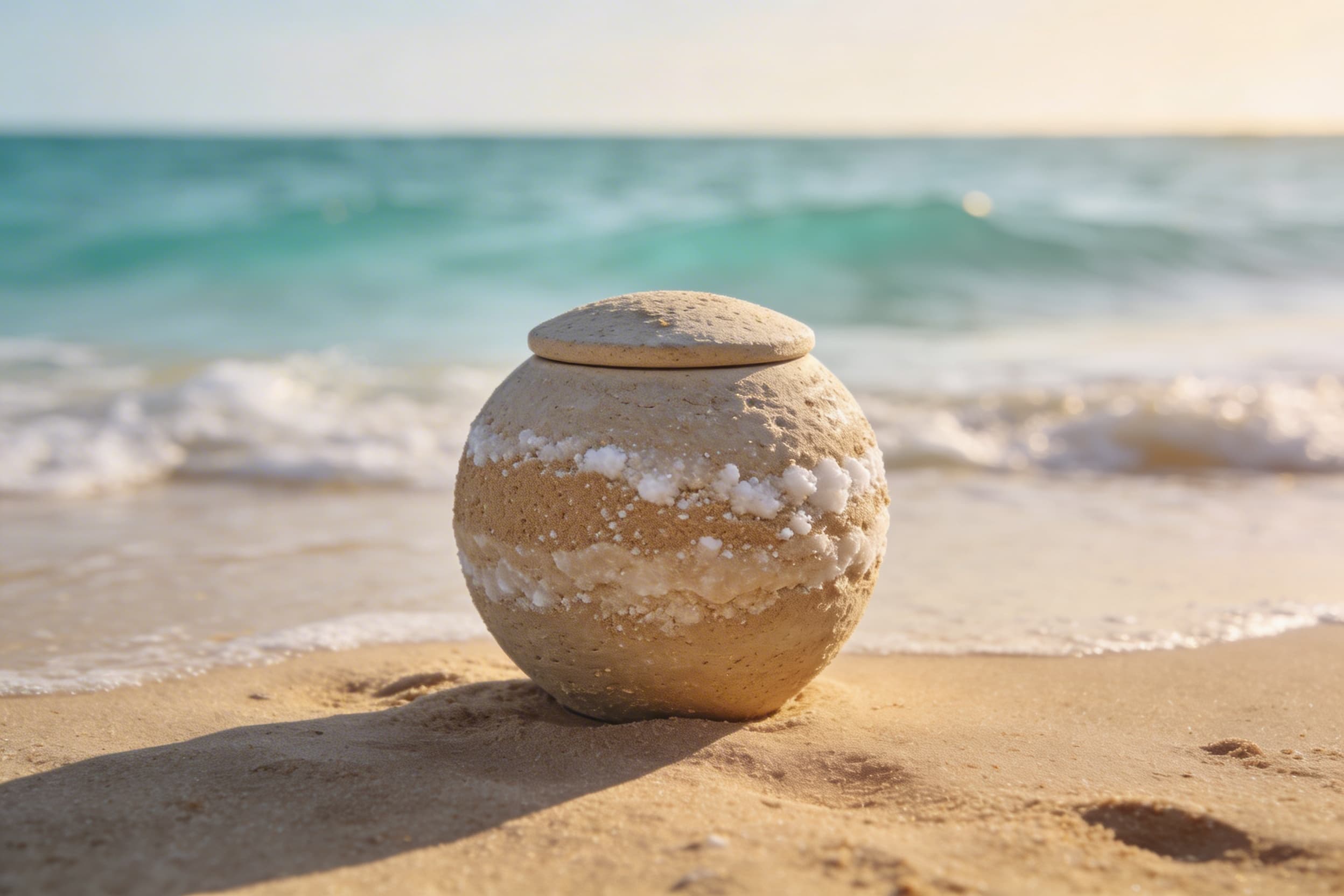
Families who plan to scatter remains can also consider biodegradable urns designed specifically for water or earth dispersal. These urns break down naturally over hours or weeks, releasing ashes gradually and reducing concentrated impact on any one area.
Greener Alternatives to Flame Cremation
For families who want to reduce the environmental footprint of their end-of-life arrangements, several alternatives to standard flame cremation are gaining traction.
Aquamation (Alkaline Hydrolysis)
Aquamation water cremation uses water, alkaline chemicals, heat, and gentle pressure to break down the body over a period of several hours. The process produces roughly one-tenth the carbon emissions of flame cremation, eliminates mercury pollution entirely, and uses significantly less energy. The liquid byproduct is a sterile, nutrient-rich solution that can be safely returned to the water system. Families receive bone fragments that are processed into a powder, just as with flame cremation. Aquamation is currently legal in a growing number of U.S. states, though availability varies by region.
Green Burial
Green and eco-friendly burials skip embalming chemicals entirely and use only biodegradable materials — a simple shroud, a wicker casket, or a plain wood coffin. The body is placed directly into the earth, where natural decomposition returns nutrients to the soil. Many green burial grounds double as conservation areas that protect wildlife habitat and prevent commercial development. Families looking for green caskets have a growing selection of willow, bamboo, and unfinished wood options.
Mushroom Burial
A newer option, mushroom burial alternatives use specially designed suits or coffins lined with mycelium — the root structure of mushrooms. The mycelium accelerates decomposition, neutralizes environmental toxins in the body, and enriches the surrounding soil. While still emerging, this technology represents a fundamentally different approach: using the body as an active contributor to ecological restoration rather than a source of emissions.
Tree Burial and Living Memorials
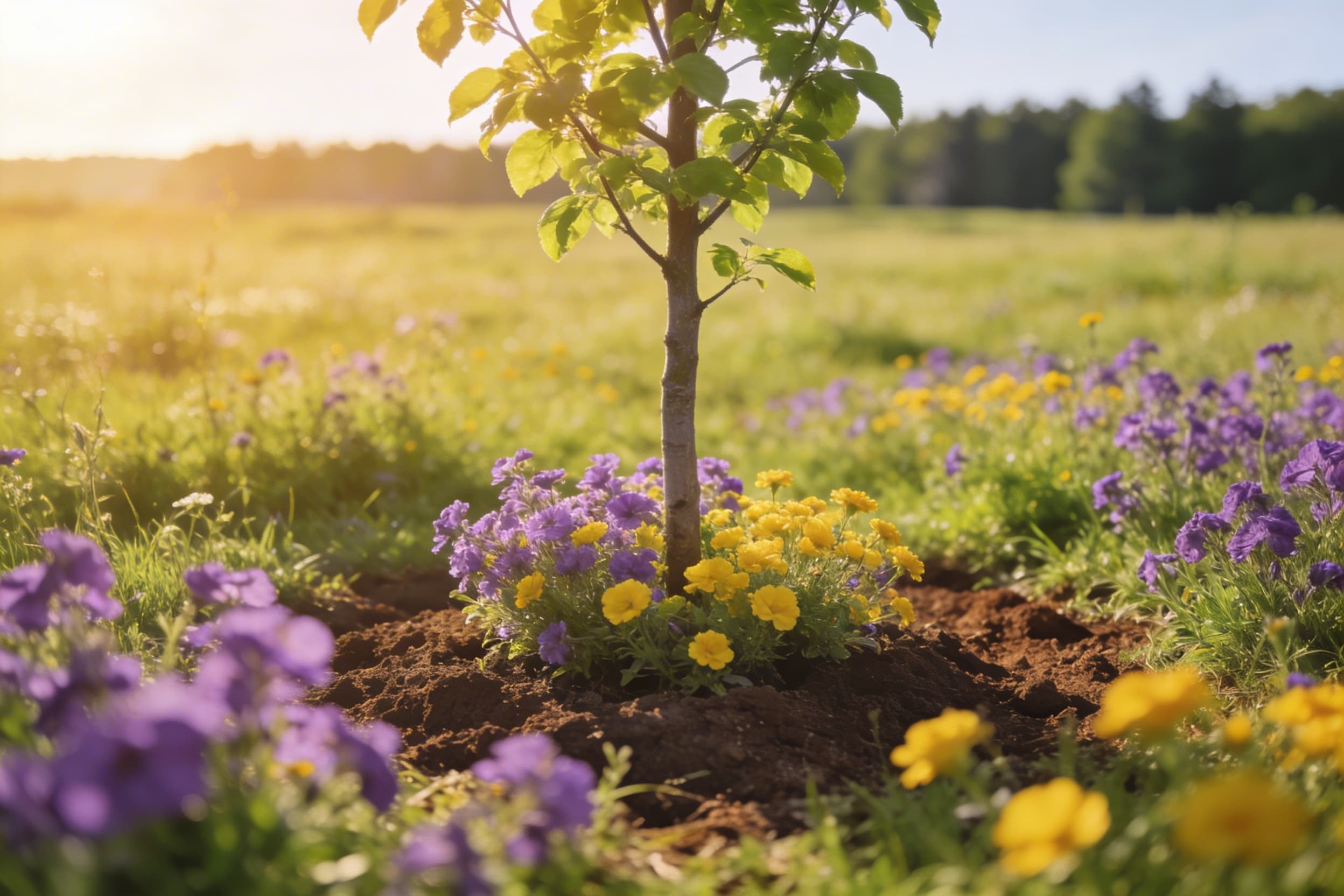
Tree burial options transform cremated remains or a naturally buried body into the foundation for a living tree. Some systems mix treated ashes with nutrient-balanced soil in a biodegradable pod, which is then planted with a sapling. Over the years, the tree grows as a living memorial, actively absorbing carbon dioxide from the atmosphere and offsetting a portion of the emissions that cremation or other processes produced.
How to Reduce the Environmental Impact of Cremation
If cremation remains the right choice for your family — whether for reasons of cost, tradition, cultural practice, or personal preference — there are concrete steps you can take to reduce its environmental impact.
Choose a simple cremation container. Ornate caskets made with metals, plastics, and synthetic linings add unnecessary pollutants to the process. A plain cardboard or unfinished wood container burns cleaner and reduces emissions.
Ask about the facility's equipment. Newer cremation retorts are significantly more energy-efficient than older models. Some facilities have installed mercury abatement systems and improved filtration. If you have a choice of crematories, ask about their technology and environmental practices.
Consider direct cremation. A direct cremation skips the formal funeral service at the crematory, which eliminates the need for embalming and reduces the transportation, materials, and energy associated with a traditional funeral. It is also typically the most affordable option.
Scatter ashes responsibly. If you plan to scatter, disperse remains widely rather than dumping them in a concentrated spot. Use a flowing waterway rather than a still pond. Consider a biodegradable scattering urn designed for gradual release.
Offset the carbon footprint. Some families choose to plant trees or contribute to verified reforestation programs to offset the roughly 535 pounds of CO2 produced by a single cremation. While this does not eliminate the emissions, it balances them against new carbon absorption.
Explore biodegradable urn options. Whether you plan to bury, scatter, or create a living memorial, urns for ashes include biodegradable options made from salt, sand, recycled paper, or plant-based materials that minimize long-term environmental impact.
The Bigger Picture: Perspective on Cremation's Impact
It is easy to feel overwhelmed by environmental data, but perspective matters. The carbon footprint of a single cremation — roughly 535 pounds of CO2 — is equivalent to about one week of an average American household's electricity use. It represents a fraction of a fraction of a person's lifetime carbon output.
The funeral industry as a whole, including both burial and cremation, accounts for a very small share of national greenhouse gas emissions. The environmental gains from choosing cremation over traditional vault burial are real, even if cremation is not the absolute greenest option available. Families who feel strongly about minimizing their ecological impact have meaningful choices: aquamation, green burial, mushroom composting, or tree pod burial, each with its own trade-offs in cost, availability, and cultural fit.
The most important thing is that you have the information to make a decision that feels right. Environmental responsibility is one factor among many — alongside cost, religious or cultural tradition, family wishes, and personal values. No choice is perfect, and no family should feel guilty for choosing cremation when it aligns with their needs.
Frequently Asked Questions
Is cremation or burial worse for the environment?
Neither option is impact-free. Traditional vault burial consumes more materials, land, and chemicals over time, while cremation produces more immediate carbon emissions and air pollutants. A 2017 Dutch study found that when all environmental categories are measured together, burial has a slightly larger overall impact than cremation. Green burial — without embalming, vaults, or metal caskets — has the lowest footprint of the three.
How much CO2 does cremation produce?
A single cremation generates approximately 534 to 535 pounds (roughly 243 kilograms) of carbon dioxide. This is comparable to the emissions from a 500-mile car trip or powering a three-bedroom home for one week. Across all cremations in the U.S., the total reaches an estimated 360,000 metric tons of CO2 annually.
Is aquamation better for the environment than cremation?
Aquamation (alkaline hydrolysis) produces roughly one-tenth the carbon emissions of flame cremation, uses less energy, and eliminates mercury pollution. It is widely regarded as a significantly greener alternative, though it is not yet available in every state.
Are cremated ashes toxic to plants?
In concentrated amounts, yes. Cremated remains have a very high pH (around 11) and elevated sodium content, which can damage plant roots and alter soil chemistry. However, when ashes are dispersed widely or mixed with soil amendments, the impact is minimal. Biodegradable urns designed for planting include soil blends that neutralize these effects.
What is the most eco-friendly way to handle remains?
Green burial is generally considered the lowest-impact option, followed by aquamation. Natural organic reduction (human composting) is emerging as another strong contender, converting the body into usable soil. For families who choose cremation, using a biodegradable urn and scattering responsibly can reduce the downstream environmental effects.