🏬Supersize Online Funeral Retailer🪦1000's of Headstones⚱️Over 15,000 Cremation Urns⚰️Caskets Overnight Delivery🛒Funeral & Memorial Superstore🚚FREE Shipping on ALL Orders👨👩👧👦Helping Families for over 20 Years💰Lowest Price Guarantee🏬Supersize Online Funeral Retailer🪦1000's of Headstones⚱️Over 15,000 Cremation Urns⚰️Caskets Overnight Delivery🛒Funeral & Memorial Superstore🚚FREE Shipping on ALL Orders👨👩👧👦Helping Families for over 20 Years💰Lowest Price Guarantee
🏬Supersize Online Funeral Retailer🪦1000's of Headstones⚱️Over 15,000 Cremation Urns⚰️Caskets Overnight Delivery🛒Funeral & Memorial Superstore🚚FREE Shipping on ALL Orders👨👩👧👦Helping Families for over 20 Years💰Lowest Price Guarantee🏬Supersize Online Funeral Retailer🪦1000's of Headstones⚱️Over 15,000 Cremation Urns⚰️Caskets Overnight Delivery🛒Funeral & Memorial Superstore🚚FREE Shipping on ALL Orders👨👩👧👦Helping Families for over 20 Years💰Lowest Price Guarantee
Ask what do wind chimes symbolize after death and you will get the same answer from almost every direction: presence. Not the person returning, and not a message — presence. A sound that arrives without being summoned, in a place the person used to be.
That is why the memorial wind chime has quietly become one of the most common sympathy gifts in the United States, and why it behaves so differently from the rest of them. A card is read once. Flowers last a week. A chime hangs on a porch and keeps speaking for years, on no schedule anybody controls.
This guide sets out what the symbol actually means, where the tradition comes from, and what belongs on one — and it is honest about the line between documented custom and the sentiment that has grown up around it since. For the wider vocabulary of mourning, our death symbolism guide collects the signs and objects people reach for after a loss.
What a Wind Chime Symbolizes After a Death
Strip away the marketing and three meanings do the work.
A continuing bond. Grief researchers describe mourning not as letting go but as rebuilding a relationship in a new form, and physical objects are how most people do it. A chime is unusually well suited to that job because it is not a picture of the person. It does not insist on a face or a date. It simply sounds, and the listener supplies the rest.
A presence you do not control. This is the part people describe most often and explain least well. You cannot make a wind chime ring. You can only be there when it does. That asymmetry — attention arriving rather than being summoned — is the whole emotional mechanism, and it is why a chime consoles people who find photographs too direct.
Air, breath, and spirit as one idea. Across a remarkable number of languages the word for breath and the word for spirit are the same word, or share a root: Latin spiritus, Greek pneuma, Hebrew ruach, Sanskrit prana. An object that only speaks when air moves through it sits directly on top of that very old association. Nobody needs to know the etymology for the symbol to land.
What do wind chimes symbolize after death of a loved one, then? Less a statement than a standing invitation to remember — one that does its work in the background of an ordinary day rather than demanding a visit to a graveside.
The reason a chime consoles people who cannot yet look at photographs: it does not require you to do anything. It sounds while you are thinking about something else.
Ask why do people give wind chimes at funerals and the practical answer comes first, before any symbolism.
It arrives after everyone leaves. The hardest stretch of a bereavement is rarely the week of the funeral, when the house is full. It is the month after, when the casseroles stop. A chime is one of the few gifts that is still working then.
It asks nothing of the recipient. Flowers must be tended and then thrown away. Food must be eaten. A chime is hung once. For someone who has no capacity left for admin, that matters more than it sounds.
It does not require words. Most people giving a sympathy gift are afraid of saying the wrong thing. An object that carries the sentiment without a sentence attached solves a real problem, which is also why our guide to sympathy gifts by budget keeps coming back to objects over gestures.
It suits a death with no grave. With cremation now the majority choice in the United States, a great many families have nowhere to visit. A chime on a porch becomes the place — the equivalent of a headstone for a household that does not have one.
That last point also explains the other way the question gets typed — why do people give windchimes when someone dies — and why it is asked more now than a generation ago. The gift did not change. The circumstances did.
Where the Tradition Comes From
Here the honest answer and the marketing answer part company.
Hanging objects that sound in the wind is genuinely ancient and genuinely widespread. Bronze and ceramic wind bells hung from the eaves of temples in China and Japan for well over a millennium, where they served as much to ward off misfortune as to please the ear. Roman tintinnabula hung in gardens and doorways for protection. Bells appear on sacred garments in the Hebrew Bible — Exodus 28 describes them on the hem of the high priest's robe, sounding as he entered and left the sanctuary.
What is not ancient is the memorial wind chime as a sympathy gift. That is a recent and largely American development, and the engraved, boxed, giftable version most people picture is younger still. Anyone who tells you the memorial chime is an ancient funerary tradition is reaching.
Both things can be true: the object is old, the specific custom is new. That is the ordinary life of a symbol, and it is the same pattern our guide to symbols of grief and mourning traces through black clothing, the color of flowers, and the weeping willow on a Victorian gravestone.
Does the Bible Say Anything About Wind Chimes?
Directly, no. People ask does the bible say anything about windchimes because they want to know whether hanging one is appropriate, and the plain answer is that wind chimes as such do not appear in scripture.
Bells do. The Exodus passage above is the clearest instance, and the sound there is functional and reverent rather than ornamental. Nothing in that text addresses remembrance of the dead, so reading the meaning of wind chimes in the bible as a memorial endorsement is reading something in that is not there.
For most faith traditions a chime is a neutral object, and the question of appropriateness turns on the inscription rather than the thing itself. If the question matters in your family, it is worth asking the person who will lead the service — the same approach we suggest in what does the Bible say about cremation, where the text is likewise quieter on the subject than people expect.
Do Wind Chimes Bring Spirits?
Some folk traditions hold that they do. The belief that chimes attract or disturb spirits turns up in several regional folklores, usually alongside the opposite belief that their sound drives bad spirits away. Both exist, often in the same place, which is a good sign that we are looking at folklore rather than doctrine.
So if you are asking do wind chimes bring spirits, the accurate answer is: some people hold that belief, it is not a universal one, and the traditions disagree with each other about which direction it runs. We mention it because people search for it and deserve a straight answer, not because the question has a factual resolution.
What is far better documented is the human side — the way a sound outside a window reorganizes attention. That is also what people describe when they talk about a red cardinal as a sign of a lost loved one, or about butterflies and the symbolism of transformation. The pattern is the same across all three: an ordinary event, an extraordinary moment, and a meaning the grieving person assigns.
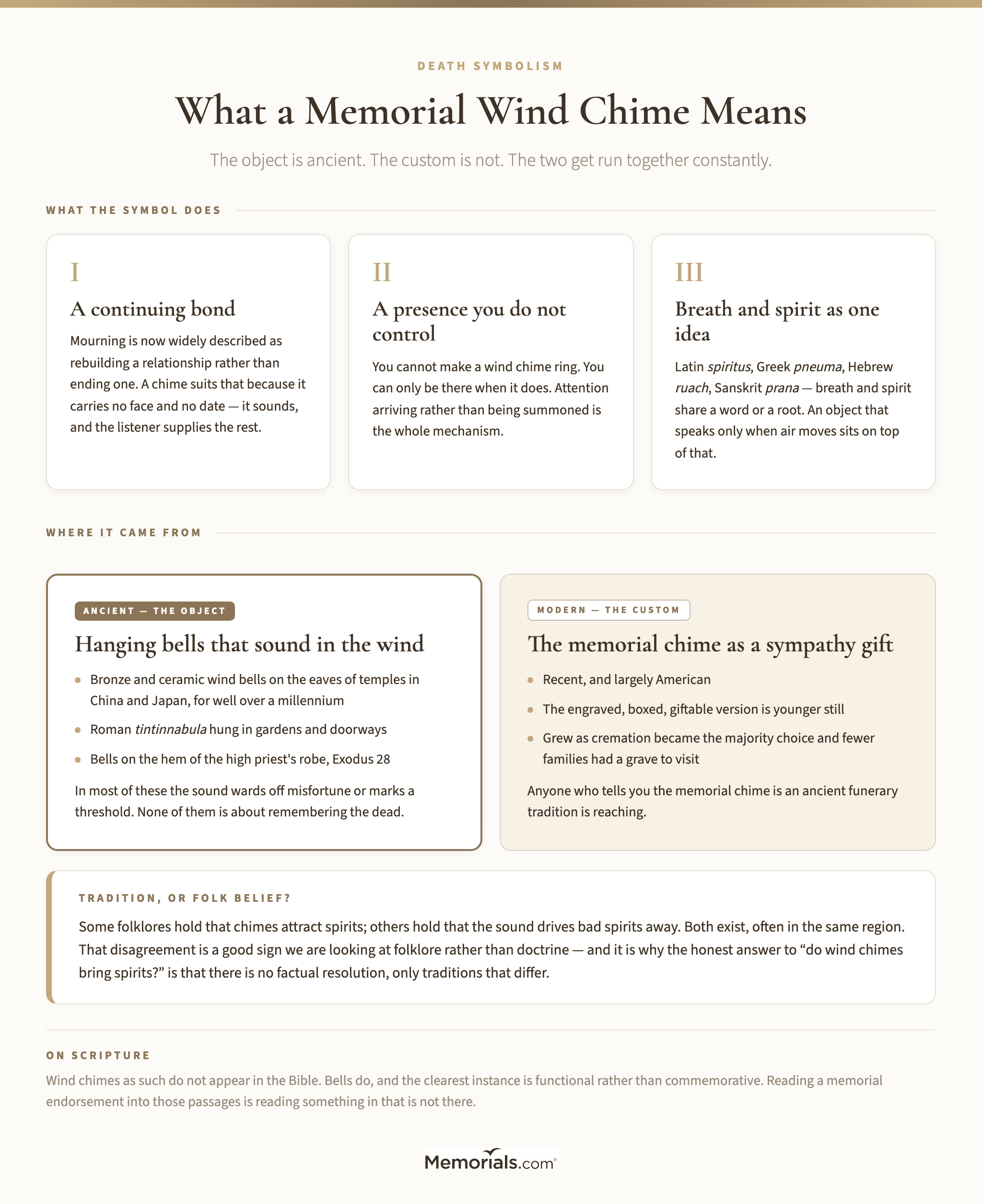
The object is ancient and the custom is modern, and the two get run together constantly. The left column is what the symbol does today; the right is what can actually be traced.
Where to Hang a Memorial Wind Chime — and Where Not To
People search where should you not put wind chimes for two different reasons, and they need different answers.
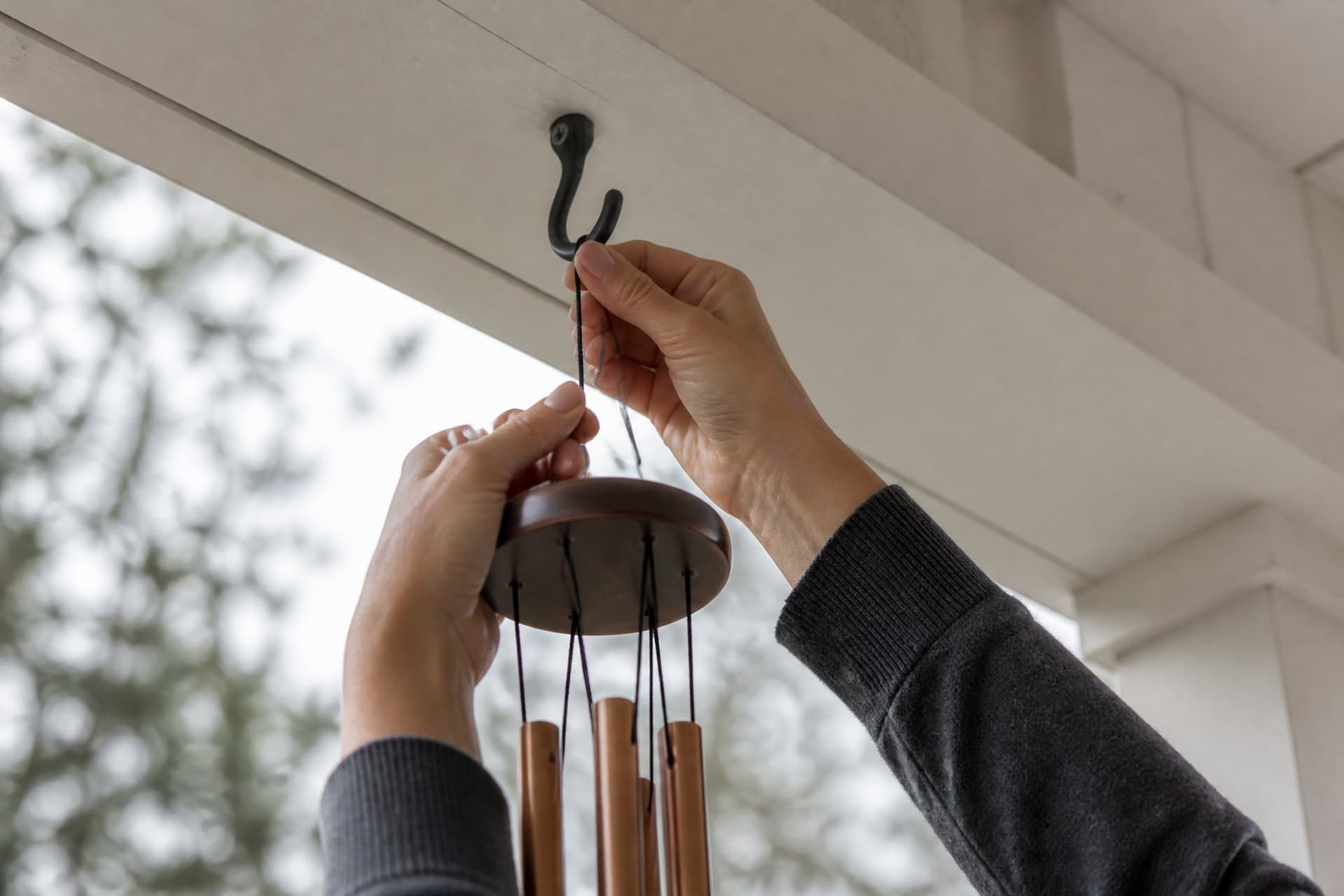
If the question is practical, the rules are short. Hang it where air moves but weather does not punish it: under an eave, a porch roof, a pergola, a sturdy branch with some shelter. Avoid a spot directly outside a bedroom window — a chime that is consoling at four in the afternoon is not consoling at four in the morning. Think about the neighbors, particularly with a deep-toned chime in a close-set street. And avoid anywhere it will strike a wall or a post as it swings, which wrecks both the tone and the finish.
If the question is about placement beliefs, feng shui practice has a good deal to say about direction and material, and those rules are about energy in a home rather than about mourning. They are worth reading on their own terms. They are not rules about memorials, and nothing in them should override putting the chime where the person who is grieving will actually hear it.
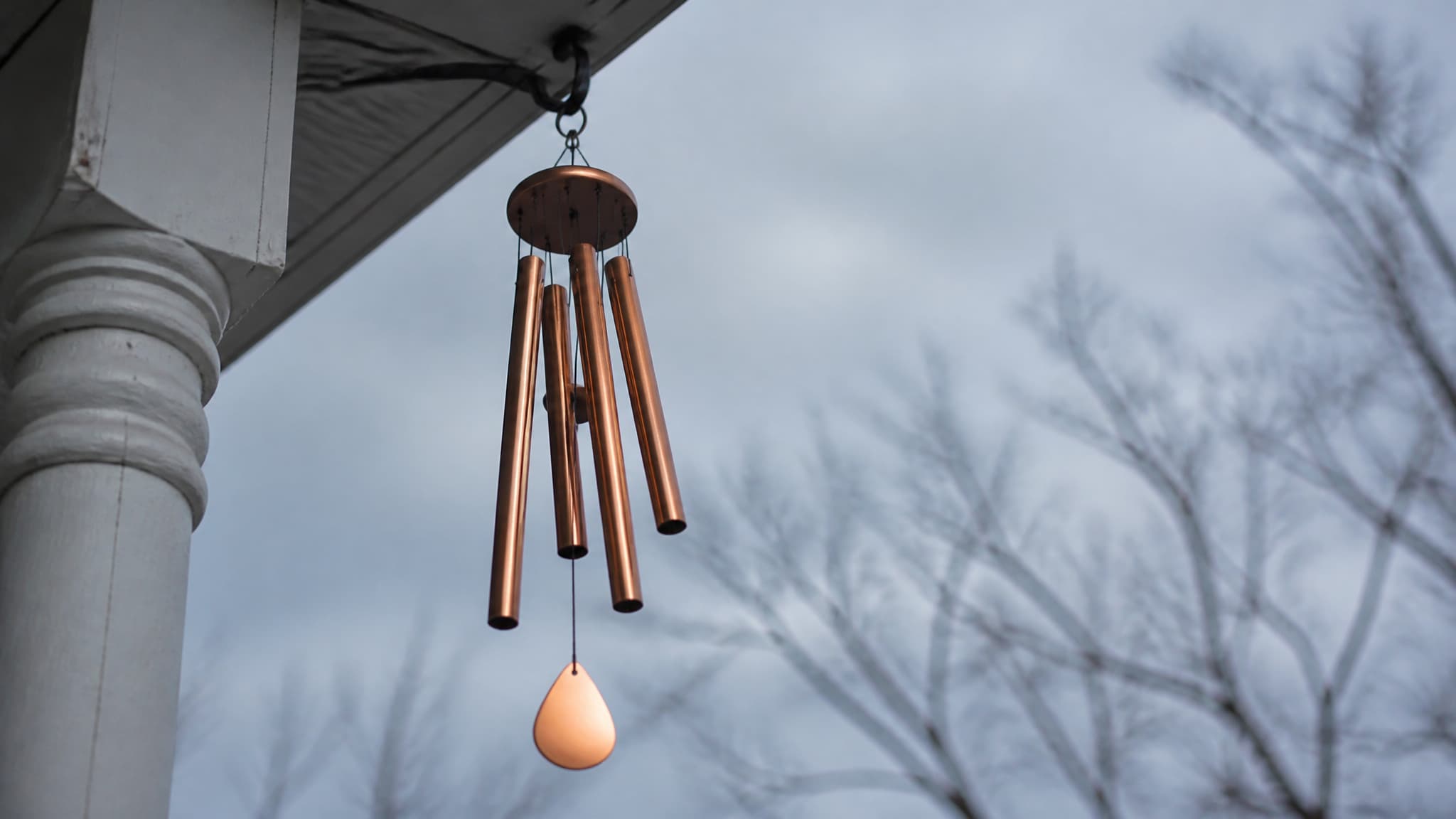
Under an eave is the usual answer: air moves there, weather mostly does not, and the chime is clear of any wall it could strike as it swings.
At a cemetery, ask first. Many cemeteries restrict what may be left at a grave, and hanging items are among the most commonly removed. Our guide to cemetery grave decoration ideas covers how those rules usually work and how to find out before you hang anything. A chime removed by grounds staff is a second loss, and an avoidable one.
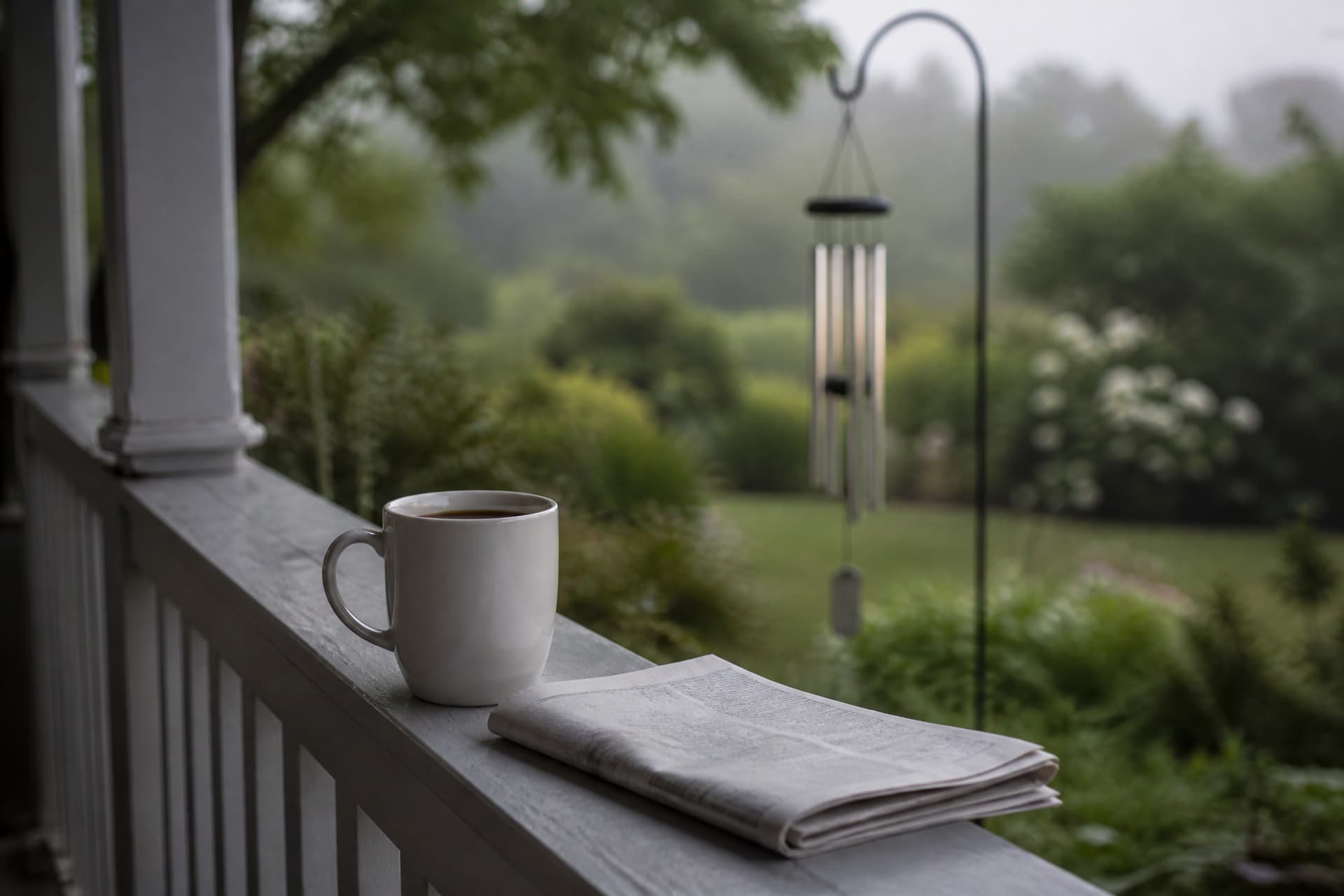
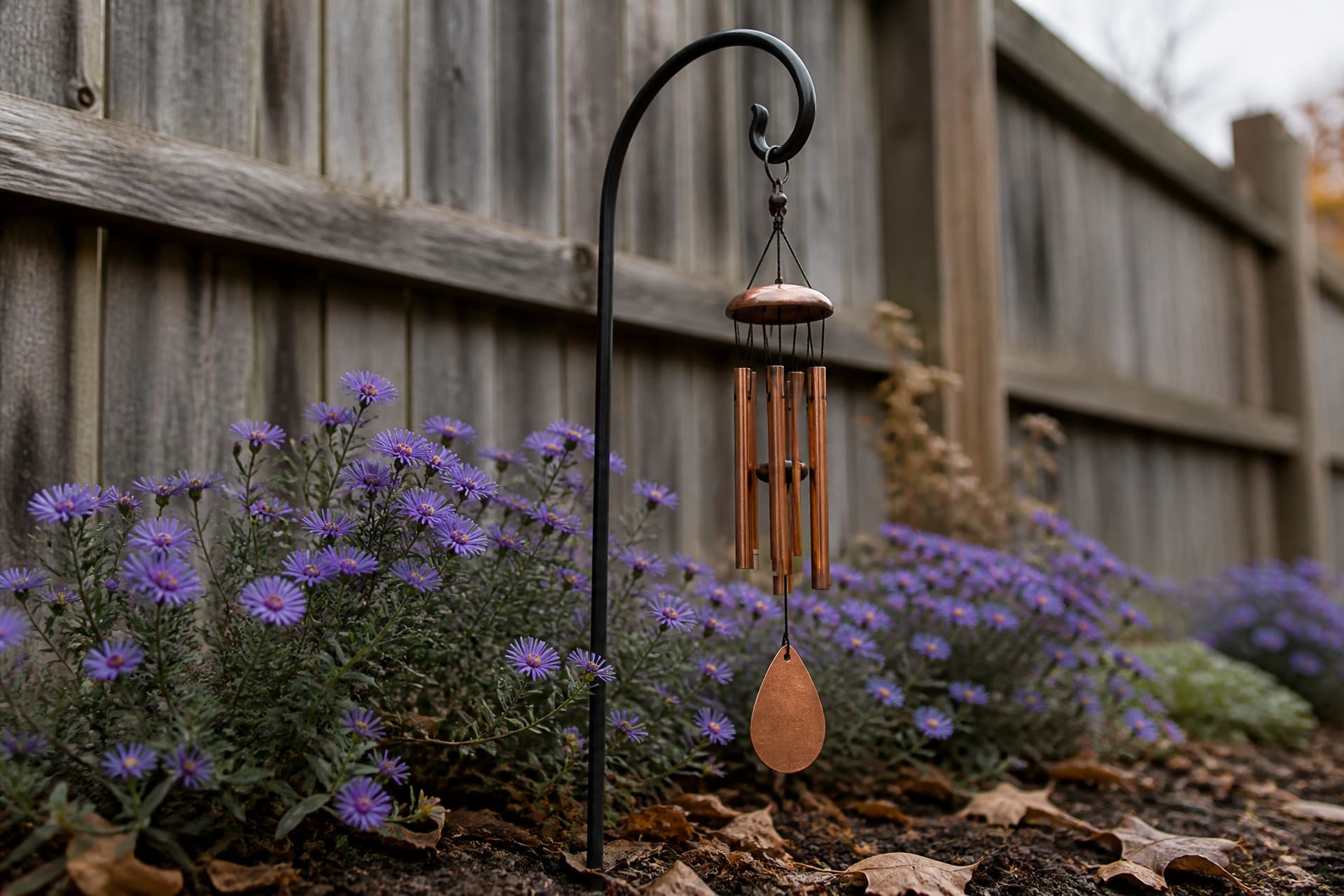
A shepherd's hook in a border is the usual answer when there is no porch to hang from — it keeps the chime clear of walls and lets a family move it without replacing the fixing.
What to Write on a Memorial Wind Chime
Deciding what to write on a memorial wind chime is where most people stall, and it is the one decision that cannot be undone. Three things make it easier.
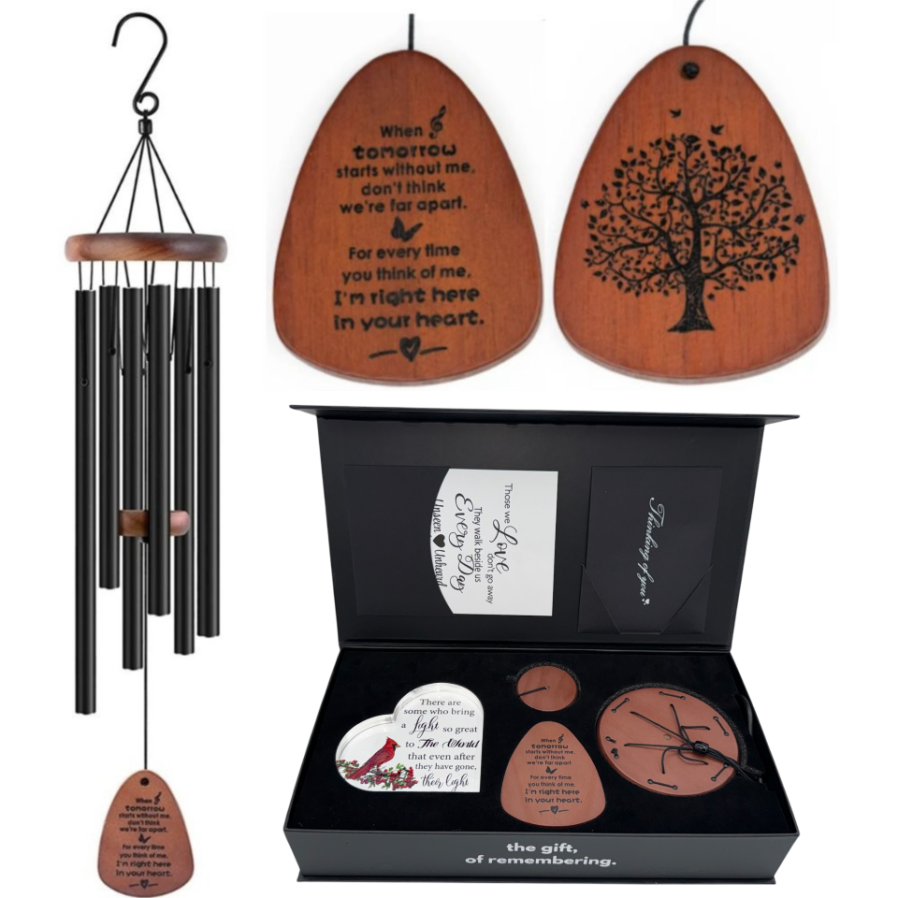
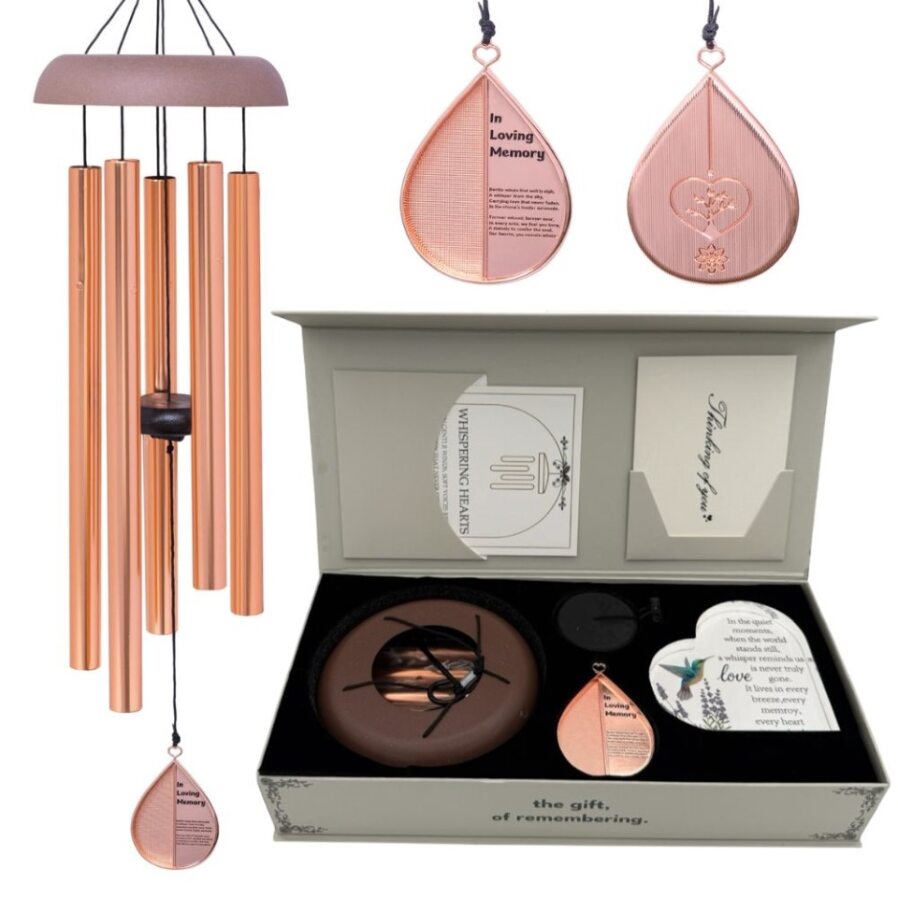
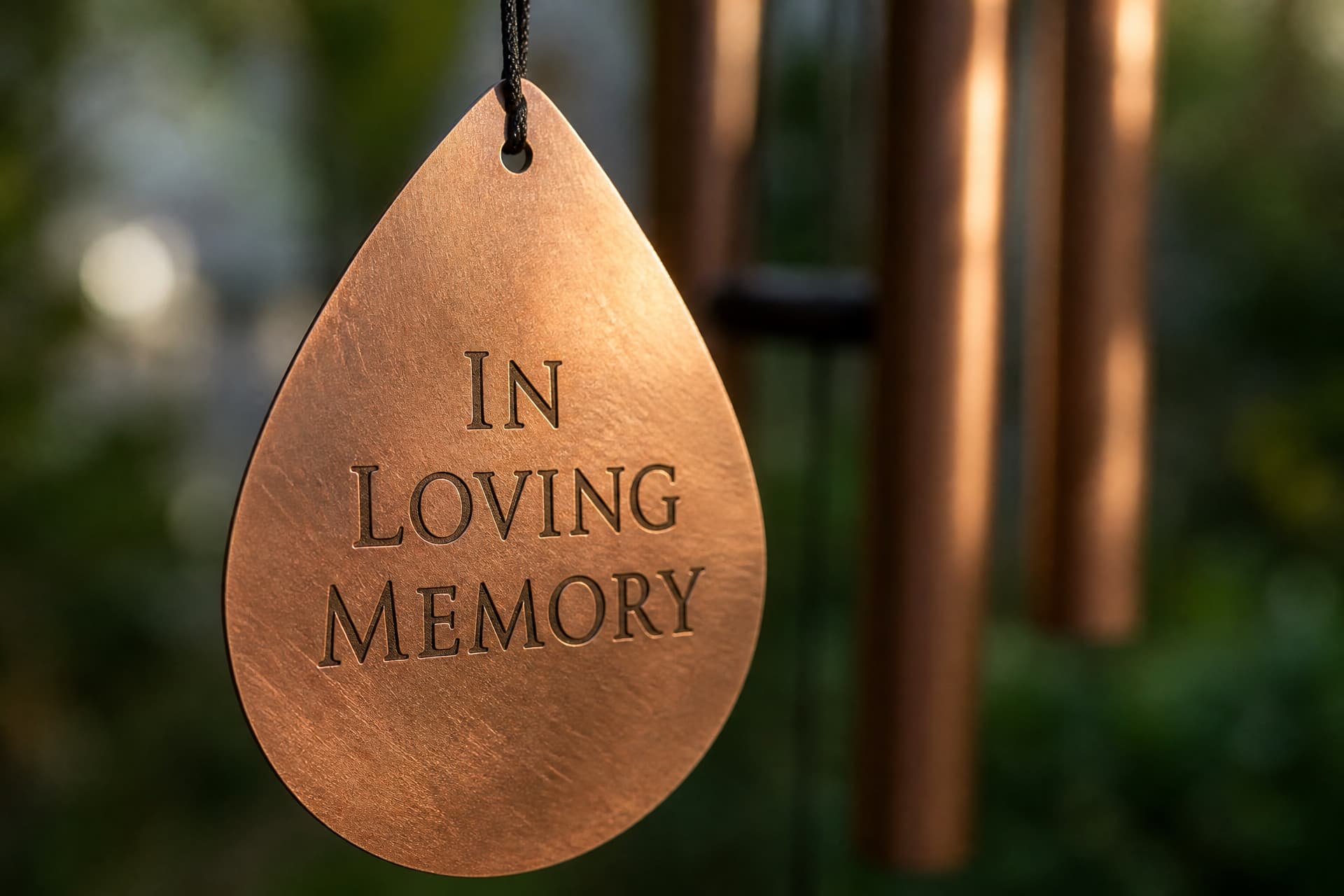
Keep it shorter than you think. Engraving space on a wind catcher or a tag is small, and the piece is read at arm's length in a garden, not held in the hand. Most engraved chimes carry somewhere between three and twelve words well. Beyond that the letters shrink to the point of being decorative rather than legible.
Decide who the inscription is for. An inscription addressed to the person who died reads very differently from one addressed to whoever is standing in the garden. Both are right; they are just different objects. "Listen for me" and "In memory of Robert, who loved this garden" do different work.
Name something specific. The single biggest improvement to any memorial inscription is a concrete detail. A date is specific. A nickname is specific. "Forever in our hearts" is not, and our piece on the meaning behind forever in our hearts is partly about why that phrase has worn so smooth.
Three words, cut deep enough to read at arm's length. Most engraved chimes carry between three and twelve words comfortably; past that the letters shrink until they are decoration rather than a message.
Memorial Wind Chime Quotes
People searching memorial wind chime quotes and wind chimes quotes short are usually after something that fits a small plate. These are the shapes that work, rather than a list to copy:
Direct address.Listen for me in the wind.I am still here, in the quiet.
The sound as the message.When you hear this, think of me.Every breeze, a hello.
Name and detail.For Dad, who whistled.Margaret, 1941 to 2026, in her garden.
A line from the person. Something they actually said, in their own words, beats any quotation.
A line from a shared text. A hymn, a song, a verse the family already holds in common.
Two cautions. Check every spelling and every date twice before you approve a proof, because engraving is permanent and the error will be the only thing anyone sees afterward. And if the chime is a gift rather than something you are buying for your own home, consider leaving it unengraved — an inscription you chose on someone else's behalf can land badly, and a blank chime can always be engraved later.
The same thinking applies across every engraved memorial, which is why we treat it at length in our guide to sympathy gifts for the loss of a spouse, where getting the words wrong carries the highest cost.
Choosing a Memorial Wind Chime
Four things decide whether a chime gets hung or quietly put in a cupboard.
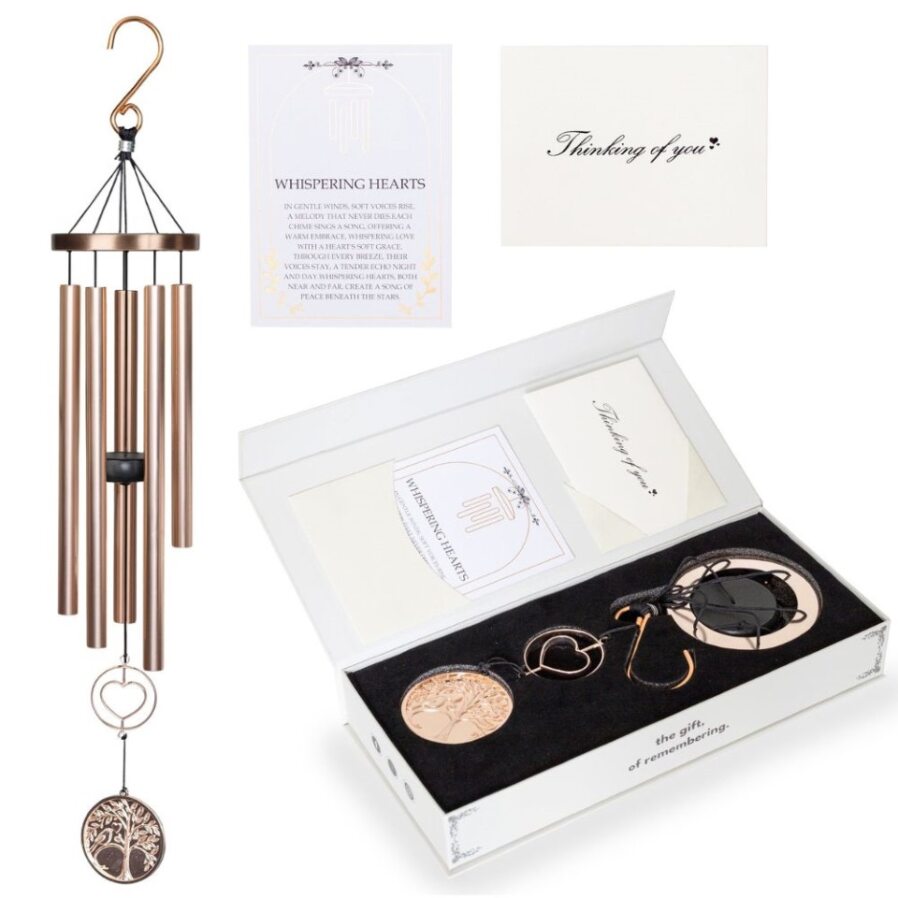
Tone. Longer and thicker tubes give deeper, slower notes; short thin tubes give a bright jingle. Deep tones suit mourning better for most people and carry less far, which also makes them kinder to neighbors. If you can hear a sample before buying, do.
Material. Aluminum holds tune well and resists weather, which is why most serious chimes use it. Copper and bronze weather to a patina some families like and others do not expect. Wood and bamboo sound softer and warmer but will not survive a wet climate outdoors indefinitely.
Size. A large chime in a small courtyard is too much, and a small one on an exposed hillside is inaudible. Match it to where it is actually going.
Whether to engrave. Covered above, and worth deciding before you order rather than after.
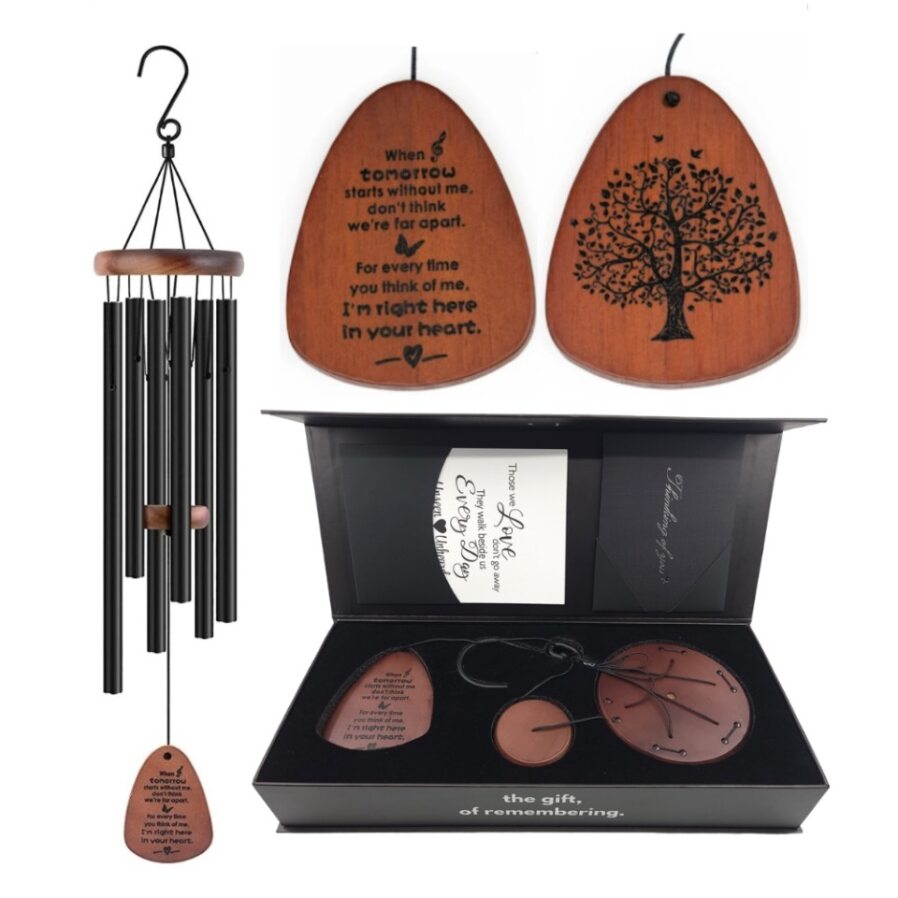
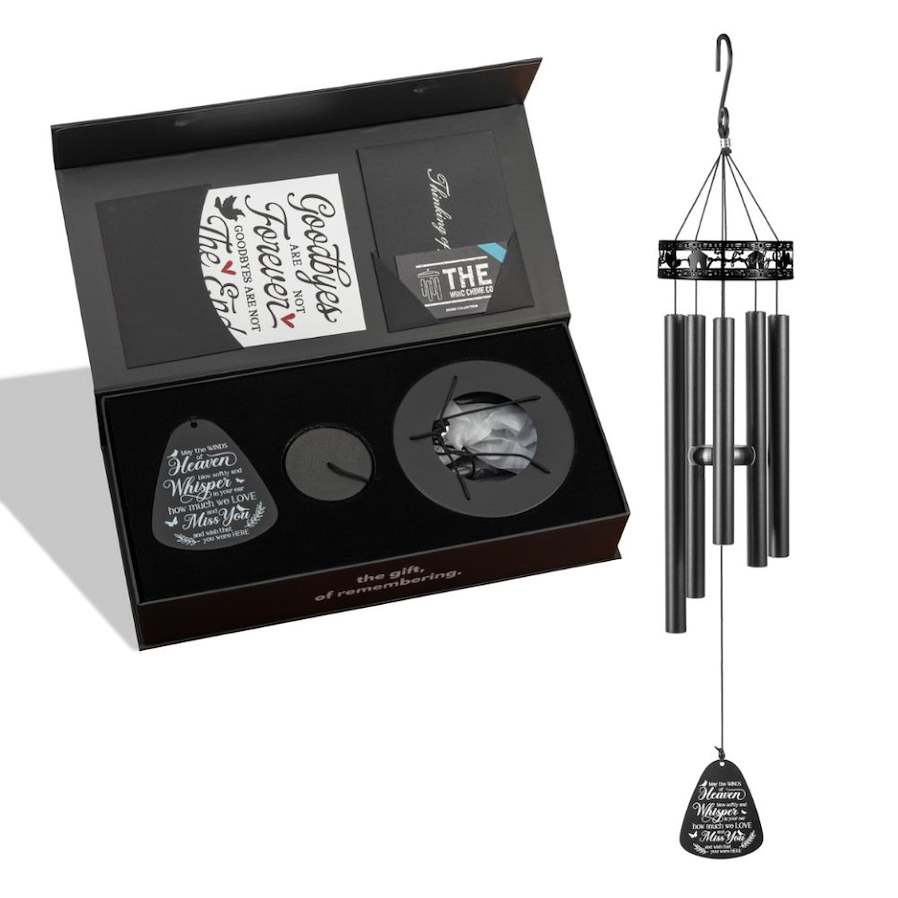
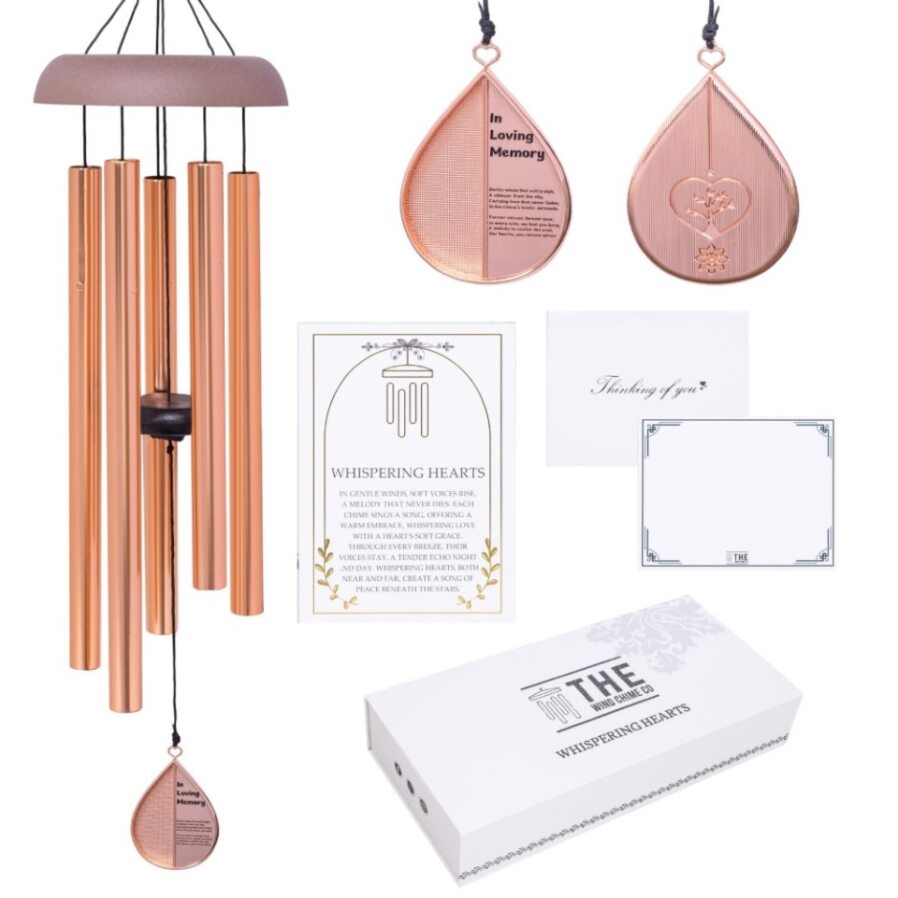
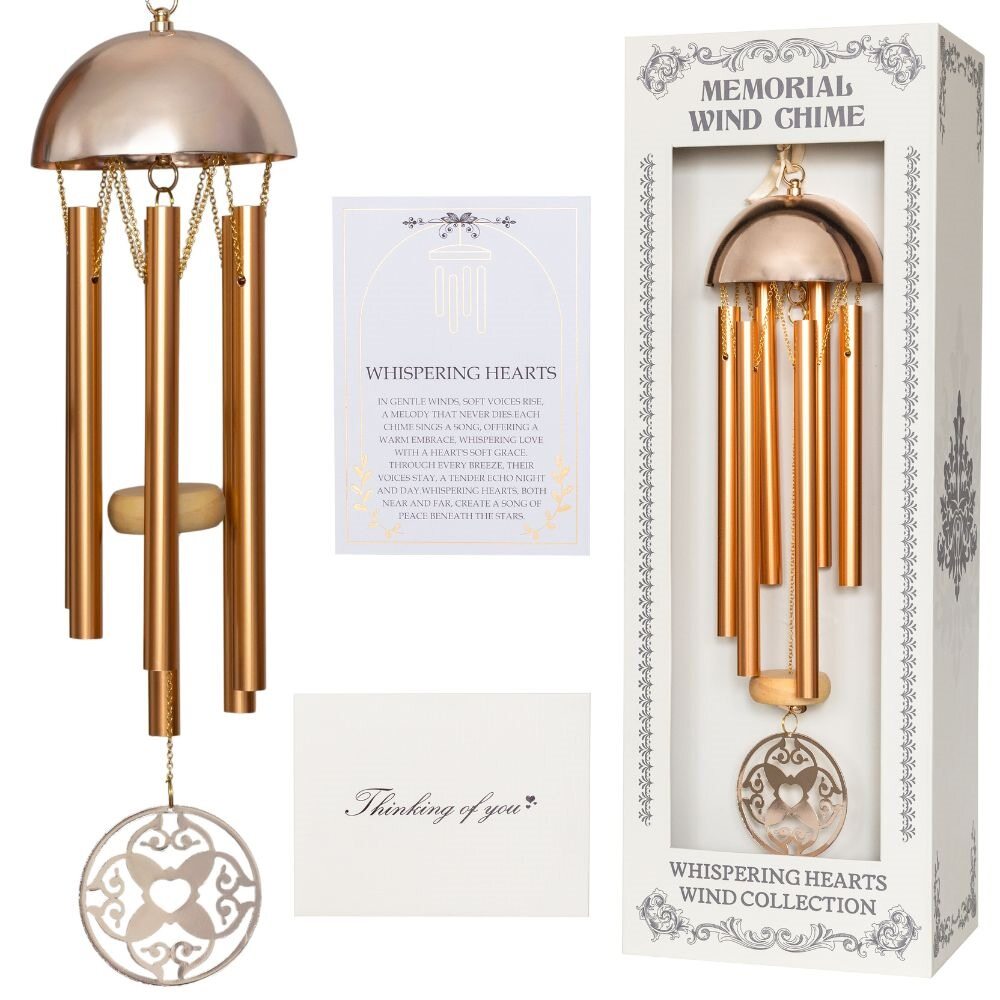
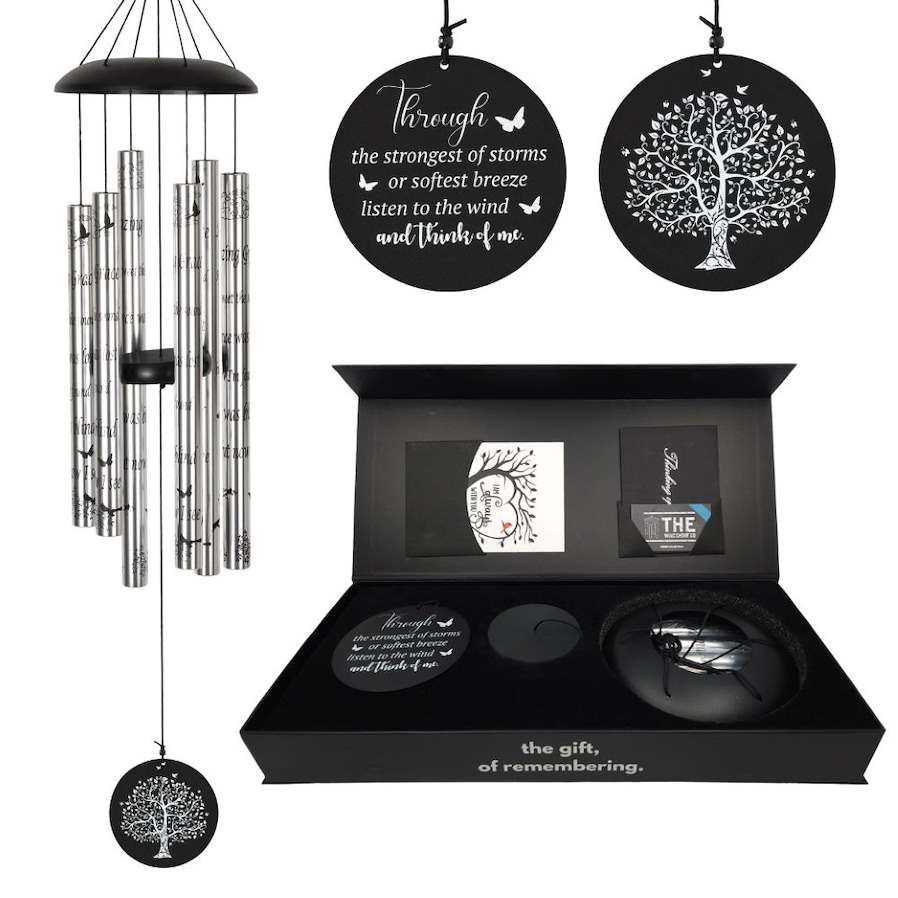
Our memorial wind chimes collection gathers the engraved and deep-tone chimes in one place, with free shipping on every order. They sit alongside our wider memorial gifts for loss and the full range of sympathy gifts for anyone not yet sure a chime is the right object.
Frequently Asked Questions
What do wind chimes symbolize after death? Presence and a continuing bond. A chime sounds without being summoned, which is why so many people describe it as feeling like company rather than like a monument. It carries no image and no date unless you add one, so the listener supplies the meaning.
Why do people give wind chimes at funerals? Because the gift keeps working after the funeral is over, asks nothing of a grieving household, and carries sympathy without requiring the giver to find the right words. For families who chose cremation and have no grave to visit, it also becomes the place to go.
Is a memorial wind chime an appropriate sympathy gift? For most families, yes, and it is among the most commonly given. Two situations call for a moment's thought: a household in a very close-set street where a loud chime may become a nuisance, and a family whose tradition holds specific beliefs about hanging objects. When in doubt, choose a deeper, quieter tone and leave it unengraved.
What should I write on a memorial wind chime? Keep it short enough to read at arm's length, decide whether you are addressing the person who died or the person in the garden, and name one concrete detail — a nickname, a date, something they did. Check spelling and dates twice; engraving cannot be undone.
Where should you not put a wind chime? Outside a bedroom window, anywhere it will strike a wall or post as it swings, anywhere fully exposed to hard weather if it is wood or bamboo, and at a grave without first checking the cemetery's rules on hanging items.
Do wind chimes bring spirits? Some folk traditions say they attract spirits and others say the sound drives them off, which is a reasonable sign that this is folklore rather than settled belief. There is no factual answer. What is well documented is the effect on the living: a sound outside the window that redirects attention toward someone remembered.