🏬Supersize Online Funeral Retailer🪦1000's of Headstones⚱️Over 10,000 Cremation Urns⚰️Caskets Overnight Delivery🛒Funeral & Memorial Superstore🚚FREE Shipping on ALL Orders👨👩👧👦Helping Families for over 20 Years💰Lowest Price Guarantee🏬Supersize Online Funeral Retailer🪦1000's of Headstones⚱️Over 10,000 Cremation Urns⚰️Caskets Overnight Delivery🛒Funeral & Memorial Superstore🚚FREE Shipping on ALL Orders👨👩👧👦Helping Families for over 20 Years💰Lowest Price Guarantee
🏬Supersize Online Funeral Retailer🪦1000's of Headstones⚱️Over 10,000 Cremation Urns⚰️Caskets Overnight Delivery🛒Funeral & Memorial Superstore🚚FREE Shipping on ALL Orders👨👩👧👦Helping Families for over 20 Years💰Lowest Price Guarantee🏬Supersize Online Funeral Retailer🪦1000's of Headstones⚱️Over 10,000 Cremation Urns⚰️Caskets Overnight Delivery🛒Funeral & Memorial Superstore🚚FREE Shipping on ALL Orders👨👩👧👦Helping Families for over 20 Years💰Lowest Price Guarantee
Death Traditions: Symbols, Omens, Mythology and Mourning Customs Across Cultures and Faiths
funeral
Almost nobody arrives at a page about death traditions out of general interest. They arrive from one specific thing: a red bird that has been on the fence every morning since the funeral, a clock in the hallway that stopped the week their father died, a line the officiant said at the graveside that went past too quickly to catch. The question underneath is usually the same one, and it is rarely typed out. Does this mean anything, and am I being ridiculous for wanting it to.
This guide is the answer to the general version of that question, and it is the front door to twenty more pages that answer the specific ones. What it covers is the vocabulary — the symbols, omens, figures and mourning customs that different cultures and faiths have used to say a small number of things about dying. What it deliberately does not cover is the order of service. How a Muslim burial is conducted, what happens at a Hindu cremation, how long a Jewish family sits shiva: those are questions about practice, and they get their own pages elsewhere on this site rather than a paragraph here.
Read straight through, this is a map of how the world has handled its dead. Read for one thing, use the symbols of grief and mourning index or the Hub Library at the end, which lists every page under this guide with a line on what each one settles.
What a Death Tradition Is Actually For
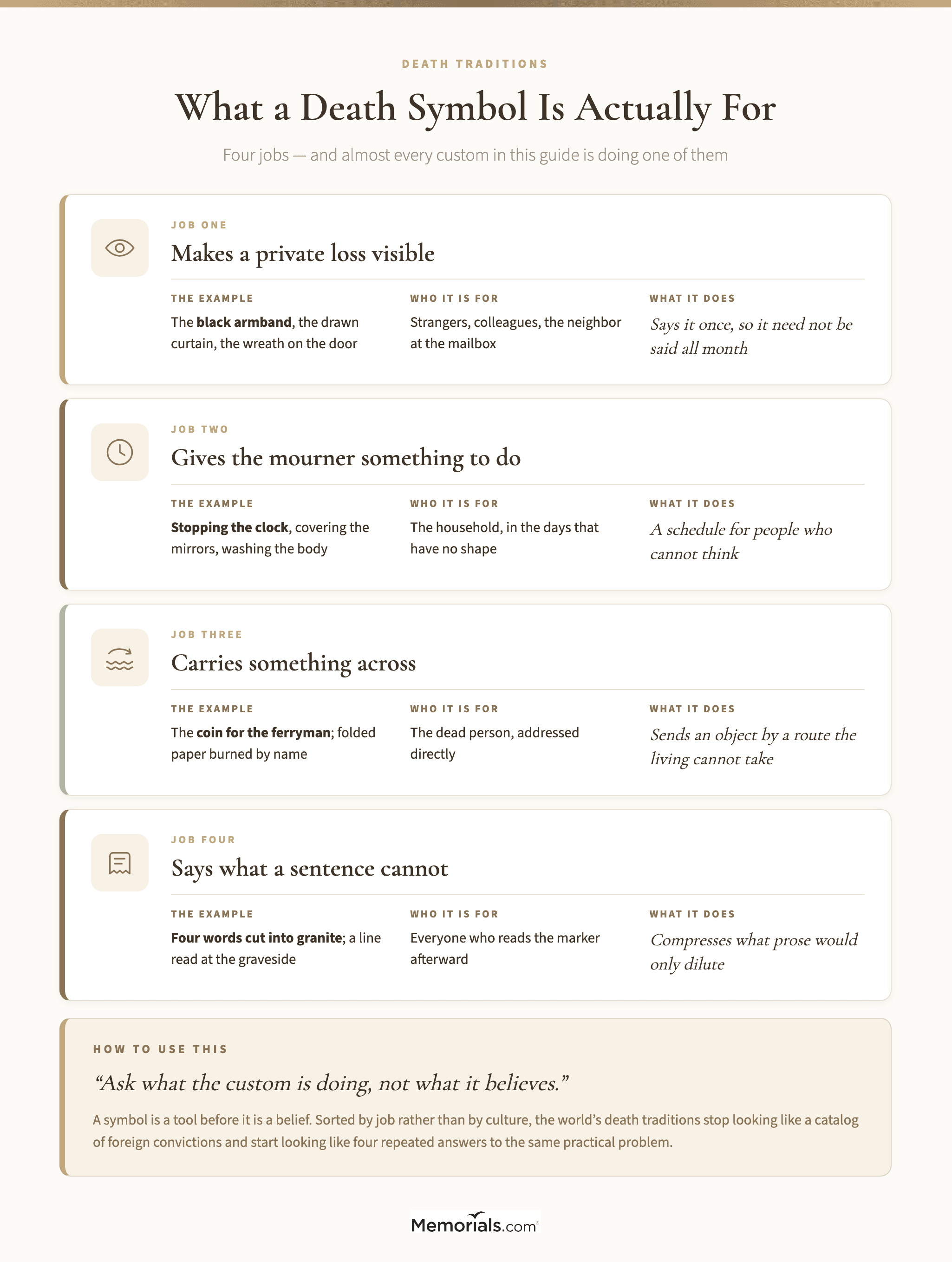
A symbol is not a decoration and it is not a belief. It is a tool, and it usually has a job so practical that describing it out loud makes it sound obvious.
The first job is making a private thing visible. A black armband on a coat sleeve tells a stranger something the wearer would otherwise have to say aloud to every person they meet for a month. A neighbor who sees it does not ask how your week has been. That is the entire function, and it is why the armband, the black dress, the drawn curtain and the wreath on the door all appear independently in cultures that never met.
The second is giving the mourner something to do. The days after a death are shapeless in a way that is hard to describe until you are in them, and almost every tradition responds by prescribing tasks. Wash the body. Cover the mirrors. Sit with him and do not leave him alone. Stop the clock. None of these is a claim about the afterlife. They are a schedule for people who cannot think.
The third is moving something across. This is the one that looks most like superstition and is most consistent across the map. A coin, a bowl of rice, a folded paper suit, a burned letter, a poured cup of wine: an object is put into the hands of the dead by a route the living cannot take themselves.
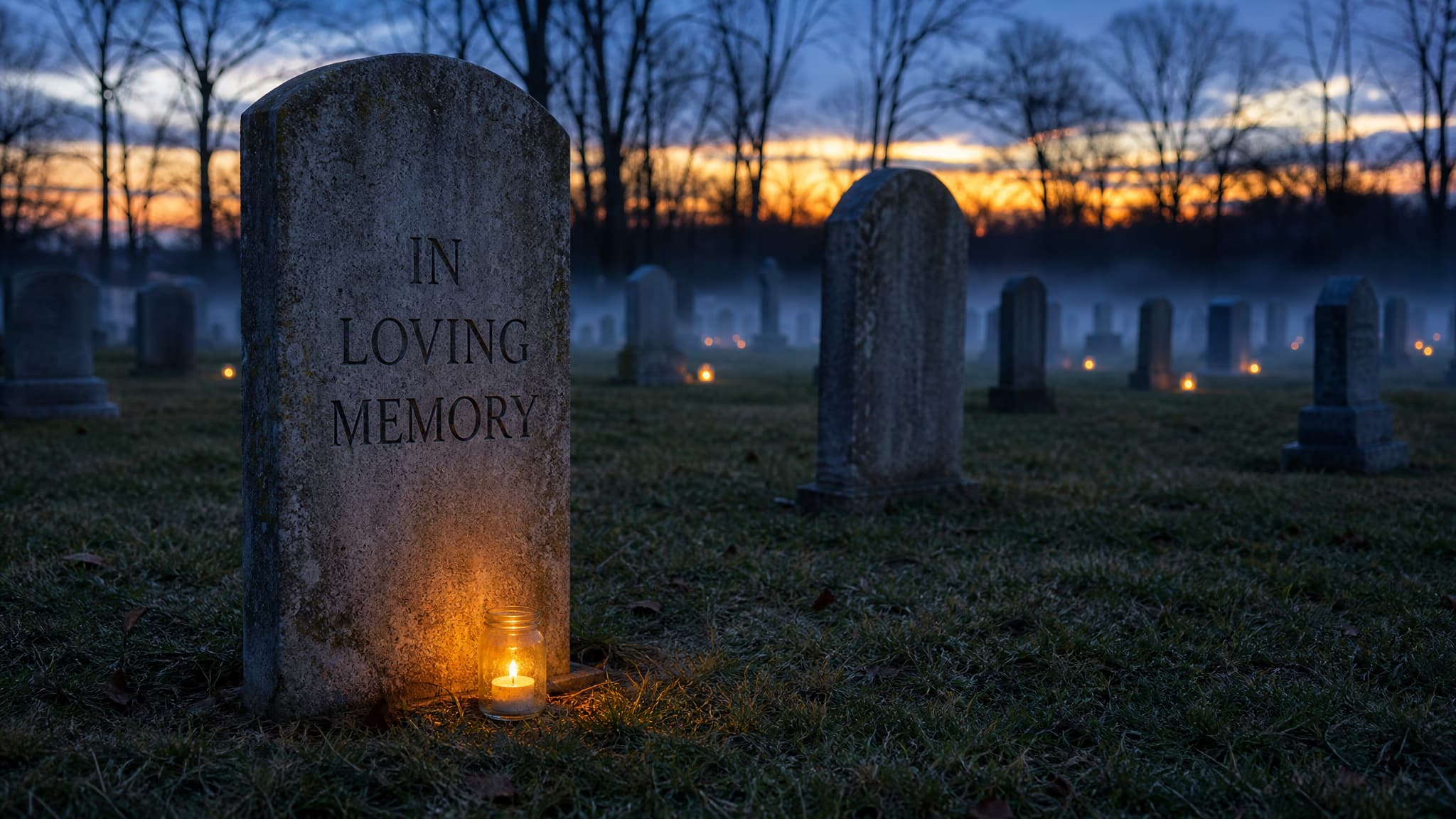
The fourth is saying the thing that cannot be said in a sentence. Four words cut into granite carry a weight that four hundred words of prose do not, which is why memorial phrases are so short and so repeated.
Nearly every custom in this guide is doing one of four things: making a private loss visible to strangers, giving a mourner a task, carrying an object across to the dead, or compressing what cannot be said into a few words.
Urns That Carry the Emblem
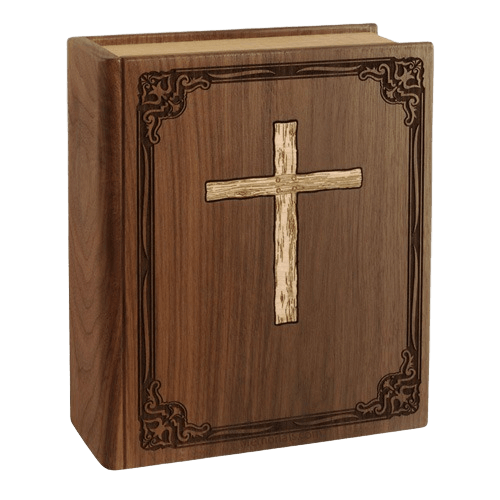
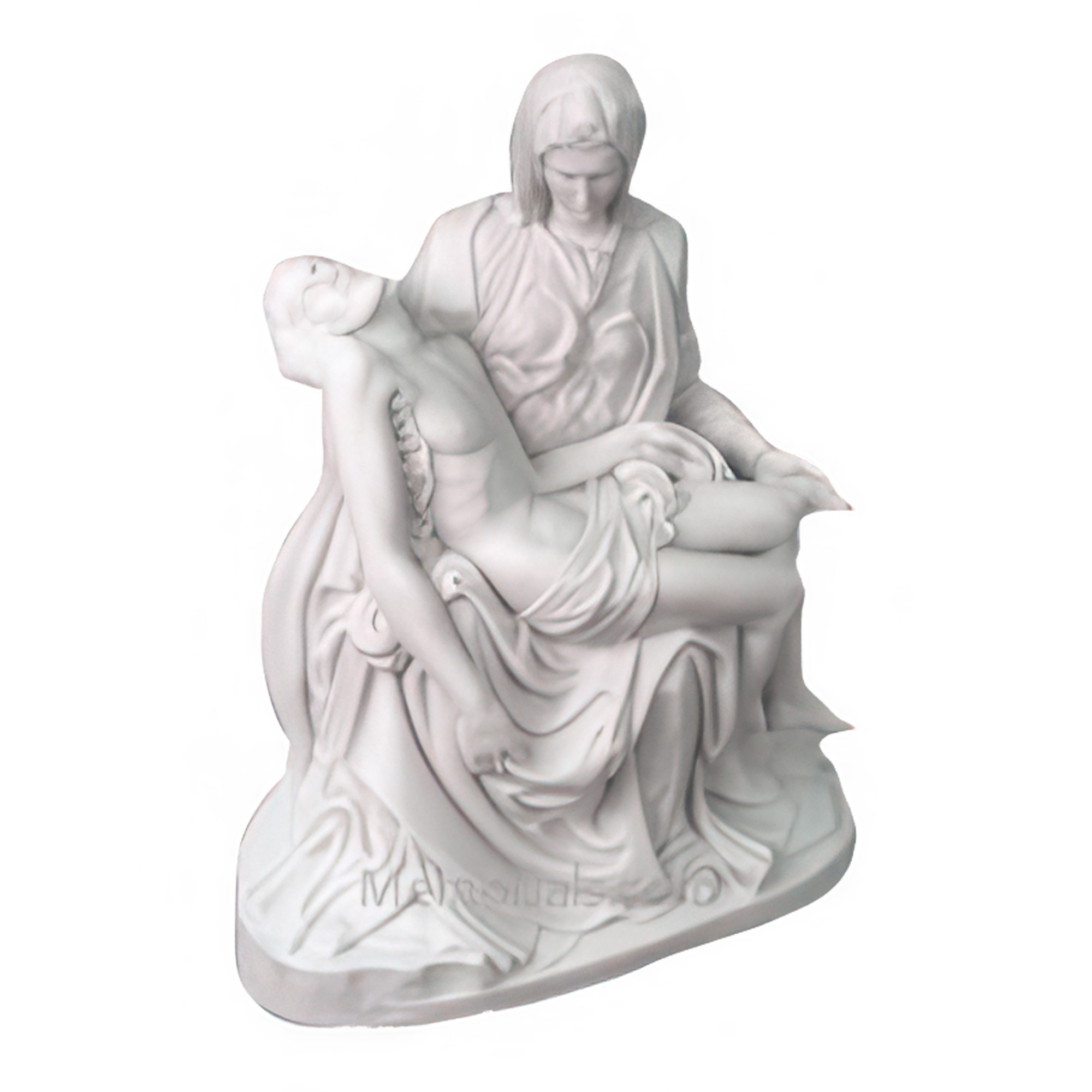
Religious cremation urns from the pictures on this page
The Same Small Number of Ideas, in Different Costumes
Put the world's death traditions side by side and the striking thing is not how different they are. It is how few underlying ideas there turn out to be, and how often unrelated cultures reach for the same one.
Somebody comes for you. Death is almost never described as a process. It is described as an arrival — a figure, a summons, a hand on the shoulder.
There is a journey, and it has a toll. A river, a bridge, a desert, a ladder, a set of gates. The dead do not simply stop being here; they go, and getting there costs something. Ancient Greece made this literal with a fare, which is why a coin for the ferryman turns up in graves.
There is a boundary, and it can be crossed the wrong way. Covering mirrors, turning photographs to the wall, carrying a body out feet first, taking it out through a window rather than the door: these are all barrier maintenance. Something has opened and it needs closing behind them.
Objects can be sent, but only by changing their state. A thing has to stop existing here in order to exist there. Fire is the commonest conversion, which is the whole logic behind burning paper offerings, and breaking, burying and pouring do the same work.
The dead come back on a schedule. Not as a haunting but as a visit, and an expected one. The living set out food, light a path, and go to the cemetery to meet them.
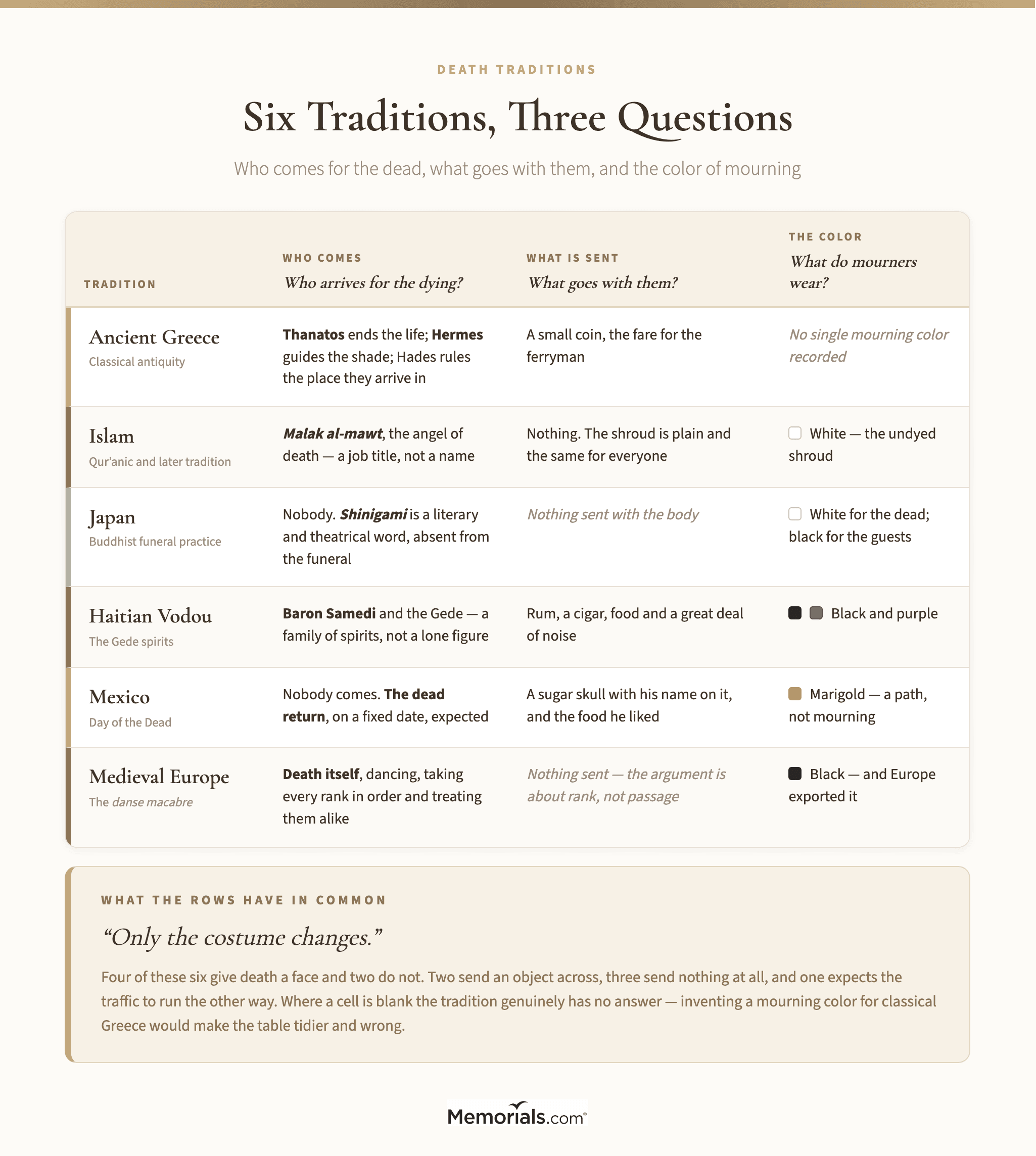
Six traditions, three questions. Greece sends a fare with the dead and Vodou sends rum and a cigar; Islam and Japan send nothing at all; Mexico expects the dead to come back and lays out the food he liked. Only the costume changes.
Who Comes for You — Death With a Face
Giving death a face is the oldest move in the collection, and the faces are more different from each other than the modern shorthand suggests.
The Greeks split the work three ways, and most modern comparisons collapse it into one. Thanatos and Hades are not two versions of the same god and not rivals — one ends a life, the other rules the place the dead go afterward, and Hermes walks them between the two. Confusing them is a bit like confusing a paramedic with a mayor.
Islam names a single being with one assigned task and gives him a job title rather than a name. The Qur'an calls him malak al-mawt, the angel of death. The name most readers arrive with, Azrael, comes from later tradition rather than from the text, and the angel of death in Islam is nothing like a reaper: he is a servant carrying out an appointment already fixed, not a hunter choosing a target.
Japan supplies the word most often handed to English speakers as "grim reaper," and it is the closest word rather than the same figure. Shinigami is written with two characters meaning death and god, it is largely a literary and theatrical word rather than an old folk belief, and no shinigami appears anywhere in a Japanese funeral.
Haitian Vodou does something different again. Death there is not a lone figure but a family of spirits, the Gede, and the one who leads them is a personality rather than an office — Baron Samedi and the Gede come with a top hat, dark glasses, rum, a cigar and a great deal of obscene humor. A tradition that gives death a sense of humor is making a specific argument about death, and it is not the argument the skeleton in the black robe makes.
The hooded figure with the scythe, which is what most people picture, is not universal and is not ancient. It is a European invention, and it arrived considerably later than the pandemic it usually gets attached to.
Death in Medieval Art and the Danse Macabre
The image of Death as an active, mobile skeleton — leading, grabbing, dancing — comes from a specific artistic tradition with a name. The danse macabre, the dance of death, showed a procession in which skeletal figures took the living by the hand and led them away: a pope, an emperor, a bishop, a knight, a merchant, a laborer, a child. The point was rank. Death arrived for every station in the order, took them in that order, and treated them identically once it had them.
The phrases people type — medieval art death, death in medieval art — return the same small group of surviving pictures, because so little of it survives. The best-documented early cycle was painted in the 1420s along a charnel-house wall in a Paris cemetery and was lost when the site was cleared some two centuries later; what remains of it is a printed edition made from the paintings before they went. Other great painted cycles in Basel and in Lübeck are known chiefly from copies and photographs, having been destroyed by demolition and by war. A handful of wall paintings survive in place in smaller churches across France and central Europe, and they are what most reproductions of danse macabre art are actually reproducing.
The version that spread furthest was printed rather than painted. Hans Holbein the Younger designed a series of small woodcuts in which Death interrupts each figure at work — the plowman in his field, the merchant at his goods, the bishop with his flock — published in the 1530s and copied for centuries afterward. Almost every later image of a personified Death carrying an hourglass owes something to those blocks.
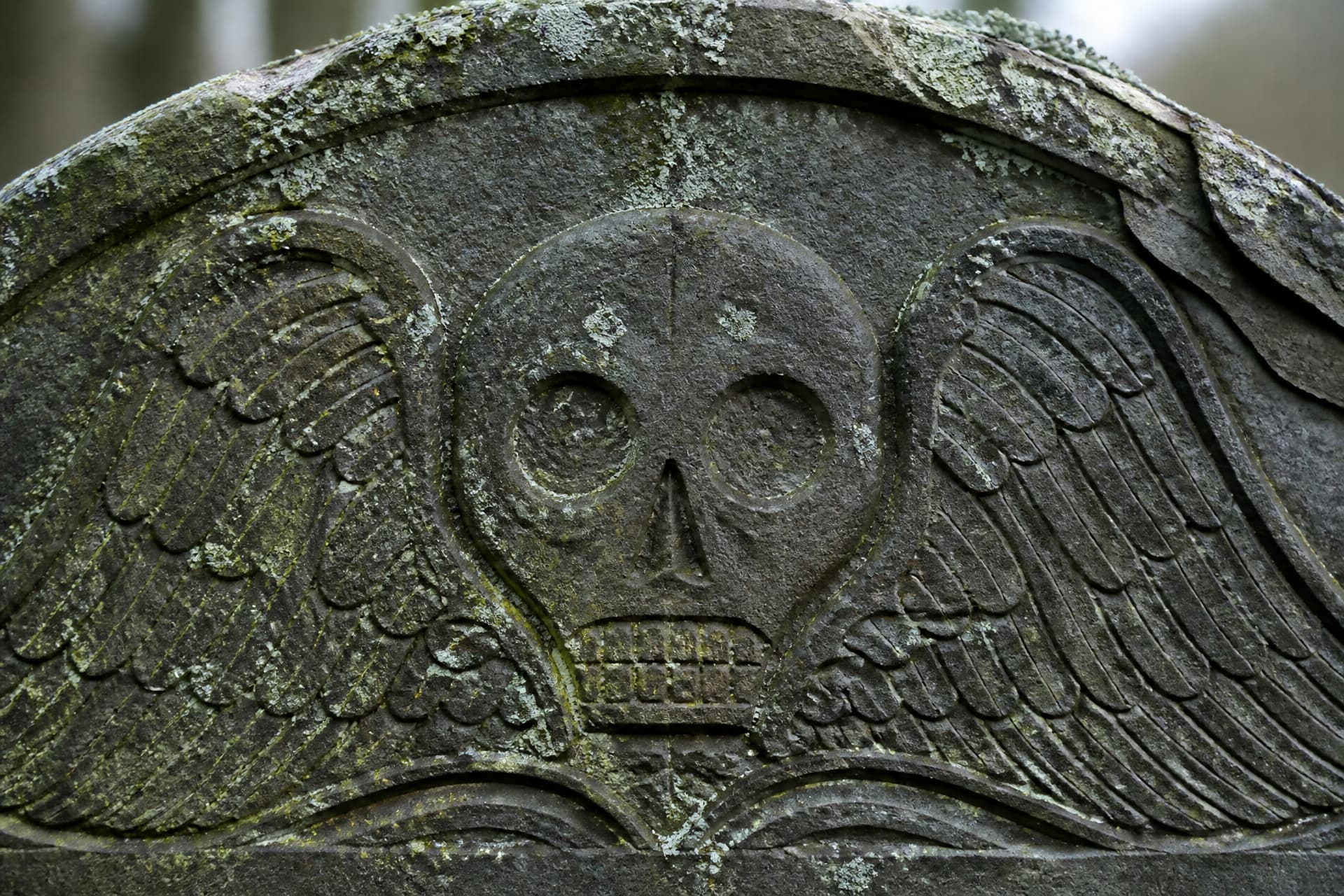
The medieval danse macabre did not appear out of nowhere. It grew out of an older set of images with the same argument, the best known being the tale of three living men who meet three corpses and are told, in effect, what you are, we were; what we are, you will be. It sits beside the cadaver tombs of the same period, where a carved effigy of the person in life lies above a carving of the same body decayed, commissioned by the person themselves. And it belongs with the wider vocabulary of memento mori — the skull on the desk, the hourglass, the guttering candle, the winged death's head cut into New England slate two centuries later.
Whether the Black Death caused it is argued over, and the honest answer is that the timing fits and the causation does not follow automatically. What is clear is that the danse macabre medieval art tradition is where our reaper comes from: not from antiquity, but from a late-medieval European argument about rank, conducted in pictures. The other figure people associate with plague, the beaked plague doctor, is later still and arrives from a completely different direction — a real occupational costume, roughly three centuries after the pandemic it now stands for.
The winged death's head, cut into colonial slate, is the danse macabre's argument reduced to a single carving — and stonecutters in New England were still cutting it long after the painted cycles were gone.
Omens — The Things People Notice
An omen is a different kind of symbol from an emblem. Nobody chooses it. It happens, and the noticing is involuntary, which is why people are so much more embarrassed about omens than about wreaths.
Clocks are the most common by a distance. Households across Britain, Ireland, Germany and rural America did not wait for a clock to stop on its own — they stopped it themselves, within minutes of a death, and the spiritual meaning of clock stopping turns out to have at least four competing explanations, none of which the households themselves agreed on. The modern version, where a clock or a watch stops by itself around the time of a death, usually has a plain mechanical cause, and knowing the cause does not stop people finding the coincidence remarkable.
Birds carry more of this weight than any other animal. Some are read as messengers and some as warnings, and which is which changes by a few hundred miles. The whole subject is laid out in our guide to bird symbolism after a death — including the bird that comes into the house, which is one of the most widely shared omens on earth, and the dead bird on the doorstep, which is generally not the omen people fear it is.
One bird accounts for more of these questions than the rest combined. In much of the eastern United States, a red cardinal turning up after a funeral is read as a visit, and the fuller answer to what it means when you see a red cardinal has to hold two things at once: the bird does not migrate, does not leave its half-acre, and is the loudest, reddest thing in a gray February yard — and it is still the case that a person noticing it in the week after a death is doing something ordinary and human rather than something foolish.
Butterflies, moths, howling dogs, a picture falling off a wall, the smell of somebody's tobacco in a room: the list is long, local, and remarkably consistent in structure. Something ordinary happens at an extraordinary moment, and the mind does what minds do.
Emblems — What Gets Carved, Worn and Sent
Emblems are the chosen half of the vocabulary. Somebody selects them, pays for them, and expects them to be read.
Worn. Mourning dress was once a code with rules — what to wear, for how long, and what you were allowed to change into next. The black armband survives as its last widely understood fragment. Alongside it sat a whole industry of jewelry made to be worn in grief, and the history of mourning jewelry is stranger and more specific than most people expect, down to the woven hair and the black jet.
Carried. At a Masonic funeral, each man files past the grave and drops a small green branch onto the casket. The sprig of acacia stands for the immortality of the soul, and nobody outside the fraternity is expected to know that in advance — the men conducting the service do not assume you do.
Sent. Flowers are the emblem most people actually buy, and they carry meanings that vary by color and by country. Black carnations are the clearest case of a symbol that works despite having no natural basis at all — no carnation grows black, every one is dyed or is a very dark burgundy, and almost everybody reads a dark carnation in an arrangement as mourning anyway.
Carved. Cemetery stone is where this vocabulary is most densely packed and least explained. The lamb, the broken column, the clasped hands, the draped urn, the weeping angel: our guide to headstone symbols and their meanings works through what each was understood to say, and the Angel of Grief is the single carving that has been copied more than any other.
Released, or painted, or tattooed. The dove does more work than any other bird in this collection — what a dove represents is three separate claims stacked on each other, and the oldest of them is not peace but news that the worst has passed.
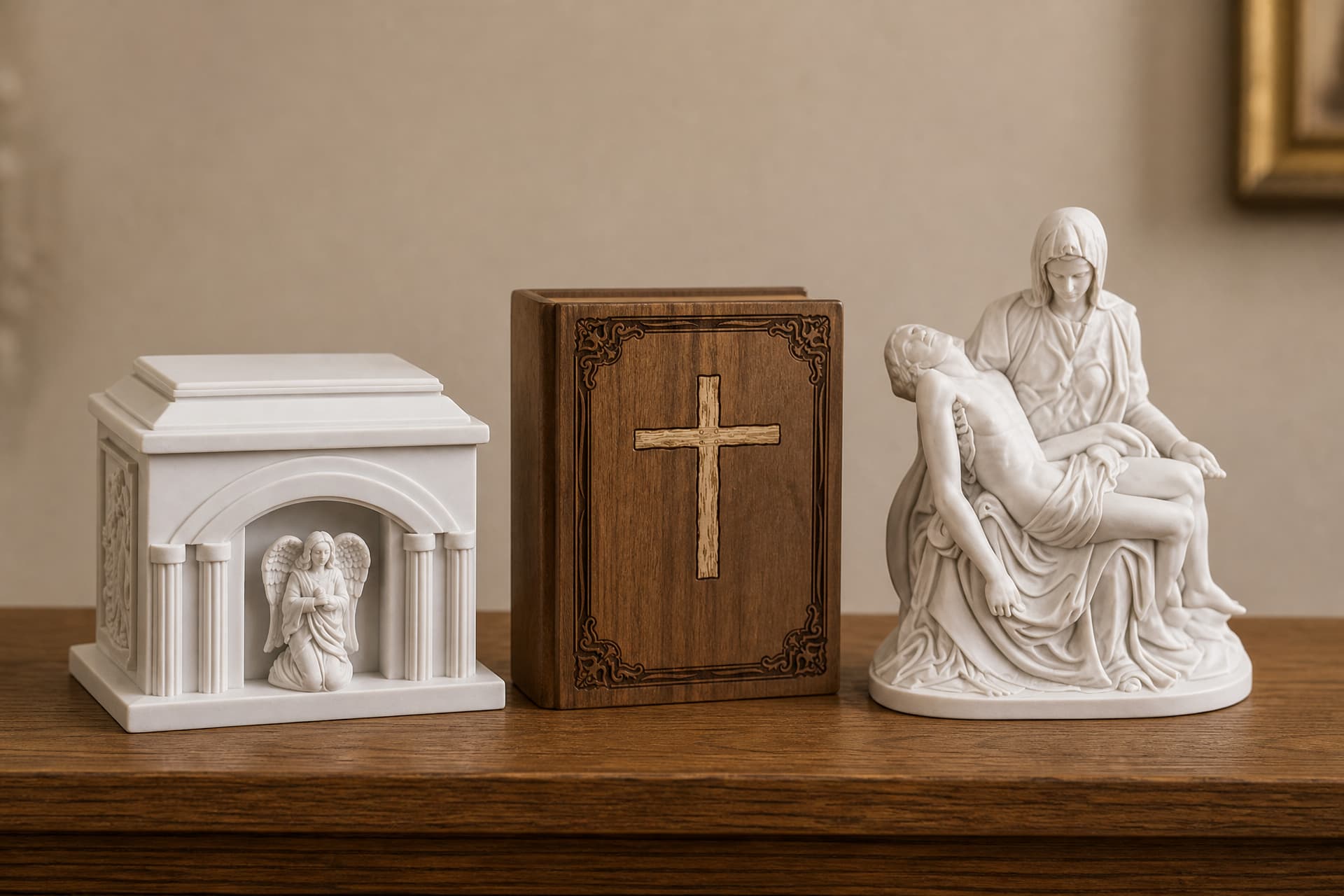
These are the same emblems the cemetery uses, moved indoors and reduced to something that fits on a shelf — a figure, a book, a scene. The choice between them is usually made in seconds, and almost always on which one looks like the person rather than on which is most devout. Products from left to right: Praying Angel Religious Cremation Urn, Bible Cremation Urn and Pieta Cremation Urn.
The Colors of Mourning Are Not the Same Everywhere
Black is not the world's mourning color. It is Europe's, and it became a great many other places' by export.
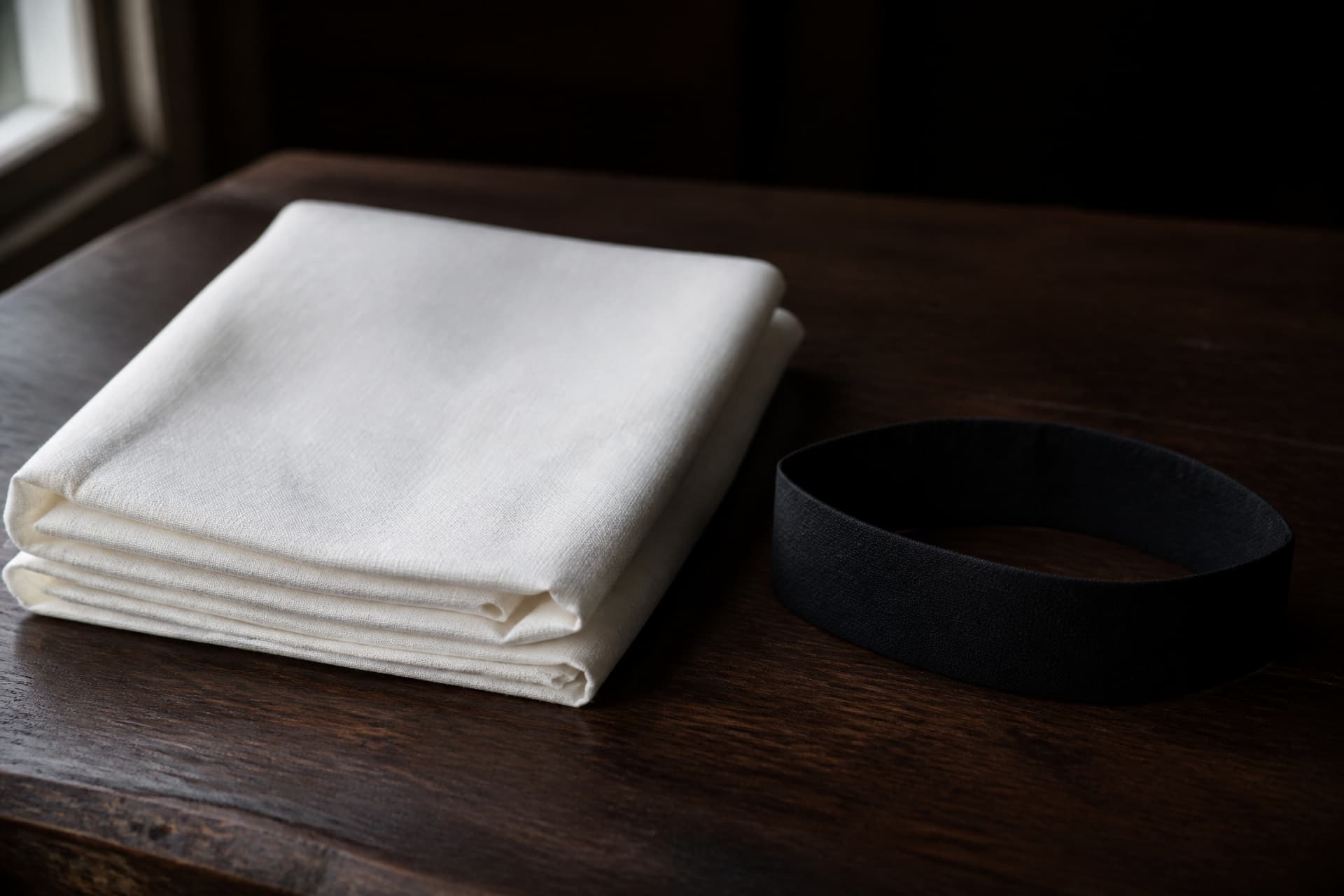
White is at least as widespread and considerably older in several traditions. Across much of East and South Asia white is the color of mourning and of the funeral itself, which means a guest wearing black to be respectful and a guest wearing white to be respectful can be in the same room disagreeing about which one is dressed correctly. In Islamic burial the plain white shroud carries an argument of its own — everyone is buried in the same unmarked cloth, so status does not follow the body into the ground.
Red is mourning in parts of West Africa and in South Africa, and in Chinese practice it is close to forbidden at a funeral because it belongs to celebration. Purple is mourning in parts of Latin America and appears again, with black, in the colors of the Gede spirits. Marigold orange is not mourning at all in Mexico — it is a path, laid down so the dead can find the house.
The practical point for a reader who is a guest rather than a mourner is that the color rule is the one custom people get wrong most confidently. Our guide to the colors of remembrance covers what each color has come to stand for, and the rule of thumb below is worth more than any chart: ask the family, and wear what they say.
Two mourning colors, both correct. A guest who assumes black is universal will be wrong across most of Asia, and a guest who assumes white will be wrong across most of Europe.
What Gets Sent With the Dead
Grave goods are among the oldest evidence we have that people thought of death as a departure rather than an ending, and the practice has never really stopped — it has only become less obvious.
The Greek version is the famous one. A small coin was placed with the dead as a fare for the ferryman, and what archaeologists actually find in the ground is messier and more interesting than the tidy picture of coins resting on closed eyelids, which comes from somewhere else entirely.
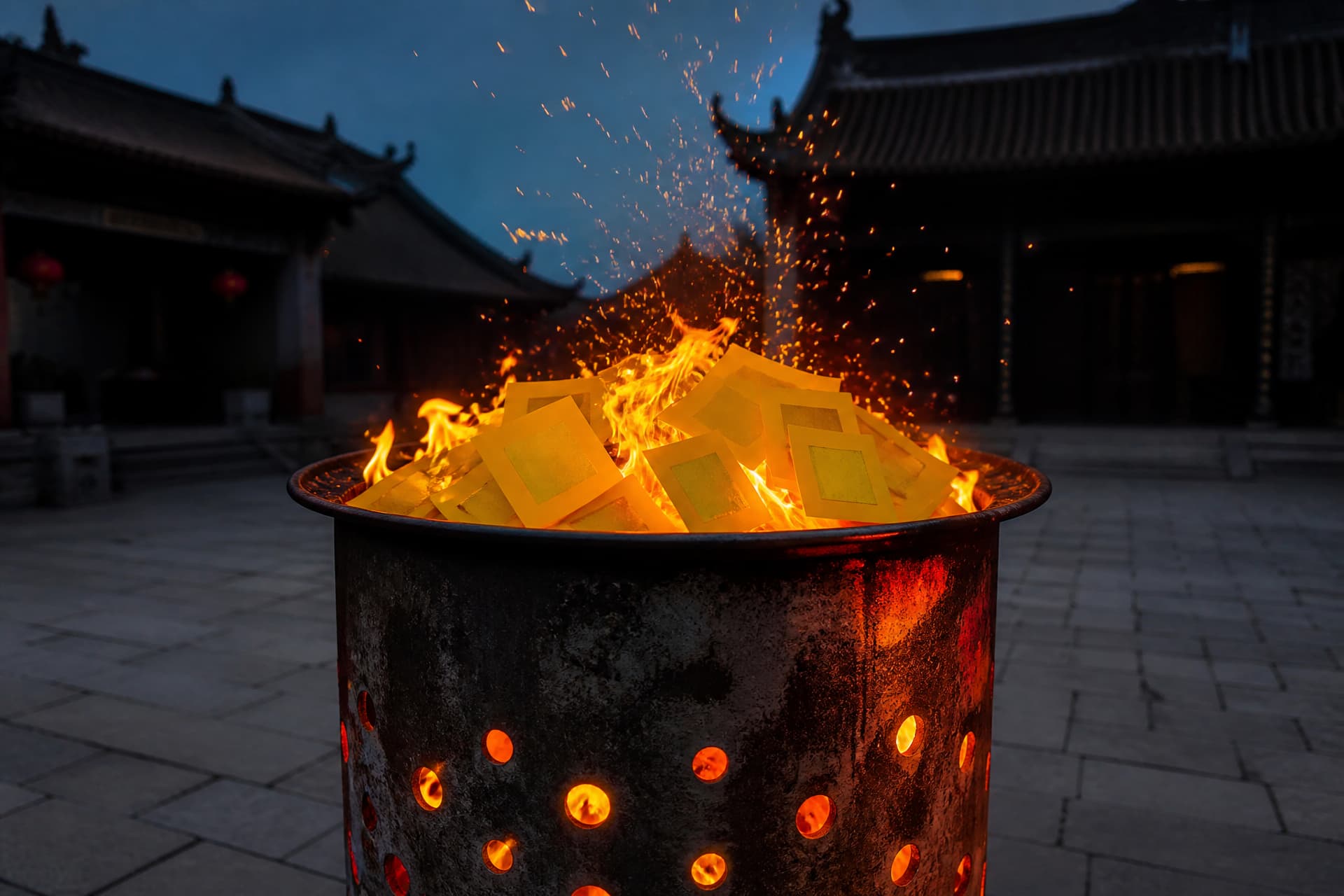
In Chinese practice the sending is done by fire. Paper is folded into the shape of money, clothes, a house, a phone, addressed to a particular person by name, and burned so that it arrives. The object is a stand-in, the recipient is specific, and the fire is the route between them.
In Mexico the traffic runs the other way. Nothing is sent, because the dead come back. A sugar skull is not a decoration and not a memento mori — it has a name written across the forehead in icing, it names one particular dead person, and it sits on a table beside the food he liked while his family stands around talking about him.
The burner, not the fire, is the point. Paper is folded into the shape of a thing, addressed to one named person, and burned because burning is understood as the route between here and there.
The Words — What Gets Said and Engraved
The spoken and engraved parts of this vocabulary are the ones people carry away from a funeral, usually half-remembered.
The graveside line almost everybody recognizes is longer than they think. Ashes to ashes, dust to dust is the middle of a three-part committal, and the clause that follows it is not about decay at all — which is why the whole thing reads so differently once you have seen it written down, and why it still works after a cremation.
The engraved words are shorter and much more repeated. Forever in our hearts is one of the most-cut phrases in American memorial work, and it is doing something unusual: it is a promise made by the people still standing there, not a claim about the person who died or where they have gone.
And then there is the sung part. A death song in the older sense is not a track chosen by the living for a service — it is a song made or sung by the person who is dying, a last statement in music. Three quite different meanings have collected around the phrase, and pulling them apart is most of what makes the question answerable.
When the Faith Changes the Object
For a great many families the symbolism stops being abstract at exactly one moment: when somebody has to choose the container, the marker or the piece of jewelry, and the question becomes whether the faith should be visible on it.
There is no correct answer, and the two honest ones point in opposite directions. Some families want the emblem present and unmissable — a cross, a Star of David, a Pietà, an Om, a crescent — because it names what the person believed in a form a stranger will read in a second. Others want nothing on it at all, on the grounds that the faith was the person's own and does not need announcing at the cemetery, and that plainness is itself a religious statement in traditions where an unmarked shroud is the rule.
Where the emblem is wanted, the choice is usually narrower than it looks. A catholic urn is a different object from a general one in only a few respects — an applied crucifix, a Madonna, an engraved cross, occasionally a scene in relief — and families are often surprised by how much difference those few respects make when the container is going to sit on a shelf in the house for thirty years. Our guide to religious and cultural cremation urns walks through what each tradition typically expects, including the traditions that expect no container at all.
One practical caution worth stating here rather than at the end. Where a faith has actual rules about the body — burial timing, cremation, embalming, what may and may not be placed with the deceased — those rules are the family's to interpret and often the clergy's to confirm, and no symbol chart substitutes for asking. Every tradition described on this site has internal variation, and where a family's practice differs from the general account, the family is right about their own funeral.
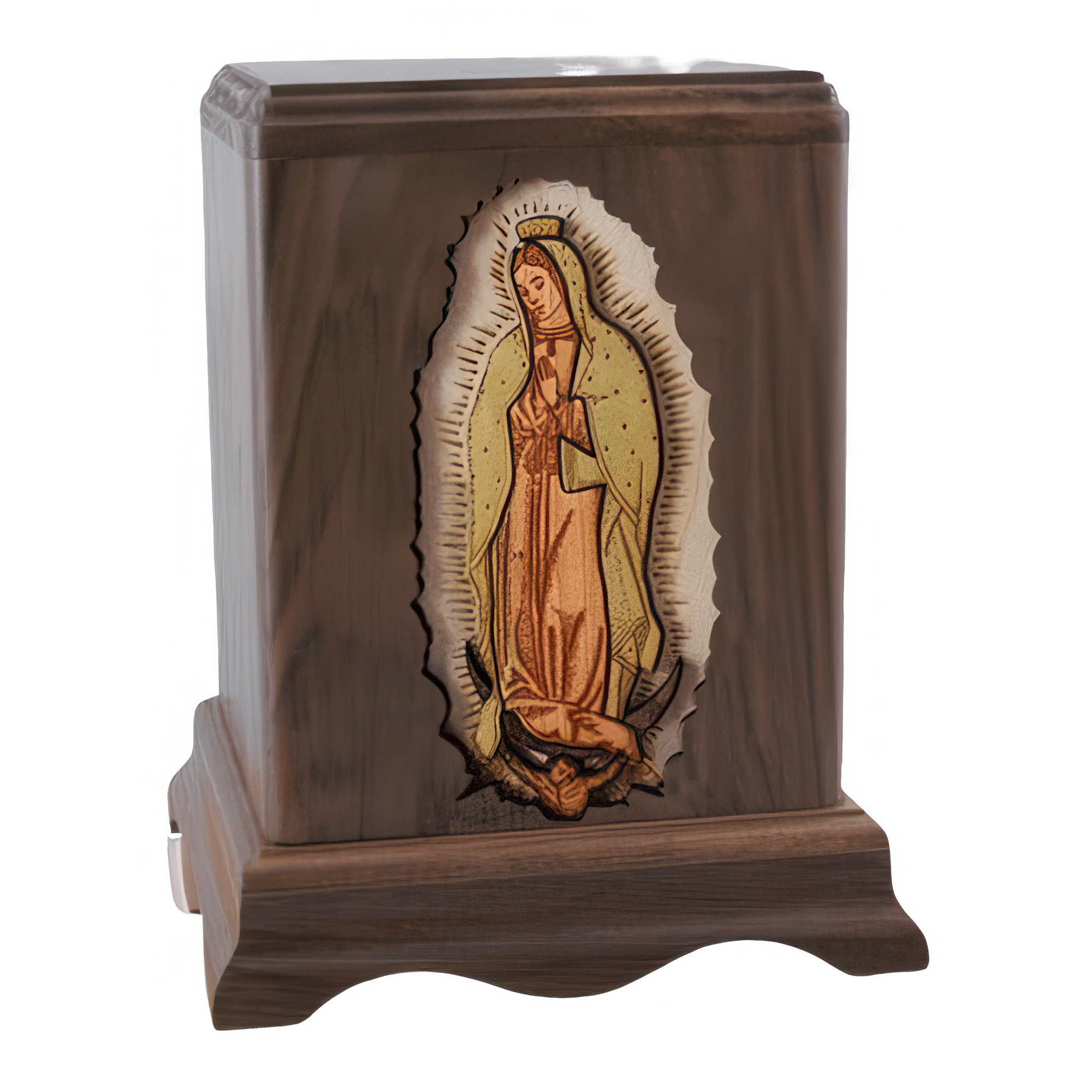
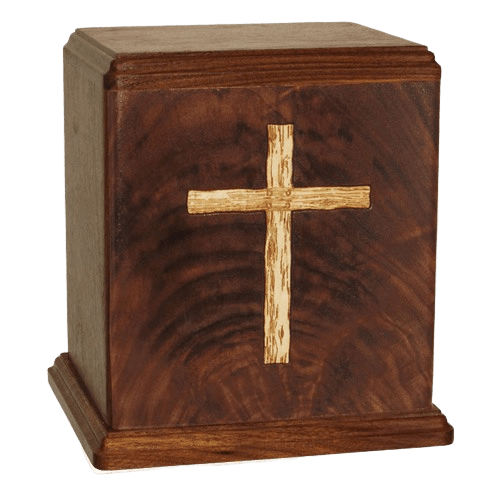
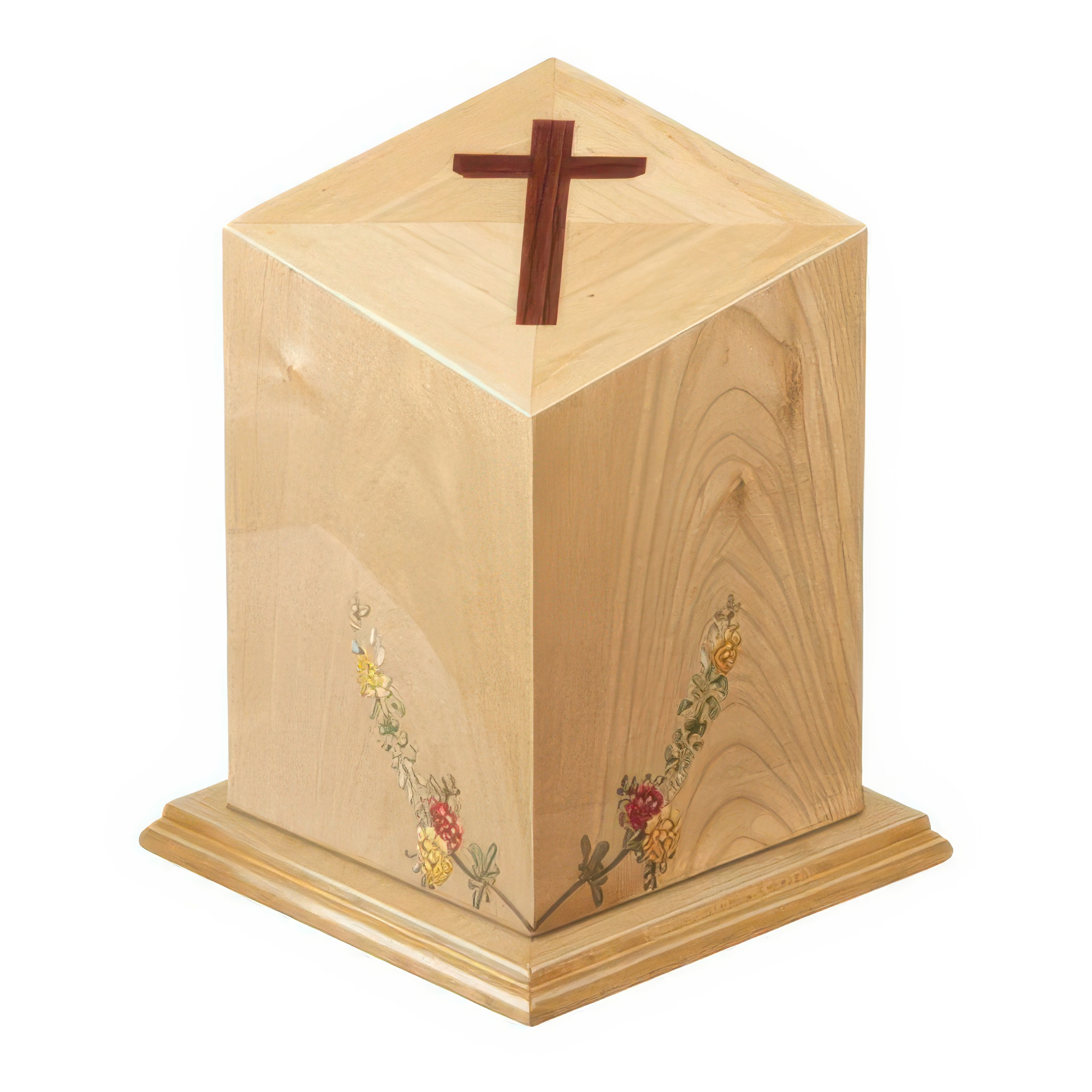
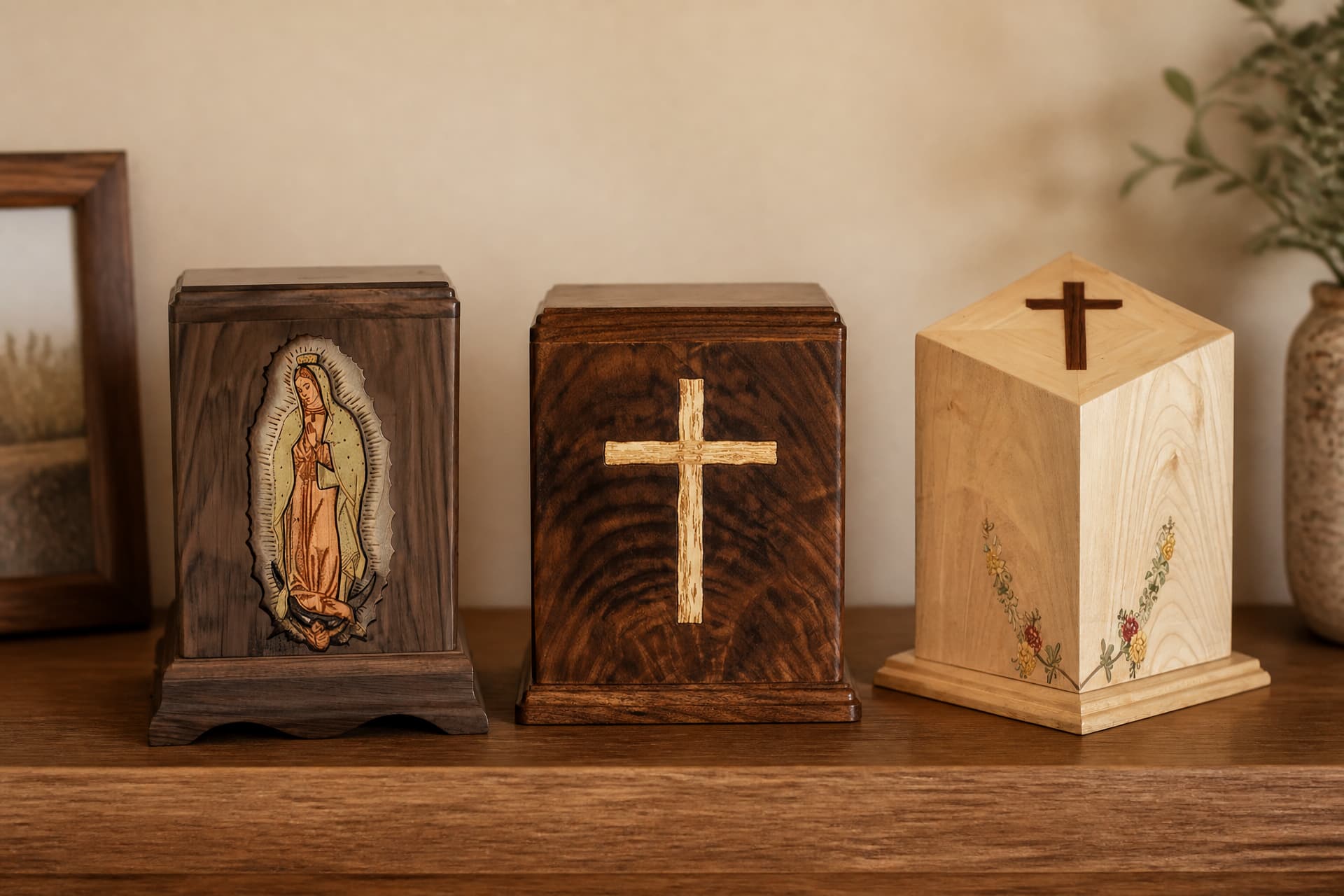
How visible the emblem is turns out to matter more than which emblem it is. A full-color image on the front reads across a room; a pale cross set into dark wood reads only from a few feet away; a cross on the lid is barely an announcement at all. Families who want the faith present but not declared tend to end up at the far end of that range. Products from left to right: Lady of Guadalupe Cremation Urn, Cross Cremation Urn and Forever Cross Wood Cremation Urn.
If You Are the Guest and Do Not Know the Customs
Most people reading a page like this are not planning a funeral. They have been invited to one that will not work the way theirs do, and they are worried about causing offense in a room where nobody has the energy to forgive it.
The reassuring part is that the expectations for a guest are far lower than the anxiety suggests. Almost every tradition on earth has a category for the respectful outsider, and almost every one of them treats attendance as the thing that mattered.
Four things cover most of it. Ask somebody. A cousin, a colleague, the funeral home — the question "is there anything I should know before I come" is welcome everywhere and is never read as ignorance. Arrive early and sit near the back, so you can watch what the family does and follow half a beat behind. Do not photograph anything unless you have seen other guests doing it and have been told it is fine. Follow the family on standing, sitting, shoes, hats and covering your head — these are the four that vary most and the four a guest is least likely to guess.
For the specifics of what to wear, our funeral attire guide covers the general case and several particular ones, and funeral etiquette covers what to say and do once you are there. If the gathering you have been invited to is a wake rather than a service, Irish wake traditions explains why the register is so different from what most people expect — food, drink, noise, and stories told about the person in the same room as the person.
Reading a Sign Without Being Fooled by It
The hardest question this guide gets is not what a symbol means. It is whether the thing that happened last Tuesday counts.
Two things are true at once, and most writing on the subject drops one of them. The first is that there is almost always an ordinary explanation. Pendulums stop because a clock was not wound during a week when nobody was thinking about winding clocks. Cardinals appear in February because cardinals do not migrate. Moths come to lit windows. The second is that noticing it is not an error. People do not report signs from species they have never seen or objects they have never owned; the folklore of every region is assembled out of whatever was already in the yard, which is exactly what you would expect from a real human process rather than a mistaken one.
Where this gets genuinely difficult is waiting. A sign that arrives is a small gift. A sign that is being waited for can become a second loss — a person checking the feeder every morning and finding the day worse for the bird not coming. If the noticing has turned into vigilance, that is worth saying out loud to somebody.
And if a sign has already arrived and you want to keep it, keeping it is an ordinary impulse with a long history behind it. Some families put the image on a marker, some on a piece of jewelry, and some on their own skin — our page on the death cardinal memorial tattoo separates the symbolic half of that decision from the permanent half, which are usually made together and should not be.
Frequently Asked Questions
What are death traditions? They are the customs, symbols and rituals a culture uses to mark a death — everything from what mourners wear and what is placed in the grave to which figure is imagined arriving and what is said at the graveside. They are distinct from funeral practice, which is the order of events at a service.
What is the most common symbol of death? In the Western world, the skeleton or hooded figure carrying a scythe, which comes from late-medieval European art rather than from antiquity. Worldwide, the answer is more likely to be a color — white or black cloth — because clothing is the symbol every mourner uses whether or not they own anything else.
Why do people cover mirrors or stop clocks when someone dies? Both are barrier customs. Covering mirrors was widely explained as keeping the soul from being caught or the household from being drawn after it, and stopping the clock marked the exact hour and signaled to visitors that the household's ordinary time had halted. The explanations varied by village even when the practice did not.
Is seeing a cardinal after a death actually a sign? There is no way to test that, and this site will not pretend otherwise. What can be said is that the bird's presence has a plain explanation, that the tradition attaching it to a visit is genuinely widespread in the eastern United States, and that finding the moment meaningful is a normal response to grief rather than a lapse in judgment.
What is the danse macabre? A late-medieval European artistic subject in which skeletal figures lead people of every rank away in a dance — pope, emperor, knight, laborer, child. It survives mostly in printed copies and a handful of wall paintings, and it is where the modern personification of Death comes from.
What should I wear to a funeral in a tradition I do not know? Ask the family or the funeral home. If you cannot, wear plain, dark, modest clothing that covers the arms and knees, bring something to cover your head, and choose shoes you can remove easily. That combination is acceptable or close to it almost everywhere.
Hub Library
This guide is part of the Memorials.com Death Symbolism collection. Every page below goes considerably deeper than this overview into one symbol, one figure, or one custom — what it meant, who used it, and what to do with it now.
Signs People Notice
The involuntary half of the vocabulary: the things that happen, and what people make of them.
Bird Symbolism in Grief and Remembrance — Which birds are read as messengers and which as omens, what a bird in the house is supposed to mean, what a dead bird does and does not signify, and when waiting for a sign starts to hurt.
Butterfly Symbolism Death: What the Butterfly Has Meant — Greece, Michoacán and the Day of the Dead, the moths that really were read as death omens, whether the color means anything, and why the image attaches so often to the death of a child.
Spiritual Meaning of Clock Stopping When Someone Dies — Why families stopped the clocks themselves within minutes of a death, the four explanations nobody agreed on, the mechanical reasons a clock or a watch really does stop, and how to start it again.
Emblems, Flowers and Objects
The chosen half: the things somebody selects, pays for, and expects to be read.
Symbols of Grief and Mourning: Common Icons and Meanings — The armband, mourning dress, the stone lamb, the draped urn and the hired weeper, gathered in one index with what each traditionally meant and who was expected to understand it.
Black Carnations: What They Mean and Where They Belong — No carnation grows black, so what florists sell is one of two things. What the color says, what each carnation color traditionally meant, and whether carnations belong at a funeral at all.
Sprig of Acacia: The Masonic Funeral Symbol Explained — The small green branch each man drops onto the casket, what the evergreen stands for, what happens at a Masonic service, why the apron is buried with him, and what to wear if you have been invited.
Shinigami Meaning: What the Japanese Death God Actually Is — Two characters, one translation everybody reaches for, and the gap it hides. Where the word came from, why shikigami is a completely unrelated thing, and why none of these figures appears at a Japanese funeral.
Angel of Death in Islam: Who Azrael Is, and What the Qur'an Says — The Qur'an gives him a job title rather than a name. Where Azrael came from, how the role differs from the Western reaper, why there are no pictures of him, and what to expect at a janazah.
Bubonic Plague Mask: Why Plague Doctors Wore a Beak — A real object, designed roughly three centuries after the pandemic everyone attaches it to. What the beak held, what the rest of the costume did, whether any of it worked, and how it reached the costume rack.
The Words
What gets said at the graveside, cut into stone, and sung.
Ashes to Ashes, Dust to Dust: What the Words Really Mean — The graveside line most people half-remember has three clauses rather than two, and the one that follows is not about decay. Where it came from, which half-remembered version is right, and what it means after a cremation.
Death Song: Meaning, History, and the Music People Choose — Three meanings tangled into one phrase, and only one of them is a playlist. The song a person makes for their own end, the lament sung for somebody else's, and how to choose music for a service or a scattering.
Things Families Do
The customs that are still practiced, and the ones people invent for themselves.
Spiritual Meaning of Burning Paper: What the Fire Is Meant to Carry — Joss paper, spirit money and hell bank notes: a stand-in object, a named recipient, and a fire understood to carry it across. When families burn it, how, where it is legal in the US, and what it means with no tradition behind it.
The traditions in this guide look like a catalog of beliefs and are better read as a catalog of tools. A culture that stops the clocks and a culture that burns a paper house are both answering the same practical problem: something enormous has happened, the people it happened to cannot think, and there needs to be something to do with their hands.
That is why the pages under this guide are written the way they are. Each one says what a symbol meant and who used it, says plainly where the ordinary explanation is, and then declines to tell anybody that the ordinary explanation settles it. Both halves are true, and the honest version keeps both.
If you are choosing an object rather than reading about one — a container, a marker, a piece of jewelry that will carry the symbol — the useful order is to decide what you want it to say first, and shop second. Every spoke in this collection that touches a real object links to the products it is talking about, so the vocabulary and the choice sit on the same page rather than in different places.