🏬Supersize Online Funeral Retailer🪦1000's of Headstones⚱️Over 10,000 Cremation Urns⚰️Caskets Overnight Delivery🛒Funeral & Memorial Superstore🚚FREE Shipping on ALL Orders👨👩👧👦Helping Families for over 20 Years💰Lowest Price Guarantee🏬Supersize Online Funeral Retailer🪦1000's of Headstones⚱️Over 10,000 Cremation Urns⚰️Caskets Overnight Delivery🛒Funeral & Memorial Superstore🚚FREE Shipping on ALL Orders👨👩👧👦Helping Families for over 20 Years💰Lowest Price Guarantee
🏬Supersize Online Funeral Retailer🪦1000's of Headstones⚱️Over 10,000 Cremation Urns⚰️Caskets Overnight Delivery🛒Funeral & Memorial Superstore🚚FREE Shipping on ALL Orders👨👩👧👦Helping Families for over 20 Years💰Lowest Price Guarantee🏬Supersize Online Funeral Retailer🪦1000's of Headstones⚱️Over 10,000 Cremation Urns⚰️Caskets Overnight Delivery🛒Funeral & Memorial Superstore🚚FREE Shipping on ALL Orders👨👩👧👦Helping Families for over 20 Years💰Lowest Price Guarantee
The next of kin hierarchy is a legal order, not a measure of who was closest. That single sentence resolves most of the distress this subject causes, and it is worth saying at the top because families discover it at the worst possible moment.
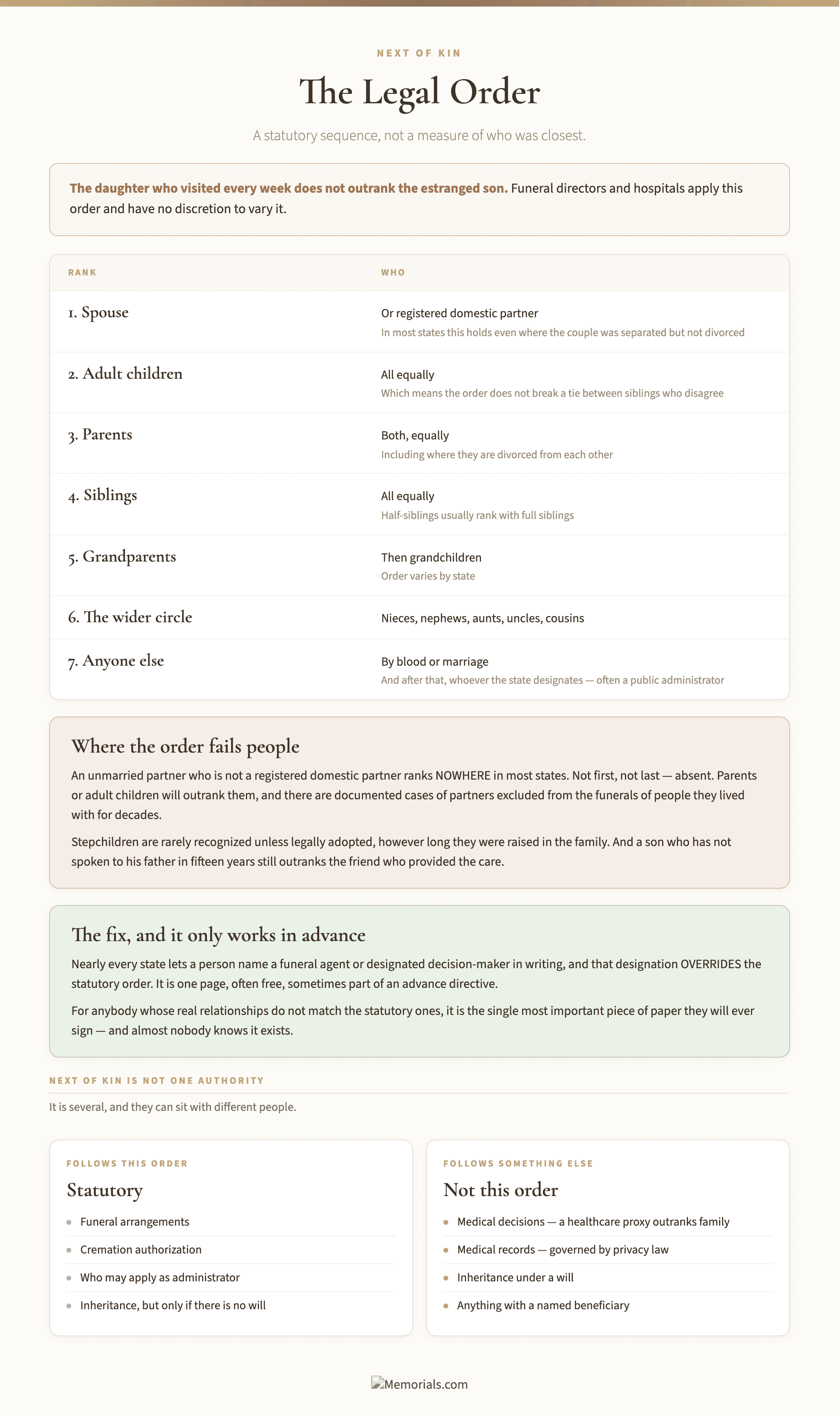
The daughter who visited every week does not outrank the estranged son. A partner of twenty years who never married may rank nowhere at all. The order is fixed by statute, it is applied by funeral directors and hospitals who have no discretion to vary it, and it does not care about the shape of the actual relationship.
This page sets out the usual sequence and what each position can decide. It belongs in the estate affairs guide because four separate decisions turn on it.
General information rather than legal advice. The order is set state by state and the variations are real.
The legal order of next of kin runs broadly the same way in most states, and this is the sequence — the next of kin list nearly every funeral home works from:
1. Spouse or registered domestic partner. Almost always first, and in most states this holds even where the couple was separated but not divorced — which is one of the sharper edges in the whole subject.
2. Adult children. All of them equally, which means the order does not break a tie between siblings who disagree.
3. Parents.
4. Siblings, again equally.
5. Grandparents, then grandchildren, depending on the state.
6. Nieces, nephews, aunts, uncles, cousins, in a widening circle.
7. Any other relative by blood or marriage, and after that whoever the state designates — often a public administrator.
The primary next of kin is simply the first living person in that sequence. Not the person named in a hospital form, and not the person who has been doing the caring.
Equal-rank ties are the hard part. Where three adult children hold equal authority and two disagree with the third, the law provides no ranking. In practice a funeral director will look for a majority, or ask for it in writing, or refuse to proceed until it is resolved.
A legal order, not a measure of closeness. It does not care who visited every week.
A legal order, not a measure of closeness. It does not care who visited every week.
What Each Position Can Decide
Next of kin is not one authority. It is several, and they can sit with different people.
Funeral arrangements and disposition. Next of kin funeral arrangements authority means deciding burial or cremation, choosing the funeral home, and signing the paperwork. This follows the statutory order unless the person left a valid written directive.
Cremation authorization. The most tightly controlled of all. Cremation authorization next of kin requirements are strict because cremation is irreversible, and many states require the authorizing person to be the highest-ranking kin available, with written consent, sometimes from multiple people at the same rank. Crematoria are cautious for good reason and will not proceed on a verbal assurance.
Medical decisions before death, which follow a different order entirely — a healthcare proxy or power of attorney, if one exists, outranks family completely.
Access to medical records, which is governed by privacy law rather than by kinship order.
Inheritance, which follows the will if there is one. Only where there is no will does inheritance follow intestacy rules — a similar order, but not identical to the funeral one, and the difference catches people out.
Estate administration, meaning who may apply to be appointed. Again the statutory order, unless the will names an executor.
None of these is the same list. Somebody can have the right to arrange the funeral and no right to inherit, or be the executor and rank low as next of kin.
Where the Order Fails People
Worth being direct about, because these are common and each one hurts.
Unmarried partners. In most states a long-term partner who never married and is not a registered domestic partner ranks nowhere. Not first, not last — absent. Parents or adult children will outrank them, and there are documented cases of partners excluded from funerals of people they lived with for decades.
Estranged relatives outranking chosen family. A son who has not spoken to his father in fifteen years still outranks the friend who provided care.
Separated spouses. Separated but not divorced usually means still first.
Stepchildren. Rarely recognized unless legally adopted, however long they were raised in the family.
The fix, and it only works in advance. Nearly every state allows a person to name a funeral agent or designated decision-maker in writing, and that designation overrides the statutory order. It is a short document, often free, sometimes part of an advance directive or a will. For anybody whose real relationships do not match the statutory ones, it is the single most important piece of paper they will ever sign, and almost nobody knows it exists.
What Happens If Next of Kin Does Not Claim a Body
People ask what happens if next of kin does not claim body arrangements for two very different reasons — because they cannot afford a funeral, or because they do not want one — and both deserve a plain answer rather than a euphemism.
The hospital or medical examiner tries to find somebody. They work down the order, and they try for a period set by state law, commonly a few days to a few weeks.
Nobody is compelled to claim. Declining is not a criminal matter, and there is no obligation to take on a funeral you cannot pay for.
If nobody claims, the county takes responsibility. The person receives an indigent or county burial — usually a simple cremation or a burial in a designated section, at public expense. It is dignified in most jurisdictions and it is not a pauper's grave in the Victorian sense.
Records are kept. The county records where the remains are, and a family who changes its mind later can usually find out and sometimes arrange a transfer.
Ashes are held for a period, often years, before being interred in a communal plot. A family who comes forward within that window can generally claim them.
If cost is the reason, ask about the alternatives first. Direct cremation is far cheaper than a funeral, county assistance programs exist in many places, and crowdfunding a funeral is a real option. Declining to claim because a full funeral is unaffordable is a decision made on a false choice.
Nobody is compelled to claim. If nobody does, the county arranges it, and it keeps a record of where.
A written designation overrides the statutory order. One page, and almost nobody knows it exists.
When the Family Disagrees
Equal rank is where this gets genuinely painful, and it is worth knowing how it actually resolves before you are in it.
The funeral director is not a referee. They will not choose between two siblings with equal authority. What they will do is stop, which means the person is not moved and nothing is arranged until it is settled.
Most homes ask for a majority in writing. Three children, two agreeing, a signed form. This is the ordinary resolution and it works.
A single objector can stall it entirely in some states, particularly for cremation, where several require unanimous consent among equal-ranking kin. One holdout is enough.
Courts can decide, and it is a bad outcome for everybody. A petition takes days at minimum, costs money the estate pays, and the family does not recover from it quickly. Funeral disputes are among the most bitter litigation there is precisely because there is no way to compromise on cremation.
What helps, in order: a written directive from the person who died, which ends the argument immediately; a majority reached quickly; a neutral relative willing to broker rather than take a side; and a funeral director experienced enough to say plainly what the options are.
What does not help is relitigating the relationship. The disagreement is almost never about disposition, and saying so out loud sometimes lets people find the smaller decision underneath.
Naming Yours
The name of next of kin field appears on hospital admission forms, employment records and emergency contact lists, and it is worth knowing what that field does and does not do.
On a hospital form it is a contact, not an authority. It tells staff who to call. It does not confer decision-making power, which comes from a healthcare proxy or from the statutory order.
Which means naming your partner there does not protect them. Families discover this at the point it matters, and it is the reason the written designation above exists.
What actually carries weight, in rough order of usefulness: a healthcare power of attorney for decisions while living, a written funeral agent designation for afterward, a will naming an executor, and beneficiary designations on accounts, which override everything.
Tell the people involved. A designation nobody knows about, in a drawer nobody opens, does not work. Tell the person you named, and tell one other person that it exists.
If the person who should decide for you is not the person the law picks, that is fixable — but only in advance.
When There Is Genuinely Nobody
It happens more often than people expect, and the process is quieter than the phrase "no next of kin" suggests.
A search is made. Hospitals and medical examiners look for relatives through records, known contacts and sometimes a public administrator's office. It is not perfunctory, and it occasionally finds relatives the person had lost touch with decades earlier.
A public administrator may be appointed to handle the estate where there are assets and nobody to claim them. They are paid from the estate, they act under court supervision, and they are the reason an unclaimed estate does not simply vanish.
Anything left over usually escheats to the state, which is the same mechanism described in unclaimed money left by a deceased relative — held, not absorbed, and claimable by a relative who surfaces later.
Friends can often do more than they think. Several states let a close friend petition to take responsibility for disposition where no relative can be found, and many funeral homes will work with a friend who is willing to sign and pay. It requires asking rather than assuming.
If you are that person — a neighbor, a carer, the friend who was there — say so early and in writing to the hospital or the medical examiner. The system defaults to the statutory order, and it needs somebody to tell it that the order has run out.
Frequently Asked Questions
No spouse and no children — who is next? People phrase this as what is the order of next to kin? and the answer is: parents, then siblings, then grandparents and grandchildren, then the widening circle of aunts, uncles and cousins.
Two siblings disagree about cremation. Who wins? Neither automatically — they hold equal rank. The funeral home will usually require agreement or a majority in writing, and an unresolved dispute can end up in court, which is slow and expensive and rarely leaves the family intact.
Can I be next of kin for someone I am not related to? Only by their written designation in advance, or by a court appointment afterward. This is why the designation matters so much.
Does next of kin have to pay for the funeral? No. Authority to arrange is not liability to pay — the cost falls on the estate. A person who signs a contract with a funeral home becomes personally liable for that contract, which is a different thing and worth understanding before signing.
Does the order differ for inheritance? Yes, and it is a common confusion. Funeral authority and intestate inheritance follow similar but distinct orders, so the person arranging the funeral may not be the person inheriting.
Does the order change if the person died in another state? Generally the law of the state where the death occurred governs disposition, which can differ from where they lived. Where the two conflict, the funeral director in the state holding the body is the one who has to be satisfied.
Somebody is claiming to be next of kin and I do not believe them. Raise it with the funeral home in writing immediately. They have an interest in getting this right and will generally pause. A death certificate names the informant, which is a useful record of who told them what.
In Closing
The order is fixed, it is applied by people with no discretion to vary it, and it will not reflect your family if your family is not the shape the statute assumes.
Which makes the practical takeaway a small one: if the person who should decide for you is not the person the law would pick, put it in writing while you can. It is one page, and it is the only thing that changes the answer.