🏬Supersize Online Funeral Retailer🪦1000's of Headstones⚱️Over 10,000 Cremation Urns⚰️Caskets Overnight Delivery🛒Funeral & Memorial Superstore🚚FREE Shipping on ALL Orders👨👩👧👦Helping Families for over 20 Years💰Lowest Price Guarantee🏬Supersize Online Funeral Retailer🪦1000's of Headstones⚱️Over 10,000 Cremation Urns⚰️Caskets Overnight Delivery🛒Funeral & Memorial Superstore🚚FREE Shipping on ALL Orders👨👩👧👦Helping Families for over 20 Years💰Lowest Price Guarantee
🏬Supersize Online Funeral Retailer🪦1000's of Headstones⚱️Over 10,000 Cremation Urns⚰️Caskets Overnight Delivery🛒Funeral & Memorial Superstore🚚FREE Shipping on ALL Orders👨👩👧👦Helping Families for over 20 Years💰Lowest Price Guarantee🏬Supersize Online Funeral Retailer🪦1000's of Headstones⚱️Over 10,000 Cremation Urns⚰️Caskets Overnight Delivery🛒Funeral & Memorial Superstore🚚FREE Shipping on ALL Orders👨👩👧👦Helping Families for over 20 Years💰Lowest Price Guarantee
Every state holds money that belongs to somebody who has not come to collect it, and a meaningful share of it belongs to people who have died. Searching for unclaimed money from deceased relatives is free, takes about ten minutes, and finds something more often than people expect.
The money gets there by a process called escheatment. When an account goes untouched for a set period — commonly three to five years — the institution holding it is legally required to hand it to the state, which holds it indefinitely until somebody claims it. Nothing is lost and nothing expires. It simply sits there.
For an executor this is a genuine part of the job rather than a long shot, and it belongs on the list in the estate affairs guide alongside the accounts you already know about.
More than people assume, and rarely the dramatic things:
Dormant bank accounts. A savings account somebody opened decades ago and forgot, still accruing a little interest until the bank gave up on them.
Uncashed checks. Final paychecks, expense reimbursements, insurance refunds, utility deposits, closing overpayments from a house sale.
Insurance proceeds where the beneficiary was never found. This is one of the largest categories and one of the saddest — a policy that paid out to nobody because the family did not know it existed.
Stocks, dividends and bond interest, particularly from companies that changed name or were acquired, so the mail stopped reaching anybody.
Safe deposit box contents, where the rent went unpaid and the box was drilled. The contents are inventoried and held.
Utility and rental deposits, refunds from long-closed accounts, and pension payments that stopped reaching a valid address.
What is generally not there: real estate, vehicles, or anything with a title. Escheatment is for intangible property and cash.
Dormant accounts, uncashed checks, insurance nobody claimed. It sits with the state indefinitely and does not expire.
How to Search, Free
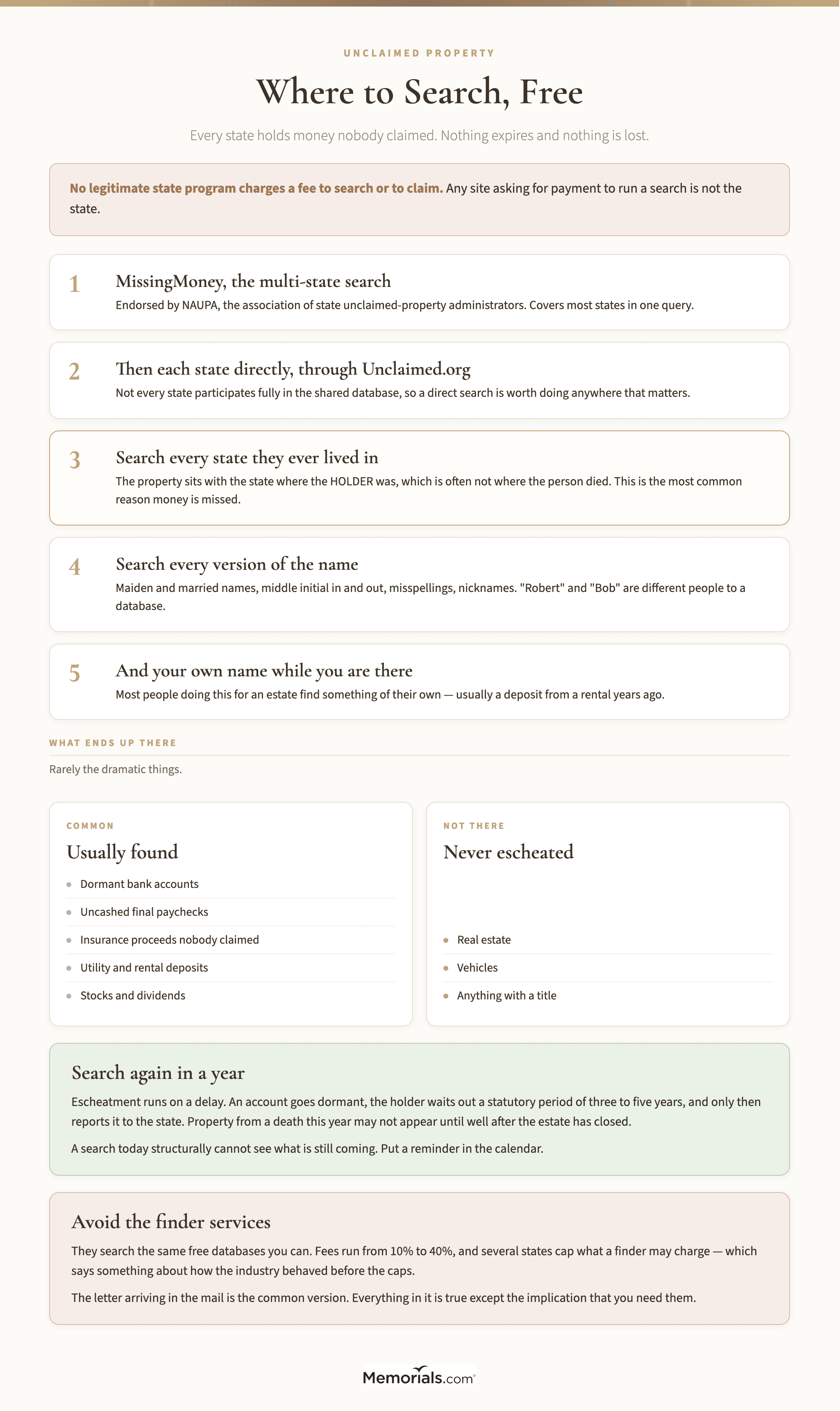
The official search is run by the states themselves through their treasurer or comptroller offices, and it costs nothing.
Start at MissingMoney, the multi-state search endorsed by the National Association of Unclaimed Property Administrators. It covers most states in one query.
Then check individual states directly through Unclaimed.org, which links to every state's official program. Not every state participates fully in the shared database, so a direct search is worth doing for anywhere that matters.
Search every state they ever lived in. The property is held by the state where the holder was located, which is often not where the person died. Somebody who worked in one state and retired to another may have money sitting in both.
Search name variations. Maiden names, married names, middle initial included and omitted, common misspellings, nicknames. Records are entered by hand somewhere along the line and "Robert" and "Bob" are different people to a database.
Search the estate too, and any business the person owned. A sole proprietorship or a small company that was wound up years ago frequently has a final refund or an uncashed vendor payment sitting against its name rather than the owner's, and nobody searches for a business.
While you are there, search for bank accounts in my name — your own, and your parents'. Most people who do this on behalf of an estate find something of their own, usually a deposit from a rental years ago.
Federal sources are separate. Unclaimed savings bonds, tax refunds, pension benefits from failed plans, and FHA insurance refunds are each held by different federal agencies with their own search tools, none of which appear in the state databases.
Free, ten minutes, and it finds something more often than people expect.
Avoid the Finder Services
A search to find unclaimed money produces a page of results, and many of them are companies that will do it for you and keep a percentage.
They are searching the same free databases you can. There is no privileged access, no hidden list, and nothing they can see that you cannot.
Fees run from 10% to 40%, and several states cap what a finder may charge — which tells you something about how the industry behaved before the caps.
The letter arriving in the mail is the common version. "We have identified funds belonging to your late father. Sign here and we will recover them for a fee." Everything in that letter is true except the implication that you need them.
Do the free search first, always. If the money is there, you will find it in the same database they used. If it is a large or genuinely complicated claim — a contested estate, an out-of-state property, multiple heirs disagreeing — then a probate attorney is the right professional, not a finder.
No legitimate state program charges a fee to search or to claim. Any site asking for a payment to run a search is not the state.
Claiming It
Finding funds is the easy half. Claiming on behalf of somebody who has died takes more.
Proof of your authority — letters testamentary, or a small estate affidavit where the amount is under the state's threshold, which for most of these claims it will be.
Proof of the connection between the person and the property. An old statement, a utility bill at that address, a policy number. This is the part that stalls claims, because the whole reason the money escheated is that the paperwork was lost.
Your own identification.
Small claims are often simplified. Many states have a streamlined route below a few thousand dollars needing far less documentation, and most estate claims fall inside it.
Expect it to take weeks to months. These are small offices processing a great deal of mail, and following up politely by phone after six weeks moves things along more reliably than waiting does.
If several heirs are entitled, most states will want them all to sign or to appoint one to claim on behalf of the estate. Sort that out before filing rather than after.
The money belongs to the estate, not to whoever found it. It is distributed like any other asset, which occasionally disappoints the sibling who did the searching.
Finding it is ten minutes. Proving the connection is what stalls claims — the paperwork was lost, which is why it escheated.
The paperwork that proves the connection is usually in a box somebody nearly threw out.
Where the Evidence Usually Is
The claim stalls on proving the person and the property are connected, so it is worth knowing where that proof tends to hide before you conclude you do not have it.
Old tax returns. Interest and dividend statements list institutions by name, which is often the only surviving record that an account existed at all. Returns going back several years are worth more than anything else in the box.
The address history. States match on names and addresses, and an old utility bill or a piece of mail from the right period is frequently accepted as the link. This is one of several reasons not to be hasty clearing a house.
A safe deposit box, if there is one — and its own contents may be what escheated.
The address book and the Rolodex. Old-fashioned, and where the name of a broker or an insurance agent from thirty years ago turns up.
Employment records. Pensions and final paychecks are a large escheatment category, and an old employer's name is enough to start.
The social accounts, before anybody closes them. A profile is a dated record of towns lived in, employers and family names — which is exactly what a state matches a claim on. Read how to memorialize an Instagram account before deleting anything, because memorializing keeps the page and removal takes the evidence with it.
The credit report obtained when notifying the bureaus, which lists institutions the family had never heard of.
Do not throw away the paperwork until the estate closes, and photograph what you do discard. The one document that proves a claim is the one that was in the box somebody emptied in week two.
Search Again in a Year
Worth knowing, because most people search once and conclude there is nothing.
Escheatment runs on a delay. An account goes dormant, the holder waits out the statutory period, and only then reports it to the state. Property from a death this year may not appear in the database for three to five years.
Which means a search today can miss what will be there later. If the person had accounts nobody could trace, put a reminder in the calendar and search again — annually if the estate stays open, and once more a few years on even if it has closed.
An estate that has been closed can usually be reopened for a newly discovered asset, or in small cases claimed by the heirs directly. It is a nuisance rather than a barrier.
Tell the other heirs you are doing this. A claim arriving years later, after everything was settled, is much easier if everybody knew it might.
Search again in a year. Escheatment runs on a delay, so today's search cannot see what is still coming.
The Other Places Money Hides
Unclaimed property is one database. Several other categories go missing in their own way and none of them appear in a state search.
Life insurance nobody knew about. The largest single thing families miss. Insurers are increasingly required to check death records and pay out proactively, and that system is imperfect. If you suspect a policy existed, the NAIC operates a free policy locator service that queries participating insurers on behalf of a family.
Pensions from employers that no longer exist. When a company folds or terminates a plan, benefits are often transferred to the Pension Benefit Guaranty Corporation, which maintains its own searchable list of people owed money.
Savings bonds that stopped earning. Paper bonds mature and stop paying interest, and millions sit in drawers past that point. The Treasury has a tool for checking whether a bond is still earning and for tracing lost ones.
Old brokerage accounts and share certificates. Companies get acquired and renamed, and the trail goes cold. A transfer agent can usually trace a holding from an old certificate or statement.
Foreign accounts, where the person lived or worked abroad. Entirely outside the US system, and each country's rules differ.
Deposits and prepayments. Utility deposits, a prepaid funeral plan bought decades ago, a cemetery plot paid for and never used. These are worth checking specifically, because nobody thinks of them as assets.
Frequently Asked Questions
Is this really free? Yes, at every legitimate state program. Searching is free and claiming is free.
How much do people typically find? Most claims are small — tens or low hundreds of dollars. A minority are much larger, and insurance proceeds are where the large ones usually come from.
They lived in several states. Search all of them, plus anywhere they worked. This is the single most common reason money is missed.
Someone else already claimed it. Contact the state's program directly. They investigate improper claims and can reverse them, though it takes time and documentation.
Does unclaimed property expire? In nearly every state, no. It is held indefinitely, which is why decades-old property is still claimable by descendants.
Can I claim for a distant relative? Only with a legal entitlement to their estate — which follows the fixed order in next of kin hierarchy, not family closeness.
Do I have to reopen probate to claim it? Often not. Most states allow a small claim to be paid to the heirs directly, or against a small estate affidavit, without reopening anything. Ask the program before assuming a court is involved — they deal with this constantly and will tell you.
Is what arrives taxable? The property itself is generally not new income — it was already theirs — though interest paid on it, and anything that was untaxed wages or a pension when it escheated, can be. Worth a preparer's hour on a large claim. It is the same line families have to draw around are funeral donations tax deductible: what is a gift, what is income, and who reports which.
The amount is tiny. Is it worth the paperwork? For twenty dollars, probably not. But claim amounts are not always displayed accurately in a search result, and several states show only a range or the word "unknown". It is worth one inquiry before deciding, because the categories that turn out to be large — insurance proceeds especially — frequently display as nothing much.
I found an old savings bond in a drawer. Not escheated property but worth chasing — savings bonds continue earning interest for decades and many people hold matured bonds that stopped paying years ago. The Treasury has its own tool for checking.
In Closing
Ten minutes, free, at MissingMoney and then at each relevant state's own program. Search every state they lived in, every version of their name, and your own name while you are there.
Then put a reminder in for a year's time, because the delay built into escheatment means the search you do today cannot see everything that is coming. It is the rare part of settling an estate where the outcome is occasionally a pleasant surprise.