🏬Supersize Online Funeral Retailer🪦1000's of Headstones⚱️Over 10,000 Cremation Urns⚰️Caskets Overnight Delivery🛒Funeral & Memorial Superstore🚚FREE Shipping on ALL Orders👨👩👧👦Helping Families for over 20 Years💰Lowest Price Guarantee🏬Supersize Online Funeral Retailer🪦1000's of Headstones⚱️Over 10,000 Cremation Urns⚰️Caskets Overnight Delivery🛒Funeral & Memorial Superstore🚚FREE Shipping on ALL Orders👨👩👧👦Helping Families for over 20 Years💰Lowest Price Guarantee
🏬Supersize Online Funeral Retailer🪦1000's of Headstones⚱️Over 10,000 Cremation Urns⚰️Caskets Overnight Delivery🛒Funeral & Memorial Superstore🚚FREE Shipping on ALL Orders👨👩👧👦Helping Families for over 20 Years💰Lowest Price Guarantee🏬Supersize Online Funeral Retailer🪦1000's of Headstones⚱️Over 10,000 Cremation Urns⚰️Caskets Overnight Delivery🛒Funeral & Memorial Superstore🚚FREE Shipping on ALL Orders👨👩👧👦Helping Families for over 20 Years💰Lowest Price Guarantee
Most people use the words "casket" and "coffin" as though they mean exactly the same thing. In everyday conversation, that works fine — everyone understands you're talking about a burial container. But if you're arranging a funeral and a supplier asks which one you want, the distinction matters. Shape, lid design, materials, price, and even regional customs all differ between the two, and knowing those differences can save you time, confusion, and money. For a broader look at every decision involved in arranging a service, see our guide to funeral planning.
This article covers the practical differences between a casket and a coffin so you can make a confident choice — or at least know what questions to ask.
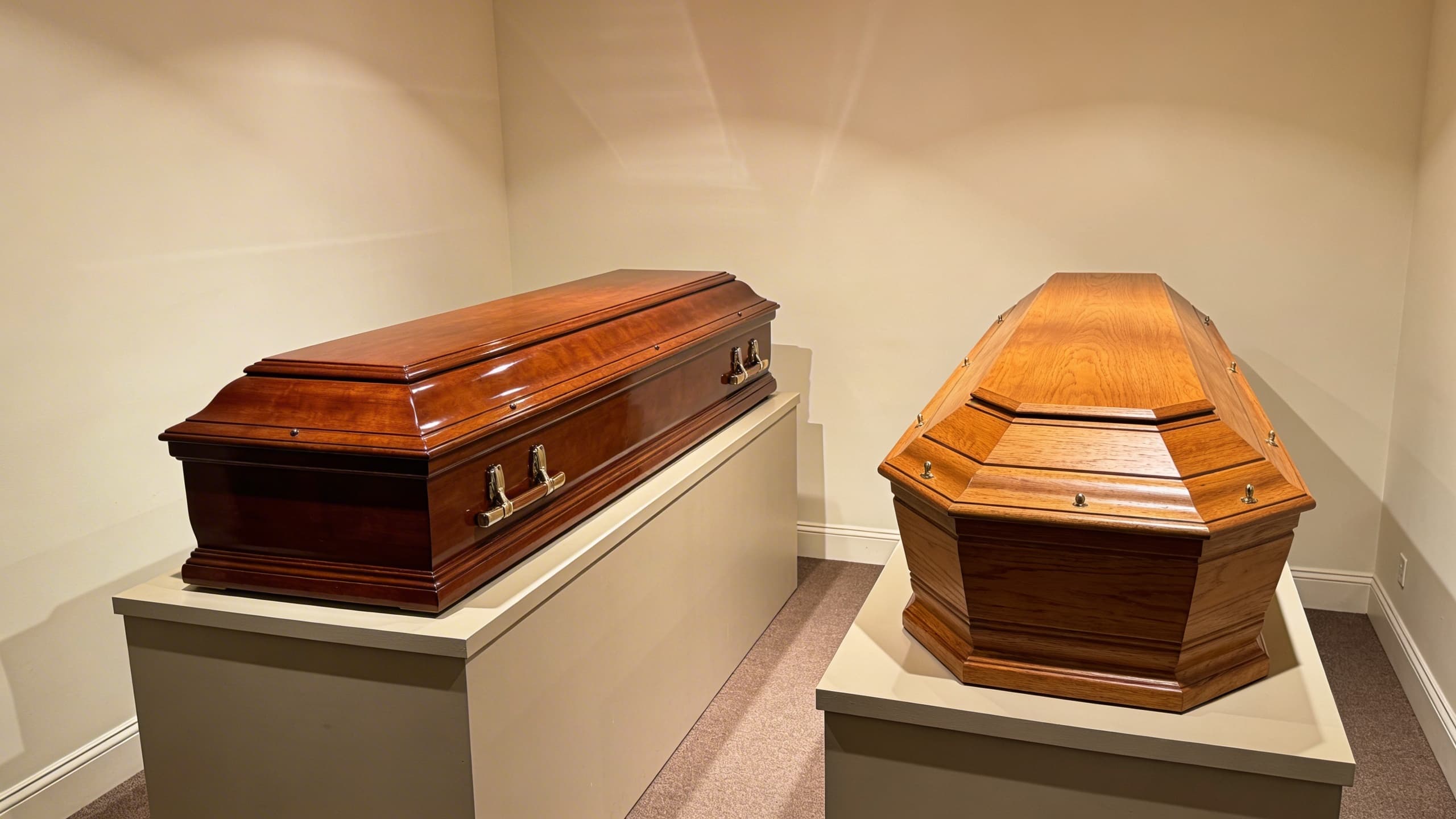
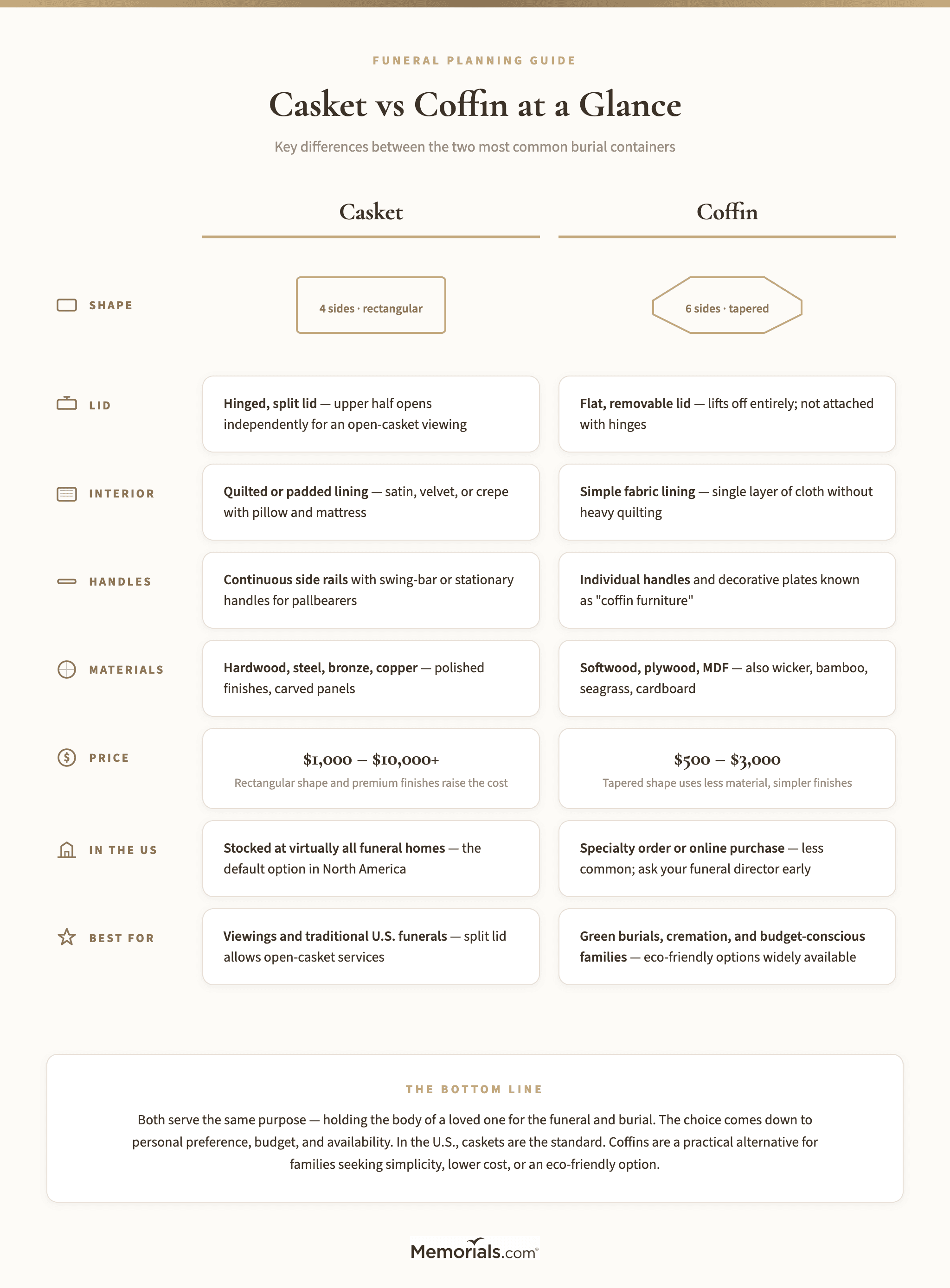
A casket is rectangular with four equal-length sides. It looks the same from the head end or the foot end — uniform width, uniform depth. Rails run along both sides so pallbearers can grip and carry it easily.
A coffin has six sides (sometimes eight). It's wider at the shoulders and tapers toward the feet, creating the anthropoid silhouette sometimes called a "toe pincher." That tapered shape follows the contour of the human body and uses less material than a full rectangle.
If you've seen an old Western film with a burial scene, the hexagonal box onscreen was almost certainly a coffin — not a casket.
Lid, Interior, and Hardware
Beyond shape, the two differ in how they open and what's inside.
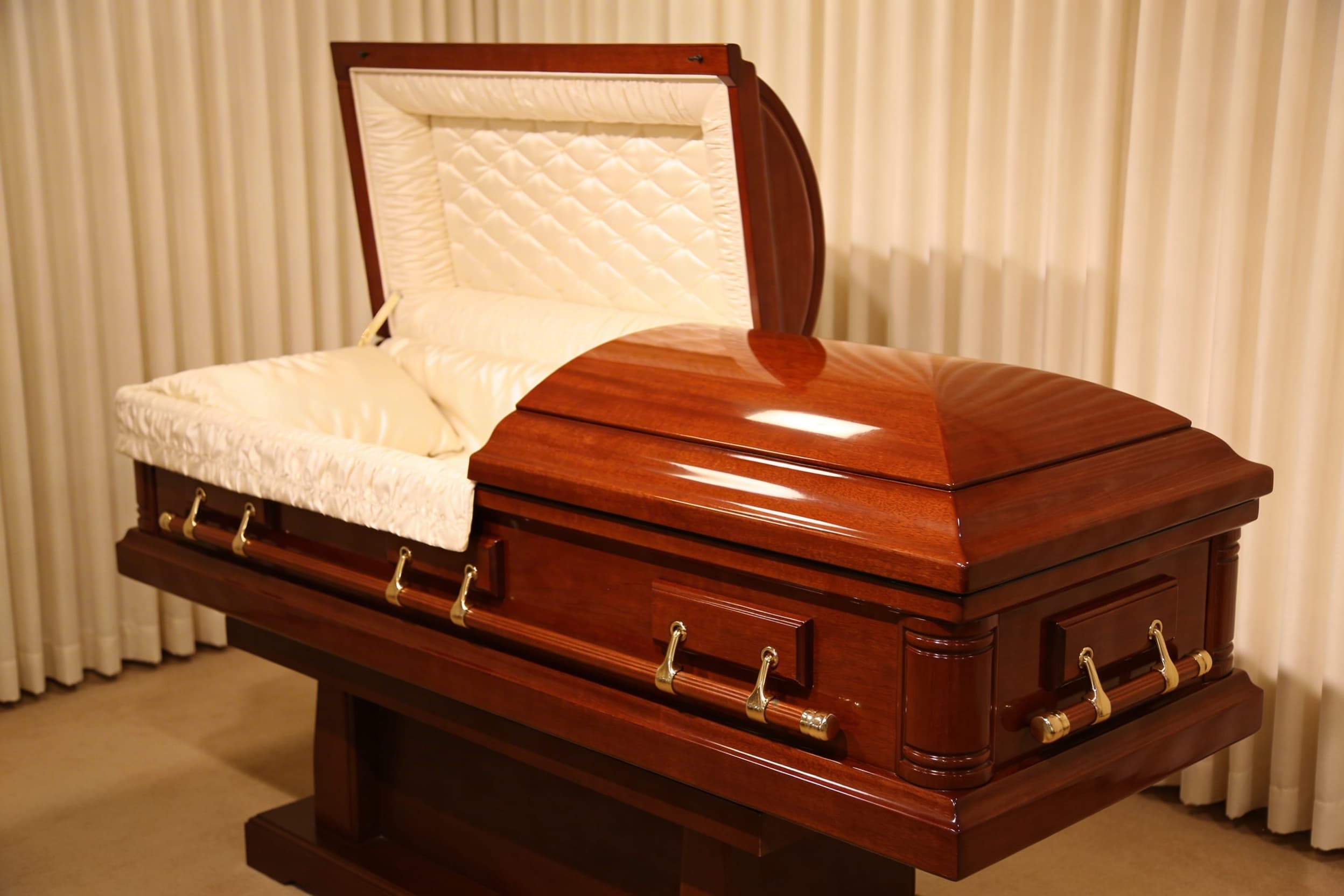
Caskets have a hinged lid, usually split into two halves. The upper half can be raised independently for an open-casket viewing while the lower half stays closed. The interior is typically lined with padded or quilted fabric — satin, velvet, or crepe — and includes a pillow and mattress. Exterior hardware includes side rails, corner pieces, and swing-bar or stationary handles.
Coffins have a flat, removable lid that lifts off entirely rather than swinging on hinges. Interior linings tend to be simpler — a single layer of fabric without heavy quilting. Traditional coffin hardware, sometimes called "coffin furniture," includes individual handles and decorative plates rather than continuous rails.
For families planning a viewing or visitation, the split-lid design of a casket is usually more practical. If you're still sorting out the different parts of a service, our overview of wake vs funeral vs viewing explains how each one works.
Materials and Cost
Both caskets and coffins can be built from wood or metal, but the typical material mix differs.
Caskets are commonly manufactured in steel, bronze, copper, or hardwoods like mahogany, cherry, and walnut. Higher-end models feature brushed-metal finishes, carved wood panels, and elaborate interior trimmings. Because of the rectangular shape and premium materials, casket prices in the U.S. generally range from about $1,000 for a basic model to $10,000 or more for top-tier options.
Coffins are more often constructed from softwoods, plywood, or medium-density fibreboard. Eco-friendly versions made from wicker, bamboo, seagrass, or cardboard are also widely available and popular for green burials. Coffins typically cost less — roughly $500 to $3,000 — because the tapered shape requires less material and the finishes tend to be simpler.
If you're weighing material options in detail, our guide to different casket types covers every major material, from wood caskets to metal and beyond.
Material drives weight as well as cost, and how much does a casket weigh sets out the figures for each one — along with the loaded weight pallbearers actually carry.
Regional and Cultural Usage
Geography plays a large role in which term people use — and which product they buy.
In the United States and Canada, rectangular caskets dominate the market. American funeral directors adopted the word "casket" in the mid-1800s as a gentler alternative to "coffin," borrowing a term that originally described a small jewelry box. The shift in language was deliberate: by the early 1900s, "casket" had largely replaced "coffin" in American funeral vocabulary. For more on how burial containers evolved over the centuries, see the history of coffins and caskets.
In the United Kingdom, Ireland, Australia, and much of Europe, the tapered coffin remains the standard. The word "coffin" carries no negative connotation in those regions — it's simply the normal term for a burial container. Caskets are available but are considered a specialty or upgrade item, not the default.
Religious traditions also influence the choice. Jewish and Muslim burials typically call for a simple, unadorned wooden container — closer to a coffin in spirit, though the exact shape varies. Catholic and mainstream Protestant services in the U.S. almost always use caskets.
Does the Choice Actually Matter?
From a practical standpoint, both serve the same function: they hold the body of the deceased for the funeral service and burial or cremation. Cemeteries in the U.S. accept both caskets and coffins, though some may require a burial vault or outer container regardless of which you choose.
For cremation, the container requirements are minimal. Many families opt for an inexpensive wooden coffin or a cardboard alternative cremation container rather than a full casket. The container is cremated along with the body, so investing in premium materials isn't necessary unless a viewing is planned beforehand.
The biggest factor for most families is availability. Caskets are stocked at virtually every funeral home in North America. Coffins are harder to find — you may need to order one from a specialty supplier or purchase online. If a coffin is important to you, mention it early when working with your funeral director so they can source one in time.
If you're ready to move from terminology into selection, our guide on how to choose a casket walks through sizing, materials, and budget step by step.
Frequently Asked Questions
Is a coffin cheaper than a casket?
Generally, yes. Coffins use less material due to their tapered shape, and they're typically finished with simpler linings and hardware. Basic coffins start around $500, while entry-level caskets usually begin around $1,000. The gap narrows for high-end models in either category.
Can you use a coffin for cremation?
Yes. Cremation requires only a rigid, combustible container. A simple wooden coffin or even a cardboard cremation container meets the requirement. Many families choose this route to reduce costs when no viewing is planned.
Why do Americans say "casket" instead of "coffin"?
American funeral directors introduced the term in the mid-nineteenth century as a softer, more comforting word. "Casket" originally referred to a small box for jewelry or valuables. The euphemism caught on and eventually became the standard term across the United States.
Do funeral homes carry coffins?
Most U.S. funeral homes stock only caskets. If you prefer a coffin, ask your funeral director early — they can typically order one, or you can purchase from an online retailer. Federal law requires funeral homes to accept a coffin or casket you provide from any outside source.