🏬Supersize Online Funeral Retailer🪦1000's of Headstones⚱️Over 10,000 Cremation Urns⚰️Caskets Overnight Delivery🛒Funeral & Memorial Superstore🚚FREE Shipping on ALL Orders👨👩👧👦Helping Families for over 20 Years💰Lowest Price Guarantee🏬Supersize Online Funeral Retailer🪦1000's of Headstones⚱️Over 10,000 Cremation Urns⚰️Caskets Overnight Delivery🛒Funeral & Memorial Superstore🚚FREE Shipping on ALL Orders👨👩👧👦Helping Families for over 20 Years💰Lowest Price Guarantee
🏬Supersize Online Funeral Retailer🪦1000's of Headstones⚱️Over 10,000 Cremation Urns⚰️Caskets Overnight Delivery🛒Funeral & Memorial Superstore🚚FREE Shipping on ALL Orders👨👩👧👦Helping Families for over 20 Years💰Lowest Price Guarantee🏬Supersize Online Funeral Retailer🪦1000's of Headstones⚱️Over 10,000 Cremation Urns⚰️Caskets Overnight Delivery🛒Funeral & Memorial Superstore🚚FREE Shipping on ALL Orders👨👩👧👦Helping Families for over 20 Years💰Lowest Price Guarantee
Selecting a casket is one of the most visible decisions in funeral planning, and the range of materials, lid styles, interior options, and price points can feel overwhelming when you're navigating it for the first time. Caskets today come in everything from polished bronze to hand-woven willow, and the right choice depends on a mix of budget, personal values, and how the casket will ultimately be used — whether for a traditional burial, cremation, or above-ground entombment. This guide walks through every major category so you can compare your options side by side.
For families working through the full scope of end-of-life planning, our funeral planning guide covers the broader timeline of decisions you'll face, from choosing a service type to coordinating with a funeral home.
Understanding the terminology helps too. While many people use "casket" and "coffin" interchangeably, the two are structurally different — caskets are rectangular with a hinged split lid, while coffins are hexagonal or octagonal and taper at the shoulders and feet. For a deeper look at where the distinction comes from and whether it matters for your planning, see our breakdown of casket vs coffin. In the United States, rectangular caskets are far more common and are the standard at most funeral homes.
Casket materials: what each is made of and why it matters
Material is the single biggest factor in both appearance and cost. Every funeral casket falls into one of a few broad material families, each with its own characteristics.
Metal caskets
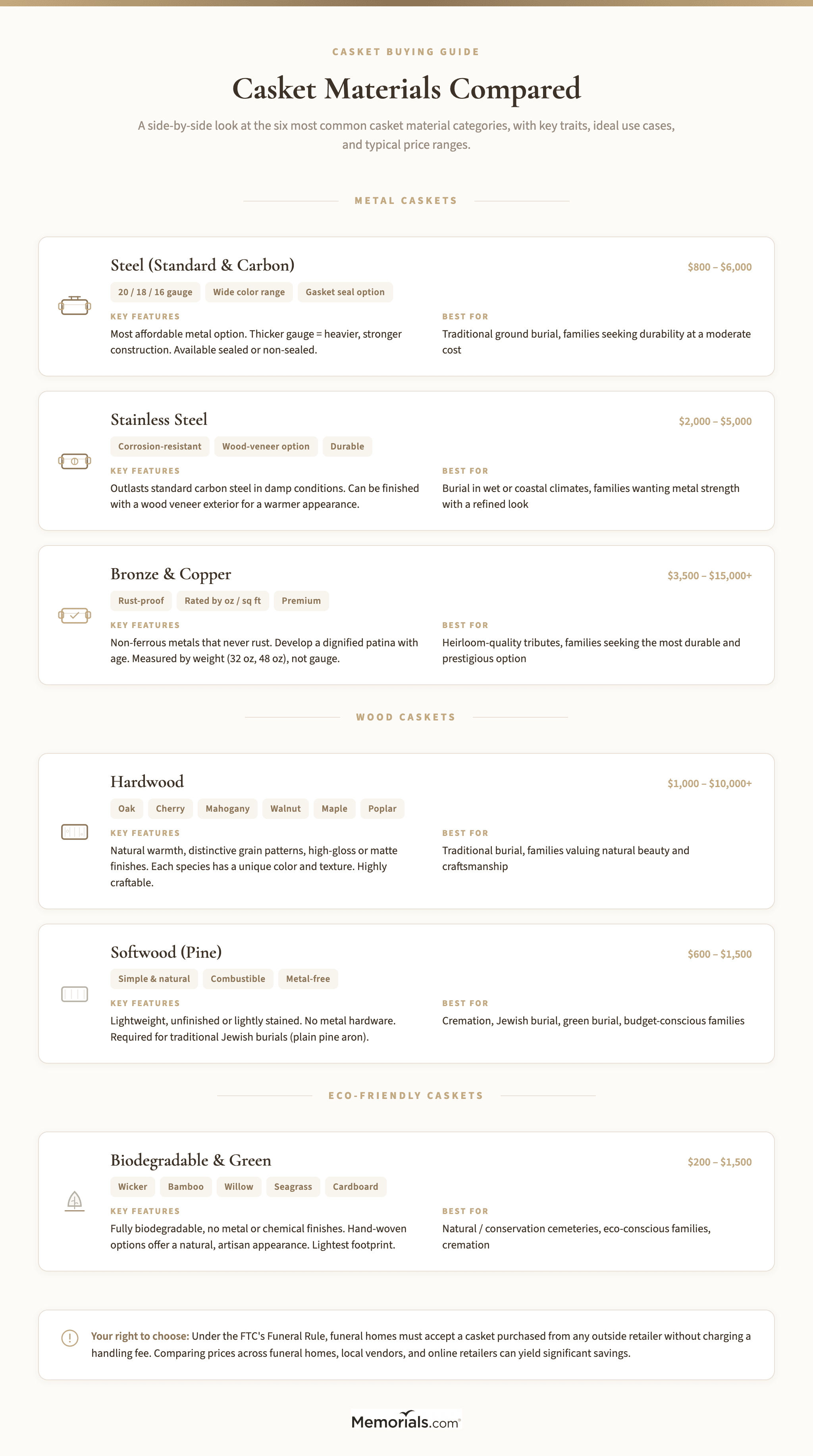
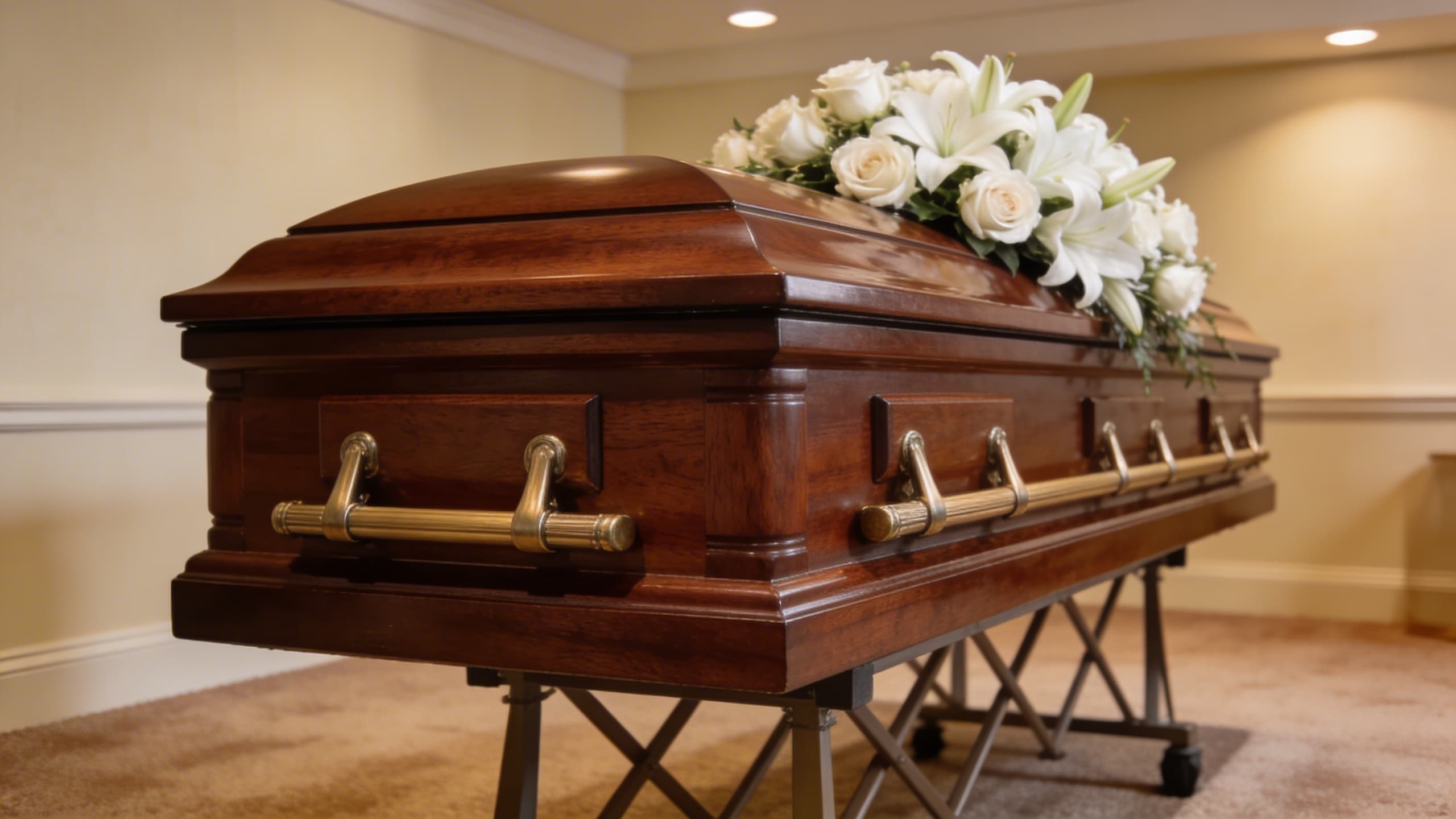
Metal caskets are the most widely purchased option in the United States, valued for their durability and the wide variety of finishes available. They come in three primary metals: steel, stainless steel, and the premium non-ferrous metals (bronze and copper).
Steel caskets are the most common and the most affordable metal option. Steel thickness is measured by gauge — a number that, counterintuitively, decreases as the metal gets thicker. A 20-gauge steel casket uses thinner steel than an 18-gauge, and an 18-gauge is thinner than a 16-gauge. Most families select 20-gauge for its balance of durability and cost, while 18-gauge and 16-gauge models offer heavier construction and a more substantial feel. Steel caskets can be finished in virtually any color, from classic silver and white to deep burgundy, blue, or black.
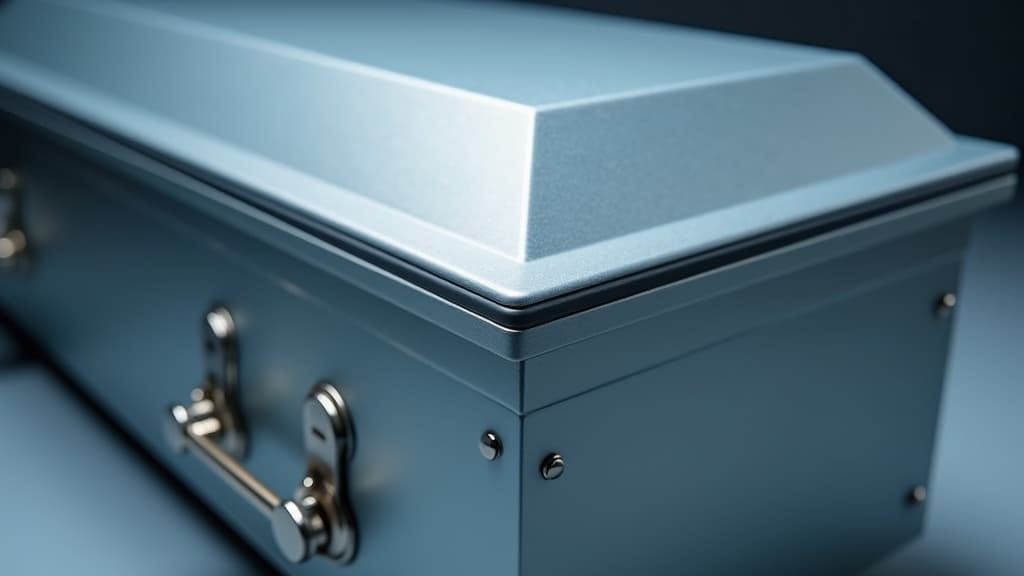
Many steel caskets include a rubber gasket that runs along the lid's contact edge, creating a seal when closed. Funeral homes sometimes market this as a "protective" feature, but it primarily prevents water and soil from entering — it does not slow natural decomposition. The gasket is not required by law, and the Federal Trade Commission's Funeral Rule prohibits any claim that a casket or its features can preserve remains indefinitely.
Stainless steel caskets are a step up from standard carbon steel. They resist corrosion more effectively and hold up better in damp burial conditions. They are available in the same gauge increments and generally cost more than their carbon steel equivalents. Some stainless steel models feature a wood-veneer exterior, combining the structural strength of metal with the warmth and appearance of wood.
Bronze and copper caskets sit at the top of the metal price range. Unlike steel, these metals do not rust — they are naturally corrosion-resistant. Quality is rated by the weight of the metal per square foot (for example, 32 ounces or 48 ounces) rather than by gauge. Bronze caskets develop a dignified patina over time, and copper has a distinctive warm tone that many families find appealing. While neither material lasts forever — both will eventually oxidize — they outlast steel by a significant margin underground.
Metal casket price range: $800 for a 20-gauge steel casket up to $15,000 or more for a bronze casket with premium hardware.
Wood caskets
Wood caskets carry a natural warmth and craftsmanship that many families prefer, and they are the traditional choice across numerous cultures and faiths. Wood caskets fall into two broad categories: hardwood and softwood.
Hardwood caskets are crafted from dense, durable woods sourced from flowering trees (angiosperms). The most common species include:
Mahogany — A rich, reddish-brown wood prized for its deep color, fine grain, and ability to take a high-gloss polish. Mahogany caskets sit at the top of the wood price range and are often considered the most luxurious wood option.
Cherry — Known for its warm reddish hue that deepens with age. Cherry caskets offer an elegant appearance with a smoother grain pattern than oak.
Walnut — A darker brown wood with distinctive, sometimes dramatic grain patterns. Walnut takes stain exceptionally well and is popular for its stately appearance.
Oak — One of the most recognized and widely available hardwoods. Oak caskets feature a pronounced, distinctive grain pattern and are extremely durable. White oak and red oak are both used, with white oak being slightly more moisture-resistant.
Maple — A lighter-toned hardwood that produces a clean, smooth finish. Maple is dense and strong, making it a practical and attractive mid-range option.
Poplar — The most affordable hardwood commonly used in caskets. Poplar is lighter in weight and takes paint well, making it popular for painted or colored casket finishes.
Softwood caskets are made from the wood of coniferous trees (gymnosperms) and are generally less expensive. Pine is the most common softwood used, and it holds a special place in Jewish burial tradition — a plain pine box (aron) is the standard choice in traditional Jewish funerals, reflecting values of simplicity and equality. Pine caskets are also appropriate for cremation, as the wood is combustible and contains no metal hardware.
Wood caskets do not seal the way metal gasket caskets do. They close securely but without a rubber gasket, which is one reason they are the preferred option for green burials and cremation. Interior options for wood caskets are just as varied as metal — satin, velvet, or crepe lining in a range of colors, with matching pillows and mattress cushions.
Wood casket price range: $600 for basic softwood or veneer models up to $10,000 or more for solid mahogany or cherry with premium hardware and finishes.
Green and biodegradable caskets
As environmental awareness grows, biodegradable caskets have become a meaningful option for families who want their loved one's burial to leave a lighter footprint. These caskets are constructed entirely from natural, non-toxic materials that break down in the soil over time, returning the body and container to the earth.
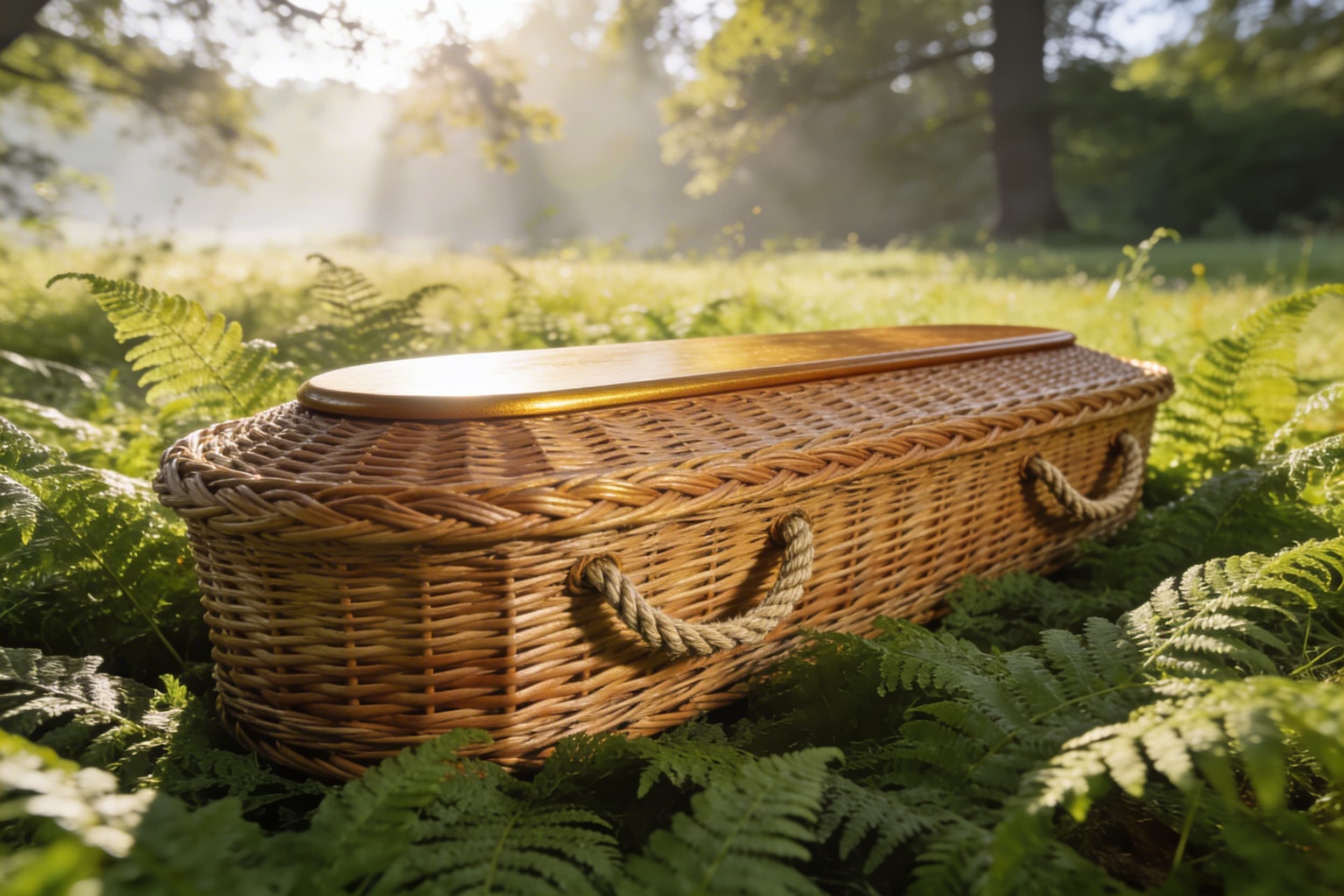
Common materials for green caskets include woven willow, bamboo, and seagrass — each producing a handcrafted, basket-like appearance that is both beautiful and fully biodegradable. Cardboard caskets offer the most affordable green option and are sometimes decorated with digitally printed designs. Other options include caskets made from organic cotton, recycled paper, or raw untreated wood.
Green caskets contain no metal hardware, chemical paints, lacquers, or synthetic materials. Handles and hinges are typically wood, rope, or woven fiber. This makes them suitable for natural burial grounds, conservation cemeteries, and any cemetery section that accepts green burials.
For families exploring broader eco-friendly end-of-life options, our guide to green and biodegradable caskets covers specific materials, burial requirements, and how to find participating cemeteries. Families weighing the environmental considerations between cremation vs burial will also find helpful context there.
Green casket price range: $200 for a basic cardboard casket up to $1,500 for a hand-woven willow or bamboo model.
Casket types by purpose and use
Beyond material, caskets are also categorized by their intended use. The right type depends on whether the plan involves traditional burial, cremation, a viewing service, or above-ground entombment.
Cremation caskets
Cremation caskets are designed to hold the body during a funeral or viewing service and then accompany the deceased into the cremation chamber. Crematories require that the container be rigid, leak-proof, combustible, and free of metal components. Most cremation caskets are made from wood, particleboard, cardboard, or woven natural fibers.
Families who want a viewing before cremation but do not want to purchase a full-price casket sometimes opt for a rental casket. Rental caskets are typically high-quality half-couch models with a removable interior insert. The body rests in the insert during the service, and the insert goes to the crematory while the exterior casket is cleaned and reused. Rental caskets typically cost $500 to $2,000, making them a practical middle ground.
Child and infant caskets
Losing a child is among the most painful experiences a family can endure, and child casket options are designed with both dignity and tenderness. Infant and child caskets are available in smaller dimensions, in both wood and metal, and are often offered in soft white, pastel, or natural wood finishes. Some families choose a wicker or willow option for a gentle, natural look. Many funeral providers carry a range of sizes from infant to adolescent to accommodate the family's needs.
Military and veteran caskets
Military caskets honor the service of veterans with patriotic design elements such as branch-of-service emblems, flag-draped exteriors, and customized interior panels featuring insignia. Most military caskets are constructed from steel or hardwood and meet the requirements for burial in national cemeteries with full military honors. Families of veterans should coordinate with their local Veterans Affairs office to understand burial benefits, which may offset a portion of casket and burial costs.
Oversized caskets
Standard casket interior dimensions are roughly 24 inches wide by 79 inches long. For individuals who need more room, oversized caskets are available with interior widths of 27 to 30 inches or more. These are offered in both metal and wood and come with the same range of interior and exterior features as standard-size models. If an oversized casket is needed, families should confirm the cemetery's vault dimensions as well, since an oversized casket requires a correspondingly larger vault or grave liner.
Personalized and custom caskets
Custom caskets allow families to reflect the personality, passions, or cultural identity of their loved one. Customization options range from exterior color and hardware selection to fully themed designs featuring sports teams, hobbies, or personal artwork. Some families commission hand-painted designs or add photographs under the lid's interior panel.
Personalization can be as simple as selecting a specific interior fabric color to match a loved one's favorite hue, or as elaborate as a custom casket shaped like a favorite car or musical instrument — sometimes called a "fantasy casket." While fantasy designs are more common in certain West African funeral traditions, custom-themed caskets are growing in popularity in the United States.
Casket styles: lid type, interior, and hardware
Material tells you what a casket is made of, but style tells you how it looks, opens, and functions. Three style elements matter most: lid design, interior fabric, and hardware.
Half-couch vs full-couch caskets
The most visible style distinction is the lid design:
Half-couch caskets have a two-piece lid. The upper section opens independently, allowing mourners to view the deceased's face and upper body during a wake or viewing while the lower section remains closed. Half-couch caskets are by far the most popular choice in the United States because they offer the family flexibility — the option to open either just the upper lid or both sections.
Full-couch caskets have a single, one-piece lid that opens fully to reveal the entire body. These are sometimes chosen for services where the body will not be viewed, or in situations where the family prefers the cleaner visual line of a single-piece lid in its closed position.
The choice between half-couch and full-couch is largely one of personal and cultural preference. Both are available in every material and price range.
Interior fabrics and lining
The casket interior — often called the "bed" — is lined with fabric that provides both a cushioned appearance and a dignified resting place. The three most common interior fabrics are:
Crepe — Made from silk, wool, or synthetic fiber with a distinctive crimped texture. Crepe has a muted, traditional appearance and has long been associated with funeral and mourning customs. It is the most common lining material in mid-range caskets.
Velvet — A thicker, softer fabric with a rich pile that gives a premium, luxurious feel. Velvet interiors are typically found in higher-end caskets and are available in deep jewel tones as well as classic neutrals.
Satin — A smooth, glossy fabric that reflects light gently. Satin gives the interior a refined, luminous quality and is popular across all price ranges. It is available in a wide spectrum of colors.
Interior lining also includes a pillow, sometimes a mattress cushion, and occasional extras like memory compartments — small, sealed pockets in the lid where families can place letters, photographs, or keepsakes.
Hardware: handles, corners, and finish details
Exterior hardware includes the handles (also called "bars"), corner pieces, and decorative accents. Handles come in swing-bar and stationary designs and are typically finished in brushed nickel, bronze, gold tone, or antique copper. Corner caps and ornamental lugs may feature scrollwork, floral patterns, religious symbols, or engraved nameplates. While largely aesthetic, hardware contributes significantly to the casket's overall character and perceived quality.
Burial vaults and outer burial containers
Many cemeteries require an outer container — either a burial vault or a grave liner — to be placed in the ground before the casket is lowered in. The purpose is structural: without an outer container, the weight of the earth and cemetery maintenance equipment can cause the ground to sink over the casket as it settles, creating uneven terrain.
Burial vaults are the more protective option, typically made of reinforced concrete, sometimes lined with bronze, copper, or stainless steel. Grave liners serve the same structural function but are not sealed on top, making them less expensive. Neither is required by law in most states, but many cemeteries include the requirement in their bylaws.
Vault costs range from $1,000 for a basic concrete liner to $10,000 or more for a bronze-lined vault, and this is a cost families should factor in alongside the casket purchase.
How much does each type of casket cost?
Price varies widely based on material, finish, hardware, and where you purchase. The table below gives approximate ranges:
Material
Typical Price Range
Best For
20-gauge steel
$800 – $2,500
Budget-conscious traditional burial
18-gauge steel
$1,500 – $4,000
Mid-range burial with more durability
16-gauge steel
$2,500 – $6,000
Premium steel burial
Stainless steel
$2,000 – $5,000
Corrosion resistance in damp conditions
Bronze
$4,000 – $15,000+
Heirloom quality, lasting tribute
Copper
$3,500 – $10,000
Premium non-ferrous, warm tone
Pine / softwood
$600 – $1,500
Cremation, Jewish burial, simple burial
Poplar / maple
$1,000 – $3,000
Mid-range hardwood
Oak / cherry
$2,000 – $5,000
Classic hardwood, distinctive grain
Walnut / mahogany
$3,000 – $10,000+
Luxury hardwood
Wicker / bamboo
$900 – $1,500
Green burial, eco-friendly
Cardboard
$200 – $500
Cremation, budget green burial
Cremation casket
$300 – $1,500
Pre-cremation viewing or direct cremation
Rental casket
$500 – $2,000
Viewing before cremation
Funeral homes are the most common point of purchase but also tend to carry the highest markups. Online casket retailers and direct-to-consumer companies can offer the same models at 50–80% less, and under the FTC's Funeral Rule, funeral homes must accept a casket purchased from any outside source without charging a handling fee.
For a comprehensive approach to this decision — including step-by-step guidance on narrowing your options — our guide on how to choose a casket walks through budget, material, style, and delivery coordination.
A brief note on casket history
The caskets we know today are a relatively modern development. For centuries, the dead were buried in simple wooden boxes — or no box at all. The rectangular, upholstered casket emerged in the 19th century as the funeral industry professionalized and embalming became widespread. Metal caskets followed in the early 20th century as manufacturing techniques advanced. Our article on the history of coffins traces this evolution from ancient burial practices through the rise of the modern funeral industry.
Frequently asked questions about casket types
What is the most common type of casket?
The 20-gauge steel half-couch casket is the most widely purchased option in the United States. It strikes a balance between durability, appearance, and affordability, and it is available in the widest range of colors and finishes. Wood caskets are the second most common choice, with oak and cherry leading hardwood sales.
Do sealed caskets really preserve the body?
No. A gasket-sealed casket prevents water and soil from entering, but it does not halt decomposition. The FTC's Funeral Rule specifically prohibits funeral providers from claiming that any casket or casket feature will preserve remains indefinitely. The seal is a preference, not a necessity.
Can I use any casket for cremation?
Crematories require a container that is rigid, leak-proof, combustible, and free of metal. Wood caskets, particleboard containers, and cardboard caskets all meet these requirements. You cannot cremate a metal casket. Families can also rent a casket for a viewing and then use a simple combustible container for the actual cremation.
Do I have to buy a casket from the funeral home?
No. The Funeral Rule gives you the right to purchase a casket from any retailer — online, at a local vendor, or even build one yourself — and the funeral home must accept it without a surcharge. Before purchasing, confirm delivery timing to ensure the casket arrives before the service.
How do I know what size casket I need?
Standard caskets accommodate most adults, with interior dimensions of approximately 24 inches wide by 79 inches long. If the deceased was taller than about 6 feet 2 inches or weighed over 300 pounds, an oversized model may be needed. Funeral directors can help with sizing, and many online retailers list exact interior dimensions.
Are wood caskets required for Jewish funerals?
Traditional Jewish law requires a simple wooden casket — typically unfinished pine — with no metal hardware, upholstery, or embellishments. This reflects values of simplicity, equality, and allowing the body to return to the earth naturally. Reform and Conservative congregations may be more flexible, but families should consult with their rabbi for guidance.
What is the difference between a casket and a coffin?
A casket is rectangular with four straight sides, a hinged split lid (half-couch or full-couch), and an interior lined with fabric. A coffin is hexagonal or octagonal — wider at the shoulders and narrower at the head and feet — and has a single removable lid. Caskets are standard in the United States; coffins are more traditional in the United Kingdom and parts of Europe.
Where can I buy a casket?
You can purchase a casket from a funeral home, an online retailer, a local casket showroom, or even build one yourself. Under the FTC's Funeral Rule, a funeral home must accept a casket purchased elsewhere and cannot charge a fee for doing so. Online retailers frequently offer significant savings compared to funeral home prices, though you should confirm delivery lead times to ensure the casket arrives before the service.
Can I be buried without a casket?
In most states, there is no legal requirement for a casket. Natural or green burial grounds often permit the use of a simple shroud instead. However, most traditional cemeteries require at least a rigid container, and many also require an outer burial container (vault or grave liner). Check with your specific cemetery before planning a shroudless burial.
Tips for comparing casket options
Narrowing your choices is easier when you work through a few practical questions before visiting a showroom or browsing online.
Start with the destination. A casket chosen for an in-ground burial needs different qualities than one meant for cremation or mausoleum entombment. If the plan includes ground burial, ask the cemetery whether a vault is required — that cost needs to factor into your total budget. If cremation is the plan, metal caskets are not an option, so the search narrows immediately to wood, particleboard, or natural materials.
Set a firm budget. Funeral homes are required to show you a price list before showing caskets. Decide what you can comfortably spend before looking, and ask to see options within that range first. Emotional pressure at the point of purchase can lead to overspending. A $1,200 steel casket and a $6,000 steel casket serve the same structural purpose — the difference is in finish, gauge, and hardware, not in the dignity of the tribute.
Consider the viewing. If the family plans an open-casket service, the exterior appearance, lid style, and interior fabric all become more significant. If the casket will remain closed during the service or if no viewing is planned, a simpler or less expensive option may be entirely appropriate.
Ask about warranties and return policies. Some retailers and funeral homes offer limited warranties on casket construction and finish. Online retailers may have return or exchange policies if the casket arrives damaged. Understanding these terms before purchasing avoids surprises.
Factor in total funeral costs. The casket is just one piece of the overall expense, which also includes the service fee, embalming (if applicable), cemetery or crematory charges, vault, headstone, and flowers. Looking at the casket cost in context helps ensure the family doesn't overinvest in one area at the expense of others.
The best casket is the one that reflects your loved one's values, fits your family's budget, and meets the practical requirements of your chosen burial or cremation plan. Take time to consider the material, understand the style options, and compare prices before visiting a funeral home showroom. Having a clear sense of what you want — and what you can spend — gives you confidence during an emotionally charged process.
Memorials.com carries a wide selection of casket options across every material and price range, with delivery coordinated directly to your funeral home.